Overview
Contrast clues are one of the most powerful and frequently tested signal types in GRE Text Completion questions. These linguistic markers indicate that the missing word or phrase should express an idea that opposes, contradicts, or differs from another part of the sentence. Mastering contrast clues is essential because they provide direct logical relationships that guide test-takers to the correct answer with remarkable precision.
On the GRE Verbal Reasoning section, approximately 30-40% of Text Completion questions contain explicit contrast relationships. Understanding how to identify and leverage these clues transforms what might appear to be vocabulary-dependent questions into logic puzzles that can be solved systematically. GRE contrast clues function as roadmaps within sentences, telling you exactly what type of word you need—not through memorization, but through logical opposition.
The ability to recognize contrast clues connects directly to broader Verbal Reasoning skills including reading comprehension, critical reasoning, and sentence equivalence. When students develop expertise in identifying contrast relationships, they simultaneously improve their ability to follow complex arguments in Reading Comprehension passages and to recognize parallel structures in Sentence Equivalence questions. This topic serves as a foundational pillar for all GRE verbal strategies, making it one of the highest-yield areas for focused study.
Learning Objectives
- [ ] Identify when Contrast clues is being tested
- [ ] Explain the core rule or strategy behind Contrast clues
- [ ] Apply Contrast clues to GRE-style questions accurately
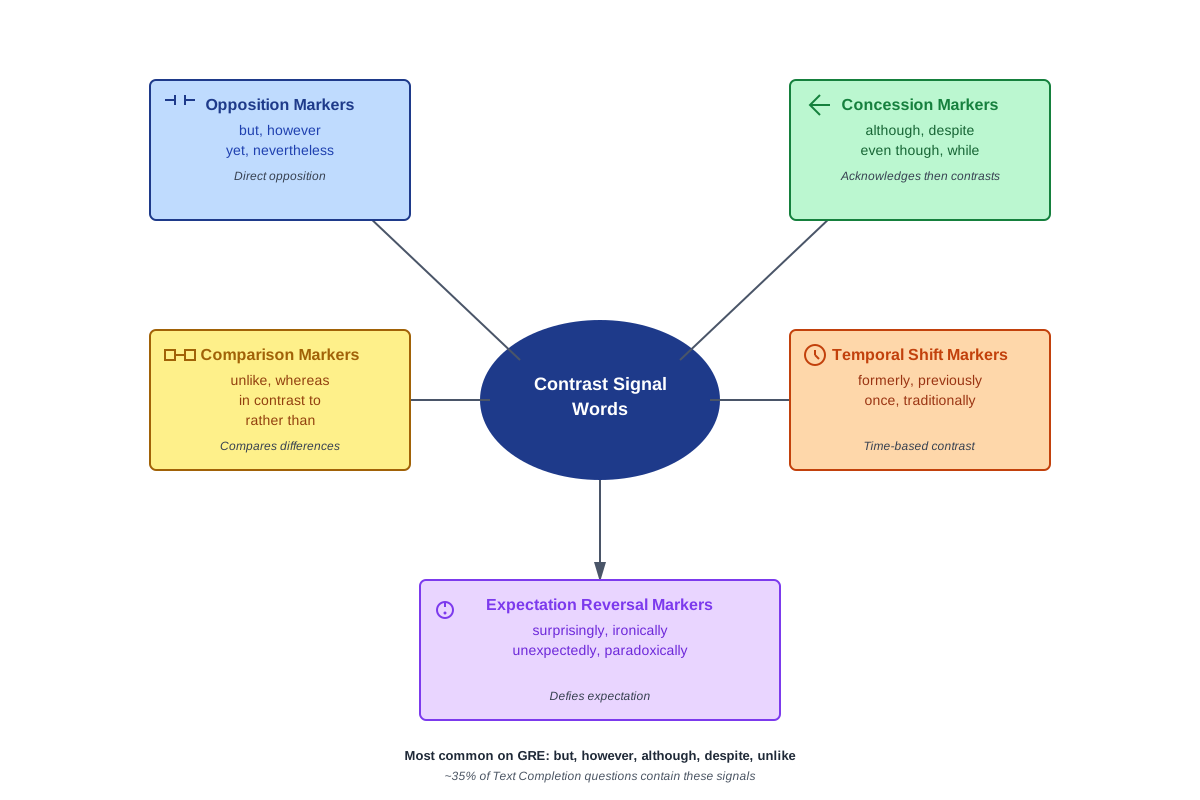
- [ ] Recognize and categorize the five major types of contrast signal words
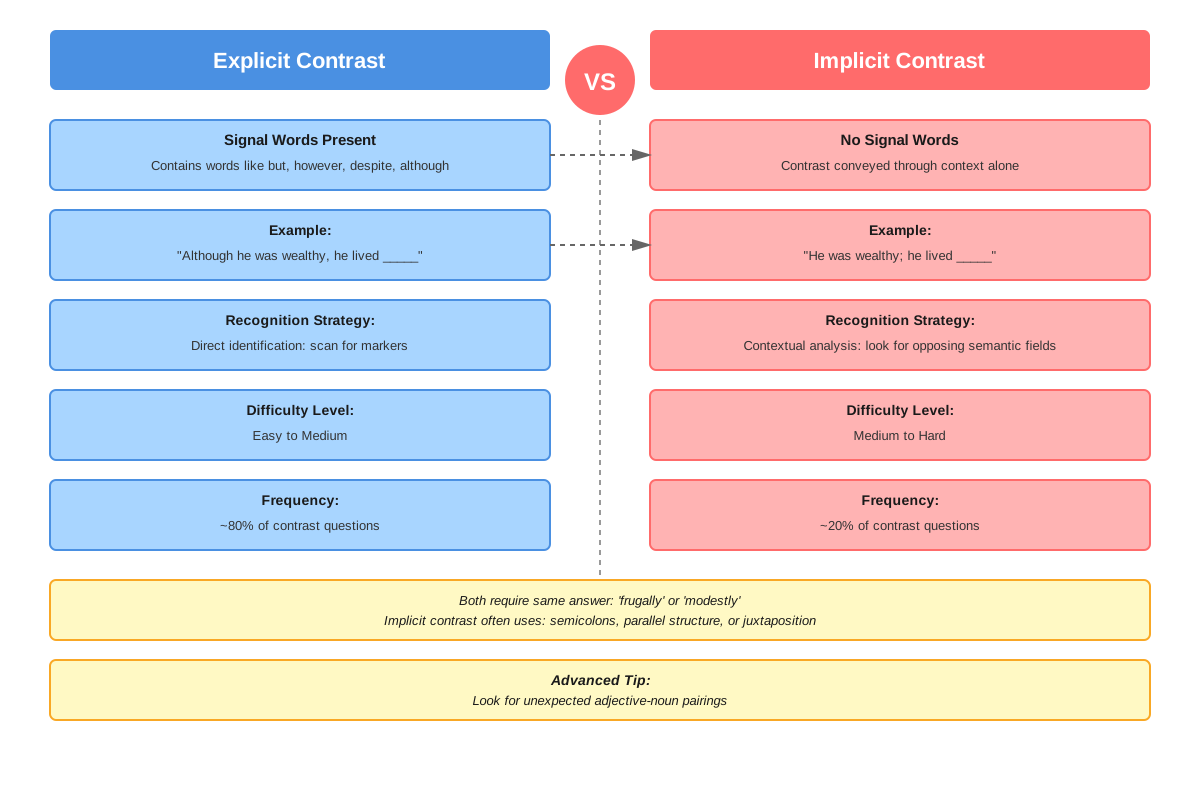
- [ ] Distinguish between explicit contrast markers and implicit contrast relationships
- [ ] Predict the semantic field of the correct answer before reviewing answer choices
- [ ] Evaluate answer choices systematically using contrast logic to eliminate incorrect options
Prerequisites
- Basic sentence structure understanding: Recognizing subjects, verbs, and clauses is necessary to identify which parts of a sentence are being contrasted
- Fundamental vocabulary knowledge: A working vocabulary of approximately 2,000-3,000 words enables students to understand the non-blank portions of sentences
- Logical reasoning skills: The ability to understand "if A, then not B" relationships forms the foundation for contrast clue application
- Familiarity with Text Completion format: Understanding that blanks must fit logically and grammatically within the sentence context
Why This Topic Matters
In real-world communication, contrast relationships help readers and listeners understand nuanced arguments, recognize exceptions to rules, and follow complex reasoning. Academic writing, professional correspondence, and sophisticated discourse all rely heavily on contrast structures to convey precise meaning. The GRE tests this skill because graduate-level work demands the ability to understand subtle distinctions and opposing viewpoints in scholarly literature.
On the GRE specifically, contrast clues appear in approximately 35% of all Text Completion questions and 25% of Sentence Equivalence questions. This frequency makes contrast clues the single most common structural pattern tested in the Verbal Reasoning section. Questions featuring contrast clues typically appear at all difficulty levels, from easy to hard, with harder questions often featuring multiple contrast relationships or less common contrast signal words.
Contrast clues commonly appear in several exam contexts: sentences discussing historical shifts or changes ("Unlike previous theories..."), descriptions of unexpected outcomes ("Despite extensive preparation..."), characterizations that defy expectations ("Although she appeared timid..."), and comparisons between two entities with opposing qualities ("While his brother was gregarious..."). Recognizing these patterns allows test-takers to anticipate contrast structures even before identifying specific signal words.
Core Concepts
Definition and Function of Contrast Clues
Contrast clues are words, phrases, or punctuation marks that signal an opposition, difference, or unexpected relationship between two parts of a sentence. These linguistic markers tell the reader that the idea following the clue will contradict, oppose, or differ from the idea that precedes it. In Text Completion questions, contrast clues create a logical bridge that points directly toward the semantic category of the correct answer.
The fundamental mechanism of contrast clues operates on a simple principle: if you know what something is NOT, you can determine what it IS. When a sentence states "Unlike her pessimistic colleagues, Maria maintained a(n) _____ outlook," the contrast clue "unlike" tells you that Maria's outlook must be the opposite of pessimistic—therefore, optimistic, positive, or hopeful. This logical relationship transforms vocabulary questions into reasoning exercises.
The Five Major Categories of Contrast Signal Words
Understanding the different types of contrast markers helps students recognize these clues regardless of how they appear in sentences. Each category functions slightly differently but all indicate opposition or difference.
| Category | Function | Common Examples |
|---|---|---|
| Subordinating Conjunctions | Introduce dependent clauses that contrast with main clauses | although, though, even though, while, whereas |
| Coordinating Conjunctions | Connect two independent clauses with contrasting ideas | but, yet |
| Prepositions | Show contrast through comparison or exception | despite, in spite of, unlike, notwithstanding |
| Transition Words | Signal a shift to an opposing idea | however, nevertheless, nonetheless, conversely, on the contrary |
| Verbs and Adjectives | Indicate opposition through meaning | differ, contradict, oppose, unexpected, surprising, paradoxical |
Explicit vs. Implicit Contrast Relationships
Explicit contrast clues are clearly marked signal words that directly announce opposition. These are the most straightforward to identify and include words like "but," "however," "although," and "despite." When students see these markers, they should immediately recognize that a contrast relationship exists and begin looking for the two opposing ideas.
Implicit contrast relationships exist without obvious signal words, relying instead on context, punctuation (particularly semicolons), or the logical structure of the sentence. For example: "The executive's public statements emphasized transparency; her actual business practices revealed systematic concealment." The semicolon here creates a contrast between stated values and actual behavior without using any contrast signal word. These implicit contrasts appear more frequently in harder GRE questions and require deeper analytical reading.
The Contrast Clue Strategy: A Step-by-Step Process
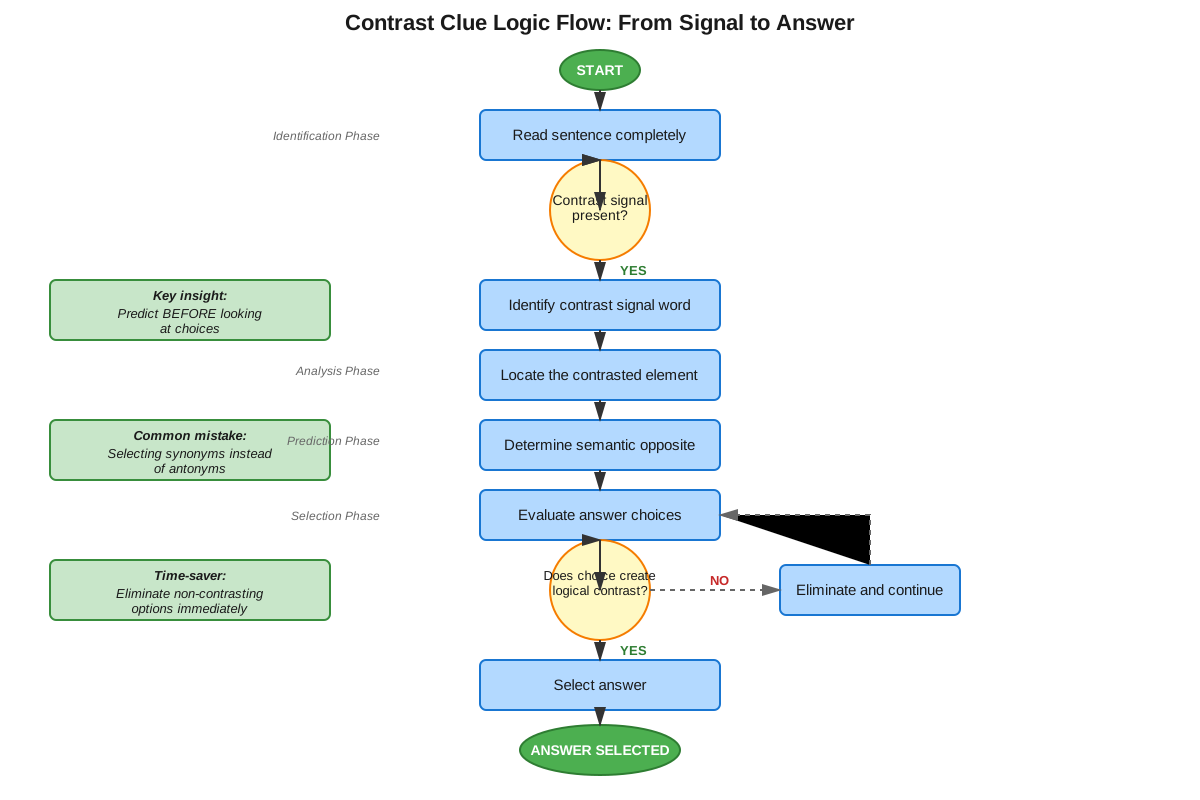
- Scan for signal words: Before reading the entire sentence carefully, quickly scan for common contrast markers
- Identify the two contrasting elements: Determine which parts of the sentence are being opposed
- Locate the known element: Find the word or phrase that provides information about what the blank should contrast with
- Predict the semantic opposite: Before looking at answer choices, formulate your own word or concept that would create the contrast
- Evaluate answer choices: Compare each option against your prediction, eliminating choices that don't create the required opposition
- Verify the logic: Read the complete sentence with your selected answer to ensure it creates a coherent contrast
Semantic Opposition: Understanding Degrees of Contrast
Not all contrasts are simple antonyms. The GRE tests sophisticated understanding of opposition across several dimensions:
Direct antonyms: Complete opposites (hot/cold, generous/stingy, expand/contract)
Degree contrasts: Differences in intensity rather than complete opposition (warm/freezing, helpful/indispensable, concerned/obsessed)
Expectation violations: Outcomes that differ from what would normally be anticipated (studied diligently/failed, appeared fragile/demonstrated resilience)
Comparative contrasts: Differences between two entities without absolute opposition (more cautious/less cautious, somewhat effective/highly effective)
Understanding these nuances prevents students from automatically selecting the most extreme antonym when a more moderate contrast is logically required.
Position and Scope of Contrast Clues
Contrast signal words can appear at various positions within sentences, and their placement affects how students should analyze the sentence structure:
Initial position: "Although the medication was expensive, patients found it _____ their budgets." The contrast word appears first, signaling that the main clause will oppose the dependent clause.
Medial position: "The politician's rhetoric was inflammatory, but her actual policies were _____." The contrast marker separates two independent clauses, with the blank appearing in the second clause.
Multiple contrasts: "Despite being _____ in public, the celebrity was surprisingly approachable in private settings, though this warmth would _____ when cameras appeared." Advanced questions may contain multiple contrast relationships requiring careful tracking of which elements oppose each other.
Concept Relationships
Contrast clues function as one component within the broader category of structural clues in Text Completion questions. They work alongside continuation clues (which signal agreement rather than opposition) and cause-and-effect clues (which indicate logical consequences). Understanding contrast clues first often makes learning these related clue types easier because students develop the fundamental skill of recognizing logical relationships.
The relationship flow operates as follows: Sentence structure → Signal word identification → Contrast clue recognition → Logical prediction → Answer selection. Each step depends on the previous one, creating a systematic approach to Text Completion questions.
Contrast clues also connect directly to Reading Comprehension skills. Passages frequently use contrast structures to present opposing viewpoints, introduce counterarguments, or describe shifts in scientific understanding. Students who master contrast clues in Text Completion questions find themselves better equipped to follow complex argumentative structures in longer passages.
The relationship between contrast clues and Sentence Equivalence questions is particularly strong. Many Sentence Equivalence questions require identifying two words that create the same contrast relationship with other elements in the sentence. The same analytical process applies: identify the contrast marker, determine what's being opposed, and select words that create equivalent oppositions.
High-Yield Facts
⭐ Approximately 35% of GRE Text Completion questions contain explicit contrast clues, making this the most frequently tested structural pattern.
⭐ The words "but," "although," "despite," "however," and "while" account for over 60% of all contrast markers on the GRE.
⭐ When a contrast clue appears, the correct answer will create opposition with a specific word or phrase elsewhere in the sentence, not with the general topic.
⭐ Semicolons can function as implicit contrast markers, especially when connecting two independent clauses with opposing ideas.
⭐ The correct answer doesn't always need to be a perfect antonym—it must create logical opposition appropriate to the sentence context.
- Contrast clues can appear at the beginning, middle, or end of sentences, requiring flexible analytical approaches.
- Multiple contrast relationships within a single sentence typically indicate a harder question with a higher point value.
- Phrases like "far from," "rather than," and "instead of" function as contrast markers even though they're less commonly recognized.
- The intensity of the contrast (mild disagreement vs. complete opposition) must match the sentence's logical requirements.
- Contrast clues in dependent clauses usually point toward opposites in independent clauses, and vice versa.
- Time-based contrasts ("previously," "formerly," "now," "currently") often signal shifts that require contrasting vocabulary.
- Negative constructions ("not," "never," "hardly") can intensify or modify contrast relationships.
- The GRE occasionally uses double negatives with contrast clues to create complex logical relationships.
- Contrast clues remain effective even when students don't know all the vocabulary in the sentence—the structural relationship still guides prediction.
- Advanced questions may feature contrast clues that oppose entire concepts rather than single words.
Quick check — test yourself on Contrast clues so far.
Try Flashcards →Common Misconceptions
Misconception: Contrast clues always require selecting the exact antonym of a word in the sentence.
Correction: Contrast clues require logical opposition appropriate to context, which may involve degree differences, expectation violations, or comparative contrasts rather than perfect antonyms. The word "warm" might contrast with "freezing" rather than just "cold" if the context emphasizes extreme opposition.
Misconception: Only obvious signal words like "but" and "however" indicate contrast relationships.
Correction: Contrast can be signaled through punctuation (semicolons, colons), implicit logical relationships, time-based shifts, or words like "surprising," "unexpected," and "paradoxically" that indicate deviation from norms. Approximately 15% of contrast relationships on the GRE lack explicit signal words.
Misconception: The blank always contrasts with the word or phrase immediately adjacent to the contrast clue.
Correction: The contrasting element may appear anywhere in the sentence. In "Although critics praised the film's cinematography, audiences found the plot _____," the blank contrasts with "praised," not with "cinematography." Students must identify which specific element creates the logical opposition.
Misconception: All answer choices that are antonyms of words in the sentence are equally valid.
Correction: The correct answer must create a contrast with the specific element indicated by the sentence's logical structure, not just any word that happens to appear. Multiple words in a sentence might have antonyms among the answer choices, but only one creates the required logical relationship.
Misconception: Harder questions use more obscure contrast signal words.
Correction: Harder questions typically use common contrast signals but create complexity through multiple contrast relationships, implicit contrasts, or requiring students to identify which of several possible elements the blank should oppose. The difficulty lies in logical analysis, not signal word recognition.
Worked Examples
Example 1: Single Contrast with Explicit Signal
Question: Although the restaurant's décor was _____, the quality of the cuisine more than compensated for the aesthetic shortcomings.
Step 1 - Identify the contrast clue: "Although" at the beginning of the sentence signals that the dependent clause will contrast with the independent clause.
Step 2 - Identify the contrasting elements: The dependent clause describes the décor, while the independent clause states that the cuisine "more than compensated" for problems. The phrase "aesthetic shortcomings" confirms that the décor had negative qualities.
Step 3 - Locate the known element: "Compensated for the aesthetic shortcomings" tells us the décor was problematic or negative in some way.
Step 4 - Predict the answer: The blank should describe the décor negatively. Possible predictions: unappealing, shabby, uninspiring, drab, lackluster.
Step 5 - Evaluate answer choices (hypothetical options):
- (A) elegant - INCORRECT: This is positive, creating agreement rather than contrast
- (B) uninspiring - CORRECT: Creates the required negative contrast with the positive cuisine
- (C) spacious - INCORRECT: Neutral descriptor that doesn't create meaningful contrast
- (D) authentic - INCORRECT: Positive quality that doesn't contrast with compensation
- (E) uninspiring - CORRECT: (In Sentence Equivalence, this would be the second correct answer)
Step 6 - Verify: "Although the restaurant's décor was uninspiring, the quality of the cuisine more than compensated for the aesthetic shortcomings." The sentence creates a logical contrast between disappointing décor and excellent food.
Connection to learning objectives: This example demonstrates identifying when contrast clues are tested (objective 1), applying the core strategy (objective 2), and accurately solving GRE-style questions (objective 3).
Example 2: Multiple Contrasts with Implicit Signals
Question: The scientist's public persona suggested _____ personality; in private, however, colleagues described her as surprisingly _____ and even withdrawn.
Step 1 - Identify contrast clues: "However" explicitly signals contrast between public and private personas. The word "surprisingly" also indicates that the private behavior contradicts expectations set by the public persona.
Step 2 - Identify contrasting elements: The first blank describes the public persona, while the second blank describes private behavior. These two descriptions must contrast with each other. Additionally, "withdrawn" provides information about the second blank.
Step 3 - Analyze the relationship: The second blank must be similar to "withdrawn" (since "and even" suggests intensification or similarity). Therefore, the first blank must contrast with withdrawn behavior—suggesting outgoing, sociable, or gregarious qualities.
Step 4 - Predict both answers:
- First blank: outgoing, gregarious, extroverted, sociable
- Second blank: reserved, reticent, introverted, taciturn (similar to withdrawn)
Step 5 - Evaluate answer choices (hypothetical):
- First blank: (A) an ebullient (B) a reserved (C) an analytical
- Second blank: (D) reticent (E) animated (F) meticulous
Correct answers: (A) ebullient and (D) reticent
Step 6 - Verify: "The scientist's public persona suggested an ebullient personality; in private, however, colleagues described her as surprisingly reticent and even withdrawn." Both contrasts work: ebullient opposes reticent/withdrawn, and "however" signals the shift between public and private behaviors.
Connection to learning objectives: This example demonstrates recognizing multiple contrast types (objective 4), distinguishing explicit and implicit markers (objective 5), and predicting semantic fields before reviewing choices (objective 6).
Exam Strategy
Systematic Approach to Contrast Clue Questions
When approaching any Text Completion question, invest the first 10-15 seconds in structural analysis before considering vocabulary. This front-loaded analysis pays dividends by providing a logical framework that guides answer selection.
Exam Tip: Circle or mentally note every contrast signal word immediately upon reading the sentence. This visual or mental marking prevents overlooking crucial structural clues under time pressure.
Trigger Words and Phrases to Watch For
High-frequency triggers (appear in 60%+ of contrast questions):
- but, yet, however, although, though, despite, while, whereas
Medium-frequency triggers (appear in 20-30% of contrast questions):
- nevertheless, nonetheless, conversely, on the contrary, in contrast, unlike, rather than
Low-frequency triggers (appear in 10-15% of contrast questions):
- notwithstanding, albeit, even so, still, paradoxically, surprisingly, unexpectedly
Implicit triggers (no signal word, but context indicates contrast):
- Semicolons connecting opposing ideas
- Time shifts (formerly/now, previously/currently)
- Expectation setups followed by different outcomes
Process of Elimination Strategies
- Eliminate continuation answers: If the question contains a contrast clue, immediately eliminate any answer choice that agrees with or continues the established idea rather than opposing it.
- Eliminate neutral options: Contrast requires opposition. Neutral words that neither agree nor disagree with the contrasting element are incorrect.
- Check intensity matching: If the sentence suggests mild contrast, eliminate extreme opposites. If it suggests strong opposition, eliminate moderate differences.
- Verify grammatical fit: After identifying logically appropriate answers, confirm that they fit grammatically (correct part of speech, proper idiom usage).
- Test the complete sentence: Read the entire sentence with your selected answer to ensure it creates coherent meaning, not just local contrast.
Time Allocation Advice
For single-blank Text Completion questions with contrast clues: 45-60 seconds total
- 10-15 seconds: Identify structure and predict answer
- 20-30 seconds: Evaluate answer choices
- 10-15 seconds: Verify selection
For two-blank questions with contrast clues: 75-90 seconds total
- 15-20 seconds: Identify all structural relationships
- 40-50 seconds: Evaluate answer combinations
- 15-20 seconds: Verify both selections
Exam Tip: If you identify a clear contrast clue and make a strong prediction but don't see a matching answer choice, reconsider which element the blank should contrast with. You may have identified the wrong contrasting element.
Advanced Strategy: The Contrast Chain
In complex sentences with multiple clauses, create a "contrast chain" to track relationships:
- Clause A (positive) → BUT → Clause B (negative) → HOWEVER → Clause C (positive again)
This visualization helps prevent confusion about which elements oppose each other, especially in sentences with three or more clauses.
Memory Techniques
The "BUT Family" Mnemonic
Remember the most common contrast words using the acronym BADWHALE:
- But
- Although
- Despite
- While
- However
- Albeit
- Less (as in "no less than," "nothing less than")
- Even though
Visualization Strategy: The Seesaw
Imagine a seesaw or balance scale when you encounter contrast clues. One side represents the known element in the sentence, and the other side (where the blank sits) must move in the opposite direction. If one side is "up" (positive), the other must be "down" (negative). This physical metaphor helps students intuitively grasp opposition.
The "Opposite Day" Technique
When you identify a contrast clue, mentally declare "Opposite Day" for that sentence. Whatever quality, characteristic, or idea appears in the non-blank portion, the blank must express the opposite. This simple mental trigger activates contrast-seeking behavior.
Color Coding for Practice
When practicing with physical materials, use colored highlighters:
- Yellow: Contrast signal words
- Blue: The element that the blank contrasts with
- Green: Your predicted answer
This visual system reinforces the analytical process and helps students recognize patterns across multiple practice questions.
The Three-Question Contrast Check
Before finalizing any answer on a suspected contrast question, ask:
- "What's the signal word?" (Identify the contrast clue)
- "What's the opposite of?" (Identify the contrasting element)
- "Does my answer create opposition?" (Verify logical contrast)
This three-step mental checklist takes only seconds but prevents careless errors.
Summary
Contrast clues represent the most frequently tested structural pattern in GRE Text Completion questions, appearing in approximately 35% of all items. These linguistic signals—including words like "but," "although," "despite," and "however"—indicate that the missing word must oppose, contradict, or differ from another element in the sentence. Mastering contrast clues transforms vocabulary-dependent questions into logic puzzles that can be solved systematically through structural analysis. The core strategy involves five steps: identifying signal words, locating contrasting elements, determining the known element, predicting the semantic opposite, and evaluating answer choices against that prediction. Success requires understanding that contrast encompasses not just direct antonyms but also degree differences, expectation violations, and comparative oppositions. Students must distinguish between explicit contrast markers and implicit relationships signaled through punctuation or context. By recognizing these patterns and applying systematic analysis, test-takers can answer contrast clue questions accurately even when unfamiliar vocabulary appears in the sentence, making this skill one of the highest-yield areas for GRE Verbal preparation.
Key Takeaways
- Contrast clues appear in approximately 35% of Text Completion questions, making them the single most important structural pattern to master for GRE Verbal success.
- The five major categories of contrast signals—subordinating conjunctions, coordinating conjunctions, prepositions, transition words, and meaning-based indicators—cover virtually all contrast relationships on the exam.
- Systematic analysis beats vocabulary memorization: Identifying the contrast structure and predicting the answer before reviewing choices leads to higher accuracy than relying on word knowledge alone.
- Contrast doesn't always mean perfect antonym: The GRE tests sophisticated opposition including degree contrasts, expectation violations, and comparative differences.
- Implicit contrasts without obvious signal words appear in approximately 15% of contrast questions and typically indicate harder items requiring deeper analytical reading.
- The element that the blank contrasts with may appear anywhere in the sentence, not necessarily adjacent to the contrast signal word, requiring careful logical analysis.
- Time invested in structural analysis (10-15 seconds) pays dividends by providing a logical framework that accelerates answer evaluation and increases accuracy.
Related Topics
Continuation Clues: After mastering contrast clues, students should study continuation clues, which signal agreement rather than opposition. These clues (such as "and," "moreover," "similarly") require selecting answers that align with established ideas. Understanding both contrast and continuation creates a complete framework for structural analysis.
Cause-and-Effect Relationships: Many Text Completion questions test the ability to recognize causal relationships signaled by words like "because," "therefore," and "consequently." Mastering contrast clues provides the analytical foundation for understanding these logical connections.
Sentence Equivalence Strategies: The same contrast clue recognition skills apply directly to Sentence Equivalence questions, where students must identify two words that create equivalent logical relationships. Proficiency with contrast clues in Text Completion transfers immediately to this question type.
Reading Comprehension Argument Structure: Longer passages frequently use contrast structures to present opposing viewpoints, introduce counterarguments, or describe paradigm shifts. Students who master contrast clues in Text Completion find themselves better equipped to follow complex argumentative structures in passages.
Practice CTA
Now that you've mastered the core concepts of contrast clues, it's time to cement your understanding through active practice. Attempt the practice questions associated with this topic, focusing on applying the systematic five-step strategy outlined in this guide. As you work through questions, pay special attention to predicting answers before reviewing choices—this skill separates good test-takers from great ones. Use the flashcards to reinforce recognition of contrast signal words until identifying these markers becomes automatic. Remember: contrast clues appear in over one-third of Text Completion questions, making this one of the highest-yield skills you can develop. Every minute invested in mastering this topic directly translates to points on test day. You've built the foundation—now apply it with confidence!
Sign up free to keep reading
Create a free AnvayaPrep account to finish this GRE guide on Contrast clues — plus flashcards and practice questions.