Overview
Blank prediction is one of the most powerful and fundamental strategies for conquering Text Completion questions on the GRE Verbal Reasoning section. This technique involves formulating your own word or phrase to fill a blank before looking at the answer choices, thereby preventing the test-makers' carefully crafted distractors from leading you astray. Rather than passively reading through answer options and hoping one "sounds right," blank prediction transforms you into an active reader who understands the logical structure of the sentence and can anticipate what type of word must fill each gap.
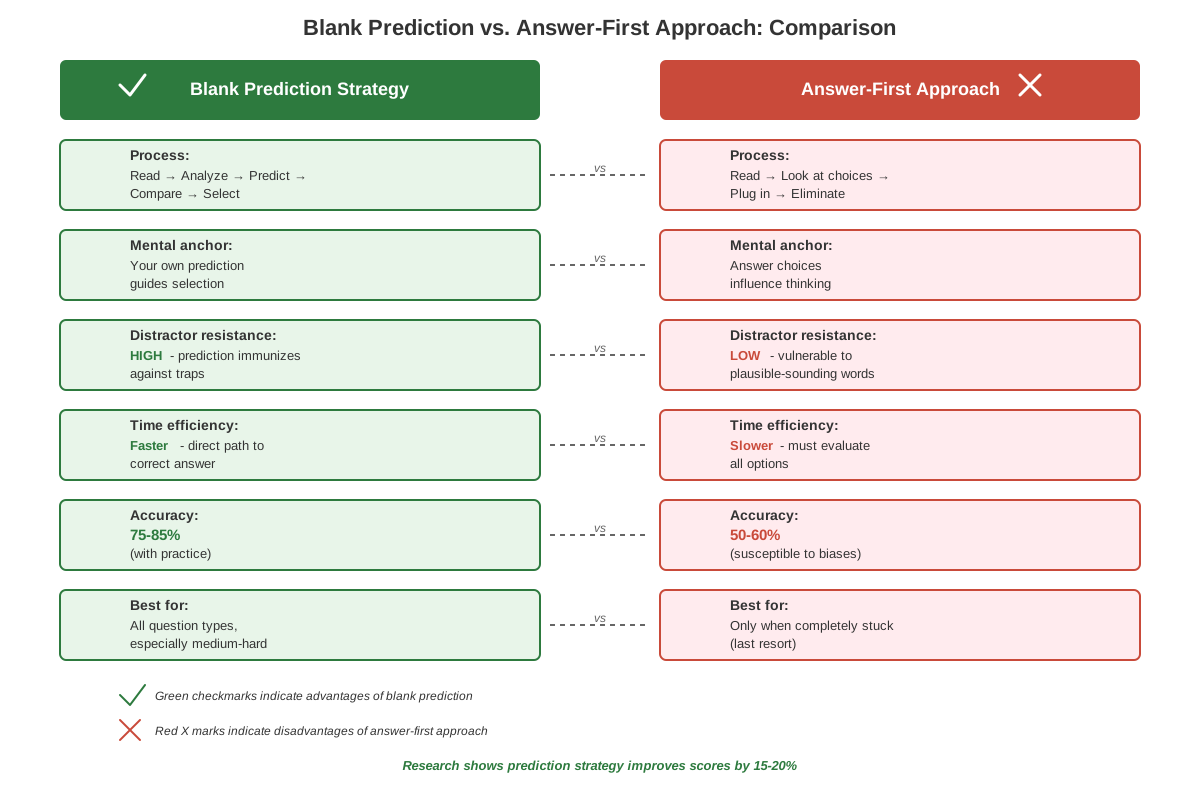
The importance of GRE blank prediction cannot be overstated. Text Completion questions constitute approximately one-third of the Verbal Reasoning section, and students who master blank prediction consistently outperform those who rely on answer-choice elimination alone. The GRE is designed to exploit common reading habits and cognitive biases—answer choices often include sophisticated vocabulary words that sound plausible but subtly distort the sentence's meaning. By predicting the blank before examining these options, you create a mental anchor that helps you identify the correct answer with confidence and speed.
This strategy connects intimately with other Verbal Reasoning skills, particularly vocabulary knowledge, contextual analysis, and logical reasoning. Blank prediction requires you to identify transition words, understand sentence structure, recognize contrast and support relationships, and synthesize multiple clauses into a coherent meaning. It serves as the foundation upon which other Text Completion strategies are built, making it an essential skill for achieving a competitive GRE score.
Learning Objectives
- [ ] Identify when Blank prediction is being tested
- [ ] Explain the core rule or strategy behind Blank prediction
- [ ] Apply Blank prediction to GRE-style questions accurately
- [ ] Analyze sentence structure to determine logical relationships between clauses
- [ ] Generate appropriate predictions using context clues and transition words
- [ ] Evaluate answer choices against predictions to select the best match
- [ ] Recognize when to adjust predictions based on answer choice patterns
Prerequisites
- Basic sentence structure understanding: Recognizing subjects, verbs, objects, and modifiers helps identify which parts of the sentence provide clues for the blank
- Familiarity with transition words: Words like "however," "although," "moreover," and "therefore" signal logical relationships essential for accurate predictions
- Fundamental vocabulary knowledge: A working vocabulary enables you to articulate predictions and recognize synonyms among answer choices
- Reading comprehension skills: The ability to extract main ideas and understand author intent provides the foundation for contextual analysis
Why This Topic Matters
Blank prediction represents a critical skill that extends beyond standardized testing into real-world reading comprehension and communication. In professional and academic contexts, the ability to anticipate missing information based on context demonstrates sophisticated analytical thinking. This skill helps readers identify gaps in arguments, predict conclusions, and engage critically with complex texts.
On the GRE specifically, Text Completion questions appear in approximately 6-7 questions per Verbal Reasoning section, accounting for roughly 30-35% of your Verbal score. These questions range from single-blank to triple-blank formats, with difficulty levels spanning from straightforward vocabulary tests to complex logical puzzles requiring multi-step reasoning. The Educational Testing Service (ETS) reports that Text Completion questions are among the most reliable predictors of graduate-level reading ability, which explains their prominence on the exam.
Blank prediction appears in every Text Completion question format. In single-blank questions, it helps you avoid attractive distractors that fit grammatically but distort meaning. In double- and triple-blank questions, it becomes even more crucial, as you must predict each blank independently while maintaining logical consistency across the entire sentence. The strategy is particularly valuable when dealing with unfamiliar vocabulary in answer choices—if you have a clear prediction, you can often identify the correct answer even when you don't know every word's precise definition.
Core Concepts
The Fundamental Principle of Blank Prediction
Blank prediction operates on a simple but powerful principle: the sentence itself contains all the information needed to determine what belongs in the blank. GRE sentences are carefully constructed logical units where every word contributes to a coherent meaning. The blank represents a missing piece of this logical puzzle, and the surrounding context provides clues—sometimes obvious, sometimes subtle—that point toward the correct answer.
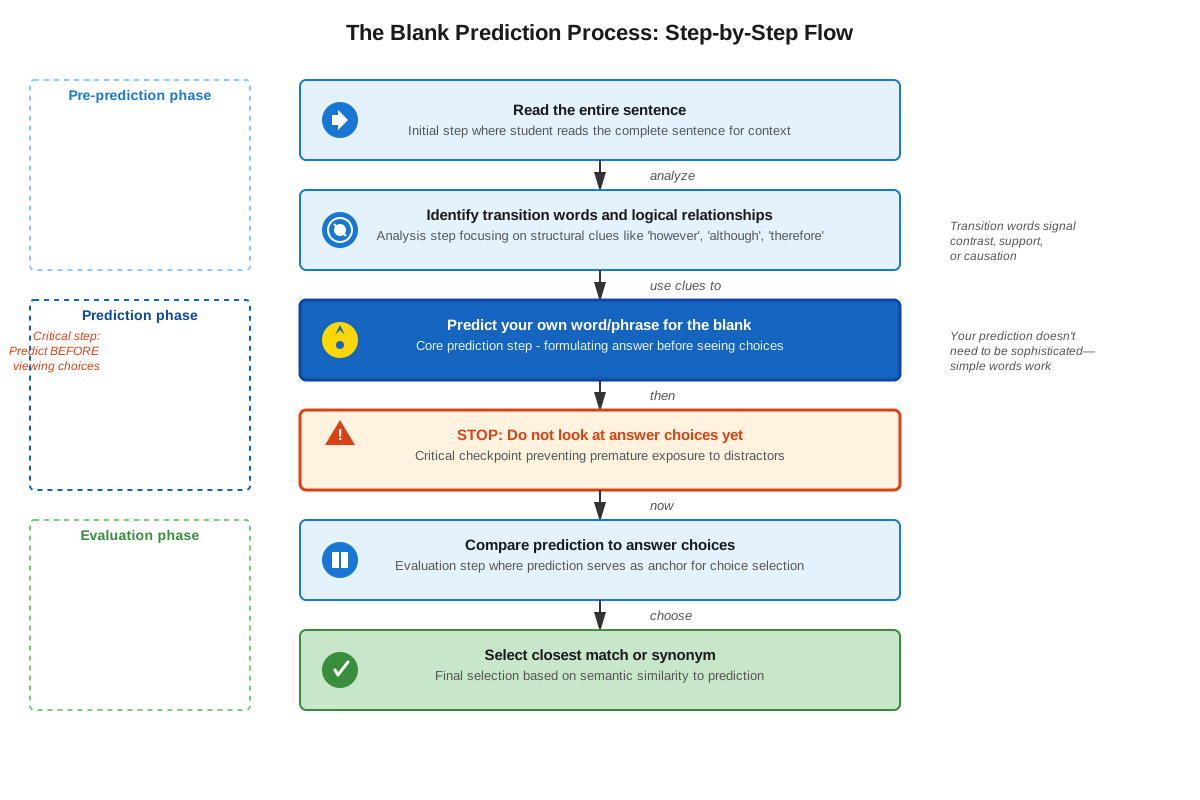
The prediction process involves three essential steps:
- Read the entire sentence for overall meaning, ignoring the answer choices completely
- Identify context clues that indicate what type of word or concept belongs in the blank
- Formulate a prediction using your own words before examining the options
This approach leverages a psychological principle: when you generate your own answer first, you're less susceptible to the anchoring effect that makes incorrect but plausible-sounding options seem attractive.
Context Clues and Signal Words
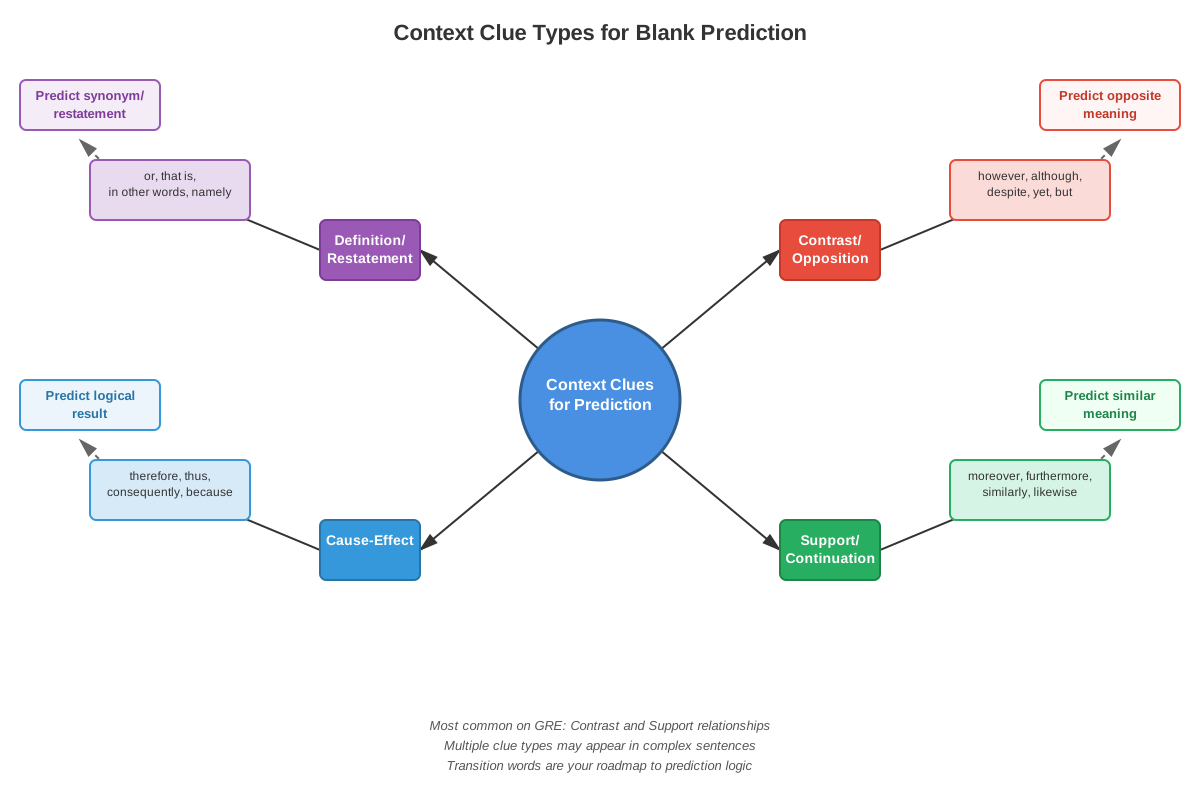
Context clues are the textual evidence that reveals what should fill the blank. These clues typically appear in several forms:
Restatement clues occur when the sentence essentially defines or restates the blank using different words. Signal words for restatement include "in other words," "that is," "namely," semicolons, colons, and dashes. For example: "The professor's lectures were so ___; that is, they were filled with unnecessary words and repetitive examples." The phrase after the semicolon tells you the blank should mean something like "wordy" or "verbose."
Contrast clues indicate that the blank should mean the opposite of something stated elsewhere in the sentence. Common contrast signals include "however," "although," "despite," "while," "but," "yet," "nevertheless," and "on the other hand." Example: "Although the politician's public persona was ___, his private correspondence revealed a deeply cynical worldview." The contrast signal "although" indicates the blank should be the opposite of "cynical"—perhaps "idealistic" or "optimistic."
Support clues show that the blank should align with or reinforce another idea in the sentence. Support signals include "and," "moreover," "furthermore," "similarly," "likewise," and "because." Example: "The scientist's methodology was rigorous and her conclusions were ___." The support structure suggests the blank should be positive and align with "rigorous"—perhaps "reliable" or "well-founded."
Cause-and-effect clues indicate that the blank represents either a cause or consequence of something stated in the sentence. Signals include "because," "since," "therefore," "thus," "consequently," and "as a result."
The Direction and Charge Method
A highly effective framework for blank prediction involves determining two key attributes: direction and charge.
Direction refers to whether the blank should align with (same direction) or contrast with (opposite direction) a key word or phrase in the sentence. Identifying transition words helps determine direction.
Charge refers to whether the blank should be positive, negative, or neutral in connotation. Even if you cannot predict the exact word, knowing whether you need a positive or negative term dramatically narrows your options.
| Element | Questions to Ask | Example Signals |
|---|---|---|
| Direction | Does the blank agree or contrast with other ideas? | Same: and, moreover, similarly / Opposite: but, however, although |
| Charge | Should the word be positive, negative, or neutral? | Context-dependent; look for evaluative language |
Prediction Specificity Levels
Not all predictions need to be equally specific. Depending on the sentence complexity and your vocabulary, predictions can operate at different levels:
Level 1 - Exact word prediction: You can predict the precise word or a close synonym. This occurs with straightforward sentences containing clear restatement clues.
Level 2 - Concept prediction: You can predict the general concept or meaning, even if you cannot think of the exact word. For example, predicting "something that makes things worse" even if "exacerbate" doesn't immediately come to mind.
Level 3 - Charge prediction: You can determine only whether the blank should be positive, negative, or neutral. This minimum level of prediction still provides valuable guidance when evaluating answer choices.
Even a Level 3 prediction significantly improves your odds. If you know the blank must be negative, you can immediately eliminate all positive and neutral options, often reducing five choices to two or three.
Multiple-Blank Prediction Strategy
For sentences with two or three blanks, the prediction strategy requires adaptation:
- Read the entire sentence first to understand the overall meaning and logical flow
- Identify the easiest blank—the one with the clearest context clues
- Predict and solve that blank first, using it as an anchor
- Use your first answer to inform predictions for remaining blanks, as the sentence must be logically consistent
- Verify that all selected answers create a coherent, logical sentence
This approach is more efficient than trying to predict all blanks simultaneously and helps you avoid the trap of selecting answers that work individually but create logical contradictions when combined.
Concept Relationships
Blank prediction serves as the foundational strategy that connects to virtually every other Text Completion skill. The relationship map flows as follows:
Sentence Structure Analysis → Blank Prediction → Answer Choice Evaluation → Final Selection
Understanding sentence structure (prerequisite knowledge) enables effective blank prediction by helping you identify which clauses contain context clues and which contain the blank. Transition word recognition (prerequisite) directly feeds into blank prediction by revealing logical relationships between sentence parts.
Blank prediction then informs answer choice evaluation—your prediction serves as a filter through which you examine each option, asking "Does this match my prediction?" This evaluation process connects to vocabulary knowledge, as you must recognize synonyms and subtle meaning differences between similar words.
Within the blank prediction process itself, concepts build hierarchically: identifying context clues → determining direction and charge → formulating a prediction → matching prediction to answers. Each step depends on the previous one, creating a systematic approach that reduces cognitive load and increases accuracy.
The strategy also connects forward to more advanced Text Completion techniques like working with difficult vocabulary, managing time pressure, and handling complex sentence structures. Mastering blank prediction provides the stable foundation upon which these advanced skills are built.
High-Yield Facts
⭐ Blank prediction should always occur BEFORE looking at answer choices to avoid anchoring bias and distractor influence.
⭐ Transition words are the most reliable indicators of logical relationships and therefore the most valuable context clues for prediction.
⭐ Even predicting just the charge (positive/negative/neutral) significantly improves accuracy by eliminating incompatible answer choices.
⭐ In multiple-blank questions, solve the easiest blank first and use it as an anchor for predicting remaining blanks.
⭐ The correct answer will match your prediction in meaning, not necessarily in exact wording—look for synonyms and conceptual equivalents.
- Restatement clues (semicolons, colons, "in other words") are the strongest predictors because they essentially define the blank.
- Contrast signals like "although," "despite," and "however" indicate the blank should mean the opposite of a key word or phrase.
- Support signals like "and," "moreover," and "similarly" indicate the blank should align with or reinforce another idea.
- If you cannot predict a specific word, predicting the general concept or category still provides valuable guidance.
- Your prediction should be flexible enough to accommodate synonyms but specific enough to eliminate clearly wrong answers.
- Time spent on prediction is time saved on answer choice evaluation—a good prediction makes selection quick and confident.
- If none of the answer choices match your prediction, reconsider your analysis of the sentence rather than forcing a match.
Quick check — test yourself on Blank prediction so far.
Try Flashcards →Common Misconceptions
Misconception: Blank prediction means you must think of the exact word that appears in the answer choices. → Correction: Predictions can be synonyms, phrases, or even general concepts. The goal is to understand what meaning belongs in the blank, not to guess the test-maker's specific word choice. If you predict "make worse" and the answer is "exacerbate," your prediction was successful.
Misconception: You should look at answer choices to help you understand what the sentence means. → Correction: Answer choices are designed to confuse and mislead. Reading them before forming your own understanding contaminates your analysis with the test-maker's distractors. Always read and analyze the sentence independently first.
Misconception: If your prediction doesn't match any answer choice, you should pick the closest option. → Correction: A mismatch between your prediction and all answer choices signals that you've misunderstood the sentence's logic. Return to the sentence, reanalyze the context clues and transition words, and formulate a new prediction rather than forcing an incorrect answer.
Misconception: Blank prediction only works for easy questions with obvious context clues. → Correction: Blank prediction is actually most valuable on difficult questions where sophisticated distractors make answer-choice elimination unreliable. Even predicting just the charge (positive/negative) helps significantly on challenging items.
Misconception: In multiple-blank questions, you must predict all blanks before looking at any answer choices. → Correction: The most efficient approach is to predict and solve the easiest blank first, then use that answer to inform your predictions for remaining blanks. This sequential strategy reduces cognitive load and improves accuracy.
Misconception: A good prediction should be a single, specific word. → Correction: Predictions can be phrases, descriptions, or concepts. "Something that makes the situation worse" is a perfectly valid prediction that will help you identify "exacerbate," "aggravate," or "compound" as the correct answer.
Worked Examples
Example 1: Single-Blank Question
Question: "Although the new policy was intended to ___ bureaucratic inefficiency, it actually created additional layers of administrative complexity."
Step 1 - Read for overall meaning: The sentence discusses a policy that was supposed to do something about bureaucratic inefficiency but had the opposite effect.
Step 2 - Identify context clues: The contrast signal "although" is crucial here. It indicates that what the policy was "intended" to do contrasts with what it "actually" did. The policy actually "created additional layers of administrative complexity," which is clearly negative. Therefore, the policy must have been intended to do the opposite—something positive regarding bureaucratic inefficiency.
Step 3 - Determine direction and charge: The blank should contrast with "created additional layers" (opposite direction) and should be positive in charge since it describes a good intention.
Step 4 - Formulate prediction: The blank should mean something like "reduce," "eliminate," "decrease," or "address" bureaucratic inefficiency.
Step 5 - Evaluate answer choices (hypothetical options):
- (A) perpetuate - means to continue or maintain; opposite of our prediction; ELIMINATE
- (B) ameliorate - means to make better or improve; MATCHES our prediction
- (C) document - means to record; doesn't match; ELIMINATE
- (D) understand - doesn't match the meaning of reducing; ELIMINATE
- (E) exacerbate - means to make worse; opposite of our prediction; ELIMINATE
Answer: (B) ameliorate
Connection to learning objectives: This example demonstrates identifying context clues (the contrast signal "although"), formulating an appropriate prediction ("reduce" or "improve"), and accurately matching that prediction to the correct answer choice.
Example 2: Double-Blank Question
Question: "The historian's interpretation of the ancient texts was both ___(i)___ and ___(ii)___: she drew bold conclusions that challenged conventional wisdom while acknowledging the limitations of the fragmentary evidence."
Blank (i) options: (A) cautious (B) audacious (C) derivative
Blank (ii) options: (D) dogmatic (E) circumspect (F) superficial
Step 1 - Read for overall meaning: The sentence describes a historian whose interpretation had two qualities, which are then explained after the colon.
Step 2 - Identify the easier blank: The explanation after the colon provides clear clues for both blanks. "Drew bold conclusions that challenged conventional wisdom" describes the first quality, while "acknowledging the limitations of the fragmentary evidence" describes the second quality.
Step 3 - Predict Blank (i): "Bold conclusions that challenged conventional wisdom" suggests something like "daring," "bold," or "innovative." The charge is positive, and the meaning relates to taking intellectual risks.
Step 4 - Evaluate Blank (i) choices:
- (A) cautious - opposite of bold; ELIMINATE
- (B) audacious - means bold and daring; MATCHES
- (C) derivative - means unoriginal; opposite of challenging conventional wisdom; ELIMINATE
Blank (i) answer: (B) audacious
Step 5 - Predict Blank (ii): "Acknowledging the limitations of the fragmentary evidence" suggests something like "careful," "modest," or "cautious." This contrasts with the boldness of the first blank—she was both daring AND careful.
Step 6 - Evaluate Blank (ii) choices:
- (D) dogmatic - means rigidly certain; opposite of acknowledging limitations; ELIMINATE
- (E) circumspect - means careful and prudent; MATCHES
- (F) superficial - means shallow; doesn't match; ELIMINATE
Blank (ii) answer: (E) circumspect
Final verification: "The historian's interpretation was both audacious and circumspect: she drew bold conclusions that challenged conventional wisdom while acknowledging the limitations of the fragmentary evidence." This creates a logical, coherent sentence that captures the nuanced description of the historian's approach.
Connection to learning objectives: This example demonstrates solving multiple-blank questions by identifying clear context clues for each blank, predicting appropriate meanings, and verifying that the selected answers create logical consistency across the entire sentence.
Exam Strategy
Systematic Approach for Text Completion Questions
When encountering any Text Completion question on the GRE, follow this proven sequence:
- Cover the answer choices (literally place your hand over them or scroll so they're not visible)
- Read the entire sentence to grasp the overall meaning and logical structure
- Identify transition words and context clues that signal relationships between ideas
- Formulate your prediction using your own words, writing it down if using scratch paper
- Uncover answer choices and scan for matches to your prediction
- Select the answer that best matches your prediction in meaning
- Verify by reading the complete sentence with your selected answer
Trigger Words to Watch For
Certain words and punctuation marks are high-value signals that should immediately focus your attention:
Contrast triggers: although, despite, however, but, yet, while, nevertheless, nonetheless, even though, in contrast, on the other hand, rather than
Support triggers: and, moreover, furthermore, similarly, likewise, indeed, in fact, additionally
Restatement triggers: semicolons (;), colons (:), dashes (—), "in other words," "that is," "namely," "specifically"
Cause-effect triggers: because, since, therefore, thus, consequently, as a result, hence, so
Exam Tip: When you spot a transition word, immediately ask yourself: "Does this signal same direction or opposite direction?" This single question often unlocks the entire sentence.
Process of Elimination Specific to Blank Prediction
After forming your prediction, use it to eliminate answer choices systematically:
- First pass: Eliminate choices that have the wrong charge (positive vs. negative)
- Second pass: Eliminate choices that have the wrong general meaning category
- Third pass: Choose between remaining options based on precise meaning and context fit
If you're down to two choices that both seem to match your prediction, look for subtle differences in connotation, intensity, or scope. The correct answer will fit the sentence's tone and specificity level perfectly.
Time Allocation Advice
For single-blank questions, spend approximately:
- 15-20 seconds reading and predicting
- 10-15 seconds evaluating answer choices
- 5 seconds verifying
- Total: 30-40 seconds
For double-blank questions, spend approximately:
- 25-30 seconds reading and predicting both blanks
- 20-25 seconds evaluating answer choices
- 5-10 seconds verifying
- Total: 50-65 seconds
For triple-blank questions, spend approximately:
- 35-45 seconds reading and predicting all blanks
- 30-40 seconds evaluating answer choices
- 10 seconds verifying
- Total: 75-95 seconds
Time spent on prediction is an investment that pays dividends in faster, more confident answer selection. Students who skip prediction often spend more total time because they must carefully evaluate every answer choice without a clear criterion for selection.
Memory Techniques
The PREDICT Acronym
Pause before looking at answers
Read the entire sentence
Examine transition words
Determine direction and charge
Imagine your own word
Compare to answer choices
Test your selection in the sentence
Visualization Strategy
Imagine the sentence as a bridge with a missing plank (the blank). The planks on either side (context clues) show you exactly what size and shape the missing plank must be. You wouldn't randomly try planks from a pile without first looking at the gap—similarly, don't randomly try answer choices without first "measuring" what the blank needs to be.
The Traffic Light Method
Assign colors to charges:
- Green = positive words (beneficial, improve, enhance)
- Red = negative words (harmful, worsen, undermine)
- Yellow = neutral words (change, affect, influence)
When you determine the blank's charge, visualize the appropriate color. This creates a strong mental anchor that helps you quickly eliminate wrong-charge options.
Transition Word Categories Mnemonic
CARS for the four main transition types:
- Contrast (although, but, however)
- Agreement/Support (and, moreover, similarly)
- Restatement (semicolon, colon, "in other words")
- Sequence/Cause-effect (because, therefore, consequently)
Summary
Blank prediction is the cornerstone strategy for Text Completion success on the GRE Verbal Reasoning section. This technique requires reading the sentence independently before examining answer choices, identifying context clues and transition words that reveal logical relationships, and formulating a prediction for what belongs in the blank. The prediction can range from a specific word to a general concept or even just the charge (positive/negative/neutral), but any level of prediction significantly improves accuracy by providing a criterion against which to evaluate answer choices. The strategy is particularly powerful because it counteracts the GRE's sophisticated distractors, which are designed to sound plausible but subtly distort the sentence's meaning. For multiple-blank questions, the most efficient approach involves predicting and solving the easiest blank first, then using that answer to inform predictions for remaining blanks. Mastering blank prediction requires understanding sentence structure, recognizing transition words, and practicing the systematic process until it becomes automatic, but the investment pays substantial dividends in both accuracy and speed.
Key Takeaways
- Always formulate your prediction before looking at answer choices to avoid distractor influence and anchoring bias
- Transition words (although, however, moreover, because) are the most reliable signals of logical relationships and prediction clues
- Even predicting just the charge (positive/negative/neutral) dramatically improves your odds by eliminating incompatible options
- In multiple-blank questions, solve the easiest blank first and use it as an anchor for remaining predictions
- Your prediction should match the correct answer in meaning, not necessarily in exact wording—look for synonyms and conceptual equivalents
- If your prediction doesn't match any answer choice, reanalyze the sentence rather than forcing an incorrect selection
- Time spent on prediction is time saved on answer evaluation—a clear prediction makes selection quick and confident
Related Topics
Transition Words and Logical Relationships: Understanding the full range of transition words and the specific logical relationships they signal (contrast, support, cause-effect, restatement) deepens your ability to make accurate predictions. This topic expands on the transition word recognition introduced in blank prediction.
Vocabulary in Context: While blank prediction helps you identify what type of word belongs in the blank, vocabulary knowledge enables you to recognize synonyms among answer choices and distinguish between similar words with subtle meaning differences. These skills work synergistically.
Complex Sentence Structure Analysis: Advanced Text Completion questions feature complex sentences with multiple clauses, embedded phrases, and sophisticated logical structures. Mastering blank prediction provides the foundation for tackling these challenging items.
Elimination Strategies for Text Completion: While blank prediction is the primary strategy, understanding systematic elimination techniques helps when you're uncertain between two similar answer choices or when dealing with unfamiliar vocabulary.
Time Management for Verbal Reasoning: Blank prediction is a time-efficient strategy, but integrating it into your overall pacing strategy for the Verbal section ensures you maximize your score across all question types.
Practice CTA
Now that you understand the blank prediction strategy, it's time to put this knowledge into action. The practice questions and flashcards are specifically designed to reinforce these concepts and build your confidence with GRE-style Text Completion items. Start with the practice questions to apply the systematic prediction process you've learned, paying special attention to identifying transition words and formulating predictions before examining answer choices. The flashcards will help you internalize key transition words and their logical relationships, making prediction faster and more automatic. Remember: blank prediction is a skill that improves dramatically with deliberate practice. Each question you work through strengthens your ability to analyze sentences, identify context clues, and make accurate predictions. You're building the foundation for Text Completion mastery—keep practicing, and you'll see your accuracy and confidence soar!
Sign up free to keep reading
Create a free AnvayaPrep account to finish this GRE guide on Blank prediction — plus flashcards and practice questions.