Overview
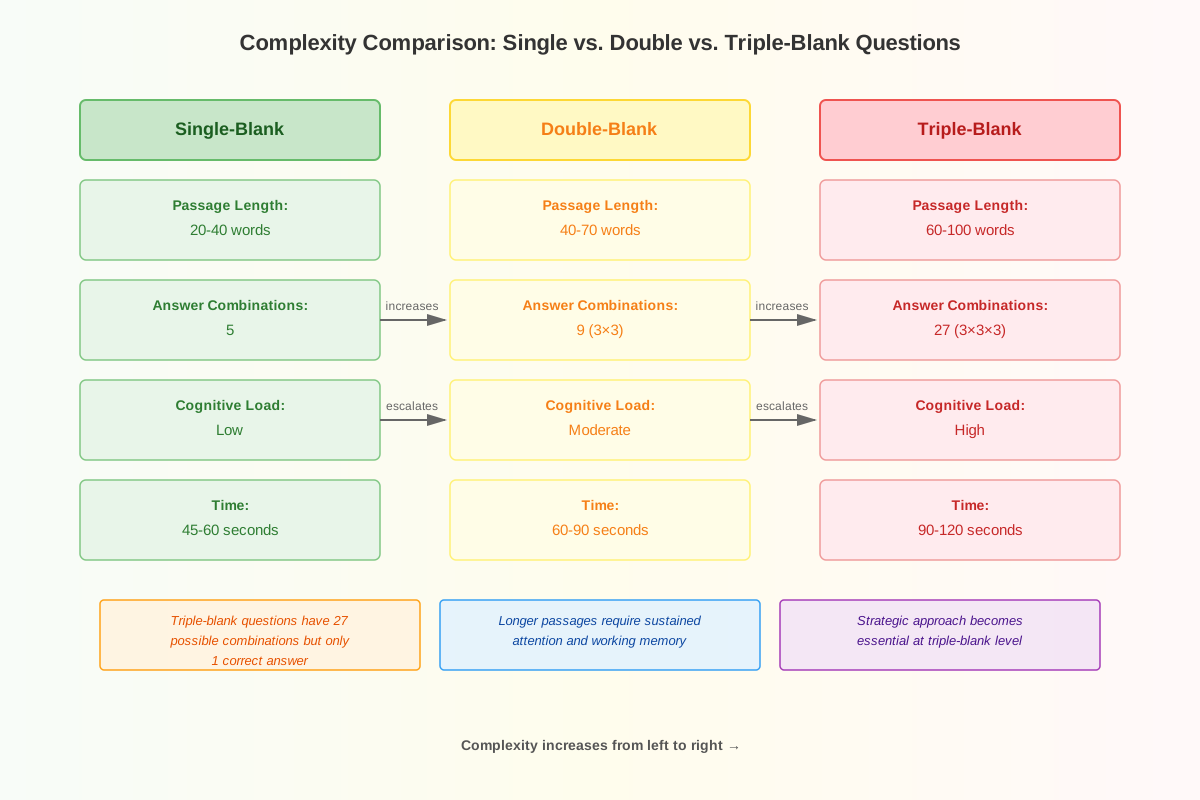
Triple-blank text completion represents the most challenging format within the GRE Text Completion question type. These questions present a passage containing three blanks, each accompanied by three answer choices, requiring test-takers to select the correct word for each blank to create a coherent, logical passage. Unlike single- or double-blank questions, triple-blank items demand sustained attention across longer passages and require students to track multiple logical relationships simultaneously. The complexity increases exponentially because there are 27 possible answer combinations (3 × 3 × 3), yet only one combination produces a passage that makes complete sense both grammatically and contextually.
Mastering GRE triple-blank text completion questions is essential for achieving competitive Verbal Reasoning scores. These questions typically appear 1-2 times per Verbal section and carry the same weight as other question types, meaning each represents approximately 5-7% of your section score. The passages for triple-blank questions are generally longer (60-100 words) and more complex than their single- and double-blank counterparts, often featuring sophisticated vocabulary, nuanced logical transitions, and intricate cause-and-effect relationships. Success requires not only strong vocabulary knowledge but also exceptional reading comprehension and the ability to maintain logical consistency across multiple decision points.
Within the broader Verbal Reasoning framework, triple-blank text completion serves as the ultimate test of contextual reasoning skills. These questions synthesize vocabulary knowledge, logical reasoning, and reading comprehension—the three pillars of GRE Verbal success. They build directly upon the skills developed through single-blank and double-blank text completion practice while adding layers of complexity that mirror the analytical demands of graduate-level reading. Students who excel at triple-blank questions demonstrate the sophisticated verbal reasoning abilities that graduate programs seek in successful candidates.
Learning Objectives
- [ ] Identify when Triple-blank text completion is being tested
- [ ] Explain the core rule or strategy behind Triple-blank text completion
- [ ] Apply Triple-blank text completion to GRE-style questions accurately
- [ ] Analyze the logical relationships between multiple blanks within a single passage
- [ ] Evaluate answer choices systematically to eliminate incorrect combinations efficiently
- [ ] Synthesize contextual clues from different parts of the passage to verify answer consistency
- [ ] Prioritize which blank to solve first based on contextual strength and logical dependencies
Prerequisites
- Single-blank text completion proficiency: Understanding how to use context clues to select appropriate vocabulary for one missing word establishes the foundation for handling multiple blanks simultaneously
- Double-blank text completion experience: Familiarity with tracking relationships between two blanks and ensuring logical consistency across paired choices prepares students for the increased complexity of three interdependent blanks
- Advanced vocabulary knowledge: A robust vocabulary (typically 1000+ GRE-level words) enables quick recognition of answer choices and reduces cognitive load when evaluating multiple options
- Reading comprehension skills: The ability to identify main ideas, logical transitions, and rhetorical structure in complex passages is essential for understanding the overall meaning that guides blank completion
- Logical reasoning fundamentals: Understanding cause-and-effect relationships, contrast signals, and continuation patterns helps predict what type of word belongs in each blank
Why This Topic Matters
Triple-blank text completion questions represent a critical assessment of the verbal reasoning skills necessary for graduate-level academic success. Graduate programs require students to comprehend complex texts, follow extended arguments, and understand nuanced relationships between ideas—precisely the skills these questions evaluate. The ability to maintain logical coherence across multiple decision points while processing sophisticated vocabulary mirrors the demands of reading research papers, understanding theoretical frameworks, and synthesizing information from multiple sources.
On the GRE, triple-blank text completion questions appear with consistent frequency. Test-takers can expect to encounter 1-2 triple-blank questions per Verbal Reasoning section, making them responsible for approximately 10-14% of the section score across both Verbal sections. Each question is worth one raw point regardless of difficulty, meaning a single triple-blank question carries the same weight as a reading comprehension question or vocabulary-focused sentence equivalence item. Given their complexity and time demands, these questions offer high-value scoring opportunities for well-prepared students while posing significant challenges for those without systematic strategies.
These questions commonly appear in passages discussing academic topics such as scientific discoveries, historical analyses, literary criticism, social science research, and philosophical arguments. The passages typically feature sophisticated logical structures including contrast relationships (however, although, despite), cause-and-effect chains (because, therefore, consequently), continuation patterns (moreover, furthermore, similarly), and qualification statements (somewhat, partially, relatively). Understanding how these structural elements guide word choice across all three blanks is essential for consistent success.
Core Concepts
Understanding the Triple-Blank Format
Triple-blank text completion questions present a passage of 60-100 words containing three blanks labeled (i), (ii), and (iii). Each blank is accompanied by exactly three answer choices, creating 27 possible combinations. The passage structure typically follows academic prose conventions with complex sentence structures, subordinate clauses, and sophisticated transitions. Unlike shorter text completion formats, triple-blank passages often develop complete arguments or narratives, requiring students to understand not just individual sentences but the overall logical flow of ideas.
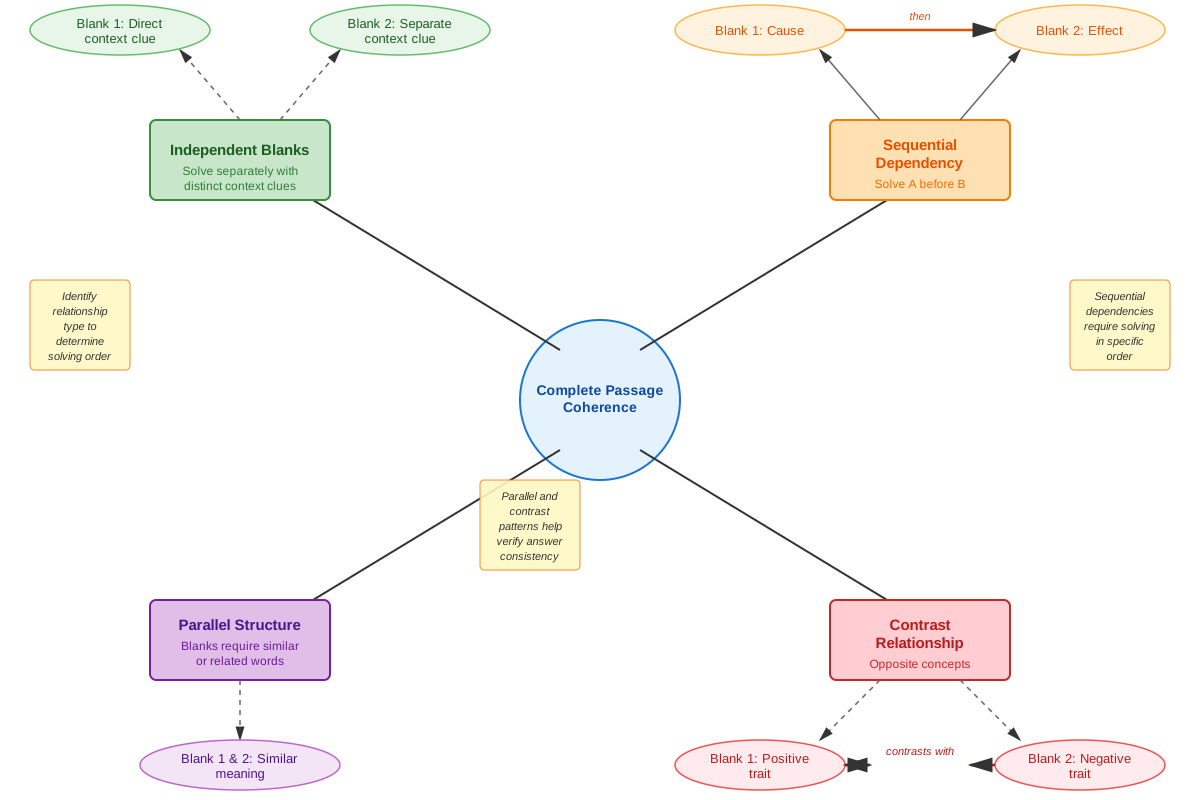
The fundamental challenge lies in the interdependence of the blanks. The correct answer for blank (i) often influences or constrains the possibilities for blank (ii), which in turn affects blank (iii). This creates a cascading effect where an incorrect choice early in the passage can make subsequent blanks appear unsolvable or force illogical word combinations. Conversely, recognizing these dependencies allows strategic test-takers to use strong contextual clues in one part of the passage to narrow options elsewhere.
The One-Blank-at-a-Time Strategy
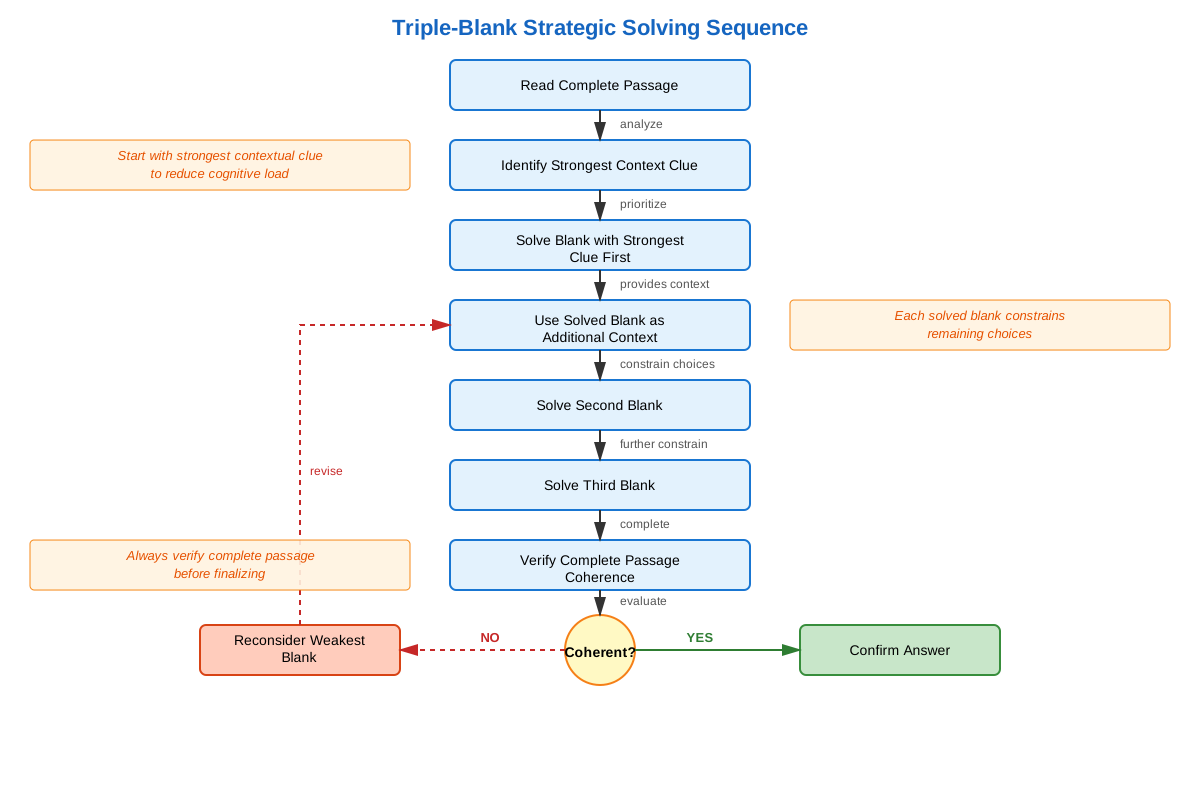
The most effective approach to triple-blank questions involves solving blanks sequentially rather than simultaneously. Attempting to evaluate all 27 combinations mentally is cognitively overwhelming and time-inefficient. Instead, skilled test-takers identify which blank has the strongest contextual support—the clearest clues indicating what type of word belongs there—and solve that blank first. This reduces the problem from 27 combinations to 9 (three choices for the first blank × three choices for each remaining blank).
After determining the most likely answer for the first blank, test-takers move to whichever remaining blank now has the strongest contextual support. This might be the blank that appears second in the passage, or it might be the third blank if that position contains clearer clues. The key principle is following the strength of context rather than the numerical order of blanks. Once two blanks are solved with confidence, only three combinations remain to evaluate for the final blank, making verification straightforward.
Identifying Contextual Clues Across the Passage
Successful triple-blank completion requires recognizing and categorizing contextual clues that signal what type of word belongs in each blank. These clues fall into several categories:
Contrast signals indicate that the blank should contain a word opposite in meaning to another word or phrase in the passage. Common contrast markers include: however, although, despite, yet, but, nevertheless, in contrast, on the other hand, and while. When a blank follows a contrast signal, look for words or phrases earlier in the passage that the blank should oppose.
Continuation signals suggest that the blank should reinforce, extend, or parallel an idea already expressed. Markers include: moreover, furthermore, similarly, likewise, indeed, in fact, and additionally. These signals indicate semantic alignment between the blank and surrounding content.
Cause-and-effect relationships reveal logical dependencies where one idea produces or results from another. Markers include: because, since, therefore, thus, consequently, as a result, and accordingly. The blank in a cause-and-effect structure must maintain the logical chain.
Definitional or explanatory structures occur when the passage defines a term, provides examples, or elaborates on a concept. Phrases like "that is," "in other words," "specifically," or the use of colons and semicolons often introduce these structures. The blank must align with the definition or explanation provided.
Maintaining Logical Consistency
The correct answer combination must produce a passage that is logically consistent throughout. This means not only that each individual blank makes sense in its immediate context but also that the completed passage presents a coherent argument or narrative from beginning to end. Test-takers must verify that their answer choices don't create contradictions, non-sequiturs, or tonal shifts that would be inappropriate in academic writing.
Consider the logical flow: Does the passage build an argument that reaches a reasonable conclusion? Do the ideas progress naturally from one sentence to the next? Are cause-and-effect relationships maintained? Does the overall tone remain consistent (formal, critical, admiring, neutral)? These questions help verify that the selected combination creates genuine coherence rather than merely avoiding obvious errors.
The Elimination Strategy
Given the complexity of triple-blank questions, systematic elimination is often more efficient than attempting to identify the correct answer immediately. For each blank, test-takers should:
- Eliminate choices that are grammatically incompatible with the sentence structure
- Eliminate choices that create obvious logical contradictions with the surrounding context
- Eliminate choices that produce inappropriate tone or register for academic prose
- Evaluate remaining choices for subtle meaning differences and contextual fit
This process should be repeated for each blank in sequence, with each elimination narrowing the field of possible combinations. Even eliminating one choice per blank reduces the combinations from 27 to 8 (2 × 2 × 2), significantly improving efficiency.
Vocabulary Precision and Connotation
Triple-blank questions frequently test subtle distinctions between near-synonyms. Answer choices for a single blank might include words with similar denotations but different connotations, registers, or usage contexts. For example, choices might include "criticize," "denounce," and "question"—all negative responses but with vastly different intensities. The passage context must guide selection of the word with the appropriate degree of intensity, formality, and specificity.
Understanding connotation (the emotional or cultural associations of a word) versus denotation (the literal dictionary definition) is crucial. A passage discussing a scientist's careful methodology might require "meticulous" rather than "obsessive," even though both suggest attention to detail, because "obsessive" carries negative connotations inappropriate for a neutral or positive description.
Concept Relationships
The core concepts within triple-blank text completion form an interconnected system where each element supports and reinforces the others. Contextual clue identification serves as the foundation, enabling the one-blank-at-a-time strategy by revealing which blank has the strongest support. This strategy, in turn, makes systematic elimination more manageable by reducing cognitive load. Both elimination and the sequential approach depend on maintaining logical consistency as the verification mechanism that confirms or rejects answer combinations. Finally, vocabulary precision operates throughout the process, as understanding subtle word distinctions enables both accurate elimination and confident selection.
The relationship to prerequisite topics is direct and cumulative. Single-blank text completion teaches basic contextual analysis and vocabulary application—skills that remain essential but must now be applied three times within a single question. Double-blank completion introduces the concept of interdependence between blanks and the need to verify consistency across multiple choices, which scales up to the triple-blank format. Advanced vocabulary knowledge, developed through systematic study, reduces the time needed to evaluate answer choices and increases the likelihood of recognizing subtle distinctions that determine correct answers.
The conceptual flow follows this pattern: Passage analysis → Contextual clue identification → Blank prioritization → Sequential solving with elimination → Consistency verification → Final answer selection. Each stage depends on the previous one, creating a systematic approach that transforms an overwhelming 27-combination problem into a manageable series of focused decisions.
Quick check — test yourself on Triple-blank text completion so far.
Try Flashcards →High-Yield Facts
⭐ Triple-blank text completion questions appear 1-2 times per Verbal Reasoning section, representing approximately 10-14% of the section score.
⭐ Solving blanks sequentially based on contextual strength rather than numerical order reduces the problem from 27 to 9 to 3 possible combinations.
⭐ The blank with the strongest contextual clues should always be solved first, regardless of its position in the passage.
⭐ Contrast signals (however, although, despite) are the most common and reliable contextual clues in triple-blank passages.
⭐ The correct answer combination must maintain logical consistency throughout the entire passage, not just within individual sentences.
- Triple-blank passages typically range from 60-100 words and feature complex academic prose with multiple clauses and sophisticated transitions.
- Each blank in a triple-blank question has exactly three answer choices, never more or fewer.
- Grammatical compatibility is the first and fastest elimination criterion—if a choice doesn't fit the sentence structure, it cannot be correct.
- Tone consistency matters: a passage that begins neutrally cannot suddenly shift to highly emotional language without explicit justification.
- Reading the completed passage aloud (mentally) helps identify awkward phrasing or logical gaps that indicate incorrect answer combinations.
- Time management is critical: spending more than 2.5-3 minutes on a single triple-blank question reduces time available for other questions without proportionally increasing accuracy.
- Answer choices within a single blank are typically arranged alphabetically, not by difficulty or correctness, so position provides no clues.
- Passages often contain "pivot points"—words or phrases that signal a shift in direction or introduce a contrasting idea—which are crucial for understanding blank relationships.
Common Misconceptions
Misconception: All three blanks must be solved in the order they appear in the passage (i, then ii, then iii).
Correction: Blanks should be solved in order of contextual strength, not numerical order. The blank with the clearest clues should be solved first, even if it's blank (iii), because this reduces the number of combinations to evaluate and provides anchoring information for the other blanks.
Misconception: If two of the three blanks seem correct, the answer combination must be right even if the third blank feels uncertain.
Correction: All three blanks must work together to create a fully coherent passage. An uncertain third blank suggests either an error in one of the first two blanks or insufficient verification of logical consistency. The correct combination will make all three blanks feel clearly appropriate in context.
Misconception: Triple-blank questions are worth more points than other question types because they're harder.
Correction: All GRE Verbal Reasoning questions are worth exactly one raw point regardless of difficulty or format. Triple-blank questions are not weighted more heavily, though they may appear more frequently in higher-difficulty sections for test-takers performing well.
Misconception: Sophisticated or unusual vocabulary choices are more likely to be correct because the GRE tests advanced words.
Correction: The correct answer is the word that best fits the context, which may be a relatively common word used precisely rather than an obscure word used impressively. Context determines correctness, not vocabulary level alone.
Misconception: If the passage makes basic sense with a particular combination, that combination must be correct.
Correction: The correct combination must create not just basic sense but optimal coherence with precise word choice, appropriate tone, and flawless logical consistency. "Good enough" is not sufficient—the passage should read as polished academic prose without any awkwardness or ambiguity.
Misconception: All answer choices for a blank are equally plausible until proven otherwise.
Correction: Often one or two choices can be eliminated immediately based on grammar, obvious logical contradictions, or inappropriate register. Treating all choices as equally viable wastes time and mental energy that should be focused on distinguishing between genuinely plausible options.
Worked Examples
Example 1: Scientific Discovery Passage
Passage: "The researcher's methodology was initially _____(i)_____ by her colleagues, who considered her approach too _____(ii)_____ to yield reliable results. However, when her experiments produced _____(iii)_____ findings that could be consistently replicated, even her harshest critics acknowledged the validity of her work."
Blank (i): A) celebrated B) dismissed C) refined
Blank (ii): D) conventional E) innovative F) meticulous
Blank (iii): G) ambiguous H) robust I) preliminary
Solution Process:
Step 1: Identify the blank with the strongest contextual clues. Blank (iii) has excellent support: the word "However" signals a contrast, and the phrase "even her harshest critics acknowledged the validity" indicates that the findings must have been convincing and strong. Additionally, "consistently replicated" suggests reliable, solid results.
Step 2: Solve blank (iii) first.
- G) "ambiguous" contradicts "consistently replicated" and wouldn't convince critics—eliminate.
- H) "robust" means strong and reliable, fitting perfectly with replication and convincing critics—strong candidate.
- I) "preliminary" suggests early-stage, incomplete findings that wouldn't typically convince harsh critics—eliminate.
Blank (iii) answer: H) robust
Step 3: Move to blank (i), which now has clear context. The "However" creates a contrast between the initial reception and the eventual validation. If the findings ultimately proved robust and convinced critics, the initial reception must have been negative.
- A) "celebrated" would mean positive initial reception, contradicting the contrast structure—eliminate.
- B) "dismissed" indicates rejection, fitting the contrast with eventual validation—strong candidate.
- C) "refined" suggests improvement rather than rejection, which doesn't create the necessary contrast—eliminate.
Blank (i) answer: B) dismissed
Step 4: Solve blank (ii) with the established context. The methodology was dismissed initially but proved valid. What quality would cause dismissal but could actually work? The passage needs a word that explains why colleagues were skeptical.
- D) "conventional" wouldn't typically cause dismissal—eliminate.
- E) "innovative" could cause skepticism from conservative colleagues who prefer traditional methods, fitting the narrative—strong candidate.
- F) "meticulous" is a positive quality that wouldn't cause dismissal—eliminate.
Blank (ii) answer: E) innovative
Step 5: Verify logical consistency. "The researcher's methodology was initially dismissed by her colleagues, who considered her approach too innovative to yield reliable results. However, when her experiments produced robust findings that could be consistently replicated, even her harshest critics acknowledged the validity of her work." This creates a coherent narrative about innovative research overcoming initial skepticism through strong results.
Final Answer: B, E, H
Example 2: Historical Analysis Passage
Passage: "Although the emperor's reign was marked by military _____(i)_____, his domestic policies were surprisingly _____(ii)_____, focusing on infrastructure development rather than _____(iii)_____ displays of power."
Blank (i): A) conquests B) setbacks C) reforms
Blank (ii): D) aggressive E) pragmatic F) symbolic
Blank (iii): G) practical H) grandiose I) subtle
Solution Process:
Step 1: Identify contextual clues. "Although" signals contrast between military activities and domestic policies. "Rather than" in the third blank creates an additional contrast with "infrastructure development."
Step 2: Solve blank (iii) first because "rather than" provides direct contrast with "infrastructure development," which is practical and functional.
- G) "practical" would parallel infrastructure development, not contrast with it—eliminate.
- H) "grandiose" (impressive, showy) contrasts well with practical infrastructure—strong candidate.
- I) "subtle" doesn't create meaningful contrast with infrastructure development—eliminate.
Blank (iii) answer: H) grandiose
Step 3: Solve blank (ii). The domestic policies focused on practical infrastructure "rather than grandiose displays," suggesting they were functional and sensible.
- D) "aggressive" doesn't fit with infrastructure focus—eliminate.
- E) "pragmatic" (practical, sensible) fits perfectly with infrastructure development—strong candidate.
- F) "symbolic" would be closer to grandiose displays than infrastructure—eliminate.
Blank (ii) answer: E) pragmatic
Step 4: Solve blank (i). "Although" contrasts military activities with pragmatic domestic policies. What military characteristic would contrast with pragmatic domestic focus?
- A) "conquests" (military victories) would contrast with domestic pragmatism, suggesting external aggression versus internal development—strong candidate.
- B) "setbacks" (defeats) wouldn't create the intended contrast—eliminate.
- C) "reforms" doesn't fit military context as naturally—eliminate.
Blank (i) answer: A) conquests
Step 5: Verify. "Although the emperor's reign was marked by military conquests, his domestic policies were surprisingly pragmatic, focusing on infrastructure development rather than grandiose displays of power." This creates a coherent contrast between external military aggression and internal practical governance.
Final Answer: A, E, H
Exam Strategy
Approach triple-blank questions with a systematic four-phase process: (1) Read the entire passage once for overall meaning, (2) Identify and mark transition words and logical signals, (3) Determine which blank has the strongest contextual support, (4) Solve blanks sequentially while eliminating incorrect choices.
Trigger words and phrases to watch for include contrast markers (however, although, despite, yet, nevertheless), continuation signals (moreover, furthermore, similarly, indeed), cause-and-effect indicators (because, therefore, thus, consequently), and definitional structures (that is, in other words, specifically). These signals reveal the logical relationships that determine correct word choices.
Time management is critical: allocate approximately 2.5-3 minutes maximum per triple-blank question. If you've spent 2 minutes and haven't confidently solved at least two blanks, make your best educated guess and move on. The opportunity cost of spending 5 minutes on one question (potentially getting it right) versus spending 3 minutes (with reasonable accuracy) and having 2 minutes for another question typically favors the latter strategy.
Process-of-elimination tips specific to triple-blank questions:
- Eliminate grammatically incompatible choices first (wrong part of speech, singular/plural mismatch)
- Eliminate choices that create obvious logical contradictions with explicit statements in the passage
- Eliminate choices that produce inappropriate tone shifts (formal to colloquial, neutral to highly emotional)
- Between two remaining choices, select the one that creates more precise, natural-sounding prose
Use the "read-through test": After selecting your answer combination, mentally read the entire completed passage. If any phrase sounds awkward, unnatural, or ambiguous, reconsider your choices. The correct combination should produce prose that sounds like it could appear in an academic journal or sophisticated publication.
Strategic guessing: If you must guess, first eliminate any choices you can for each blank, then select the combination that creates the most logical flow in the opening sentence, as this often sets up the passage's direction. If completely uncertain, avoid extreme or unusual vocabulary choices in favor of more moderate, contextually flexible words.
Memory Techniques
C-O-N-T-E-X-T Mnemonic for systematic passage analysis:
- Contrast signals (however, although, despite)
- Order of solving (strongest context first)
- Number reduction (27 → 9 → 3 combinations)
- Tone consistency (maintain appropriate register)
- Elimination first (remove impossible choices)
- X-check logic (verify coherence throughout)
- Time limit (2.5-3 minutes maximum)
The "Anchor-Chain-Verify" visualization: Picture the blank with the strongest context as an anchor that holds your answer in place. The second blank is a chain link connecting to the anchor. The third blank is another link completing the chain. Finally, verify that the entire chain is strong by testing for logical consistency. This mental image reinforces the sequential solving strategy.
S-E-A-L acronym for final verification:
- Sense: Does the passage make complete sense?
- Elegance: Does it read smoothly like polished prose?
- Accuracy: Are all logical relationships maintained?
- Logic: Does the argument or narrative flow coherently from start to finish?
The "Traffic Light" system for blank prioritization: Mentally assign colors to blanks based on contextual strength. Green = strong, clear context (solve first); Yellow = moderate context (solve second); Red = weak or dependent context (solve last). This visual categorization speeds up the decision about where to begin.
Summary
Triple-blank text completion questions represent the most complex format within GRE Text Completion, requiring test-takers to select the correct word for three blanks from three choices each, creating 27 possible combinations. Success demands a systematic approach: reading for overall meaning, identifying logical signals (contrast, continuation, cause-and-effect), determining which blank has the strongest contextual support, and solving blanks sequentially rather than simultaneously. This strategy reduces the problem from 27 combinations to a manageable series of focused decisions. The correct answer combination must maintain logical consistency throughout the entire passage, creating coherent academic prose with appropriate tone, precise vocabulary, and flawless logical flow. Effective time management (2.5-3 minutes maximum per question) and systematic elimination of grammatically incompatible or logically contradictory choices are essential. These questions appear 1-2 times per Verbal section and test the integrated skills of vocabulary knowledge, contextual reasoning, and reading comprehension that are fundamental to graduate-level academic success.
Key Takeaways
- Triple-blank text completion questions present three blanks with three choices each, but should be solved sequentially based on contextual strength rather than numerical order
- Contrast signals (however, although, despite) are the most reliable contextual clues and appear in the majority of triple-blank passages
- The correct answer combination must create complete logical consistency throughout the passage, not just within individual sentences
- Systematic elimination of grammatically incompatible and logically contradictory choices reduces cognitive load and improves accuracy
- Time management is critical: allocate 2.5-3 minutes maximum per question to maintain overall section pacing
- Reading the completed passage mentally to verify natural flow and coherence is the essential final verification step
- These questions appear 1-2 times per Verbal section and are worth the same single point as any other question type
Related Topics
Double-blank text completion provides the immediate foundation for triple-blank questions, introducing the concept of interdependent blanks and the need to maintain consistency across multiple choices. Mastering double-blank questions builds the skills necessary for handling the increased complexity of three blanks.
Sentence Equivalence develops complementary skills in identifying synonyms and understanding subtle vocabulary distinctions, which directly supports the ability to evaluate near-synonym answer choices in triple-blank questions.
Reading Comprehension - Logical Structure enhances the ability to identify argument flow, recognize transitions, and understand cause-and-effect relationships—all critical for maintaining logical consistency across triple-blank passages.
Advanced Vocabulary Study expands the word knowledge necessary to quickly evaluate answer choices and recognize subtle connotation differences that often determine correct answers in triple-blank questions.
Critical Reasoning strengthens the logical analysis skills needed to verify that answer combinations create coherent arguments without contradictions or non-sequiturs.
Practice CTA
Now that you've mastered the strategies and concepts behind triple-blank text completion, it's time to put your knowledge into action. Attempt the practice questions to reinforce these techniques and build the confidence needed for test day. Each practice question you complete strengthens your pattern recognition, speeds up your contextual analysis, and refines your elimination skills. Remember: consistent practice with systematic strategy application is what transforms understanding into high scores. Challenge yourself with the flashcards to cement key vocabulary and review the worked examples whenever you need to refresh your approach. You've built a strong foundation—now build your expertise through deliberate practice!
Sign up free to keep reading
Create a free AnvayaPrep account to finish this GRE guide on Triple-blank text completion — plus flashcards and practice questions.