Overview
Clue words are the linguistic signposts embedded within GRE Text Completion and Sentence Equivalence questions that reveal the logical relationships between different parts of a sentence. These words and phrases function as the architectural framework of complex sentences, indicating whether ideas contrast, continue in the same direction, show cause and effect, or illustrate examples. Mastering clue words transforms Text Completion from a vocabulary guessing game into a logical puzzle where the correct answer becomes predictable based on structural analysis.
On the GRE Verbal Reasoning section, GRE clue words serve as the primary mechanism through which test-makers create answerable questions even when students don't know every vocabulary word. The test designers deliberately construct sentences where clue words provide sufficient context to determine whether a blank requires a word that matches, contrasts, or modifies the surrounding content. Students who systematically identify and interpret these signals can often predict the general meaning or tone of the correct answer before even looking at the answer choices—a strategy that dramatically improves both accuracy and speed.
Understanding clue words represents a foundational skill that connects to virtually every aspect of GRE Verbal Reasoning. In Reading Comprehension, these same transitional words signal shifts in argument structure and authorial perspective. In Sentence Equivalence, clue words help identify which two answer choices create sentences with equivalent meanings. The ability to recognize and interpret these linguistic markers separates students who approach verbal questions strategically from those who rely solely on vocabulary knowledge or intuition.
Learning Objectives
- [ ] Identify when Clue words is being tested
- [ ] Explain the core rule or strategy behind Clue words
- [ ] Apply Clue words to GRE-style questions accurately
- [ ] Categorize clue words into their appropriate logical relationship types (continuation, contrast, cause-effect, illustration)
- [ ] Predict the general meaning or tone required in a blank based on clue word analysis
- [ ] Distinguish between multiple clue words in complex sentences and determine their hierarchical relationships
Prerequisites
- Basic sentence structure understanding: Recognizing subjects, verbs, and objects enables students to identify which parts of a sentence the clue words are connecting
- Fundamental vocabulary knowledge: While clue words reduce vocabulary dependence, students still need baseline vocabulary to understand the non-blank portions of sentences
- Logical reasoning skills: Interpreting clue words requires understanding basic logical relationships like similarity, opposition, and causation
Why This Topic Matters
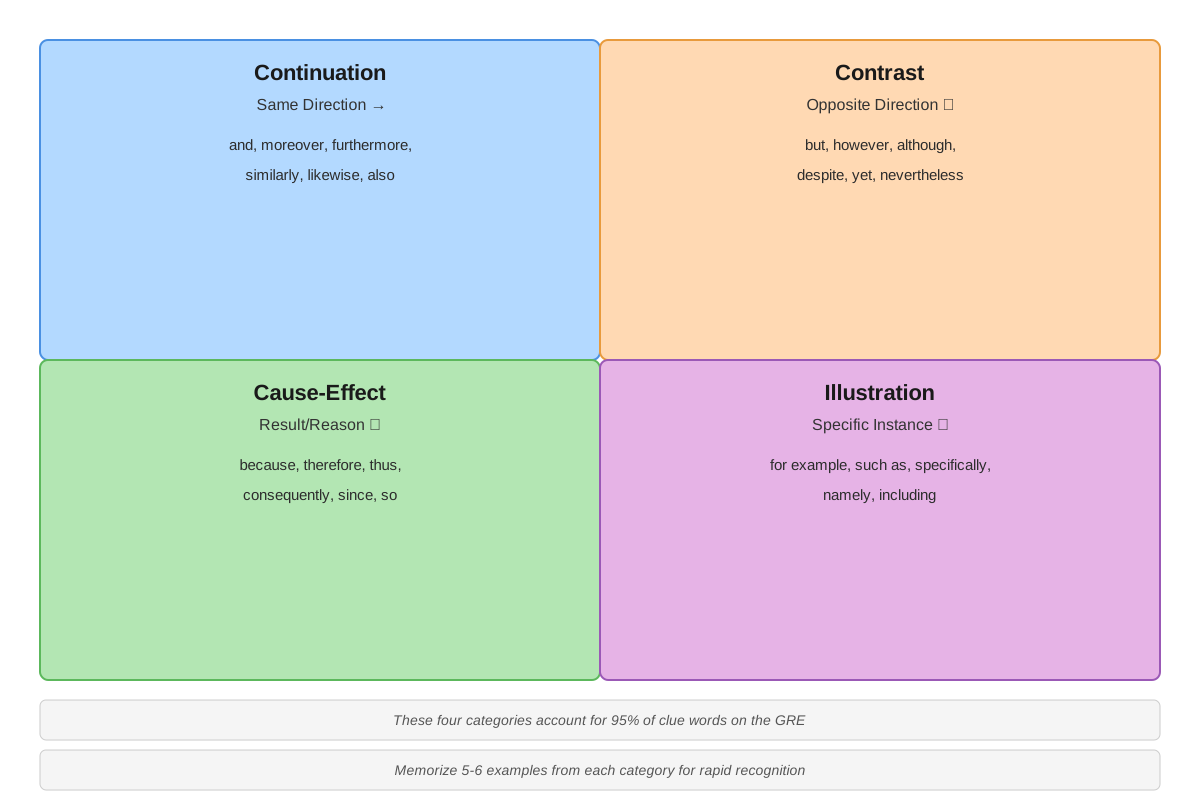
Clue words appear in virtually every Text Completion and Sentence Equivalence question on the GRE, making them one of the highest-yield topics in the entire Verbal Reasoning section. Research on GRE question construction reveals that approximately 95% of Text Completion questions contain at least one identifiable clue word or phrase that signals the logical relationship needed to solve the question. Questions without obvious clue words typically rely on implicit contrasts or continuations that still follow the same logical patterns.
In real-world applications, the ability to identify logical relationships through transitional language proves essential for academic reading, professional communication, and critical thinking. Graduate-level coursework requires students to follow complex arguments where authors use sophisticated transitions to build multi-layered reasoning. Professional writing in fields from law to medicine to business relies on precise logical connectors to convey relationships between ideas clearly.
On the GRE specifically, clue words most commonly appear in three contexts: single-blank Text Completion questions where one clue word determines the answer; multi-blank Text Completion questions where multiple clue words create a chain of logical relationships; and Sentence Equivalence questions where clue words help identify which two answer choices produce equivalent meanings. The test frequently embeds clue words in subordinate clauses, prepositional phrases, and between independent clauses—positions that require careful reading to identify. High-scoring students report that systematic clue word identification is their primary strategy for Text Completion questions, often allowing them to predict correct answers before reviewing choices.
Core Concepts
Definition and Function of Clue Words
Clue words are transitional words, phrases, or punctuation marks that signal the logical relationship between different parts of a sentence or between sentences. These linguistic markers function as explicit instructions from the author about how to interpret the connection between ideas. On the GRE, clue words serve as the primary mechanism for making Text Completion questions solvable through logic rather than pure vocabulary knowledge.
The fundamental principle underlying clue word strategy is that GRE sentences are constructed with internal logical consistency. Each blank must be filled with a word that maintains the logical relationship indicated by the clue words. This means that even if a student doesn't know the precise vocabulary word needed, they can determine whether the blank requires something positive or negative, similar or opposite, specific or general, based solely on clue word analysis.
Categories of Clue Words
GRE clue words fall into four primary categories, each indicating a distinct logical relationship:
Continuation/Same-Direction Clue Words
Continuation clue words signal that the idea following the clue word continues in the same direction as the preceding idea. These words indicate similarity, agreement, or logical extension. When a continuation clue word appears, the blank typically requires a word that matches the tone, meaning, or direction of the surrounding context.
Common continuation clue words include:
| Clue Word/Phrase | Function | Example Context |
|---|---|---|
| and, also, moreover | Addition | "The scientist was meticulous and _____" |
| similarly, likewise | Comparison | "Just as the first theory failed, the second _____ proved inadequate" |
| indeed, in fact | Emphasis | "The policy was controversial; indeed, it was _____" |
| furthermore, additionally | Extension | "The evidence was compelling; furthermore, it was _____" |
| ; (semicolon) | Connection | "The artist was prolific; she _____ dozens of works annually" |
Contrast/Reversal Clue Words
Contrast clue words indicate that the idea following the clue word opposes, contradicts, or reverses the preceding idea. These are among the most common and important clue words on the GRE. When a contrast clue word appears, the blank typically requires a word with the opposite tone or meaning from the surrounding context.
Common contrast clue words include:
| Clue Word/Phrase | Function | Example Context |
|---|---|---|
| but, yet, however | Direct opposition | "The theory seemed sound, but it was actually _____" |
| although, though, while | Concession | "Although the data appeared conclusive, it was _____" |
| despite, in spite of | Opposition despite circumstances | "Despite his reputation for honesty, he proved _____" |
| rather than, instead of | Alternative | "Rather than accepting the conventional view, she _____ it" |
| nevertheless, nonetheless | Opposition after concession | "The evidence was limited; nevertheless, the conclusion was _____" |
| conversely, on the contrary | Direct reversal | "The first group thrived; conversely, the second group _____" |
Cause-and-Effect Clue Words
Cause-and-effect clue words signal that one idea results from, leads to, or explains another. These words indicate logical consequence or reasoning. When a cause-and-effect clue word appears, the blank typically requires a word that logically follows from or produces the surrounding context.
Common cause-and-effect clue words include:
| Clue Word/Phrase | Function | Example Context |
|---|---|---|
| because, since, as | Reason | "Because the experiment was _____, the results were unreliable" |
| therefore, thus, hence | Conclusion | "The data was flawed; therefore, the theory was _____" |
| consequently, as a result | Result | "The policy failed; consequently, public opinion became _____" |
| so, so that | Purpose/Result | "The procedure was _____ so that errors would be minimized" |
| leads to, results in | Direct causation | "Careful preparation leads to _____ outcomes" |
Illustration/Example Clue Words
Illustration clue words signal that what follows provides an example, specification, or clarification of a general idea. These words indicate that the blank and surrounding context should be consistent in a specific-to-general or general-to-specific relationship.
Common illustration clue words include:
| Clue Word/Phrase | Function | Example Context |
|---|---|---|
| for example, for instance | Specific example | "The artist employed various techniques; for example, she _____ colors boldly" |
| such as, like | Exemplification | "The scientist demonstrated _____ qualities such as patience and precision" |
| specifically, in particular | Specification | "The policy affected many groups, specifically those who were _____" |
| : (colon) | Explanation/list | "The researcher had one goal: to _____ the hypothesis" |
Implicit Clue Words and Structural Signals
Not all logical relationships are marked by explicit clue words. The GRE frequently uses implicit signals that function like clue words without being traditional transitional phrases:
- Punctuation as clue words: Semicolons typically indicate continuation; colons introduce explanations or examples; dashes can signal either continuation or contrast depending on context
- Parallel structure: When sentence elements are grammatically parallel, they typically continue in the same direction
- Negation words: "Not," "never," "rarely," "hardly," and similar words function as contrast signals by reversing the expected meaning
- Comparative structures: "More/less than," "as...as," and similar constructions create implicit comparisons that function as clue words
Multiple Clue Words and Hierarchical Relationships
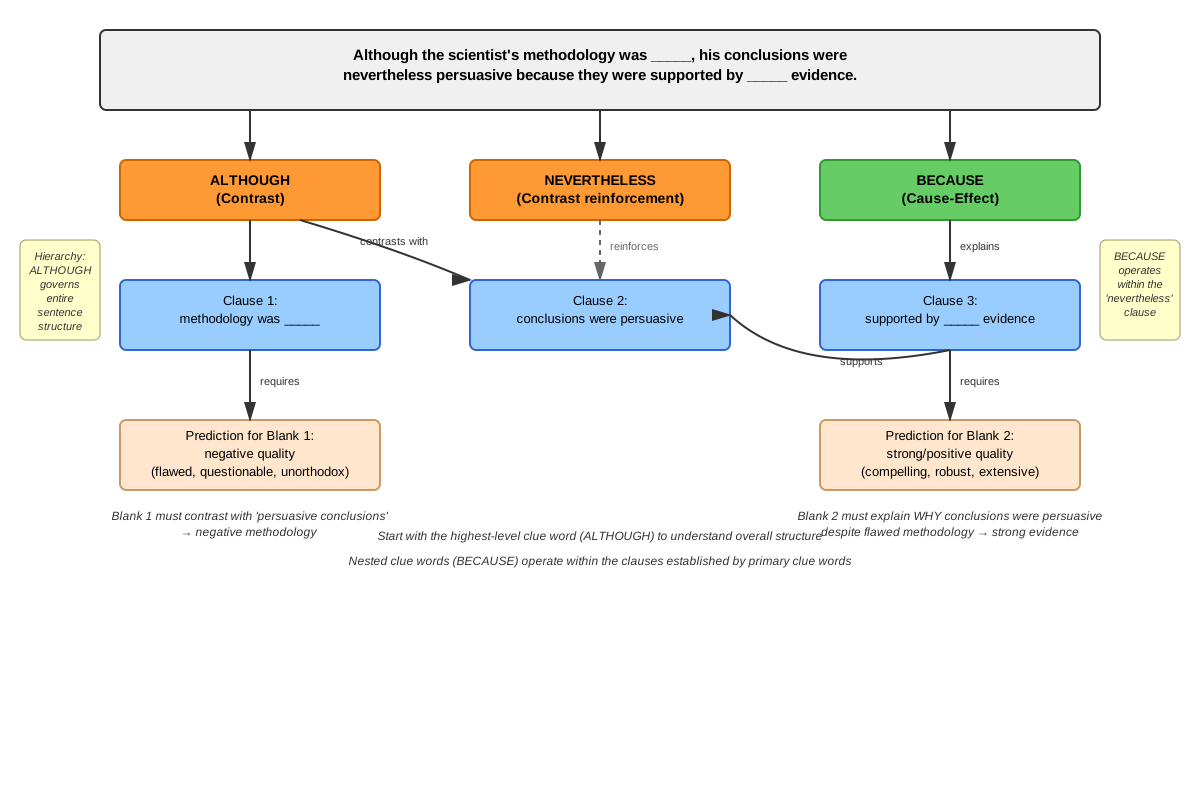
Complex GRE sentences often contain multiple clue words that create layered logical relationships. In these cases, students must:
- Identify all clue words in the sentence
- Determine the scope of each clue word (which parts of the sentence it connects)
- Establish hierarchy (which clue word governs the blank most directly)
- Trace the logical chain from known information through each clue word to the blank
For example: "Although the scientist's methodology was rigorous, her conclusions were nevertheless questionable because the data was _____."
This sentence contains three clue words: "although" (contrast), "nevertheless" (contrast reinforcement), and "because" (cause-effect). The hierarchy shows that "because" most directly governs the blank, indicating the blank must explain why conclusions were questionable. The double contrast ("although...nevertheless") establishes that despite rigorous methodology, something went wrong—and "because" points to the data as the problem. The blank must describe data that would make conclusions questionable: "incomplete," "biased," "insufficient," etc.
Concept Relationships
The relationship between different types of clue words forms a logical system where each category serves a distinct function in sentence construction. Continuation clue words and contrast clue words represent opposite ends of a spectrum—continuation maintains direction while contrast reverses it. These two categories are the most fundamental and appear most frequently on the GRE.
Cause-and-effect clue words build upon the foundation of continuation and contrast by adding a temporal or logical sequence dimension. A cause-effect relationship can continue in the same direction (positive cause → positive effect) or involve contrast (positive cause → negative effect with an intervening contrast clue word).
Illustration clue words function differently from the other three categories because they operate on a specificity axis rather than a directional axis. Illustrations can continue, contrast, or show cause-effect relationships while simultaneously moving between general and specific levels.
The connection to prerequisite knowledge flows directly: understanding basic sentence structure enables students to identify which sentence elements the clue words connect; fundamental vocabulary allows comprehension of the non-blank portions that clue words relate to the blank; logical reasoning skills permit interpretation of what each clue word type means for the blank's required meaning.
This topic connects forward to advanced Text Completion strategies (using clue words to predict answers before reviewing choices), Sentence Equivalence techniques (using clue words to identify which two answers create equivalent meanings), and Reading Comprehension skills (using transitional words to follow argument structure in passages).
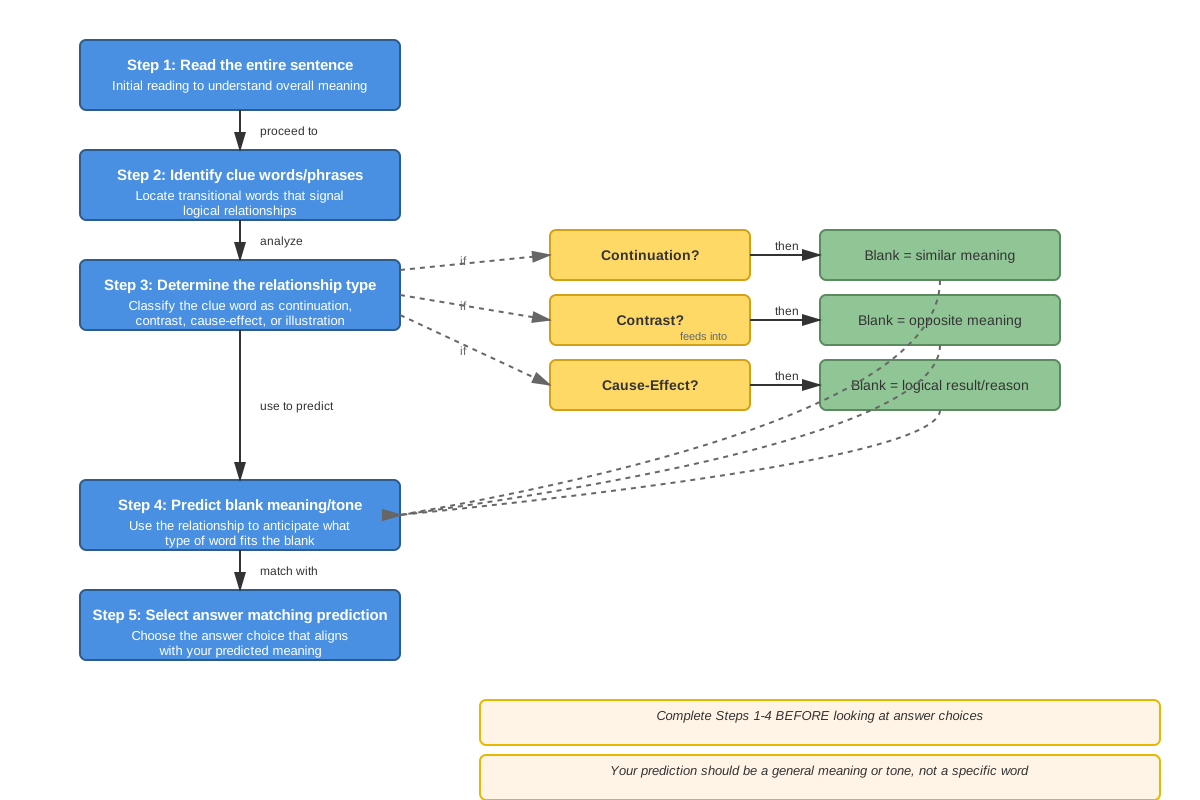
The logical flow can be mapped as: Sentence Structure Recognition → Clue Word Identification → Relationship Type Classification → Directional Prediction (positive/negative, similar/opposite) → Answer Selection → Verification (checking that the selected answer maintains logical consistency with all clue words).
Quick check — test yourself on Clue words so far.
Try Flashcards →High-Yield Facts
⭐ Contrast clue words (but, although, despite, however, yet) are the most frequently tested clue word category on the GRE, appearing in approximately 40% of Text Completion questions.
⭐ Semicolons function as continuation clue words in GRE sentences, indicating that the clause following the semicolon continues in the same direction as the preceding clause.
⭐ The word "and" can function as either a simple addition or a strong continuation signal depending on context; when connecting two adjectives describing the same noun, it typically indicates both adjectives should have similar connotations.
⭐ Multiple contrast words in the same sentence (e.g., "although...nevertheless") create a double negative effect, ultimately indicating continuation rather than contrast.
⭐ Negation words (not, never, rarely, hardly, scarcely) function as implicit contrast clue words by reversing the expected meaning of surrounding context.
- Cause-and-effect clue words often appear in subordinate clauses beginning with "because," "since," or "as," requiring students to identify which clause contains the blank to determine whether they're solving for cause or effect.
- Colons typically introduce explanations, examples, or specifications of what immediately precedes them, functioning as illustration clue words.
- The phrase "rather than" creates a strong contrast and often appears in GRE questions testing whether students can identify opposite meanings.
- Continuation clue words can be implicit in sentences with parallel structure, where grammatically parallel elements typically continue in the same semantic direction.
- Time-based transitions (previously, formerly, now, currently, subsequently) can function as contrast clue words when they indicate a change over time.
- The word "while" can indicate either simultaneous action (continuation) or concession (contrast), requiring context analysis to determine which function it serves.
- Comparative structures ("more...than," "less...than") create implicit contrast relationships between the compared elements.
Common Misconceptions
Misconception: All "and" instances are simple additions with no logical significance → Correction: When "and" connects descriptive words about the same subject, it typically signals that both words should have similar connotations or meanings, functioning as a continuation clue word that helps predict blank answers.
Misconception: Contrast clue words always mean the blank requires the exact opposite of surrounding words → Correction: Contrast clue words indicate a shift in direction or tone, but not necessarily a perfect antonym; "although the weather was pleasant" doesn't require "unpleasant" in the blank, but rather any word indicating a negative outcome or unexpected result.
Misconception: Only one clue word matters in sentences with multiple transitional phrases → Correction: Complex GRE sentences often contain multiple clue words that must all be considered; ignoring any clue word can lead to selecting an answer that satisfies one logical relationship while violating another.
Misconception: Clue words always appear immediately adjacent to the blank → Correction: Clue words can appear anywhere in the sentence and may govern the blank from several clauses away; students must analyze the entire sentence structure to identify which clue words relate to which blanks.
Misconception: Memorizing clue word lists is sufficient for mastering this strategy → Correction: While knowing common clue words is important, students must also practice identifying implicit signals, understanding context-dependent meanings (like "while"), and analyzing how multiple clue words interact in complex sentences.
Misconception: Punctuation marks are not clue words → Correction: Semicolons, colons, and dashes function as powerful clue words on the GRE; semicolons indicate continuation, colons introduce explanations or examples, and dashes can signal either continuation or contrast depending on context.
Misconception: If a sentence contains no obvious clue words, it cannot be solved logically → Correction: Sentences without explicit clue words typically rely on implicit signals like parallel structure, negation words, or comparative constructions that function as clue words when properly identified.
Worked Examples
Example 1: Single-Blank Text Completion with Contrast Clue Word
Question: Although the historian's research was _____, her writing style made the subject accessible to general readers.
Step 1 - Identify clue words: The word "although" is a contrast clue word indicating that the two parts of the sentence oppose each other in some way.
Step 2 - Analyze the known information: The second part of the sentence (after the comma) tells us that "her writing style made the subject accessible to general readers." This is a positive statement about accessibility and readability.
Step 3 - Determine what the contrast requires: Since "although" creates a contrast, and the second part is about making things accessible/readable, the first part (the blank) should describe research that would typically make things inaccessible or difficult to read. We need a word that contrasts with "accessible."
Step 4 - Predict the blank's meaning: The blank should describe research that is complex, specialized, detailed, or technical—qualities that would normally make writing inaccessible, creating a contrast with the actual accessible writing style.
Step 5 - Evaluate answer choices (hypothetical choices):
- (A) superficial - This would not contrast with accessible; superficial research would likely be easy to write about accessibly
- (B) meticulous - This could work; meticulous research is detailed and could be hard to make accessible
- (C) esoteric - This works perfectly; esoteric (specialized, obscure) research would typically be inaccessible, creating the contrast
- (D) preliminary - This doesn't create the needed contrast
- (E) collaborative - This doesn't relate to accessibility
Answer: (C) esoteric creates the logical contrast indicated by "although."
Connection to learning objectives: This example demonstrates identifying when clue words are being tested (the "although" signals a contrast relationship), explaining the core strategy (contrast clue words require opposite tones or meanings), and applying the strategy to select the correct answer.
Example 2: Multi-Blank Text Completion with Multiple Clue Words
Question: The scientist's theory was initially (i)_____ by her colleagues because the supporting evidence seemed (ii)_____; however, subsequent research vindicated her position.
Blank (i) options: (A) celebrated (B) dismissed (C) refined
Blank (ii) options: (D) overwhelming (E) inadequate (F) irrelevant
Step 1 - Identify all clue words:
- "because" (cause-and-effect) connects blank (i) and blank (ii)
- "however" (contrast) connects the first part of the sentence to "subsequent research vindicated her position"
Step 2 - Analyze the known information: The end of the sentence tells us that "subsequent research vindicated her position," meaning later research proved she was right. The word "however" creates a contrast with this vindication.
Step 3 - Work backwards from the contrast: If later research vindicated her (proved her right), and "however" creates a contrast, then initially her theory must have been received negatively. This means blank (i) needs a negative word about how colleagues received the theory.
Step 4 - Use the cause-and-effect relationship: The word "because" tells us that blank (ii) explains why colleagues responded as they did in blank (i). If they responded negatively (blank i), it must be because the evidence had some negative quality (blank ii).
Step 5 - Solve blank (i): Given the contrast with vindication, colleagues must have initially rejected or dismissed the theory. Answer: (B) dismissed.
Step 6 - Solve blank (ii): Since colleagues dismissed the theory (blank i), and "because" indicates blank (ii) explains this dismissal, the evidence must have seemed insufficient or problematic. Answer: (E) inadequate.
Step 7 - Verify logical consistency: "The scientist's theory was initially dismissed by her colleagues because the supporting evidence seemed inadequate; however, subsequent research vindicated her position." This creates perfect logical flow: inadequate evidence (ii) → dismissal (i) → [contrast] → vindication. All clue words are satisfied.
Connection to learning objectives: This example demonstrates identifying multiple clue words, explaining how different clue word types interact (cause-effect and contrast), and applying hierarchical analysis to solve complex multi-blank questions accurately.
Exam Strategy
Systematic Approach to Clue Word Questions
When approaching any Text Completion or Sentence Equivalence question, follow this process:
- Read the entire sentence first without looking at answer choices to understand the overall meaning and structure
- Circle or mentally note every clue word in the sentence, including punctuation marks that function as clue words
- Classify each clue word by type (continuation, contrast, cause-effect, illustration)
- Determine which clue word(s) most directly govern each blank by analyzing sentence structure
- Predict the general meaning or tone required in each blank based on clue word analysis (positive/negative, similar/opposite to surrounding context)
- Review answer choices looking for words that match your prediction
- Verify your selection by reading the complete sentence with your chosen answer to ensure all clue words are satisfied
Trigger Words and Phrases to Watch For
High-Alert Contrast Signals: "but," "although," "despite," "however," "yet," "nevertheless" — these appear in approximately 40% of Text Completion questions and are the most reliable clue words for predicting blank requirements.
Semicolon Alert: When you see a semicolon, immediately recognize it as a continuation signal; the clause after the semicolon should continue in the same direction as the clause before it.
Double Contrast Recognition: When two contrast words appear in the same sentence ("although...nevertheless," "despite...however"), they typically cancel each other out, creating an ultimate continuation relationship.
"Because" Hierarchy: When "because" appears, identify whether the blank is in the cause clause or the effect clause, as this determines whether you're solving for what produced an outcome or what resulted from a cause.
Process-of-Elimination Tips
- Eliminate answers that violate the primary clue word even if they seem to fit other aspects of the sentence
- For Sentence Equivalence, eliminate any answer that doesn't have a synonym pair among the choices, as the correct answers must create equivalent meanings
- Test extreme answers carefully with contrast clue words; strong contrasts often require strong (not moderate) opposite words
- Eliminate answers that create logical contradictions when you read the complete sentence, even if they seem to fit the blank in isolation
- Watch for trap answers that match the tone of surrounding words when a contrast clue word requires the opposite tone
Time Allocation Advice
Spend approximately 60-90 seconds per Text Completion question, allocating time as follows:
- 15-20 seconds: Initial read and clue word identification
- 20-30 seconds: Logical analysis and prediction
- 15-25 seconds: Answer choice evaluation
- 10-15 seconds: Verification
For multi-blank questions, add approximately 20-30 seconds per additional blank. If clue word analysis doesn't yield a clear prediction within 30 seconds, make your best educated guess and move on rather than spending excessive time on a single question.
Memory Techniques
The "DICE" Mnemonic for Clue Word Categories
Direction (Continuation): and, moreover, similarly, furthermore, semicolon
Inversion (Contrast): but, although, despite, however, yet
Causation (Cause-Effect): because, therefore, since, thus, consequently
Example (Illustration): for example, such as, specifically, colon
The "BAND" Acronym for Contrast Clue Words
But
Although
Nevertheless
Despite
These four words account for the majority of contrast clue words on the GRE and should trigger immediate recognition of a contrast relationship.
Visualization Strategy: The Direction Arrow
When reading a sentence, visualize an arrow representing the direction of meaning:
- Continuation clue words = arrow continues straight →
- Contrast clue words = arrow reverses direction ←
- Cause-effect clue words = arrow with a push symbol →|
- Illustration clue words = arrow with a magnifying glass →🔍
This visual system helps quickly categorize clue words and predict their effect on blank requirements.
The Semicolon Rule Rhyme
"When you see a semicolon sign, the second clause continues the line."
This simple rhyme reinforces that semicolons function as continuation signals, one of the most frequently tested clue word concepts.
Summary
Clue words are the linguistic signposts that reveal logical relationships within GRE Text Completion and Sentence Equivalence questions, transforming these questions from vocabulary tests into logical puzzles. The four primary categories—continuation, contrast, cause-effect, and illustration—each signal distinct relationships that determine what type of word belongs in a blank. Contrast clue words (but, although, despite, however) are the most frequently tested and indicate that the blank requires a meaning or tone opposite to surrounding context. Continuation clue words (and, moreover, semicolons) signal that the blank should match surrounding context. Cause-effect clue words (because, therefore, since) indicate logical consequence, while illustration clue words (for example, such as, colons) signal specific-to-general relationships. Mastering clue word identification and interpretation enables students to predict correct answers before reviewing choices, dramatically improving both accuracy and efficiency. Complex sentences often contain multiple clue words that must be analyzed hierarchically to determine which most directly governs each blank. Success with clue words requires systematic identification, classification, and application of logical relationships rather than relying solely on vocabulary knowledge.
Key Takeaways
- Clue words appear in approximately 95% of GRE Text Completion questions and provide the primary mechanism for solving these questions through logic rather than pure vocabulary
- Contrast clue words (but, although, despite, however, yet) are the most frequently tested category, requiring blanks that oppose or reverse the tone/meaning of surrounding context
- Semicolons function as continuation clue words, indicating that the clause following the semicolon continues in the same direction as the preceding clause
- Multiple clue words in complex sentences must all be satisfied by the correct answer; ignoring any clue word can lead to selecting a logically inconsistent answer
- Predicting the general meaning or tone of the blank before reviewing answer choices improves accuracy and prevents being misled by attractive but incorrect options
- Implicit clue words (punctuation, negation words, parallel structure) are as important as explicit transitional phrases and must be identified through careful sentence analysis
- The systematic process of identifying, classifying, and applying clue words should become automatic through practice, enabling efficient question-solving under timed conditions
Related Topics
Text Completion Strategy - Advanced Techniques: Building on clue word mastery, this topic covers sophisticated strategies for multi-blank questions, including working backwards from the most constrained blank and using answer choice elimination based on logical consistency.
Sentence Equivalence Techniques: This topic applies clue word analysis specifically to Sentence Equivalence questions, focusing on how clue words help identify which two answer choices create sentences with equivalent meanings.
Reading Comprehension - Argument Structure: The same transitional words that function as clue words in Text Completion appear throughout Reading Comprehension passages to signal shifts in argument, contrasts between viewpoints, and logical relationships between ideas.
Vocabulary in Context: Understanding how clue words create context enables more sophisticated vocabulary learning, as students can use clue words in example sentences to infer word meanings and remember connotations.
Logical Reasoning Fundamentals: The logical relationships signaled by clue words (similarity, opposition, causation) form the foundation for broader logical reasoning skills tested throughout the GRE Verbal and Analytical Writing sections.
Practice CTA
Now that you've mastered the core concepts of clue words, it's time to cement your understanding through active practice. Attempt the practice questions associated with this topic, focusing on systematically identifying and classifying clue words before predicting answers. Use the flashcards to build automatic recognition of common clue words and their categories. Remember that clue word mastery is a skill that improves dramatically with deliberate practice—each question you analyze strengthens your ability to spot these signals quickly and accurately under timed conditions. Your investment in mastering this high-yield topic will pay dividends across every Text Completion and Sentence Equivalence question you encounter on test day.
Sign up free to keep reading
Create a free AnvayaPrep account to finish this GRE guide on Clue words — plus flashcards and practice questions.