Overview
Continuation clues are one of the most fundamental and frequently tested signal types in GRE Text Completion questions. These linguistic markers indicate that the missing word or phrase should maintain the same direction, tone, or meaning as the surrounding context. Unlike contrast clues that signal a shift in direction, continuation clues tell test-takers that the blank should reinforce, extend, or elaborate upon ideas already present in the sentence. Mastering continuation clues is essential because they appear in approximately 40-50% of all Text Completion questions, making them the single most common clue type on the exam.
Understanding GRE continuation clues provides a strategic advantage because they create a direct logical pathway to the correct answer. When a continuation clue is present, the sentence essentially provides its own answer key—the missing word must align with the established meaning. This makes continuation clue questions among the most straightforward to solve when approached systematically, yet many test-takers miss these questions by overthinking or failing to recognize the continuation signal words.
Within the broader framework of GRE Verbal Reasoning, continuation clues represent the foundation upon which more complex clue recognition skills are built. Before students can effectively identify contrast clues, cause-and-effect relationships, or restatement patterns, they must first develop the ability to recognize when a sentence is simply continuing in the same semantic direction. This skill directly supports performance not only in Text Completion but also in Sentence Equivalence questions, where identifying synonymous relationships depends on recognizing continuation patterns between answer choices.
Learning Objectives
- [ ] Identify when Continuation clues is being tested
- [ ] Explain the core rule or strategy behind Continuation clues
- [ ] Apply Continuation clues to GRE-style questions accurately
- [ ] Recognize and categorize the major types of continuation signal words
- [ ] Distinguish between continuation clues and other clue types (especially contrast clues)
- [ ] Predict the correct answer before reviewing answer choices using continuation clues
- [ ] Evaluate answer choices systematically based on continuation relationships
Prerequisites
- Basic sentence structure understanding: Recognizing subjects, verbs, and objects helps identify which parts of the sentence provide context for the blank
- Vocabulary fundamentals: A working vocabulary enables students to understand the context that continuation clues are meant to continue
- Logical reasoning skills: The ability to follow an argument's direction is necessary to determine whether ideas are continuing or contrasting
- Familiarity with Text Completion format: Understanding the basic structure of GRE Text Completion questions allows focus on clue identification rather than format confusion
Why This Topic Matters
Continuation clues represent the most reliable and high-yield pattern recognition skill for GRE Verbal Reasoning success. Research on GRE question patterns reveals that continuation clues appear in nearly half of all Text Completion questions, making them statistically the most important single concept to master. Unlike vocabulary-dependent questions where success hinges on knowing obscure words, continuation clue questions reward systematic analysis and pattern recognition—skills that can be developed through deliberate practice regardless of initial vocabulary level.
In real-world applications, the ability to recognize continuation patterns translates directly to reading comprehension and critical thinking skills essential for graduate-level academic work. Graduate students must constantly identify whether authors are building upon previous points, introducing contrasts, or shifting argumentative direction. The same analytical framework used to identify continuation clues on the GRE applies to parsing complex academic prose, legal documents, and research literature.
On the exam itself, continuation clues most commonly appear in medium-difficulty Text Completion questions with one or two blanks. They frequently occur in sentences discussing consistent character traits, reinforcing descriptions, or elaborating on previously stated ideas. The GRE test makers often pair straightforward continuation clues with challenging vocabulary in the answer choices, testing whether students can use structural analysis to overcome vocabulary gaps. Recognizing the continuation pattern allows test-takers to eliminate answer choices that shift direction, even when they don't know every word's precise definition.
Core Concepts
Definition and Function of Continuation Clues
Continuation clues are words, phrases, or structural elements within a sentence that signal the blank should be filled with a word that maintains the same semantic direction as the surrounding context. These clues indicate that the missing word will reinforce, elaborate, extend, or provide a similar example to ideas already expressed. The fundamental principle is straightforward: when a continuation clue is present, the correct answer will be consistent with—not opposite to—the established meaning.
The function of continuation clues extends beyond simple agreement. They create logical bridges between different parts of a sentence, ensuring coherent meaning flows throughout. When the GRE includes a continuation clue, it's providing a roadmap to the correct answer by explicitly signaling that the blank relates to the context in a supportive rather than oppositional way.
Major Categories of Continuation Signal Words
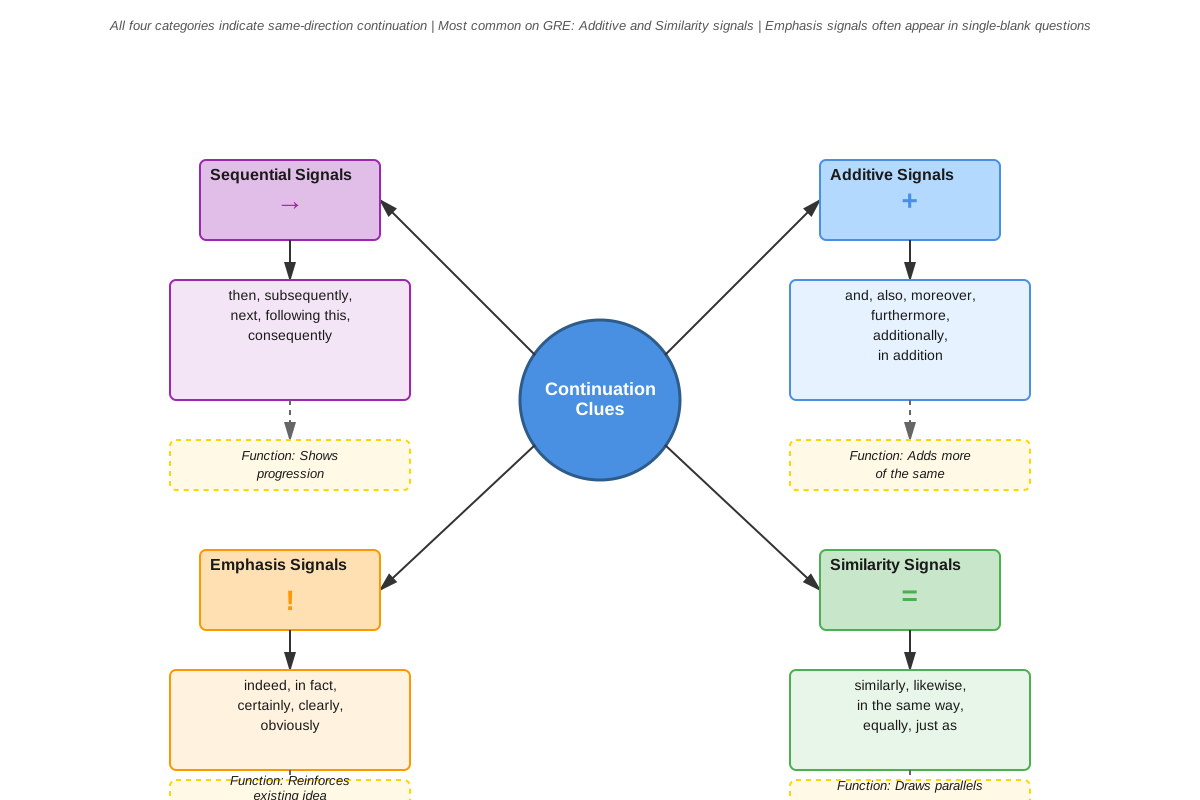
Continuation clues manifest through several distinct categories of signal words and phrases. Understanding these categories enables systematic identification:
Additive signals indicate that additional similar information is being provided:
- and
- moreover
- furthermore
- additionally
- also
- as well as
- in addition
- likewise
- similarly
Elaboration signals show that the sentence is expanding upon or explaining a previous point:
- in fact
- indeed
- specifically
- particularly
- especially
- that is
Emphasis signals reinforce or intensify the existing direction:
- even
- very
- truly
- certainly
- undoubtedly
Consistency signals indicate ongoing or repeated patterns:
- consistently
- continually
- still
- remain
- continue
- always
- perpetually
Structural Continuation Patterns
Beyond explicit signal words, continuation clues often appear through structural patterns within sentences. The parallel structure pattern occurs when a sentence establishes a pattern in one clause that must be maintained in another. For example: "The professor was known for her _____ lectures; students found her presentations equally engaging." The semicolon creates a continuation relationship, and "equally" reinforces that the blank should align with "engaging."
The appositive pattern uses commas or dashes to set off a phrase that renames or elaborates on a noun. This structure inherently creates continuation: "The politician, a _____ speaker, captivated audiences with his eloquent rhetoric." The appositive must continue the positive characterization suggested by "captivated" and "eloquent."
The colon pattern introduces explanation or elaboration: "The scientist's approach was thoroughly _____: she verified every result through multiple independent experiments." The colon signals that what follows will explain or exemplify the blank, creating a continuation relationship.
Semantic Field Continuation
A sophisticated form of continuation occurs through semantic field relationships—when words from the same conceptual domain appear throughout a sentence. The GRE frequently tests whether students can recognize that a blank should be filled with a word from the same semantic field as other words in the sentence. For example: "The garden's _____ was evident in its vibrant flowers, lush foliage, and thriving vegetables." Words like "vibrant," "lush," and "thriving" all belong to the semantic field of healthy growth, signaling that the blank should continue this theme (answer: "fertility" or "abundance").
Tone and Register Continuation
Continuation clues also operate at the level of tone and register. When a sentence establishes a formal, informal, positive, or negative tone, the blank typically must maintain that tone. Consider: "The critic's _____ review praised the film's cinematography, lauded its performances, and celebrated its innovative narrative structure." The positive verbs "praised," "lauded," and "celebrated" establish a positive tone that must continue in the blank (answer: "glowing" or "enthusiastic").
Quantitative and Degree Continuation
Some continuation clues involve degree or intensity relationships. Words like "even," "more," "most," "increasingly," and "extremely" signal that the blank should represent an intensification or continuation of a trend: "The drought was severe in June and even more _____ in July." The phrase "even more" signals that the blank should represent an intensification of "severe" (answer: "devastating" or "catastrophic").
Concept Relationships
The various types of continuation clues form an interconnected system where recognition of one type enhances ability to identify others. Additive signals often work in conjunction with parallel structure patterns—when "and" or "moreover" appears, the sentence frequently employs parallel grammatical construction to reinforce the continuation relationship. Similarly, semantic field continuation typically appears alongside tone continuation, as words from the same conceptual domain naturally carry similar emotional valences.
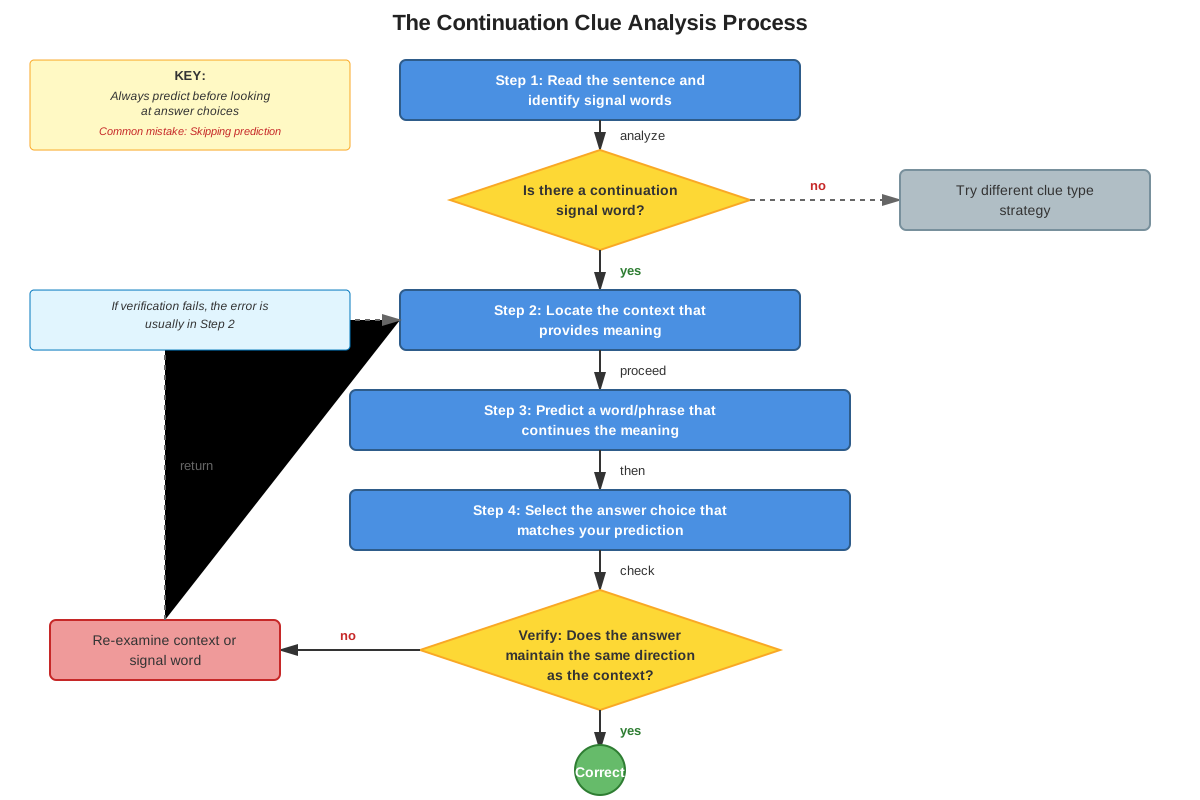
The relationship between continuation clues and other Text Completion strategies follows this progression: Continuation clue recognition → Context analysis → Answer prediction → Answer choice evaluation. Identifying the continuation clue is the first step that enables accurate context analysis. Once the continuation relationship is established, students can predict the general meaning or tone of the correct answer before examining choices. This prediction then guides systematic elimination of answer choices that fail to continue the established direction.
Continuation clues connect to prerequisite knowledge of sentence structure because recognizing these clues requires identifying which parts of the sentence provide the context being continued. Students must parse sentences to determine whether a continuation clue links the blank to a preceding clause, a following clause, or an appositive phrase. This parsing ability, built on foundational grammar knowledge, transforms continuation clue recognition from a vague intuition into a systematic analytical process.
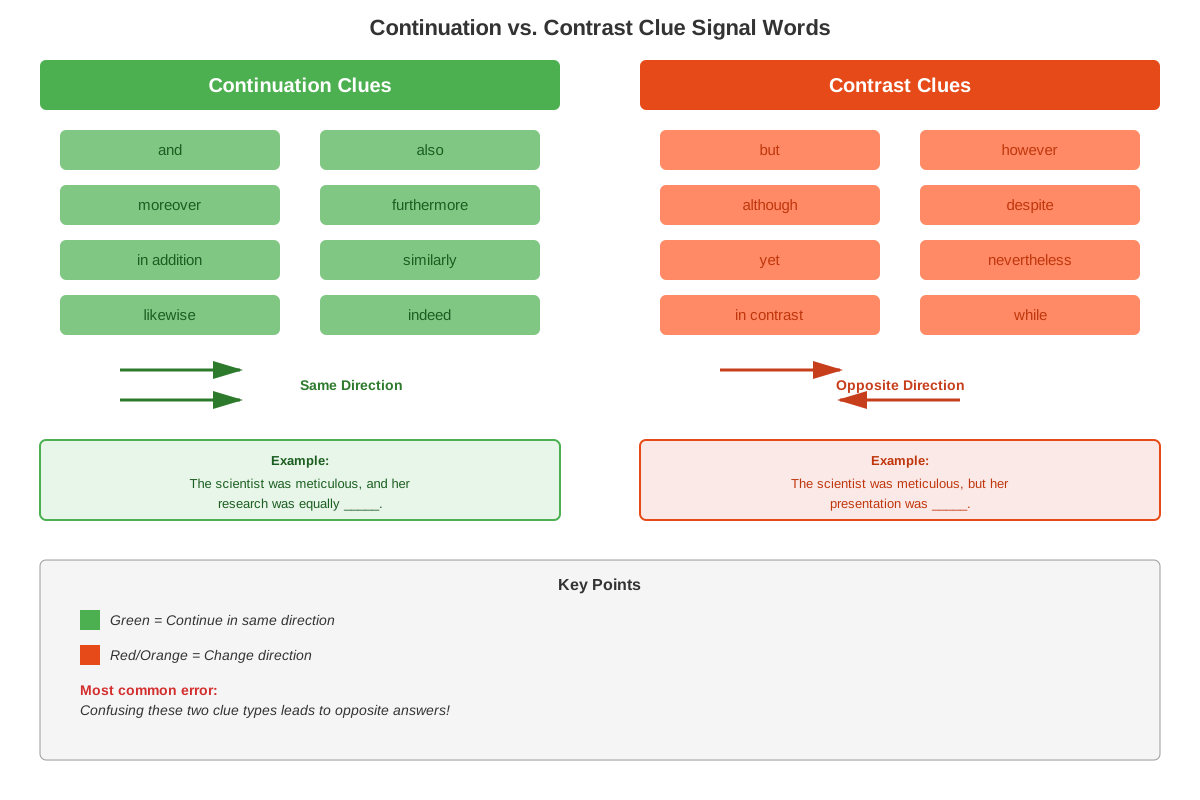
The distinction between continuation and contrast clues represents the most critical conceptual relationship. These two clue types are mirror images: where continuation signals "same direction," contrast signals "opposite direction." Mastering continuation clues provides the foundation for understanding contrast clues because students learn to identify the sentence's established direction—a necessary first step whether that direction will be continued or reversed.
High-Yield Facts
⭐ Continuation clues appear in approximately 40-50% of all GRE Text Completion questions, making them the most frequently tested clue type.
⭐ The word "and" is the single most common continuation signal on the GRE, appearing in roughly 15-20% of Text Completion questions.
⭐ When a semicolon appears without a contrast word (however, yet, but), it almost always signals continuation between the clauses.
⭐ Parallel structure (matching grammatical patterns) inherently creates continuation relationships even without explicit signal words.
⭐ Words like "even," "more," and "increasingly" signal continuation through intensification—the blank should represent a stronger version of the established idea.
- Appositive phrases set off by commas or dashes create automatic continuation relationships with the nouns they modify.
- Colons typically introduce continuation through explanation, elaboration, or exemplification of what precedes them.
- Multiple descriptive words in a sentence usually belong to the same semantic field, signaling that the blank should continue that field.
- Positive or negative tone established early in a sentence typically continues throughout unless a contrast word appears.
- The phrase "in fact" is a high-frequency continuation signal that indicates the following information will reinforce or intensify the previous statement.
- Continuation clues can appear before or after the blank; always scan the entire sentence for context.
- When answer choices include both synonyms and antonyms of context words, continuation clues help identify which relationship is correct.
Quick check — test yourself on Continuation clues so far.
Try Flashcards →Common Misconceptions
Misconception: Continuation clues always appear as explicit signal words like "and" or "moreover."
Correction: While explicit signal words are common, continuation relationships often exist through structural patterns (semicolons, colons, appositives) or semantic field relationships without any explicit signal word. Students must recognize continuation through sentence structure and meaning, not just through memorized signal words.
Misconception: A comma always signals continuation between clauses.
Correction: Commas serve many grammatical functions and do not inherently signal continuation. A comma might separate contrasting elements, set off introductory phrases, or divide items in a list. The continuation relationship must be confirmed through signal words or logical analysis, not assumed from punctuation alone.
Misconception: If the sentence seems to agree with itself, any positive word will work in the blank.
Correction: Continuation clues require precise semantic matching, not just general positivity or negativity. A sentence about "meticulous attention to detail" requires a continuation word in the same semantic field (like "thorough" or "careful"), not just any positive word (like "cheerful" or "generous").
Misconception: Continuation clues make questions easy, so they only appear in low-difficulty questions.
Correction: The GRE frequently pairs straightforward continuation clues with challenging vocabulary in answer choices, creating medium and high-difficulty questions. Recognizing the continuation pattern is only the first step; students must still evaluate sophisticated vocabulary to select the precise correct answer.
Misconception: The word "but" always signals contrast, never continuation.
Correction: While "but" typically signals contrast, it can occasionally introduce continuation when it means "except" or when the contrast is between two external things while the blank continues describing one of them. Context analysis must accompany signal word recognition.
Misconception: Once a continuation clue is identified, any answer choice with similar meaning to context words is correct.
Correction: The correct answer must match not just the general meaning but also the specific tone, intensity, and register of the context. A continuation of "angry" might be "furious" (intensification) or "irritated" (similar level), depending on other clues in the sentence about degree.
Worked Examples
Example 1: Explicit Continuation Signal
Question: The novelist's prose style was remarkably _____, employing elaborate metaphors, complex sentence structures, and sophisticated vocabulary.
Step 1 - Identify the clue type: The comma after the blank introduces a list of examples that elaborate on the blank. This is a continuation pattern where the examples explain the blank.
Step 2 - Analyze the context: The examples provided are "elaborate metaphors," "complex sentence structures," and "sophisticated vocabulary." All three phrases describe ornate, complicated, or refined writing.
Step 3 - Predict the answer: The blank should describe a prose style characterized by complexity and ornamentation. Predicted words might include: ornate, elaborate, complex, sophisticated, or baroque.
Step 4 - Evaluate answer choices (hypothetical choices):
- (A) sparse - INCORRECT: This contrasts with the elaborate examples
- (B) ornate - CORRECT: Continues the pattern of complexity and elaboration
- (C) concise - INCORRECT: This contrasts with "elaborate" and "complex"
- (D) pedestrian - INCORRECT: This contrasts with "sophisticated"
- (E) florid - CORRECT: Also continues the pattern of elaborate, ornate writing
Step 5 - Select the best answer: Both (B) and (E) continue the established pattern. In an actual GRE question, only one would appear, or if this were Sentence Equivalence, both would be correct. The key insight is that continuation clues eliminate choices (A), (C), and (D) that shift direction.
Connection to learning objectives: This example demonstrates identifying continuation clues (the comma introducing examples), explaining the core strategy (matching the blank to the semantic field of the examples), and applying the strategy to eliminate incorrect answers.
Example 2: Structural Continuation Pattern
Question: The committee's decision was not merely controversial; it was utterly _____, provoking outrage from every constituency.
Step 1 - Identify the clue type: The semicolon without a contrast word signals continuation. The phrase "not merely" followed by "it was utterly" creates an intensification pattern—the second clause will present a stronger version of the first.
Step 2 - Analyze the context: "Controversial" is the baseline descriptor. The phrase "not merely" indicates the reality exceeds this baseline. "Utterly" signals complete or extreme degree. "Provoking outrage from every constituency" confirms an extreme negative reaction.
Step 3 - Predict the answer: The blank should be a more intense version of "controversial"—something that goes beyond mere controversy to universal condemnation. Predicted words: outrageous, scandalous, egregious, indefensible, or unconscionable.
Step 4 - Evaluate answer choices (hypothetical choices):
- (A) questionable - INCORRECT: Too mild; doesn't intensify "controversial"
- (B) egregious - CORRECT: Intensifies "controversial" to match "outrage from every constituency"
- (C) beneficial - INCORRECT: Shifts to positive; contradicts "outrage"
- (D) typical - INCORRECT: Diminishes rather than intensifies "controversial"
- (E) debatable - INCORRECT: Roughly synonymous with "controversial," doesn't intensify
Step 5 - Select the best answer: Choice (B) correctly continues and intensifies the negative direction established by "controversial" and confirmed by "provoking outrage."
Connection to learning objectives: This example shows how continuation clues work through punctuation (semicolon) and intensification phrases ("not merely...utterly"), requiring students to recognize that continuation can mean intensification rather than simple repetition.
Exam Strategy
When approaching GRE Text Completion questions, implement this systematic process for continuation clue questions:
First pass - Signal word scan (5-10 seconds): Quickly scan the sentence for explicit continuation signals: and, moreover, furthermore, also, indeed, in fact, even. Circle or mentally note these markers. Also identify structural signals: semicolons without contrast words, colons, appositives set off by commas or dashes.
Second pass - Context identification (10-15 seconds): Determine what the continuation clue is connecting. Is the blank continuing a description from earlier in the sentence? Is it elaborating on a concept? Is it intensifying an established idea? Identify the specific words or phrases that provide the context being continued.
Third pass - Answer prediction (5-10 seconds): Before looking at answer choices, predict the general meaning, tone, and semantic field of the correct answer. This prediction doesn't need to be a specific word—"something meaning very angry" or "a word for elaborate writing style" suffices. The prediction serves as a filter for evaluating choices.
Fourth pass - Systematic elimination (15-20 seconds): Evaluate each answer choice against the continuation relationship. Immediately eliminate any choice that contrasts with or shifts away from the established context. Among remaining choices, select the one that most precisely matches the tone, intensity, and semantic field of the context.
Exam Tip: If you're torn between two answer choices that both seem to continue the context, look for degree or intensity clues. Words like "even," "more," "most," "utterly," or "completely" signal that the correct answer should be more intense than a simple continuation.
Trigger phrases to watch for:
- "and" (especially when connecting two parallel descriptions)
- "in fact" (signals reinforcement or intensification)
- "indeed" (confirms and strengthens previous statement)
- "even" (signals intensification)
- "also," "as well," "similarly" (signal addition of similar information)
- Semicolons without "however," "yet," or "but" (signal continuation between independent clauses)
Time allocation: Continuation clue questions should be among the fastest to solve—aim for 30-45 seconds per question once you've mastered recognition. If you're spending more than one minute on a continuation clue question, you're likely overthinking. Trust the structural analysis and move forward.
Process-of-elimination specific to continuation clues: Create a mental or physical checklist:
- Does this answer choice maintain the same positive/negative tone? (Eliminate if not)
- Does this answer choice belong to the same semantic field as context words? (Eliminate if not)
- Does this answer choice match the intensity level signaled by degree words? (Eliminate if not)
- Does this answer choice make logical sense when substituted into the sentence? (Final check)
Memory Techniques
SAME Direction Mnemonic for common continuation signals:
- Similarly, Specifically, Still
- And, Also, Additionally, As well
- Moreover, More
- Even, Especially, Equally
The Semicolon Rule: "Semicolon without 'however' = same direction as before." This simple rhyme helps remember that semicolons typically signal continuation unless followed by a contrast word.
The Colon Clarifies: Visualize a colon as an arrow pointing forward (→) that says "here comes more detail about what I just said." This reinforces that colons introduce continuation through elaboration.
Parallel = Pair: When you see parallel grammatical structure, visualize the two parts as a matched pair of shoes—they must go in the same direction. This helps remember that parallel structure creates continuation relationships.
Tone Continuation Visualization: Imagine the sentence as a color gradient. If the sentence starts with a "red" (negative) tone, the blank should be another shade of red (negative), not blue (positive). If it starts "light red" and includes intensification words, the blank should be "dark red." This visual metaphor helps maintain tone consistency.
The "And" Expansion: Remember that many continuation signals are elaborate versions of "and." When you see "moreover," "furthermore," or "additionally," mentally substitute "and" to simplify the relationship: "The weather was cold, moreover/and it was snowy."
Summary
Continuation clues represent the foundational pattern recognition skill for GRE Text Completion success, appearing in approximately half of all questions. These linguistic and structural signals indicate that the blank should maintain the same semantic direction, tone, and intensity as the surrounding context. Mastery requires recognizing both explicit signal words (and, moreover, furthermore, indeed, even) and structural patterns (semicolons, colons, appositives, parallel structure) that create continuation relationships. The core strategy involves identifying the continuation signal, analyzing the context being continued, predicting the answer's general meaning and tone, and systematically eliminating choices that shift direction. Continuation clues can signal simple agreement, elaboration, intensification, or semantic field consistency. Success depends on precise analysis rather than vague intuition—students must match not just general positivity or negativity but specific semantic fields, intensity levels, and registers. When approached systematically, continuation clue questions become among the most reliable point-earners on the GRE, rewarding structural analysis over pure vocabulary knowledge.
Key Takeaways
- Continuation clues signal that the blank maintains the same direction as the context—they're the most common clue type on the GRE, appearing in 40-50% of Text Completion questions
- Explicit signals include "and," "moreover," "furthermore," "indeed," "in fact," and "even," while structural signals include semicolons without contrast words, colons, and appositives
- Effective strategy requires four steps: identify the continuation signal, analyze the context being continued, predict the answer before viewing choices, and systematically eliminate answers that shift direction
- Continuation encompasses multiple relationships: simple agreement, elaboration, intensification, semantic field consistency, and tone maintenance
- Parallel grammatical structure inherently creates continuation relationships even without explicit signal words
- Degree words like "even," "more," and "utterly" signal continuation through intensification—the blank should be stronger than the established baseline
- Precise semantic matching matters more than general tone—a continuation of "meticulous" requires words in the same semantic field (thorough, careful), not just any positive descriptor
Related Topics
Contrast Clues: The mirror image of continuation clues, contrast signals indicate the blank should oppose or shift away from the established context. Mastering continuation clues provides the foundation for understanding contrast because both require identifying the sentence's established direction—continuation maintains it while contrast reverses it.
Cause-and-Effect Relationships: These clues signal logical connections between events or conditions. Understanding continuation helps with cause-and-effect because some causal relationships involve continuation (the effect continues the direction of the cause) while others involve transformation.
Restatement and Definition Clues: These signals indicate the blank is synonymous with or defined by other parts of the sentence. Restatement represents a specific type of continuation where the blank directly restates rather than elaborates upon the context.
Sentence Equivalence Strategy: This question type requires selecting two answer choices that create sentences with equivalent meaning. Continuation clue recognition helps identify which answer pairs maintain consistent relationships with the sentence context.
Time and Logic Signals: Words indicating temporal or logical sequence (first, then, finally, therefore, thus) often work in conjunction with continuation clues to show how ideas build upon each other progressively.
Practice CTA
Now that you've mastered the fundamentals of continuation clues, it's time to cement your understanding through active practice. Attempt the practice questions designed specifically for this topic—they'll challenge you to apply the four-step strategy under timed conditions and expose any gaps in your recognition skills. The flashcards will help you internalize the common continuation signal words until their recognition becomes automatic. Remember: continuation clues are the highest-yield pattern on the GRE Text Completion section. Every minute you invest in mastering this skill translates directly to points on test day. Your ability to systematically identify and apply continuation clues will set you apart from test-takers who rely on intuition alone. Start practicing now, and watch your accuracy and speed improve dramatically!
Sign up free to keep reading
Create a free AnvayaPrep account to finish this GRE guide on Continuation clues — plus flashcards and practice questions.