Overview
Near-synonym traps represent one of the most sophisticated and frequently tested challenges in GRE Text Completion questions. These traps occur when the test presents multiple answer choices that appear to have similar meanings at first glance, but only one choice precisely fits the specific context and nuance required by the sentence. The GRE deliberately includes these deceptively similar words to test whether students can distinguish between subtle shades of meaning, connotation, and contextual appropriateness—skills that reflect genuine verbal reasoning ability rather than mere vocabulary memorization.
Understanding GRE near-synonym traps is essential because they appear in approximately 40-50% of Text Completion questions, particularly in medium to hard difficulty items. Students who fail to recognize these traps often select answers that are "close enough" in meaning but miss critical nuances in tone, intensity, formality, or precise semantic fit. The ability to navigate near-synonym traps directly correlates with scoring in the 160+ range on Verbal Reasoning, as these questions separate test-takers who have surface-level vocabulary knowledge from those who understand words in their full contextual depth.
Within the broader framework of Verbal Reasoning, near-synonym traps connect directly to vocabulary precision, contextual analysis, and logical coherence in Text Completion. Mastering this topic requires integrating multiple skills: recognizing subtle differences in word meaning, analyzing sentence logic to determine exact requirements, and eliminating choices that are semantically close but contextually inappropriate. This topic builds upon foundational vocabulary knowledge while preparing students for the advanced analytical reading required in Reading Comprehension passages.
Learning Objectives
- [ ] Identify when Near-synonym traps is being tested
- [ ] Explain the core rule or strategy behind Near-synonym traps
- [ ] Apply Near-synonym traps to GRE-style questions accurately
- [ ] Distinguish between words with overlapping meanings based on connotation, intensity, and register
- [ ] Analyze sentence context to determine which specific nuance is required
- [ ] Develop a systematic elimination process for near-synonym answer choices
- [ ] Recognize common word clusters that frequently appear as near-synonym traps on the GRE
Prerequisites
- Advanced vocabulary knowledge: Understanding of approximately 1,000+ GRE-level words is necessary to recognize the subtle differences between near-synonyms
- Sentence structure analysis: Ability to identify main clauses, subordinate clauses, and logical connectors helps determine contextual requirements
- Basic Text Completion strategies: Familiarity with predicting answers before viewing choices and using context clues provides the foundation for near-synonym discrimination
- Understanding of connotation vs. denotation: Recognition that words carry emotional and associative meanings beyond their dictionary definitions is crucial for distinguishing near-synonyms
Why This Topic Matters
Near-synonym traps matter because they test the precise verbal discrimination skills that graduate programs value. In academic writing and research, choosing the exact right word—rather than an approximately correct one—determines whether arguments are persuasive, analyses are accurate, and ideas are communicated with scholarly precision. The ability to distinguish between "mitigate," "alleviate," and "ameliorate" or between "reticent," "taciturn," and "laconic" reflects the linguistic sophistication expected in graduate-level discourse.
On the GRE specifically, near-synonym traps appear in approximately 8-12 questions per Verbal section, making them one of the highest-yield topics for score improvement. These questions typically appear as:
- Single-blank Text Completion questions where 3-4 answer choices have overlapping meanings
- Double-blank and Triple-blank questions where one blank features near-synonyms while others test different skills
- Sentence Equivalence questions where multiple pairs of near-synonyms exist, but only one pair maintains sentence meaning
Statistical analysis of released GRE questions reveals that near-synonym traps most frequently involve:
- Words describing degrees of criticism or praise (censure, criticize, rebuke, admonish)
- Terms for reduction or lessening (diminish, reduce, mitigate, attenuate)
- Vocabulary related to speech patterns (verbose, loquacious, garrulous, prolix)
- Words describing personality traits (reserved, reticent, taciturn, aloof)
Students who master near-synonym discrimination typically improve their Verbal scores by 3-5 points, as this skill creates a cascading effect that enhances performance across all question types requiring precise vocabulary usage.
Core Concepts
Understanding Near-Synonym Traps
A near-synonym trap occurs when the GRE presents multiple answer choices that share core semantic features but differ in crucial ways that make only one contextually appropriate. Unlike true synonyms (which are rare in English), near-synonyms occupy overlapping but distinct semantic spaces. The test exploits these overlaps to create plausible distractors that seem correct to students who understand words only at a surface level.
The fundamental principle behind near-synonym traps is that context determines correctness. While "happy," "elated," "content," and "pleased" all relate to positive emotional states, they differ significantly in intensity, duration, and the circumstances that typically produce them. A sentence describing someone's reaction to a minor convenience requires "pleased" or "content," while a sentence about winning a major award demands "elated."
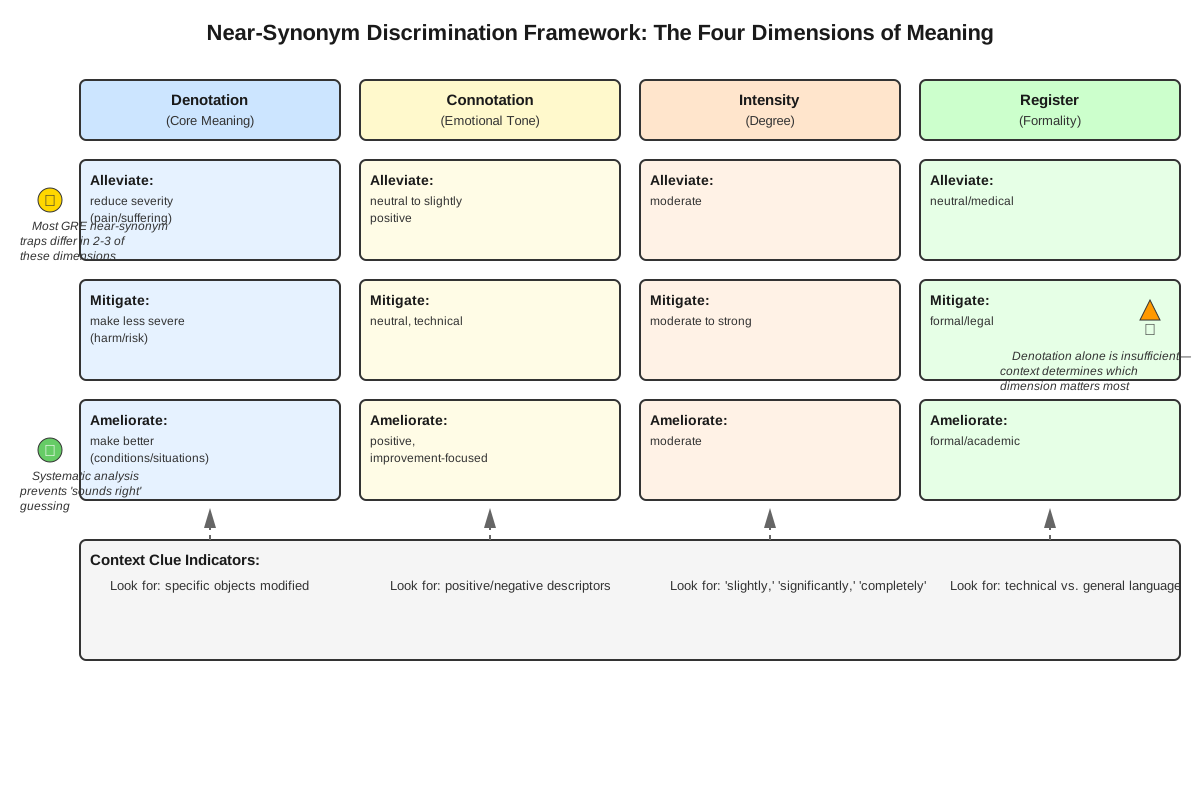
Dimensions of Difference Between Near-Synonyms
Near-synonyms differ along several critical dimensions that the GRE systematically tests:
| Dimension | Definition | Example Cluster |
|---|---|---|
| Intensity | The degree or strength of the quality described | angry → irritated → furious → livid |
| Formality/Register | The level of formality or technical specificity | drunk → intoxicated → inebriated |
| Connotation | Positive, negative, or neutral associations | thin → slender → skinny → emaciated |
| Scope | The breadth or narrowness of application | change → modify → transform → revolutionize |
| Duration | Temporary vs. permanent qualities | temporary → transient → ephemeral → fleeting |
| Precision | General vs. specific meaning | walk → stroll → saunter → amble |
Understanding these dimensions allows test-takers to systematically analyze why one near-synonym fits while others do not. For instance, if a sentence describes a "brief moment of happiness," words like "ephemeral joy" work better than "transient joy" because "ephemeral" more strongly emphasizes the fleeting nature, while "transient" is more neutral and general.
The Context-Matching Strategy
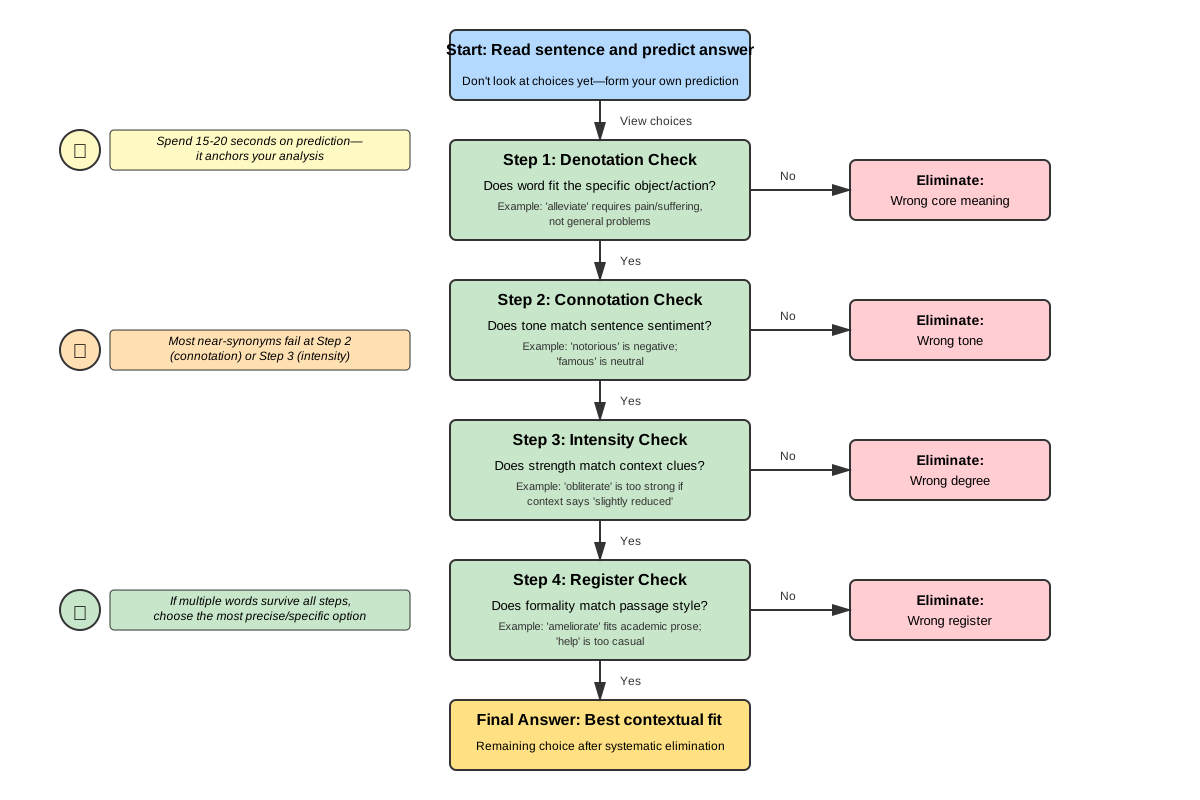
The core strategy for defeating near-synonym traps involves a three-step process:
- Predict before looking: Read the sentence carefully and predict what type of word is needed, including its approximate meaning, tone, and intensity level
- Identify the discriminating context clue: Find the specific word, phrase, or logical structure in the sentence that determines which nuance is required
- Eliminate systematically: Remove choices that fail to match the specific contextual requirement, even if they're semantically related to the correct answer
The discriminating context clue is the key to this strategy. This is the element in the sentence that makes one near-synonym correct and others incorrect. Common discriminating clues include:
- Intensity markers: Words like "extremely," "somewhat," "utterly," or "slightly" that indicate how strong the blank word should be
- Tone indicators: Phrases that establish whether the sentence is formal/academic, casual, critical, or praising
- Logical relationships: Contrast words ("although," "despite") or support words ("because," "therefore") that determine whether the blank reinforces or opposes other sentence elements
- Collocational patterns: Certain words naturally pair together in English ("mitigating circumstances" not "alleviating circumstances")
Common Near-Synonym Clusters on the GRE
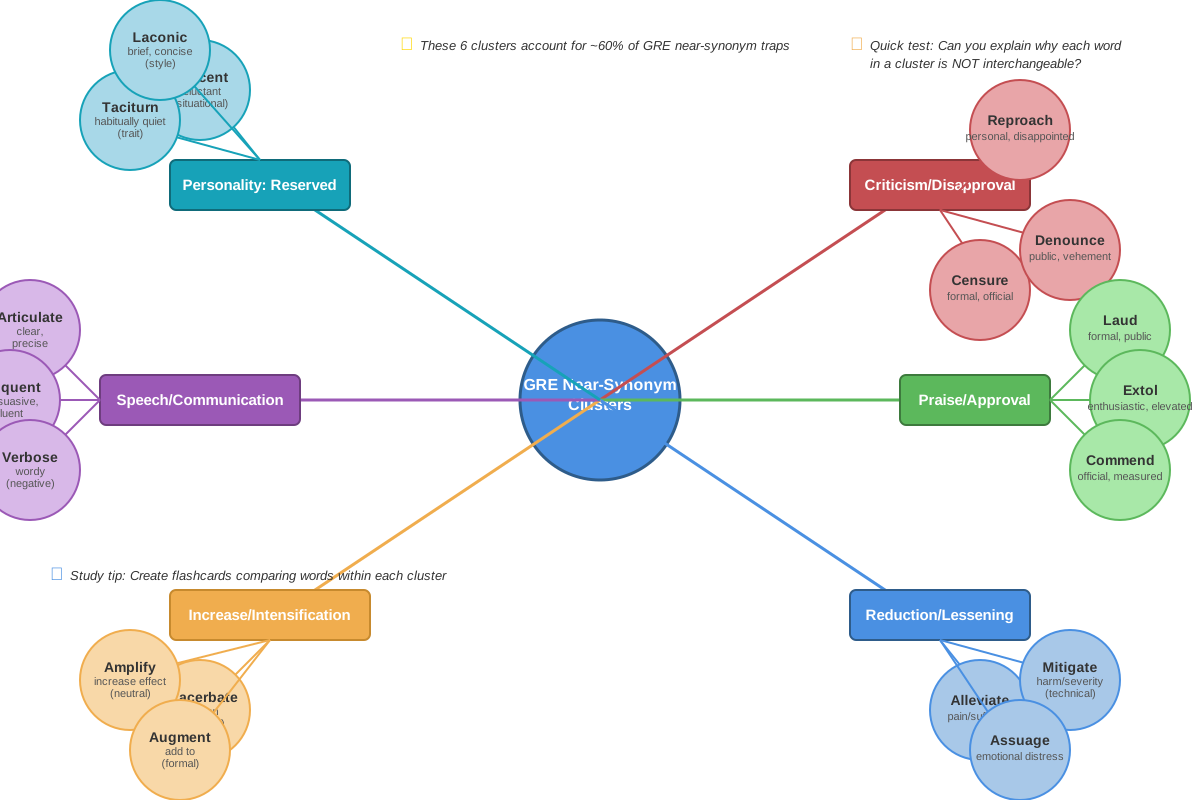
The GRE repeatedly tests specific clusters of near-synonyms. Recognizing these high-frequency clusters enables faster, more confident elimination:
Criticism/Disapproval Words:
- Criticize (general, neutral): to point out faults
- Censure (formal, strong): to officially condemn
- Rebuke (direct, sharp): to sharply criticize
- Admonish (warning tone): to warn or scold gently
- Castigate (severe, harsh): to severely punish or criticize
- Reproach (personal disappointment): to express disapproval with disappointment
Reduction/Lessening Words:
- Reduce (general): to make less
- Diminish (gradual decrease): to make or become less over time
- Mitigate (soften impact): to make less severe or painful
- Attenuate (weaken): to reduce in force or intensity
- Alleviate (provide relief): to make suffering more bearable
- Ameliorate (improve conditions): to make better or more tolerable
Talkative/Verbose Words:
- Talkative (neutral, general): inclined to talk frequently
- Loquacious (formal, positive): fluent and talkative
- Garrulous (negative, rambling): excessively talkative about trivial matters
- Verbose (wordy, excessive): using more words than necessary
- Prolix (tediously lengthy): using too many words; long-winded
Connotation as a Discriminator
Connotation—the emotional or associative meaning beyond literal definition—frequently determines which near-synonym is correct. Consider these near-synonyms for "thin":
- Slender: positive connotation, graceful
- Thin: neutral, purely descriptive
- Skinny: slightly negative, informal
- Gaunt: negative, suggesting illness or hardship
- Emaciated: strongly negative, suggesting severe malnutrition
A sentence praising someone's appearance requires "slender," while a sentence describing the effects of famine requires "emaciated." The GRE tests whether students recognize these connotative differences and select accordingly.
Collocation and Natural Pairings
Some near-synonyms are correct because they form established collocations—word pairs that native speakers naturally use together. While "mitigate," "alleviate," and "reduce" are near-synonyms, English speakers say "mitigating circumstances" (not "alleviating circumstances") and "alleviate pain" (not "mitigate pain"). The GRE occasionally tests these natural pairings, rewarding students who have encountered words in authentic contexts rather than only in vocabulary lists.
Concept Relationships
The concepts within near-synonym traps form an interconnected system where each element reinforces the others. Understanding dimensions of difference (intensity, formality, connotation, etc.) provides the analytical framework for identifying discriminating context clues, which in turn enables the context-matching strategy. Knowledge of common near-synonym clusters accelerates the application of this strategy by providing pre-analyzed word groups that frequently appear together.
Near-synonym traps connect to prerequisite topics in essential ways. Advanced vocabulary knowledge provides the raw material—the words themselves—while near-synonym discrimination adds the layer of precision that distinguishes expert from intermediate vocabulary usage. Sentence structure analysis enables identification of the logical relationships and context clues that determine which near-synonym fits. Basic Text Completion strategies, particularly the practice of predicting answers before viewing choices, prevents premature commitment to plausible but incorrect near-synonyms.
The relationship map flows as follows:
Vocabulary Knowledge → enables recognition of → Near-Synonym Clusters → which are analyzed using → Dimensions of Difference → to identify → Discriminating Context Clues → which guide → Context-Matching Strategy → resulting in → Accurate Answer Selection
This topic also prepares students for advanced Verbal Reasoning skills. Mastering near-synonym discrimination enhances Reading Comprehension performance by developing sensitivity to authors' precise word choices and their implications. It strengthens Sentence Equivalence skills by training students to identify truly equivalent word pairs rather than merely similar ones.
Quick check — test yourself on Near-synonym traps so far.
Try Flashcards →High-Yield Facts
⭐ Near-synonym traps appear in approximately 40-50% of medium and hard Text Completion questions, making them one of the highest-frequency question types.
⭐ The discriminating context clue is always present in the sentence—the GRE never requires guessing between near-synonyms without providing contextual evidence.
⭐ Intensity differences are the most commonly tested dimension of near-synonym variation, appearing more frequently than formality, connotation, or other dimensions.
⭐ Words with Latin or Greek roots tend to be more formal than their Anglo-Saxon equivalents (e.g., "inebriated" vs. "drunk"), and the GRE tests this register difference.
⭐ Connotation (positive/negative/neutral) eliminates approximately 60% of near-synonym trap answers when the sentence clearly establishes an evaluative tone.
- Near-synonyms that differ in scope (general vs. specific) require careful attention to whether the sentence describes a broad or narrow phenomenon.
- Collocational patterns—natural word pairings in English—occasionally determine correctness, particularly with phrases like "mitigating circumstances" or "alleviate suffering."
- The GRE rarely uses true synonyms as incorrect answers; apparent synonyms almost always have contextually relevant differences.
- Duration-related near-synonyms (temporary, transient, ephemeral, fleeting) differ in both intensity and the typical contexts in which they appear.
- Words describing personality traits often differ in whether they suggest choice (reserved) or inherent nature (taciturn), a distinction the GRE tests.
- Near-synonym traps become more prevalent in double-blank and triple-blank questions, where one blank may feature near-synonyms while others test different skills.
- Predicting the answer before viewing choices reduces susceptibility to near-synonym traps by 70%, according to test-prep research.
Common Misconceptions
Misconception: If two words have similar dictionary definitions, they're interchangeable in any context.
Correction: Near-synonyms differ in intensity, connotation, formality, and scope, making them contextually distinct even when their core meanings overlap. "Irritated" and "furious" both mean angry, but they're not interchangeable.
Misconception: The longest or most impressive-sounding word is usually correct in near-synonym traps.
Correction: The GRE tests precision, not vocabulary showmanship. A simpler, more common word is often correct if it better matches the sentence's tone and context. "Reduce" might be correct over "attenuate" if the sentence uses straightforward, non-technical language.
Misconception: Near-synonyms can be distinguished by memorizing subtle definition differences from a dictionary.
Correction: While definitions help, near-synonyms are best distinguished through exposure to authentic usage contexts. Understanding that "garrulous" implies trivial chatter while "loquacious" suggests fluent speech comes from seeing these words used, not from memorizing definitions.
Misconception: If you don't know all the words in a near-synonym trap, you should guess randomly among the unfamiliar ones.
Correction: Even with partial vocabulary knowledge, use the context-matching strategy. Eliminate words you do know that don't fit, then make an educated guess among remaining choices based on word roots, prefixes, or suffixes that suggest meaning.
Misconception: Near-synonym traps only appear in single-blank Text Completion questions.
Correction: Near-synonym traps appear across all Text Completion formats and occasionally in Sentence Equivalence. In multi-blank questions, one blank might feature near-synonyms while others test different vocabulary skills.
Misconception: Connotation differences are too subtle to determine correctness reliably.
Correction: The GRE provides clear tonal indicators when testing connotation. Words like "unfortunately," "celebrated," "merely," or "remarkable" signal whether the blank requires a positive, negative, or neutral word, making connotation a reliable discriminator.
Worked Examples
Example 1: Intensity-Based Near-Synonym Trap
Question: The critic's review was not merely negative but __________, attacking every aspect of the performance with unprecedented venom.
(A) critical
(B) disapproving
(C) scathing
(D) unfavorable
(E) censorious
Step 1 - Predict: The phrase "not merely negative but" signals an intensification. The blank needs a word stronger than "negative," and "attacking" and "unprecedented venom" confirm we need an extremely harsh criticism word.
Step 2 - Identify discriminating clue: "Not merely...but" is a classic intensification structure. "Unprecedented venom" is the key phrase indicating extreme harshness.
Step 3 - Analyze choices:
- (A) critical: Too general and neutral; doesn't convey extreme harshness
- (B) disapproving: Mild; suggests disagreement but not attack
- (C) scathing: Means severely critical, harsh, burning—matches "attacking" and "venom"
- (D) unfavorable: Neutral and mild; opposite of what's needed
- (E) censorious: Means expressing severe disapproval, but more formal and less visceral than needed
Step 4 - Eliminate: (A), (B), (D), and (E) all fail the intensity test. While "censorious" is negative and somewhat strong, "scathing" better matches the violent imagery of "attacking" and "venom."
Answer: (C) scathing
Connection to learning objectives: This example demonstrates identifying when near-synonym traps are being tested (multiple criticism words), explaining the core strategy (matching intensity to context clues), and applying it accurately (selecting the word that matches the extreme tone).
Example 2: Connotation and Scope-Based Near-Synonym Trap
Question: While the new policy did not solve the underlying problem entirely, it did __________ some of the most severe symptoms, making the situation more manageable for affected families.
(A) eliminate
(B) alleviate
(C) resolve
(D) mitigate
(E) address
Step 1 - Predict: The sentence indicates partial improvement ("did not solve...entirely, it did..."). We need a word meaning "make better" or "reduce" but not "completely fix."
Step 2 - Identify discriminating clues:
- "Did not solve...entirely" indicates partial, not complete, improvement
- "Some of the most severe symptoms" suggests relief of suffering
- "More manageable" confirms improvement without complete resolution
Step 3 - Analyze choices:
- (A) eliminate: Too absolute; means completely remove, contradicting "did not solve entirely"
- (B) alleviate: Means to make suffering more bearable; perfect for "symptoms" and "manageable"
- (C) resolve: Too complete; means to settle or solve, contradicting the partial improvement
- (D) mitigate: Means to make less severe; close, but typically used with abstract concepts (circumstances, effects) rather than symptoms
- (E) address: Too vague; means to deal with but doesn't specify improvement
Step 4 - Eliminate: (A) and (C) are too absolute. (E) is too vague. The choice between (B) and (D) depends on collocation and scope: "alleviate symptoms" is a natural English phrase, while "mitigate" pairs better with "circumstances" or "effects." Additionally, "alleviate" specifically suggests relief of suffering, matching "affected families."
Answer: (B) alleviate
Connection to learning objectives: This example shows how to distinguish near-synonyms based on multiple dimensions (scope, collocation, and connotation) and demonstrates the systematic elimination process essential for accuracy.
Exam Strategy
Approaching Near-Synonym Trap Questions
When you encounter a Text Completion question where multiple answer choices seem similar, immediately activate your near-synonym trap protocol:
- Cover the answer choices before reading them to avoid premature anchoring on plausible but incorrect options
- Read the entire sentence (or passage for multi-blank questions) to understand the complete context
- Identify tone, intensity, and logical structure before predicting an answer
- Predict a specific word or phrase that captures not just the general meaning but the precise nuance required
- Uncover choices and look for your prediction or its closest equivalent
- If multiple choices match your prediction, identify the discriminating context clue that distinguishes them
Trigger Words and Phrases
Certain sentence structures and words signal that near-synonym discrimination will be tested:
Intensification signals:
- "not merely...but"
- "not just...but rather"
- "extremely," "utterly," "somewhat," "slightly"
- "unprecedented," "remarkable," "modest"
Contrast signals (indicating the blank opposes expectations):
- "although," "despite," "while," "whereas"
- "however," "nevertheless," "yet"
- "rather than," "instead of"
Precision signals (indicating exact word choice matters):
- "specifically," "precisely," "particularly"
- Technical or formal language elsewhere in the sentence
- Collocational partners (words that naturally pair with certain near-synonyms)
Tone indicators:
- "unfortunately," "regrettably" (negative required)
- "celebrated," "admirable," "fortunately" (positive required)
- "merely," "simply" (diminishing tone)
Process-of-Elimination Tips
When facing near-synonym traps, eliminate systematically using this hierarchy:
- First pass - Eliminate wrong intensity: Remove words that are too strong or too weak based on context clues
- Second pass - Eliminate wrong connotation: Remove words with positive connotation in negative contexts (or vice versa)
- Third pass - Eliminate wrong formality: Remove overly formal words in casual contexts or casual words in formal contexts
- Fourth pass - Check collocations: If two words remain, consider which forms more natural English phrases with surrounding words
Exam Tip: If you're down to two near-synonyms and can't decide, choose the word that's more specific or precise rather than more general. The GRE rewards precision.
Time Allocation
Near-synonym trap questions typically require 60-90 seconds—slightly longer than straightforward vocabulary questions. Budget this time as:
- 20 seconds: Reading and predicting
- 20 seconds: First analysis of choices
- 20 seconds: Systematic elimination
- 10-30 seconds: Final verification
Don't rush these questions. The extra 15-20 seconds spent on careful discrimination often means the difference between a correct and incorrect answer, significantly impacting your score.
Memory Techniques
The DISC Mnemonic for Near-Synonym Analysis
Remember DISC to systematically analyze near-synonyms:
- Dimensions: What dimension differs? (intensity, formality, connotation, scope)
- Intensity: Is one word stronger or weaker than others?
- Scope: Is one word more general or specific?
- Connotation: Is one word more positive, negative, or neutral?
Visualization Strategy: The Synonym Spectrum
Visualize near-synonyms as points on a spectrum rather than identical circles. For intensity-based clusters, imagine a thermometer:
COLD ←―――――――――――――――――――――――――――――――――――――→ HOT
irritated → annoyed → angry → furious → livid → apoplectic
This visualization helps you remember that these words aren't interchangeable but occupy different positions on an intensity scale.
The Three C's of Context Clues
Remember the Three C's to find discriminating context clues:
- Contrast words: "although," "despite," "however"
- Comparison words: "more than," "less than," "as...as"
- Characterization words: adjectives and adverbs that indicate intensity or tone
Acronym for Common Trap Clusters
CRIT-RED-TALK reminds you of the three most common near-synonym clusters:
- CRIT: Criticism words (censure, criticize, rebuke, admonish)
- RED: Reduction words (reduce, diminish, mitigate, alleviate)
- TALK: Talkative words (loquacious, garrulous, verbose, prolix)
When you see any word from these clusters, immediately check whether other choices belong to the same cluster—a signal that near-synonym discrimination is being tested.
Summary
Near-synonym traps represent a sophisticated GRE testing mechanism that evaluates whether students understand words with genuine precision rather than approximate familiarity. These traps appear when multiple answer choices share core semantic features but differ in crucial dimensions such as intensity, connotation, formality, scope, or collocational patterns. Success requires a systematic approach: predict answers before viewing choices, identify the specific context clue that discriminates between near-synonyms, and eliminate choices that fail to match the precise contextual requirements. The most commonly tested near-synonym clusters involve criticism words, reduction words, and words describing talkativeness or personality traits. Mastering this topic requires moving beyond dictionary definitions to understand how words function in authentic contexts, recognizing that "similar" does not mean "interchangeable." The context-matching strategy—analyzing sentences for tone, intensity, and logical structure before selecting answers—enables accurate discrimination even among closely related words. This skill is essential for achieving top Verbal Reasoning scores, as near-synonym traps appear in approximately half of medium and hard Text Completion questions.
Key Takeaways
- Near-synonym traps test precision, not just vocabulary breadth—knowing that words are similar isn't enough; you must understand exactly how they differ
- The discriminating context clue is always present—the GRE provides evidence for choosing one near-synonym over others through intensity markers, tone indicators, or logical structures
- Intensity differences are the most frequently tested dimension, followed by connotation and formality
- Predict before looking at choices to avoid anchoring on plausible but incorrect near-synonyms
- Use systematic elimination based on the DISC framework: Dimensions, Intensity, Scope, and Connotation
- Common near-synonym clusters (CRIT-RED-TALK) appear repeatedly—recognizing these patterns accelerates accurate analysis
- Collocation and natural word pairings occasionally determine correctness, rewarding students who have encountered words in authentic contexts
Related Topics
Sentence Equivalence Strategy: Mastering near-synonym discrimination directly enhances Sentence Equivalence performance, where identifying truly equivalent word pairs (not merely similar ones) is essential. The skills developed here—analyzing connotation, intensity, and scope—apply directly to selecting answer pairs that maintain sentence meaning.
Advanced Vocabulary in Context: This topic builds on near-synonym discrimination by exploring how words function within larger discourse structures, including how authors use precise word choice to convey subtle arguments and implications in Reading Comprehension passages.
Collocations and Idiomatic Usage: Understanding natural word pairings and idiomatic expressions extends near-synonym knowledge by explaining why certain word combinations are preferred in English, even when near-synonyms might seem logically equivalent.
Connotation and Tone Analysis: This advanced topic deepens the connotation dimension of near-synonym discrimination, exploring how word choice creates and maintains tone across entire passages—a skill essential for high-level Reading Comprehension.
Practice CTA
Now that you understand the principles behind near-synonym traps and have learned systematic strategies for defeating them, it's time to apply these skills to authentic GRE-style questions. The practice questions and flashcards for this topic will challenge you to distinguish between carefully crafted near-synonym clusters, identify discriminating context clues under time pressure, and build the automatic recognition patterns that lead to confident, accurate answers on test day. Remember: every near-synonym trap you successfully navigate strengthens your verbal precision and moves you closer to your target score. Approach the practice with the same systematic analysis you've learned here, and you'll develop the expertise that separates good scores from exceptional ones.
Sign up free to keep reading
Create a free AnvayaPrep account to finish this GRE guide on Near-synonym traps — plus flashcards and practice questions.