Overview
Opposite answer choices represent one of the most frequently tested trap patterns in GRE Text Completion questions. This phenomenon occurs when the test makers deliberately include answer choices that convey the exact opposite meaning of what the sentence requires. These distractors are strategically designed to catch students who misread the sentence's logical direction, overlook crucial transition words, or fail to track negations properly. Understanding how to identify and avoid these traps is essential for achieving a competitive Verbal Reasoning score.
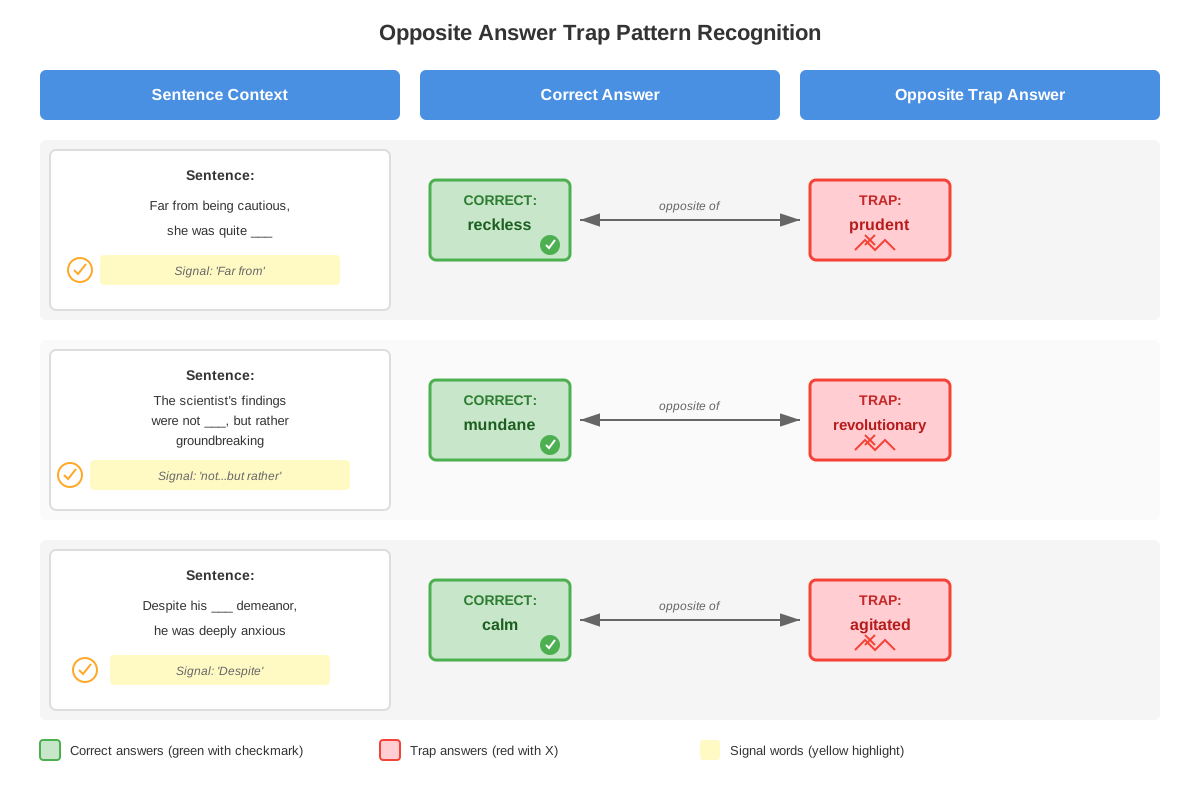
The GRE test makers exploit a fundamental aspect of human cognition: when reading quickly under time pressure, test-takers often latch onto familiar words and concepts without fully processing the sentence's logical structure. GRE opposite answer choices capitalize on this tendency by presenting vocabulary that seems contextually appropriate but actually contradicts the sentence's intended meaning. For instance, if a sentence describes someone who "far from being cautious, was actually quite ___," the correct answer might be "reckless," while "prudent" (the opposite) would appear as a trap answer. Both words fit the general context of decision-making behavior, but only one aligns with the sentence's logical direction.
Mastering this concept connects directly to broader Text Completion strategies, including identifying signal words, tracking sentence logic, and understanding how the GRE constructs plausible distractors. This skill also reinforces critical reading abilities needed for Reading Comprehension passages, where tracking logical relationships and authorial intent proves equally important. Students who develop expertise in recognizing opposite answer traps significantly improve their accuracy across all Verbal Reasoning question types.
Learning Objectives
- [ ] Identify when Opposite answer choices is being tested
- [ ] Explain the core rule or strategy behind Opposite answer choices
- [ ] Apply Opposite answer choices to GRE-style questions accurately
- [ ] Recognize the linguistic signals that indicate a sentence's logical direction
- [ ] Distinguish between genuinely opposite meanings and merely different concepts
- [ ] Develop a systematic approach to eliminate opposite answer traps before selecting the correct response
- [ ] Analyze how negations, contrast words, and logical pivots create opportunities for opposite answer traps
Prerequisites
- Basic vocabulary knowledge: Understanding word meanings and connotations is essential for recognizing when two words represent true opposites rather than simply different concepts
- Sentence structure comprehension: Students must be able to identify main clauses, dependent clauses, and how different sentence parts relate logically to each other
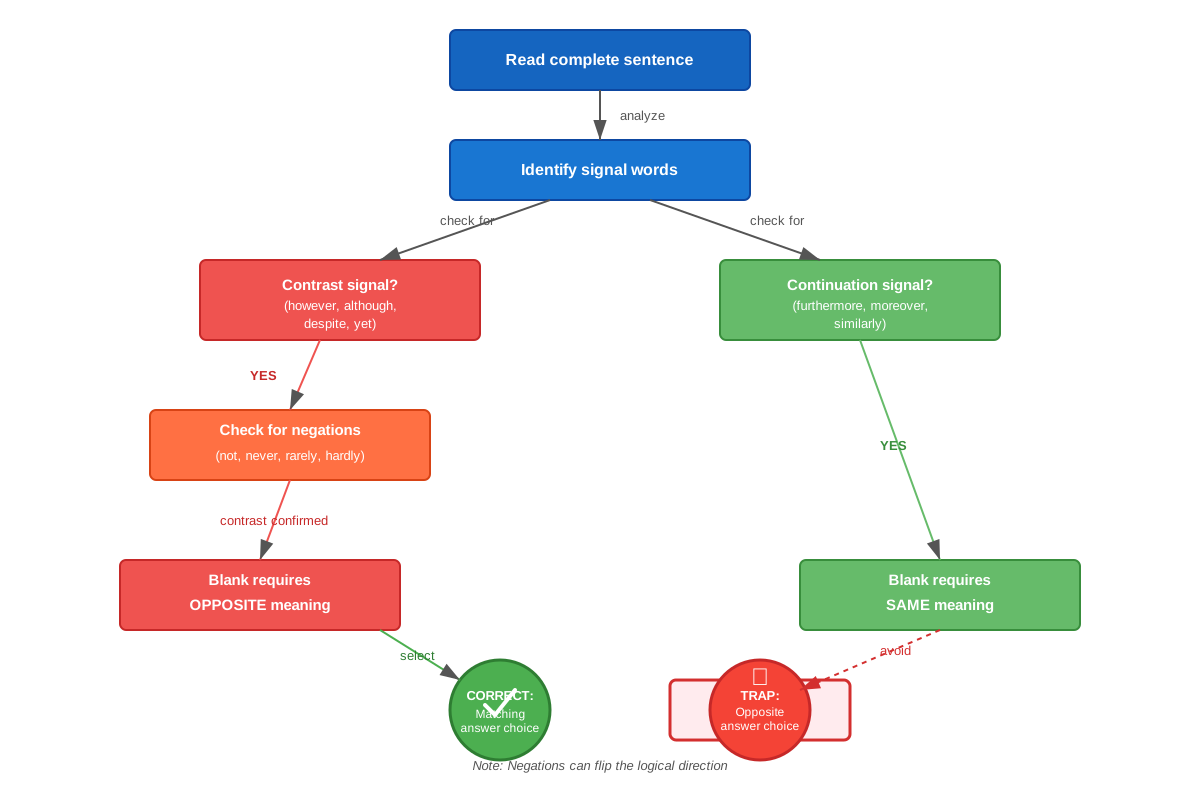
- Familiarity with transition words: Recognizing contrast words (however, although, despite) versus continuation words (furthermore, moreover, similarly) determines whether the blank requires a supporting or opposing concept
- Text Completion question format: Understanding the basic mechanics of single-blank, double-blank, and triple-blank questions provides the foundation for recognizing specific trap patterns
Why This Topic Matters
In real-world reading and professional communication, the ability to track logical relationships and identify contradictions proves invaluable. Legal documents, scientific papers, and business communications often hinge on subtle logical distinctions where misreading a negation or contrast signal can lead to costly misunderstandings. The GRE tests this skill because graduate-level academic work demands precise comprehension of complex arguments where authors frequently present contrasting viewpoints or unexpected conclusions.
On the GRE specifically, opposite answer choices appear in approximately 40-50% of Text Completion questions, making this one of the highest-yield trap patterns to master. These traps appear most frequently in medium-to-hard difficulty questions, where the test makers assume students have eliminated obviously wrong answers and must now distinguish between sophisticated distractors. The pattern appears across all Text Completion formats: single-blank, double-blank, and triple-blank questions.
Common manifestations include sentences with explicit contrast structures ("Although X, actually Y"), sentences with negations ("not X but rather Y"), sentences describing unexpected outcomes ("Despite expectations of X, the result was Y"), and sentences where the blank follows a phrase like "far from" or "anything but." The test makers also create opposite answer traps in sentences describing reversals, contradictions, or ironic situations where surface-level reading might suggest one direction while careful analysis reveals the opposite.
Core Concepts
The Fundamental Mechanism of Opposite Answer Traps
The opposite answer choices strategy exploits the difference between what test-takers expect based on superficial reading versus what the sentence actually requires based on its logical structure. The GRE constructs these traps by including answer choices that would be correct if the sentence's logical direction were reversed. This creates a powerful distractor because the vocabulary seems contextually appropriate—it relates to the same semantic field or topic as the correct answer—but points in the wrong direction.
Consider the logical structure: if a sentence establishes that "The scientist's approach was ___ rather than methodical," the blank requires a word meaning "not methodical" or "disorganized." However, the test makers will include "systematic" or "meticulous" (synonyms of methodical) as trap answers. These words feel right because they belong to the same conceptual domain (approaches to work), but they represent the opposite of what the sentence requires.
Signal Words That Create Opposite Answer Opportunities
Several categories of linguistic signals create the conditions for opposite answer traps:
Contrast signals explicitly indicate that the blank should oppose or contradict another element in the sentence. These include:
- Although, though, even though, while
- However, nevertheless, nonetheless, yet
- Despite, in spite of, notwithstanding
- Rather than, instead of, as opposed to
- But, whereas, conversely, on the contrary
Negation markers reverse the expected meaning:
- Not, no, never, neither, nor
- Hardly, scarcely, barely
- Far from, anything but
- Lack of, absence of, without
Reversal indicators suggest an unexpected turn:
- Surprisingly, unexpectedly, ironically
- Contrary to, in contrast to
- Paradoxically, counterintuitively
The Semantic Field Trap
A crucial aspect of opposite answer choices involves understanding semantic fields—groups of related words that share a common topic or domain. The GRE deliberately selects opposite answer pairs from the same semantic field to maximize their plausibility. For example:
| Semantic Field | Correct Answer | Opposite Trap |
|---|---|---|
| Personality traits | gregarious | reclusive |
| Intellectual qualities | astute | obtuse |
| Emotional states | elated | despondent |
| Work approaches | meticulous | haphazard |
| Communication styles | verbose | laconic |
Both words in each pair relate to the same general concept, making them both seem contextually appropriate. Only careful attention to the sentence's logical direction reveals which is correct.
Double Negatives and Complex Logical Structures
Advanced opposite answer traps involve multiple negations or complex logical structures that require careful tracking. A sentence like "The author was not unaware of the criticism" contains a double negative (not + unaware) that actually means "the author was aware." If the next blank requires a word describing the author's response, students who mistrack the negations might select an opposite answer.
Similarly, sentences with multiple clauses and embedded logical relationships create opportunities for confusion:
"Although critics claimed the policy was ___, supporters argued that far from being impractical, it was actually quite ___."
Here, the second blank requires a word meaning "practical" because "far from being impractical" reverses the direction. The test makers will include "unrealistic" or "idealistic" as opposite traps for students who lose track of the logical flow.
The "Seems Right" Phenomenon
Opposite answer choices succeed because they trigger what cognitive psychologists call confirmation bias—the tendency to accept information that seems to fit our initial impression. When students read a sentence about a scientist's research methods, words like "rigorous," "systematic," and "methodical" all feel appropriate because they relate to scientific work. However, if the sentence actually describes how the scientist's approach was "anything but ___," only words meaning "unsystematic" or "careless" would be correct, while those positive scientific terms become opposite traps.
Identifying True Opposites Versus Merely Different Concepts
Not every wrong answer is an opposite answer trap. The GRE includes various types of distractors:
- Opposite answers: Convey the reverse meaning (generous vs. miserly)
- Unrelated answers: Come from different semantic fields (generous vs. articulate)
- Degree mismatches: Same direction but wrong intensity (generous vs. extravagant)
- Connotation errors: Similar denotation but wrong tone (thrifty vs. stingy)
True opposite answer traps specifically involve words that would be correct if the sentence's logical direction were reversed. Recognizing this distinction helps students avoid over-applying the opposite answer strategy to every wrong answer.
Concept Relationships
The opposite answer choices concept connects to several other Text Completion strategies in a hierarchical relationship:
Signal Word Recognition → Logical Direction Determination → Opposite Answer Identification
Students must first identify signal words (contrast markers, negations, reversals), then use those signals to determine the sentence's logical direction, and finally recognize which answer choices represent opposite traps based on that direction.
Semantic Field Analysis ↔ Opposite Answer Recognition operates as a bidirectional relationship. Understanding semantic fields helps identify potential opposite pairs, while recognizing opposite patterns helps students understand how the GRE groups vocabulary.
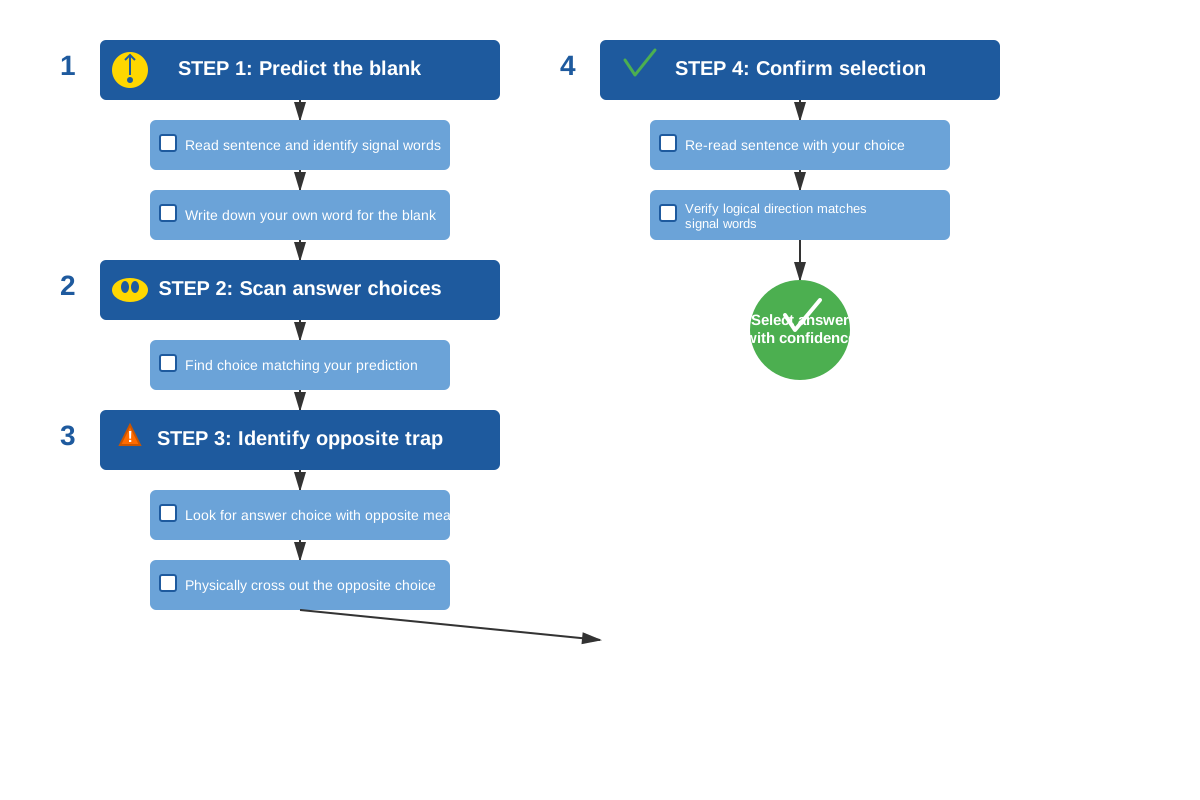
Prediction Strategy → Opposite Answer Elimination follows a sequential relationship. Students who predict the blank's meaning before reading answer choices can more easily identify opposites of their prediction as traps to eliminate.
The concept also connects to broader Verbal Reasoning skills: Critical Reading → Logical Structure Analysis → Opposite Answer Avoidance. The same skills that help students track arguments in Reading Comprehension passages—following logical transitions, recognizing contrasts, tracking negations—directly support avoiding opposite answer traps in Text Completion.
High-Yield Facts
⭐ Opposite answer choices appear in approximately 40-50% of medium-to-hard Text Completion questions, making them one of the most common trap patterns on the GRE.
⭐ Contrast signal words (although, however, despite, rather than) are the strongest indicators that opposite answer traps will be present in the answer choices.
⭐ Both the correct answer and its opposite trap typically come from the same semantic field, making them both seem contextually plausible at first glance.
⭐ The phrase "far from" always indicates that the blank requires the opposite of the concept that immediately follows it.
⭐ Double negatives require careful tracking: "not un-X" actually means "X," and selecting based on the first negation alone leads to opposite answer traps.
- Opposite answer traps are more common in single-blank questions than in multi-blank questions because the test makers have limited space to create sophisticated distractors.
- When a sentence describes an ironic or surprising situation, expect opposite answer choices that represent the expected (but incorrect) outcome.
- Negation words like "hardly," "scarcely," and "barely" function as negatives and create opposite answer opportunities just as strongly as "not."
- The construction "anything but X" means "definitely not X" and requires an opposite concept in the blank.
- Time pressure increases susceptibility to opposite answer traps because students skip careful logical analysis and rely on surface-level contextual fit.
- Opposite answer pairs often involve words with Greek or Latin roots that share prefixes or suffixes (e.g., "benevolent" vs. "malevolent," "orthodox" vs. "heterodox").
- When two answer choices are clear opposites of each other, one of them is very likely correct, and the other is the primary trap answer.
Quick check — test yourself on Opposite answer choices so far.
Try Flashcards →Common Misconceptions
Misconception: Every wrong answer in a Text Completion question is an opposite answer trap.
Correction: Opposite answer traps are a specific type of distractor where the wrong answer would be correct if the sentence's logical direction were reversed. Many wrong answers are simply unrelated, too extreme, or have wrong connotations without being true opposites.
Misconception: If a word seems to fit the context of the sentence, it must be correct.
Correction: Opposite answer traps are designed to seem contextually appropriate because they come from the same semantic field as the correct answer. Contextual fit is necessary but not sufficient; the word must also match the sentence's logical direction.
Misconception: Contrast words like "however" always mean the blank needs the opposite of what came before.
Correction: While contrast words do indicate a logical shift, students must identify what specifically is being contrasted. Sometimes the contrast involves degree, perspective, or scope rather than direct opposition.
Misconception: In double-blank or triple-blank questions, if one blank has opposite answer traps, all blanks will follow the same pattern.
Correction: Each blank in multi-blank questions has its own logical structure and trap patterns. One blank might feature opposite answer traps while another uses degree mismatches or unrelated distractors.
Misconception: Predicting an answer before reading the choices eliminates the risk of opposite answer traps.
Correction: While prediction is valuable, students who predict incorrectly (by misreading the logical direction) will actually be more vulnerable to opposite answer traps because they'll select the trap that matches their incorrect prediction.
Misconception: Opposite answer traps only appear in vocabulary-heavy questions with difficult words.
Correction: Opposite answer traps can involve relatively common vocabulary. The trap lies in the logical structure, not necessarily in word difficulty. A question might use straightforward words like "careful" and "careless" as an opposite pair.
Worked Examples
Example 1: Single-Blank Text Completion with Contrast Signal
Question: Although the committee's investigation was widely praised for its thoroughness, critics argued that the final report was surprisingly ___.
(A) comprehensive
(B) superficial
(C) impartial
(D) meticulous
(E) extensive
Step 1: Identify signal words and logical structure
The sentence begins with "Although," a strong contrast signal. This indicates that the blank should contrast with "thoroughness." Additionally, "surprisingly" reinforces that the blank describes an unexpected quality.
Step 2: Determine the logical direction
The investigation was thorough, BUT (contrast) the report was [opposite of thorough]. The blank needs a word meaning "not thorough" or "lacking depth."
Step 3: Predict before reading choices
Prediction: "shallow," "incomplete," "lacking detail," or "cursory"
Step 4: Identify opposite answer traps
Choices (A), (D), and (E) are all synonyms or near-synonyms of "thorough":
- Comprehensive = thorough, complete
- Meticulous = extremely thorough, careful
- Extensive = thorough, wide-ranging
These are opposite answer traps—they would be correct if the sentence said "The investigation was thorough, and the report was equally ___" (no contrast). But the contrast signal "although" makes them wrong.
Step 5: Select the correct answer
(B) superficial means "lacking depth" or "not thorough," which matches our prediction and correctly contrasts with "thoroughness."
(C) impartial means "unbiased," which doesn't relate to thoroughness at all—this is an unrelated distractor, not an opposite trap.
Correct Answer: (B) superficial
Learning Objective Connection: This example demonstrates identifying when opposite answer choices are being tested (contrast signal "although"), explaining the strategy (recognizing that multiple answers are synonyms of the contrasted concept), and applying it accurately (eliminating three opposite traps to find the correct answer).
Example 2: Double-Blank with Complex Negation
Question: The scientist's reputation for ___ (i) ___ was undeserved; far from being resistant to new ideas, she was actually quite ___ (ii) ___ in her thinking.
Blank (i)
(A) innovation
(B) dogmatism
(C) creativity
Blank (ii)
(D) flexible
(E) rigid
(F) conventional
Step 1: Analyze the logical structure
The sentence contains two key signals:
- "undeserved" (negation) indicates the reputation was false
- "far from being X" (strong negation + contrast) means "definitely not X, actually the opposite"
Step 2: Work through the logic systematically
The reputation was for ___(i)___, but this reputation was FALSE (undeserved).
The second part clarifies: she was "far from being resistant to new ideas," meaning she WAS open to new ideas.
Therefore, the reputation (blank i) must have been for being "resistant to new ideas" or "closed-minded."
Step 3: Solve Blank (i)
We need a word meaning "resistant to new ideas":
- (A) innovation = creating new ideas (OPPOSITE of what we need—trap!)
- (B) dogmatism = rigid adherence to beliefs, resistance to change (CORRECT)
- (C) creativity = generating new ideas (OPPOSITE of what we need—trap!)
Choices (A) and (C) are opposite answer traps. They would be correct if the sentence said her reputation for ___ WAS deserved, but the negation "undeserved" reverses the direction.
Step 4: Solve Blank (ii)
"Far from being resistant" means "actually open/receptive." We need a word meaning "open to new ideas":
- (D) flexible = adaptable, open to change (CORRECT)
- (E) rigid = inflexible, resistant to change (OPPOSITE—trap!)
- (F) conventional = traditional, following established patterns (related but not quite right)
Choice (E) is the opposite answer trap for blank (ii). It would be correct if the sentence said "far from being open, she was actually quite ___," but the actual logical direction requires the opposite.
Correct Answers: Blank (i) = (B) dogmatism; Blank (ii) = (D) flexible
Learning Objective Connection: This example shows how complex negations ("undeserved" + "far from") create multiple opportunities for opposite answer traps, requiring systematic tracking of logical direction through each part of the sentence.
Exam Strategy
Pre-Reading Strategy
Before looking at answer choices, invest 10-15 seconds in careful sentence analysis:
- Circle all signal words: Underline or mentally note every contrast word, negation, and reversal indicator
- Map the logical flow: Identify what concept the blank should support or oppose
- Make a prediction: Generate your own word for the blank based on logical analysis
- Note the direction: Explicitly think "same direction as X" or "opposite of X"
Answer Choice Analysis Process
When evaluating answer choices, use this systematic approach:
- Identify semantic pairs: Look for answer choices that are opposites of each other—one is likely correct, the other is likely the primary trap
- Test against your prediction: Does this choice match the meaning you predicted, or is it the opposite?
- Verify logical direction: Reread the sentence with your selected answer to confirm it follows the logical flow
- Eliminate opposite traps first: Actively identify and eliminate answers that point in the wrong direction before considering subtle distinctions among remaining choices
Trigger Phrases That Demand Extra Caution
When you encounter these phrases, slow down and double-check logical direction:
- "Far from" (always requires opposite of what follows)
- "Anything but" (always requires opposite)
- "Rather than" (requires contrast with what follows)
- "Not so much X as Y" (requires Y-type concept, not X-type)
- "Less X than Y" (requires Y-direction concept)
- "Despite," "although," "however" at sentence beginnings (prime opposite trap territory)
Time Management
Opposite answer traps are most dangerous when students rush. Allocate time as follows:
- Easy questions (30-45 seconds): Quick signal word check, rapid elimination
- Medium questions (60-75 seconds): Careful logical analysis, systematic elimination
- Hard questions (90-120 seconds): Detailed mapping of complex logical structures, verification of final answer
If you find yourself torn between two answers that are opposites of each other, invest an extra 15-20 seconds to reread the sentence carefully—this situation almost always indicates one correct answer and one opposite trap.
Process of Elimination Specific to Opposite Traps
Use this hierarchy when eliminating answers:
- First pass: Eliminate obvious opposite traps (words that clearly point in the wrong direction)
- Second pass: Eliminate unrelated words (different semantic field entirely)
- Third pass: Distinguish among remaining choices based on degree, connotation, or subtle meaning differences
Memory Techniques
The OPPOSITE Acronym
Observe signal words carefully
Predict before looking at choices
Pairs of opposites indicate traps
Opposite of your prediction = eliminate
Semantic field analysis reveals traps
Identify logical direction first
Test your answer by rereading
Eliminate wrong-direction choices first
Visualization Strategy: The Logic Arrow
Mentally draw an arrow showing logical direction:
- Continuation words (moreover, furthermore) = arrow pointing SAME direction →
- Contrast words (however, although) = arrow pointing OPPOSITE direction ←
- Negations (not, far from) = arrow REVERSES direction ↩
When you see your arrow reverse, you know opposite answer traps will be present.
The "Flip Test" Mnemonic
When you identify a contrast signal, mentally add "FLIP" in the margin:
Find the contrast word
Locate what's being contrasted
Identify the opposite direction needed
Predict the opposite concept
Semantic Field Color Coding
During practice, mentally assign colors to semantic fields:
- Personality traits = blue
- Intellectual qualities = green
- Emotional states = red
- Work approaches = yellow
When you see two blue words (both personality traits) as answer choices, recognize they're likely from the same semantic field, making one a potential opposite trap.
Summary
Opposite answer choices represent a sophisticated trap pattern where the GRE includes answer options that would be correct if the sentence's logical direction were reversed. These traps succeed because they come from the same semantic field as the correct answer, making them contextually plausible while being logically incorrect. Mastering this concept requires three core skills: identifying signal words that indicate logical direction (contrast markers, negations, reversals), tracking that logical direction carefully through complex sentence structures, and recognizing when answer choices represent true opposites versus merely different concepts. The strategy appears in approximately 40-50% of medium-to-hard Text Completion questions, making it one of the highest-yield patterns to master. Success depends on systematic analysis rather than intuitive reading—students must slow down at key signal words, predict answers before reading choices, and actively identify opposite traps during elimination. The most dangerous situations involve double negatives, complex contrast structures, and phrases like "far from" or "anything but" that reverse expected meanings.
Key Takeaways
- Opposite answer choices are deliberate traps where wrong answers would be correct if the sentence's logical direction were reversed, making them highly plausible distractors
- Contrast signals (although, however, despite, rather than) are the strongest indicators that opposite answer traps will appear in the answer choices
- Both correct answers and opposite traps typically come from the same semantic field, so contextual fit alone is insufficient for selection
- Systematic analysis beats intuition: predict the blank's meaning based on logical structure before reading answer choices to avoid being swayed by plausible-sounding opposites
- When two answer choices are clear opposites of each other, one is very likely correct and the other is the primary trap—invest time to determine which matches the sentence's logical direction
- Phrases like "far from," "anything but," and "hardly" function as strong negations that reverse meaning and create opposite answer trap opportunities
- Time pressure increases vulnerability to opposite traps, so allocate sufficient time for careful logical analysis on medium and hard questions
Related Topics
Signal Words and Transition Analysis: Deepening understanding of how different categories of transition words (contrast, continuation, causation, exemplification) shape sentence logic provides the foundation for recognizing when opposite answer traps will appear.
Semantic Relationships and Vocabulary Clusters: Studying how the GRE groups vocabulary into semantic fields helps students recognize when multiple answer choices relate to the same concept domain, indicating potential opposite trap patterns.
Double and Triple Blank Strategy: Mastering opposite answer recognition in single-blank questions provides essential skills for navigating the more complex logical structures in multi-blank questions, where tracking multiple logical relationships simultaneously becomes crucial.
Negation Tracking in Complex Sentences: Advanced study of how multiple negations, conditional statements, and embedded clauses create intricate logical structures builds on opposite answer recognition to handle the most difficult Text Completion questions.
Reading Comprehension Logical Structure: The same skills used to avoid opposite answer traps in Text Completion—tracking contrasts, following logical transitions, recognizing reversals—directly transfer to analyzing arguments and authorial intent in Reading Comprehension passages.
Practice CTA
Now that you understand how opposite answer choices function as sophisticated traps on the GRE, it's time to put this knowledge into action. The practice questions and flashcards have been specifically designed to reinforce your ability to identify signal words, track logical direction, and eliminate opposite traps systematically. Each practice question you complete strengthens the neural pathways that enable rapid, accurate analysis under test conditions. Remember: recognizing opposite answer traps isn't about memorizing rules—it's about developing the analytical reflexes that allow you to navigate complex logical structures confidently. Your investment in deliberate practice now will pay dividends in both accuracy and speed on test day. Begin your practice session with focused attention on the signal words and logical flow in each sentence, and watch your performance improve dramatically.
Sign up free to keep reading
Create a free AnvayaPrep account to finish this GRE guide on Opposite answer choices — plus flashcards and practice questions.