Overview
Paired blank dependency is one of the most sophisticated and frequently tested concepts in GRE Text Completion questions. Unlike simpler text completion items where each blank can be solved independently, paired blank dependency questions require test-takers to recognize that the correct answer for one blank directly determines or constrains the correct answer for another blank. These questions test not just vocabulary knowledge, but logical reasoning, contextual analysis, and the ability to track relationships between ideas across sentence structures.
Understanding GRE paired blank dependency is essential because it represents a significant portion of two-blank and three-blank text completion questions on the exam. The GRE deliberately designs these questions to punish students who attempt to solve each blank in isolation. Students who fail to recognize the dependency relationship between blanks often select answers that seem individually plausible but create logical contradictions when combined. Mastering this concept typically results in a measurable score improvement, as it unlocks a category of questions that many test-takers find particularly challenging.
Within the broader context of Verbal Reasoning, paired blank dependency sits at the intersection of vocabulary, logic, and reading comprehension. It builds upon fundamental text completion skills—such as identifying context clues and understanding sentence structure—but adds an additional layer of complexity by requiring students to manage multiple interdependent variables simultaneously. This skill directly translates to the kind of analytical reading required for Reading Comprehension passages, where understanding how different parts of an argument relate to each other is crucial for success.
Learning Objectives
- [ ] Identify when paired blank dependency is being tested in GRE Text Completion questions
- [ ] Explain the core rule or strategy behind paired blank dependency
- [ ] Apply paired blank dependency to GRE-style questions accurately
- [ ] Distinguish between dependent and independent blanks within multi-blank questions
- [ ] Determine the optimal order for solving dependent blanks based on context clues
- [ ] Recognize common dependency patterns (parallel, contrast, cause-effect) in GRE questions
- [ ] Verify answer choices by checking logical consistency across all dependent blanks
Prerequisites
- Basic Text Completion Strategy: Understanding how to use context clues to predict appropriate words for blanks is fundamental, as paired blank dependency builds upon this foundation by requiring simultaneous consideration of multiple contexts.
- Transition Words and Logical Connectors: Recognizing words like "although," "because," "similarly," and "however" is essential because these often signal the nature of the dependency relationship between blanks.
- Vocabulary Range: A working knowledge of intermediate to advanced GRE vocabulary enables students to evaluate answer choices efficiently once the logical relationship between blanks has been identified.
- Sentence Structure Analysis: The ability to identify main clauses, subordinate clauses, and modifying phrases helps students locate the structural elements that create dependencies between blanks.
Why This Topic Matters
Paired blank dependency appears in approximately 40-50% of all two-blank and three-blank Text Completion questions on the GRE, making it one of the highest-yield topics for score improvement in Verbal Reasoning. The Educational Testing Service (ETS) specifically designs these questions to differentiate between students who approach text completion strategically versus those who rely solely on vocabulary knowledge. Questions testing this concept typically appear throughout the exam at all difficulty levels, though the vocabulary and logical complexity increase in harder questions.
In real-world contexts, the skill of recognizing interdependent relationships between ideas translates directly to academic reading, professional communication, and critical thinking. Graduate-level coursework requires students to track complex arguments where multiple claims depend on each other, making this a genuinely practical skill beyond test preparation. Legal documents, scientific papers, and policy analyses all contain interdependent statements where understanding one element requires understanding its relationship to others.
On the GRE, paired blank dependency most commonly appears in sentences containing logical relationships such as contrast (where one blank must oppose the other), parallelism (where blanks must align in meaning or tone), or cause-and-effect (where one blank describes a cause and another describes its result). The exam frequently embeds these relationships within complex sentence structures featuring multiple clauses, making the dependency less obvious to students who read superficially. Recognizing these patterns quickly allows test-takers to solve questions more efficiently and accurately.
Core Concepts
Understanding Blank Dependency
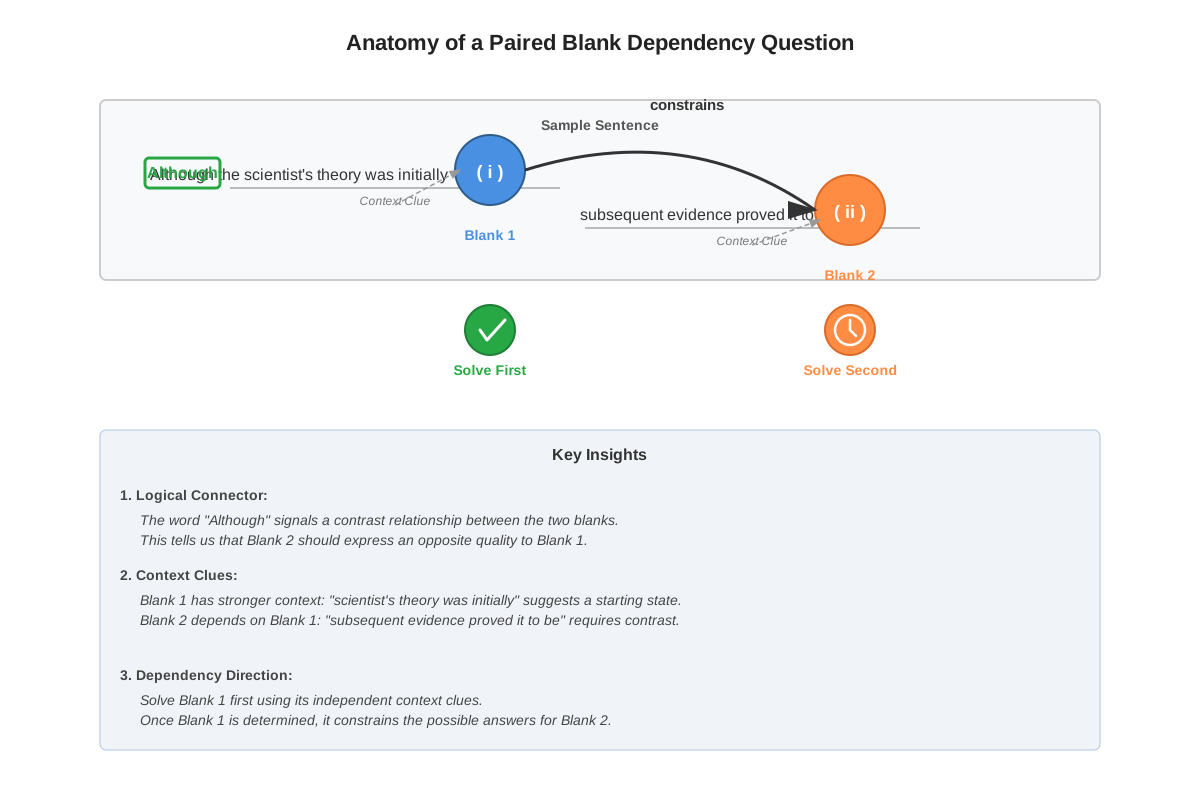
Paired blank dependency occurs when the meaning or logical requirements of one blank in a Text Completion question directly constrains the possible answers for another blank. In dependent blanks, you cannot definitively solve one blank without considering the other, because the relationship between them is part of what the sentence logic requires. This contrasts with independent blanks, where each blank can be solved using only its immediate context without reference to other blanks in the sentence.
The key to recognizing dependency lies in identifying logical connectors and structural relationships within the sentence. When a sentence establishes that two ideas must be similar, opposite, or causally related, the blanks representing those ideas become dependent. For example, if a sentence states "Although the critic's review was _____, the director found it _____," the contrast word "although" creates a dependency: whatever fills the first blank must contrast with whatever fills the second blank.
Types of Dependency Relationships
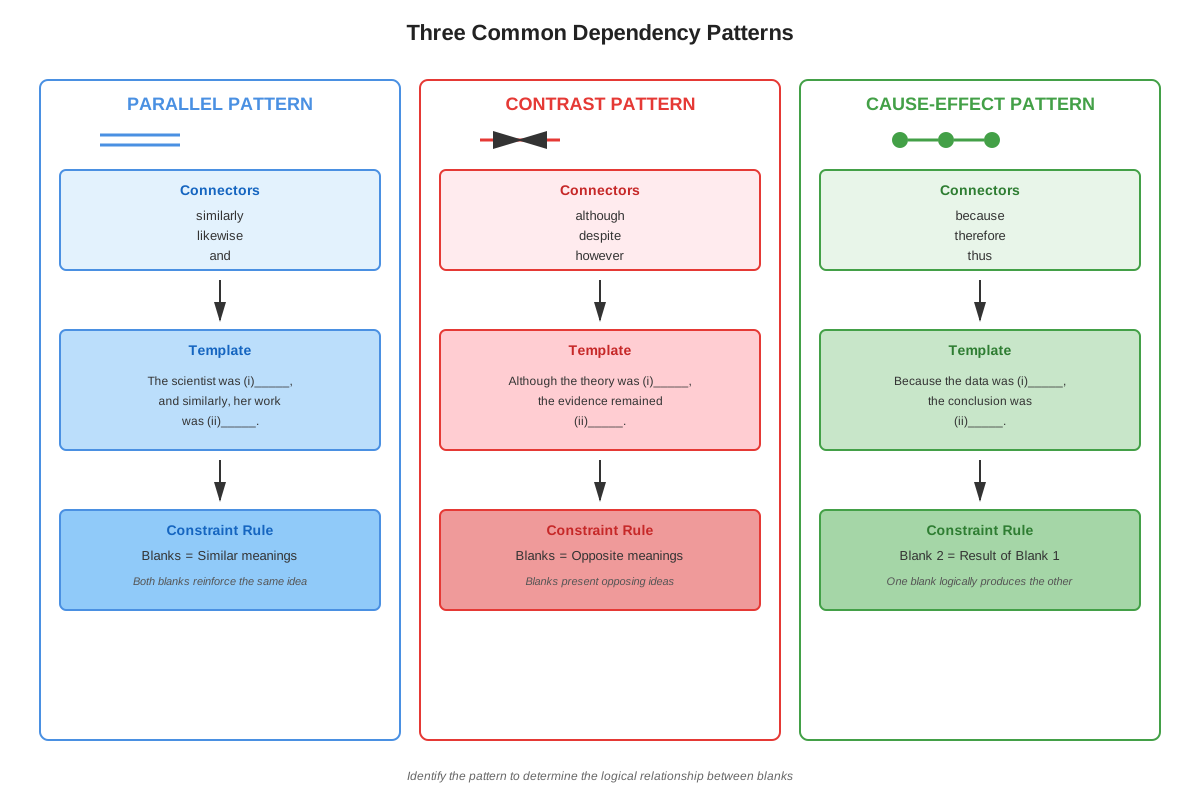
There are three primary dependency patterns that appear repeatedly on the GRE:
Parallel Dependency occurs when two blanks must contain words with similar meanings, connotations, or logical functions. Signal words include "similarly," "likewise," "and," "also," and "both...and." For example: "The scientist's approach was both _____ and _____" requires two words that align in meaning—both positive qualities, both negative qualities, or both neutral descriptors that logically pair together.
Contrast Dependency occurs when two blanks must contain words with opposite meanings, connotations, or logical functions. Signal words include "although," "despite," "however," "but," "while," "whereas," and "in contrast to." For example: "Despite her _____ demeanor, she possessed _____ intelligence" requires the first blank to contrast with expectations that might arise from the second blank, or vice versa.
Cause-Effect Dependency occurs when one blank describes a cause, condition, or reason, while another blank describes its result, consequence, or outcome. Signal words include "because," "therefore," "thus," "consequently," "as a result," and "so...that." For example: "Because the evidence was _____, the jury reached a _____ verdict" requires the second blank to logically follow from the first—weak evidence might lead to an uncertain verdict, while strong evidence might lead to a confident verdict.
Identifying the Anchor Blank
When solving paired blank dependency questions, one blank typically serves as the anchor blank—the blank that provides more definitive context clues and should be solved first. The anchor blank usually has:
- More explicit context clues in its immediate vicinity
- Fewer plausible answer choices based on context alone
- Clearer grammatical or logical constraints
Once the anchor blank is solved, its answer constrains the possibilities for the dependent blank based on the relationship type (parallel, contrast, or cause-effect). This strategic approach prevents the common error of trying to solve both blanks simultaneously, which often leads to confusion and incorrect answers.
The Verification Process
After selecting answers for dependent blanks, verification is crucial. The correct answer pair must satisfy three conditions:
| Verification Criterion | What to Check |
|---|---|
| Individual Plausibility | Each word must make grammatical and contextual sense in its own blank |
| Relationship Consistency | The two words must exhibit the required relationship (parallel, contrast, or cause-effect) |
| Whole-Sentence Coherence | The complete sentence must express a logical, coherent idea |
Many incorrect answer choices on the GRE will satisfy one or two of these criteria but fail the third. For example, two words might individually fit their blanks but fail to maintain the contrast relationship the sentence requires, or they might maintain the correct relationship but create an illogical overall sentence meaning.
Complex Multi-Blank Dependencies
In three-blank questions, dependencies can become more complex. Possible patterns include:
- Chain dependency: Blank 1 determines Blank 2, which determines Blank 3
- Hub dependency: Blank 2 depends on both Blank 1 and Blank 3
- Partial dependency: Two blanks are dependent on each other, while the third is independent
Recognizing which pattern applies requires careful analysis of the sentence structure and logical connectors. The most efficient approach involves identifying all dependency relationships before attempting to solve any blank, then solving in an order that leverages the strongest context clues.
Common Structural Patterns
The GRE frequently embeds paired blank dependency within specific sentence structures:
Comparative structures: "More _____ than _____" or "As _____ as _____" create dependencies where the relationship between the blanks is built into the comparison itself.
Conditional structures: "If _____, then _____" creates cause-effect dependency where the first blank establishes a condition and the second blank must logically follow.
Concessive structures: "Although _____" or "Despite _____" followed by a main clause creates contrast dependency between the subordinate and main clauses.
Correlative structures: "Not only _____ but also _____" or "Both _____ and _____" creates parallel dependency where both blanks must align in meaning and tone.
Concept Relationships
The concept of paired blank dependency builds directly upon fundamental text completion skills, particularly the ability to identify context clues and predict appropriate words. However, it adds a layer of complexity by requiring students to manage multiple context clues simultaneously and recognize how they interact. This relationship can be mapped as: Basic Context Clues → Single Blank Completion → Paired Blank Dependency → Complex Multi-Blank Analysis.
Within paired blank dependency itself, the three relationship types (parallel, contrast, cause-effect) are not isolated concepts but rather different manifestations of the same underlying principle: logical coherence across sentence elements. Understanding transition words and logical connectors serves as the bridge between recognizing that a dependency exists and identifying which type of dependency is present. This flows as: Sentence Structure Analysis → Logical Connector Identification → Dependency Type Classification → Strategic Solving Order.
The verification process connects back to reading comprehension skills, as checking whether a completed sentence makes logical sense requires the same analytical reading ability used in passage-based questions. Additionally, the concept of anchor blanks relates to the broader test-taking strategy of identifying and leveraging the strongest available evidence, a principle that applies across all GRE Verbal question types. Thus, mastering paired blank dependency strengthens overall Verbal Reasoning performance beyond just Text Completion questions.
High-Yield Facts
⭐ Approximately 40-50% of two-blank and three-blank Text Completion questions test paired blank dependency.
⭐ The three primary dependency types are parallel (similar meanings), contrast (opposite meanings), and cause-effect (logical consequence).
⭐ Contrast dependency is the most frequently tested type, often signaled by "although," "despite," "however," or "but."
⭐ The anchor blank should be solved first—it's the blank with the most explicit context clues and fewest plausible answer choices.
⭐ Correct answer pairs must satisfy three criteria: individual plausibility, relationship consistency, and whole-sentence coherence.
- Parallel dependency often appears in sentences with "and," "both...and," "similarly," or "likewise" as logical connectors.
- Cause-effect dependency frequently uses "because," "therefore," "thus," or "consequently" to signal the relationship.
- In three-blank questions, not all blanks are necessarily dependent—some may be independent and solvable separately.
- The GRE deliberately includes answer choices that work individually but fail when combined with the dependent blank.
- Verifying your answer by reading the complete sentence aloud (mentally) helps catch logical inconsistencies.
- Time pressure often causes students to skip the verification step, leading to avoidable errors on dependency questions.
- Dependency relationships can span across semicolons, colons, and em-dashes, not just within single clauses.
Quick check — test yourself on Paired blank dependency so far.
Try Flashcards →Common Misconceptions
Misconception: All blanks in multi-blank questions are dependent on each other. → Correction: Many multi-blank questions contain a mix of dependent and independent blanks. Not every blank constrains every other blank. Careful analysis of sentence structure and logical connectors reveals which blanks are actually dependent.
Misconception: The blanks should always be solved in the order they appear in the sentence. → Correction: The optimal solving order depends on which blank has the strongest context clues (the anchor blank), not the physical position of blanks in the sentence. Often, solving the second blank first provides the key to solving the first blank.
Misconception: If two words are synonyms, they must be correct for parallel dependency blanks. → Correction: Parallel dependency requires logical alignment, not necessarily synonymy. Two words might both be positive or both be negative without being synonyms, or they might describe related aspects of the same concept using different vocabulary.
Misconception: Contrast dependency always means the two words must be antonyms. → Correction: Contrast dependency requires logical opposition within the sentence context, which is broader than antonymy. For example, "modest" and "extraordinary" aren't strict antonyms but create effective contrast in many contexts.
Misconception: Once you've selected answers for dependent blanks, you don't need to verify them. → Correction: Verification is essential because the GRE specifically designs incorrect answer choices that seem plausible when considered individually but create logical problems when combined. Reading the complete sentence with your selected answers catches these errors.
Misconception: Dependency only occurs between blanks in the same clause. → Correction: Dependency relationships frequently span across clauses, especially in complex sentences with subordinate clauses, relative clauses, or multiple independent clauses connected by semicolons or conjunctions.
Worked Examples
Example 1: Contrast Dependency
Question: "Although the new policy was intended to _____ bureaucratic inefficiency, critics argued that it would actually _____ the problem by adding more layers of oversight."
Blank (i): (A) eliminate (B) perpetuate (C) analyze
Blank (ii): (D) solve (E) exacerbate (F) investigate
Solution Process:
Step 1 - Identify the dependency: The word "although" signals contrast dependency. Whatever the policy was intended to do must contrast with what critics say it will actually do.
Step 2 - Identify the anchor blank: Blank (ii) has stronger context clues. The phrase "by adding more layers of oversight" suggests making something worse, and "the problem" refers back to "bureaucratic inefficiency." This context strongly suggests "exacerbate" (E) for Blank (ii).
Step 3 - Solve the dependent blank: Since Blank (ii) is "exacerbate" (making the problem worse), and "although" signals contrast, Blank (i) must be the opposite—something that would make the problem better. "Eliminate" (A) fits perfectly.
Step 4 - Verify: "Although the new policy was intended to eliminate bureaucratic inefficiency, critics argued that it would actually exacerbate the problem by adding more layers of oversight." This sentence is logically coherent: the policy aims to eliminate inefficiency, but critics say it will worsen it instead. The contrast relationship is maintained, and the whole sentence makes sense.
Answer: Blank (i) = A, Blank (ii) = E
Connection to Learning Objectives: This example demonstrates identifying dependency (the "although" trigger), determining solving order (Blank ii as anchor), and verifying logical consistency.
Example 2: Parallel Dependency with Cause-Effect
Question: "The researcher's methodology was so _____ that her conclusions, while _____, could not be reliably verified by other scientists in the field."
Blank (i): (A) rigorous (B) idiosyncratic (C) conventional
Blank (ii): (D) erroneous (E) intriguing (F) mundane
Solution Process:
Step 1 - Identify the dependency: The structure "so _____ that _____" creates a cause-effect dependency. The first blank describes a quality of the methodology that causes the result described in the second part of the sentence.
Step 2 - Analyze the effect: The key phrase is "could not be reliably verified by other scientists." This suggests the methodology was unusual or non-standard in some way that prevented replication.
Step 3 - Solve the anchor blank: Blank (i) is the anchor because it must explain why verification was impossible. "Idiosyncratic" (B) means peculiar to an individual, which would explain why others couldn't verify the work. "Rigorous" (A) would make verification easier, not harder. "Conventional" (C) would also facilitate verification.
Step 4 - Solve the dependent blank: The phrase "while _____" creates a concessive relationship within the main clause. The conclusions are something positive (otherwise, why mention them?), but they can't be verified. "Intriguing" (E) fits this pattern—the conclusions are interesting but unverifiable. "Erroneous" (D) doesn't fit because there's no reason to mention erroneous conclusions positively. "Mundane" (F) contradicts the idea that they're worth discussing.
Step 5 - Verify: "The researcher's methodology was so idiosyncratic that her conclusions, while intriguing, could not be reliably verified by other scientists in the field." This creates a coherent narrative: unusual methods led to interesting but unverifiable results. The cause-effect relationship is maintained.
Answer: Blank (i) = B, Blank (ii) = E
Connection to Learning Objectives: This example shows recognizing complex dependency patterns (cause-effect combined with concessive contrast), identifying the anchor blank through logical analysis, and applying verification to ensure whole-sentence coherence.
Exam Strategy
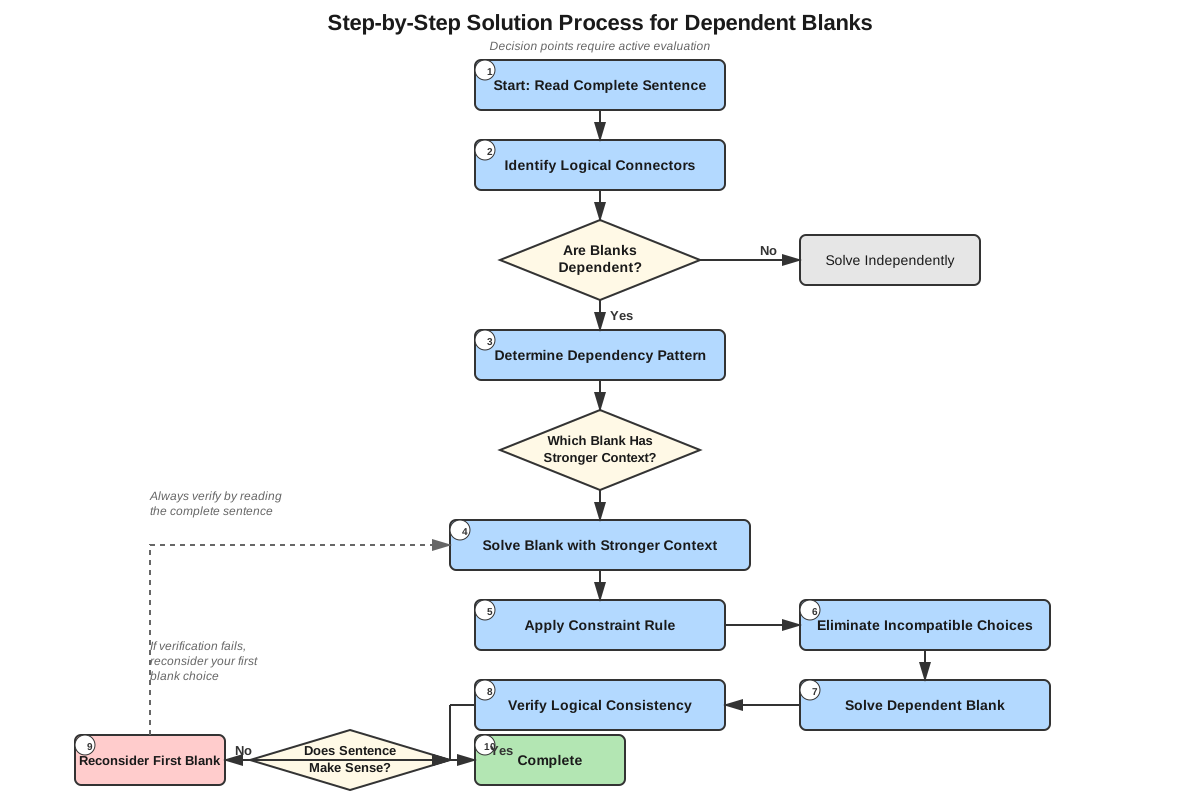
When approaching GRE questions testing paired blank dependency, follow this systematic process:
Initial Assessment (5-10 seconds): Quickly scan the sentence for logical connectors and structural signals. Look for words like "although," "because," "similarly," "but," "therefore," and "while." These immediately indicate potential dependencies. Also note the sentence structure—complex sentences with multiple clauses are more likely to contain dependencies than simple sentences.
Dependency Mapping (10-15 seconds): Before looking at answer choices, determine which blanks are dependent and what type of relationship exists. Ask yourself: "Do these blanks need to be similar, opposite, or causally related?" Mark this relationship mentally or on your scratch paper using symbols (= for parallel, ≠ for contrast, → for cause-effect).
Anchor Identification (5 seconds): Determine which blank has the strongest context clues. Look for blanks that are:
- Immediately preceded or followed by descriptive phrases
- Part of a clause with concrete, specific information
- Constrained by grammatical requirements or collocations
Strategic Solving Order: Always solve the anchor blank first, even if it appears second or third in the sentence. Use the answer choices for the anchor blank to narrow possibilities, then use your selected answer to constrain the dependent blank. This prevents the overwhelming feeling of having too many possible combinations to consider.
Elimination Technique: For the dependent blank, eliminate answer choices that fail to maintain the required relationship with your anchor blank answer. If you've identified contrast dependency and selected a positive word for the anchor blank, immediately eliminate all positive words from the dependent blank's choices.
Verification Protocol: After selecting answers, always read the complete sentence with your choices inserted. Check three things in order:
- Does each word fit grammatically and contextually in its blank?
- Do the words maintain the required relationship (parallel, contrast, or cause-effect)?
- Does the complete sentence express a logical, coherent idea?
Time Management: Allocate approximately 60-75 seconds for two-blank dependency questions and 90-105 seconds for three-blank questions. If you exceed these times, make your best educated guess and move on. Paired blank dependency questions are worth the same as simpler questions, so don't sacrifice time needed elsewhere.
Exam Tip: If you're stuck between two answer pairs, try substituting each pair into the sentence and reading it aloud mentally. The correct answer will typically "sound right" because it creates natural, logical English, while incorrect pairs often create awkward or illogical statements even if the individual words seem plausible.
Memory Techniques
The "ABC" Mnemonic for Dependency Types:
- Align = Parallel dependency (words align in meaning)
- But = Contrast dependency (words oppose each other)
- Consequence = Cause-effect dependency (one word causes the other)
The "SOLVE" Process for Paired Blanks:
- Scan for logical connectors
- Order the blanks (identify the anchor)
- Link the relationship type
- Verify with complete sentence
- Eliminate inconsistent pairs
Visualization Strategy: Picture dependent blanks as connected by a rubber band. When you pull one blank toward a particular meaning (positive, negative, strong, weak), the rubber band pulls the other blank in a predictable direction—either the same direction (parallel), opposite direction (contrast), or along a cause-to-effect path.
The "Connector Color Code": Mentally assign colors to relationship types:
- Green for parallel (go together, like a green light means proceed together)
- Red for contrast (stop and reverse, like a red light means opposite direction)
- Yellow for cause-effect (caution—one leads to another, like yellow means something is coming)
Anchor Blank Acronym - "CLUE":
- Context-rich (surrounded by descriptive information)
- Limited choices (fewer plausible answers)
- Unambiguous (clearer meaning from context)
- Easier (simpler vocabulary or more familiar concepts)
Summary
Paired blank dependency represents a critical skill for GRE Text Completion success, appearing in approximately half of all multi-blank questions. The core principle is that certain blanks cannot be solved independently because their correct answers depend on maintaining a specific logical relationship—parallel, contrast, or cause-effect—with other blanks in the sentence. Success requires a systematic approach: identifying dependency through logical connectors and sentence structure, determining which blank serves as the anchor by evaluating context clues, solving blanks in strategic order rather than sequential order, and verifying that the complete sentence maintains logical coherence. The three dependency types each have characteristic signal words, with contrast dependency being most common and typically signaled by words like "although," "despite," or "however." Students must resist the temptation to solve blanks in isolation or to select answers that seem individually plausible without checking whether they maintain the required relationship. Mastering this concept requires practice in recognizing structural patterns, managing multiple constraints simultaneously, and developing the discipline to verify answers systematically before moving to the next question.
Key Takeaways
- Paired blank dependency occurs when one blank's correct answer directly constrains another blank's answer through a logical relationship
- The three primary dependency types—parallel, contrast, and cause-effect—each have characteristic signal words that reveal the relationship
- Always identify the anchor blank (strongest context clues) and solve it first, regardless of its position in the sentence
- Verification is non-negotiable: correct answer pairs must satisfy individual plausibility, relationship consistency, and whole-sentence coherence
- Contrast dependency, signaled by words like "although" and "despite," is the most frequently tested type on the GRE
- The GRE deliberately includes trap answers that work individually but fail when combined, making systematic verification essential
- Efficient time management requires spending 60-75 seconds on two-blank dependency questions and moving on if you exceed this target
Related Topics
Three-Blank Text Completion Strategy: Building on paired blank dependency, this advanced topic addresses questions where multiple dependencies may exist simultaneously, requiring more complex analysis of how three blanks interact. Mastering paired blank dependency provides the foundation for managing these more challenging questions.
Logical Reasoning in Reading Comprehension: The skill of tracking relationships between ideas transfers directly to analyzing argument structure in RC passages, particularly in questions asking about the relationship between different parts of a passage or how one claim supports another.
Sentence Equivalence Strategy: While SE questions don't have multiple blanks, they require identifying two words that create equivalent meanings, which involves similar logical analysis to parallel dependency in text completion.
Advanced Vocabulary in Context: As dependency questions become harder, they incorporate more sophisticated vocabulary, making the study of words in context (rather than in isolation) increasingly important for accurate blank solving.
Transition Word Mastery: Deepening knowledge of logical connectors and their precise meanings enhances the ability to quickly identify dependency types and predict the required relationships between blanks.
Practice CTA
Now that you understand the principles of paired blank dependency, it's time to put this knowledge into action. The practice questions and flashcards have been specifically designed to reinforce the concepts covered in this guide, with questions that progressively increase in difficulty to build your confidence and skill. Remember that mastery comes through deliberate practice—focus not just on getting questions right, but on applying the systematic approach outlined here: identify dependencies, find the anchor blank, solve strategically, and always verify. Each practice question is an opportunity to strengthen your pattern recognition and develop the intuition that will serve you on test day. You've invested the time to understand the strategy; now invest the time to make it automatic through practice. Your improved performance on Text Completion questions starts with the next practice set you complete!
Sign up free to keep reading
Create a free AnvayaPrep account to finish this GRE guide on Paired blank dependency — plus flashcards and practice questions.