Overview
The independent blank strategy is one of the most powerful and frequently applicable techniques for tackling Text Completion questions on the GRE Verbal Reasoning section. This strategy applies when a Text Completion question contains multiple blanks that can be solved separately, without requiring information from one blank to determine another. Understanding when and how to apply this approach can dramatically improve both accuracy and efficiency on test day.
Many students waste valuable time trying to solve multi-blank questions holistically, attempting to find the perfect combination of words across all blanks simultaneously. This approach often leads to confusion and second-guessing. The gre independent blank strategy teaches test-takers to recognize when blanks operate independently within a passage, allowing them to break down complex questions into manageable single-blank problems. By solving each blank individually based on its own contextual clues, students can eliminate wrong answers systematically and arrive at the correct response with greater confidence.
This strategy sits at the intersection of critical reading comprehension and logical analysis within the Verbal Reasoning framework. It requires students to parse sentence structure, identify logical relationships, and recognize when information flows in one direction rather than creating interdependencies. Mastering this technique not only improves performance on Text Completion questions but also strengthens overall analytical reading skills that benefit Reading Comprehension and Sentence Equivalence questions. The independent blank strategy represents a fundamental shift from intuitive guessing to methodical problem-solving, making it essential for students targeting competitive scores.
Learning Objectives
- [ ] Identify when Independent blank strategy is being tested
- [ ] Explain the core rule or strategy behind Independent blank strategy
- [ ] Apply Independent blank strategy to GRE-style questions accurately
- [ ] Distinguish between independent and dependent blanks in multi-blank Text Completion questions
- [ ] Develop a systematic approach for determining the optimal order to solve independent blanks
- [ ] Evaluate answer choices for each blank without being influenced by other blanks
Prerequisites
- Basic sentence structure understanding: Recognizing subjects, verbs, objects, and modifying clauses helps identify which parts of a sentence provide clues for specific blanks
- Contextual clue identification: The ability to spot transition words, contrast indicators, and support signals is essential for determining what type of word belongs in each blank
- Fundamental Text Completion format knowledge: Understanding that some questions have one blank, others have two or three, and knowing how answer choices are presented and selected
- Vocabulary foundation: A working knowledge of common GRE vocabulary enables faster evaluation of answer choices once the blank's meaning is determined
Why This Topic Matters
The independent blank strategy addresses one of the most common pain points for GRE test-takers: multi-blank Text Completion questions. These questions appear frequently on the exam, with approximately 40% of Text Completion questions containing two or three blanks. Students who lack a systematic approach often find themselves overwhelmed by the combinatorial complexity—a three-blank question with five choices per blank theoretically has 125 possible combinations.
In real-world applications, the analytical skills developed through this strategy extend beyond standardized testing. The ability to break complex problems into independent components, solve each systematically, and then verify the overall solution reflects critical thinking patterns used in academic research, professional writing, and logical reasoning across disciplines. Graduate programs value this type of structured analytical thinking.
On the GRE specifically, independent blank questions typically appear in passages where each blank is supported by distinct contextual clues within different clauses or sentences. Common patterns include: (1) passages where the first sentence establishes one idea with its own blank, and a subsequent sentence introduces a separate concept with another blank; (2) compound or complex sentences where independent clauses each contain a blank supported by information within that clause; (3) passages where blanks appear in different logical relationships (one showing cause, another showing effect, but each determinable from separate textual evidence).
Mastering this strategy can save 30-45 seconds per question by eliminating the need to mentally test multiple combinations. More importantly, it significantly improves accuracy by preventing the common error of choosing an answer for one blank that "sounds good" with an incorrect choice for another blank.
Core Concepts
Defining Independent Blanks
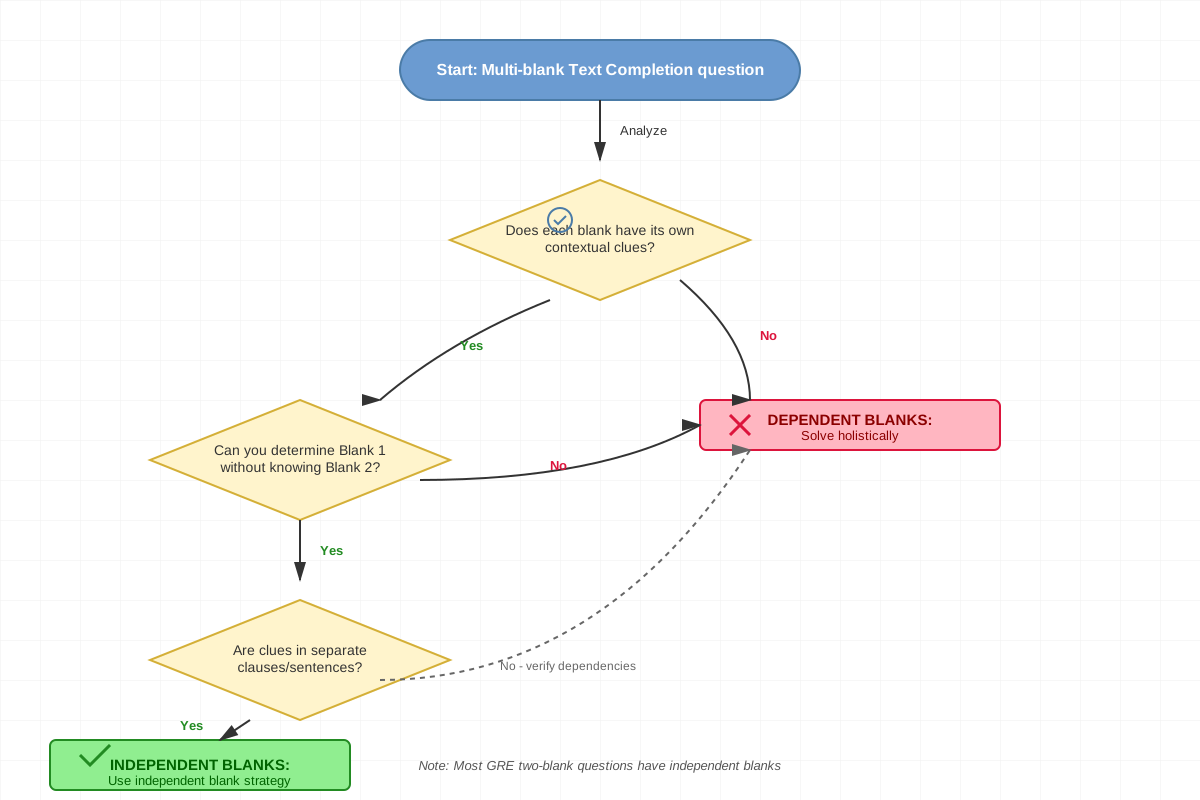
Independent blanks are blanks in a multi-blank Text Completion question where each blank can be solved using contextual clues that do not depend on knowing the answer to any other blank. The passage provides sufficient information to determine the correct answer for each blank separately. This independence means that the logical flow, transition words, descriptive phrases, or structural clues for one blank exist independently of the words that would fill other blanks.
The key characteristic of independent blanks is that you can cover up one blank entirely, solve another blank with complete confidence, and then return to the covered blank without needing to know what you selected for the first one. The passage's meaning and structure support each blank through distinct evidence.
Identifying Independent vs. Dependent Blanks
Not all multi-blank questions feature independent blanks. Dependent blanks require information from one blank to solve another—the blanks are logically interconnected. Distinguishing between these types is the first critical skill in applying the independent blank strategy.
Characteristics of Independent Blanks:
- Each blank is supported by separate contextual clues
- Transition words or logical connectors relate to specific blanks individually
- Different sentences or clauses provide evidence for different blanks
- You can determine the meaning needed for one blank without considering other blanks
- The passage maintains coherent meaning regardless of which blank you solve first
Characteristics of Dependent Blanks:
- One blank describes or modifies the concept in another blank
- The relationship between blanks is explicit (e.g., "not X but Y" where both blanks are in the same logical structure)
- Solving one blank significantly narrows the possibilities for another
- The blanks work together to create a single unified idea
- Parallel structure connects the blanks directly
The Core Strategy: Solve Each Blank Independently
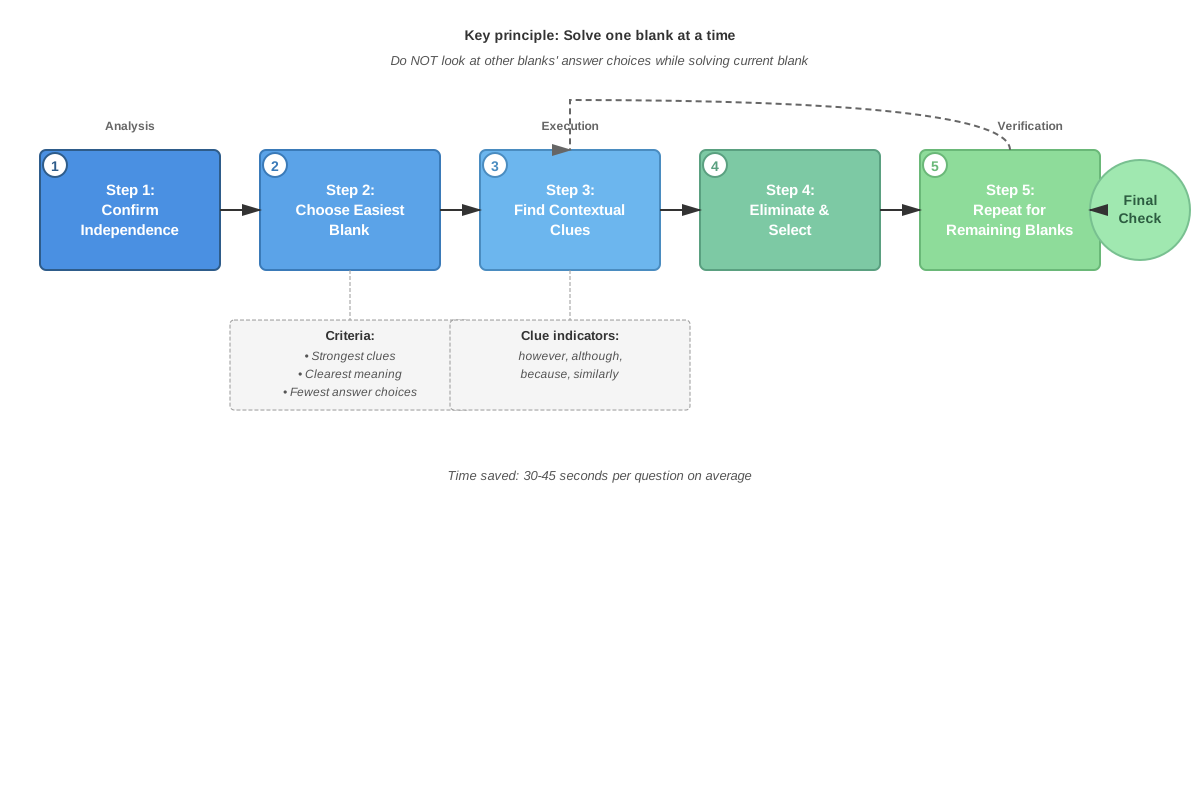
When independent blanks are identified, follow this systematic approach:
- Read the entire passage first to understand the overall meaning and structure
- Identify which blanks are independent by locating separate contextual clues for each
- Choose the easiest blank to solve first—typically the one with the most explicit contextual support
- Solve that blank completely by predicting the type of word needed and evaluating all answer choices
- Select your answer for that blank before considering other blanks
- Move to the next blank and repeat the process, treating it as an entirely new single-blank question
- Verify the complete passage by reading through with all selected answers to ensure overall coherence
This approach transforms a complex multi-blank question into a series of simpler single-blank questions, dramatically reducing cognitive load and error potential.
Locating Contextual Clues for Each Blank
The effectiveness of the independent blank strategy depends on accurately identifying which contextual clues support which blanks. Common clue patterns include:
Structural Clues:
- Blanks in different sentences typically have independent clues
- Blanks in separate independent clauses often operate independently
- Blanks separated by semicolons usually have distinct supporting evidence
Logical Clues:
- Transition words (however, moreover, furthermore) often signal which blank they modify
- Cause-and-effect relationships may support different blanks independently
- Contrast indicators (although, despite, while) typically relate to specific blanks
Descriptive Clues:
- Adjectives, adverbs, and modifying phrases usually support the nearest blank
- Examples or elaborations typically clarify the blank in the same sentence
- Definitions or restatements provide direct evidence for specific blanks
Determining Solving Order
While independent blanks can theoretically be solved in any order, strategic sequencing improves efficiency and accuracy:
Solve first:
- Blanks with the most explicit contextual clues
- Blanks with strong transition words or logical indicators
- Blanks where you immediately recognize the needed word type
- Blanks in simpler sentence structures
Solve later:
- Blanks with subtle or complex clues
- Blanks requiring inference rather than direct evidence
- Blanks where multiple answer choices seem plausible initially
- Blanks in complex subordinate clauses
This prioritization builds confidence and momentum, making subsequent blanks easier to solve.
Common Independent Blank Patterns
Certain passage structures reliably produce independent blanks:
| Pattern | Example Structure | Why Blanks Are Independent |
|---|---|---|
| Sequential ideas | First sentence establishes concept A with blank 1. Second sentence introduces concept B with blank 2. | Each sentence provides complete context for its own blank |
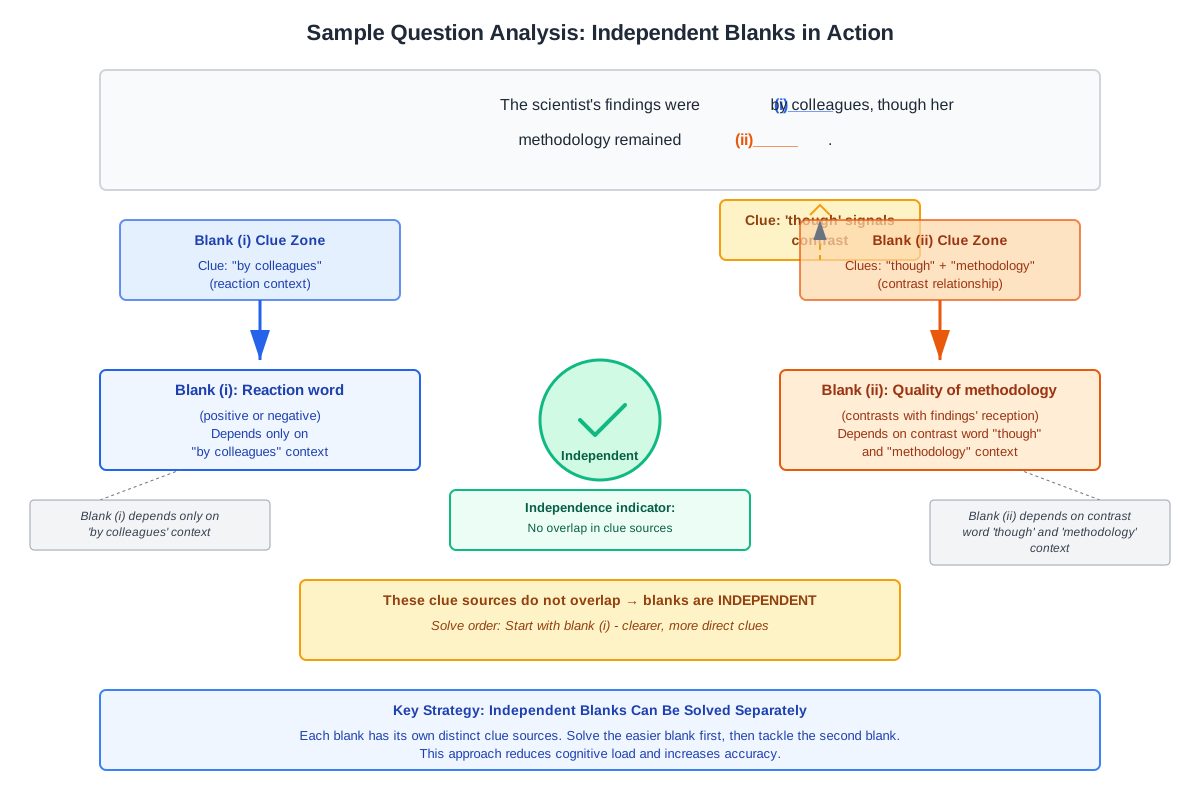
| Compound sentences | The theory was _____(1)_____ by critics, but the methodology remained _____(2)_____. | Each independent clause contains its own subject and supporting context |
| Cause and separate effect | Because of the _____(1)_____ weather, the crops failed. The economic impact was _____(2)_____. | Cause and effect are described with distinct evidence |
| Multiple characteristics | The professor was known for _____(1)_____ lectures and _____(2)_____ grading policies. | Each characteristic is independently described |
Avoiding Common Traps
When applying the independent blank strategy, students must avoid several pitfalls:
The Combination Trap: Choosing answers that "sound good together" rather than solving each blank based on its own evidence. Always evaluate each blank independently before considering overall flow.
The First-Blank Bias: Automatically solving blanks in order (first to last) rather than identifying the easiest blank first. Flexibility in solving order is crucial.
The Confirmation Bias: After solving one blank, unconsciously favoring answers for other blanks that seem to "match" or "complement" the first answer. Each blank must be solved on its own merits.
The Dependency Assumption: Assuming blanks are dependent when they're actually independent, leading to unnecessary complexity. Always check whether each blank truly requires information from another.
Concept Relationships
The independent blank strategy builds directly on foundational Text Completion skills. Contextual clue identification (prerequisite knowledge) provides the raw material that makes independent blank solving possible—without the ability to spot transition words, contrast indicators, and supporting evidence, students cannot determine which clues support which blanks.
Within the strategy itself, concepts flow in a logical sequence: Identifying independent blanks → Locating contextual clues → Determining solving order → Solving each blank individually → Verifying overall coherence. Each step depends on the previous one, creating a systematic problem-solving framework.
The strategy also connects to broader Verbal Reasoning skills. The sentence structure analysis required to identify independent blanks strengthens Reading Comprehension abilities, particularly for parsing complex academic prose. The logical relationship recognition used to distinguish independent from dependent blanks directly applies to argument analysis in both Reading Comprehension and Analytical Writing sections.
Furthermore, the independent blank strategy contrasts with the dependent blank strategy (a related topic for further study), where blanks must be solved together. Understanding when to apply each strategy requires meta-cognitive awareness of question types—a higher-order skill that distinguishes top-scoring test-takers.
Finally, the vocabulary evaluation that occurs after determining what type of word belongs in each blank connects to Sentence Equivalence skills, where similar contextual analysis determines which two words create equivalent meanings.
High-Yield Facts
⭐ Independent blanks can be solved in any order; always start with the blank that has the clearest contextual clues.
⭐ If you can determine the meaning needed for one blank without knowing the answer to another blank, those blanks are independent.
⭐ Approximately 60-70% of multi-blank Text Completion questions on the GRE feature independent blanks.
⭐ The most common independent blank pattern involves blanks in different sentences or independent clauses.
⭐ Each independent blank should be treated as a separate single-blank question with its own contextual evidence.
- Blanks separated by semicolons are frequently independent because semicolons join independent clauses.
- Transition words (however, moreover, additionally) typically signal which specific blank they modify, helping identify independence.
- Reading the entire passage before solving any blank is essential for recognizing the overall structure and identifying independent blanks.
- The independent blank strategy typically saves 30-45 seconds per question compared to testing multiple combinations.
- Dependent blanks often appear in parallel structures (e.g., "not X but Y") or when one blank directly modifies another.
- After solving all blanks independently, always read the complete passage with selected answers to verify logical coherence.
- The easiest blank to solve is not always the first blank in the passage; flexibility in solving order is crucial.
Quick check — test yourself on Independent blank strategy so far.
Try Flashcards →Common Misconceptions
Misconception: All multi-blank questions should be solved from first blank to last blank in order.
Correction: Independent blanks can and should be solved in order of difficulty, starting with whichever blank has the clearest contextual support. Solving order should be strategic, not automatic.
Misconception: If blanks appear in the same sentence, they must be dependent.
Correction: Blanks in the same sentence can be independent if they appear in separate independent clauses or if each has distinct contextual clues. Sentence boundaries don't determine independence—logical relationships do.
Misconception: After solving one blank, you should choose answers for other blanks that "match" or "complement" the first answer.
Correction: Each independent blank must be solved based solely on its own contextual evidence. Creating artificial relationships between independent blanks leads to errors.
Misconception: The independent blank strategy only works for two-blank questions.
Correction: The strategy applies equally to three-blank questions and is actually most valuable there, where the combinatorial complexity is greatest (125 possible combinations vs. 25 for two-blank questions).
Misconception: If you can't immediately see how to solve a blank, it must be dependent on another blank.
Correction: Difficulty in solving a blank doesn't indicate dependence. Some independent blanks simply have more subtle contextual clues or require more careful analysis. Always check whether the blank truly requires information from another blank or just needs closer reading.
Misconception: Independent blanks never relate to each other thematically.
Correction: Independent blanks can and often do relate to the same overall topic or theme. Independence refers to whether each blank can be solved using separate contextual evidence, not whether the blanks discuss related concepts.
Misconception: You should verify your answer for one blank before moving to the next blank.
Correction: While you should select your answer for one blank before solving another, extensive verification should wait until all blanks are solved. This prevents wasting time and maintains focus on systematic solving.
Worked Examples
Example 1: Two-Blank Independent Question
Passage:
"The archaeologist's methodology was _____(1)_____ by her peers, who praised her systematic approach to excavation. However, her conclusions about the site's age proved _____(2)_____, contradicting established carbon-dating evidence."
Answer Choices:
Blank (1): (A) derided (B) lauded (C) questioned
Blank (2): (D) prescient (E) erroneous (F) innovative
Solution Process:
Step 1: Read and identify structure
The passage contains two sentences connected by "However," suggesting contrast. The first sentence discusses methodology; the second discusses conclusions. These are separate topics, suggesting independent blanks.
Step 2: Identify contextual clues for each blank
- Blank (1) clues: "praised her systematic approach" directly describes peers' reaction
- Blank (2) clues: "contradicting established carbon-dating evidence" indicates the conclusions were wrong
Step 3: Determine which blank to solve first
Blank (1) has the most explicit clue ("praised"), making it easier to solve first.
Step 4: Solve Blank (1)
The peers "praised" her approach, so they must have viewed it positively. Predict: "praised" or "approved."
- (A) derided = criticized (opposite of praised) ✗
- (B) lauded = praised ✓
- (C) questioned = doubted (negative, not praise) ✗
Answer for Blank (1): (B) lauded
Step 5: Solve Blank (2) independently
The conclusions "contradicted established evidence," meaning they were wrong. Predict: "incorrect" or "wrong."
- (D) prescient = accurately predictive (opposite) ✗
- (E) erroneous = incorrect ✓
- (F) innovative = new/creative (doesn't address correctness) ✗
Answer for Blank (2): (E) erroneous
Step 6: Verify complete passage
"The archaeologist's methodology was lauded by her peers, who praised her systematic approach to excavation. However, her conclusions about the site's age proved erroneous, contradicting established carbon-dating evidence."
The passage is coherent: good methodology, but wrong conclusions. The contrast word "However" appropriately connects the two ideas.
Learning Objective Connection: This example demonstrates identifying independent blanks (different sentences, different topics), locating separate contextual clues, and solving each blank based solely on its own evidence.
Example 2: Three-Blank Independent Question
Passage:
"Although the novelist's early works were _____(1)_____ by critics as derivative, her later novels demonstrated remarkable originality. Her prose style became increasingly _____(2)_____, employing complex syntactic structures that challenged readers. Meanwhile, her thematic focus shifted toward _____(3)_____ social issues, addressing topics often ignored by mainstream literature."
Answer Choices:
Blank (1): (A) dismissed (B) celebrated (C) analyzed
Blank (2): (D) simplistic (E) ornate (F) accessible
Blank (3): (G) conventional (H) marginal (I) popular
Solution Process:
Step 1: Read and identify structure
Three sentences, each discussing a different aspect of the novelist's work: critical reception (sentence 1), prose style (sentence 2), thematic focus (sentence 3). The word "Meanwhile" in sentence 3 signals a separate, parallel development. This suggests all three blanks are independent.
Step 2: Identify contextual clues
- Blank (1): "Although" signals contrast; "derivative" is negative; later works showed "originality" (opposite)
- Blank (2): "increasingly" + "complex syntactic structures that challenged readers"
- Blank (3): "topics often ignored by mainstream literature"
Step 3: Determine solving order
Blank (2) has the most explicit clue ("complex syntactic structures"), making it easiest. Blank (3) is next ("ignored by mainstream"). Blank (1) requires understanding the "Although" contrast, making it slightly more complex.
Step 4: Solve Blank (2) first
"Complex syntactic structures that challenged readers" describes difficult, elaborate prose. Predict: "complex" or "elaborate."
- (D) simplistic = overly simple (opposite) ✗
- (E) ornate = elaborate, decorated ✓
- (F) accessible = easy to understand (opposite) ✗
Answer for Blank (2): (E) ornate
Step 5: Solve Blank (3) second
"Topics often ignored by mainstream literature" means topics outside the mainstream, on the edges. Predict: "overlooked" or "peripheral."
- (G) conventional = mainstream (opposite) ✗
- (H) marginal = on the edges, peripheral ✓
- (I) popular = widely accepted (opposite) ✗
Answer for Blank (3): (H) marginal
Step 6: Solve Blank (1) last
"Although" signals contrast. Early works were "derivative" (negative), but later works showed "originality" (positive). So critics must have viewed early works negatively. Predict: "criticized" or "rejected."
- (A) dismissed = rejected, disregarded ✓
- (B) celebrated = praised (opposite of negative) ✗
- (C) analyzed = examined (neutral, not negative) ✗
Answer for Blank (1): (A) dismissed
Step 7: Verify complete passage
"Although the novelist's early works were dismissed by critics as derivative, her later novels demonstrated remarkable originality. Her prose style became increasingly ornate, employing complex syntactic structures that challenged readers. Meanwhile, her thematic focus shifted toward marginal social issues, addressing topics often ignored by mainstream literature."
The passage coherently describes a novelist's evolution: from dismissed early works to original later works, with increasingly complex prose and focus on overlooked topics.
Learning Objective Connection: This example demonstrates applying the independent blank strategy to a three-blank question, determining optimal solving order based on clue clarity, and solving each blank without being influenced by others.
Exam Strategy
Recognizing Independent Blank Questions
On test day, quickly assess whether blanks are independent by asking: "Can I determine what type of word belongs in this blank without knowing the answer to the other blank(s)?" If yes, apply the independent blank strategy immediately.
Trigger patterns that suggest independent blanks:
- Blanks in different sentences
- Blanks separated by semicolons
- Transition words that clearly modify specific blanks (however, moreover, additionally)
- Blanks describing different aspects of the same subject (e.g., "His methodology was _____ but his conclusions were _____")
- The word "meanwhile" or "separately" appearing between blanks
Systematic Approach for Exam Conditions
- First 10 seconds: Read the entire passage to understand structure and identify whether blanks are independent
- Next 5 seconds: If independent, identify which blank has the clearest contextual clues
- Next 20-30 seconds: Solve that blank completely—predict the word type, evaluate all choices, select answer
- Next 20-30 seconds per remaining blank: Repeat the process for each blank independently
- Final 10 seconds: Read the complete passage with all selected answers to verify coherence
Process of Elimination Tips
For each independent blank:
- Eliminate opposites first: If contextual clues indicate positive, immediately eliminate negative choices
- Eliminate intensity mismatches: If the passage suggests a moderate concept, eliminate extreme choices
- Eliminate category errors: If the blank needs an adjective describing personality, eliminate choices describing physical appearance
- Don't eliminate based on other blanks: Never reject an answer because it doesn't "match" your choice for another independent blank
Time Allocation
- Two-blank independent questions: Target 60-75 seconds total
- 10 seconds: initial read and identification
- 25-30 seconds: first blank
- 25-30 seconds: second blank
- 10 seconds: verification
- Three-blank independent questions: Target 90-110 seconds total
- 10 seconds: initial read and identification
- 25-30 seconds per blank (75-90 seconds total)
- 10 seconds: verification
The independent blank strategy should actually save time compared to testing combinations, so if you're exceeding these targets, you may be overthinking or not fully treating blanks independently.
Red Flags and Course Corrections
If you find yourself:
- Testing multiple combinations of answers → Stop and verify that blanks are truly independent; solve each blank based only on its own clues
- Unable to choose between two answers for one blank → Move to another blank first; solving easier blanks builds confidence and momentum
- Changing your answer for one blank after solving another → You're not treating blanks independently; recommit to solving each blank based solely on its own contextual evidence
- Spending more than 40 seconds on a single blank → Make your best choice and move on; you can return if time permits
Memory Techniques
The "ISOLATE" Mnemonic
Remember the independent blank strategy process with ISOLATE:
- Identify independent blanks by checking if each has separate contextual clues
- Select the easiest blank to solve first (clearest clues)
- Observe only the contextual evidence for that specific blank
- Locate the answer choice that matches your prediction
- Avoid considering other blanks while solving
- Treat each remaining blank as a new single-blank question
- Evaluate the complete passage with all answers for coherence
Visualization Strategy
Picture each independent blank as a separate puzzle piece with its own unique shape (contextual clues). These pieces don't interlock with each other—they each fit into their own distinct space in the passage. When you try to force pieces to interlock (treating independent blanks as dependent), they don't fit properly.
The "Cover-Up" Test
Physical technique for practice: When working through practice questions, literally cover one blank with your finger or a piece of paper. If you can confidently solve the visible blank without seeing the covered blank, they're independent. This kinesthetic technique reinforces the mental habit of treating blanks separately.
The "Different Sentences, Different Evidence" Rule
Simple memory aid: If blanks appear in different sentences, they're usually independent. If they're in the same sentence, check whether they're in separate independent clauses or have distinct contextual clues. This quick heuristic works for approximately 80% of questions.
Summary
The independent blank strategy is a systematic approach for solving multi-blank Text Completion questions where each blank can be determined using separate contextual evidence. The core principle is simple but powerful: treat each independent blank as an individual single-blank question, solving them one at a time based solely on their own contextual clues rather than attempting to find the perfect combination across all blanks simultaneously. Success with this strategy requires three key skills: (1) identifying when blanks are independent by verifying that each has distinct supporting evidence, (2) determining the optimal solving order by starting with the blank that has the clearest contextual clues, and (3) maintaining discipline to solve each blank independently without being influenced by answers selected for other blanks. The strategy transforms complex multi-blank questions into manageable sequential problems, dramatically improving both accuracy and efficiency. Students must avoid common traps such as choosing answers that "sound good together" rather than solving each blank on its own merits, or assuming blanks are dependent simply because they appear in the same sentence. Mastery of this technique is essential for competitive GRE scores, as it applies to the majority of multi-blank Text Completion questions and can save 30-45 seconds per question while significantly reducing error rates.
Key Takeaways
- Independent blanks can be solved in any order; always start with the blank that has the most explicit contextual clues to build confidence and momentum
- Each independent blank must be solved using only its own contextual evidence, without considering what answers might "match" or "complement" choices for other blanks
- Approximately 60-70% of multi-blank Text Completion questions feature independent blanks, making this strategy one of the highest-yield techniques for the Verbal Reasoning section
- The most reliable indicator of independent blanks is that each blank has separate, distinct contextual clues—often in different sentences, independent clauses, or supported by different transition words
- The strategy transforms complex multi-blank questions into a series of simpler single-blank questions, reducing cognitive load and preventing the combinatorial explosion of testing multiple answer combinations
- Common patterns for independent blanks include blanks in different sentences, blanks separated by semicolons, and blanks describing different aspects of the same subject with distinct supporting evidence
- Always verify the complete passage after solving all blanks to ensure overall coherence, but don't let this final check cause you to second-guess answers that were correctly solved using independent contextual evidence
Related Topics
Dependent Blank Strategy: When blanks are logically interconnected and must be solved together, a different approach is required. Mastering the independent blank strategy provides the foundation for recognizing when blanks are NOT independent, enabling effective application of dependent blank techniques.
Contextual Clue Identification: The ability to spot transition words, contrast indicators, cause-effect relationships, and supporting evidence is the prerequisite skill that makes independent blank solving possible. Deepening this skill improves performance across all Text Completion question types.
Sentence Equivalence Strategy: The analytical skills developed through independent blank solving—particularly predicting word types based on context and evaluating answer choices systematically—transfer directly to Sentence Equivalence questions, where similar contextual analysis determines which two words create equivalent meanings.
Reading Comprehension Inference Questions: The logical reasoning required to identify independent relationships between ideas in Text Completion passages strengthens the ability to track multiple independent claims in Reading Comprehension passages and make valid inferences.
Time Management for Verbal Reasoning: Understanding which questions can be solved efficiently using the independent blank strategy (versus which require more time-intensive approaches) is crucial for optimal pacing across the entire Verbal section.
Practice CTA
Now that you understand the independent blank strategy, it's time to put this knowledge into action. The practice questions and flashcards have been specifically designed to reinforce the skills you've learned in this guide—identifying independent blanks, locating contextual clues, and solving each blank systematically. Remember, this strategy becomes more powerful with practice as you develop the pattern recognition and discipline to treat each blank independently. Start with the practice questions to apply the strategy in realistic GRE contexts, then use the flashcards to reinforce key concepts and common patterns. Every practice question you complete builds the confidence and automaticity you'll need on test day. You've learned a high-yield strategy that applies to the majority of multi-blank questions—now make it yours through deliberate practice!
Sign up free to keep reading
Create a free AnvayaPrep account to finish this GRE guide on Independent blank strategy — plus flashcards and practice questions.