Overview
Positive negative neutral prediction is one of the most fundamental and high-yield strategies for conquering GRE Text Completion questions. This approach involves analyzing the context clues within a sentence or passage to determine whether the missing word should carry a positive, negative, or neutral connotation before examining the answer choices. By predicting the emotional tone or evaluative direction of the blank, test-takers can eliminate incorrect options rapidly and select answers with greater confidence and accuracy.
This strategy is essential for the GRE because Text Completion questions constitute a significant portion of the Verbal Reasoning section, and many students waste valuable time by reading all answer choices without first understanding what type of word belongs in the blank. The GRE positive negative neutral prediction technique transforms a potentially overwhelming task into a systematic process. Rather than evaluating five or six answer choices blindly, students who master this approach can often eliminate three or four options immediately based solely on their predicted charge or tone.
Within the broader landscape of Verbal Reasoning, positive negative neutral prediction serves as a foundational skill that supports other critical competencies including context clue analysis, vocabulary application, and logical reasoning. This technique works synergistically with transition word recognition and sentence structure analysis, creating a comprehensive toolkit for attacking even the most challenging Text Completion questions. Students who internalize this strategy report significant score improvements because it provides a reliable framework for approaching every single-blank, double-blank, and triple-blank question on the exam.
Learning Objectives
- [ ] Identify when Positive negative neutral prediction is being tested
- [ ] Explain the core rule or strategy behind Positive negative neutral prediction
- [ ] Apply Positive negative neutral prediction to GRE-style questions accurately
- [ ] Distinguish between subtle gradations of positive, negative, and neutral tones in context
- [ ] Recognize transition words and phrases that signal tone shifts or continuations
- [ ] Combine tone prediction with other context clues to narrow answer choices systematically
- [ ] Evaluate answer choices efficiently by eliminating options that mismatch the predicted tone
Prerequisites
- Basic vocabulary knowledge: Understanding common GRE-level words enables recognition of positive, negative, and neutral connotations in answer choices
- Sentence structure comprehension: Identifying subjects, verbs, and modifiers helps locate context clues that signal the required tone
- Reading comprehension fundamentals: The ability to extract meaning from complex sentences is necessary to determine the overall direction of the passage
- Familiarity with Text Completion format: Understanding how single-blank, double-blank, and triple-blank questions function allows efficient application of prediction strategies
Why This Topic Matters
The positive negative neutral prediction strategy matters because it directly addresses one of the most common pitfalls in GRE Verbal Reasoning: premature evaluation of answer choices. Research on test-taking behavior shows that students who read answer choices before forming predictions are significantly more likely to select trap answers—options that sound sophisticated but don't fit the sentence's logical flow. By predicting tone first, test-takers engage in active reading and develop a clear target before confronting potentially confusing options.
On the GRE, approximately 40% of Verbal Reasoning questions are Text Completion items, and virtually all of these can benefit from tone prediction. The strategy is particularly valuable for medium-to-hard difficulty questions where answer choices include multiple words with similar meanings but different connotations. For example, a question might offer "criticized," "denounced," and "questioned" as options—all negative words, but with varying intensities. Predicting not just "negative" but "strongly negative" helps distinguish between these nuanced choices.
This topic appears consistently across all GRE administrations in several common patterns: sentences with clear positive-to-negative transitions (using words like "although," "despite," or "however"), sentences with reinforcing structures (using words like "indeed," "furthermore," or "similarly"), and sentences with cause-and-effect relationships where the tone of the cause determines the tone of the effect. Mastering tone prediction provides a competitive advantage because it's a skill that improves with practice and becomes nearly automatic, freeing cognitive resources for more challenging aspects of difficult questions.
Core Concepts
Understanding Tone Categories
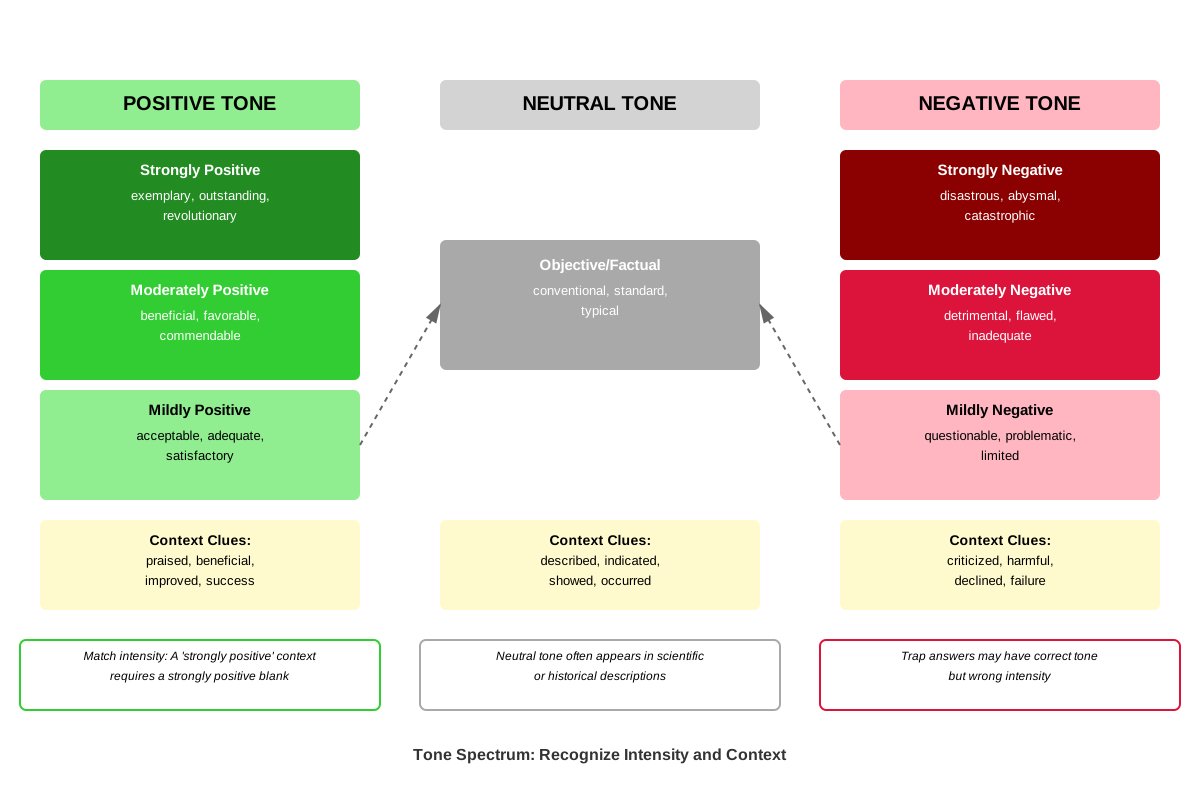
The foundation of positive negative neutral prediction rests on categorizing words and concepts into three primary tonal categories. Positive tone words express approval, benefit, improvement, or favorable qualities. Examples include "beneficial," "enhance," "commendable," "flourish," and "exemplary." Negative tone words convey disapproval, harm, deterioration, or unfavorable qualities, such as "detrimental," "undermine," "reprehensible," "languish," and "abysmal." Neutral tone words describe without evaluating, presenting information objectively: "change," "different," "modify," "occur," and "characteristic."
The GRE frequently tests the ability to distinguish between these categories because many sophisticated vocabulary words have subtle connotations that native speakers might overlook. A word like "notorious" is negative (famous for something bad), while "renowned" is positive (famous for something good), even though both relate to being well-known. Similarly, "frugal" carries a positive or neutral connotation (wisely economical), while "miserly" is decidedly negative (stingy to an excessive degree).
Identifying Context Clues for Tone
Context clues are the textual signals that reveal what tone the blank requires. These clues typically fall into several categories:
Descriptive context provides direct information about the subject. If a sentence describes someone as "generous and kind," any blank describing that person likely requires a positive word. If the sentence mentions "devastating consequences" or "severe problems," blanks related to these outcomes will likely need negative words.
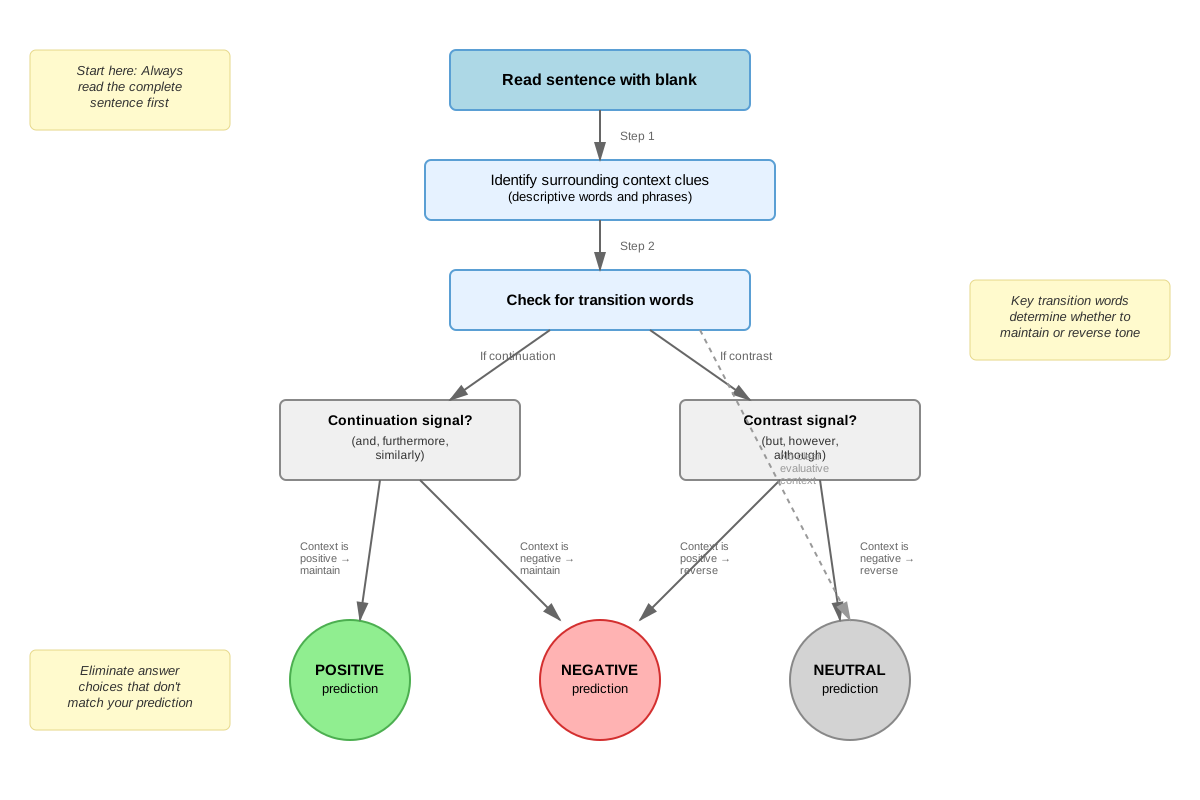
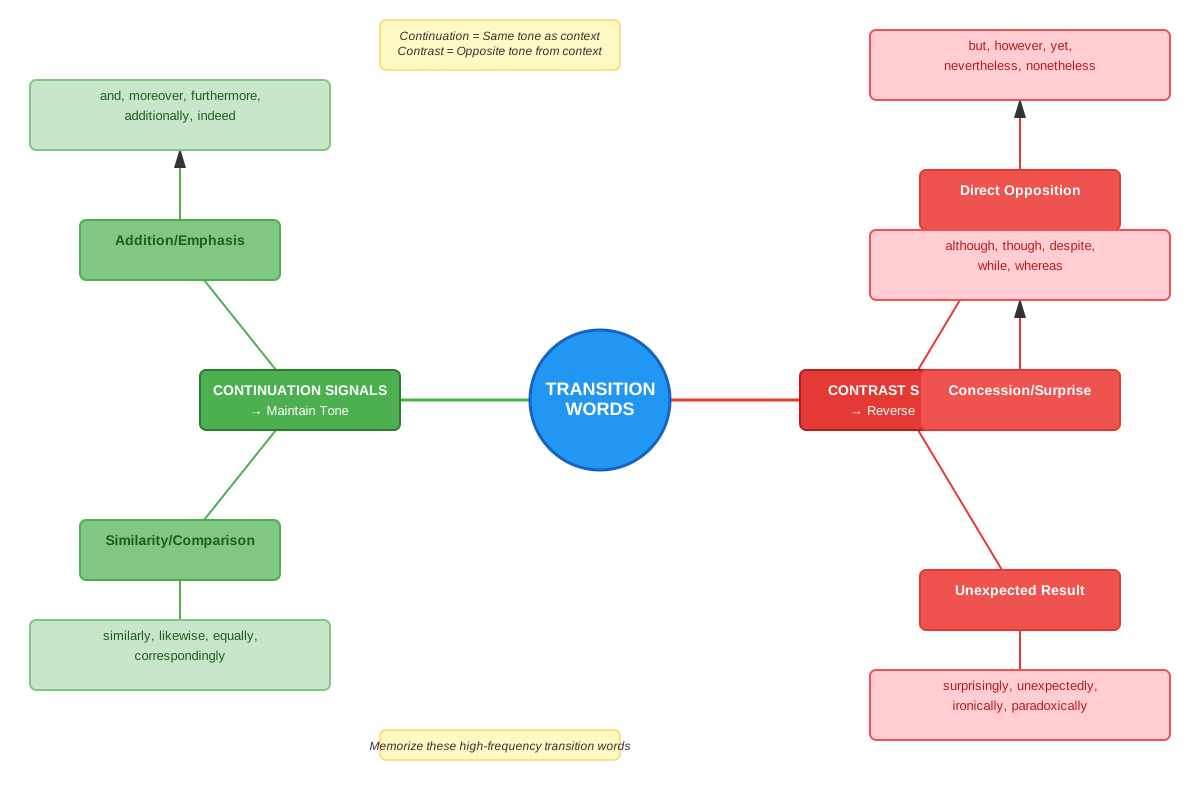
Transition words are perhaps the most reliable tone indicators. Continuity transitions (moreover, furthermore, similarly, likewise, indeed, in fact) signal that the blank should match the tone of the surrounding context. Contrast transitions (however, although, despite, nevertheless, yet, but, conversely) indicate that the blank should have the opposite tone from what precedes or follows it.
Cause-and-effect relationships create logical tone connections. If a sentence states that "Because the policy was disastrous, the results were _____," the blank must be negative to maintain logical consistency. Conversely, "Because the innovation was groundbreaking, it _____ the industry" requires a positive word like "revolutionized" or "transformed."
The Prediction Process
The systematic application of positive negative neutral prediction follows a four-step process:
- Read the entire sentence carefully without looking at answer choices, identifying the main subject and the relationship between clauses
- Locate and analyze context clues, paying special attention to transition words, descriptive phrases, and logical relationships
- Predict the tone (positive, negative, or neutral) and, if possible, predict the intensity (mildly positive, strongly negative, etc.) or a rough synonym
- Evaluate answer choices by immediately eliminating options that don't match the predicted tone, then selecting the best fit from remaining options
This process transforms Text Completion from a vocabulary test into a logical reasoning exercise. Even when students don't know the precise definition of every answer choice, they can often eliminate three or four options based solely on tone, dramatically improving their odds of selecting the correct answer.
Tone Intensity and Nuance
Advanced application of this strategy requires recognizing that tone exists on a spectrum, not as binary categories. Consider these negative words arranged by intensity:
| Mild Negative | Moderate Negative | Strong Negative |
|---|---|---|
| questionable | problematic | catastrophic |
| concerning | troubling | devastating |
| imperfect | flawed | abysmal |
| criticized | condemned | vilified |
The GRE often includes answer choices that match the correct tone but have inappropriate intensity. A sentence describing a "minor setback" wouldn't pair well with "catastrophic," even though both are negative. Context clues about severity, scope, and impact help predict not just tone but intensity.
Special Cases: Neutral Predictions
While positive and negative predictions are more common, some GRE questions require neutral words. These typically appear in sentences that describe changes, differences, or characteristics without evaluating them as good or bad. Phrases like "merely different," "simply a variation," or "neither better nor worse" signal neutral predictions. Neutral words include "alter," "modify," "distinguish," "characterize," and "vary."
Concept Relationships
The positive negative neutral prediction strategy connects intimately with several other Text Completion skills. Context clue analysis provides the raw material for tone prediction—without identifying relevant context clues, accurate tone prediction becomes impossible. The relationship flows: Context Clues → Tone Prediction → Answer Elimination → Correct Selection.
Transition word recognition serves as a specialized subset of context clue analysis that directly determines whether tone should continue or reverse. Mastering transitions (a prerequisite skill) enables faster and more accurate tone predictions. The relationship is: Transition Word Identified → Tone Direction Determined (same or opposite) → Prediction Refined.
Vocabulary knowledge operates bidirectionally with tone prediction. Strong vocabulary enables recognition of answer choice tones, but tone prediction also helps students work with unfamiliar vocabulary. If a student doesn't know "vituperate" but has predicted "strongly negative," they can infer that "vituperate" (which means to criticize harshly) might be correct if other negative options are milder or don't fit contextually.
The strategy also connects forward to more advanced skills like semantic field analysis (grouping words by meaning) and logical completion (ensuring the sentence makes logical sense). Tone prediction acts as the first filter, followed by semantic appropriateness, then logical coherence. This hierarchical relationship creates an efficient decision-making process: Tone Match → Meaning Match → Logic Check → Answer Selected.
Quick check — test yourself on Positive negative neutral prediction so far.
Try Flashcards →High-Yield Facts
- ⭐ Transition words are the most reliable indicators of whether a blank requires the same tone or opposite tone as surrounding context
- ⭐ Approximately 70% of GRE Text Completion questions can be narrowed to two choices using tone prediction alone
- ⭐ Contrast transitions (however, although, despite, yet, nevertheless) signal tone reversal and are tested more frequently than continuity transitions
- ⭐ When a sentence contains multiple blanks, solving the blank with the clearest context clues first often reveals the tone needed for other blanks
- ⭐ Words describing consequences typically match the tone of their causes (positive cause → positive consequence; negative cause → negative consequence)
- Neutral predictions are less common but appear in approximately 15% of Text Completion questions
- Intensity mismatches (correct tone but wrong degree) are among the most common trap answers on medium and hard questions
- Descriptive adjectives and adverbs near the blank are high-yield context clues for tone prediction
- Questions with three blanks almost always require tone prediction for at least two of the blanks
- The GRE rarely uses purely neutral sentences; most contain evaluative language that signals positive or negative tone
Common Misconceptions
Misconception: All words with similar meanings have the same tone. → Correction: Synonyms often differ significantly in connotation. "Childlike" (positive/neutral) and "childish" (negative) both relate to children but carry different tones. "Assertive" (positive) and "aggressive" (negative) both describe forceful behavior but with opposite evaluations.
Misconception: Formal or sophisticated-sounding words are more likely to be correct. → Correction: The GRE includes trap answers that sound impressive but don't match the required tone or meaning. A simple word that fits the tone and context perfectly is always better than a complex word that doesn't fit.
Misconception: Neutral words can substitute for positive or negative words when unsure. → Correction: Using a neutral word when the context clearly requires evaluation (positive or negative) creates a sentence that lacks logical coherence. Neutral words work only when the context genuinely avoids evaluation.
Misconception: Tone prediction only works for single-blank questions. → Correction: Tone prediction is equally valuable—and often more powerful—for double-blank and triple-blank questions, where the tone of one blank often determines or constrains the tone of others.
Misconception: If you can't predict an exact word, tone prediction won't help. → Correction: Even when you cannot predict a specific word, predicting tone eliminates multiple answer choices and dramatically improves your odds. Tone prediction is most valuable precisely when vocabulary knowledge is incomplete.
Worked Examples
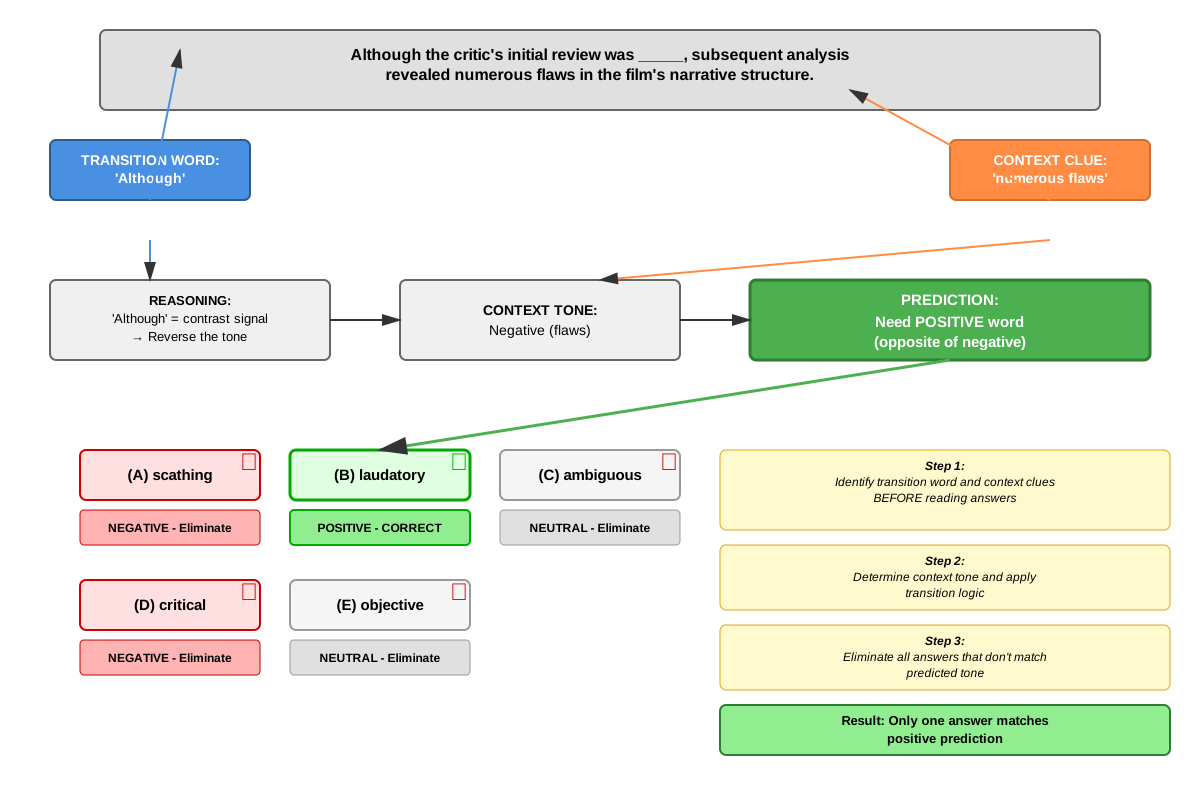
Example 1: Single-Blank with Contrast Transition
Question: Although the scientist's methodology was _____, her conclusions were widely accepted by the research community.
Step 1 - Read and Identify Structure: The sentence uses "Although," a contrast transition, indicating that the blank should have the opposite tone from "widely accepted" (positive).
Step 2 - Analyze Context Clues: "Widely accepted" is clearly positive. The contrast transition "Although" signals that the methodology must be described negatively.
Step 3 - Predict Tone: Negative (something wrong with the methodology, despite good conclusions)
Step 4 - Evaluate Hypothetical Answer Choices:
- (A) innovative [positive - ELIMINATE]
- (B) questionable [negative - KEEP]
- (C) meticulous [positive - ELIMINATE]
- (D) conventional [neutral - ELIMINATE]
- (E) flawed [negative - KEEP]
Step 5 - Final Selection: Between "questionable" and "flawed," both fit the tone. Additional context about severity would determine the best choice, but tone prediction has eliminated three options immediately, improving odds from 20% to 50%.
Example 2: Double-Blank with Cause-Effect Relationship
Question: The manager's (i)_____ approach to employee feedback created a (ii)_____ work environment where staff felt undervalued.
Blank (i) Options: supportive, dismissive, systematic
Blank (ii) Options: productive, toxic, structured
Step 1 - Identify Relationships: The first blank (approach to feedback) causes the second blank (type of environment). The phrase "staff felt undervalued" provides crucial context—this is clearly negative.
Step 2 - Work Backward from Clearest Clue: "Undervalued" is negative, so blank (ii) must be negative. Among the options, "toxic" is the only negative word (productive is positive, structured is neutral).
Step 3 - Determine Blank (i) Tone: Since the negative environment was caused by the manager's approach, blank (i) must also be negative. "Dismissive" is the only negative option (supportive is positive, systematic is neutral).
Step 4 - Verify Logic: "The manager's dismissive approach to employee feedback created a toxic work environment where staff felt undervalued." This sentence is logically coherent with consistent negative tone throughout.
Answer: dismissive, toxic
This example demonstrates how tone prediction for one blank can determine the tone needed for another blank, and how working from the clearest context clue (in this case, "undervalued") provides the key to solving the entire question.
Exam Strategy
When approaching GRE Text Completion questions using positive negative neutral prediction, follow this strategic framework:
Before reading answer choices, invest 15-20 seconds in careful sentence analysis. This upfront investment saves time by preventing the need to re-read after being confused by answer choices. Cover the answer choices with your hand if necessary to avoid premature exposure.
Trigger words to watch for include all contrast transitions (however, although, despite, yet, nevertheless, but, conversely, on the contrary), continuity transitions (moreover, furthermore, similarly, likewise, indeed, in fact, additionally), and evaluative language (beneficial, harmful, problematic, excellent, poor, effective, ineffective). Circle or mentally note these words as you read.
Process of elimination becomes highly efficient with tone prediction. Immediately cross out any answer choice that doesn't match your predicted tone. If you predicted "negative" and three of five options are positive or neutral, you've instantly improved your odds to 50-50 or better. For double-blank and triple-blank questions, eliminate entire answer combinations if even one blank doesn't match the predicted tone.
Time allocation should follow the 1-1.5 minute per question guideline, with tone prediction consuming approximately 20-30 seconds of that time. If you cannot determine tone within 30 seconds, make your best guess about tone and proceed—spending more time rarely improves accuracy and may cost you time needed for other questions.
When stuck between two options that both match the predicted tone, look for secondary factors: intensity (does the context suggest mild or strong?), semantic field (does the word relate to the right concept area?), and logical coherence (does the completed sentence make perfect sense?). If still uncertain, trust your first instinct—research shows that changing answers based on overthinking reduces accuracy.
Exam Tip: On test day, physically write "+" for positive, "-" for negative, or "=" for neutral next to each blank before looking at answer choices. This concrete prediction increases commitment to the strategy and improves accuracy.
Memory Techniques
TONE Mnemonic for the prediction process:
- Transitions first (identify contrast or continuity words)
- Opposite or same (determine if tone reverses or continues)
- Narrow choices (eliminate mismatched tones)
- Evaluate remaining (select best fit from tone-matched options)
Contrast Transition Acronym - HANDY:
- However
- Although
- Nevertheless
- Despite
- Yet
Continuity Transition Acronym - FILMS:
- Furthermore
- Indeed
- Likewise
- Moreover
- Similarly
Visualization Strategy: Imagine a traffic light system. Green = positive (go ahead, good), Red = negative (stop, bad), Yellow = neutral (caution, neither). As you read the sentence, visualize which color light should fill the blank based on context clues.
Intensity Scale Memory Aid: Picture a volume dial or thermometer. Mild words are at low volume/temperature, moderate words in the middle, and strong words at high volume/temperature. This helps distinguish between "concerned" (mild negative), "worried" (moderate negative), and "terrified" (strong negative).
Summary
Positive negative neutral prediction is a systematic strategy for GRE Text Completion questions that involves analyzing context clues to determine whether a blank requires a positive, negative, or neutral word before examining answer choices. This approach transforms Text Completion from a vocabulary challenge into a logical reasoning task by providing a clear framework for elimination. The strategy relies on identifying transition words (contrast vs. continuity), descriptive context, and cause-effect relationships to predict tone accurately. By predicting tone first, test-takers eliminate 60-80% of answer choices immediately, dramatically improving accuracy and efficiency. The technique works for single-blank, double-blank, and triple-blank questions, with particular power in multi-blank questions where solving one blank reveals the tone needed for others. Mastery requires recognizing not just positive versus negative, but also intensity gradations and the special case of neutral predictions. Combined with vocabulary knowledge and logical reasoning, tone prediction provides a reliable, repeatable approach to one of the most heavily tested question types on the GRE Verbal Reasoning section.
Key Takeaways
- Always predict tone (positive, negative, or neutral) before reading answer choices to avoid trap answers and improve efficiency
- Transition words are the most reliable tone indicators: contrast transitions signal tone reversal, continuity transitions signal tone continuation
- Eliminate answer choices that don't match predicted tone immediately, often removing 60-80% of options
- For multi-blank questions, solve the blank with the clearest context clues first, then use that answer to predict tone for remaining blanks
- Tone prediction works even with incomplete vocabulary knowledge, making it especially valuable for challenging questions
- Consider both tone category and intensity when predicting—"negative" is less precise than "strongly negative"
- Practice the TONE process (Transitions, Opposite or same, Narrow choices, Evaluate remaining) until it becomes automatic
Related Topics
Context Clue Analysis: A broader skill encompassing all types of textual hints (definition, example, contrast, cause-effect) that reveal what belongs in a blank. Mastering tone prediction provides a foundation for recognizing and categorizing these diverse clue types.
Transition Word Mastery: An in-depth study of all transition categories (contrast, continuity, cause-effect, sequence, example) and their specific functions. Strong transition word knowledge makes tone prediction faster and more accurate.
Vocabulary in Context: The skill of determining word meaning from surrounding text and selecting words that fit both semantically and tonally. Tone prediction serves as the first filter in this more comprehensive approach.
Sentence Equivalence Strategies: A related question type where two answers must create sentences with equivalent meaning. Tone prediction helps identify the pair of words that match both the required tone and each other's meaning.
Double and Triple Blank Techniques: Advanced strategies for multi-blank questions, including blank interdependence and systematic elimination. Tone prediction is foundational to these more complex approaches.
Practice CTA
Now that you understand the positive negative neutral prediction strategy, it's time to put this knowledge into action. The practice questions and flashcards are specifically designed to reinforce the TONE process and build your ability to predict accurately under timed conditions. Each practice question you complete strengthens the neural pathways that make tone prediction automatic, transforming this conscious strategy into an unconscious skill. Remember: every GRE expert was once a beginner who committed to deliberate practice. Your investment in mastering this high-yield strategy will pay dividends across dozens of questions on test day. Start practicing now, and watch your Text Completion accuracy soar!
Sign up free to keep reading
Create a free AnvayaPrep account to finish this GRE guide on Positive negative neutral prediction — plus flashcards and practice questions.