Overview
Tone clues represent one of the most powerful and frequently tested strategies in GRE Text Completion questions. These linguistic signals reveal the author's attitude, emotional stance, or evaluative perspective toward the subject matter, providing critical context that helps test-takers predict the correct answer before even examining the answer choices. Mastering tone clues transforms Text Completion from a vocabulary guessing game into a logical, systematic process grounded in textual evidence.
On the GRE Verbal Reasoning section, gre tone clues appear in approximately 60-70% of Text Completion questions, making them one of the highest-yield strategies for score improvement. These clues manifest through specific word choices, punctuation patterns, and structural elements that signal whether the author views something positively, negatively, or neutrally. Understanding tone clues enables test-takers to eliminate incorrect answer choices rapidly and select responses that maintain logical and tonal consistency throughout the passage.
Within the broader framework of Text Completion strategies, tone clues work synergistically with other contextual indicators such as transition words, contrast signals, and definitional clues. While transition words show logical relationships between ideas and contrast signals indicate opposing concepts, tone clues specifically reveal the emotional or evaluative dimension of the text. This makes them particularly valuable for questions involving adjectives, adverbs, and verbs that carry attitudinal weight. Developing sensitivity to tone clues enhances overall reading comprehension and prepares students for the nuanced language analysis required throughout the Verbal Reasoning section.
Learning Objectives
- [ ] Identify when Tone clues is being tested in GRE Text Completion questions
- [ ] Explain the core rule or strategy behind Tone clues and how they function in context
- [ ] Apply Tone clues to GRE-style questions accurately and efficiently
- [ ] Distinguish between positive, negative, and neutral tone indicators in complex sentences
- [ ] Recognize subtle tone shifts and their implications for answer selection
- [ ] Combine tone clue analysis with other contextual strategies for maximum accuracy
- [ ] Predict answer choices based on tone before reviewing options
Prerequisites
- Basic vocabulary knowledge: Understanding common GRE-level words enables recognition of tone-carrying terms and their connotations
- Sentence structure comprehension: Identifying subjects, verbs, and modifiers helps locate where tone clues appear and what they modify
- Logical reasoning skills: Following cause-and-effect relationships and understanding how ideas connect supports accurate tone interpretation
- Familiarity with Text Completion format: Knowing the question structure allows focus on strategy rather than format confusion
Why This Topic Matters
Tone clues represent a fundamental skill that extends far beyond standardized testing into academic reading, professional communication, and critical analysis. In scholarly articles, business communications, and literary texts, recognizing an author's attitude toward their subject matter enables deeper comprehension and more sophisticated interpretation. This skill proves essential for graduate-level coursework where students must analyze arguments, evaluate sources, and understand nuanced positions.
On the GRE specifically, tone clues appear in approximately 12-15 questions per test across both Text Completion and Sentence Equivalence formats. Questions testing tone awareness typically appear at medium to high difficulty levels, making them critical for achieving scores above the 160 threshold. The Educational Testing Service (ETS) deliberately constructs questions where tone consistency serves as the primary discriminator between correct and incorrect answers, particularly in questions featuring evaluative adjectives or attitudinal verbs.
Common manifestations of tone clues in GRE passages include: adjectives describing people, ideas, or phenomena (laudable, deplorable, remarkable); adverbs modifying actions or qualities (surprisingly, predictably, unfortunately); verbs conveying judgment or evaluation (condemn, celebrate, dismiss); and nouns with inherent positive or negative connotations (triumph, debacle, achievement). These elements often appear in contexts where the author's perspective becomes the key to solving the blank, rather than pure definitional knowledge or logical relationships alone.
Core Concepts
Definition and Function of Tone Clues
Tone clues are words, phrases, or punctuation marks within a sentence or passage that reveal the author's attitude, emotional stance, or evaluative judgment toward the subject matter. These linguistic signals function as contextual anchors that constrain the range of acceptable answers by establishing whether the missing word must be positive, negative, or neutral in connotation. Unlike purely logical or definitional clues, tone clues operate on the affective dimension of language, requiring test-takers to sense the emotional temperature of the text.
The primary function of tone clues involves creating tonal consistency throughout a sentence or passage. When an author describes something as "unfortunately" or "regrettably," subsequent word choices must align with this negative evaluation. Conversely, words like "fortunately," "admirably," or "impressively" establish positive frameworks that demand corresponding positive vocabulary in the blank. This consistency principle operates even in complex sentences with multiple clauses, where tone established in one segment must be maintained or deliberately contrasted in another.
Categories of Tone-Carrying Words
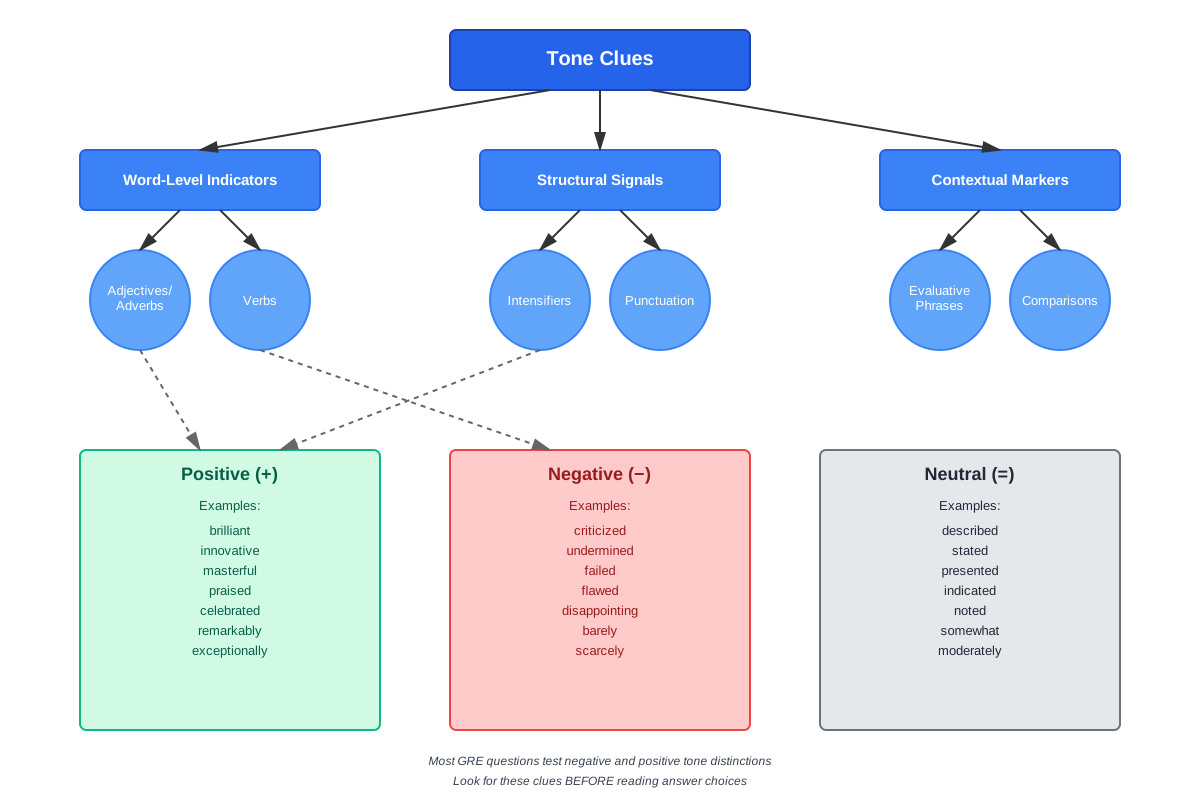
Tone clues manifest through several distinct grammatical categories, each serving specific functions in conveying authorial attitude:
| Category | Function | Examples | Tone Indicated |
|---|---|---|---|
| Evaluative Adjectives | Directly describe qualities with judgment | laudable, deplorable, exemplary, abysmal | Strong positive/negative |
| Attitudinal Adverbs | Modify actions/states with emotional coloring | fortunately, regrettably, surprisingly, predictably | Positive/negative/neutral |
| Judgment Verbs | Express approval, disapproval, or assessment | celebrate, condemn, lament, praise, criticize | Clear positive/negative |
| Loaded Nouns | Carry inherent positive/negative associations | triumph, disaster, achievement, fiasco | Strong connotations |
| Intensifiers | Amplify or diminish tone strength | utterly, somewhat, extremely, barely | Degree of tone |
Positive Tone Indicators
Positive tone clues signal approval, admiration, success, or favorable evaluation. These indicators appear in contexts where the author views something as beneficial, impressive, or desirable. Common positive tone markers include:
- Approval words: commendable, praiseworthy, admirable, exemplary, laudable
- Success indicators: triumph, achievement, breakthrough, success, accomplishment
- Positive adverbs: fortunately, happily, impressively, remarkably, brilliantly
- Enhancement verbs: improve, enhance, elevate, enrich, strengthen
- Favorable adjectives: beneficial, advantageous, productive, valuable, constructive
When positive tone clues appear, the blank must be filled with a word that maintains this favorable evaluation. For example, if a sentence describes a scientist's work as "laudable," any blank describing that work must contain a positive term like "innovative" rather than a negative term like "derivative."
Negative Tone Indicators
Negative tone clues express disapproval, criticism, failure, or unfavorable judgment. These signals indicate the author's negative stance toward the subject matter. Key negative tone markers include:
- Disapproval words: deplorable, lamentable, regrettable, unfortunate, troubling
- Failure indicators: debacle, disaster, fiasco, setback, catastrophe
- Negative adverbs: unfortunately, regrettably, disappointingly, alarmingly, disturbingly
- Criticism verbs: condemn, denounce, criticize, disparage, censure
- Unfavorable adjectives: detrimental, harmful, counterproductive, problematic, deficient
Negative tone clues require corresponding negative vocabulary in blanks. A sentence describing a policy as "regrettably shortsighted" demands that any blank describing its effects contain negative terms like "undermined" rather than positive terms like "enhanced."
Neutral and Objective Tone Indicators
Some passages maintain neutral, objective, or balanced tone, particularly in scientific or analytical contexts. Neutral tone clues include:
- Factual verbs: demonstrate, indicate, show, reveal, suggest
- Objective descriptors: significant, notable, considerable, substantial, marked
- Analytical terms: analysis, examination, investigation, assessment, evaluation
- Balanced language: both, however, although, while, whereas
Neutral contexts require answer choices that avoid strong positive or negative connotations, focusing instead on descriptive or analytical vocabulary.
Tone Shifts and Contrast Signals
Advanced GRE questions often feature tone shifts where the author's attitude changes within a sentence, typically signaled by contrast words. Common contrast signals that indicate tone shifts include:
- Strong contrasts: but, however, yet, nevertheless, nonetheless
- Unexpected outcomes: surprisingly, ironically, paradoxically, contrary to expectations
- Opposition markers: despite, although, while, whereas, in contrast
When contrast signals appear, the tone after the signal typically opposes the tone before it. For example: "Although the theory seemed _____ at first, it proved remarkably insightful." The contrast signal "although" indicates that the blank must contain a negative term (like "dubious") to contrast with the positive "remarkably insightful."
Punctuation as Tone Indicator
Punctuation marks can serve as subtle tone clues:
- Quotation marks: Often indicate skepticism, irony, or distancing from a term
- Exclamation points: Signal strong emotion or emphasis (rare in GRE passages)
- Dashes: Frequently introduce explanatory material that clarifies tone
- Parentheses: May contain asides that reveal authorial attitude
For example: The so-called "expert" offered advice that was _____ at best. The quotation marks around "expert" signal skepticism, indicating the blank should contain a negative term like "questionable."
Concept Relationships
Tone clues function as one component within a comprehensive Text Completion strategy framework. They connect most directly to context clues, serving as a specific type of contextual information that reveals authorial attitude rather than pure meaning. While definitional clues tell us what something is, tone clues tell us how the author feels about it.
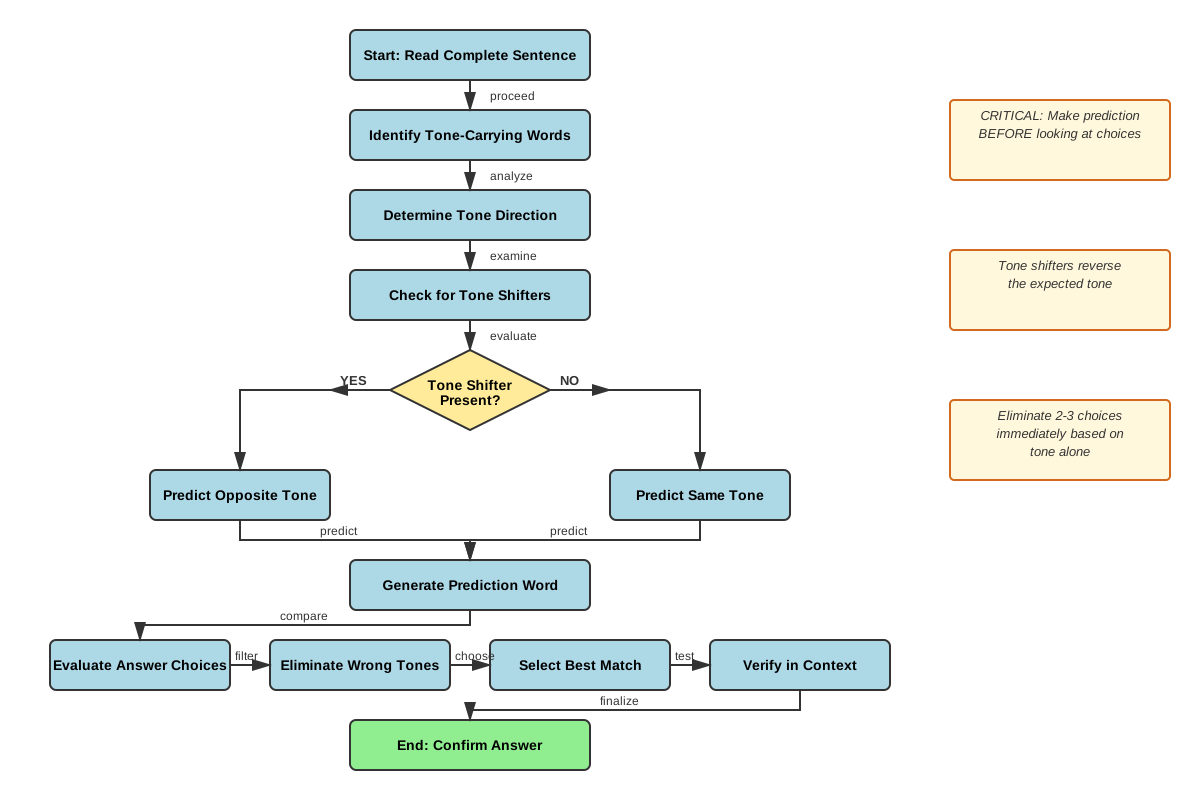
The relationship between tone clues and contrast signals proves particularly important: contrast words often trigger tone shifts, requiring test-takers to recognize when tone reverses within a sentence. This creates a hierarchical relationship: Contrast Signal → Tone Shift → Opposite Tone Required in Blank.
Similarly, tone clues interact with support/continuation signals (words like "and," "also," "furthermore") which indicate that tone should remain consistent rather than shift. This creates another pathway: Support Signal → Tone Continuation → Same Tone Required in Blank.
The relationship map flows as follows:
Sentence Structure → contains → Tone Clues → reveal → Authorial Attitude → constrains → Answer Choice Connotation → determines → Correct Answer
Additionally: Contrast Signals → trigger → Tone Shifts → require → Opposite Tone in Blank
And: Support Signals → maintain → Tone Consistency → require → Same Tone in Blank
High-Yield Facts
⭐ Tone clues appear in approximately 60-70% of GRE Text Completion questions, making them one of the most frequently tested strategies.
⭐ Contrast words (but, however, yet, although, despite) typically signal tone shifts, requiring opposite-tone vocabulary in the blank.
⭐ Evaluative adjectives and adverbs are the most common tone clue carriers, particularly words ending in -able, -ful, -ly, and -ous.
⭐ Positive tone clues require positive answer choices; negative tone clues require negative answer choices to maintain tonal consistency.
⭐ Quotation marks around a word often signal authorial skepticism or irony, indicating a negative or questioning tone toward that concept.
- Tone clues can appear anywhere in a sentence: before the blank, after the blank, or in a different clause entirely.
- Multiple tone clues in a single sentence typically reinforce each other, creating cumulative evidence for the correct answer's connotation.
- Neutral, objective passages require answer choices that avoid strong positive or negative connotations.
- Words like "surprisingly," "ironically," and "paradoxically" signal unexpected outcomes and often indicate tone shifts.
- The strongest tone clues are words that inherently carry judgment: condemn, celebrate, lament, praise, deplore, admire.
- Intensifiers (very, extremely, utterly, somewhat, barely) modify the strength of tone but not its direction.
- When tone clues conflict with logical clues, tone typically takes precedence in determining the correct answer's connotation.
Quick check — test yourself on Tone clues so far.
Try Flashcards →Common Misconceptions
Misconception: Tone clues only appear immediately adjacent to the blank.
Correction: Tone clues can appear anywhere in the sentence or even in preceding sentences. Test-takers must scan the entire context, not just words immediately surrounding the blank. A tone clue in an opening clause can determine the correct answer for a blank in the final clause.
Misconception: All adjectives and adverbs function as tone clues.
Correction: Only evaluative or attitudinal adjectives and adverbs serve as tone clues. Purely descriptive words (large, blue, quickly, slowly) provide factual information without revealing authorial attitude. Tone clues specifically convey judgment, emotion, or evaluation.
Misconception: Neutral passages don't contain tone clues.
Correction: Even objective, analytical passages contain subtle tone indicators through word choice. The absence of strong positive or negative language itself serves as a tone clue, indicating that answer choices should be neutral or balanced rather than emotionally charged.
Misconception: Tone clues always appear as single words.
Correction: Tone can be established through phrases ("contrary to expectations," "much to everyone's surprise"), sentence structure (rhetorical questions suggesting skepticism), or cumulative word choice across multiple clauses. Effective tone analysis requires holistic reading, not just keyword spotting.
Misconception: If a sentence contains both positive and negative words, tone clues are unreliable.
Correction: Sentences with mixed tone typically feature contrast signals that clarify which tone applies to which part of the sentence. The key is identifying whether the blank falls before or after the contrast signal, then applying the appropriate tone. Mixed-tone sentences test sophisticated reading comprehension but remain solvable through careful structural analysis.
Misconception: Tone clues work independently of other context clues.
Correction: Tone clues function most effectively when integrated with logical relationships, definitional clues, and structural signals. The most reliable answers satisfy both tonal consistency and logical coherence. Tone narrows the connotation (positive/negative/neutral) while other clues narrow the specific meaning.
Worked Examples
Example 1: Basic Tone Clue Application
Question: The critic's review was surprisingly _____, given her typically harsh assessments of contemporary art.
(A) scathing
(B) laudatory
(C) ambivalent
(D) technical
(E) brief
Step 1 - Identify tone clues: The word "surprisingly" signals an unexpected outcome. The phrase "typically harsh assessments" establishes the critic's usual negative tone.
Step 2 - Determine required tone: Since "surprisingly" indicates something unexpected, and the critic is "typically harsh," the blank must contain a word with the opposite tone—something positive or at least not harsh.
Step 3 - Evaluate answer choices by tone:
- (A) scathing = negative (matches typical tone, not surprising)
- (B) laudatory = positive (opposite of typical tone, would be surprising) ✓
- (C) ambivalent = neutral (somewhat different but not strongly opposite)
- (D) technical = neutral/descriptive (no tonal opposition)
- (E) brief = neutral/descriptive (no tonal opposition)
Step 4 - Select answer: (B) laudatory is correct because it provides the positive tone required to create the surprising contrast with "typically harsh assessments."
Connection to learning objectives: This example demonstrates identifying tone clues ("surprisingly," "harsh"), explaining the strategy (contrast signals require opposite tone), and applying it accurately to select the correct answer.
Example 2: Complex Tone Shift with Multiple Clues
Question: Although the initial results appeared _____, further investigation revealed that the methodology was fundamentally flawed, rendering the conclusions entirely unreliable.
(A) promising
(B) inconclusive
(C) erroneous
(D) conventional
(E) preliminary
Step 1 - Identify structural signals: "Although" signals a contrast between two parts of the sentence. This indicates a tone shift.
Step 2 - Analyze tone in each segment:
- First clause (before contrast): describes "initial results" with blank
- Second clause (after contrast): strongly negative tone ("fundamentally flawed," "entirely unreliable")
Step 3 - Determine required tone: Since "although" creates opposition, and the second clause is strongly negative, the first clause (containing the blank) must be positive or at least not negative. The blank describes how results "appeared" initially, before the problems were discovered.
Step 4 - Evaluate answer choices:
- (A) promising = positive (creates effective contrast with negative second clause) ✓
- (B) inconclusive = neutral (weak contrast)
- (C) erroneous = negative (no contrast, same tone as second clause)
- (D) conventional = neutral (no tonal contrast)
- (E) preliminary = neutral/descriptive (no tonal contrast)
Step 5 - Verify logical coherence: "Although the initial results appeared promising" makes logical sense—researchers initially thought they had good results, but later discovered problems. This satisfies both tonal and logical requirements.
Answer: (A) promising
Connection to learning objectives: This example demonstrates identifying complex tone clues (contrast signal plus multiple negative descriptors), recognizing tone shifts, and combining tone analysis with logical reasoning for accurate answer selection.
Exam Strategy
Systematic Approach to Tone Clue Questions
When approaching GRE Text Completion questions, implement this four-step process:
- Read the entire sentence first without looking at answer choices, focusing on understanding the overall meaning and identifying any tone indicators
- Circle or mentally note all tone clues: evaluative adjectives, attitudinal adverbs, judgment verbs, and contrast/support signals
- Predict the tone (positive, negative, or neutral) required in the blank before reviewing options
- Eliminate answer choices that don't match the required tone, then select the best remaining option based on meaning
Trigger Words to Watch For
Develop automatic recognition of these high-frequency tone indicators:
Positive triggers: fortunately, admirably, commendable, laudable, exemplary, impressive, beneficial, enhance, celebrate, triumph
Negative triggers: unfortunately, regrettably, deplorable, lamentable, problematic, detrimental, undermine, condemn, disaster, flawed
Contrast triggers (indicating tone shift): but, however, yet, although, despite, nevertheless, surprisingly, ironically, contrary to
Support triggers (indicating tone continuation): and, also, furthermore, similarly, likewise, indeed, in fact
Process of Elimination Strategy
Tone clues enable rapid elimination of incorrect answers:
- First pass: Eliminate all choices with wrong tone (if tone is clearly positive, eliminate all negative options immediately)
- Second pass: Among remaining choices with correct tone, eliminate those that don't fit the logical context
- Final selection: Choose the answer that best satisfies both tonal and logical requirements
This strategy typically eliminates 3-4 options quickly, leaving only 1-2 viable candidates for careful consideration.
Time Allocation Advice
For medium-difficulty tone clue questions:
- 15-20 seconds: Initial reading and tone clue identification
- 10-15 seconds: Predicting required tone and eliminating wrong-tone options
- 10-15 seconds: Evaluating remaining options and selecting answer
- Total: 35-50 seconds per question
For complex questions with multiple blanks or subtle tone shifts, allocate up to 60-75 seconds. If a question requires more time, mark it for review and move forward to maintain pacing.
Exam Tip: When two answer choices have the correct tone, the distinguishing factor is usually specificity or logical fit. Choose the word that most precisely matches both the tone and the specific context described in the sentence.
Memory Techniques
The TONE Acronym
Test for attitude words (adjectives, adverbs expressing judgment)
Opposite tone after contrast words (but, however, although)
Note the direction (positive, negative, neutral)
Eliminate mismatched options immediately
Visualization Strategy: The Emotional Thermometer
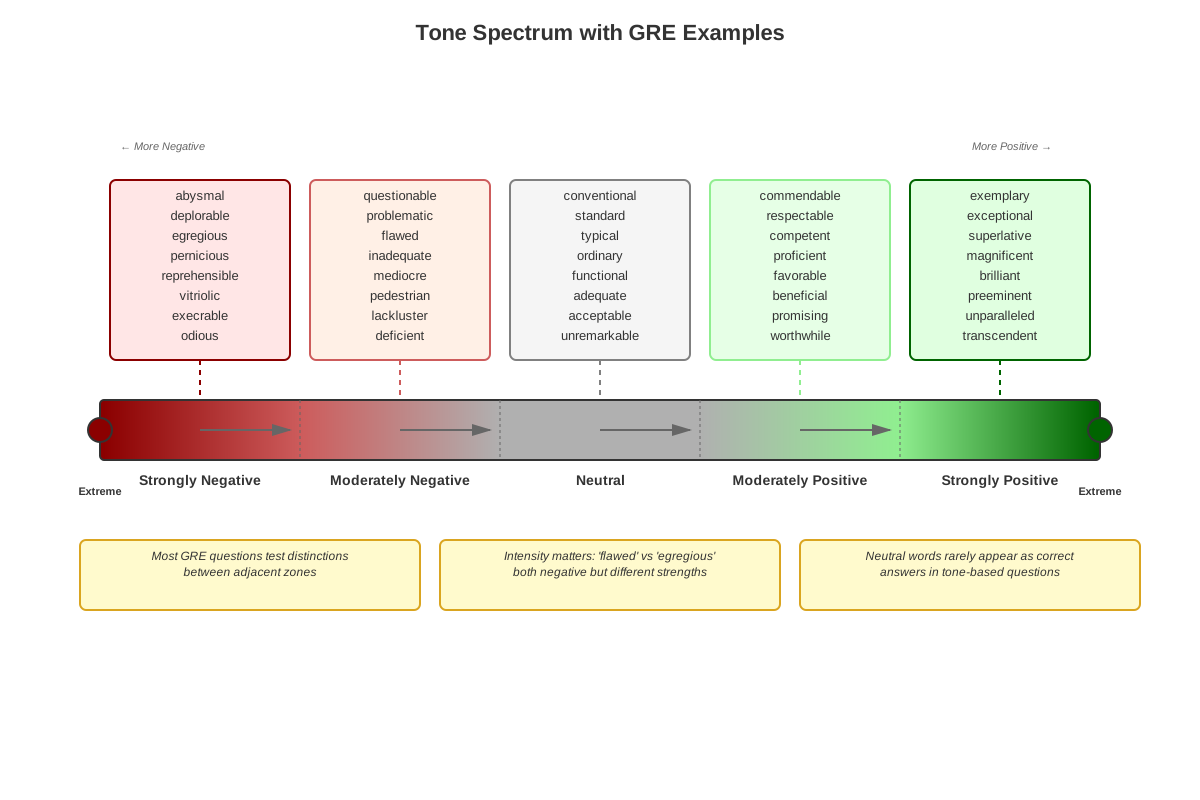
Visualize tone on a thermometer scale:
- Hot (top): Strongly positive (celebrate, exemplary, triumph)
- Warm: Moderately positive (beneficial, commendable, favorable)
- Room temperature (middle): Neutral (significant, notable, considerable)
- Cool: Moderately negative (problematic, questionable, concerning)
- Cold (bottom): Strongly negative (deplorable, disastrous, condemn)
When you identify a tone clue, mentally place it on this thermometer, then find an answer choice at the same temperature level.
The Contrast Flip Technique
For sentences with contrast words, use this mental image: Picture a light switch. When you encounter "but," "however," or "although," mentally flip the switch. If the tone before the switch was positive (light on), the tone after must be negative (light off), and vice versa.
Mnemonic for Common Positive Tone Words
PLACE - Positive Language Appears in Commendable Expressions:
- Praiseworthy, Productive
- Laudable, Lucrative
- Advantageous, Admirable
- Commendable, Constructive
- Exemplary, Enriching
Mnemonic for Common Negative Tone Words
DREAD - Disapproval Reveals Extremely Adverse Descriptions:
- Deplorable, Detrimental
- Regrettable, Ruinous
- Egregious, Erroneous
- Abysmal, Adverse
- Disastrous, Deficient
Summary
Tone clues represent a critical strategy for GRE Text Completion success, appearing in the majority of questions and providing reliable pathways to correct answers. These linguistic signals—including evaluative adjectives, attitudinal adverbs, judgment verbs, and loaded nouns—reveal the author's emotional stance or evaluative perspective toward the subject matter. Mastering tone clue recognition enables test-takers to predict answer connotation (positive, negative, or neutral) before examining options, dramatically improving accuracy and efficiency. The core principle is tonal consistency: answer choices must match the tone established by clues elsewhere in the sentence unless contrast signals (but, however, although, despite) indicate a deliberate tone shift. Effective application requires systematic identification of tone indicators, classification of required tone, elimination of mismatched options, and final selection based on both tonal and logical fit. By integrating tone clue analysis with other contextual strategies and practicing recognition of high-frequency tone indicators, students develop the sophisticated reading comprehension skills necessary for top Verbal Reasoning scores.
Key Takeaways
- Tone clues appear in 60-70% of Text Completion questions, making them essential for GRE success and score improvement
- Identify tone through evaluative adjectives, attitudinal adverbs, judgment verbs, and loaded nouns that reveal authorial attitude
- Maintain tonal consistency: positive tone clues require positive answers; negative tone clues require negative answers
- Contrast words (but, however, although, despite) signal tone shifts, requiring opposite-tone vocabulary after the contrast
- Predict the required tone before reviewing answer choices, then eliminate all options with mismatched connotation
- Combine tone analysis with logical reasoning for maximum accuracy, ensuring answers satisfy both tonal and contextual requirements
- Practice systematic tone clue identification to develop automatic recognition and improve speed on test day
Related Topics
Contrast and Continuation Signals: Understanding transition words that indicate whether ideas oppose or support each other builds directly on tone clue mastery, as these signals often trigger tone shifts or maintain tone consistency.
Sentence Equivalence Strategy: Tone clue analysis proves equally valuable for Sentence Equivalence questions, where two answer choices must create sentences with equivalent meaning and tone.
Reading Comprehension - Author's Attitude Questions: The tone sensitivity developed through Text Completion practice transfers directly to identifying authorial perspective in longer passages.
Vocabulary in Context: Recognizing connotation (positive, negative, neutral) versus denotation (literal meaning) deepens understanding of how tone operates at the word level.
Advanced Text Completion - Multiple Blanks: Mastering single-blank tone clue questions prepares students for complex multi-blank questions where tone must remain consistent across multiple answer selections.
Practice CTA
Now that you understand the fundamental principles of tone clues and their application to GRE Text Completion questions, reinforce your mastery through deliberate practice. Complete the practice questions associated with this topic, focusing on identifying tone clues before predicting answers. Use the flashcards to build automatic recognition of high-frequency tone indicators, ensuring you can spot these critical signals quickly under timed conditions. Remember: tone clue mastery transforms Text Completion from vocabulary guessing into strategic, evidence-based reasoning. Every practice question you complete strengthens your pattern recognition and builds the confidence necessary for test-day success. Your investment in mastering this high-yield strategy will pay dividends across the entire Verbal Reasoning section!
Sign up free to keep reading
Create a free AnvayaPrep account to finish this GRE guide on Tone clues — plus flashcards and practice questions.