Overview
Commonly confused words represent one of the most frequently tested elements in GRE Verbal Reasoning, appearing across multiple question types including Text Completion, Sentence Equivalence, and Reading Comprehension. These are word pairs or groups that share similar spellings, pronunciations, or meanings but have distinct definitions and usage contexts. The GRE deliberately tests these words because they reveal a test-taker's precision in language use—a critical skill for graduate-level academic work. Mastering commonly confused words demonstrates not just vocabulary breadth but also the nuanced understanding of semantic distinctions that separates competent writers from exceptional ones.
The challenge with GRE commonly confused words extends beyond simple memorization. Test-makers craft questions that exploit the subtle differences between words like "affect" versus "effect," "prescribe" versus "proscribe," or "disinterested" versus "uninterested." These distinctions often hinge on part of speech, connotation, or contextual appropriateness rather than completely different meanings. A student might understand both words in isolation yet still select the wrong answer when faced with a sophisticated sentence that could seemingly accommodate either option. This topic requires developing an eye for precision and context-sensitivity that elevates overall verbal performance.
Within the broader Verbal Reasoning framework, commonly confused words intersect with vocabulary building, contextual analysis, and grammatical awareness. They bridge pure vocabulary knowledge with reading comprehension skills, as identifying the correct word often requires understanding the sentence's logical structure, tone, and intended meaning. Success with this topic strengthens performance across all verbal question types and builds the linguistic precision necessary for the Analytical Writing section, where word choice directly impacts scoring.
Learning Objectives
- [ ] Identify when commonly confused words is being tested in GRE questions
- [ ] Explain the core rule or strategy behind commonly confused words distinctions
- [ ] Apply commonly confused words knowledge to GRE-style questions accurately
- [ ] Distinguish between words based on part of speech, connotation, and usage context
- [ ] Recognize the most frequently tested word pairs on the GRE
- [ ] Develop systematic approaches for eliminating incorrect options when confused words appear
- [ ] Create personal memory aids for the 50+ most common word confusions tested on the GRE
Prerequisites
- Basic vocabulary foundation: Understanding of approximately 3,000 common English words provides the baseline for recognizing when words sound or look similar
- Parts of speech knowledge: Ability to identify nouns, verbs, adjectives, and adverbs is essential since many confused words differ primarily in grammatical function
- Sentence structure comprehension: Understanding subject-verb relationships and clause structure helps determine which word fits the grammatical context
- Contextual reading skills: Capacity to derive meaning from surrounding text enables proper word selection based on semantic appropriateness
Why This Topic Matters
Commonly confused words appear in approximately 15-20% of all GRE Verbal Reasoning questions, making them one of the highest-yield study areas for score improvement. Unlike obscure vocabulary that might appear once across an entire test, the same 50-75 commonly confused word pairs recur repeatedly across different test administrations. This predictability makes targeted study exceptionally efficient—mastering this finite list directly translates to correct answers.
In real-world academic and professional contexts, precision in word choice signals credibility and expertise. Graduate programs value this skill because research papers, grant proposals, and professional communications require exact language. A researcher who confuses "imply" and "infer" or "principal" and "principle" undermines their authority regardless of the quality of their ideas. The GRE tests these distinctions because they predict success in environments where linguistic precision matters.
On the exam itself, commonly confused words appear most frequently in Text Completion questions (especially single-blank items where the correct answer hinges on one precise word choice) and Sentence Equivalence questions (where two synonyms must both fit the context perfectly). They also appear in Reading Comprehension through vocabulary-in-context questions and in answer choices that use subtle word substitutions to create incorrect options. The Analytical Writing section indirectly tests this knowledge, as graders evaluate word choice precision when assigning scores.
Core Concepts
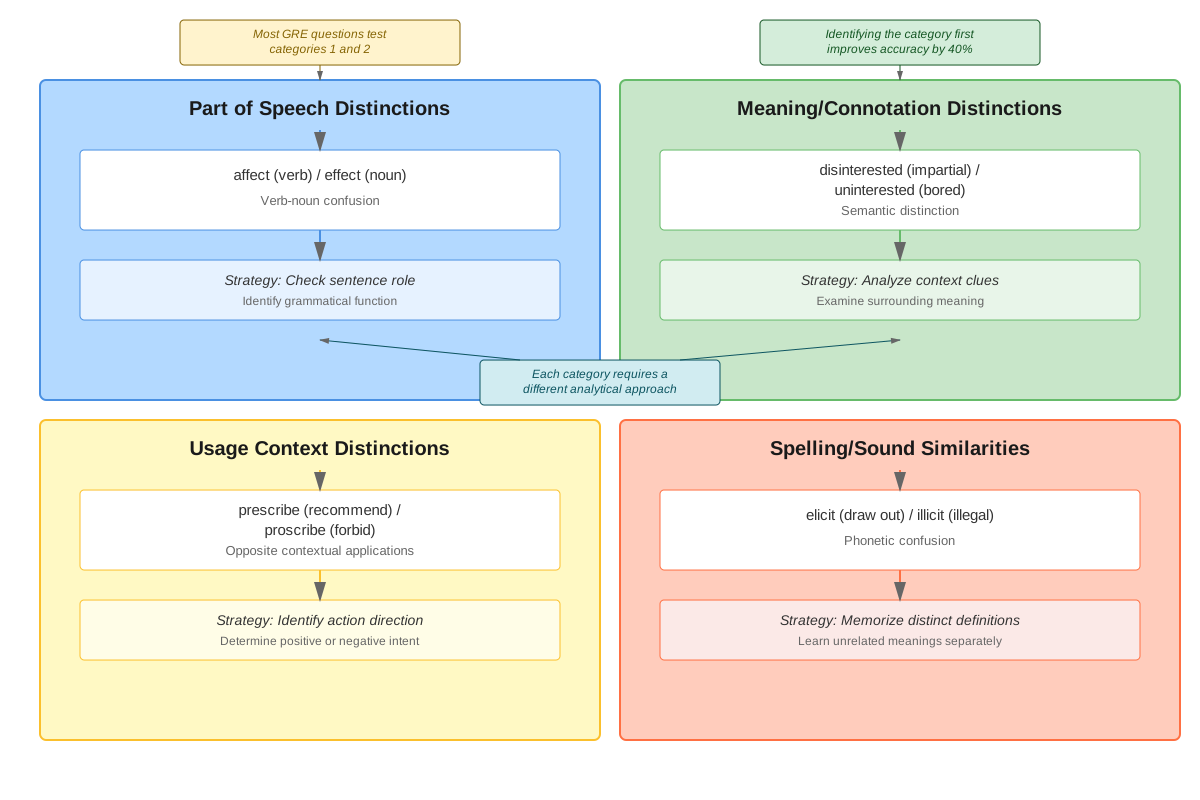
Understanding Word Confusion Categories
Commonly confused words fall into several distinct categories, each requiring different recognition strategies. The first category includes homophones—words that sound identical but have different spellings and meanings (e.g., "complement" vs. "compliment"). The second category encompasses near-homophones with similar but not identical pronunciations (e.g., "accept" vs. "except"). The third category includes words with similar spellings but different meanings and pronunciations (e.g., "desert" vs. "dessert"). Finally, some words share etymological roots but have diverged in meaning (e.g., "continuous" vs. "continual").
Part of Speech Distinctions
Many GRE word confusions center on part of speech differences. Consider "affect" versus "effect": "affect" functions primarily as a verb meaning "to influence" (though it has a rare noun usage in psychology), while "effect" functions primarily as a noun meaning "result" (though it can be a verb meaning "to bring about"). The sentence structure determines which word fits: "The medication will _____ her symptoms" requires the verb "affect," while "The medication had a positive _____ on her symptoms" requires the noun "effect."
| Word Pair | Primary Part of Speech | Meaning | Example |
|---|---|---|---|
| affect | verb | to influence | The weather affects mood |
| effect | noun | result | The effect was dramatic |
| principal | adjective/noun | main; school leader | The principal reason |
| principle | noun | fundamental truth | A matter of principle |
| stationary | adjective | not moving | The car remained stationary |
| stationery | noun | writing paper | She bought new stationery |
Semantic Nuance Distinctions
Beyond grammatical differences, many confused words have subtle semantic distinctions. "Disinterested" means "impartial or unbiased," while "uninterested" means "lacking interest or bored." Both are adjectives describing attitudes, but they convey completely different concepts. A judge should be disinterested (impartial) but not uninterested (engaged with the case). Similarly, "prescribe" means "to recommend or authorize," while "proscribe" means "to forbid or prohibit"—nearly opposite meanings despite similar appearances.
Connotation and Register Differences
Some word pairs differ primarily in connotation or formality level. "Childish" and "childlike" both relate to children, but "childish" carries negative connotations (immature, petulant), while "childlike" suggests positive qualities (innocent, wonder-filled). The GRE tests whether students recognize these evaluative dimensions. Similarly, "famous" and "notorious" both mean "widely known," but "notorious" specifically implies negative fame.
Usage Context Patterns
Certain confused words appear in predictable contexts. "Emigrate" means "to leave one's country," while "immigrate" means "to enter a new country"—the same person does both, but the perspective differs. "Emigrate" pairs with "from" (emigrate from Ireland), while "immigrate" pairs with "to" (immigrate to America). Recognizing these prepositional patterns provides quick elimination strategies on test day.
Degree and Intensity Variations
Some word pairs represent different degrees of the same concept. "Nauseous" traditionally means "causing nausea," while "nauseated" means "experiencing nausea" (though modern usage increasingly blurs this distinction). "Farther" refers to physical distance, while "further" refers to metaphorical or abstract distance. These distinctions test precision in matching word intensity to context.
Temporal and Frequency Distinctions
Words like "continuous" and "continual" both describe ongoing actions but differ in pattern. "Continuous" means "without interruption" (a continuous hum), while "continual" means "repeated regularly" (continual interruptions). Similarly, "historic" means "significant in history," while "historical" simply means "related to history"—a historical novel might not be historic.
Concept Relationships
The various categories of commonly confused words interconnect through overlapping principles. Part of speech distinctions often combine with semantic nuances—"advice" (noun) and "advise" (verb) differ grammatically, but understanding their relationship requires recognizing that one is the action and the other is the product of that action. This pattern repeats across multiple pairs: "practice/practise," "prophecy/prophesy," and "device/devise" all follow the same noun-verb structure.
Homophones and near-homophones frequently involve both spelling and meaning relationships. "Capital" and "capitol" sound identical, but "capital" has multiple meanings (city, money, uppercase letter, excellent) while "capitol" refers exclusively to a government building. Understanding this requires connecting phonetic similarity → spelling distinction → semantic specialization.
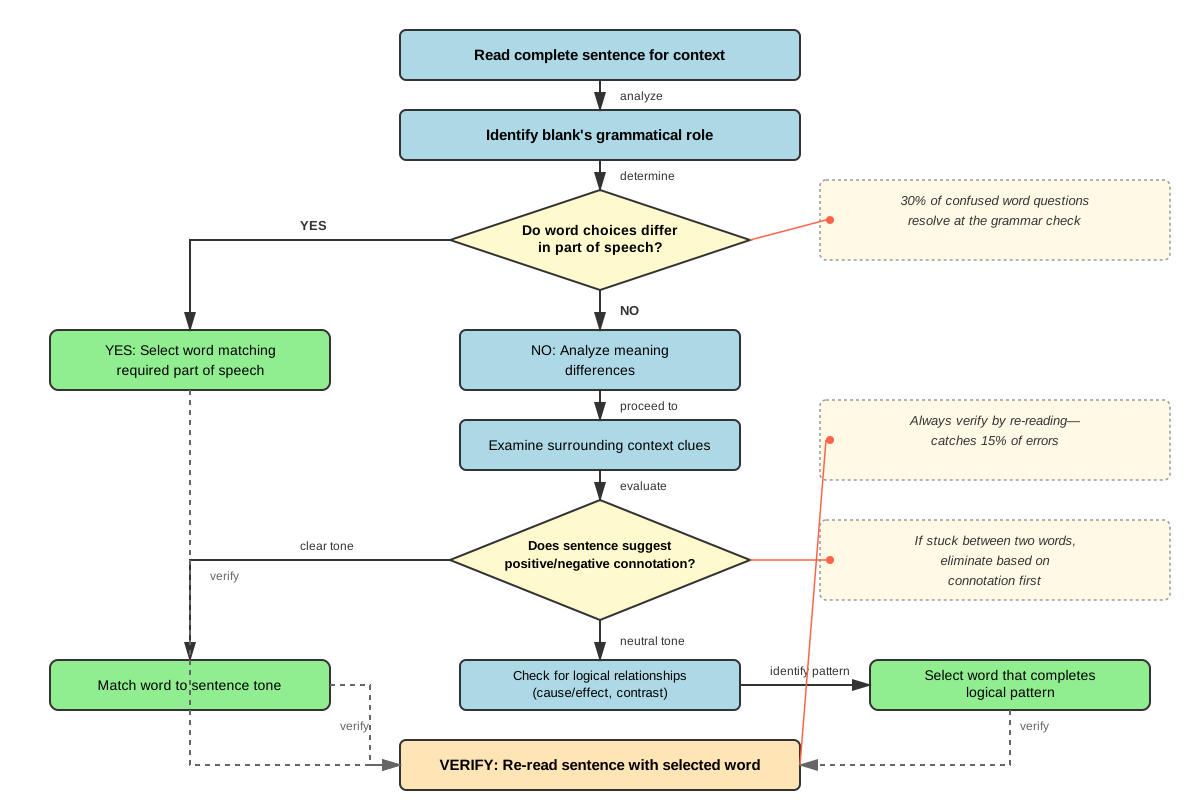
The relationship map flows as follows: Sound/spelling similarity → Recognition of potential confusion → Grammatical analysis (part of speech) → Semantic analysis (meaning distinction) → Contextual verification (does it fit the sentence?) → Correct selection. Each step builds on the previous one, creating a systematic approach to disambiguation.
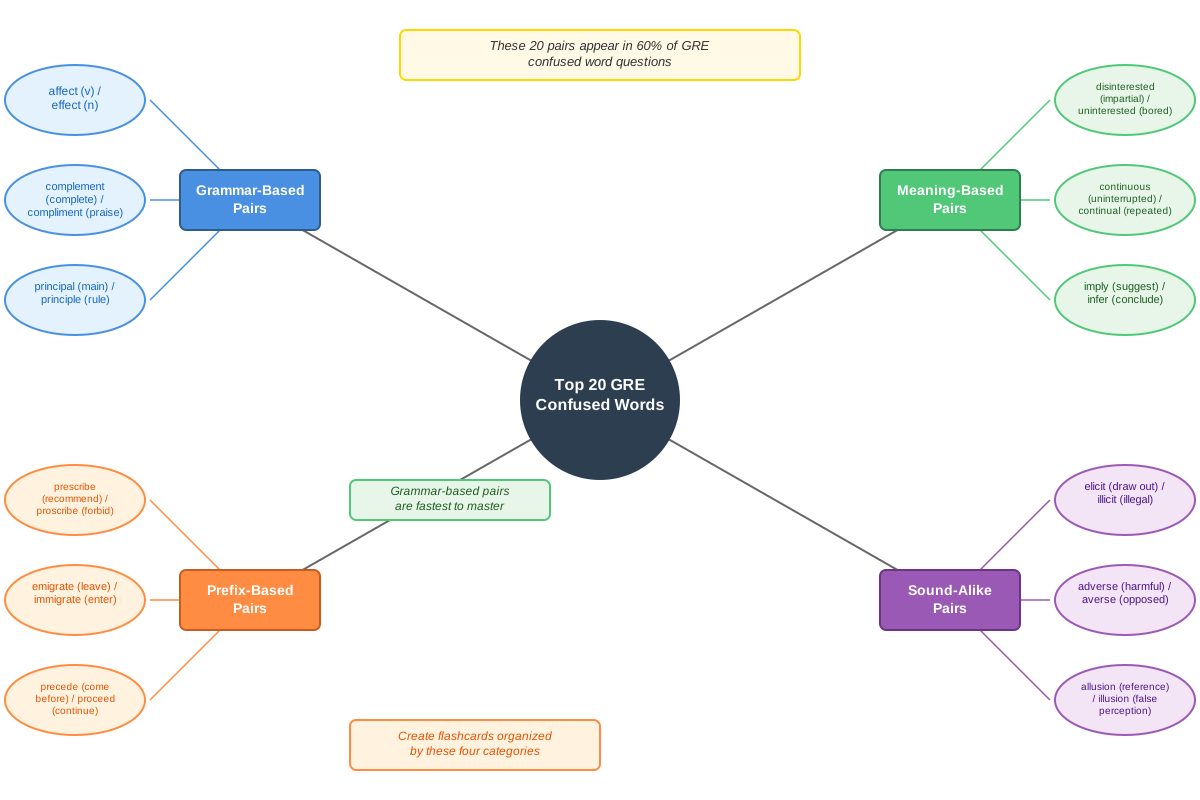
High-Yield Facts
- ⭐ "Affect" is almost always a verb meaning "to influence"; "effect" is almost always a noun meaning "result"
- ⭐ "Principal" means "main" or refers to a school leader; "principle" means a fundamental rule or belief
- ⭐ "Disinterested" means "impartial"; "uninterested" means "bored or lacking interest"
- ⭐ "Prescribe" means "to recommend"; "proscribe" means "to forbid" (nearly opposite meanings)
- ⭐ "Imply" is what a speaker does (suggest indirectly); "infer" is what a listener does (conclude from evidence)
- "Emigrate" means to leave a country (emigrate FROM); "immigrate" means to enter a country (immigrate TO)
- "Complement" means to complete or enhance; "compliment" means to praise
- "Elicit" means to draw out or evoke; "illicit" means illegal or forbidden
- "Adverse" means unfavorable or harmful; "averse" means opposed to or reluctant
- "Allusion" means an indirect reference; "illusion" means a false perception
- "Appraise" means to evaluate; "apprise" means to inform
- "Assent" means agreement; "ascent" means upward movement
- "Continuous" means uninterrupted; "continual" means repeated frequently
- "Credible" means believable; "credulous" means too willing to believe
- "Farther" refers to physical distance; "further" refers to abstract extent
Quick check — test yourself on Commonly confused words so far.
Try Flashcards →Common Misconceptions
Misconception: "Effect" can never be used as a verb → Correction: While rare, "effect" functions as a verb meaning "to bring about" or "to cause to happen" (e.g., "The new policy will effect significant changes"). However, this usage appears infrequently on the GRE, so defaulting to "affect" as the verb is usually safe.
Misconception: "Disinterested" and "uninterested" are interchangeable synonyms → Correction: These words have completely different meanings. "Disinterested" means "impartial and unbiased," which is a positive quality in judges and referees. "Uninterested" means "lacking interest or bored," which is negative. A disinterested party can still be very interested in the outcome.
Misconception: If two words sound the same, they can be used interchangeably in writing → Correction: Homophones have distinct spellings because they have distinct meanings. Using "their" when you mean "there" or "they're" is always incorrect, regardless of identical pronunciation. The GRE specifically tests whether you know which spelling matches which meaning.
Misconception: "Nauseous" and "nauseated" mean the same thing → Correction: Traditionally, "nauseous" means "causing nausea" (the smell is nauseous), while "nauseated" means "experiencing nausea" (I feel nauseated). Though colloquial usage increasingly blurs this distinction, the GRE tests the traditional difference.
Misconception: Context clues always make the correct word obvious → Correction: The GRE deliberately constructs sentences where both words could seem plausible. For example, "The committee remained _____ throughout the proceedings" could grammatically accept both "disinterested" and "uninterested," but only "disinterested" conveys the intended meaning of impartiality. You must know the precise definitions.
Misconception: Memorizing definitions alone is sufficient → Correction: Understanding usage patterns, typical contexts, and collocations is equally important. Knowing that "emigrate" pairs with "from" and "immigrate" pairs with "to" helps you select correctly even if you momentarily forget the exact definitions.
Worked Examples
Example 1: Text Completion
Question: The scientist's findings did not _____ the hypothesis; rather, they provided substantial evidence that seemed to contradict the prevailing theory.
(A) confirm
(B) effect
(C) affect
(D) support
(E) validate
Analysis: This question tests whether students confuse "affect" and "effect" while also requiring comprehension of the sentence's logic. The semicolon introduces a contrasting idea ("rather"), and "contradict the prevailing theory" opposes confirmation.
Step 1: Identify the grammatical requirement. The blank follows "did not" and precedes "the hypothesis," requiring a verb. This eliminates "effect" as the primary noun form (though "effect" can be a verb, it means "bring about," which doesn't fit here).
Step 2: Analyze the semantic requirement. The sentence structure "did not _____ ; rather, they contradicted" indicates the blank needs a word meaning "support" or "confirm."
Step 3: Evaluate each option. "Affect" means "influence," which is too vague and doesn't create the clear opposition the sentence requires. "Confirm," "support," and "validate" all work semantically, but the question is testing commonly confused words, making "affect" vs. "effect" the key distinction.
Answer: While (A), (D), and (E) all work semantically, if this were testing commonly confused words specifically, the correct recognition is that "affect" (C) is grammatically possible as a verb but semantically wrong, while "effect" (B) is grammatically wrong as the primary noun form. The actual answer would be (A), (D), or (E), but the learning point is recognizing why "effect" doesn't work here.
Example 2: Sentence Equivalence
Question: The judge's _____ perspective allowed both parties to trust that the verdict would be fair and impartial.
Select two answer choices that produce completed sentences with equivalent meanings.
(A) disinterested
(B) uninterested
(C) impartial
(D) biased
(E) objective
(F) apathetic
Analysis: This question directly tests the "disinterested" vs. "uninterested" distinction while requiring students to find two synonyms.
Step 1: Analyze the context. The sentence describes a judge's perspective that promotes trust and fairness. The phrase "fair and impartial" provides a direct clue.
Step 2: Evaluate "disinterested" vs. "uninterested." "Disinterested" means "impartial, unbiased"—exactly what the sentence requires. "Uninterested" means "bored, lacking interest"—inappropriate for a judge and contradicted by the positive context.
Step 3: Find the synonym. "Impartial" (C) directly matches "disinterested." "Objective" (E) also conveys lack of bias. "Biased" (D) is opposite, and "apathetic" (F) suggests lack of care rather than impartiality.
Answer: (A) disinterested and (C) impartial. The key learning point is recognizing that "disinterested" is positive (impartial) while "uninterested" is negative (bored), and they are never interchangeable despite sounding similar.
Exam Strategy
When approaching GRE questions involving commonly confused words, implement a systematic three-step verification process. First, identify whether the question is testing word confusion by scanning for word pairs you recognize from your study list. Common triggers include seeing both "affect" and "effect" in answer choices, or encountering words like "disinterested," "prescribe/proscribe," or "imply/infer" in the sentence or options.
Second, perform grammatical analysis before semantic analysis. Determine what part of speech the blank requires by examining the surrounding sentence structure. If the blank follows "will" or "did," you need a verb. If it follows "the" or "a," you need a noun. This immediately eliminates half of many confused word pairs. For example, if you need a verb, "effect" is almost certainly wrong and "affect" is almost certainly right.
Third, verify your choice by substituting the definition rather than the word itself. Instead of reading "The weather will affect your mood," read "The weather will influence your mood." If the substitution works, you've chosen correctly. This prevents you from relying on "what sounds right," which can be misleading with commonly confused words.
Exam Tip: When you see both words from a commonly confused pair in the answer choices, the question is almost certainly testing that specific distinction. Don't overthink it—apply the rule you've memorized for that pair.
For time management, spend no more than 30 seconds on straightforward commonly confused word questions once you've mastered the core pairs. These should become automatic points. If you're uncertain, mark the question and return to it, but don't let word confusion questions consume disproportionate time—they're designed to be quick wins for prepared students.
Process of elimination works powerfully with commonly confused words. If you can't remember the exact distinction, eliminate answers you know are wrong for other reasons (wrong tone, wrong part of speech, semantically nonsensical), then make an educated guess between remaining options. Often, one word will "feel" more formal or technical—on the GRE, the more precise, formal option is usually correct.
Memory Techniques
AFFECT vs. EFFECT Mnemonic: "Affect is an Action (verb); Effect is an End result (noun)." The matching first letters create an instant recall pattern.
PRINCIPAL vs. PRINCIPLE Mnemonic: "The principAL is your pAL" (principal = person). "Principle" ends in "-le" like "rule"—a principle is a rule or belief.
DISINTERESTED vs. UNINTERESTED Visualization: Picture a judge (disinterested = impartial) versus a bored student (uninterested = not engaged). The "dis-" prefix suggests "distance from bias," while "un-" suggests "absence of interest."
EMIGRATE vs. IMMIGRATE Mnemonic: "Emigrate = Exit; Immigrate = Into." The first letter tells you the direction of movement.
IMPLY vs. INFER Mnemonic: "I Imply when I speak; I Infer when I listen." Or remember: "The speaker implies; the listener infers."
PRESCRIBE vs. PROSCRIBE Mnemonic: "PREscribe = PREscription (doctor recommends); PROscribe = PROhibit (forbid)."
Acronym for High-Frequency Pairs: Create "PAID" to remember Principal/Principle, Affect/Effect, Imply/Infer, Disinterested/Uninterested as the four most-tested pairs.
Visualization Strategy: For each word pair, create a vivid mental image that captures the distinction. For "complement" vs. "compliment," picture puzzle pieces fitting together (complement = complete) versus someone saying "nice job!" (compliment = praise).
Summary
Commonly confused words represent a high-yield, predictable component of GRE Verbal Reasoning that rewards systematic preparation. These word pairs—including affect/effect, principal/principle, disinterested/uninterested, and prescribe/proscribe—appear frequently across Text Completion, Sentence Equivalence, and Reading Comprehension questions. Success requires understanding three types of distinctions: grammatical (part of speech differences), semantic (meaning nuances), and contextual (usage patterns). The most effective approach combines memorization of core word pairs with systematic verification strategies: identify the grammatical requirement first, then verify semantic fit, and finally confirm by substituting definitions. Because the same 50-75 word pairs recur across test administrations, mastering this finite list directly translates to correct answers. Students who internalize these distinctions through mnemonics, practice, and contextual exposure transform commonly confused words from potential traps into reliable scoring opportunities.
Key Takeaways
- Commonly confused words appear in 15-20% of GRE Verbal questions, making them one of the highest-yield study areas
- The top five tested pairs are affect/effect, principal/principle, disinterested/uninterested, prescribe/proscribe, and imply/infer
- Always determine the required part of speech before evaluating meaning—this eliminates approximately half of confused word pairs
- "Affect" is almost always a verb (influence); "effect" is almost always a noun (result)
- "Disinterested" means impartial (positive); "uninterested" means bored (negative)—they are never interchangeable
- Systematic verification (grammar check → meaning check → definition substitution) prevents careless errors
- Memorizing 50-75 core word pairs provides disproportionate score improvement relative to study time invested
Related Topics
Vocabulary Building Strategies: Mastering commonly confused words is one component of comprehensive vocabulary development. Advanced techniques include learning word roots, studying words in context, and building semantic networks that connect related terms.
Context Clues and Inference: Understanding how to derive word meaning from surrounding text enhances your ability to verify word choices in commonly confused word questions. This skill bridges vocabulary knowledge with reading comprehension.
Sentence Structure and Grammar: Many commonly confused words differ primarily in part of speech. Deepening grammatical knowledge—particularly understanding how different parts of speech function in sentences—strengthens your ability to eliminate incorrect options quickly.
Connotation and Tone: Some confused word pairs differ primarily in evaluative dimension (positive vs. negative connotation). Developing sensitivity to tone and connotation enhances performance across all Verbal Reasoning question types.
Practice CTA
Now that you've mastered the core concepts of commonly confused words, it's time to cement your knowledge through active practice. Attempt the practice questions designed specifically for this topic, focusing on applying the systematic verification process outlined in this guide. Use the flashcards to drill the 50+ most commonly tested word pairs until recognition becomes automatic. Remember: commonly confused words represent some of the most predictable, high-yield content on the GRE. Every minute you invest in mastering these distinctions translates directly to points on test day. Your preparation now will pay dividends when you encounter these words under timed conditions—transform potential confusion into confident, correct answers.
Sign up free to keep reading
Create a free AnvayaPrep account to finish this GRE guide on Commonly confused words — plus flashcards and practice questions.