Overview
Mastering vocabulary is one of the most critical components of success on the GRE Verbal Reasoning section. However, simply memorizing word lists is inefficient and often leads to rapid forgetting. A vocabulary retention strategy refers to the systematic approach students use to learn, store, and recall GRE-level vocabulary words effectively over time. Unlike passive reading or cramming, effective retention strategies leverage cognitive science principles to create durable memory traces that persist through test day and beyond.
The GRE Verbal Reasoning section tests vocabulary knowledge across multiple question types, including Text Completion, Sentence Equivalence, and Reading Comprehension. Students who lack a robust GRE vocabulary retention strategy often struggle to distinguish between answer choices, misinterpret passage meanings, and lose valuable points on otherwise manageable questions. Research shows that the average GRE test-taker needs to master approximately 1,000-1,500 advanced vocabulary words beyond their everyday lexicon, making strategic retention not just helpful but essential.
This topic connects directly to broader Verbal Reasoning skills by providing the foundational word knowledge necessary for comprehension and analysis. Without effective retention strategies, students waste countless hours reviewing the same words repeatedly, experiencing the frustration of recognizing a word during study but drawing a blank during the actual exam. The strategies covered in this guide integrate with other vocabulary skills such as context clue analysis, word root recognition, and semantic relationship identification, creating a comprehensive approach to verbal mastery.
Learning Objectives
- [ ] Identify when Vocabulary retention strategy is being tested
- [ ] Explain the core rule or strategy behind Vocabulary retention strategy
- [ ] Apply Vocabulary retention strategy to GRE-style questions accurately
- [ ] Implement spaced repetition schedules to maximize long-term retention
- [ ] Create personalized mnemonic devices and memory associations for challenging words
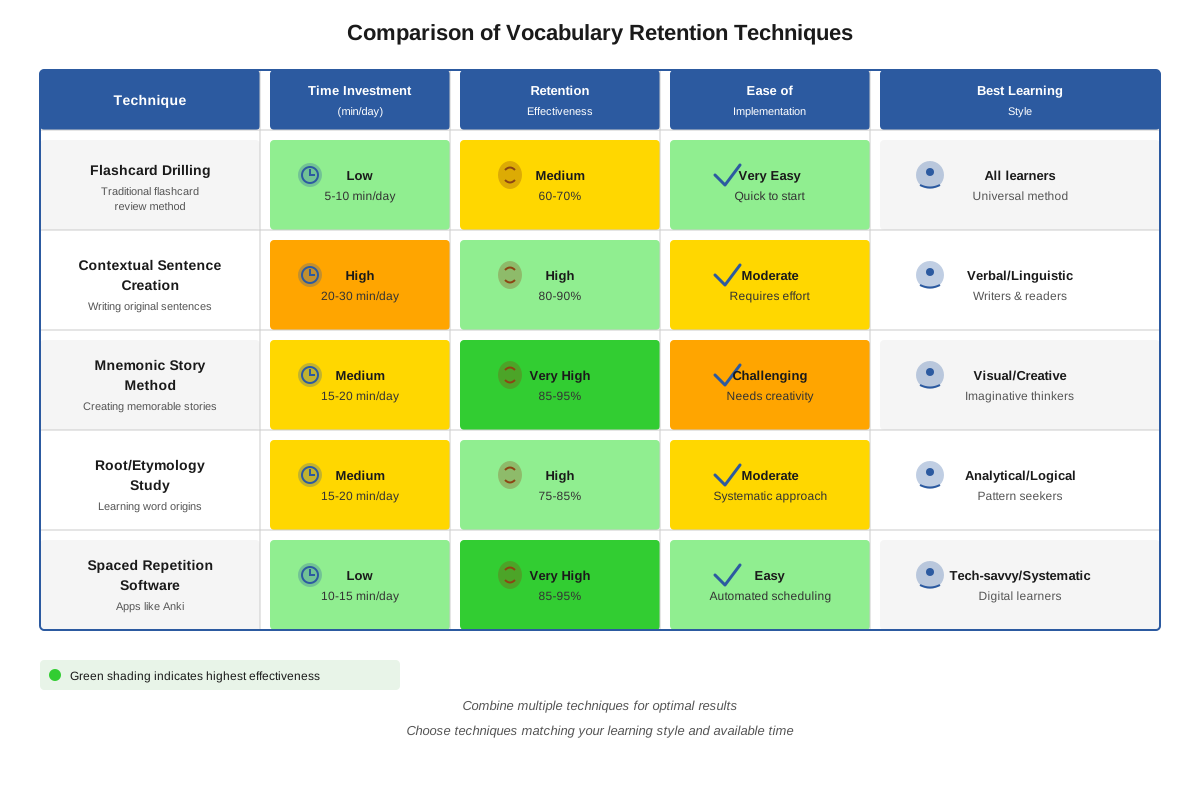
- [ ] Evaluate the effectiveness of different retention techniques for individual learning styles
- [ ] Synthesize multiple retention strategies into a cohesive study plan
Prerequisites
- Basic understanding of word parts (roots, prefixes, suffixes): Essential for creating meaningful associations and understanding word families that aid retention
- Familiarity with GRE question formats: Necessary to understand how vocabulary knowledge will be tested and which words to prioritize
- Time management skills: Required to implement consistent study schedules that support spaced repetition and regular review
- Access to vocabulary resources: Flashcards, word lists, or vocabulary apps provide the raw material for retention practice
Why This Topic Matters
Vocabulary retention strategies directly impact GRE performance across all Verbal Reasoning question types. Studies of GRE test-takers reveal that vocabulary knowledge accounts for approximately 40-50% of the variance in Verbal Reasoning scores. Students with strong retention strategies consistently outperform those who rely on passive exposure or last-minute cramming, often scoring 5-7 points higher on the Verbal section.
In real-world applications, the vocabulary retention techniques developed for GRE preparation transfer to professional and academic contexts. Graduate students must rapidly acquire specialized terminology in their fields, professionals need to master industry-specific jargon, and effective communicators continuously expand their lexical repertoire. The metacognitive skills developed through strategic vocabulary retention—understanding how one learns best, monitoring comprehension, and adjusting study approaches—prove valuable throughout one's career.
On the GRE specifically, vocabulary appears in multiple contexts: as answer choices in Text Completion questions (where precise word meaning determines correctness), in Sentence Equivalence questions (requiring recognition of synonymous relationships), and throughout Reading Comprehension passages (where unfamiliar words can obscure meaning). Approximately 10-12 questions per Verbal section directly test vocabulary knowledge, while another 8-10 questions indirectly require strong vocabulary to understand complex passages or subtle distinctions. Without effective retention strategies, students often recognize words as "familiar" without recalling precise meanings—a phenomenon that leads to incorrect answer selection and score deflation.
Core Concepts
The Forgetting Curve and Spaced Repetition
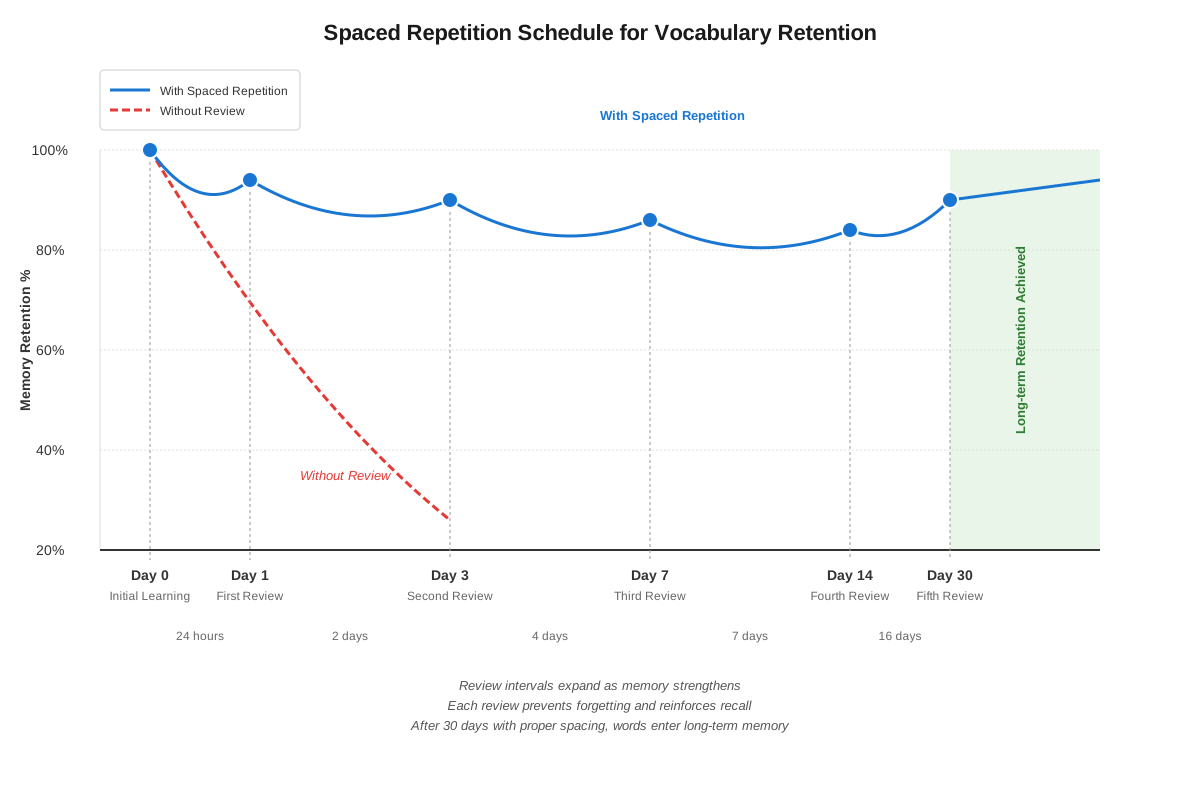
The forgetting curve, discovered by psychologist Hermann Ebbinghaus, demonstrates that newly learned information decays rapidly without reinforcement. Within 24 hours of initial exposure, most people forget approximately 70% of new vocabulary words. However, each subsequent review slows this decay, eventually moving words into long-term memory. Spaced repetition leverages this principle by scheduling reviews at increasing intervals: first after one day, then three days, then one week, then two weeks, and so forth.
For GRE vocabulary, optimal spaced repetition schedules typically follow this pattern:
- Initial learning session (Day 0)
- First review (Day 1)
- Second review (Day 3)
- Third review (Day 7)
- Fourth review (Day 14)
- Fifth review (Day 30)
- Final review (Day 60)
This approach requires significantly less total study time than massed practice (cramming) while producing superior retention rates. Digital flashcard systems like Anki automatically implement spaced repetition algorithms, but students can also create manual review schedules using physical flashcards organized into dated boxes or folders.
Active Recall vs. Passive Recognition
Active recall involves retrieving information from memory without prompts, while passive recognition merely requires identifying correct information when presented. Research consistently shows that active recall produces stronger, more durable memories. When studying GRE vocabulary, this means testing oneself on word definitions rather than simply reading word lists repeatedly.
Effective active recall techniques include:
- Covering definitions and attempting to recall them from the word alone
- Writing sentences using target words without reference materials
- Teaching words to others, explaining meanings in one's own words
- Creating flashcards with the word on one side and definition on the reverse
- Taking practice quizzes that require definition production, not just recognition
Students who rely primarily on passive recognition often experience the frustrating phenomenon of "knowing" a word during study but failing to recall it during the exam. The additional cognitive effort required by active recall, though initially more challenging, creates stronger neural pathways and more reliable retrieval.
Elaborative Encoding and Deep Processing
Elaborative encoding involves connecting new vocabulary to existing knowledge, personal experiences, or vivid imagery. The more connections created during learning, the more retrieval pathways exist during recall. This contrasts with shallow processing, which focuses only on superficial features like spelling or pronunciation.
Deep processing strategies for GRE vocabulary include:
| Strategy | Example | Benefit |
|---|---|---|
| Personal association | "Gregarious reminds me of my outgoing friend Greg" | Creates emotional and autobiographical connections |
| Visual imagery | "Imagine an obstinate donkey refusing to move" | Engages visual memory systems |
| Etymology exploration | "Benevolent comes from Latin 'bene' (good) + 'volent' (wishing)" | Links to word families and related terms |
| Contextual sentences | "The laconic professor answered questions with single words" | Demonstrates usage and meaning simultaneously |
| Synonym/antonym networks | "Taciturn = laconic = reticent ≠ loquacious" | Builds semantic relationships |
Research indicates that students who engage in elaborative encoding retain approximately 60-70% more vocabulary words after one month compared to those using rote memorization alone.
The Method of Loci and Memory Palaces
The method of loci (memory palace technique) involves associating vocabulary words with specific locations in a familiar physical space. Students mentally "walk through" this space during recall, encountering words at designated locations. While this technique requires initial setup time, it produces exceptional retention for challenging words that resist other methods.
To implement this strategy:
- Select a familiar route (home layout, commute path, childhood neighborhood)
- Identify 10-20 distinct locations along this route
- Create vivid, unusual images linking each vocabulary word to its location
- Practice mentally walking the route, encountering each word-image
- Review by retracing the mental journey
For example, to remember "ebullient" (enthusiastically excited), one might imagine entering their front door and encountering a bubbling, overflowing fountain of champagne, with the bubbles representing the "ebullient" enthusiasm.
Contextual Learning and Authentic Usage
Contextual learning emphasizes encountering vocabulary in authentic sentences and passages rather than isolated word-definition pairs. This approach mirrors how native speakers naturally acquire vocabulary and provides crucial information about word usage, connotation, and register that definitions alone cannot convey.
Effective contextual learning practices include:
- Reading GRE-level passages from sources like The Economist, Scientific American, and The New Yorker
- Noting how target words function grammatically and semantically in sentences
- Creating original sentences that demonstrate precise word usage
- Analyzing multiple example sentences for each word to understand usage range
- Distinguishing between denotation (dictionary definition) and connotation (emotional associations)
Words learned contextually show 40-50% better retention than those learned from definitions alone, and students demonstrate superior ability to use these words correctly in their own writing.
Mnemonic Devices and Memory Hooks
Mnemonic devices are memory aids that create memorable associations between new information and existing knowledge. For GRE vocabulary, effective mnemonics often use sound-alike words, acronyms, or vivid stories to create retrieval cues.
Common mnemonic types for vocabulary:
- Sound-alike associations: "Loquacious sounds like 'talk-acious'—very talkative"
- Keyword method: "Taciturn contains 'turn'—someone who turns away from conversation"
- Acronym sentences: For remembering synonyms for "stubborn": "Obstinate People Resist Instruction" (Obstinate, Pertinacious, Recalcitrant, Intransigent)
- Story-based mnemonics: "The VERBOSE professor was VERY BORED of his OWN SPEECH but kept talking"
While mnemonics require creativity and initial effort, they provide powerful retrieval cues for words that otherwise prove difficult to remember. The most effective mnemonics are personally meaningful, slightly absurd or humorous, and multisensory.
Interleaving and Varied Practice
Interleaving involves mixing different types of vocabulary practice rather than studying words in blocks by category or difficulty. Research shows that interleaved practice, though initially more challenging, produces superior long-term retention and transfer compared to blocked practice.
For GRE vocabulary, interleaving might involve:
- Mixing words from different semantic categories (emotions, descriptions, actions)
- Alternating between synonym identification, definition recall, and sentence completion
- Combining new words with previously learned words in review sessions
- Practicing words in random order rather than alphabetical or thematic groupings
This approach prevents students from relying on contextual cues (like category membership) and forces genuine retrieval of word meanings, better simulating actual test conditions where words appear unpredictably.
Concept Relationships
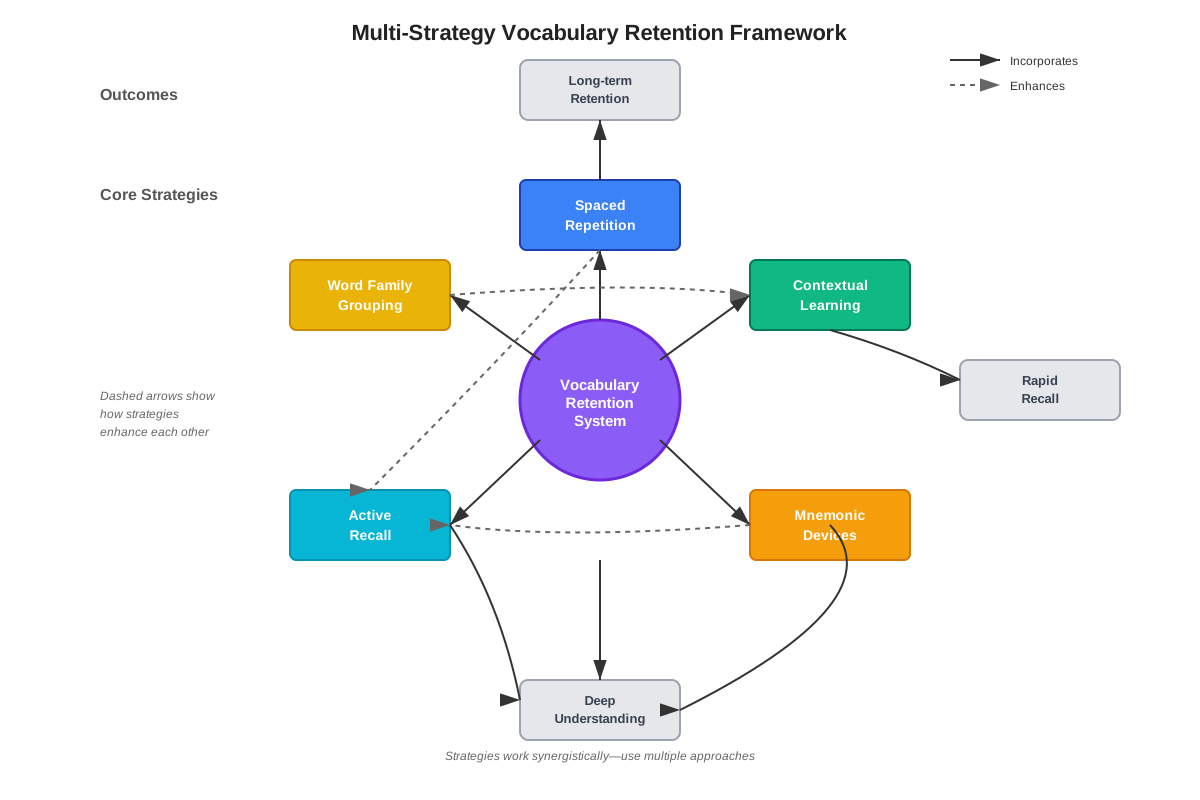
The core concepts of vocabulary retention form an interconnected system where each strategy enhances the others. Spaced repetition provides the temporal framework for review, while active recall determines the quality of each review session. Elaborative encoding creates the initial memory traces that spaced repetition then strengthens over time. Contextual learning supplies the authentic usage examples that enable deep processing, while mnemonic devices provide backup retrieval pathways when direct recall fails.
The relationship flows as follows:
Initial exposure (contextual learning) → Deep processing (elaborative encoding) → First retrieval (active recall) → Scheduled reinforcement (spaced repetition) → Difficult word support (mnemonics and method of loci) → Varied application (interleaving)
These strategies also connect to prerequisite knowledge: understanding word roots enables more effective elaborative encoding by revealing etymological connections, while familiarity with GRE question formats helps students prioritize which words require the most intensive retention efforts. The strategies prepare students for advanced topics like semantic relationship analysis and context-based vocabulary inference by ensuring that foundational word knowledge is secure and readily accessible.
High-Yield Facts
⭐ Spaced repetition produces 200-300% better long-term retention than massed practice (cramming) for the same total study time
⭐ Active recall (testing yourself) is significantly more effective than passive review (re-reading definitions)
⭐ The optimal first review occurs within 24 hours of initial learning to combat the forgetting curve's steepest decline
⭐ Words learned in context show 40-50% better retention than words learned from isolated definitions
⭐ Elaborative encoding (creating personal connections) creates multiple retrieval pathways, increasing recall probability
- The method of loci can enable recall of 50+ vocabulary words in sequence with 90%+ accuracy after proper training
- Interleaved practice improves discrimination between similar words and reduces interference errors
- Mnemonic devices are most effective for words that resist other retention methods, not as a primary strategy for all words
- Sleep plays a crucial role in memory consolidation; studying vocabulary before sleep enhances retention
- Self-testing should occur before complete mastery to maximize the benefits of retrieval practice
- Creating original sentences with target words produces deeper processing than reading example sentences
- Emotional or humorous associations create stronger memories than neutral associations
- The "generation effect" means that self-created definitions or associations are remembered better than provided ones
Quick check — test yourself on Vocabulary retention strategy so far.
Try Flashcards →Common Misconceptions
Misconception: Reading word lists repeatedly is an effective way to memorize vocabulary.
Correction: Passive reading produces weak memories that decay rapidly. Active recall through self-testing creates significantly stronger, more durable memories. Students should spend 80% of study time testing themselves and only 20% reviewing materials.
Misconception: All words should be studied with equal intensity and frequency.
Correction: Effective retention strategies prioritize high-frequency GRE words and personally challenging words. The Pareto principle applies: approximately 20% of vocabulary words account for 80% of test appearances. Students should identify their personal weak spots and allocate study time accordingly.
Misconception: Cramming vocabulary the week before the test is sufficient if done intensively.
Correction: While cramming may produce short-term recognition, it fails to create the long-term memories necessary for reliable test-day recall. Vocabulary study should begin at least 8-12 weeks before the exam, with consistent daily practice rather than intensive last-minute sessions.
Misconception: Mnemonics are childish tricks that don't work for sophisticated vocabulary.
Correction: Mnemonics are evidence-based memory tools used by memory champions and cognitive scientists. When properly constructed, they provide powerful retrieval cues for challenging words. The key is creating personally meaningful associations rather than using generic, pre-made mnemonics.
Misconception: Once a word is learned, it doesn't need further review.
Correction: Without periodic review, even well-learned words decay over time. The forgetting curve applies to all memories. Spaced repetition schedules should continue until test day, though intervals between reviews can extend to weeks or months for well-mastered words.
Misconception: Digital flashcard apps are just as effective as any other study method.
Correction: While digital flashcard apps can be highly effective, their value depends on proper use. Apps that implement spaced repetition algorithms (like Anki) significantly outperform simple flashcard apps. However, the app itself is just a tool—students must still engage in active recall, create quality cards, and maintain consistent practice.
Misconception: Learning synonyms together helps distinguish between similar words.
Correction: While understanding synonym relationships is important, studying synonyms simultaneously often creates interference, making it harder to recall specific words. It's more effective to learn words individually first, then study their relationships once each word is secure in memory.
Worked Examples
Example 1: Implementing Spaced Repetition for a Challenging Word Set
Scenario: A student encounters five challenging words on Monday: "recalcitrant," "obstinate," "intransigent," "pertinacious," and "obdurate" (all meaning stubbornly resistant).
Step 1 - Initial Learning (Monday): The student creates flashcards for each word, including:
- Front: The word
- Back: Definition, example sentence, personal mnemonic, and etymology
For "recalcitrant": "Stubbornly resistant to authority. 'The recalcitrant student refused to follow classroom rules.' Mnemonic: 'RE-CAL-citrant' sounds like 'recall-resistant'—resistant to being called back to obedience. From Latin 'recalcitrare' (to kick back)."
Step 2 - First Review (Tuesday): The student tests herself by looking at each word and attempting to recall the definition before checking. She gets 3/5 correct. The two incorrect words are marked for additional review later that day.
Step 3 - Second Review (Thursday): Following the spaced repetition schedule, she reviews all five words again. This time she achieves 5/5 correct, but "intransigent" required significant effort to recall.
Step 4 - Third Review (Following Monday): One week after initial learning, she reviews again. All words are recalled correctly, with "intransigent" now feeling more secure.
Step 5 - Fourth Review (Two weeks later): She reviews the set again, achieving perfect recall with minimal effort. These words are now moved to a "monthly review" pile.
Step 6 - Final Review (One month later): A final review confirms long-term retention. These words are now considered mastered and only need occasional review.
Key Learning: This example demonstrates how spaced repetition transforms initially challenging words into secure knowledge through strategic timing of reviews. The student invested approximately 15 minutes total across six weeks, far less than the hours required by daily review, while achieving superior retention.
Example 2: Using Elaborative Encoding for Abstract Vocabulary
Scenario: A student struggles to remember "ephemeral" (lasting a very short time).
Surface-level approach (ineffective): "Ephemeral means short-lived. Ephemeral means short-lived. Ephemeral means short-lived." [Rote repetition]
Deep processing approach (effective):
Step 1 - Etymology: "Ephemeral comes from Greek 'ephemeros' meaning 'lasting only a day,' from 'epi' (upon) + 'hemera' (day). This connects to 'ephemeris,' an astronomical almanac showing daily positions."
Step 2 - Personal association: "I think of mayflies, which live for only one day—their existence is ephemeral. Last summer, I saw thousands of mayflies near the lake, and by the next morning, they were all gone."
Step 3 - Visual imagery: "I imagine a beautiful ice sculpture melting in the sun—its beauty is ephemeral, lasting only hours before disappearing completely."
Step 4 - Word family: "Ephemeral relates to other time-based words: transient, fleeting, evanescent, momentary. But ephemeral specifically emphasizes the brevity, like something that exists for just a day."
Step 5 - Contextual sentence creation: "The ephemeral beauty of cherry blossoms makes their annual blooming a celebrated event in Japan—people know the flowers will last only a week or two."
Step 6 - Mnemonic device: "E-PHEMER-al sounds like 'E-FEMUR-al'—imagine a femur bone that crumbles to dust in a day, lasting only briefly."
Result: By engaging in deep processing across multiple dimensions (etymology, personal experience, visual imagery, semantic relationships, contextual usage, and mnemonics), the student creates numerous retrieval pathways. When encountering "ephemeral" on the GRE, any of these associations can trigger recall, making the memory robust and reliable.
Key Learning: This example illustrates how elaborative encoding transforms a simple definition into a rich network of associations. The initial investment of 5-10 minutes creates a memory that persists for months, whereas rote repetition would require dozens of reviews to achieve similar retention.
Exam Strategy
When approaching GRE Verbal Reasoning questions, effective vocabulary retention strategies translate into specific test-taking approaches:
Pre-Test Preparation:
- Complete final vocabulary review 2-3 days before the exam, not the night before, allowing time for memory consolidation
- Focus review on high-frequency words and personal weak spots rather than attempting to cram new words
- Practice retrieving words under timed conditions to simulate test pressure
During Text Completion Questions:
- Trigger phrase: When you encounter an unfamiliar word in the answer choices, check if it triggers any mnemonic associations or word root knowledge before eliminating it
- If a word seems familiar but you can't recall the precise definition, try to remember the context where you studied it—this often triggers full recall
- Use process of elimination based on words you do know confidently rather than guessing among unfamiliar options
During Sentence Equivalence Questions:
- These questions specifically test vocabulary retention by requiring recognition of synonymous relationships
- If you've studied words in semantic clusters (synonyms and antonyms together), recall the entire cluster to identify the pair
- Watch for false synonyms—words that seem similar but have crucial connotational differences
Time Management:
- Don't spend excessive time trying to recall a single word—if it doesn't come within 10-15 seconds, use context clues and move forward
- Mark questions where vocabulary gaps prevented confident answers for review if time permits
- Allocate approximately 1-1.5 minutes per Text Completion question and 1.5-2 minutes per Sentence Equivalence question
Trigger Words and Phrases:
- "Although," "despite," "however" signal contrast—look for antonyms
- "Similarly," "likewise," "moreover" signal continuation—look for synonyms
- "Because," "therefore," "consequently" signal cause-effect—consider logical relationships
- Blank placement matters: words filling early blanks often provide context clues for later blanks
Process of Elimination:
- Eliminate words with clearly wrong connotations (positive vs. negative) first
- Remove words that create grammatical errors or illogical meanings
- Between two unfamiliar words, favor the one whose word roots or structure suggest appropriate meaning
- In Sentence Equivalence, eliminate any word that doesn't have a potential synonym among the other choices
Memory Techniques
Acronym for Retention Strategy Steps: SPACE-M
- Spaced repetition schedules
- Personal associations and elaborative encoding
- Active recall through self-testing
- Contextual learning in authentic sentences
- Etymology and word root analysis
- Mnemonics for challenging words
Visualization for the Forgetting Curve: Imagine a steep cliff (representing rapid initial forgetting) that gradually slopes into a gentle hill (representing slower forgetting after reviews). Each review session builds a small platform on the slope, making it easier to climb back up (recall the information).
Mnemonic for Optimal Review Timing: "1-3-7-14-30-60" (days between reviews)
Memory aid: "One tree (1-3) grows seven (7) branches, fourteen (14) leaves, thirty (30) flowers, and sixty (60) fruits"—each stage requires more time to develop, just as memory consolidation requires increasing intervals.
The "Three C's" of Effective Flashcards:
- Clear: One concept per card, unambiguous definitions
- Contextual: Include example sentences showing usage
- Connected: Note related words, antonyms, and word families
Rhyme for Active vs. Passive Study: "Test yourself, don't just read the shelf"—emphasizing that active recall (testing) beats passive review (reading).
Visual Memory Palace Anchor: For particularly challenging words, imagine them as physical objects in your study space. "Recalcitrant" might be a stubborn door that won't open, "ephemeral" a candle that burns out instantly, "verbose" a book that never stops growing pages.
Summary
Vocabulary retention strategy encompasses the evidence-based techniques that enable students to learn, store, and recall GRE-level vocabulary effectively. The foundation rests on spaced repetition—reviewing words at increasing intervals to combat the forgetting curve—combined with active recall that forces retrieval rather than passive recognition. Elaborative encoding creates rich, multidimensional memories by connecting new words to existing knowledge, personal experiences, and vivid imagery. Contextual learning ensures words are understood in authentic usage contexts, not just as isolated definitions. For particularly challenging words, mnemonic devices and the method of loci provide powerful backup retrieval pathways. Interleaved practice prevents over-reliance on contextual cues and builds flexible, robust knowledge. These strategies work synergistically: spaced repetition provides the temporal framework, active recall ensures quality practice, elaborative encoding creates strong initial memories, and contextual learning enables proper usage. Students who implement these strategies systematically, beginning 8-12 weeks before the exam with consistent daily practice, achieve significantly higher vocabulary retention rates than those relying on cramming or passive review, directly translating to improved GRE Verbal Reasoning scores.
Key Takeaways
- Spaced repetition at increasing intervals (1-3-7-14-30-60 days) produces superior long-term retention compared to massed practice
- Active recall through self-testing creates stronger memories than passive review of definitions
- Elaborative encoding—connecting words to personal experiences, imagery, and existing knowledge—creates multiple retrieval pathways
- Contextual learning in authentic sentences provides crucial usage information that definitions alone cannot convey
- Mnemonic devices and memory palaces serve as powerful tools for words that resist other retention methods
- Vocabulary study should begin 8-12 weeks before the exam with consistent daily practice rather than last-minute cramming
- The most effective approach combines multiple strategies: spaced repetition for timing, active recall for practice quality, elaborative encoding for depth, and contextual learning for authentic understanding
Related Topics
Word Roots, Prefixes, and Suffixes: Understanding etymological components enables students to decode unfamiliar words and creates natural connections between related words, enhancing the elaborative encoding process. Mastering retention strategies provides the foundation for efficiently learning word families.
Context Clues and Vocabulary in Reading Comprehension: Strong vocabulary retention enables students to focus cognitive resources on passage analysis rather than word-level comprehension. The contextual learning component of retention strategies directly supports inference skills needed for comprehension questions.
Semantic Relationships and Analogies: Once individual words are securely retained, students can analyze relationships between words (synonyms, antonyms, degrees of intensity). Retention strategies that emphasize word networks and semantic clusters prepare students for this advanced analysis.
Text Completion and Sentence Equivalence Strategies: These question types directly test vocabulary knowledge. Effective retention strategies ensure that students can confidently recall word meanings under test conditions, enabling accurate answer selection.
Advanced Vocabulary: Nuance and Connotation: After mastering basic retention, students can explore subtle distinctions between near-synonyms and understand connotational differences. The deep processing and contextual learning components of retention strategies lay the groundwork for this sophisticated understanding.
Practice CTA
Now that you understand the evidence-based strategies for vocabulary retention, it's time to put these techniques into practice. Begin by attempting the practice questions and flashcards associated with this topic, applying spaced repetition schedules and active recall techniques. Remember that vocabulary mastery is a marathon, not a sprint—consistent daily practice using these strategies will yield dramatic improvements in retention and test performance. Start building your personalized study system today, and watch your vocabulary knowledge transform from fragile recognition into confident, test-ready recall. Your future GRE score will reflect the strategic effort you invest now!
Sign up free to keep reading
Create a free AnvayaPrep account to finish this GRE guide on Vocabulary retention strategy — plus flashcards and practice questions.