Overview
Understanding Greek roots is one of the most powerful strategies for conquering the GRE Verbal Reasoning section. The English language contains thousands of words derived from ancient Greek, and recognizing these foundational elements can unlock the meanings of unfamiliar vocabulary without memorization. When encountering a challenging word on test day, knowledge of Greek roots enables test-takers to deconstruct complex terms into recognizable components, making educated guesses about meaning even when the word has never been seen before.
The GRE frequently tests vocabulary through Text Completion and Sentence Equivalence questions that feature sophisticated, academic language. Many of these challenging words share common Greek origins. By mastering approximately 50-75 high-frequency gre greek roots, students can dramatically expand their effective vocabulary from thousands of individual words to recognizable patterns. This approach is far more efficient than rote memorization and provides a systematic framework for understanding word relationships, a critical skill tested throughout the Verbal Reasoning section.
Greek roots form the foundation of scientific, medical, philosophical, and academic terminology in English. They work in combination with prefixes and suffixes to create precise meanings, and understanding how these elements combine provides insight into both familiar and unfamiliar words. This knowledge integrates seamlessly with other Verbal Reasoning skills, including context clue analysis, synonym/antonym recognition, and reading comprehension, making it an essential component of comprehensive GRE preparation.
Learning Objectives
- [ ] Identify when Greek roots is being tested in GRE questions
- [ ] Explain the core rule or strategy behind Greek roots analysis
- [ ] Apply Greek roots to GRE-style questions accurately
- [ ] Deconstruct unfamiliar words into component Greek roots, prefixes, and suffixes
- [ ] Recognize at least 40 high-frequency Greek roots and their meanings
- [ ] Distinguish between Greek and Latin roots to avoid confusion
- [ ] Synthesize multiple Greek roots within a single word to determine precise meaning
Prerequisites
- Basic English vocabulary: Understanding common words provides the foundation for recognizing patterns and derivatives
- Familiarity with prefixes and suffixes: Greek roots combine with these elements to form complete words
- Understanding of word parts: Recognizing that words can be broken into meaningful components enables root analysis
- Basic reading comprehension: Context clues work alongside root knowledge to confirm word meanings
Why This Topic Matters
Greek roots appear extensively throughout academic and professional English, making them invaluable beyond test preparation. Medical professionals, scientists, lawyers, and academics regularly encounter Greek-derived terminology. Mastering these roots provides lifelong vocabulary-building skills that extend far beyond the GRE, enabling faster comprehension of technical texts and professional communications.
On the GRE specifically, Greek roots appear in approximately 60-70% of challenging vocabulary words tested in Text Completion and Sentence Equivalence questions. The exam deliberately includes sophisticated vocabulary to assess verbal reasoning ability, and many of these words are Greek-derived academic terms. Questions may test words like "philanthropy," "chronology," "pathology," "anthropomorphic," or "bibliophile"—all constructed from Greek roots that, once learned, make these seemingly difficult words transparent.
The GRE also tests Greek roots indirectly through Reading Comprehension passages, particularly in science and humanities texts. Passages discussing psychology, philosophy, biology, or social sciences frequently contain Greek-derived terminology. Students who can quickly decode these words spend less time puzzling over vocabulary and more time analyzing arguments and answering questions. Additionally, the Analytical Writing section benefits from precise vocabulary usage, and Greek-root knowledge enables more sophisticated word choice and clearer expression of complex ideas.
Core Concepts
Understanding Word Structure
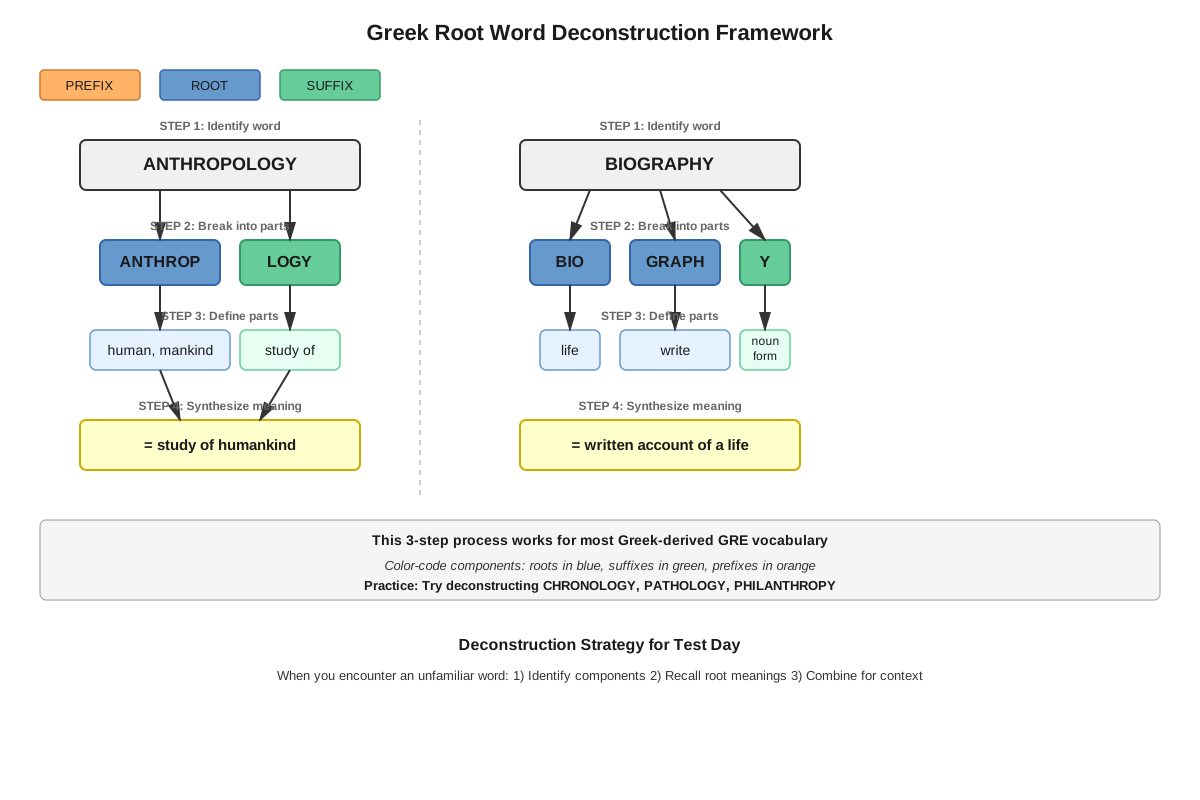
Words derived from Greek typically consist of three main components: prefixes (beginning elements), roots (core meaning elements), and suffixes (ending elements). The root carries the primary meaning, while prefixes modify or specify that meaning, and suffixes indicate grammatical function (noun, verb, adjective, etc.). For example, in "biography," "bio" (life) is the Greek root, "graph" (write) is a second root, and "y" is a suffix indicating a noun form. Understanding this structure allows systematic deconstruction of complex vocabulary.
Greek roots often appear in combination with other Greek elements rather than mixing with Latin components, though exceptions exist. Words like "television" combine Greek "tele" (distant) with Latin "vision" (seeing), but pure Greek constructions are more common in academic vocabulary. Recognizing whether a word is primarily Greek or Latin-derived helps predict which roots might be present and how they combine.
High-Frequency Greek Roots for the GRE
The following table presents essential Greek roots that appear repeatedly on the GRE:
| Greek Root | Meaning | Example Words | GRE Context |
|---|---|---|---|
| anthrop | human, mankind | anthropology, misanthrope, philanthropist | Social science passages, human behavior |
| bio | life | biology, biography, symbiotic | Science passages, life sciences |
| chron | time | chronological, anachronism, synchronize | Historical contexts, time relationships |
| dem | people | democracy, epidemic, demagogue | Political science, social structures |
| graph/gram | write, record | biography, telegram, graphology | Communication, documentation |
| log/logy | word, study, reason | logic, psychology, dialogue | Academic disciplines, reasoning |
| morph | form, shape | metamorphosis, amorphous, anthropomorphic | Change, structure descriptions |
| path | feeling, disease, suffering | empathy, pathology, apathetic | Emotions, medical contexts |
| phil | love | philosophy, bibliophile, philanthropist | Preferences, affections |
| phon | sound | phonetics, symphony, cacophony | Audio, communication |
| psych | mind, soul | psychology, psychosomatic, psyche | Mental processes, behavior |
| soph | wisdom | philosophy, sophisticated, sophomore | Knowledge, intellectual development |
| the/theo | god | theology, atheist, apotheosis | Religion, belief systems |
Combining Greek Roots
Many GRE vocabulary words contain multiple Greek roots working together. Understanding how roots combine multiplies vocabulary comprehension exponentially. For instance, "psychology" combines "psych" (mind) and "logy" (study), literally meaning "study of the mind." Similarly, "chronology" combines "chron" (time) and "logy" (study), meaning "study of time" or time-ordered sequence.
The process of combining roots follows predictable patterns:
- Root + Root: Two roots join to create a compound meaning (biography = bio + graph = "life writing")
- Prefix + Root: A modifying element precedes the main meaning (sympathy = sym + path = "feeling with")
- Root + Suffix: The root takes a grammatical ending (chronological = chron + ology + ical = "relating to time study")
- Prefix + Root + Suffix: Complete word structure (anthropological = anthrop + ology + ical = "relating to human study")
Additional Essential Greek Roots
Beyond the core roots, these additional elements frequently appear on the GRE:
- auto: self (autobiography, autonomous, autocrat)
- cracy/crat: rule, government (democracy, aristocrat, bureaucracy)
- dox: belief, opinion (orthodox, paradox, heterodox)
- gen: birth, race, kind (genesis, homogeneous, genealogy)
- geo: earth (geography, geology, geocentric)
- hetero: different, other (heterogeneous, heterodox)
- homo: same (homogeneous, homonym, homosexual)
- hydr: water (hydrate, dehydrate, hydraulic)
- macro: large (macroeconomics, macrocosm)
- micro: small (microscope, microorganism, microcosm)
- mono: one, single (monotone, monologue, monarchy)
- nym: name (synonym, pseudonym, anonymous)
- pan: all (panorama, pandemic, panacea)
- poly: many (polygon, polyglot, polygamy)
- scope: see, watch (microscope, telescope, horoscope)
- tele: distant (telephone, television, telepathy)
Greek Prefixes That Modify Roots
Understanding Greek prefixes enhances root analysis:
- a/an: without, not (amoral, anarchy, apathy)
- anti: against, opposite (antibiotic, antipathy, antithesis)
- dia: through, across (dialogue, diameter, diagnosis)
- dys: bad, difficult (dysfunctional, dyslexia, dystopia)
- eu: good, well (euphemism, eulogy, euphoria)
- hyper: over, excessive (hyperbole, hyperactive)
- hypo: under, beneath (hypothesis, hypochondriac)
- meta: beyond, change (metamorphosis, metaphor, metabolism)
- para: beside, beyond (parallel, paradox, parasite)
- syn/sym: together, with (synthesis, sympathy, synchronize)
Greek Suffixes That Complete Words
Common Greek suffixes indicate word function:
- -ism: doctrine, belief, condition (atheism, criticism, organism)
- -ist: one who practices (psychologist, philanthropist, atheist)
- -ize: to make, to cause (synthesize, criticize, ostracize)
- -ology: study of (biology, psychology, theology)
- -phobia: fear of (claustrophobia, xenophobia, agoraphobia)
Concept Relationships
Greek roots function as building blocks that combine systematically to create precise meanings. The relationship begins with individual roots carrying core meanings (bio = life, graph = write), which then combine with other roots to form compound concepts (biography = life writing). Prefixes modify these root combinations to add nuance (autobiography = self + life + writing), while suffixes determine grammatical function (autobiographical = adjective form).
This hierarchical structure connects to broader Verbal Reasoning skills: Greek roots → enable word deconstruction → supports context-based vocabulary inference → enhances reading comprehension → improves answer accuracy in Text Completion and Sentence Equivalence questions. The relationship is bidirectional—context clues from passages can confirm meanings derived from root analysis, creating a robust vocabulary strategy.
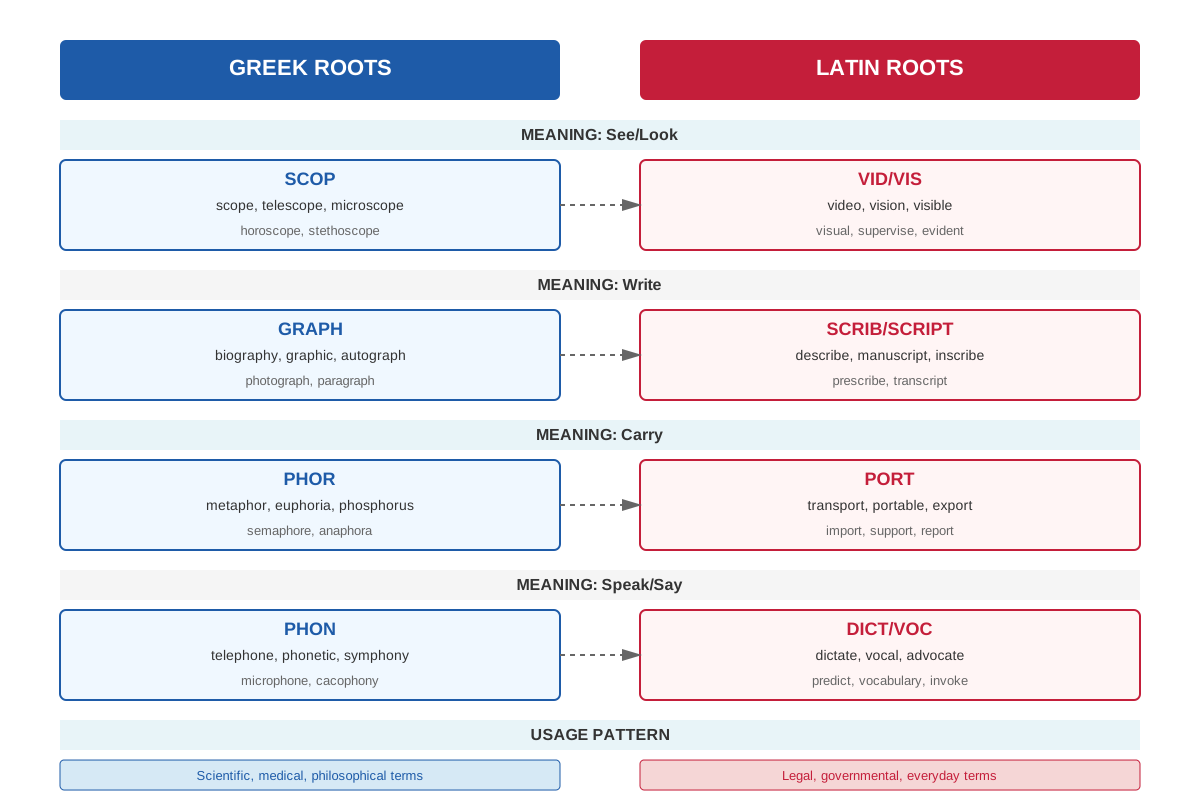
Greek roots also relate to Latin roots (covered separately in GRE preparation), and distinguishing between the two prevents confusion. Generally, Greek roots appear in scientific and philosophical terminology, while Latin roots dominate legal and governmental vocabulary. Understanding this distinction helps predict which roots might appear in specific contexts and passages.
High-Yield Facts
⭐ Approximately 60% of English words have Greek or Latin origins, with Greek dominating scientific and academic vocabulary
⭐ The root "log/logy" (study, word, reason) appears in over 100 common English words and is one of the most frequently tested on the GRE
⭐ Greek roots typically combine with other Greek elements rather than mixing with Latin components in pure academic terminology
⭐ Words beginning with "ph" are almost always Greek-derived (philosophy, philanthropy, phonetics)
⭐ The prefix "a/an" meaning "without" or "not" is exclusively Greek and appears in high-frequency GRE words like apathy, anarchy, and amoral
- Greek roots often appear in clusters within specific academic disciplines (psychology, psychiatry, psychosomatic all share "psych")
- The root "anthrop" (human) appears in numerous GRE words testing social science concepts
- Double consonants in Greek-derived words often indicate where a prefix joins a root (symmetry = syn + metry)
- Greek roots "phil" (love) and "phob" (fear) create opposite meanings and frequently appear in GRE antonym relationships
- The suffix "-ology" always indicates "study of" and transforms roots into academic disciplines
- Greek roots maintain consistent spelling across related words, making pattern recognition reliable
- Words with "ch" pronounced as "k" are typically Greek (chronology, chaos, character)
- The root "morph" (form, shape) appears in both literal and metaphorical contexts on the GRE
- Greek numerical prefixes (mono, di, tri, poly) combine with roots to indicate quantity
- Understanding Greek roots can help decode 30-40% of unfamiliar GRE vocabulary without prior exposure
Quick check — test yourself on Greek roots so far.
Try Flashcards →Common Misconceptions
Misconception: All difficult vocabulary words on the GRE are Greek-derived → Correction: While Greek roots are common in academic vocabulary, Latin roots are equally important, and many challenging words have French, Germanic, or other origins. Greek roots are particularly prevalent in scientific and philosophical terms, but comprehensive vocabulary preparation requires studying multiple root systems.
Misconception: Knowing the Greek root always provides the exact modern English meaning → Correction: Word meanings evolve over time, and some Greek-derived words have shifted from their literal root meanings. For example, "sarcasm" comes from Greek "sark" (flesh) and originally meant "to tear flesh," but now means cutting, mocking remarks. Root knowledge provides clues and educated guesses, but context remains essential for confirming precise meanings.
Misconception: Greek and Latin roots can be used interchangeably in word analysis → Correction: Greek and Latin roots have distinct patterns and rarely mix in pure academic terminology. Confusing the two can lead to incorrect meaning derivations. For instance, "aqua" (water) is Latin, while "hydr" (water) is Greek, and they appear in different word families (aquatic vs. hydraulic).
Misconception: Memorizing roots alone is sufficient for GRE vocabulary mastery → Correction: Root knowledge is a powerful tool but works best in combination with context analysis, understanding of prefixes and suffixes, and exposure to words in authentic contexts. Roots provide frameworks for educated guessing, but comprehensive vocabulary development requires multiple strategies including reading challenging texts and studying word usage patterns.
Misconception: The more roots a word contains, the more complex its meaning → Correction: Words with multiple roots often have straightforward meanings when each component is understood. "Anthropomorphic" seems complex but simply means "human-shaped" (anthrop + morph + ic). Breaking words into components actually simplifies rather than complicates understanding. Single-root words can be more challenging if the root is unfamiliar or the word has undergone significant semantic shift.
Misconception: Greek roots only appear in scientific vocabulary → Correction: While Greek roots dominate scientific terminology, they appear extensively in humanities vocabulary as well. Philosophy, theology, democracy, rhetoric, and many other non-scientific concepts use Greek roots. The GRE tests vocabulary across all academic disciplines, and Greek roots appear in social sciences, arts, and general academic discourse.
Worked Examples
Example 1: Text Completion Question
Question: The professor's lecture on ancient civilizations was remarkably _________, covering not just Greek and Roman societies but also Egyptian, Mesopotamian, and Chinese cultures.
(A) chronological
(B) comprehensive
(C) anthropological
(D) synchronous
(E) cosmopolitan
Solution Process:
Step 1: Analyze the context. The sentence indicates the lecture covered multiple civilizations from different regions, suggesting breadth or wide scope.
Step 2: Examine answer choices for Greek roots:
- (A) "chronological" = chron (time) + logical → relating to time order
- (B) "comprehensive" = Latin-derived, meaning thorough or complete
- (C) "anthropological" = anthrop (human) + ology (study) → relating to human study
- (D) "synchronous" = syn (together) + chron (time) → occurring at the same time
- (E) "cosmopolitan" = cosmo (world) + politan (citizen) → worldly, diverse
Step 3: Apply root knowledge to context. The lecture covered many different civilizations (breadth), not time order (A), not simultaneous occurrence (D), and not specifically human study methodology (C). While "cosmopolitan" has the right connotation of worldliness, "comprehensive" (B) best captures the thoroughness and breadth described.
Answer: (B) comprehensive
Learning Objective Connection: This example demonstrates identifying when Greek roots are being tested (multiple answer choices contain Greek elements) and applying root knowledge to eliminate incorrect answers, though the correct answer happens to be Latin-derived, showing that root knowledge works best alongside context analysis.
Example 2: Sentence Equivalence Question
Question: Despite his reputation for _________, the author's latest work showed surprising empathy for characters from diverse backgrounds.
Select two answer choices that produce sentences with similar meanings:
(A) misanthropy
(B) philanthropy
(C) apathy
(D) antipathy
(E) sympathy
(F) cynicism
Solution Process:
Step 1: Identify the contrast signal "Despite," indicating the blank should contrast with "empathy for characters from diverse backgrounds."
Step 2: Deconstruct Greek-root answer choices:
- (A) "misanthropy" = mis (hate) + anthrop (human) + y → hatred of humanity
- (B) "philanthropy" = phil (love) + anthrop (human) + y → love of humanity
- (C) "apathy" = a (without) + path (feeling) + y → without feeling
- (D) "antipathy" = anti (against) + path (feeling) + y → feeling against, hostility
- (E) "sympathy" = syn (with) + path (feeling) + y → feeling with, compassion
- (F) "cynicism" = Greek-derived but not from simple roots → distrust of human motives
Step 3: Apply logic. "Empathy" (feeling into/understanding others) contrasts with negative attitudes toward people. "Misanthropy" (hatred of humanity) and "cynicism" (distrust of human motives) both represent negative views of people that would contrast with showing empathy.
Step 4: Verify equivalence. Both (A) and (F) create sentences meaning the author was known for negative views of humanity but surprisingly showed empathy in the latest work.
Answer: (A) misanthropy and (F) cynicism
Learning Objective Connection: This example shows how Greek root analysis (particularly "anthrop" and "path" families) enables quick elimination of incorrect answers and identification of synonymous terms, directly applying root knowledge to GRE-style questions.
Exam Strategy
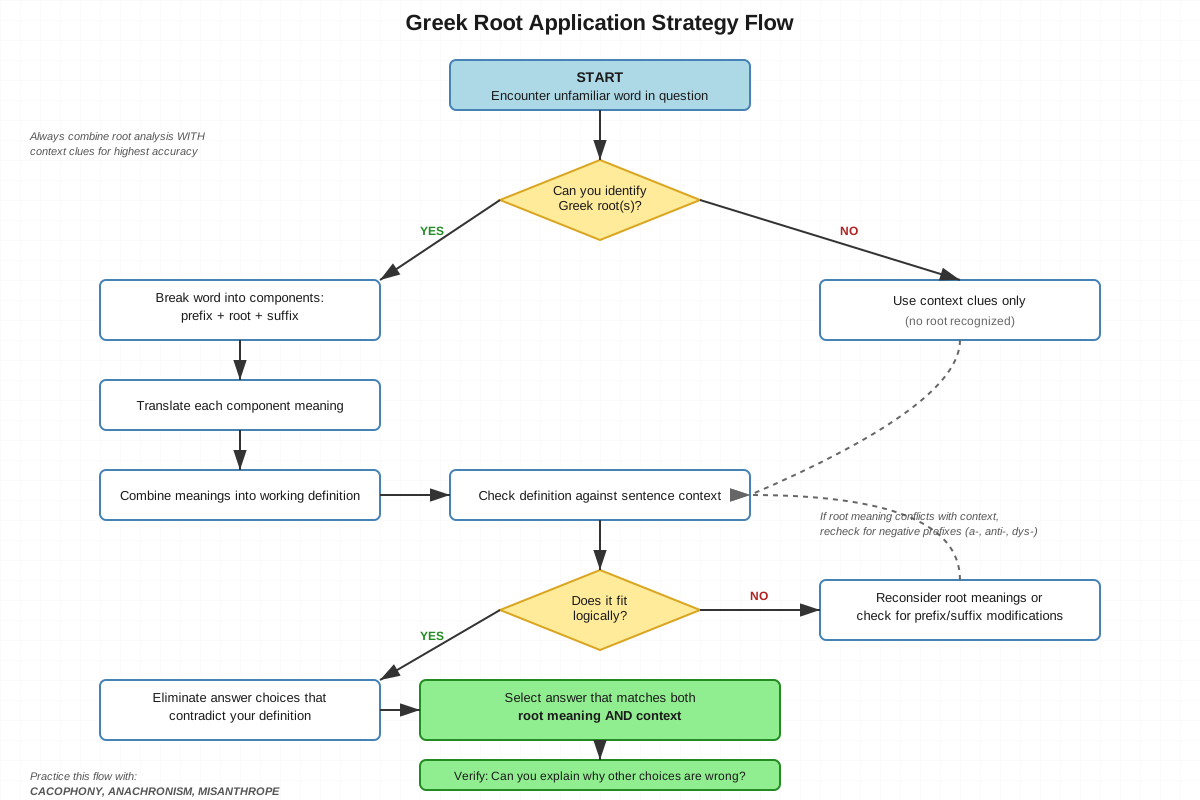
When approaching GRE questions involving Greek roots, follow this systematic process:
Step 1: Scan for recognizable Greek elements. Before reading answer choices carefully, quickly identify any words containing familiar Greek roots, prefixes, or suffixes. Words with "ph," "ch" (pronounced as k), "y" in unusual positions, or "ology" endings are likely Greek-derived.
Step 2: Deconstruct unfamiliar words. Break complex vocabulary into component parts: prefix + root(s) + suffix. Write out the meaning of each component if time permits, or mentally note them. For example, "philanthropist" = phil (love) + anthrop (human) + ist (one who) = "one who loves humanity."
Step 3: Synthesize component meanings. Combine the individual meanings to form a working definition. This definition may be approximate rather than precise, but it provides enough information to evaluate answer choices or understand context.
Step 4: Verify with context. Always confirm root-based definitions against sentence context. If the derived meaning doesn't fit logically, reconsider the root analysis or look for semantic shifts in word meaning.
Step 5: Use process of elimination. Even partial root knowledge helps eliminate incorrect answers. If you know "chron" means time, you can eliminate "chronological" from answers requiring spatial or emotional meanings.
Exam Tip: When two answer choices contain the same Greek root but different prefixes (sympathy vs. antipathy), the prefixes likely create opposite meanings, making them useful for elimination.
Trigger words and phrases that signal Greek root questions:
- Scientific terminology in answer choices (biology, psychology, geology)
- Words ending in "-ology," "-phobia," "-ism," "-ist"
- Multiple answer choices sharing root elements
- Academic or philosophical vocabulary
- Words beginning with Greek prefixes (anti-, syn-, meta-, hyper-)
Time allocation: Spend 10-15 seconds on root analysis for unfamiliar words. If deconstruction doesn't yield clear meaning quickly, rely more heavily on context clues and move forward. Root analysis should accelerate rather than slow down question completion.
Process-of-elimination specific tips:
- Eliminate answers with roots that clearly don't match context (time-related roots when discussing emotions)
- Prioritize answers where you recognize multiple components (prefix + root + suffix all known)
- Be cautious with partial matches—knowing one root in a multi-root word isn't always sufficient
- Use root knowledge to identify synonyms in Sentence Equivalence questions by finding words with similar root meanings
Memory Techniques
Mnemonic for common "path" words: People Always Think Hard = Path means feeling
- Apathy = Absence of feeling
- Sympathy = Same feeling
- Empathy = Entering another's feeling
- Antipathy = Against feeling
Visualization for "anthrop" (human): Picture an anthropomorphic cartoon character (human-shaped animal) to remember "anthrop" = human. Connect to anthropology (study of humans), misanthrope (human-hater), and philanthropist (human-lover).
Acronym for Greek prefixes indicating negation: AAA = Anti (against), A (without), Apo (away from)
Story mnemonic for "chron" (time): Chronos was the Greek god of time, and he was always chronically late, which made events achronistic (out of time order). This connects chronology, chronic, chronological, anachronism, and synchronize.
Rhyme for "phil" and "phob": "Phil loves to fill his life with thrills, while phobic folks avoid the ills." This distinguishes phil (love) from phob (fear).
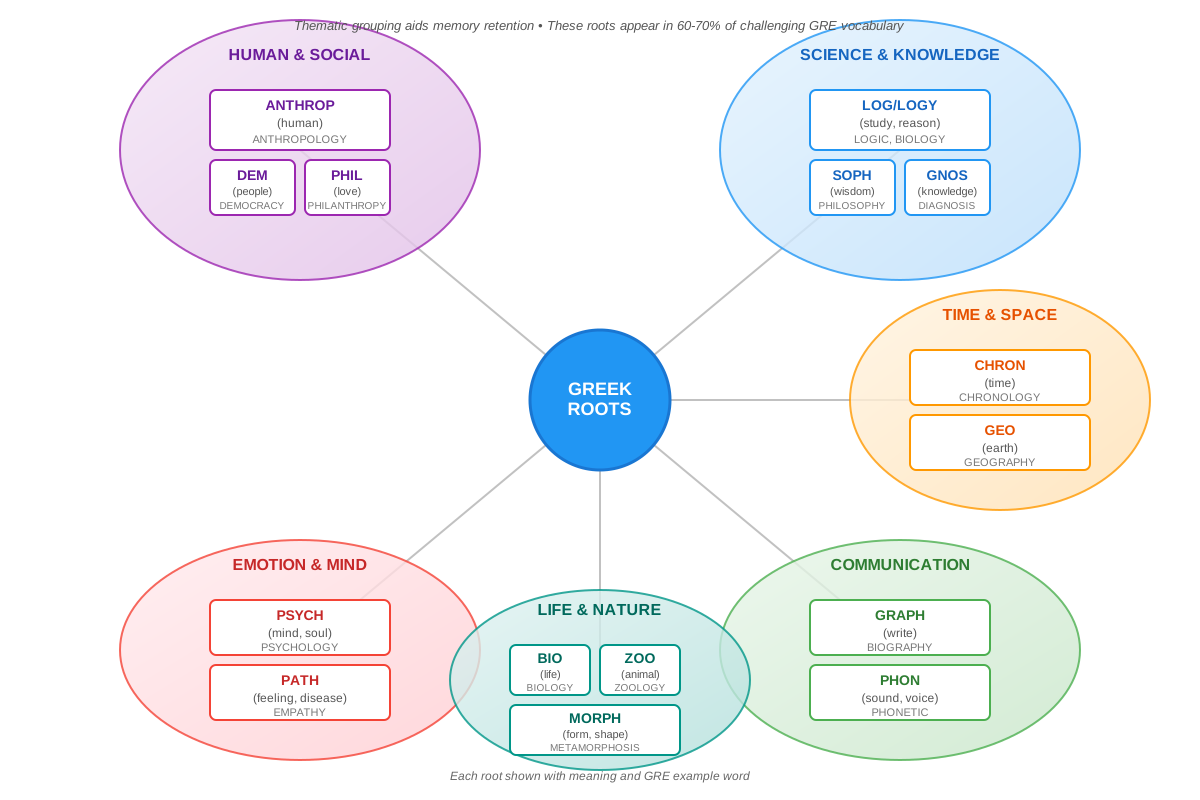
Visual clustering: Group roots by theme:
- Mind/Soul cluster: psych (mind), soph (wisdom), log (reason)
- Human/People cluster: anthrop (human), dem (people)
- Communication cluster: graph (write), phon (sound), log (word)
- Science cluster: bio (life), geo (earth), hydr (water)
Acronym for high-frequency roots: BAD CLAMPS
- Bio (life)
- Anthrop (human)
- Dem (people)
- Chron (time)
- Log (word/study)
- Auto (self)
- Morph (form)
- Path (feeling)
- Soph (wisdom)
Summary
Greek roots form the structural foundation of academic English vocabulary and provide a systematic approach to decoding unfamiliar words on the GRE. By understanding approximately 40-50 high-frequency Greek roots, along with common prefixes and suffixes, test-takers can analyze thousands of complex words without prior memorization. The key strategy involves deconstructing words into component parts (prefix + root + suffix), determining the meaning of each element, and synthesizing these meanings into a working definition that can be verified against context. Greek roots appear most frequently in scientific, philosophical, and academic terminology, making them particularly valuable for GRE Verbal Reasoning questions. Success requires not just memorizing root meanings but understanding how roots combine, recognizing patterns across word families, and integrating root analysis with context clues and reading comprehension skills. This approach transforms vocabulary from a memorization challenge into a logical puzzle-solving exercise, enabling confident handling of even the most sophisticated GRE vocabulary.
Key Takeaways
- Greek roots provide the foundation for 30-40% of challenging GRE vocabulary, particularly in scientific and academic contexts
- Systematic word deconstruction (prefix + root + suffix analysis) enables educated guessing about unfamiliar words without prior exposure
- High-frequency roots like log, anthrop, chron, path, bio, and morph appear repeatedly across multiple GRE questions and passages
- Root analysis works best in combination with context clues, not as a standalone strategy—always verify derived meanings against sentence logic
- Greek elements typically combine with other Greek components rather than mixing with Latin roots in pure academic terminology
- Pattern recognition across word families (psychology, psychiatry, psychosomatic) reinforces root meanings and accelerates vocabulary acquisition
- Prefixes dramatically modify root meanings (sympathy vs. antipathy), making prefix knowledge equally important as root knowledge for precise word analysis
Related Topics
Latin Roots: While Greek roots dominate scientific vocabulary, Latin roots appear extensively in legal, governmental, and general academic terminology. Mastering both systems provides comprehensive vocabulary coverage for the GRE. Understanding the distinction between Greek and Latin patterns prevents confusion and improves deconstruction accuracy.
Prefixes and Suffixes: These word elements work in conjunction with Greek roots to create complete meanings. Advanced study of prefix and suffix patterns enables more sophisticated word analysis and helps distinguish between related words with different grammatical functions (psychology vs. psychological vs. psychologist).
Context Clues and Vocabulary in Context: Root analysis provides one approach to unknown vocabulary, but context clues offer complementary strategies. Combining both methods creates a robust system for handling any vocabulary challenge on the GRE.
Word Relationships and Analogies: Understanding Greek roots illuminates relationships between words, helping identify synonyms, antonyms, and analogical connections tested throughout Verbal Reasoning questions.
Reading Comprehension in Science Passages: Greek-derived terminology appears frequently in scientific passages. Root knowledge accelerates comprehension of technical content, allowing more time for analyzing arguments and answering questions.
Practice CTA
Now that you've mastered the fundamentals of Greek roots, it's time to reinforce this knowledge through active practice. Complete the practice questions to apply root analysis to authentic GRE-style questions, and use the flashcards to build automatic recognition of high-frequency roots. Remember, vocabulary mastery is a cumulative process—each root you learn unlocks dozens of related words, creating exponential returns on your study investment. Consistent practice with root deconstruction will transform unfamiliar vocabulary from obstacles into opportunities to demonstrate your analytical reasoning skills. You've built the foundation; now apply it with confidence!
Sign up free to keep reading
Create a free AnvayaPrep account to finish this GRE guide on Greek roots — plus flashcards and practice questions.