Overview
Understanding Latin roots is one of the most powerful strategies for conquering the GRE Verbal Reasoning section. The majority of sophisticated English vocabulary—particularly the academic and technical terms that appear frequently on the GRE—derives from Latin origins. When students encounter an unfamiliar word on test day, knowledge of GRE Latin roots transforms what could be a paralyzing moment into an opportunity to deduce meaning through structural analysis. Rather than memorizing thousands of individual vocabulary words in isolation, mastering Latin roots allows test-takers to unlock the meanings of entire word families, exponentially expanding their effective vocabulary with significantly less effort.
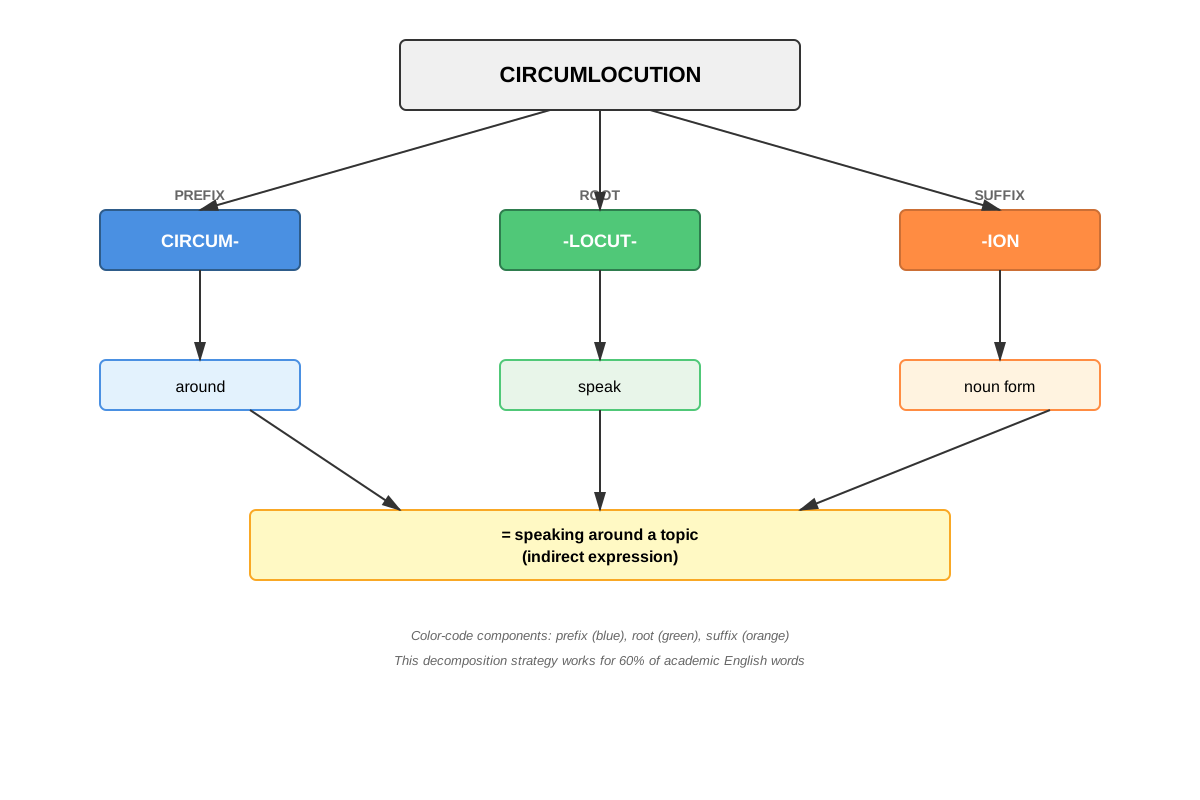
The GRE consistently tests vocabulary through Text Completion, Sentence Equivalence, and Reading Comprehension questions. Research indicates that approximately 60% of English words with academic or technical significance contain Latin elements. This means that a strategic investment in learning high-frequency Latin roots yields returns across multiple question types and passages. When students can break down a word like "circumlocution" into its components (circum = around, locut = speak, -ion = noun suffix), they can infer "speaking around a topic" or "indirect expression" even if they've never encountered the word before.
Within the broader Verbal Reasoning framework, Latin roots serve as the foundation for morphological analysis—the systematic study of word structure. This topic connects directly to Greek roots, prefixes, and suffixes, forming a comprehensive word-decoding system. While Reading Comprehension tests contextual understanding and Text Completion assesses logical reasoning, the underlying challenge in all these question types often comes down to vocabulary knowledge. Latin roots provide the architectural blueprint that makes sophisticated vocabulary accessible, transforming the GRE from a test of rote memorization into an assessment of analytical reasoning applied to language.
Learning Objectives
- [ ] Identify when Latin roots is being tested in GRE questions
- [ ] Explain the core rule or strategy behind Latin roots for vocabulary decoding
- [ ] Apply Latin roots to GRE-style questions accurately
- [ ] Decompose unfamiliar words into their Latin root components to infer meaning
- [ ] Recognize common Latin root variations and spelling changes across word families
- [ ] Distinguish between words with similar Latin roots but different meanings based on context
- [ ] Generate multiple related words from a single Latin root to expand vocabulary efficiently
Prerequisites
- Basic English vocabulary: Understanding common words provides the foundation for recognizing patterns when Latin roots are combined with familiar prefixes and suffixes
- Parts of speech recognition: Identifying whether a word functions as a noun, verb, adjective, or adverb helps determine which suffix meanings apply and clarifies word usage
- Contextual reading skills: The ability to use surrounding text to confirm or refine word meaning ensures that root-based deductions align with passage logic
- Prefix and suffix knowledge: Latin roots typically combine with these elements, so recognizing common affixes (un-, re-, -tion, -able) enables complete word analysis
Why This Topic Matters
In professional and academic contexts, Latin-derived vocabulary dominates formal writing, scientific discourse, legal documents, and scholarly publications. Medical professionals use Latin roots daily (cardiovascular, dermatology, pathology), while legal terminology relies heavily on Latin phrases and root-based constructions. Business communications, technical manuals, and research papers all employ vocabulary that becomes transparent once Latin roots are understood. This knowledge extends far beyond test preparation, serving as a lifelong tool for comprehending specialized texts across disciplines.
On the GRE specifically, Latin roots appear with remarkable frequency. Analysis of official GRE materials reveals that approximately 40-50% of challenging vocabulary words in Text Completion and Sentence Equivalence questions contain identifiable Latin roots. Reading Comprehension passages, particularly those drawn from academic journals in sciences, humanities, and social sciences, feature dense Latin-derived terminology. Questions testing vocabulary-in-context often hinge on understanding words built from Latin components. The Educational Testing Service (ETS) deliberately selects vocabulary that rewards analytical thinking over pure memorization, making root knowledge a strategic advantage.
Common manifestations include: words with roots like bene (good), mal (bad), dict (speak), scrib/script (write), port (carry), and ject (throw) appearing in answer choices where subtle meaning distinctions determine correctness. Passages discussing scientific processes, historical developments, or theoretical frameworks routinely employ Latin-based terminology. Even when the exact word hasn't been studied, test-takers with strong root knowledge can eliminate implausible answer choices and select contextually appropriate options with confidence.
Core Concepts
Understanding Latin Root Structure
Latin roots form the semantic core of words—the irreducible element that carries primary meaning. Unlike prefixes (which modify meaning) and suffixes (which indicate grammatical function), roots provide the fundamental concept. Most English words of Latin origin follow a predictable structure: prefix + root + suffix. For example, in "transportation," trans- (across) + port (carry) + -ation (noun suffix) = "the act of carrying across." Recognizing this architecture allows systematic deconstruction of unfamiliar vocabulary.
Latin roots often appear in slightly modified forms due to phonetic evolution and spelling conventions. The root duc/duct (to lead) appears as "duc" in "educate" but "duct" in "conductor." These variations follow patterns: roots typically use the shorter form before vowels and the longer form before consonants. Understanding these transformations prevents confusion when the same root looks different across word families.
High-Frequency Latin Roots for GRE Success
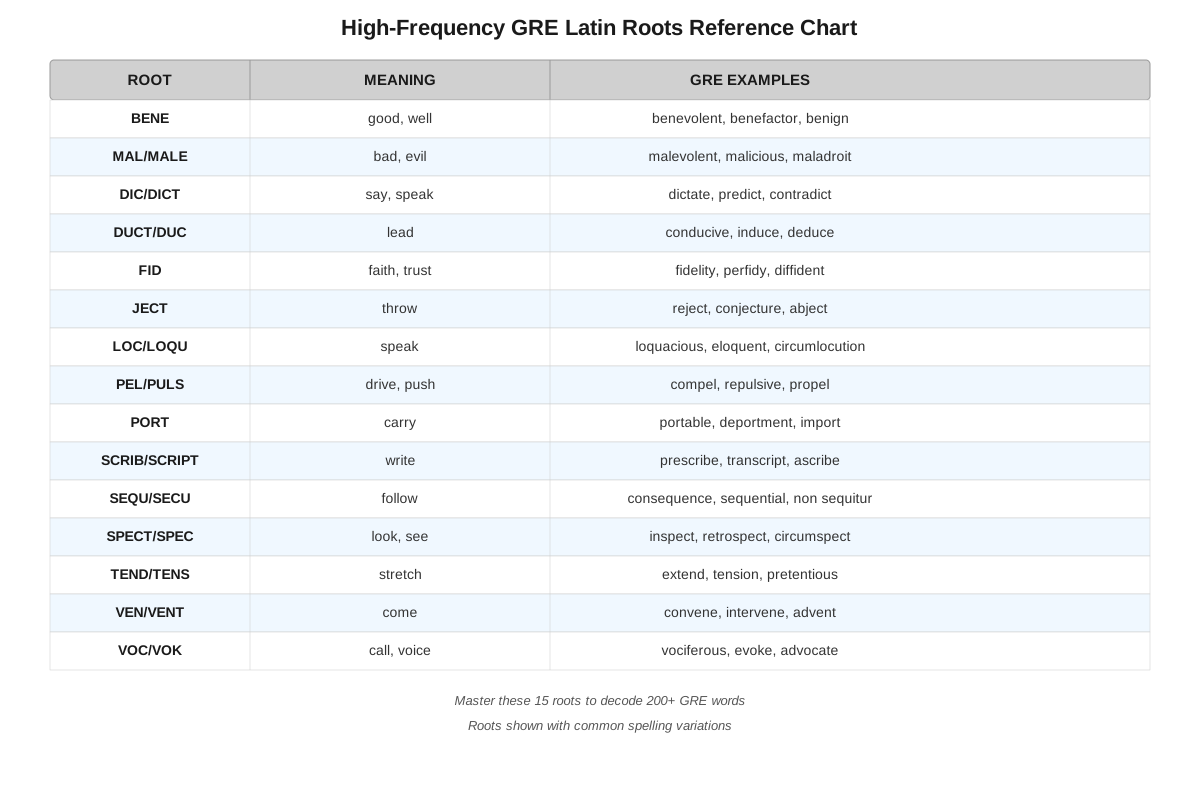
The following table presents essential Latin roots that appear repeatedly on the GRE, organized by semantic category:
| Root | Meaning | Example Words | GRE Context |
|---|---|---|---|
| bene | good, well | benefactor, benevolent, benediction | Describing positive actions or character traits |
| mal/male | bad, evil | malevolent, malfeasance, malady | Indicating negative qualities or harmful actions |
| dict | say, speak | dictate, predict, contradict | Communication and assertion contexts |
| scrib/script | write | inscribe, manuscript, prescription | Written documentation and records |
| port | carry | portable, export, deportment | Movement and transportation concepts |
| ject | throw | reject, projectile, conjecture | Forceful action or speculation |
| ced/cess | go, yield | precede, concession, recede | Movement, sequence, or surrender |
| fac/fact/fect | make, do | factory, artifact, defect | Creation and causation |
| spec/spect | look, see | inspect, spectator, retrospect | Observation and examination |
| ten/tain/tin | hold | retain, tenacious, abstinence | Possession and persistence |
Semantic Families and Word Networks
Latin roots generate extensive word families—groups of related words sharing a common root. The root vid/vis (see) produces: video, vision, visual, visible, invisible, revise, supervise, provision, improvise, visionary, and visage. Recognizing one member of this family provides access to dozens of related terms. This network effect makes Latin root study extraordinarily efficient compared to memorizing isolated words.
Understanding semantic relationships within families also clarifies subtle distinctions. Consider cred (believe): "credible" means believable, "credulous" means too willing to believe, "incredulous" means unwilling to believe, and "credulity" names the quality of being credulous. The root provides the conceptual anchor while prefixes and suffixes create precise variations.
Morphological Transformations
Latin roots undergo predictable changes when combined with certain prefixes, a phenomenon called assimilation. The prefix in- (not) becomes "im-" before roots starting with b, m, or p (impossible, immoral), "il-" before l (illegal), and "ir-" before r (irregular). Similarly, ad- (to, toward) assimilates: "ac-" in "accept," "af-" in "affix," "ag-" in "aggregate," and "ap-" in "appoint." Recognizing these patterns prevents misidentification of root boundaries.
Vowel changes also occur systematically. The root cap/cep/cip/ceiv (take, seize) demonstrates this variation: capture, accept, recipient, receive. Despite different spellings, the core meaning remains consistent. These transformations follow Latin conjugation patterns that influenced English word formation.
Contextual Application Strategy
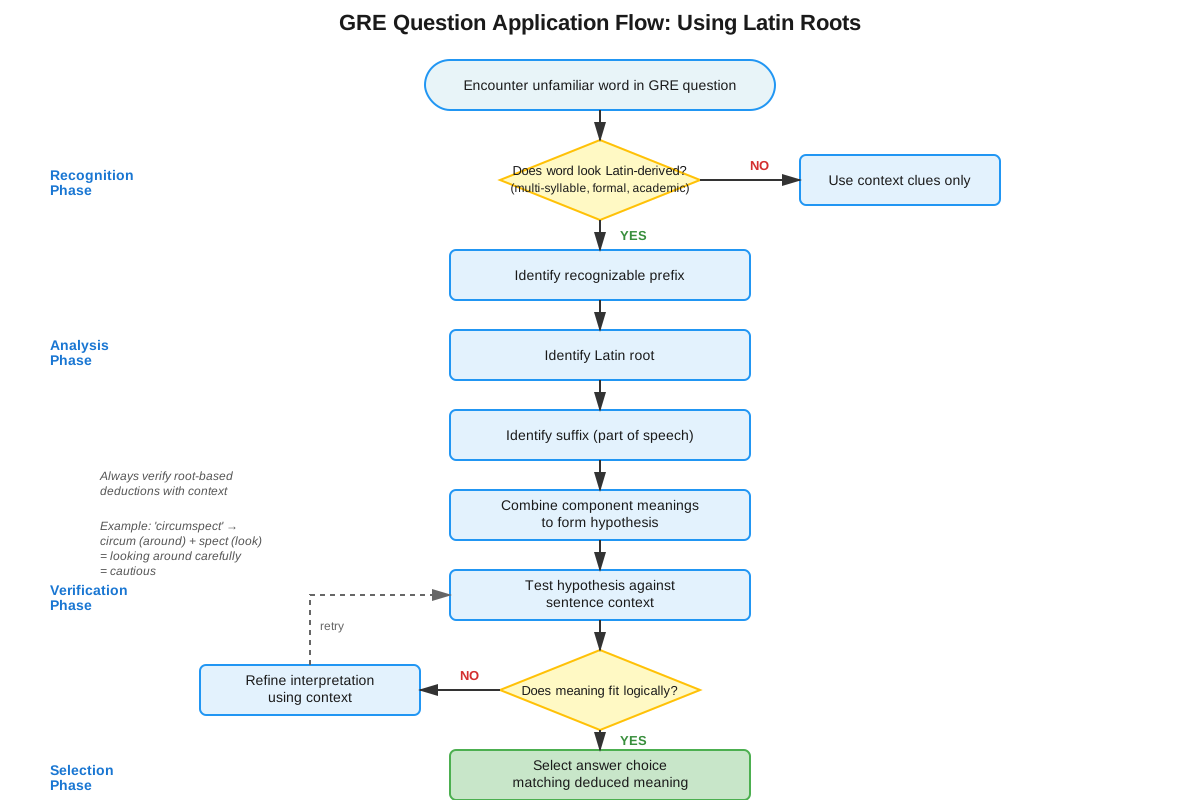
Effective use of Latin roots requires integration with contextual analysis. The root temp means "time," appearing in "temporary," "contemporary," and "temporal." However, "temper" and "temperate" derive from a different root meaning "moderate" or "mix." Context determines which root applies. The GRE rewards students who combine root knowledge with sentence-level reasoning, using roots to generate hypotheses about meaning that context confirms or refines.
The process follows these steps:
- Identify the root within the unfamiliar word
- Recall the root's core meaning
- Consider how prefixes and suffixes modify that meaning
- Generate a working definition
- Test that definition against sentence context
- Adjust interpretation based on contextual fit
Distinguishing Latin from Greek Roots
While both Latin and Greek roots appear extensively in English, they follow different patterns. GRE Latin roots typically combine more freely with common English prefixes and suffixes, while Greek roots often appear in technical or scientific terminology. Latin roots like aud (hear), vid (see), and tang (touch) relate to everyday concepts, whereas Greek roots like phon (sound), opt (sight), and hap (touch) appear in specialized vocabulary (telephone, optical, haptic). Recognizing this distinction helps predict word register and usage context.
Concept Relationships
Latin roots function as the central node in a network of vocabulary-building strategies. They connect directly to prefix knowledge—understanding that re- means "again" or "back" combines with the root vert (turn) to create "revert" (turn back). Similarly, suffix mastery completes the word-building system: the root mort (death) plus -al (adjective suffix) yields "mortal," while -ify (verb suffix) creates "mortify" (originally "to cause death," now "to humiliate deeply").
The relationship flows as follows: Prefix → Root → Suffix = Complete Word. Each element contributes specific information: prefixes provide directional or quantitative modification, roots supply core meaning, and suffixes indicate grammatical function. This tripartite structure enables systematic analysis of complex vocabulary.
Latin roots also connect to Greek roots through the broader concept of classical language influence on English. Many academic terms combine both: "television" pairs Greek "tele" (far) with Latin "vision" (seeing). Understanding both systems provides comprehensive coverage of GRE vocabulary.
Furthermore, root knowledge enhances contextual vocabulary strategies. When context clues suggest a word means something positive, and the root bene appears, confidence in that interpretation increases. Conversely, if context implies negativity but a word contains bene, re-examination is warranted—perhaps the word is being used ironically or the initial context reading was incorrect.
The progression of mastery follows this path: Individual Root Recognition → Root Family Expansion → Morphological Pattern Recognition → Integrated Contextual Application. Early learning focuses on memorizing high-frequency roots. Intermediate study explores how roots generate word families. Advanced application involves recognizing transformation patterns and seamlessly integrating root analysis with contextual reasoning during timed test conditions.
High-Yield Facts
⭐ Approximately 60% of English words with academic significance contain Latin roots, making them the highest-yield vocabulary study strategy for the GRE.
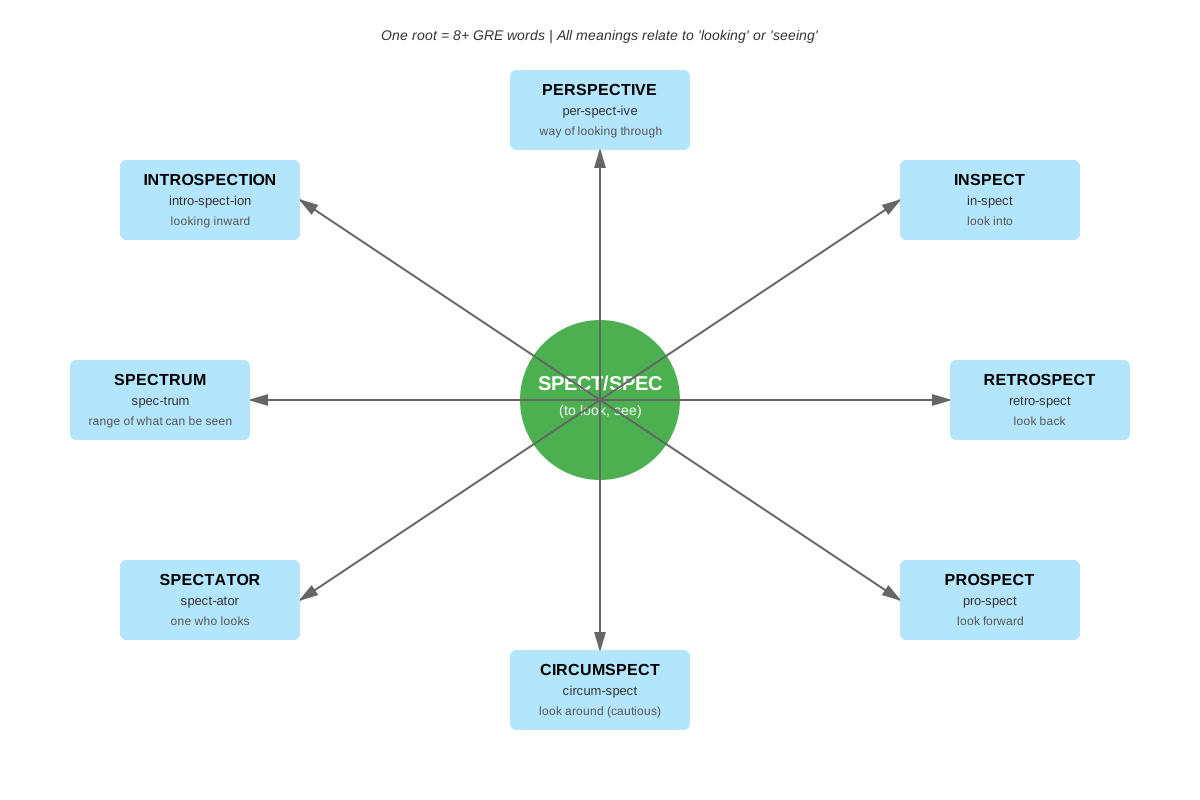
⭐ The root "spec/spect" (look, see) appears in over 50 common English words, including inspect, respect, spectacle, perspective, and introspection—all GRE-relevant terms.
⭐ Latin roots often undergo assimilation when combined with prefixes, changing spelling but not meaning (ad- + fix = affix, in- + legal = illegal).
⭐ The roots "bene" (good) and "mal" (bad) appear in approximately 15% of GRE Sentence Equivalence questions testing positive/negative word pairs.
⭐ Understanding just 50 high-frequency Latin roots provides access to over 10,000 English words, demonstrating exponential learning efficiency.
- The root duc/duct (lead) generates words across multiple parts of speech: deduce (verb), conductor (noun), inductive (adjective), seduction (noun).
- Latin roots typically carry concrete, physical meanings that evolved into abstract applications: port originally meant "carry physically" but now appears in "deportment" (how one carries oneself behaviorally).
- The root fac/fact/fect (make, do) is one of the most productive in English, appearing in manufacture, factory, artifact, perfect, defect, affect, and effect.
- Words with the root cred (believe) test trust and believability concepts frequently in Reading Comprehension passages about scientific credibility and historical sources.
- The root scrib/script (write) appears in legal and academic contexts on the GRE, particularly in passages discussing documentation, manuscripts, and prescriptive versus descriptive approaches.
- Latin roots often have multiple related meanings: ten/tain/tin means both "hold" and "stretch," connecting words like "retain" (hold back) and "tenuous" (stretched thin, weak).
- The root ject (throw) appears in words testing causation and rejection: reject, project, conjecture, dejected, trajectory.
Quick check — test yourself on Latin roots so far.
Try Flashcards →Common Misconceptions
Misconception: All words that look similar share the same Latin root and therefore have related meanings.
Correction: English contains many false cognates and coincidental similarities. "Sinister" (from Latin "left") and "minister" (from Latin "servant") share no etymological connection despite similar spelling. Always verify root identity rather than assuming based on appearance.
Misconception: Knowing the Latin root automatically provides the exact modern English meaning.
Correction: Word meanings evolve over time through semantic drift. "Egregious" originally meant "remarkably good" (e- = out, greg = flock, literally "standing out from the flock") but now means "remarkably bad." Root knowledge provides a starting hypothesis that context must confirm.
Misconception: Latin roots always appear in the same form across all words.
Correction: Roots undergo systematic transformations. The root cap (take) appears as "cap" in "capture," "cep" in "accept," "cip" in "recipient," and "ceiv" in "receive." Recognizing these variations as the same root requires understanding morphological patterns.
Misconception: If a word contains a recognizable Latin root, that root determines the word's meaning regardless of prefixes or suffixes.
Correction: Prefixes and suffixes significantly modify root meanings. The root vert (turn) appears in "convert" (turn together/change), "revert" (turn back), "invert" (turn upside down), and "divert" (turn away). The complete word meaning emerges from the interaction of all components.
Misconception: Latin root knowledge eliminates the need for contextual analysis.
Correction: Root analysis and contextual reasoning work synergistically. The root temp appears in both "temporary" (time-related) and "temperate" (moderation-related, from a different root). Context determines which interpretation applies. Effective GRE strategy integrates both approaches.
Misconception: Memorizing Latin roots means memorizing Latin vocabulary.
Correction: Students need only learn the English meanings of Latin roots, not Latin grammar or vocabulary. The root aqua means "water" in English word analysis; no knowledge of Latin declensions or conjugations is required.
Worked Examples
Example 1: Text Completion with Root Analysis
Question: The scientist's argument was so __________ that even her most loyal supporters found it impossible to defend, despite their usual willingness to overlook minor flaws in her reasoning.
(A) cogent
(B) untenable
(C) perspicacious
(D) malleable
(E) salient
Solution Process:
Step 1: Analyze context. The sentence indicates the argument was so [blank] that supporters couldn't defend it, suggesting a negative quality related to defensibility.
Step 2: Examine answer choices for Latin roots:
- (A) cogent: co- (together) + ag/cog (drive, force) = "driving together," forceful and convincing
- (B) untenable: un- (not) + ten (hold) + -able = "not able to be held/maintained"
- (C) perspicacious: per- (through) + spec (look) = "seeing through," having keen insight
- (D) malleable: mal (soft, hammer) + -able = "able to be shaped"
- (E) salient: sal (jump) + -ent = "jumping out," prominent
Step 3: Apply root meanings to context. The argument cannot be defended or maintained, matching "untenable" (not able to be held). The root ten (hold) combined with negative prefix un- and ability suffix -able creates the precise meaning needed.
Step 4: Verify by elimination. "Cogent" and "perspicacious" are positive qualities that wouldn't prevent defense. "Malleable" suggests flexibility, which would make defense easier, not harder. "Salient" means prominent but doesn't address defensibility.
Answer: (B) untenable
Connection to Learning Objectives: This example demonstrates identifying when Latin roots are tested (recognizing roots in answer choices), explaining the strategy (decomposing words into components), and applying roots accurately (selecting the contextually appropriate answer based on root analysis).
Example 2: Sentence Equivalence with Root Families
Question: The committee's decision to __________ the proposed regulations reflected their belief that the rules had become unnecessarily complex and burdensome.
Select two answer choices that produce completed sentences with similar meanings.
(A) rescind
(B) promulgate
(C) revoke
(D) substantiate
(E) ameliorate
(F) corroborate
Solution Process:
Step 1: Context analysis reveals the committee is taking action against regulations they view as too complex, suggesting removal or cancellation.
Step 2: Root analysis of each option:
- (A) rescind: re- (back) + scind (cut) = "cut back," cancel
- (B) promulgate: pro- (forward) + mulg (make known) = "make known publicly," announce officially
- (C) revoke: re- (back) + voc (call) = "call back," cancel
- (D) substantiate: sub- (under) + stan (stand) = "make stand under," provide supporting evidence
- (E) ameliorate: melior (better) = "make better," improve
- (F) corroborate: cor- (together) + robor (strength) = "strengthen together," confirm
Step 3: Identify semantic equivalents. Both "rescind" and "revoke" mean to cancel or take back, though they use different roots (scind = cut vs. voc = call). Both fit the context of removing burdensome regulations.
Step 4: Eliminate non-matches. "Promulgate" means to announce (opposite action), "substantiate" and "corroborate" mean to support (opposite intent), and "ameliorate" means to improve (which might make regulations less burdensome but doesn't match the removal implied by "unnecessarily complex").
Answer: (A) rescind and (C) revoke
Connection to Learning Objectives: This example shows how different Latin roots can produce synonymous meanings (scind vs. voc), demonstrates applying root knowledge to eliminate incorrect answers efficiently, and illustrates how root families help identify semantic relationships between words.
Exam Strategy
Recognition Triggers
GRE questions test Latin roots when answer choices contain sophisticated vocabulary with identifiable root structures. Watch for these triggers:
- Multiple answer choices with the same root but different prefixes: Questions testing whether students understand how prefixes modify root meanings (e.g., "precede" vs. "recede" vs. "concede")
- Unfamiliar words that can be decomposed: The GRE deliberately includes words most students haven't memorized but can analyze structurally
- Sentence Equivalence questions with Latin-Greek pairs: One correct answer uses a Latin root while the other uses a Greek root with equivalent meaning
- Context clues that align with root meanings: Passages provide semantic hints that confirm root-based interpretations
Systematic Approach
When encountering unfamiliar vocabulary, follow this timed protocol:
- Scan for recognizable roots (5 seconds): Identify the core element carrying primary meaning
- Note prefix and suffix (3 seconds): Determine how these modify the root
- Generate working definition (5 seconds): Combine components into a coherent meaning
- Test against context (7 seconds): Verify that the generated definition makes logical sense in the sentence
- Confirm or adjust (5 seconds): Finalize answer or reconsider if context doesn't fit
This 25-second process prevents both hasty guessing and time-consuming overthinking.
Process of Elimination Tactics
Latin root knowledge enables strategic elimination:
- Eliminate opposite valence: If context requires a positive word, eliminate options with roots like mal (bad), neg (deny), or de- (down, away)
- Eliminate wrong semantic category: If context requires action, eliminate words with roots indicating states or qualities
- Eliminate morphological mismatches: If a verb is needed, eliminate options with noun-forming suffixes like -tion or -ment
- Preserve root family members: When two answers share a root, consider whether the question tests prefix distinctions
Time Allocation
Allocate approximately 30-45 seconds per Text Completion blank and 60-90 seconds per Sentence Equivalence question. Root analysis should consume no more than one-third of this time, with the remainder devoted to contextual reasoning and answer verification. If root analysis doesn't yield clarity within 10 seconds, shift to contextual strategies and return to roots for confirmation.
Exam Tip: When two answer choices seem equally plausible, examine their Latin roots. The GRE often includes one word with a root that precisely matches the context and another with a root that's close but not exact. The root spec (look) in "circumspect" (looking around carefully) differs meaningfully from spic (see) in "conspicuous" (able to be seen together, obvious).
Memory Techniques
Root Family Visualization
Create mental images linking root meanings to memorable scenarios. For port (carry), visualize a porter carrying luggage, then extend to: ex-port (carry out), im-port (carry in), trans-port (carry across), de-port (carry away), sup-port (carry from below). The physical image anchors abstract vocabulary.
Mnemonic Sentences
Construct sentences using multiple words from the same root family:
- Dict (speak): "The dictator's dictation contradicted the prediction, leading to an indictment."
- Scrib/Script (write): "The scribe inscribed the manuscript, following the prescription precisely, though the description seemed proscribed."
- Spec/Spect (look): "The inspector's introspection revealed a spectacular perspective on the suspect's retrospective."
Prefix-Root Matrix
Organize learning using a mental grid where common prefixes intersect with high-frequency roots:
| duc (lead) | port (carry) | ject (throw) | |
|---|---|---|---|
| re- (back) | reduce | report | reject |
| de- (down/away) | deduce | deport | deject |
| in- (in/into) | induce | import | inject |
| pro- (forward) | produce | portable | project |
This matrix generates 12+ words from just three roots and four prefixes, demonstrating exponential vocabulary growth.
Acronym for Analysis Steps
DRIPS - Decompose, Recognize, Interpret, Place, Select
- Decompose the word into prefix, root, and suffix
- Recognize the root's core meaning
- Interpret how prefix and suffix modify that meaning
- Place the generated definition into sentence context
- Select the answer that best fits
Sound-Alike Associations
Link Latin roots to English words with similar sounds:
- Bene (good) sounds like "benefit"
- Mal (bad) sounds like "malfunction"
- Aud (hear) sounds like "audio"
- Vid (see) sounds like "video"
While not etymologically rigorous, these associations provide quick recall anchors during timed testing.
Summary
Mastering Latin roots represents the most efficient strategy for expanding GRE vocabulary, providing access to thousands of words through understanding of approximately 50 high-frequency roots. These roots form the semantic core of English words, particularly in academic and technical contexts that dominate GRE passages. Effective application requires systematic decomposition of unfamiliar words into prefix, root, and suffix components, followed by integration of root-based meaning with contextual analysis. The GRE tests Latin roots both directly (through vocabulary-focused questions) and indirectly (in passages requiring comprehension of sophisticated terminology). Students who internalize common roots like bene/mal (good/bad), dict (speak), scrib/script (write), port (carry), and spec/spect (look) gain the ability to decode unfamiliar vocabulary analytically rather than relying on prior exposure. This analytical approach transforms vocabulary from a memorization challenge into a reasoning task, aligning perfectly with the GRE's emphasis on analytical thinking. Success requires recognizing morphological patterns, understanding how roots transform when combined with prefixes, and maintaining awareness that modern meanings sometimes diverge from etymological origins, necessitating contextual confirmation of root-based hypotheses.
Key Takeaways
- Latin roots provide the semantic foundation for approximately 60% of academic English vocabulary, making them the highest-yield study investment for GRE preparation
- Systematic word decomposition (prefix + root + suffix) enables analytical vocabulary decoding rather than dependence on rote memorization
- High-frequency roots like bene, mal, dict, scrib, port, ject, and spec appear repeatedly across multiple GRE question types and passage topics
- Root meanings must be integrated with contextual analysis since words evolve beyond their etymological origins and context determines precise usage
- Morphological transformations (assimilation, vowel changes) create spelling variations within root families that must be recognized as the same underlying element
- Root knowledge enables strategic elimination of implausible answer choices and increases confidence when selecting between similar options
- The exponential learning effect of root families means understanding one root provides access to dozens of related words across multiple parts of speech
Related Topics
Greek Roots: Complementary to Latin roots, Greek elements dominate scientific and technical terminology (bio, geo, phon, graph). Mastering both classical language systems provides comprehensive coverage of GRE vocabulary, particularly in science-focused Reading Comprehension passages.
Prefixes and Suffixes: These elements combine with Latin roots to create complete words. Understanding how prefixes modify meaning (re-, de-, in-, ex-) and how suffixes indicate grammatical function (-tion, -able, -ous, -ify) completes the morphological analysis system.
Context Clues and Vocabulary in Context: While root analysis provides structural insight, contextual strategies offer semantic confirmation. Integrating both approaches creates robust vocabulary comprehension for GRE passages.
Word Relationships and Analogies: Latin root knowledge illuminates semantic relationships between words, helping identify synonyms, antonyms, and hierarchical connections tested in Sentence Equivalence questions.
Etymology and Historical Linguistics: Deeper study of how Latin influenced English through Norman French and scholarly borrowing enriches understanding of why certain roots appear in specific contexts and registers.
Practice CTA
Now that you've mastered the foundational concepts of Latin roots, it's time to cement your knowledge through active practice. Attempt the practice questions to apply root analysis to authentic GRE-style items, testing your ability to decompose unfamiliar words under timed conditions. Use the flashcards to build automatic recognition of high-frequency roots, ensuring that root identification becomes instinctive rather than effortful during the actual exam. Remember: every unfamiliar word you encounter is an opportunity to practice your analytical skills. With consistent application of these root-based strategies, you'll transform vocabulary from your greatest challenge into your strongest advantage on test day. Your investment in understanding these linguistic building blocks will pay dividends not only on the GRE but throughout your academic and professional career.
Sign up free to keep reading
Create a free AnvayaPrep account to finish this GRE guide on Latin roots — plus flashcards and practice questions.