Overview
Synonyms represent one of the most fundamental and frequently tested concepts in GRE Verbal Reasoning. At its core, synonym recognition requires test-takers to identify words that share similar meanings, but the GRE elevates this basic skill into a sophisticated assessment of vocabulary depth, contextual understanding, and nuanced semantic relationships. Unlike simple vocabulary matching exercises, GRE synonyms demand that students recognize subtle shades of meaning, understand connotations, and distinguish between words that may appear similar but carry distinct implications in different contexts.
The ability to identify synonyms is essential for success across multiple question types on the GRE, particularly Text Completion and Sentence Equivalence questions. In Sentence Equivalence specifically, test-takers must select two answer choices that produce sentences with equivalent meanings—a task that directly tests synonym recognition under time pressure. Beyond these explicit applications, synonym knowledge underpins reading comprehension, as understanding how authors use varied vocabulary to express similar ideas is crucial for following arguments and identifying main points in complex passages.
Mastering synonyms connects directly to broader Verbal Reasoning competencies including vocabulary acquisition, contextual analysis, and precision in language use. Strong synonym recognition accelerates reading speed, enhances comprehension accuracy, and provides the foundation for understanding more complex word relationships such as antonyms, analogies, and semantic fields. This topic serves as a gateway skill that, once mastered, significantly improves performance across all sections of the GRE Verbal Reasoning test.
Learning Objectives
- [ ] Identify when Synonyms is being tested
- [ ] Explain the core rule or strategy behind Synonyms
- [ ] Apply Synonyms to GRE-style questions accurately
- [ ] Distinguish between true synonyms and words with overlapping but distinct meanings
- [ ] Evaluate synonym pairs based on contextual appropriateness and register
- [ ] Analyze how connotation and usage patterns differentiate near-synonyms
- [ ] Synthesize vocabulary knowledge to eliminate incorrect answer choices systematically
Prerequisites
- Basic vocabulary foundation: Understanding common English words and their definitions is essential for building upon with more sophisticated GRE-level vocabulary
- Parts of speech recognition: Identifying whether a word functions as a noun, verb, adjective, or adverb helps narrow synonym choices and avoid category errors
- Context clue interpretation: The ability to derive word meaning from surrounding text enables more accurate synonym selection in sentence-based questions
- Dictionary usage skills: Familiarity with how dictionaries present multiple definitions and usage examples supports independent vocabulary development
Why This Topic Matters
Synonym recognition extends far beyond standardized testing into professional and academic communication. In graduate-level writing, the ability to vary vocabulary while maintaining precise meaning demonstrates linguistic sophistication and prevents repetitive prose. Legal, medical, and business professionals regularly encounter technical terminology where understanding synonymous expressions is critical for accurate interpretation of documents, research, and communications.
On the GRE specifically, synonym-related questions appear with remarkable frequency. Sentence Equivalence questions—which constitute approximately one-third of all Verbal Reasoning questions—explicitly test synonym recognition by requiring test-takers to select two words that create sentences with equivalent meanings. Text Completion questions frequently include answer choices that are near-synonyms, requiring fine-grained discrimination. Reading Comprehension passages often use synonymous expressions to refer back to previously mentioned concepts, and recognizing these connections is essential for tracking arguments and answering inference questions.
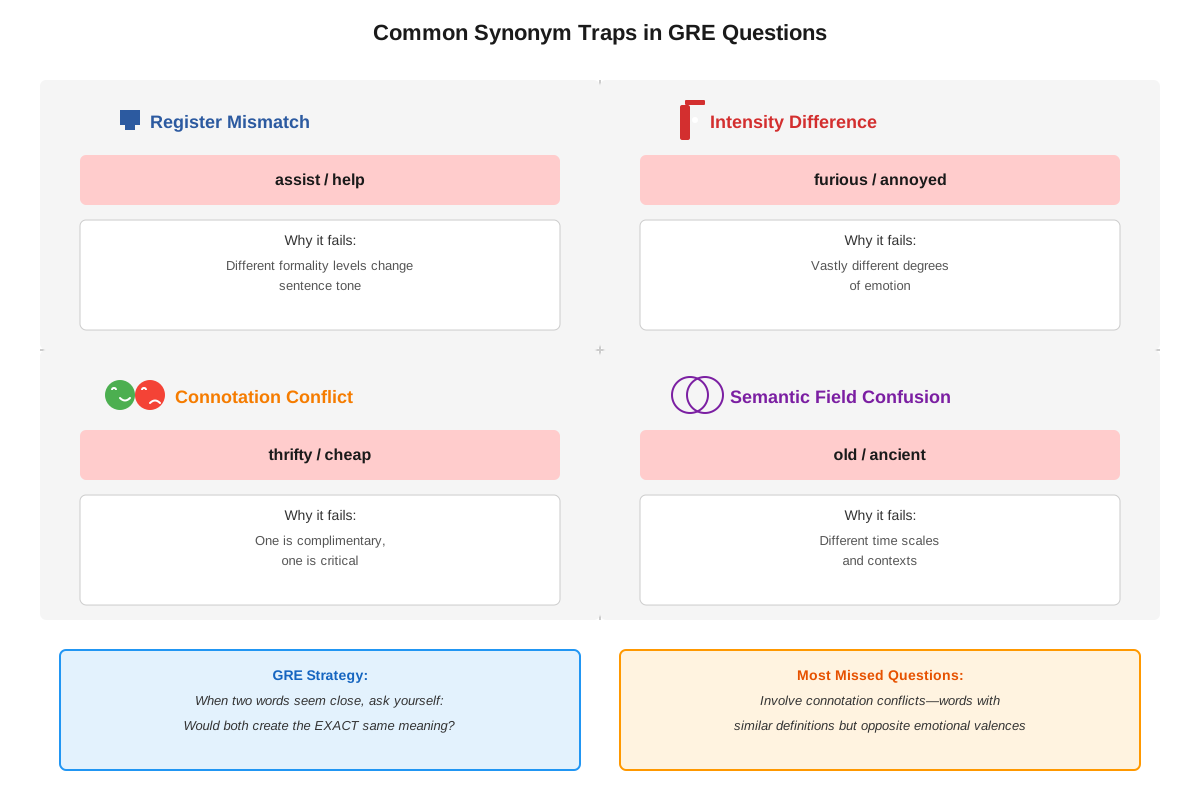
The GRE tests synonyms in several characteristic ways: through direct synonym selection in Sentence Equivalence, through contextual vocabulary questions where understanding a word's synonyms helps determine its meaning, and through paraphrase recognition in Reading Comprehension where the correct answer restates passage content using different vocabulary. Test-makers deliberately include "trap" answers that share superficial similarities with correct synonyms but differ in crucial ways—perhaps in formality level, intensity, or specific contextual application. This makes synonym mastery not just about knowing definitions, but about understanding the full semantic profile of words.
Core Concepts
Definition and Characteristics of Synonyms
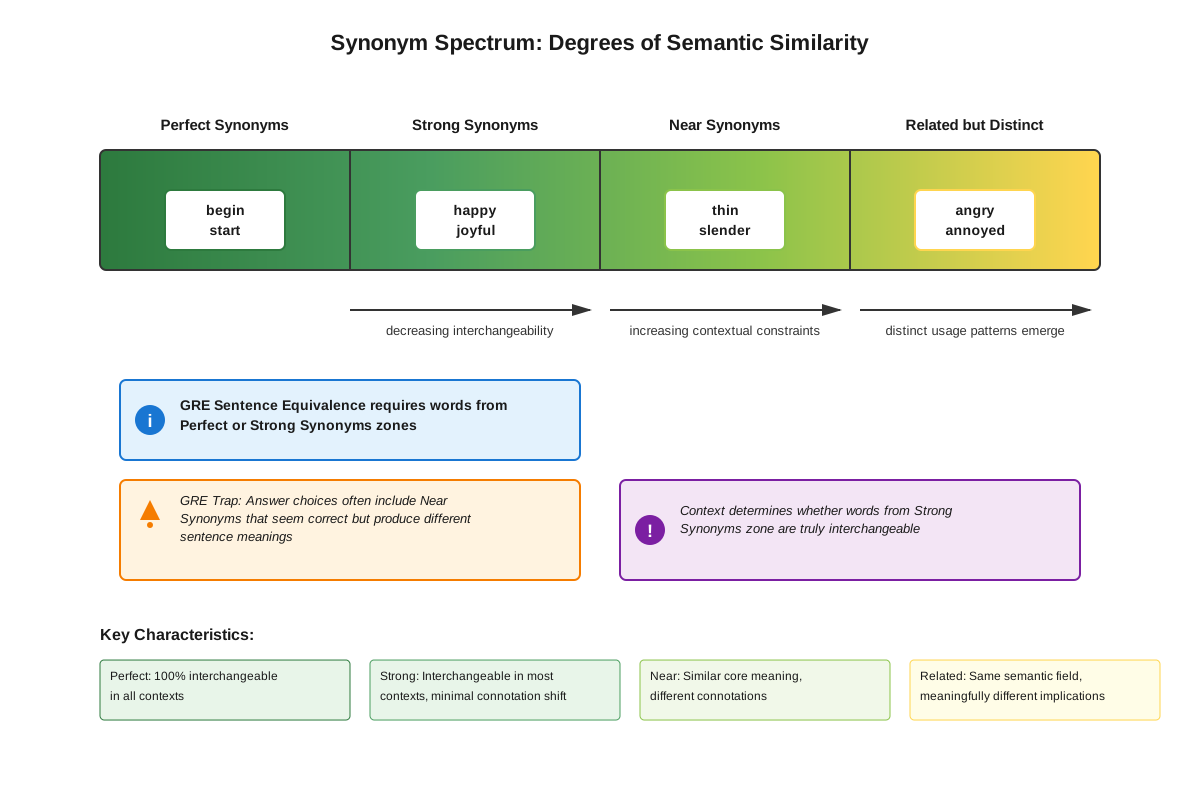
Synonyms are words that share similar or nearly identical meanings within specific contexts. However, true perfect synonyms—words that are completely interchangeable in all contexts—are exceptionally rare in English. Most synonyms exist on a spectrum of similarity, sharing core meanings while differing in connotation, register, intensity, or usage contexts. For GRE purposes, recognizing these nuanced differences is as important as identifying basic similarities.
The key characteristics that define synonym relationships include:
- Semantic overlap: The words must share a significant portion of their core meaning
- Contextual appropriateness: Synonyms must fit grammatically and semantically in similar sentence structures
- Equivalent part of speech: True synonyms function as the same grammatical category
- Comparable register: Words should occupy similar levels of formality or technical specificity
Types of Synonym Relationships
Understanding the different types of synonym relationships helps test-takers make more precise distinctions on the GRE:
| Synonym Type | Definition | Example Pair | Key Distinction |
|---|---|---|---|
| Absolute Synonyms | Words with virtually identical meanings in all contexts | "begin" / "commence" | Extremely rare; differ mainly in formality |
| Near Synonyms | Words sharing core meaning but differing in nuance | "happy" / "ecstatic" | Differ in intensity or degree |
| Contextual Synonyms | Words synonymous only in specific contexts | "run" / "manage" | Overlap only when discussing leadership |
| Register Synonyms | Words with same meaning but different formality levels | "intoxicated" / "drunk" | Differ in appropriateness for formal vs. informal contexts |
| Connotative Synonyms | Words with similar denotation but different emotional associations | "thrifty" / "stingy" | One positive, one negative connotation |
Denotation vs. Connotation in Synonym Selection
Denotation refers to a word's literal, dictionary definition, while connotation encompasses the emotional associations, cultural implications, and subjective feelings a word evokes. On the GRE, many incorrect answer choices share denotative similarity with the correct answer but differ critically in connotation.
For example, consider the words "childlike" and "childish." Both denote qualities associated with children, but "childlike" carries positive connotations of innocence and wonder, while "childish" suggests immaturity and inappropriate behavior. The GRE frequently exploits these connotative differences to create plausible but incorrect answer choices.
Intensity and Degree Variations
Many synonym sets differ primarily in intensity or degree rather than core meaning. Understanding these gradations is essential for selecting the most appropriate synonym in context:
- Mild → Moderate → Intense: "dislike" → "hate" → "abhor"
- Slight → Significant → Extreme: "tired" → "exhausted" → "enervated"
- General → Specific: "building" → "edifice" (implies grandeur)
The GRE often includes answer choices that represent different points on these intensity scales. Selecting the correct answer requires careful attention to contextual clues about the appropriate degree of intensity.
Register and Formality Levels
Register refers to the level of formality or technical specificity appropriate for a given context. The GRE tests whether students can recognize synonyms that match not just in meaning but in register:
- Formal/Academic: "commence," "endeavor," "facilitate"
- Neutral/Standard: "begin," "try," "help"
- Informal/Colloquial: "kick off," "give it a shot," "lend a hand"
GRE passages typically employ formal or academic register, so correct synonym choices usually match this level. However, test-makers may include informal synonyms as distractors to test whether students recognize register mismatches.
Contextual Constraints on Synonym Selection
Context determines which synonyms are appropriate in any given situation. The same word may have different synonyms depending on its specific usage:
Example: The word "run"
- In "run a business" → synonyms: "manage," "operate," "direct"
- In "run quickly" → synonyms: "sprint," "dash," "race"
- In "run in an election" → synonyms: "campaign," "compete," "stand"
The GRE tests this contextual sensitivity by presenting sentences where only one synonym pair produces equivalent, logical meanings. Students must read carefully to understand which specific meaning of a word is being employed.
Semantic Fields and Word Families
Words cluster into semantic fields—groups of related terms that address similar concepts or domains. Understanding these fields helps predict likely synonyms and organize vocabulary study:
- Praise/Approval: "laud," "extol," "commend," "acclaim"
- Criticism/Disapproval: "censure," "denounce," "condemn," "castigate"
- Stubbornness: "obstinate," "intransigent," "recalcitrant," "adamant"
Studying vocabulary in semantic clusters rather than alphabetically improves retention and helps students recognize synonym relationships more quickly during the exam.
Concept Relationships
The concepts within synonym recognition form an interconnected hierarchy. At the foundation lies basic semantic overlap—the core requirement that words share meaning. Building upon this foundation, denotation vs. connotation adds a layer of emotional and associative meaning that refines synonym selection. Intensity and degree variations further specify the relationship by quantifying how strongly or weakly a concept is expressed. Register and formality introduce social and contextual appropriateness as selection criteria. Finally, contextual constraints serve as the ultimate arbiter, determining which potential synonyms actually function equivalently in specific sentences.
This hierarchy connects to prerequisite knowledge of parts of speech (which determines grammatical compatibility) and context clues (which reveal which meaning of a polysemous word is intended). Looking forward, synonym mastery enables progression to more complex topics including antonyms (which require understanding what synonyms are NOT), analogies (which test relationships between synonym pairs), and semantic precision in writing (which applies synonym knowledge to composition).
The relationship map flows as follows:
Basic Vocabulary → Semantic Overlap Recognition → Denotation/Connotation Distinction → Intensity Calibration → Register Matching → Contextual Application → Accurate GRE Synonym Selection
High-Yield Facts
⭐ Sentence Equivalence questions always require selecting two synonyms that produce equivalent sentence meanings—never two words that are merely related or similar in some other way
⭐ The GRE frequently includes answer choices that share the same root or prefix as the correct answer but have different meanings (e.g., "prescient" vs. "prescribe")
⭐ Connotation differences (positive vs. negative associations) are among the most common reasons an otherwise similar word is incorrect
⭐ Words that are synonyms in one context may not be synonyms in another—always consider the specific sentence meaning
⭐ The correct synonym pair in Sentence Equivalence will create sentences that are not just similar but truly equivalent in meaning
- Near-synonyms that differ in intensity (like "annoyed" vs. "furious") are rarely correct pairs unless the context specifically supports the stronger or weaker term
- Register mismatches (formal vs. informal) are common trap answers—GRE passages typically require formal/academic vocabulary
- Two words can share a general semantic field without being synonyms (e.g., "happy" and "sad" are both emotions but are antonyms, not synonyms)
- Archaic or obsolete synonyms occasionally appear as incorrect answer choices to test whether students confuse "old-fashioned" with "sophisticated"
- The GRE tests approximately 3,000-4,000 high-frequency vocabulary words, with synonym recognition being the most common way these words appear
- Prefixes and suffixes can help identify potential synonyms (e.g., words with "bene-" often relate to goodness, while "mal-" relates to badness)
- Synonyms must match in both denotation AND connotation to be correct on Sentence Equivalence questions
Quick check — test yourself on Synonyms so far.
Try Flashcards →Common Misconceptions
Misconception: Words that are related in meaning are always synonyms.
Correction: Synonyms must be interchangeable in context, not merely related. "Doctor" and "hospital" are related but not synonymous. "Doctor" and "physician" are synonyms because they can substitute for each other.
Misconception: If two words can both fit grammatically in a sentence, they are synonyms.
Correction: Grammatical compatibility is necessary but insufficient. "The politician was honest/corrupt" both fit grammatically, but these words are antonyms, not synonyms. True synonyms must produce equivalent meanings.
Misconception: Formal vocabulary is always better than simple vocabulary on the GRE.
Correction: The correct answer matches the context and register of the passage. Sometimes a simpler word is more precise than a complex one. "Use" might be better than "utilize" if the context doesn't require the technical connotation of "utilize."
Misconception: Words with similar prefixes or roots are likely synonyms.
Correction: Etymological similarity doesn't guarantee semantic similarity. "Incredible" (not believable) and "credulous" (too willing to believe) share a root but have different meanings. Always verify actual definitions rather than assuming based on word parts.
Misconception: In Sentence Equivalence, the two correct answers must be perfect synonyms in all contexts.
Correction: The two words must create equivalent meanings in the specific sentence provided, but they don't need to be synonyms in every possible context. Context-specific equivalence is what matters.
Misconception: Thesaurus entries are always interchangeable synonyms.
Correction: Thesauruses list words with related meanings but don't always distinguish between true synonyms, near-synonyms, and merely related words. Critical evaluation of connotation, register, and context is essential.
Misconception: Longer or more complex words are more likely to be correct answers.
Correction: The GRE doesn't reward vocabulary complexity for its own sake. The correct answer is the most precise and contextually appropriate choice, regardless of word length or complexity.
Worked Examples
Example 1: Sentence Equivalence Question
Question: The professor's lecture was so __________ that even students who typically struggled with the subject found themselves engaged and interested.
- (A) tedious
- (B) captivating
- (C) lengthy
- (D) compelling
- (E) controversial
- (F) abbreviated
Solution Process:
Step 1: Analyze the context. The sentence indicates that students who normally struggle became "engaged and interested," suggesting the lecture had a positive, attention-grabbing quality.
Step 2: Eliminate words with wrong connotations. "Tedious" (A) is negative and would not lead to engagement—eliminate. "Controversial" (E) might generate interest but doesn't directly mean engaging—eliminate.
Step 3: Eliminate words that don't match the meaning. "Lengthy" (C) and "abbreviated" (F) describe duration, not quality of engagement—eliminate both.
Step 4: Identify the synonym pair. "Captivating" (B) and "compelling" (D) both mean "holding attention strongly" and are near-perfect synonyms in this context. Both would create equivalent sentence meanings: students found the lecture attention-grabbing.
Step 5: Verify equivalence. "The lecture was so captivating that students became engaged" and "The lecture was so compelling that students became engaged" convey identical meanings.
Answer: (B) and (D)
Connection to Learning Objectives: This example demonstrates identifying when synonyms are being tested (Sentence Equivalence format), applying the core strategy (finding words that create equivalent meanings), and accurately selecting GRE-style synonym pairs.
Example 2: Near-Synonym Discrimination
Question: The critic's review was __________, attacking not just the film's technical flaws but also questioning the director's competence and integrity.
- (A) harsh
- (B) scathing
- (C) negative
- (D) vitriolic
- (E) critical
- (F) unfavorable
Solution Process:
Step 1: Identify intensity clues. The phrase "attacking" and "questioning competence and integrity" suggests an extremely negative, aggressive review—not merely negative but intensely so.
Step 2: Eliminate insufficient intensity. "Negative" (C), "critical" (E), and "unfavorable" (F) all describe negative reviews but lack the aggressive, attacking quality described—eliminate.
Step 3: Evaluate remaining options. "Harsh" (A), "scathing" (B), and "vitriolic" (D) all suggest intense criticism.
Step 4: Fine-tune intensity matching. "Harsh" suggests severity but not necessarily the aggressive, burning quality implied by "attacking." "Scathing" means severely critical in a way that burns or scorches (metaphorically). "Vitriolic" means bitterly harsh and caustic. Both "scathing" and "vitriolic" match the intensity of attacking someone's competence and integrity.
Step 5: Verify contextual equivalence. "The review was scathing, attacking..." and "The review was vitriolic, attacking..." both convey the same level of intense, aggressive criticism.
Answer: (B) and (D)
Connection to Learning Objectives: This example illustrates distinguishing between near-synonyms based on intensity, evaluating contextual appropriateness, and analyzing how connotation differentiates similar words.
Exam Strategy
Approaching Synonym Questions Systematically
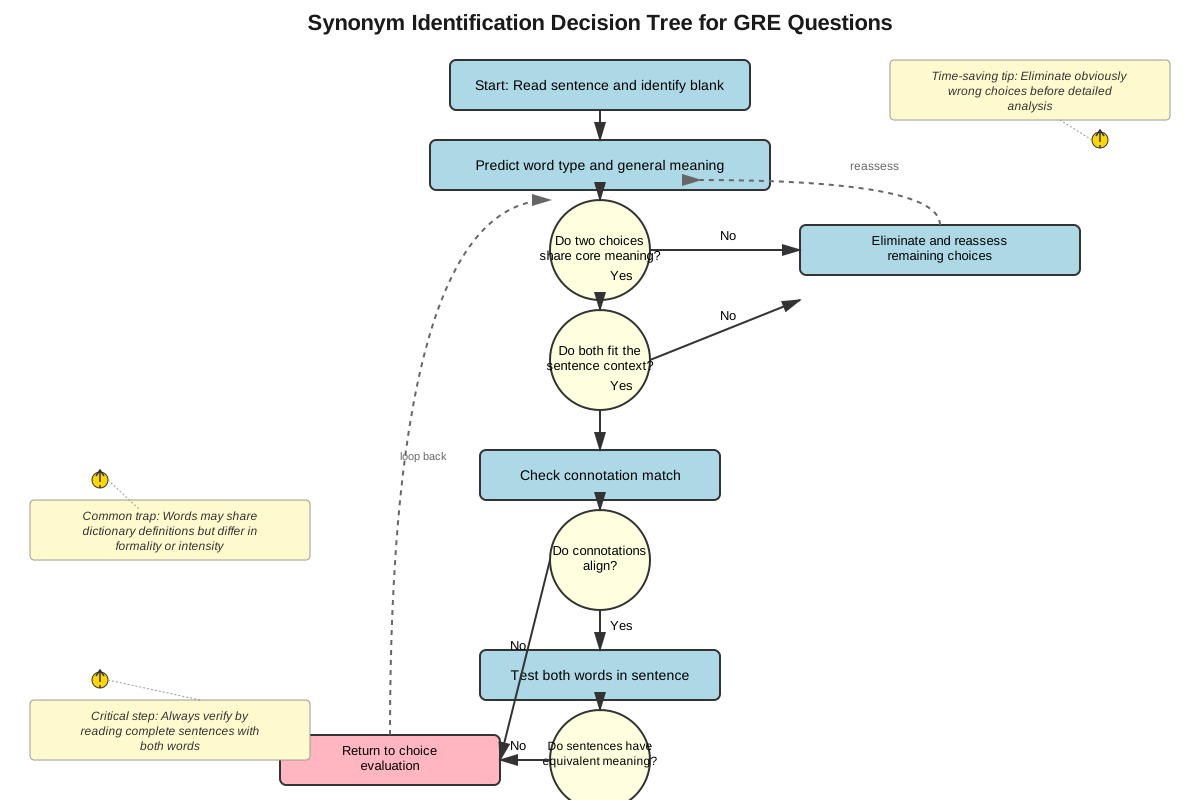
When encountering GRE questions testing synonym recognition, follow this strategic process:
- Read the entire sentence carefully to understand the complete context before looking at answer choices
- Predict a word that would fit the blank based on context clues
- Scan answer choices for words matching your prediction
- For Sentence Equivalence, immediately eliminate any answer choice that doesn't have a potential synonym partner among the other options
- Test your selected pair by substituting each word into the sentence and verifying that both create equivalent meanings
Trigger Words and Phrases
Certain textual signals indicate that synonym recognition is being tested:
- Contrast markers ("although," "despite," "however") suggest the blank requires a word opposite to another concept in the sentence—helping you identify what the synonym should NOT mean
- Support markers ("furthermore," "additionally," "similarly") indicate the blank should reinforce or parallel another idea—the synonym should align with this concept
- Intensity markers ("extremely," "somewhat," "slightly") signal the degree of the required synonym
- Definitional phrases ("that is," "in other words," "specifically") often introduce synonymous restatements
Process of Elimination Tips
Effective elimination strategies specific to synonym questions:
- Eliminate words with opposite connotations first—if context is positive, remove negative words immediately
- Remove register mismatches—informal words rarely appear in formal GRE passages
- Eliminate words from wrong semantic fields—if the context is about emotions, words about physical objects are unlikely
- Cross out words that can't form synonym pairs—in Sentence Equivalence, if a word has no potential partner, eliminate it
- Be suspicious of words that share roots with words in the sentence—these are often trap answers
Time Allocation Advice
For Sentence Equivalence questions testing synonyms:
- Spend 60-90 seconds per question on average
- Invest 20-30 seconds in careful initial reading and context analysis
- Use 30-40 seconds for answer evaluation and elimination
- Reserve 10-20 seconds for verification by substituting both words back into the sentence
- If stuck after 90 seconds, make your best guess and move on—spending excessive time on one question reduces time for others
Exam Tip: In Sentence Equivalence, the two correct answers will ALWAYS create sentences with equivalent meanings. If your selected pair produces even slightly different implications, reconsider your choices.
Memory Techniques
Mnemonic for Synonym Evaluation: CRISP
Use CRISP to remember the five key factors in evaluating potential synonyms:
- Connotation: Does the word have the right emotional association (positive/negative/neutral)?
- Register: Does the formality level match the context?
- Intensity: Is the degree or strength appropriate?
- Semantic field: Does the word belong to the right category of meaning?
- Part of speech: Does it function grammatically in the same way?
Visualization Strategy: Synonym Spectrum
Visualize synonyms as existing on a spectrum rather than as binary matches. Picture a horizontal line with the core meaning in the center and variations in intensity, formality, and connotation radiating outward. This mental model helps recognize that "good," "excellent," and "superlative" are all related but occupy different positions on the quality spectrum.
Semantic Cluster Technique
Group vocabulary words into thematic clusters and memorize them together:
Praise Cluster: laud, extol, commend, acclaim, eulogize
Criticism Cluster: censure, denounce, castigate, excoriate, lambaste
Stubbornness Cluster: obstinate, intransigent, recalcitrant, adamant, inflexible
When you encounter one word from a cluster on the exam, you'll automatically recall its synonyms from the same group.
Root-Based Association
Connect synonyms through shared roots:
- "bene-" (good): benefit, benevolent, benefactor, benign
- "mal-" (bad): malevolent, malicious, malign, malady
- "cred-" (believe): credible, credulous, incredible, creed
Understanding roots helps predict meaning and identify potential synonyms even for unfamiliar words.
Summary
Synonym recognition forms the cornerstone of GRE Verbal Reasoning success, appearing most prominently in Sentence Equivalence questions but underlying performance across all question types. True mastery requires moving beyond simple definition matching to understand the nuanced differences in connotation, intensity, register, and contextual appropriateness that distinguish near-synonyms. The GRE tests not just whether students know vocabulary definitions, but whether they can discriminate between words with overlapping meanings and select the pair that creates truly equivalent sentence meanings. Success demands systematic analysis of context clues, careful attention to semantic and grammatical compatibility, and strategic elimination of trap answers that share superficial similarities with correct choices but differ in crucial ways. By understanding that synonyms exist on spectrums of formality, intensity, and connotation rather than as perfect equivalents, test-takers can navigate the sophisticated vocabulary challenges the GRE presents and consistently identify the correct synonym pairs under time pressure.
Key Takeaways
- Synonyms on the GRE must create equivalent meanings in context, not just share general semantic similarity
- Connotation (emotional association) and register (formality level) are as important as denotation (literal meaning) in selecting correct synonyms
- Sentence Equivalence questions always require two words that produce truly equivalent sentence meanings—verify by substituting both words
- Intensity differences (mild vs. extreme) are common distinguishing factors between near-synonyms and frequent sources of trap answers
- Context determines which meaning of a polysemous word is intended, which in turn determines which synonyms are appropriate
- Systematic elimination using the CRISP framework (Connotation, Register, Intensity, Semantic field, Part of speech) improves accuracy and speed
- Studying vocabulary in semantic clusters rather than isolation enhances retention and accelerates synonym recognition during the exam
Related Topics
Antonyms and Opposites: Understanding synonyms provides the foundation for recognizing antonyms, as both require precise knowledge of word meanings and relationships. Mastering synonyms makes antonym identification more efficient by clarifying what words mean and therefore what their opposites must be.
Text Completion Strategies: Synonym knowledge directly supports Text Completion success, as many questions require selecting words that maintain semantic consistency across multiple blanks or that appropriately match the tone and meaning established by context clues.
Sentence Equivalence Advanced Techniques: Building on basic synonym recognition, advanced Sentence Equivalence strategies involve recognizing subtle logical relationships, managing complex sentence structures, and handling questions where the synonym relationship is less obvious.
Vocabulary Building Methods: Systematic vocabulary acquisition through root analysis, semantic clustering, and spaced repetition provides the raw material for synonym recognition and should be pursued alongside strategy development.
Reading Comprehension Paraphrase Recognition: Authors frequently restate ideas using synonymous expressions, and recognizing these paraphrases is essential for tracking arguments, identifying main ideas, and answering inference questions correctly.
Practice CTA
Now that you've mastered the core concepts and strategies for GRE synonym recognition, it's time to put your knowledge into action. Attempt the practice questions to reinforce these concepts under exam-like conditions, and use the flashcards to build the robust vocabulary foundation that synonym mastery requires. Remember that synonym recognition is a skill that improves dramatically with deliberate practice—each question you work through strengthens your ability to discriminate between near-synonyms and identify truly equivalent word pairs. Your investment in mastering this high-yield topic will pay dividends across every section of the GRE Verbal Reasoning test. Start practicing now to transform your understanding into top-tier performance!
Sign up free to keep reading
Create a free AnvayaPrep account to finish this GRE guide on Synonyms — plus flashcards and practice questions.