Overview
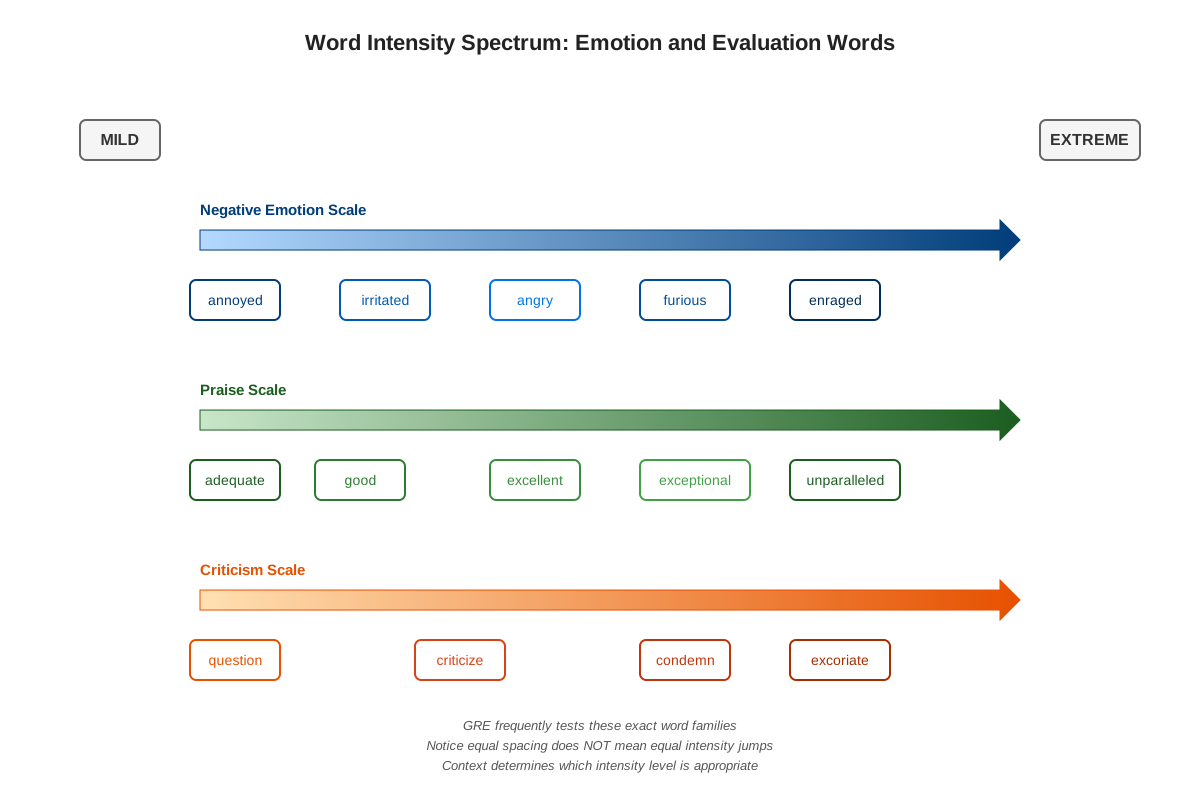
The intensity of words is a critical concept in GRE Verbal Reasoning that tests a student's ability to recognize subtle gradations in meaning among words that share similar definitions but differ in strength, force, or degree. This skill goes beyond simple vocabulary knowledge—it requires understanding that words exist on a spectrum of intensity, from mild to extreme. For example, while "annoyed," "angry," and "furious" all describe negative emotions, they represent dramatically different levels of intensity. The GRE frequently tests whether students can distinguish these nuances, particularly in Text Completion and Sentence Equivalence questions where selecting a word with the wrong intensity level will create a sentence that is technically grammatically correct but semantically inappropriate.
Understanding GRE intensity of words is essential because approximately 30-40% of Verbal Reasoning questions involve some element of intensity matching. The test makers deliberately include answer choices that are synonyms or near-synonyms but differ in intensity, creating traps for students who focus only on general meaning rather than precise degree. A student might know that both "criticize" and "excoriate" mean to express disapproval, but selecting the wrong one based on intensity can mean the difference between a correct and incorrect answer.
This topic connects fundamentally to other Verbal Reasoning concepts including context clues, tone analysis, and logical consistency within sentences. Mastering word intensity enables students to evaluate whether a word choice matches the magnitude of the situation described in a passage, aligns with transition words that signal degree (such as "extremely," "somewhat," or "barely"), and maintains logical coherence across multiple blanks in Text Completion questions. It also reinforces the broader skill of precise reading comprehension, as recognizing intensity helps students understand an author's exact position on a topic rather than just the general sentiment.
Learning Objectives
- [ ] Identify when intensity of words is being tested in GRE questions
- [ ] Explain the core rule or strategy behind intensity of words
- [ ] Apply intensity of words to GRE-style questions accurately
- [ ] Rank words along an intensity spectrum from mild to extreme
- [ ] Use contextual clues to determine the appropriate intensity level for a blank
- [ ] Distinguish between words with similar meanings but different intensity levels
- [ ] Recognize intensity modifiers and their impact on word choice
Prerequisites
- Basic vocabulary knowledge: Understanding fundamental word meanings is necessary before distinguishing intensity levels among related words
- Sentence structure comprehension: Recognizing how different parts of a sentence relate helps identify which elements signal intensity requirements
- Context clue identification: The ability to extract meaning from surrounding text is essential for determining appropriate word intensity
- Synonym and antonym recognition: Understanding word relationships provides the foundation for recognizing intensity as a dimension of similarity
Why This Topic Matters
In real-world communication, choosing words with appropriate intensity is crucial for conveying precise meaning and avoiding misunderstandings. A business professional who describes a minor setback as a "catastrophe" loses credibility, while someone who calls a genuine crisis merely "inconvenient" fails to communicate urgency. This skill translates directly to effective writing, persuasive speaking, and accurate interpretation of others' communications.
On the GRE, intensity-based questions appear with remarkable frequency. Research on GRE question patterns indicates that approximately 35% of Text Completion questions and 25% of Sentence Equivalence questions specifically test intensity discrimination. These questions often appear in the medium-to-hard difficulty range, making them critical for students aiming for scores above the 160 mark on Verbal Reasoning. The test makers favor intensity-based questions because they effectively distinguish between students who have superficial vocabulary knowledge and those who understand nuanced meaning.
Common manifestations in GRE passages include: sentences with intensity modifiers ("extremely," "slightly," "utterly") that signal the required degree of the missing word; contrasts between situations of different magnitudes requiring parallel intensity differences; escalating or de-escalating sequences where word intensity must match the progression; and tone-dependent contexts where formal/informal register combines with intensity to determine the best answer. Reading Comprehension passages also test intensity when asking about an author's attitude or the strength of a claim, requiring students to distinguish between "suggests," "argues," and "proves," or between "skeptical" and "dismissive."
Core Concepts
Understanding the Intensity Spectrum
Words exist on continuums of intensity rather than as isolated meanings. The intensity of words refers to the degree of strength, force, or extremity that a word conveys within its semantic category. Every word that describes a quality, action, or state can be positioned on a spectrum from weak to strong. Consider emotions: "content" → "happy" → "delighted" → "ecstatic" → "euphoric" represents an ascending intensity scale for positive feelings. Each word is technically correct for describing positive emotion, but they are not interchangeable because they communicate vastly different degrees.
The GRE tests intensity across multiple semantic categories:
| Category | Low Intensity | Medium Intensity | High Intensity | Extreme Intensity |
|---|---|---|---|---|
| Criticism | mention, note | criticize, question | condemn, denounce | excoriate, vilify |
| Praise | acknowledge, recognize | praise, commend | laud, extol | venerate, glorify |
| Certainty | suggest, imply | indicate, show | demonstrate, prove | establish, confirm definitively |
| Difficulty | challenging, tricky | difficult, hard | arduous, formidable | insurmountable, impossible |
| Speed | leisurely, unhurried | moderate, steady | quick, rapid | breakneck, lightning-fast |
Intensity Modifiers and Signals
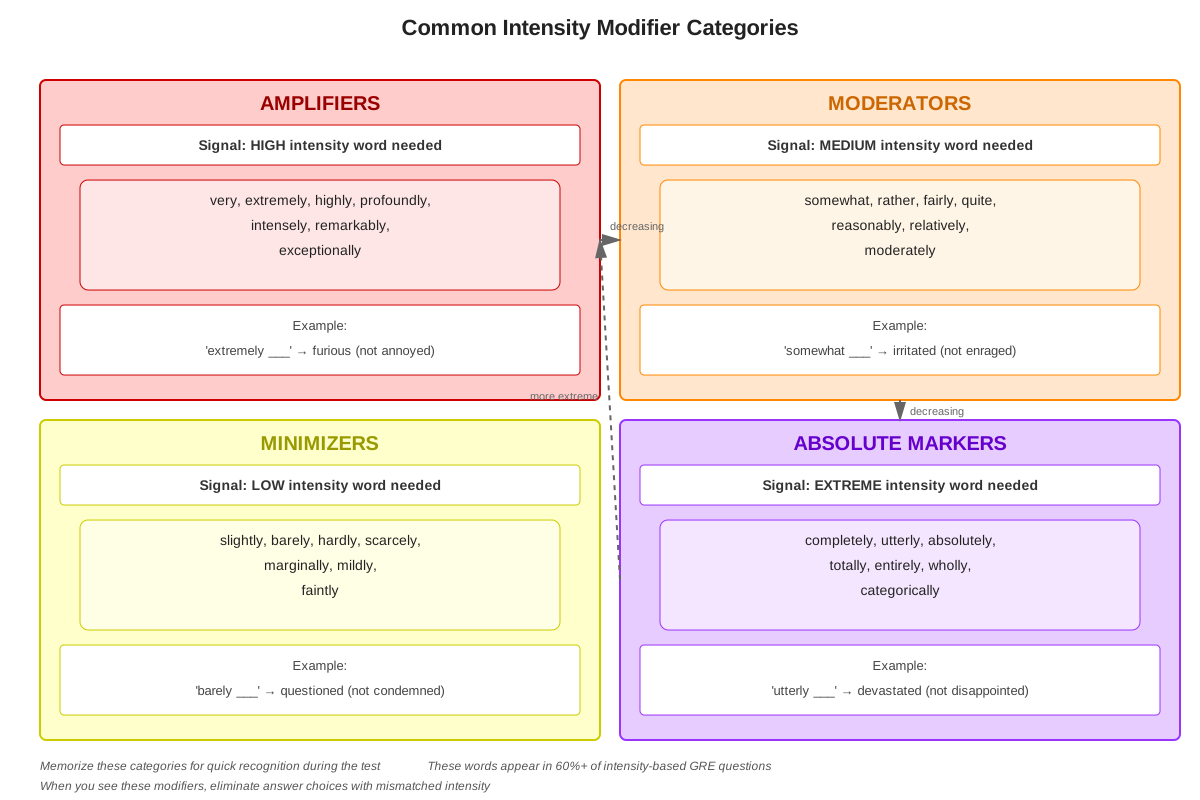
Context clues that signal intensity requirements are crucial for GRE success. Intensity modifiers are adverbs or adjectives that explicitly indicate the degree required: "somewhat," "rather," "quite," "very," "extremely," "utterly," and "absolutely" all point toward different intensity levels. When a sentence states "The critic was extremely _____ in her review," the modifier "extremely" demands a high-intensity word. Selecting "critical" would be insufficient; "scathing" or "vitriolic" would be appropriate.
Beyond explicit modifiers, several contextual patterns signal intensity:
- Magnitude of consequences: Severe outcomes require intense words; minor outcomes require mild words
- Comparative structures: "Not just X, but Y" patterns indicate Y should be more intense than X
- Emotional tone: Dramatic, urgent, or emphatic passages require higher-intensity vocabulary
- Temporal or spatial extremes: Words like "always," "never," "everywhere," or "nowhere" suggest intensity
- Causal relationships: Strong causes require strong effects, and vice versa
Intensity Matching Across Multiple Blanks
In multi-blank Text Completion questions, intensity must remain consistent across related blanks. If one blank describes a situation as a "disaster," parallel blanks should use similarly intense words. This principle of intensity parallelism means that the degree of intensity in one part of a sentence constrains choices in other parts. Consider: "The scientist's _____ (i) approach to research, which involved _____ (ii) every assumption, led to groundbreaking discoveries." If blank (i) is filled with "meticulous" (high intensity), blank (ii) should be "scrutinizing" or "questioning" (high intensity), not merely "considering" (low intensity).
Intensity Versus Connotation
A critical distinction exists between intensity and connotation. Two words can have the same intensity but different connotations (positive/negative/neutral). "Assertive" and "aggressive" both describe high-intensity behavior in expressing one's position, but "assertive" carries positive connotation while "aggressive" is negative. Conversely, "happy" (positive, medium intensity) and "sad" (negative, medium intensity) have opposite connotations but similar intensity levels. GRE questions may test either dimension, so students must evaluate both: "Does this word have the right intensity?" and "Does it have the right connotation?"
Recognizing Intensity Traps
The GRE deliberately creates wrong answer choices that are synonyms with incorrect intensity. These intensity traps are among the most common wrong answers in Verbal Reasoning. Test makers know that students under time pressure may select the first word they recognize as related to the correct meaning, without checking intensity. For example, if the correct answer is "mitigate" (reduce the severity of something), trap answers might include "eliminate" (too intense—means to remove completely) or "affect" (too weak—means merely to influence). Training yourself to ask "Is this too strong, too weak, or just right?" for every answer choice is essential.
Concept Relationships
The intensity of words concept connects internally through several relationships. Understanding the intensity spectrum enables recognition of intensity modifiers, which in turn helps with intensity matching across multiple blanks. All three concepts work together to avoid intensity traps in answer choices. The relationship flows: Spectrum Recognition → Modifier Identification → Appropriate Matching → Trap Avoidance.
This topic builds directly on prerequisite knowledge of synonyms and antonyms. While synonyms share core meaning, intensity analysis adds a second dimension: synonyms can be arranged by intensity to create more precise understanding. Context clues, another prerequisite, become specifically focused on intensity signals rather than general meaning hints.
Intensity of words connects forward to several advanced Verbal Reasoning skills. It supports tone analysis in Reading Comprehension, where distinguishing "skeptical" from "hostile" determines correct answers about author attitude. It enhances argument analysis by helping students recognize the strength of claims ("suggests" versus "proves"). It also improves performance on vocabulary-in-context questions, where the right answer must match not just meaning but also intensity.
Relationship Map:
Vocabulary Knowledge → Synonym Recognition → Intensity Spectrum Understanding → Context Clue Analysis → Intensity Modifier Identification → Appropriate Word Selection → Intensity Matching Across Blanks → Trap Avoidance → Correct Answer Selection
High-Yield Facts
⭐ Words with similar meanings can differ dramatically in intensity, and the GRE frequently tests this distinction in answer choices
⭐ Intensity modifiers (extremely, somewhat, barely, utterly) explicitly signal the required intensity level for blank-fill questions
⭐ In multi-blank questions, intensity must remain parallel across related blanks—high intensity in one blank requires high intensity in corresponding blanks
⭐ The most common wrong answers are synonyms with incorrect intensity—either too strong or too weak for the context
⭐ Magnitude of consequences in a sentence determines required word intensity—severe outcomes need intense words, minor outcomes need mild words
- Intensity exists independently of connotation; words can share intensity but differ in positive/negative valence
- Comparative structures ("not merely X, but Y") signal that Y must be more intense than X
- Formal academic writing on the GRE tends to favor moderate-to-high intensity words over extreme or colloquial options
- Intensity can be tested in Reading Comprehension through questions about author attitude or claim strength
- Creating mental intensity scales for common GRE word categories (criticism, praise, certainty, emotion) improves speed and accuracy
Quick check — test yourself on Intensity of words so far.
Try Flashcards →Common Misconceptions
Misconception: All synonyms are interchangeable in any context → Correction: Synonyms share core meaning but differ in intensity, connotation, formality, and usage context. The GRE specifically tests whether students recognize that "annoyed" and "enraged" are not interchangeable despite both meaning "angry."
Misconception: Choosing the most sophisticated or difficult vocabulary word is always best → Correction: The correct answer matches the intensity required by context, not the difficulty of the word. "Exacerbate" is not better than "worsen" if the context calls for moderate intensity; it's simply more intense and may be incorrect.
Misconception: Intensity modifiers only appear as adverbs like "very" or "extremely" → Correction: Intensity signals include magnitude of consequences, comparative structures, emotional tone, and causal relationships. The phrase "led to the complete collapse of" signals high intensity even without an explicit adverb.
Misconception: If a word fits grammatically and has the right general meaning, it's correct → Correction: GRE questions require precise intensity matching. A grammatically correct sentence with wrong-intensity words will be marked incorrect because it fails to convey the intended meaning accurately.
Misconception: Intensity is the same as formality or register → Correction: These are separate dimensions. "Mad" and "furious" differ in both formality (informal vs. formal) and intensity (medium vs. high), but "angry" and "furious" differ only in intensity while maintaining similar formality levels.
Worked Examples
Example 1: Single-Blank Text Completion
Question: The food critic's review was not merely negative but utterly _____; she described the restaurant's signature dish as inedible and questioned the chef's basic competence.
Answer Choices:
(A) critical
(B) unfavorable
(C) scathing
(D) disapproving
(E) negative
Solution Process:
Step 1: Identify intensity signals. The phrase "not merely negative but utterly" is a classic intensity escalation structure. "Not merely X but Y" indicates Y must be more intense than X. Additionally, "utterly" is an extreme intensity modifier.
Step 2: Analyze the evidence. The critic "described the dish as inedible" (extreme criticism) and "questioned the chef's basic competence" (severe, fundamental criticism). These are not mild complaints.
Step 3: Evaluate each choice by intensity:
- (A) "critical" - Medium intensity; too weak given "utterly" and the severe evidence
- (B) "unfavorable" - Low-to-medium intensity; essentially a synonym for "negative," which the sentence says we're going beyond
- (C) "scathing" - High intensity; means harshly critical, burning criticism
- (D) "disapproving" - Low-to-medium intensity; too mild for the context
- (E) "negative" - The sentence explicitly says "not merely negative," so this cannot be correct
Step 4: Select the answer. (C) scathing is correct because it's the only choice with intensity high enough to match "utterly" and the extreme nature of the criticism described.
Learning Objective Connection: This example demonstrates identifying when intensity is tested (the "not merely...but" structure), applying the core strategy (matching word intensity to context signals), and avoiding intensity traps (choices A, B, D, and E are all synonyms with insufficient intensity).
Example 2: Two-Blank Text Completion with Intensity Parallelism
Question: The archaeologist's _____ (i) examination of the artifact revealed details that _____ (ii) the prevailing theory about the civilization's technological capabilities.
Blank (i) Choices:
(A) cursory
(B) careful
(C) exhaustive
Blank (ii) Choices:
(D) questioned
(E) challenged
(F) demolished
Solution Process:
Step 1: Identify the relationship between blanks. The examination "revealed details" that had an effect on the theory. The intensity of the examination should match the intensity of the effect—a superficial examination wouldn't demolish a theory, while a thorough examination might.
Step 2: Consider logical combinations:
- If (i) is "cursory" (low intensity = quick, superficial), then (ii) should be low intensity like "questioned"
- If (i) is "careful" (medium intensity), then (ii) should be medium intensity like "challenged"
- If (i) is "exhaustive" (high intensity = extremely thorough), then (ii) should be high intensity like "demolished"
Step 3: Evaluate context for additional clues. The sentence emphasizes that details were "revealed," suggesting the examination was thorough enough to uncover new information. This points toward medium-to-high intensity.
Step 4: Test the most likely combination. "Exhaustive examination...demolished the theory" creates the strongest logical connection—an extremely thorough investigation that uncovers significant details would have the power to completely overturn an existing theory. This shows intensity parallelism: high intensity in both blanks.
Step 5: Verify by testing other combinations. "Careful examination...challenged the theory" is logically sound but less strong. "Cursory examination...questioned the theory" is possible but doesn't align with "revealed details" (cursory examinations don't typically reveal much).
Answer: (C) exhaustive and (F) demolished
Learning Objective Connection: This example shows how to apply intensity matching across multiple blanks, recognize intensity parallelism as a logical requirement, and use intensity to eliminate answer combinations that are internally inconsistent.
Exam Strategy
Systematic Approach to Intensity Questions
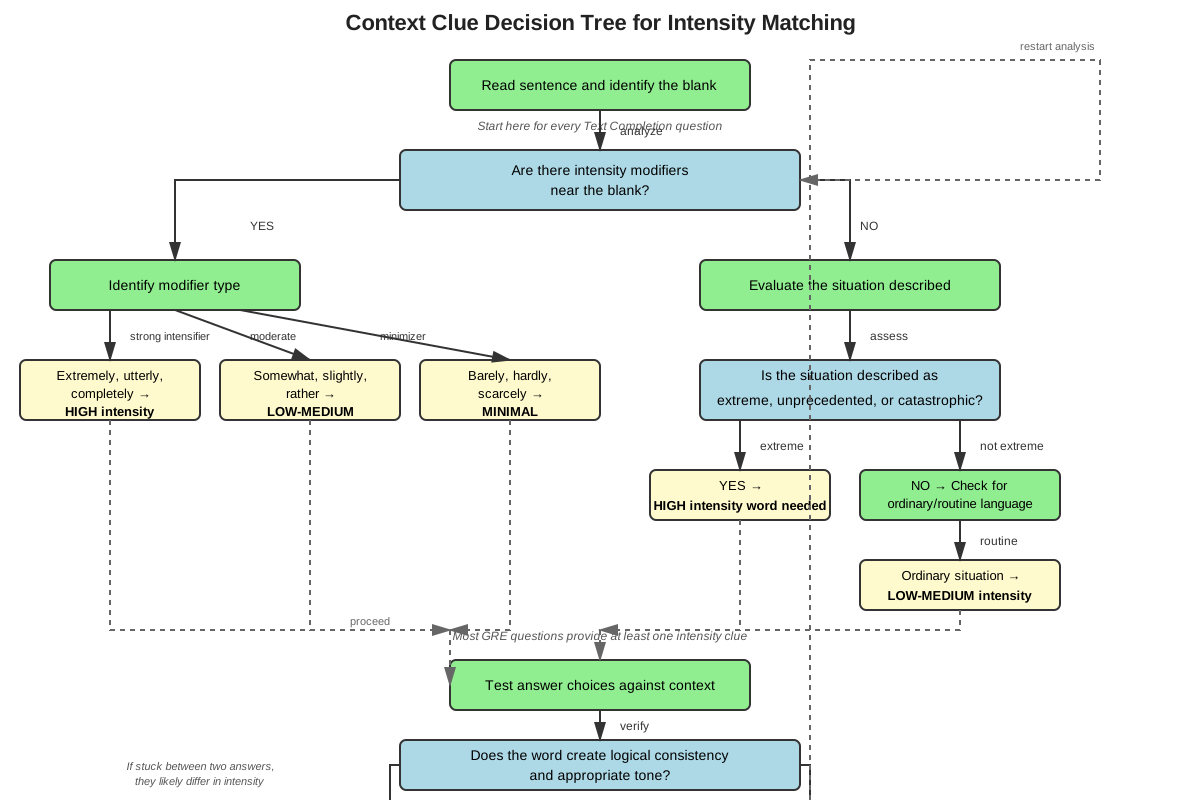
When approaching any GRE Verbal question, implement this four-step intensity check:
- Scan for intensity signals: Before reading answer choices, identify modifiers (extremely, somewhat, barely), comparative structures (not just X but Y), and magnitude indicators (catastrophic, minor, significant)
- Determine required intensity level: Based on context, classify the blank as requiring low, medium, high, or extreme intensity
- Eliminate intensity mismatches first: Cross out any answer choice that has the wrong intensity, even if it has the right general meaning
- Choose among remaining options: If multiple choices have correct intensity, use other factors (connotation, formality, precise meaning) to select the best answer
Trigger Words and Phrases
Watch for these high-yield intensity signals:
Escalation triggers (indicate increasing intensity): "not merely," "not just," "beyond," "more than," "far from," "went so far as to"
De-escalation triggers (indicate decreasing intensity): "only," "merely," "simply," "just," "somewhat," "rather," "fairly"
Extreme intensity triggers: "utterly," "completely," "absolutely," "entirely," "totally," "thoroughly," "categorically"
Moderate intensity triggers: "quite," "rather," "fairly," "reasonably," "considerably"
Mild intensity triggers: "slightly," "somewhat," "marginally," "barely," "scarcely"
Process of Elimination Tips
The GRE typically includes answer choices in this pattern for intensity-based questions:
- One correct answer with appropriate intensity
- One or two synonyms that are too intense
- One or two synonyms that are too weak
- One or two words with wrong meaning entirely
Eliminate in this order:
- Wrong meaning (fastest elimination)
- Wrong intensity (eliminates most remaining choices)
- Wrong connotation or formality (final distinction)
Time Allocation
Intensity analysis should add only 5-10 seconds to your question time. With practice, identifying intensity signals and evaluating answer choices by intensity becomes automatic. If you find yourself spending more than 15 seconds on intensity analysis alone, you may be overthinking—trust your instinct about whether a word feels "too strong" or "too weak" for the context.
Exam Tip: If you're stuck between two answers, read the sentence aloud (silently) with each option. The wrong intensity will often "sound off" or create an awkward mismatch with the context, even if you can't articulate exactly why.
Memory Techniques
The Intensity Ladder Mnemonic
For common GRE word categories, visualize a ladder with five rungs representing intensity levels. Create mental "ladders" for frequently tested categories:
CRITICISM Ladder (bottom to top):
- Mention (Mild)
- Criticize (Moderate)
- Denounce (High)
- Excoriate (Extreme)
- Vilify (Very Extreme)
Mnemonic: "My Cat Doesn't Eat Vegetables"
PRAISE Ladder:
- Acknowledge (Mild)
- Praise (Moderate)
- Laud (High)
- Extol (Extreme)
- Venerate (Very Extreme)
Mnemonic: "All People Love Eating Vegetables" (ironic contrast with criticism mnemonic helps memory)
The Thermometer Visualization
Imagine a thermometer for emotional intensity. Cold (bottom) = mild emotions, Hot (top) = extreme emotions. When you encounter emotion words, mentally place them on the thermometer:
- Freezing: content, pleased, satisfied
- Cool: happy, glad, cheerful
- Warm: delighted, joyful, thrilled
- Hot: ecstatic, euphoric, elated
- Boiling: rapturous, transported
The Modifier Match Technique
Pair intensity modifiers with appropriate word levels:
- "Somewhat" + Medium intensity words
- "Very" + Medium-to-High intensity words
- "Extremely" + High intensity words
- "Utterly" + Extreme intensity words
Practice by creating phrases: "somewhat critical," "very angry," "extremely hostile," "utterly devastated." If a combination sounds awkward ("somewhat furious," "utterly annoyed"), the intensity doesn't match.
Summary
The intensity of words is a fundamental GRE Verbal Reasoning skill that requires students to distinguish between words with similar meanings but different degrees of strength, force, or extremity. Success depends on recognizing that words exist on intensity spectrums rather than as interchangeable synonyms, and that context clues—particularly intensity modifiers, magnitude of consequences, and comparative structures—signal the appropriate intensity level required. The GRE systematically tests this skill by including answer choices that are synonyms with incorrect intensity, making intensity discrimination essential for avoiding traps and selecting precise answers. Students must develop the ability to quickly classify words as low, medium, high, or extreme intensity, match intensity across multiple blanks in Text Completion questions, and recognize that the most sophisticated vocabulary word is not always correct if its intensity doesn't match the context. Mastering intensity analysis improves performance across all Verbal Reasoning question types, from Text Completion and Sentence Equivalence to Reading Comprehension questions about author attitude and claim strength, making it one of the highest-yield skills for achieving top Verbal scores.
Key Takeaways
- Intensity of words refers to the degree of strength or extremity a word conveys, and words with similar meanings often differ significantly in intensity—a distinction the GRE frequently tests
- Intensity modifiers (extremely, somewhat, utterly) and contextual signals (magnitude of consequences, comparative structures) explicitly indicate the required intensity level for correct answers
- The most common GRE trap answers are synonyms with incorrect intensity—either too strong or too weak for the context—making intensity checking essential for elimination
- In multi-blank Text Completion questions, intensity must remain parallel across related blanks to maintain logical consistency
- Systematic intensity analysis involves identifying signals, determining required intensity level, eliminating mismatches, and choosing among remaining options based on other factors
- Creating mental intensity scales for high-frequency GRE word categories (criticism, praise, certainty, emotion, difficulty) dramatically improves speed and accuracy
- Intensity exists independently of connotation and formality, requiring separate evaluation of whether a word has the right degree of strength and the right positive/negative valence
Related Topics
Connotation and Denotation: While intensity measures degree of strength, connotation measures positive/negative/neutral associations. Mastering intensity enables more sophisticated connotation analysis, as students can distinguish between words that share both meaning and intensity but differ in emotional valence.
Context Clues and Inference: Intensity analysis is a specialized application of context clue skills. Students who master intensity can advance to more complex inference questions where subtle word choices reveal unstated author attitudes or implicit arguments.
Tone and Style Analysis: Understanding word intensity is foundational for analyzing author tone in Reading Comprehension passages. The difference between "suggests" and "insists" or between "questions" and "refutes" determines correct answers about tone and purpose.
Vocabulary Building Strategies: Rather than memorizing isolated definitions, organizing vocabulary by intensity creates deeper understanding and better retention. This approach enables progression to advanced vocabulary acquisition techniques.
Practice CTA
Now that you understand the intensity of words and how the GRE tests this critical skill, it's time to apply your knowledge! Work through the practice questions to reinforce intensity discrimination, test your ability to identify intensity signals in context, and develop the automatic intensity-checking habit that leads to higher scores. The flashcards will help you build mental intensity scales for high-frequency GRE word categories, making intensity analysis faster and more intuitive. Remember: every practice question is an opportunity to sharpen your precision and move closer to your target score. You've learned the strategy—now make it automatic through deliberate practice!
Sign up free to keep reading
Create a free AnvayaPrep account to finish this GRE guide on Intensity of words — plus flashcards and practice questions.