Overview
Understanding shades of meaning is one of the most critical skills tested on the GRE Verbal Reasoning section. This concept refers to the subtle differences in meaning, connotation, intensity, or usage between words that appear similar or related. While many test-takers can distinguish between obviously different words, the GRE specifically targets the ability to discern fine distinctions between near-synonyms, related terms, and words within the same semantic field. Mastering this skill separates average scorers from those achieving top percentiles.
The GRE consistently tests shades of meaning across multiple question types, including Text Completion, Sentence Equivalence, and Reading Comprehension. In Text Completion questions, answer choices often include several words that could plausibly fit the blank, but only one captures the precise shade of meaning required by the context. Sentence Equivalence questions demand even greater precision, as test-takers must identify two words that produce sentences with essentially the same meaning—requiring acute awareness of subtle connotative differences. Even in Reading Comprehension, understanding an author's precise word choice often determines whether a student can correctly answer inference or tone questions.
This topic sits at the intersection of vocabulary knowledge and contextual reasoning within Verbal Reasoning. While building a strong vocabulary foundation is essential, GRE shades of meaning questions test whether students can apply that knowledge with precision. The skill connects directly to understanding connotation versus denotation, recognizing register and formality levels, and appreciating intensity gradations among related words. Success requires both breadth of vocabulary and depth of understanding for each word's nuanced usage.
Learning Objectives
- [ ] Identify when Shades of meaning is being tested
- [ ] Explain the core rule or strategy behind Shades of meaning
- [ ] Apply Shades of meaning to GRE-style questions accurately
- [ ] Distinguish between words with similar denotations but different connotations
- [ ] Evaluate the intensity level of related words within a semantic spectrum
- [ ] Recognize register differences (formal vs. informal) that affect word appropriateness
- [ ] Analyze contextual clues that signal which shade of meaning is required
Prerequisites
- Basic vocabulary knowledge: Understanding common GRE-level words provides the foundation for distinguishing subtle differences between them
- Understanding of context clues: The ability to extract meaning from surrounding text is essential for determining which shade of meaning fits
- Familiarity with parts of speech: Recognizing whether words function as nouns, verbs, adjectives, or adverbs helps identify appropriate substitutions
- Reading comprehension fundamentals: The capacity to understand sentence structure and logical relationships enables proper word selection
Why This Topic Matters
In real-world communication, precision in word choice determines whether messages are understood accurately or misinterpreted. Professional writing, academic discourse, and effective communication all depend on selecting words that convey exactly the intended meaning, tone, and emphasis. The ability to distinguish shades of meaning enables clearer expression and more sophisticated comprehension of complex texts.
On the GRE, shades of meaning questions appear with remarkable frequency. Approximately 60-70% of Text Completion and Sentence Equivalence questions require distinguishing between words with similar but not identical meanings. This makes the skill one of the highest-yield areas for score improvement. A student who masters this concept can gain 3-5 additional points on the Verbal Reasoning section, which translates to a significant percentile increase.
The GRE tests this concept through several common patterns: presenting near-synonyms where only one matches the required intensity (e.g., "annoyed" vs. "furious"), offering words with similar denotations but different connotations (e.g., "frugal" vs. "miserly"), including words that differ in formality or register (e.g., "residence" vs. "domicile"), and providing terms that share semantic fields but have distinct applications (e.g., "mitigate" vs. "eliminate"). Recognition of these patterns enables strategic approach to questions.
Core Concepts
Understanding Denotation vs. Connotation
The denotation of a word refers to its literal, dictionary definition—the objective meaning that remains constant across contexts. The connotation, however, encompasses the emotional associations, cultural implications, and subjective feelings that accompany a word's use. Two words may share nearly identical denotations while carrying vastly different connotations.
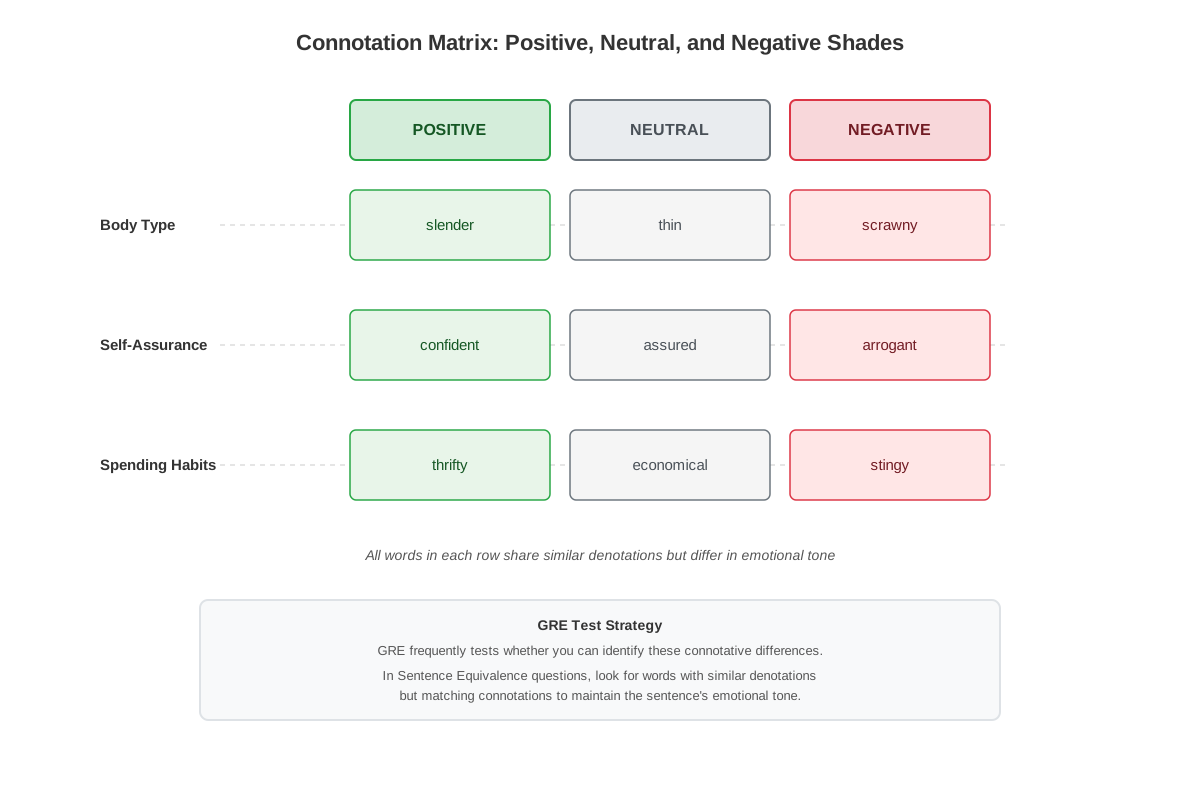
Consider "slender" and "scrawny." Both denote a thin body type, but "slender" carries positive connotations of elegance and attractiveness, while "scrawny" suggests unhealthy thinness or weakness. On the GRE, questions frequently hinge on selecting the word with the appropriate connotation for the context. A passage describing someone admiringly would require "slender," while a critical description might call for "scrawny."
Understanding connotation requires cultural and contextual awareness. Words like "childlike" (positive: innocent, pure) and "childish" (negative: immature, petty) demonstrate how subtle morphological changes signal different emotional valences. The GRE exploits these distinctions ruthlessly, making connotation awareness essential for high scores.
Intensity Gradations and Semantic Spectrums
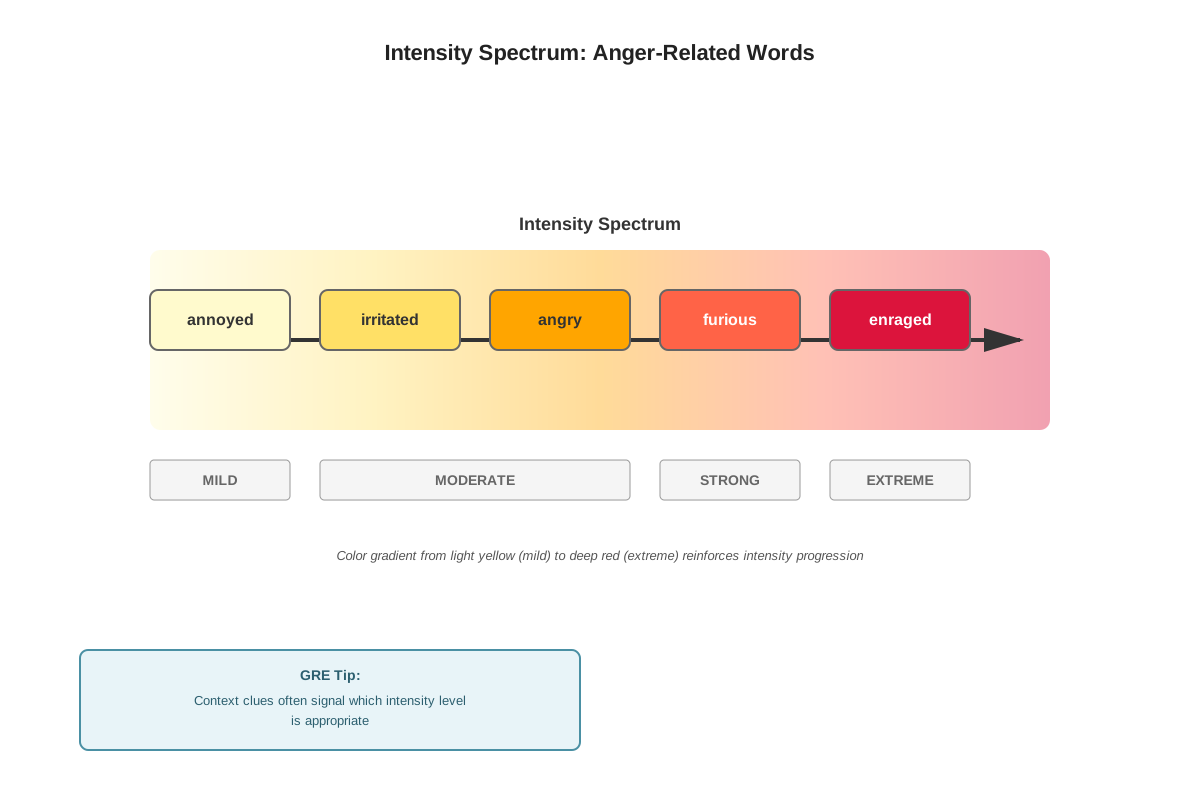
Many word groups exist along a semantic spectrum where terms share a basic meaning but differ in intensity or degree. Recognizing where words fall on these spectrums enables precise selection based on context.
| Low Intensity | Medium Intensity | High Intensity |
|---|---|---|
| dislike | hate | abhor |
| happy | joyful | ecstatic |
| sad | sorrowful | despondent |
| tired | exhausted | enervated |
| angry | furious | apoplectic |
The GRE frequently presents contexts that demand a specific intensity level. A passage describing mild disapproval requires "dislike" rather than "abhor," even though both indicate negative feelings. Conversely, a dramatic context describing extreme emotion would make "dislike" inappropriately weak. Students must calibrate their word choice to match the intensity signals in the passage.
Intensity gradations also apply to verbs of action. "Suggest," "recommend," "urge," and "demand" all involve proposing a course of action, but they differ dramatically in forcefulness. Context clues about the speaker's authority, the situation's urgency, or the relationship between parties indicate which intensity level is appropriate.
Register and Formality Levels
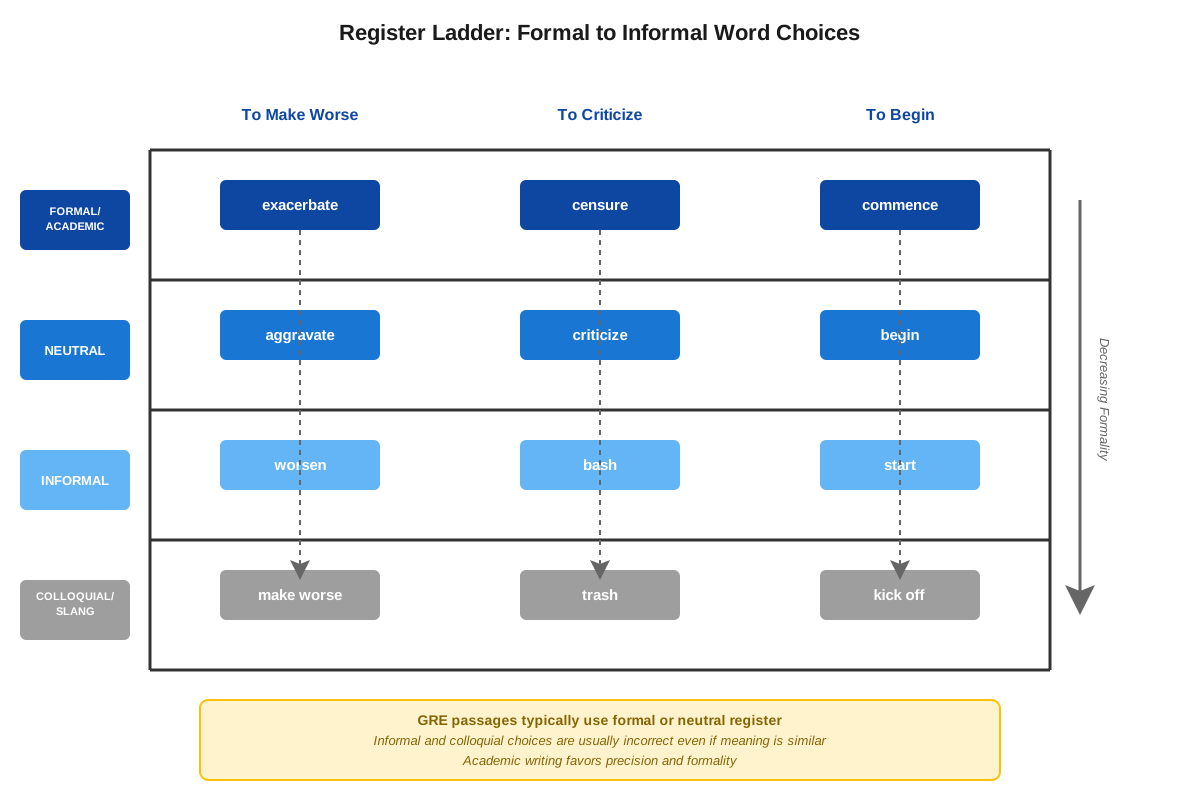
Register refers to the level of formality or technical specificity appropriate for a given context. Words can be colloquial, neutral, formal, or archaic, and selecting the wrong register creates a mismatch between word and context.
The GRE often includes one answer choice that is too informal for academic or formal writing, even if it technically fits the meaning. For example, "kids" versus "children" or "boss" versus "supervisor" represent register differences. Academic passages require formal register, making "children" and "supervisor" more appropriate despite the words being semantically similar to their informal counterparts.
Technical versus common vocabulary also reflects register. "Domicile" and "residence" both mean "place where one lives," but "domicile" carries legal/technical connotations while "residence" is more neutral. Context determines which register is appropriate: a legal discussion requires "domicile," while general description calls for "residence."
Specificity and Scope Differences
Words within a semantic field often differ in specificity—how broad or narrow their application is. The GRE tests whether students can distinguish between general terms and specific ones, selecting the appropriate scope for the context.
Consider "reduce," "mitigate," "alleviate," and "eliminate." All involve decreasing something negative, but they differ in scope:
- Eliminate: completely remove (most specific, most complete)
- Alleviate: make less severe (moderate reduction)
- Mitigate: make less harmful or serious (reduce impact)
- Reduce: make smaller or less (most general)
A context stating that a problem was "partially addressed" requires "mitigate" or "alleviate," not "eliminate." Conversely, a context indicating complete resolution demands "eliminate." Mismatching scope to context is a common error the GRE exploits.
Directional and Oppositional Nuances
Some word pairs appear similar but actually point in subtly different directions or emphasize different aspects of a concept. These directional nuances require careful attention to what the context emphasizes.
"Transparent" and "translucent" both involve light passing through material, but "transparent" means completely clear (you can see through it distinctly), while "translucent" means light passes through but images are not distinct. Similarly, "imply" and "infer" are often confused: "imply" is what a speaker does (suggest indirectly), while "infer" is what a listener does (conclude from evidence).
The GRE also tests understanding of words that seem similar but have opposite implications. "Disinterested" means impartial or unbiased (positive in contexts requiring fairness), while "uninterested" means lacking interest or bored (negative). Confusing these leads to selecting answers that reverse the intended meaning.
Temporal and Aspectual Distinctions
Verbs and adjectives often carry temporal implications or aspectual meanings that distinguish them from near-synonyms. Aspectual distinctions involve whether an action is ongoing, completed, habitual, or momentary.
"Continuous" versus "continual" exemplifies this: "continuous" means uninterrupted (without any breaks), while "continual" means repeated regularly but with breaks between occurrences. A "continuous noise" never stops; a "continual problem" recurs repeatedly. The GRE tests whether students recognize these temporal nuances.
Similarly, "chronic" versus "acute" in describing problems: "chronic" indicates long-lasting or recurring issues, while "acute" suggests sudden, severe, but potentially short-term problems. Context clues about duration and onset pattern indicate which term is appropriate.
Concept Relationships
The core concepts within shades of meaning form an interconnected system. Connotation often determines the emotional direction of a word, while intensity gradations establish its strength along that emotional spectrum. Together, these create a two-dimensional space where words can be mapped by both valence (positive/negative) and intensity (weak/strong).
Register and formality overlay this system, adding a third dimension that determines appropriateness for context. A word might have the correct connotation and intensity but wrong register, making it incorrect for formal academic writing. This three-dimensional framework (connotation × intensity × register) provides a systematic approach to evaluating answer choices.
Specificity and scope connect to intensity in that more specific terms often carry stronger implications. "Eliminate" is both more specific and more intense than "reduce." Understanding this relationship helps predict which words will appear together in answer choices—the GRE often includes options that vary along multiple dimensions simultaneously.
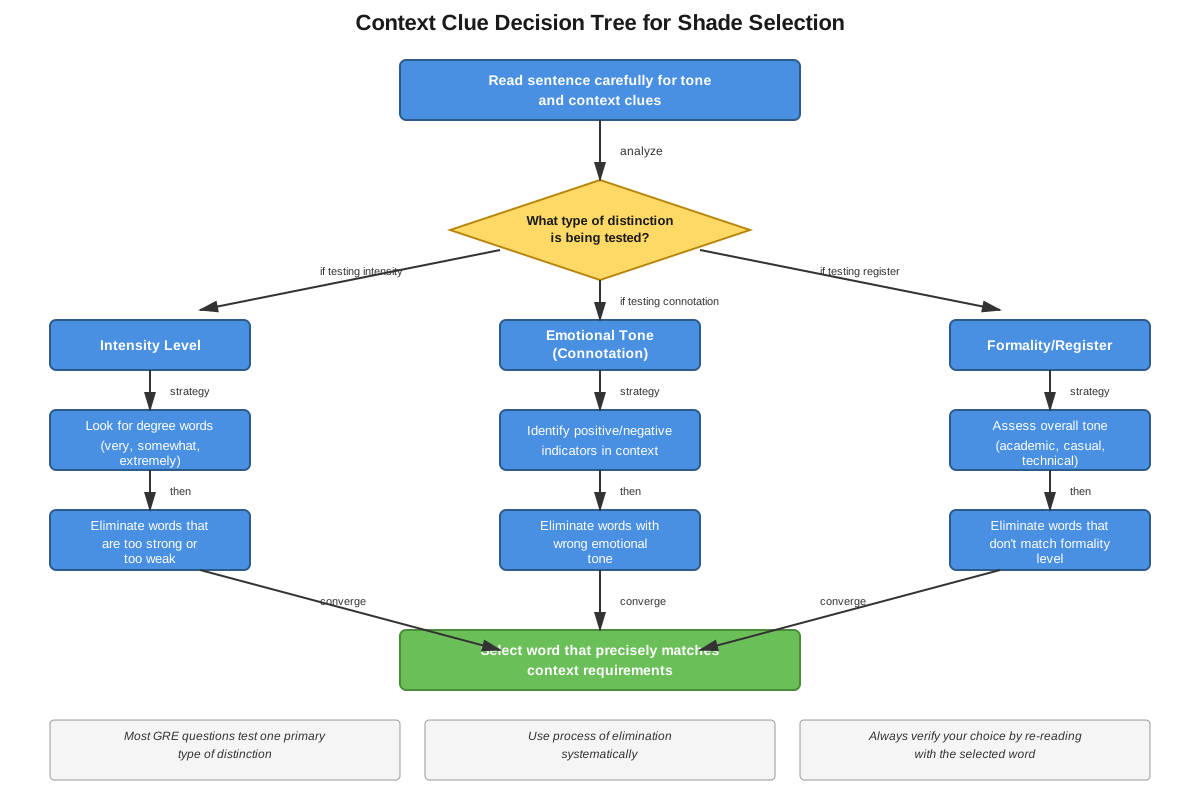
The relationship map flows as follows: Context clues → Determine required connotation → Identify appropriate intensity level → Verify register match → Confirm specificity/scope alignment → Select answer. Each step filters answer choices, narrowing to the single word that matches all dimensions.
These concepts build upon prerequisite vocabulary knowledge by adding layers of nuance. Basic vocabulary provides the denotations; shades of meaning mastery adds understanding of connotations, intensities, registers, and scopes. This progression from simple definition to sophisticated usage represents the advancement from intermediate to advanced verbal reasoning.
High-Yield Facts
⭐ The GRE rarely tests obscure vocabulary in isolation; instead, it tests the ability to distinguish between familiar words with subtle differences.
⭐ Approximately 60-70% of Text Completion and Sentence Equivalence questions require recognizing shades of meaning rather than simply knowing definitions.
⭐ Words with similar denotations but different connotations are the most common trap in Sentence Equivalence questions.
⭐ Context clues about intensity (words like "somewhat," "extremely," "slightly") signal which intensity level is required in the answer.
⭐ Formal academic passages on the GRE require formal register; colloquial or informal words are almost always incorrect, even if semantically appropriate.
- Words ending in "-ish" (childish, foolish) typically carry more negative connotations than their base forms or alternatives.
- The GRE frequently pairs words that differ by a single prefix or suffix to test whether students recognize how morphology affects meaning.
- Sentence Equivalence requires two words that create the same meaning, not merely similar meanings—subtle connotative differences disqualify otherwise plausible pairs.
- Verbs of communication (say, state, assert, claim, allege) differ in the speaker's certainty and the listener's expected belief, not just in formality.
- Temporal words (always, often, sometimes, rarely) create different logical implications; selecting the wrong frequency term can reverse a sentence's meaning.
- Words describing personality traits often exist in positive-neutral-negative triads (confident/assured/arrogant; careful/cautious/timid).
- The GRE uses "degree words" in passages (very, quite, rather, somewhat) as signals for the required intensity of the answer choice.
Quick check — test yourself on Shades of meaning so far.
Try Flashcards →Common Misconceptions
Misconception: Synonyms are interchangeable in all contexts. → Correction: True synonyms are rare; most "synonyms" differ in connotation, intensity, register, or specificity. Context determines which near-synonym is appropriate. "Happy" and "ecstatic" are not interchangeable because they differ in intensity.
Misconception: If a word fits grammatically and makes logical sense, it's correct. → Correction: The GRE requires the most precise word, not just any plausible word. Multiple answer choices may be grammatically correct and logically coherent, but only one captures the exact shade of meaning required by context clues.
Misconception: Formal words are always better choices on the GRE. → Correction: While the GRE uses formal academic language, overly archaic or pretentious words can be incorrect if they don't match the passage's register. "Domicile" isn't always better than "residence"—context determines appropriateness.
Misconception: In Sentence Equivalence, any two words with similar meanings will work. → Correction: Sentence Equivalence requires two words that produce sentences with essentially identical meanings, not just similar ones. "Angry" and "furious" are similar but create different intensity levels, making them incorrect as a pair.
Misconception: Connotation is subjective and varies by person, so it's not testable. → Correction: While personal associations vary, cultural and linguistic connotations are relatively stable and shared within language communities. The GRE tests widely recognized connotations (e.g., "slender" is positive, "scrawny" is negative) that competent English speakers consistently recognize.
Misconception: Learning more vocabulary automatically improves shades of meaning skills. → Correction: Vocabulary breadth helps, but shades of meaning requires depth—understanding each word's connotations, typical contexts, intensity level, and register. Memorizing definitions without these nuances doesn't develop the skill.
Misconception: If two words share a root, they have the same basic meaning. → Correction: Shared roots suggest related meanings, but prefixes, suffixes, and historical usage create significant differences. "Disinterested" and "uninterested" share a root but mean different things; "imply" and "implicate" have related but distinct meanings.
Worked Examples
Example 1: Text Completion with Intensity Gradation
Question: The critic's review was not merely negative but __________, attacking every aspect of the performance with unprecedented venom.
(A) unfavorable
(B) scathing
(C) critical
(D) disapproving
(E) harsh
Solution Process:
Step 1: Identify context clues. The phrase "not merely negative but" signals that the blank requires something more intense than simply negative. "Attacking" and "unprecedented venom" further indicate extreme negativity.
Step 2: Evaluate intensity levels of answer choices:
- "Unfavorable" (A): Low intensity, merely indicating something is not positive
- "Scathing" (B): High intensity, indicating severely harsh criticism
- "Critical" (C): Medium intensity, indicating negative judgment but not necessarily extreme
- "Disapproving" (D): Low-medium intensity, indicating mild negative judgment
- "Harsh" (E): Medium-high intensity, indicating severity but less extreme than "scathing"
Step 3: Match intensity to context. The context demands the highest intensity option because of "unprecedented venom" and the construction "not merely...but." This eliminates (A), (C), and (D) as too weak.
Step 4: Distinguish between remaining options. Both "scathing" (B) and "harsh" (E) indicate severe criticism, but "scathing" specifically connotes withering, destructive criticism that leaves nothing intact—perfectly matching "attacking every aspect." "Harsh" is severe but doesn't capture the comprehensive destructiveness implied.
Answer: (B) scathing
Learning Objective Connection: This example demonstrates applying shades of meaning to identify intensity gradations and select the word that precisely matches contextual intensity signals.
Example 2: Sentence Equivalence with Connotation Distinction
Question: Despite the entrepreneur's __________ spending habits, her business remained profitable due to careful financial planning in other areas.
Select two answer choices that produce sentences with essentially the same meaning.
(A) frugal
(B) lavish
(C) extravagant
(D) economical
(E) prudent
(F) wasteful
Solution Process:
Step 1: Identify the logical structure. "Despite" signals contrast—the spending habits contrast with profitability. The business remains profitable "due to careful financial planning in other areas," suggesting the spending habits themselves were not careful.
Step 2: Determine required connotation. The blank must describe spending that would typically threaten profitability but didn't because of compensating factors. This requires negative spending habits (excessive, not careful).
Step 3: Eliminate words with wrong connotation:
- "Frugal" (A): Positive, means careful with money—opposite of what's needed
- "Economical" (D): Positive, means efficient use of resources—opposite of what's needed
- "Prudent" (E): Positive, means wise and careful—opposite of what's needed
Step 4: Evaluate remaining options for connotation match:
- "Lavish" (B): Negative in financial contexts, means spending generously/excessively
- "Extravagant" (C): Negative, means spending excessively beyond necessity
- "Wasteful" (F): Negative, means spending carelessly with poor results
Step 5: Distinguish subtle differences. "Lavish" and "extravagant" both indicate excessive spending but don't necessarily imply poor judgment—one might lavishly spend on quality items. "Wasteful" implies spending that produces no value. The context suggests excessive spending that could threaten profitability but doesn't necessarily mean the spending produced nothing of value—the business remained profitable overall. "Lavish" and "extravagant" are near-perfect synonyms indicating excessive spending without the additional implication of complete waste.
Answer: (B) lavish and (C) extravagant
Learning Objective Connection: This example demonstrates distinguishing between words with similar denotations but different connotations, and recognizing that Sentence Equivalence requires precise synonym pairs, not just words in the same semantic field.
Exam Strategy
When approaching GRE questions testing shades of meaning, implement a systematic evaluation process. First, read the entire sentence or passage carefully to understand the overall meaning and tone. Identify specific context clues that signal required connotation (positive/negative), intensity level (mild/moderate/extreme), register (formal/informal), and scope (general/specific).
Trigger words and phrases to watch for include:
- Intensity signals: "merely," "somewhat," "quite," "extremely," "utterly," "slightly," "rather"
- Contrast markers: "despite," "although," "however," "yet," "but," "nevertheless"
- Continuation markers: "moreover," "furthermore," "indeed," "in fact"
- Degree modifiers: "very," "too," "so," "such"
- Temporal indicators: "always," "never," "often," "rarely," "sometimes," "occasionally"
For Text Completion, eliminate answer choices systematically. First, remove words with the wrong connotation (positive when negative is needed, or vice versa). Second, eliminate words with inappropriate intensity (too weak or too strong for context). Third, check register—remove informal words in formal contexts. Finally, verify that the remaining word's specificity matches what the context requires.
For Sentence Equivalence, the process differs slightly. After identifying context requirements, find words that match those requirements, then verify that your two selections are true synonyms in this context—they must produce sentences with essentially identical meanings. A common trap is selecting two words from the same semantic field that differ in intensity or connotation; these create similar but not equivalent sentences.
Process-of-elimination tips: The GRE typically includes one answer choice that is too informal, one that is too extreme in intensity, one with the opposite connotation from what's needed, and one that is close but differs in a subtle way (often specificity or scope). Recognizing these patterns helps eliminate four of six choices quickly, leaving a manageable comparison between two plausible options.
Time allocation: Spend 15-20 seconds reading and understanding context, 20-30 seconds evaluating answer choices systematically, and 10-15 seconds verifying your selection by re-reading the sentence with your answer inserted. For Sentence Equivalence, add 10 seconds to verify that your two choices create equivalent meanings. Rushing this verification step causes avoidable errors.
Exam Tip: If you're torn between two answer choices, look for intensity mismatches. The GRE frequently makes one option slightly too strong or too weak for the context. Words like "somewhat" or "rather" in the passage signal that moderate-intensity words are needed, not extreme ones.
Memory Techniques
The CRISP Framework for evaluating shades of meaning:
- Connotation: Is the emotional valence (positive/negative/neutral) appropriate?
- Register: Does the formality level match the context?
- Intensity: Is the strength/degree appropriate for context signals?
- Scope: Is the specificity level (general/specific) what the context requires?
- Precision: Does this word capture the exact meaning, not just a close approximation?
Intensity Spectrum Visualization: Picture words as existing on a thermometer. "Cool" words (low intensity) at the bottom, "warm" words (medium intensity) in the middle, "hot" words (high intensity) at the top. Context clues tell you which temperature zone to select from.
The Synonym Triplet Pattern: Many word groups follow a positive-neutral-negative pattern:
- Confident (positive) / Certain (neutral) / Arrogant (negative)
- Slender (positive) / Thin (neutral) / Scrawny (negative)
- Childlike (positive) / Youthful (neutral) / Childish (negative)
Memorizing these triplets helps recognize connotation patterns.
Register Ladder Mnemonic: "Kids Climb Formal Ladders" reminds you of register progression: Kolloquial → Casual → Formal → Legal/technical. Each rung up requires more formal vocabulary.
The Prefix/Suffix Alert: Remember "DIS-UN-difference": "Disinterested" (impartial) vs. "Uninterested" (bored). When words share roots but have different prefixes, they often have crucially different meanings despite appearing similar.
Summary
Mastering shades of meaning is essential for GRE Verbal Reasoning success, as the majority of Text Completion and Sentence Equivalence questions test this skill. The concept encompasses understanding subtle differences between related words across multiple dimensions: connotation (emotional associations), intensity (degree or strength), register (formality level), specificity (scope of application), and directional nuances (what aspect is emphasized). Success requires moving beyond simple definitions to appreciate how words function in context, recognizing that near-synonyms are rarely truly interchangeable. The systematic approach involves identifying context clues that signal required word characteristics, eliminating answer choices that mismatch on any dimension, and selecting the single word (or pair of words) that precisely captures the intended meaning. This skill builds upon vocabulary knowledge but requires deeper understanding of usage patterns, cultural connotations, and contextual appropriateness. Students who develop systematic evaluation strategies and learn to recognize common GRE patterns in how shades of meaning are tested can significantly improve their Verbal Reasoning scores.
Key Takeaways
- Shades of meaning questions test precision in word choice, requiring students to distinguish between near-synonyms based on connotation, intensity, register, and specificity
- Context clues about tone, intensity, formality, and scope are essential signals for determining which shade of meaning is required
- The CRISP framework (Connotation, Register, Intensity, Scope, Precision) provides a systematic approach to evaluating answer choices
- Sentence Equivalence requires true synonyms that create equivalent meanings, not just words in the same semantic field
- Most GRE vocabulary questions test the ability to distinguish between familiar words with subtle differences rather than knowledge of obscure terms
- Intensity gradations are among the most frequently tested aspects—recognizing whether context requires mild, moderate, or extreme words is crucial
- Register mismatches (using informal words in formal contexts) are common trap answers that can be quickly eliminated
Related Topics
Connotation and Tone in Reading Comprehension: Understanding shades of meaning directly supports analyzing author's tone and attitude in passages, as word choice reveals subtle positions and perspectives.
Vocabulary in Context: This skill extends shades of meaning by requiring students to determine word meanings from context when encountering unfamiliar terms, building on the same contextual analysis strategies.
Sentence Equivalence Advanced Strategies: Mastering shades of meaning is prerequisite for advanced Sentence Equivalence techniques, including recognizing false synonym pairs and identifying subtle connotative mismatches.
Rhetorical Analysis: Understanding how word choice affects meaning and persuasiveness connects shades of meaning to broader rhetorical awareness tested in Reading Comprehension questions about author's purpose and technique.
Practice CTA
Now that you've mastered the core concepts of shades of meaning, it's time to apply this knowledge! Attempt the practice questions to test your ability to distinguish subtle differences between related words under timed conditions. Use the flashcards to reinforce your understanding of common word groups that differ in connotation, intensity, or register. Remember: recognizing these patterns becomes faster and more intuitive with practice. Each question you work through strengthens your ability to identify context clues and select precisely the right word. Your investment in mastering this high-yield skill will pay dividends across every Verbal Reasoning question type!
Sign up free to keep reading
Create a free AnvayaPrep account to finish this GRE guide on Shades of meaning — plus flashcards and practice questions.