Overview
Suffixes are word endings that modify the meaning, function, or grammatical category of a root word. On the GRE, understanding suffixes is a critical vocabulary-building strategy that enables test-takers to decode unfamiliar words, determine parts of speech, and make educated guesses about word meanings even when encountering terms they've never seen before. Rather than memorizing thousands of individual vocabulary words, mastering common GRE suffixes provides a systematic framework for understanding word construction and relationships.
The GRE Verbal Reasoning section frequently tests vocabulary in context through Text Completion, Sentence Equivalence, and Reading Comprehension questions. Many high-difficulty vocabulary words share common suffixes, and recognizing these patterns allows students to break down complex words into manageable components. For instance, understanding that "-ous" typically creates adjectives meaning "full of" or "characterized by" helps decode words like "capacious," "loquacious," or "perspicacious" even without prior exposure to these terms.
Suffix knowledge integrates seamlessly with other Verbal Reasoning concepts, particularly root word analysis and prefix recognition. Together, these word-building elements form a comprehensive vocabulary strategy that extends beyond rote memorization. When combined with context clues from reading passages, suffix recognition becomes a powerful tool for eliminating incorrect answer choices and identifying precise word meanings—skills that directly translate to higher scores across all Verbal Reasoning question types.
Learning Objectives
- [ ] Identify when Suffixes is being tested
- [ ] Explain the core rule or strategy behind Suffixes
- [ ] Apply Suffixes to GRE-style questions accurately
- [ ] Categorize suffixes by the part of speech they create (noun, verb, adjective, adverb)
- [ ] Combine suffix knowledge with context clues to determine word meaning in complex passages
- [ ] Recognize how suffix changes affect word connotation and precise meaning
- [ ] Distinguish between similar suffixes with different meanings or grammatical functions
Prerequisites
- Basic parts of speech: Understanding nouns, verbs, adjectives, and adverbs is essential because suffixes primarily function to transform words between these categories
- Root word concept: Familiarity with the idea that words have base forms (roots) that can be modified helps students understand how suffixes attach and modify meaning
- Context clue strategies: The ability to use surrounding text to infer meaning complements suffix analysis when determining unfamiliar word definitions
- Fundamental vocabulary: A baseline vocabulary of approximately 2,000-3,000 common words provides the foundation upon which suffix patterns can be recognized and applied
Why This Topic Matters
Suffix knowledge represents one of the highest-yield study strategies for GRE Verbal Reasoning because it provides exponential returns on time investment. Rather than learning one word at a time, understanding 30-40 common suffixes unlocks the meaning of thousands of vocabulary words. This efficiency is particularly valuable given the GRE's emphasis on sophisticated, academic vocabulary that appears infrequently in everyday conversation.
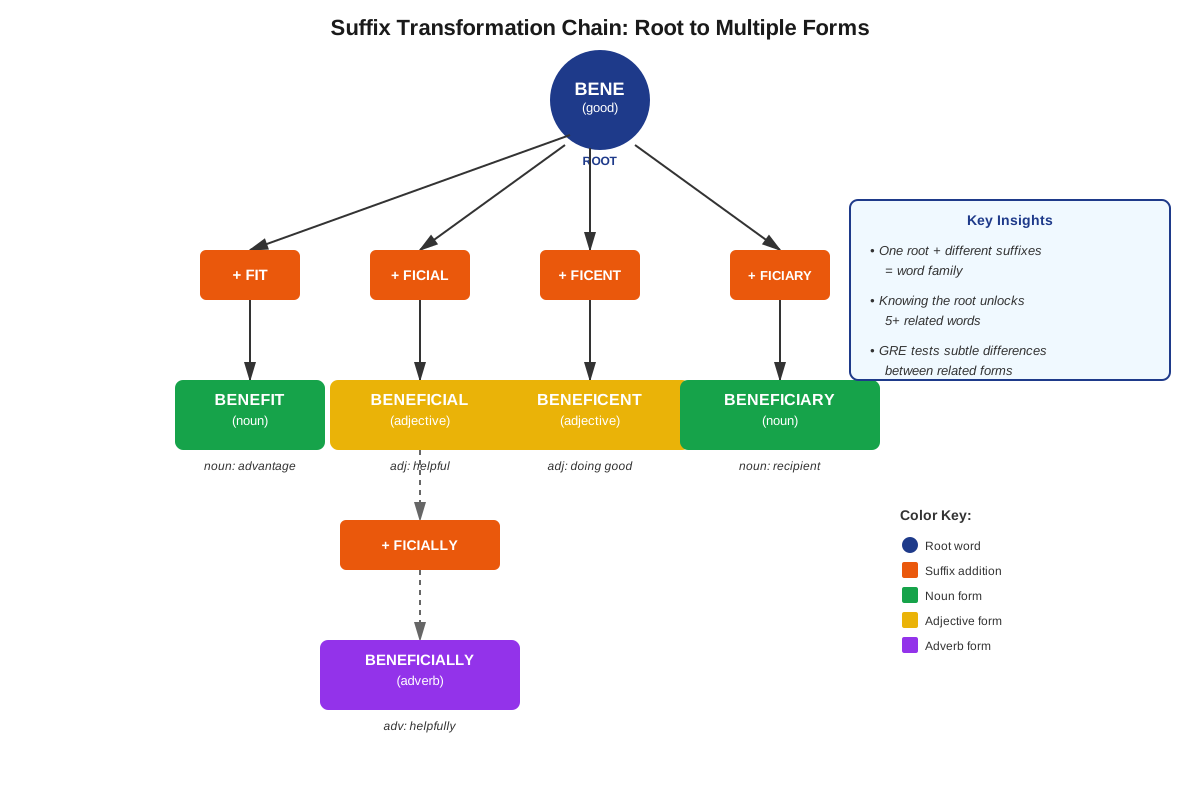
Statistical analysis of GRE questions reveals that approximately 60-70% of challenging vocabulary words contain identifiable suffixes. Text Completion questions, which comprise roughly one-third of the Verbal Reasoning section, frequently feature answer choices that differ only in their suffixes (e.g., "beneficent" vs. "beneficial" vs. "beneficiary"). Sentence Equivalence questions similarly test the ability to distinguish between words with the same root but different suffixes, requiring precise understanding of how these endings modify meaning and grammatical function.
In Reading Comprehension passages, particularly those drawn from academic journals in the sciences, humanities, and social sciences, suffix recognition enables faster processing of technical terminology. When encountering a phrase like "the epistemological implications of phenomenological reduction," students who recognize "-logical" (relating to the study of) and "-ical" (relating to or characterized by) can maintain reading flow and comprehension without getting derailed by unfamiliar terms. This skill directly impacts both accuracy and time management—two critical factors in GRE success.
Core Concepts
Understanding Suffix Function
A suffix is a morpheme (meaningful unit) added to the end of a root word or base word that changes its meaning, grammatical function, or both. Unlike prefixes, which typically modify meaning while preserving part of speech, suffixes frequently transform words from one grammatical category to another. For example, adding "-ness" to the adjective "happy" creates the noun "happiness," while adding "-ly" to the same adjective creates the adverb "happily."
Suffixes operate according to predictable patterns, though English contains numerous exceptions due to its borrowing from Latin, Greek, French, and other languages. The GRE exploits these patterns by including vocabulary that follows standard suffix rules, making systematic study highly effective. Understanding suffix function requires recognizing three key elements: the suffix itself, the part of speech it creates, and the semantic modification it introduces.
Noun-Forming Suffixes
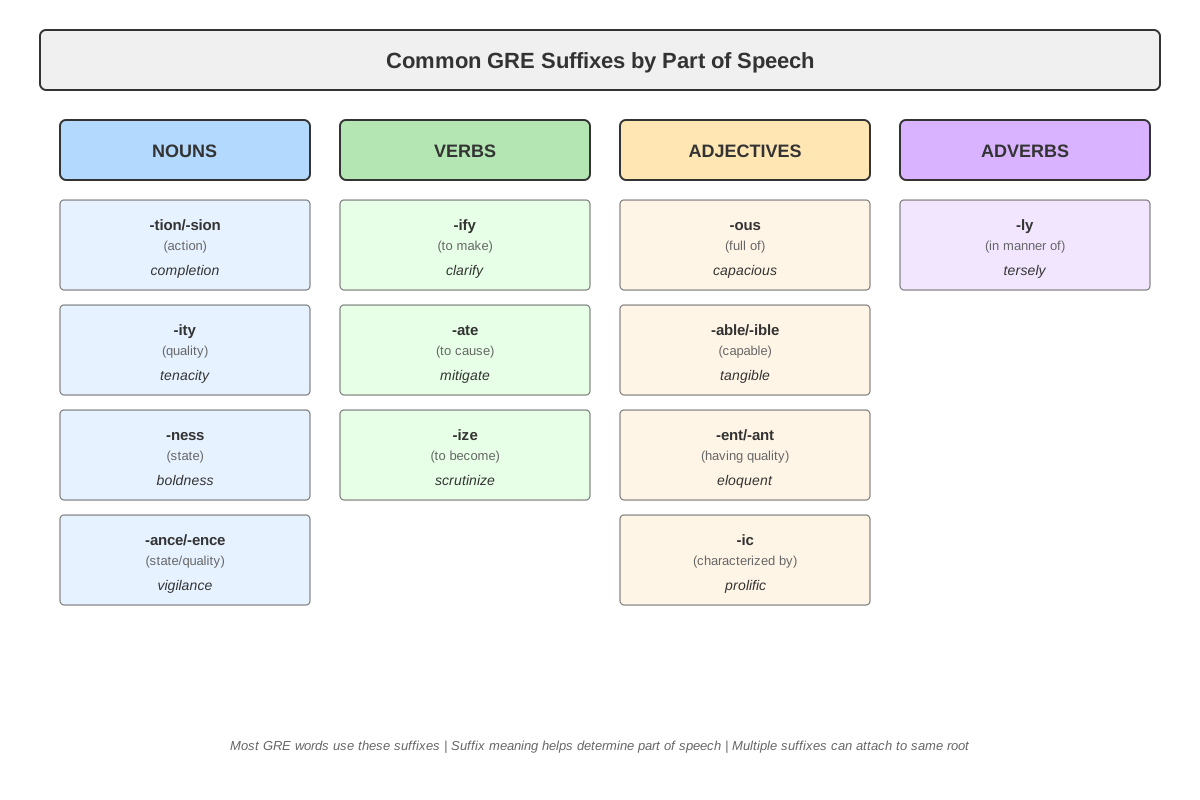
Noun-forming suffixes convert other parts of speech into nouns or create nouns with specific meanings. These are among the most common suffixes on the GRE because academic writing relies heavily on nominalization—the process of turning actions and qualities into noun concepts.
| Suffix | Meaning | Example | Root Analysis |
|---|---|---|---|
| -tion/-sion | act or process of | revolution, comprehension | revolve + tion, comprehend + sion |
| -ment | result or means of | establishment, government | establish + ment, govern + ment |
| -ness | state or quality of | darkness, effectiveness | dark + ness, effective + ness |
| -ity/-ty | quality or condition | complexity, certainty | complex + ity, certain + ty |
| -ance/-ence | state or quality | resistance, independence | resist + ance, independent + ence |
| -er/-or | one who does | teacher, conductor | teach + er, conduct + or |
| -ist | one who practices | biologist, pragmatist | biology + ist, pragmatic + ist |
| -ism | doctrine or belief | capitalism, skepticism | capital + ism, skeptic + ism |
The suffix -tion and its variant -sion appear with exceptional frequency on the GRE, particularly in abstract academic vocabulary. Words like "obfuscation," "amelioration," and "extrapolation" all follow this pattern, transforming verbs into nouns that describe processes or results.
Adjective-Forming Suffixes
Adjective-forming suffixes create descriptive words that modify nouns. The GRE frequently tests the ability to distinguish between similar adjectives formed from the same root with different suffixes, as these often carry subtle but important meaning distinctions.
| Suffix | Meaning | Example | Nuance |
|---|---|---|---|
| -ous/-ious/-eous | full of, characterized by | capacious, dubious, erroneous | Often implies abundance or strong presence |
| -ful | full of, characterized by | resourceful, meaningful | Emphasizes possession of quality |
| -less | without, lacking | feckless, fathomless | Indicates absence or negation |
| -able/-ible | capable of being | malleable, comprehensible | Suggests possibility or potential |
| -ive | having the nature of | comprehensive, decisive | Indicates tendency or inclination |
| -ic/-ical | relating to | pragmatic, philosophical | -ical often suggests "relating to the study of" |
| -ant/-ent | inclined to, causing | vigilant, persistent | Often describes ongoing states |
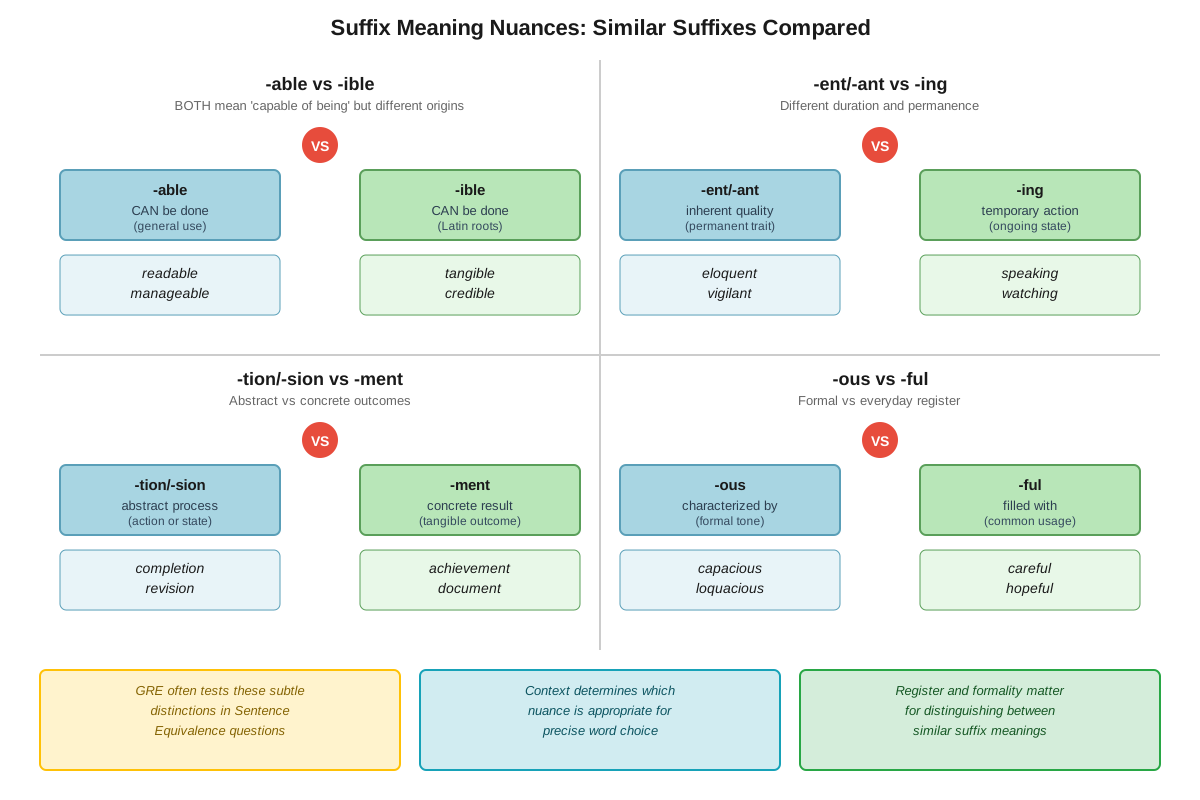
Understanding the distinction between -ic and -ical proves particularly valuable on the GRE. While sometimes interchangeable, these suffixes can create different meanings: "economic" relates to the economy, while "economical" means cost-effective or thrifty. Similarly, "historic" means famous or important in history, while "historical" simply means relating to history.
Verb-Forming Suffixes
Verb-forming suffixes are less numerous than noun or adjective suffixes but appear regularly in GRE vocabulary, particularly in words describing processes of change or causation.
| Suffix | Meaning | Example | Usage Pattern |
|---|---|---|---|
| -ize/-ise | to make, to become | standardize, compromise | Creates verbs from nouns/adjectives |
| -ate | to make, to act | facilitate, differentiate | Often in formal/academic contexts |
| -ify | to make, to cause | clarify, exemplify | Typically with Latin roots |
| -en | to make, to become | strengthen, enlighten | Often with Germanic roots |
The suffix -ate appears extensively in GRE vocabulary, particularly in words describing intellectual or analytical processes: "elucidate" (to make clear), "corroborate" (to confirm), "disseminate" (to spread widely). Recognizing this suffix helps identify verbs even in unfamiliar contexts.
Adverb-Forming Suffixes
Adverb-forming suffixes primarily modify adjectives to create words that describe how actions are performed. The GRE tests adverb recognition less frequently than other parts of speech, but understanding these patterns aids in eliminating incorrect answer choices.
| Suffix | Meaning | Example | Note |
|---|---|---|---|
| -ly | in a manner | carefully, pragmatically | Most common adverb suffix |
| -ward | in a direction | backward, forward | Indicates direction or orientation |
| -wise | in relation to | likewise, otherwise | Less common, often idiomatic |
The suffix -ly is the most reliable indicator of adverbs in English, though students must remember that some adjectives also end in -ly (e.g., "friendly," "lovely"). Context and grammatical position determine the actual part of speech.
Diminutive and Specialized Suffixes
Certain suffixes create specialized meanings beyond simple part-of-speech transformation. These appear less frequently but can be decisive in answering difficult vocabulary questions.
- -ette: small version (kitchenette, statuette)
- -ling: small or young (duckling, underling)
- -oid: resembling (humanoid, spheroid)
- -esque: in the style of (picturesque, statuesque)
- -phile: lover of (bibliophile, Francophile)
- -phobe: fear of (xenophobe, technophobe)
Suffix Stacking and Complex Words
Advanced GRE vocabulary often features suffix stacking, where multiple suffixes attach to a single root. Understanding this layering process enables decoding of highly complex terms. For example, "uncharacteristically" breaks down as: un- (prefix: not) + character (root) + -istic (adjective suffix: having the quality of) + -al (adjective suffix: relating to) + -ly (adverb suffix: in a manner).
Recognizing suffix layers requires working backward from the end of the word, identifying each suffix and its function before reaching the root. This systematic approach prevents confusion and enables accurate meaning determination even with unfamiliar vocabulary.
Concept Relationships
Suffix knowledge forms the third pillar of morphological analysis, working in concert with prefix and root word understanding. The relationship flows as follows: Root words provide core meaning → Prefixes modify that meaning → Suffixes determine grammatical function and further refine meaning. This hierarchical structure means that suffix analysis typically occurs as the final step in word decoding.
Within suffix study itself, relationships exist between suffix categories. Noun-forming suffixes often derive from adjective-forming suffixes through predictable patterns: "capable" (adjective with -able) becomes "capability" (noun with -ity). Similarly, verb-forming suffixes frequently connect to noun-forming suffixes: "clarify" (verb with -ify) produces "clarification" (noun with -tion).
The connection between suffixes and context clues operates bidirectionally. Suffix recognition helps narrow possible meanings, while context confirms which specific meaning applies. For instance, recognizing "-ous" in "capacious" identifies it as an adjective meaning "characterized by capacity," but context determines whether this refers to physical space, mental ability, or another application.
Suffix mastery also connects forward to advanced vocabulary strategies, particularly etymology and word family recognition. Understanding that "-logy" means "study of" unlocks entire vocabulary families: biology, geology, psychology, anthropology, and dozens more. This pattern recognition accelerates vocabulary acquisition exponentially.
Quick check — test yourself on Suffixes so far.
Try Flashcards →High-Yield Facts
⭐ The suffix -tion/-sion appears in approximately 15-20% of challenging GRE vocabulary words and always creates nouns describing processes or results
⭐ Adjective suffixes -ous, -ful, and -able/-ible account for over 40% of descriptive vocabulary tested on the GRE
⭐ The suffix -ly reliably indicates adverbs except in rare cases where it forms adjectives (friendly, lovely, timely)
⭐ Suffixes -er/-or and -ist both indicate "one who does," but -ist typically implies professional practice or adherence to a doctrine
⭐ The distinction between -ic and -ical often determines correct answer choices in Sentence Equivalence questions
- Suffix -ment always creates nouns and typically indicates concrete results rather than abstract processes
- The suffix -ize/-ise creates verbs meaning "to make" or "to become" and appears frequently in academic writing
- Suffixes -ance/-ence create abstract nouns describing states or qualities and often pair with adjectives ending in -ant/-ent
- The suffix -ness can attach to almost any adjective to create a noun, making it one of the most productive suffixes in English
- Recognizing suffix patterns enables educated guessing with approximately 60-70% accuracy on unfamiliar vocabulary
- Multiple suffixes can attach to a single root (e.g., "characteristically" has three suffixes: -istic, -al, -ly)
- Latin-derived suffixes (-tion, -ity, -ous) dominate formal academic vocabulary tested on the GRE
Common Misconceptions
Misconception: All words ending in -ly are adverbs → Correction: While -ly typically forms adverbs, some common adjectives also end in -ly (friendly, lovely, timely, orderly). Grammatical position and function determine the actual part of speech, not the suffix alone.
Misconception: Suffixes always attach to complete, recognizable root words → Correction: Many GRE vocabulary words use Latin or Greek roots that don't exist as standalone English words. For example, "tenacious" uses the root "tenac-" (meaning hold or grip) which isn't an independent English word, plus the suffix "-ious."
Misconception: The suffixes -able and -ible are interchangeable and mean exactly the same thing → Correction: While both mean "capable of being," they attach to different root types based on etymology. Words from Latin verbs typically take -ible (comprehensible, visible), while words from other sources take -able (readable, manageable). The distinction matters for spelling but not meaning.
Misconception: Knowing a suffix meaning allows you to determine exact word definitions → Correction: Suffixes indicate general meaning categories and grammatical function, but precise definitions require considering the root word and context. "Capacious" and "specious" both end in -ous (characterized by), but mean completely different things based on their roots.
Misconception: Longer words with multiple suffixes are always more complex or formal than shorter words → Correction: While suffix stacking often appears in academic vocabulary, word complexity depends on usage context and semantic precision, not length alone. "Uncharacteristically" is long but straightforward, while "moot" is short but semantically complex.
Misconception: The suffix -ism always indicates a negative belief system or ideology → Correction: While -ism does indicate doctrines or beliefs (capitalism, socialism, skepticism), it carries no inherent positive or negative connotation. The root word determines whether the meaning is neutral, positive, or negative.
Misconception: All words with the same suffix have similar meanings → Correction: Suffixes indicate grammatical function and general semantic categories, but the root provides specific meaning. Words ending in -tion (action, revolution, caution) are all nouns describing processes, but their actual meanings differ completely based on their roots.
Worked Examples
Example 1: Text Completion with Suffix Analysis
Question: The scientist's argument was remarkably _________, drawing on evidence from multiple disciplines to support conclusions that individually would have seemed merely speculative.
(A) comprehensive
(B) comprehensible
(C) comprehension
Solution Process:
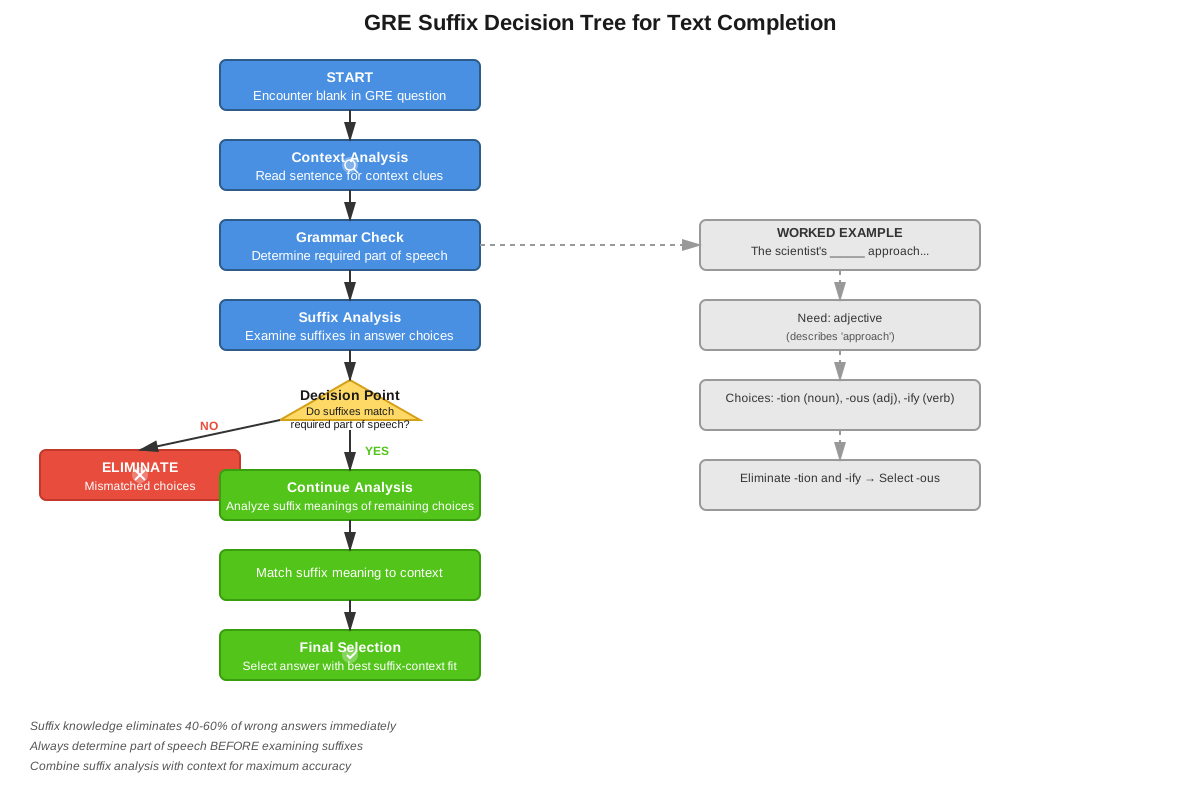
Step 1: Identify the grammatical requirement. The blank follows "was remarkably," where "was" is a linking verb and "remarkably" is an adverb. This construction requires an adjective to complete the predicate.
Step 2: Analyze each answer choice by suffix:
- (A) comprehensive: suffix -ive creates adjectives meaning "having the nature of"
- (B) comprehensible: suffix -ible creates adjectives meaning "capable of being"
- (C) comprehension: suffix -ion creates nouns describing processes
Step 3: Eliminate based on part of speech. Choice (C) is a noun, which cannot follow "was remarkably" in this construction. Eliminate (C).
Step 4: Distinguish between remaining adjectives using suffix meaning:
- "comprehensive" = having the nature of comprehending/including everything
- "comprehensible" = capable of being comprehended/understood
Step 5: Apply context. The sentence describes an argument that "draws on evidence from multiple disciplines." This suggests breadth and inclusiveness, not ease of understanding. The suffix -ive (having the nature of) fits better than -ible (capable of being).
Answer: (A) comprehensive
Learning Objective Connection: This example demonstrates applying suffix knowledge to determine both grammatical function (eliminating the noun) and precise meaning (distinguishing between similar adjectives), directly addressing the objective to "apply suffixes to GRE-style questions accurately."
Example 2: Sentence Equivalence with Suffix Discrimination
Question: The committee's decision to hire an external consultant reflected their recognition that the problem required _________ expertise beyond their internal capabilities.
Select two answer choices that produce sentences with the same meaning:
(A) technical
(B) technician
(C) specialized
(D) specialization
(E) specific
(F) specification
Solution Process:
Step 1: Determine grammatical requirements. The blank precedes "expertise" (a noun), so it must be an adjective that can modify a noun.
Step 2: Analyze suffixes to identify parts of speech:
- (A) technical: -ical = adjective suffix
- (B) technician: -ian = noun suffix (one who practices)
- (C) specialized: -ized = adjective (past participle form)
- (D) specialization: -tion = noun suffix
- (E) specific: -ic = adjective suffix
- (F) specification: -tion = noun suffix
Step 3: Eliminate nouns. Choices (B), (D), and (F) are nouns and cannot modify "expertise." This leaves (A), (C), and (E).
Step 4: Evaluate semantic equivalence among remaining adjectives:
- "technical expertise" = expertise relating to technique/technology
- "specialized expertise" = expertise that is focused on a particular area
- "specific expertise" = expertise that is precise or particular
Step 5: Identify the pair that creates equivalent meaning. The context emphasizes that internal capabilities were insufficient, suggesting the need for focused, particular expertise. "Specialized" and "specific" both convey this narrowing of focus, while "technical" emphasizes the type rather than the scope of expertise.
Answer: (C) specialized and (E) specific
Learning Objective Connection: This example illustrates identifying when suffixes are being tested (through answer choices with the same root but different suffixes) and applying suffix knowledge to eliminate incorrect answers and identify semantic equivalence.
Exam Strategy
Recognition Triggers
GRE questions test suffix knowledge through several predictable patterns. Watch for answer choices that present the same root word with different suffixes—this signals that the question tests precise understanding of how suffixes modify meaning and grammatical function. Phrases like "most nearly means" or "best describes" in question stems often indicate vocabulary questions where suffix analysis provides the key to discrimination.
Systematic Approach
When encountering unfamiliar vocabulary, apply this four-step suffix analysis process:
- Identify the suffix by working backward from the word's end
- Determine the part of speech the suffix creates
- Consider the root meaning (even if approximate)
- Combine suffix function with context to narrow possible meanings
This systematic approach takes 10-15 seconds per word but dramatically increases accuracy on challenging vocabulary questions.
Process of Elimination
Use suffix knowledge aggressively for elimination. If a blank requires an adjective, immediately eliminate all nouns and verbs based on their suffixes. This strategy often reduces five answer choices to two or three viable options within seconds, improving both accuracy and time management.
For Sentence Equivalence questions, suffix analysis provides a powerful shortcut: if two answer choices share the same root but have different suffixes, they cannot be the correct pair unless the suffixes are truly synonymous (rare). This rule eliminates impossible combinations quickly.
Time Allocation
Allocate approximately 30 seconds for suffix analysis on challenging vocabulary questions. This investment pays dividends by enabling confident elimination and selection rather than random guessing. However, if suffix analysis doesn't yield clarity within 30 seconds, make an educated guess and move forward—no single question justifies excessive time expenditure.
Common Trap Patterns
The GRE frequently includes trap answers that use the correct root with an incorrect suffix. For example, if the blank requires a noun, trap answers might include the adjective form of the correct root word. Students who focus only on root meaning without considering suffix function fall for these traps consistently. Always verify that suffix and grammatical function align before selecting an answer.
Memory Techniques
The NAVA Mnemonic
Remember the four primary suffix categories with NAVA:
- Noun suffixes: -tion, -ment, -ness, -ity
- Adjective suffixes: -ous, -ful, -able, -ive
- Verb suffixes: -ize, -ate, -ify, -en
- Adverb suffixes: -ly, -ward, -wise
Visualization Strategy: The Suffix Tree
Visualize a tree where the trunk represents the root word, branches represent different suffixes, and leaves represent the resulting words. For example, the root "care" branches into:
- care + -ful = careful (adjective branch)
- care + -less = careless (adjective branch)
- care + -fully = carefully (adverb branch)
- care + -lessness = carelessness (noun branch)
This mental image reinforces how suffixes transform a single root into multiple related words with different functions.
The "Part of Speech" Chant
Create memorable associations between common suffixes and their functions:
- "-tion makes action" (noun)
- "-ous means full of us" (adjective)
- "-ize to make it rise" (verb)
- "-ly tells us how and why" (adverb)
Suffix Families Grouping
Group suffixes by meaning rather than just function:
- "One who" family: -er, -or, -ist, -ian (teacher, actor, biologist, musician)
- "Full of" family: -ous, -ful, -ose (joyous, joyful, verbose)
- "Without" family: -less (careless, feckless, fathomless)
- "Capable of being" family: -able, -ible (readable, comprehensible)
This grouping helps distinguish between similar suffixes and reinforces semantic patterns.
The Etymology Connection
Remember that Latin-derived suffixes (-tion, -ous, -ity) dominate formal academic vocabulary, while Germanic suffixes (-ness, -ful, -less) appear in more common words. When encountering sophisticated GRE vocabulary, expect Latin suffixes; this expectation aids in word decoding and spelling.
Summary
Suffix mastery represents a high-efficiency strategy for GRE Verbal Reasoning success, enabling systematic decoding of unfamiliar vocabulary through pattern recognition rather than rote memorization. Understanding that suffixes primarily function to transform words between grammatical categories—nouns, adjectives, verbs, and adverbs—provides the foundation for analyzing complex academic vocabulary. The most frequently tested suffixes include noun-forming endings (-tion, -ment, -ness, -ity), adjective-forming endings (-ous, -ful, -able, -ive), verb-forming endings (-ize, -ate, -ify), and the adverb-forming suffix -ly. Success requires not merely recognizing these suffixes but understanding how they modify root meanings and interact with context clues. By applying systematic suffix analysis—identifying the suffix, determining part of speech, considering root meaning, and integrating context—students can accurately decode unfamiliar words and eliminate incorrect answer choices with confidence. This approach transforms vocabulary questions from memory tests into analytical exercises, leveraging pattern recognition to achieve consistent accuracy even with previously unseen words.
Key Takeaways
- Suffixes are word endings that modify meaning and grammatical function, appearing in 60-70% of challenging GRE vocabulary words
- The four primary suffix categories (noun, adjective, verb, adverb) each have high-frequency patterns that unlock thousands of vocabulary words
- Systematic suffix analysis—working backward from word endings to identify suffixes, then determining part of speech and meaning—enables accurate decoding of unfamiliar vocabulary
- Answer choices presenting the same root with different suffixes signal that the question tests precise understanding of suffix function and meaning
- Noun-forming suffixes (-tion, -ment, -ness, -ity) and adjective-forming suffixes (-ous, -ful, -able, -ive) account for the majority of suffix-based questions on the GRE
- Combining suffix knowledge with context clues and root word analysis creates a comprehensive vocabulary strategy more effective than memorization alone
- Process of elimination using suffix-based part-of-speech identification dramatically improves accuracy and time management on Verbal Reasoning questions
Related Topics
Prefixes and Root Words: Understanding prefixes (word beginnings) and roots (core word elements) completes the morphological analysis framework, enabling comprehensive word decoding. Mastering suffixes provides the foundation for integrating these related concepts into a unified vocabulary strategy.
Etymology and Word Origins: Studying the historical origins of words, particularly Latin and Greek sources, deepens suffix understanding by revealing why certain suffixes pair with specific roots and how meaning evolved over time.
Context Clues and Inference: Advanced context clue strategies complement suffix analysis by providing semantic confirmation of word meanings derived through morphological analysis, creating a two-pronged approach to vocabulary questions.
Word Families and Semantic Fields: Recognizing that words sharing roots and suffixes form related meaning clusters accelerates vocabulary acquisition and improves retention through associative learning.
Advanced Vocabulary Strategies: Combining suffix mastery with techniques like word mapping, spaced repetition, and usage-based learning creates a comprehensive approach to achieving top-percentile vocabulary scores.
Practice CTA
Now that you've mastered the systematic approach to suffix analysis, it's time to reinforce these concepts through active practice. Attempt the practice questions and flashcards designed specifically for this topic—each question provides an opportunity to apply the four-step suffix analysis process and build the pattern recognition skills that translate directly to test-day success. Remember that suffix knowledge compounds over time: each word you decode strengthens your ability to tackle the next unfamiliar term with confidence. Your investment in understanding these patterns will yield returns across every Verbal Reasoning question type, transforming vocabulary from a memorization challenge into an analytical skill you can deploy consistently under timed conditions.
Sign up free to keep reading
Create a free AnvayaPrep account to finish this GRE guide on Suffixes — plus flashcards and practice questions.