Overview
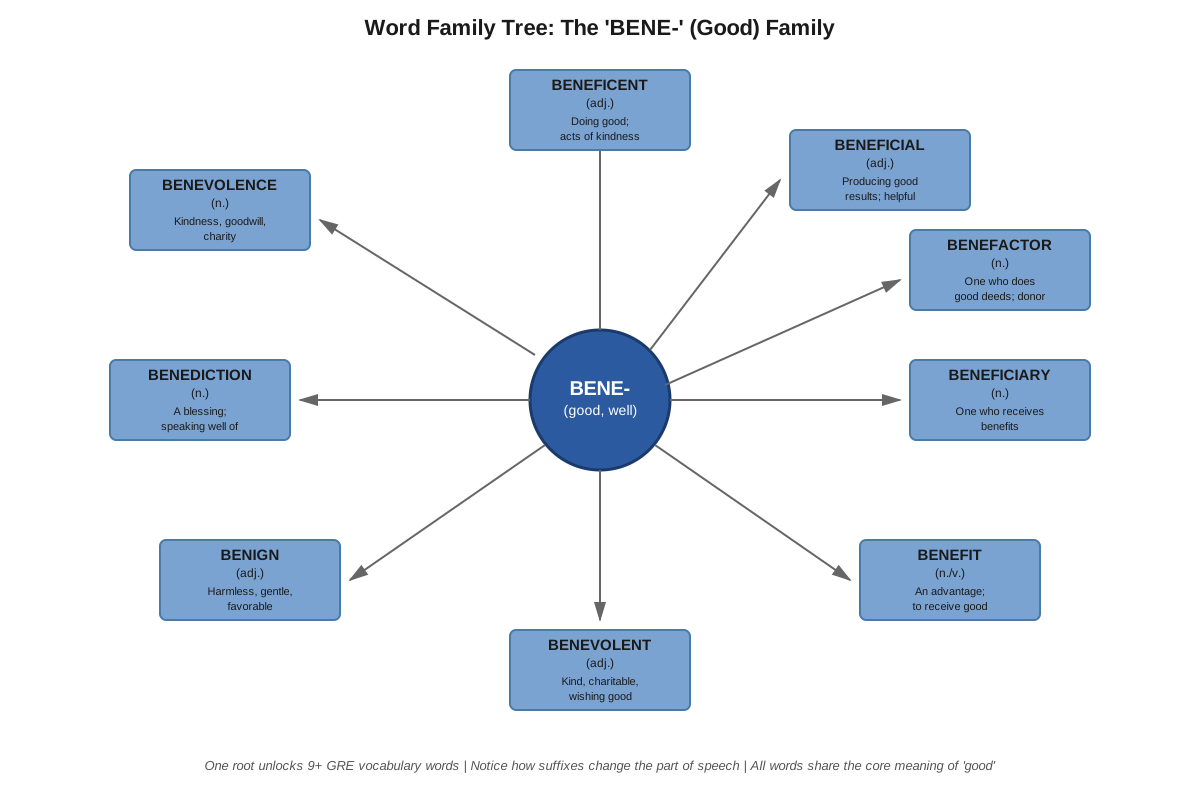
Word families represent one of the most powerful and efficient strategies for expanding vocabulary on the GRE Verbal Reasoning section. A word family consists of a group of related words that share a common root, prefix, or suffix, allowing test-takers to decode unfamiliar words by recognizing familiar components. For example, understanding that "bene-" means "good" unlocks the meaning of benevolent, benefactor, benediction, and benign—multiplying vocabulary knowledge exponentially rather than linearly.
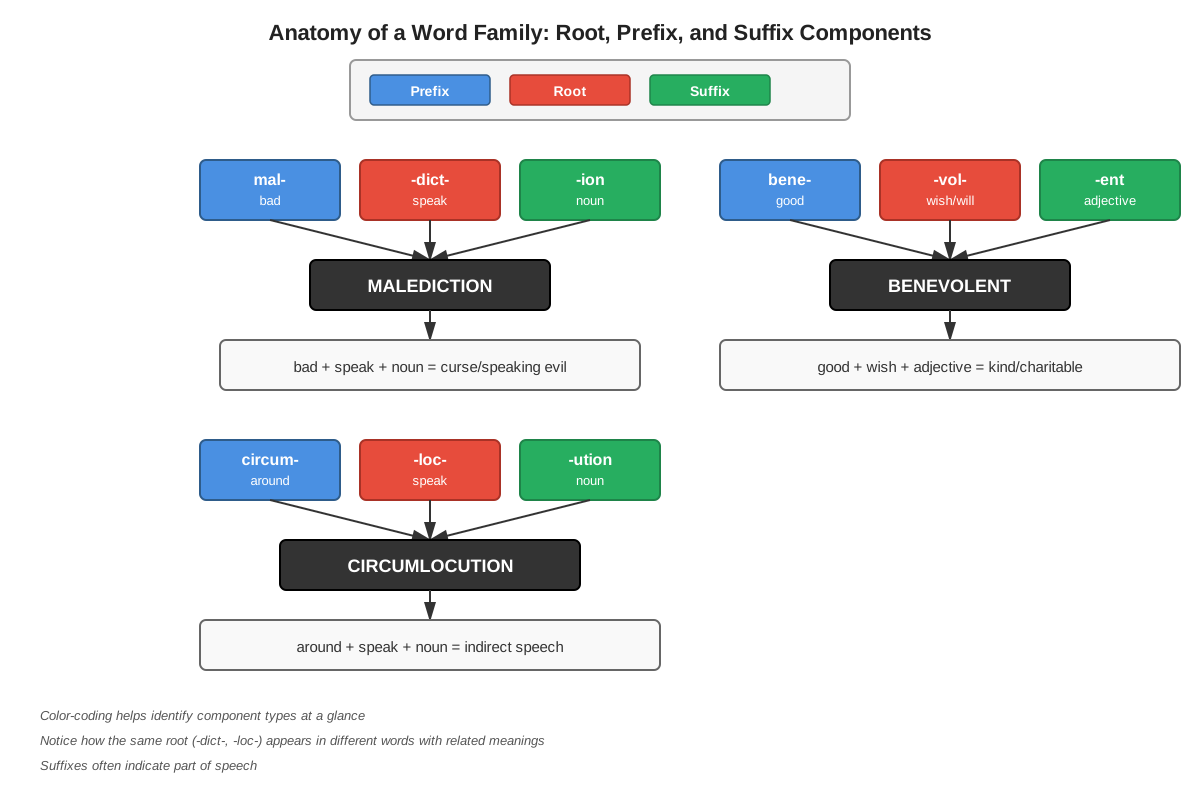
The GRE frequently tests vocabulary through Text Completion and Sentence Equivalence questions that feature sophisticated, academic words. Rather than memorizing thousands of isolated terms, mastering gre word families enables students to deduce meanings of words they've never encountered by analyzing their constituent parts. This approach transforms vocabulary study from rote memorization into pattern recognition, making it both more efficient and more effective. When facing a challenging word like "malediction," a student familiar with word families can break it down: "mal-" (bad) + "dict" (speak) + "-ion" (noun suffix) = speaking badly of someone, or a curse.
Understanding word families connects directly to other critical Verbal Reasoning skills, including context clue analysis and elimination strategies. When combined with contextual understanding, word family knowledge allows test-takers to narrow answer choices even when they don't know every word perfectly. This topic serves as a foundational skill that enhances performance across all vocabulary-dependent question types, making it one of the highest-yield study areas for GRE preparation.
Learning Objectives
- [ ] Identify when Word families is being tested
- [ ] Explain the core rule or strategy behind Word families
- [ ] Apply Word families to GRE-style questions accurately
- [ ] Deconstruct unfamiliar words into recognizable roots, prefixes, and suffixes
- [ ] Generate multiple related words from a single root to expand vocabulary efficiently
- [ ] Distinguish between words that appear similar but belong to different families
- [ ] Combine word family knowledge with context clues to eliminate incorrect answer choices
Prerequisites
- Basic understanding of parts of speech: Recognizing nouns, verbs, adjectives, and adverbs helps identify how suffixes change word function within a family
- Familiarity with common English vocabulary: A foundation of approximately 3,000-5,000 common words provides the baseline for recognizing patterns and building word families
- Reading comprehension fundamentals: The ability to use context clues complements word family analysis when determining precise meanings
Why This Topic Matters
Word families represent a force multiplier for GRE vocabulary preparation. Rather than studying 3,000 individual words in isolation, students who master approximately 150-200 common roots, prefixes, and suffixes can decode thousands of words they've never explicitly studied. This efficiency is crucial given the time constraints of GRE preparation and the virtually unlimited pool of sophisticated vocabulary the test may draw from.
On the GRE Verbal Reasoning section, vocabulary knowledge directly impacts performance on Text Completion questions (approximately 6 per section) and Sentence Equivalence questions (approximately 4 per section). Research on GRE question patterns indicates that approximately 60-70% of challenging vocabulary words in these question types can be decoded using word family analysis. The test deliberately includes sophisticated academic vocabulary that educated native speakers may not use in daily conversation, making word family strategies essential rather than optional.
Word families appear most frequently in questions testing nuanced distinctions between similar concepts. For example, a Text Completion question might offer answer choices like "ameliorate," "exacerbate," "mitigate," and "aggravate"—all words that can be partially decoded through their roots. The GRE also tests word families in Reading Comprehension passages, where understanding technical or academic terminology enhances comprehension speed and accuracy. Additionally, the Analytical Writing section benefits from word family knowledge, as it enables more precise and varied vocabulary in essays.
Core Concepts
Understanding Word Family Components
A word family consists of all words derived from a common root, often modified by various prefixes and suffixes. The three primary components that form word families are:
- Roots: The core meaning-bearing element, typically derived from Latin or Greek (e.g., "dict" meaning "speak" or "say")
- Prefixes: Elements added before the root that modify meaning (e.g., "pre-" meaning "before")
- Suffixes: Elements added after the root that often change the part of speech (e.g., "-tion" creating nouns)
Understanding these components allows for systematic vocabulary expansion. For instance, the root "spec/spect" (meaning "look" or "see") generates: inspect, spectator, introspection, retrospective, perspective, circumspect, and conspicuous. Each word maintains the core concept of "looking" while prefixes and suffixes add specific nuances.
High-Frequency Roots for GRE Success
Certain roots appear with exceptional frequency on the GRE. Mastering these provides maximum return on study investment:
| Root | Meaning | Example Words |
|---|---|---|
| bene/bon | good | benevolent, benefactor, bonhomie |
| mal/male | bad | malevolent, malfeasance, malady |
| dict/dic | speak, say | dictate, predict, contradict, edict |
| duc/duct | lead | deduce, conducive, induce, abduct |
| fac/fic/fect | make, do | facilitate, proficient, defect, artifact |
| scrib/script | write | prescribe, transcript, inscription |
| port | carry | portable, export, deportment |
| ject | throw | reject, conjecture, trajectory |
| cred | believe | credible, incredulous, credence |
| path | feeling | empathy, apathy, pathetic, antipathy |
Prefix Patterns and Meanings
Prefixes dramatically alter root meanings and often indicate relationships, directions, or negations. The most valuable GRE prefixes include:
Negation prefixes: a-, an- (without), in-, im-, il-, ir- (not), dis- (apart, not), un- (not)
- Examples: amoral (without morals), incredulous (not believing), disparate (not similar)
Quantity and degree prefixes: mono- (one), bi- (two), poly- (many), omni- (all), semi- (half)
- Examples: monotonous (one tone), bilateral (two sides), omniscient (all-knowing)
Direction and position prefixes: pre- (before), post- (after), pro- (forward), retro- (backward), circum- (around), trans- (across)
- Examples: preclude (close before), retrospective (looking backward), circumvent (go around)
Relationship prefixes: co-, com-, con- (with, together), contra-, counter- (against), syn-, sym- (together)
- Examples: collaborate (work together), contradict (speak against), synthesis (putting together)
Suffix Functions and Transformations
Suffixes primarily change the part of speech while maintaining the core meaning. Understanding these patterns enables recognition of how words function in sentences:
Noun suffixes: -tion/-sion (action/state), -ment (result), -ness (quality), -ity (state), -ance/-ence (state/quality), -er/-or (one who)
- Examples: completion, achievement, darkness, veracity, resilience, benefactor
Adjective suffixes: -able/-ible (capable of), -ous/-ious (full of), -ive (having nature of), -al (relating to), -ful (full of), -less (without)
- Examples: credible, contentious, conducive, contextual, meaningful, hapless
Verb suffixes: -ate (make/cause), -ify (make), -ize (cause to be), -en (become)
- Examples: facilitate, clarify, standardize, strengthen
Adverb suffix: -ly (in the manner of)
- Example: benevolently, incredulously
Combining Elements for Meaning
The true power of word families emerges when combining multiple elements. Consider the word "irrevocable":
- ir- (not) + re- (back) + voc (call) + -able (capable of) = not capable of being called back = permanent, irreversible
This systematic deconstruction works for even the most challenging GRE vocabulary. The word "circumlocution" breaks down as:
- circum- (around) + loc (speak) + -tion (noun) = speaking around something = indirect or evasive speech
Context-Dependent Nuances
While word families provide core meanings, context determines precise usage. The root "path" (feeling) appears in:
- Empathy: feeling with someone (understanding their emotions)
- Apathy: without feeling (indifference)
- Sympathy: feeling together with someone (sharing their emotions)
- Antipathy: feeling against (strong dislike)
- Pathetic: arousing feeling (evoking pity or sadness)
Each word shares the emotional core but requires contextual understanding for accurate application. The GRE tests these subtle distinctions, making both word family knowledge and contextual analysis essential.
Concept Relationships
Word family knowledge forms a hierarchical structure where understanding flows from basic components to complex applications. At the foundation, root recognition enables identification of core meanings. This foundation supports prefix and suffix analysis, which modifies and specifies those core meanings. Together, these elements enable word deconstruction, the active process of breaking unfamiliar words into recognizable parts.
Word deconstruction connects directly to contextual analysis, another critical Verbal Reasoning skill. When encountering an unfamiliar word, students first apply word family analysis to generate a rough meaning, then use sentence context to refine that understanding and confirm accuracy. This two-step process (word family → context) proves more reliable than either strategy alone.
The relationship map flows as follows:
Root Mastery → Prefix/Suffix Recognition → Word Deconstruction → Meaning Hypothesis → Context Verification → Answer Selection
Word families also connect to elimination strategies in multiple-choice questions. Even partial understanding of word components allows elimination of clearly incorrect answers, improving odds significantly. For example, recognizing that "bene-" means good immediately eliminates any answer choice requiring a negative meaning, even if the complete word is unfamiliar.
Finally, word family knowledge reinforces vocabulary retention through meaningful connections rather than arbitrary memorization. Learning that "aud" means "hear" simultaneously teaches audible, auditory, audience, audition, and inaudible—creating a web of interconnected knowledge more resistant to forgetting than isolated word lists.
High-Yield Facts
⭐ The 100 most common roots, prefixes, and suffixes enable decoding of approximately 60% of GRE vocabulary words
⭐ Prefixes typically modify meaning while suffixes typically change part of speech
⭐ Latin roots predominate in academic and formal English vocabulary tested on the GRE
⭐ Recognizing negation prefixes (a-, in-, dis-, un-) immediately indicates opposite meanings
⭐ The roots "bene/bon" (good) and "mal/male" (bad) appear in approximately 5-8% of challenging GRE vocabulary questions
- Greek roots often relate to scientific and technical terminology (bio-, geo-, therm-, chron-)
- Multiple prefixes can stack on a single root (un-pre-dict-able)
- Some roots have variant spellings depending on the following letter (in-/im-/il-/ir- for "not")
- The suffix "-ous" creates adjectives meaning "full of" or "characterized by" (contentious, gratuitous)
- Roots ending in consonants often require connecting vowels when adding suffixes (fact → factual, not "factual")
- The prefix "circum-" (around) appears less frequently but signals important spatial or metaphorical relationships
- Words from the same family can have dramatically different connotations despite similar denotations (childish vs. childlike)
- The root "path" (feeling/suffering) generates both emotional terms (empathy) and medical terms (pathology)
- Understanding that "-ify" and "-ize" create verbs helps identify action words in Text Completion questions
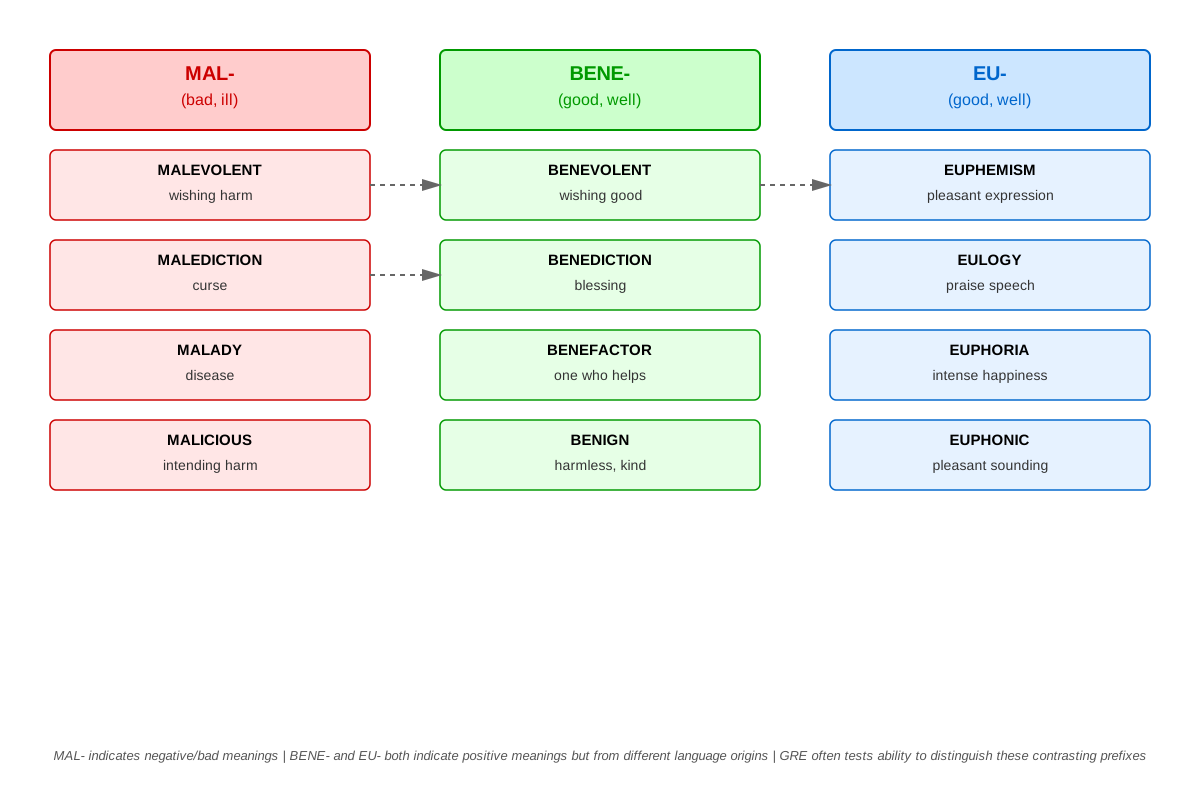
- The prefix "eu-" (good, well) appears in positive-meaning words like eulogy, euphemism, and euphoria
Quick check — test yourself on Word families so far.
Try Flashcards →Common Misconceptions
Misconception: All words that look similar belong to the same word family → Correction: Visual similarity doesn't guarantee etymological relationship. "Imply" and "implement" share the prefix "im-" but come from different roots (ply = fold; ple = fill). Always verify the root, not just the appearance.
Misconception: Word family analysis provides exact definitions → Correction: Word families provide core meanings and general semantic fields, but context determines precise usage. "Incredible" literally means "not believable" but commonly means "amazing"—the root provides direction, not definition.
Misconception: Prefixes always have the same meaning → Correction: Some prefixes have multiple meanings depending on context. "In-" can mean "not" (incredible), "in/into" (inscribe), or serve as an intensifier (invaluable = very valuable, not "not valuable"). Context and the root determine which meaning applies.
Misconception: Knowing the root is sufficient for GRE questions → Correction: The GRE tests nuanced distinctions between words from the same family. Understanding that "dict" means "speak" helps with dictate, predict, and contradict, but distinguishing between them requires understanding the prefixes and contextual usage.
Misconception: All words can be decoded through word families → Correction: Approximately 30-40% of English words, particularly common Anglo-Saxon words (get, put, make), don't follow Latin/Greek root patterns. Word family analysis is powerful but not universal—it works best with academic and formal vocabulary.
Misconception: Memorizing roots is more important than understanding how they combine → Correction: The GRE tests application, not recognition. Knowing that "bene" means "good" has limited value unless you can combine it with other elements and apply it to unfamiliar words in context. Practice deconstruction, not just memorization.
Misconception: Word families only help with vocabulary questions → Correction: Word family knowledge accelerates reading comprehension by enabling faster processing of technical terms in passages, supports more sophisticated vocabulary in Analytical Writing essays, and builds general verbal reasoning skills that transfer across question types.
Worked Examples
Example 1: Text Completion with Word Family Analysis
Question: The professor's lecture style was notably ________; rather than speaking directly about the main topic, he would digress into tangential anecdotes and peripheral observations.
(A) circumlocutory
(B) laconic
(C) perspicacious
(D) didactic
(E) mellifluous
Solution Process:
Step 1: Analyze the context. The sentence indicates the professor speaks indirectly, using digressions and tangential content rather than direct discussion.
Step 2: Deconstruct unfamiliar answer choices using word families:
(A) circumlocutory:
- circum- (around) + loc (speak) + -utory (adjective suffix)
- Meaning: speaking around something, indirect speech
- This matches the context perfectly
(B) laconic:
- From Laconia (Sparta), known for brief speech
- Meaning: using few words, concise
- This contradicts the context (the professor uses many words)
(C) perspicacious:
- per- (through) + spic (look/see) + -acious (full of)
- Meaning: having keen insight, perceptive
- This describes mental quality, not speaking style
(D) didactic:
- didact (teach) + -ic (adjective)
- Meaning: intended to teach or instruct
- This doesn't address direct vs. indirect speech
(E) mellifluous:
- melli (honey) + flu (flow) + -ous (full of)
- Meaning: sweet-sounding, smooth
- This describes sound quality, not directness
Step 3: Verify the answer. "Circumlocutory" is the only choice that captures indirect, roundabout speech. The word family analysis of "circum-" (around) + "loc" (speak) directly corresponds to "speaking around" the topic.
Answer: (A) circumlocutory
Learning Objective Connection: This example demonstrates applying word families to GRE-style questions accurately by deconstructing unfamiliar words and matching them to context.
Example 2: Sentence Equivalence with Multiple Word Families
Question: Despite the diplomat's efforts to appear neutral, his ________ toward the visiting delegation was evident in his dismissive tone and perfunctory gestures.
Select TWO answer choices:
(A) antipathy
(B) affinity
(C) ambivalence
(D) animosity
(E) deference
(F) equanimity
Solution Process:
Step 1: Identify what the sentence requires. The diplomat appears neutral but actually shows negative feelings (dismissive tone, perfunctory gestures). We need two words meaning "negative feeling" or "hostility."
Step 2: Deconstruct each choice:
(A) antipathy:
- anti- (against) + path (feeling) + -y (noun)
- Meaning: strong feeling against, dislike
- Matches: negative feeling
(B) affinity:
- af- (to, toward) + fin (end, boundary) + -ity (noun)
- Meaning: natural liking or attraction
- Opposite of what's needed
(C) ambivalence:
- ambi- (both) + val (strength) + -ence (noun)
- Meaning: having mixed feelings, both positive and negative
- Too neutral; doesn't match dismissive behavior
(D) animosity:
- anim (spirit, mind) + -osity (noun suffix indicating state)
- Meaning: strong hostility or hatred
- Matches: negative feeling
(E) deference:
- de- (from) + fer (carry) + -ence (noun)
- Meaning: respectful submission or yielding
- Opposite of dismissive behavior
(F) equanimity:
- equa (equal) + anim (mind/spirit) + -ity (noun)
- Meaning: mental calmness, composure
- Too neutral; doesn't indicate negative feeling
Step 3: Verify that both selected answers create equivalent meanings. "Antipathy" and "animosity" both indicate strong negative feelings, making the sentences equivalent in meaning.
Answer: (A) antipathy and (D) animosity
Learning Objective Connection: This example shows how word family knowledge enables identification of synonyms by recognizing that different roots can express similar concepts, and how prefixes like "anti-" signal opposition or negativity.
Exam Strategy
Systematic Approach to Word Family Questions
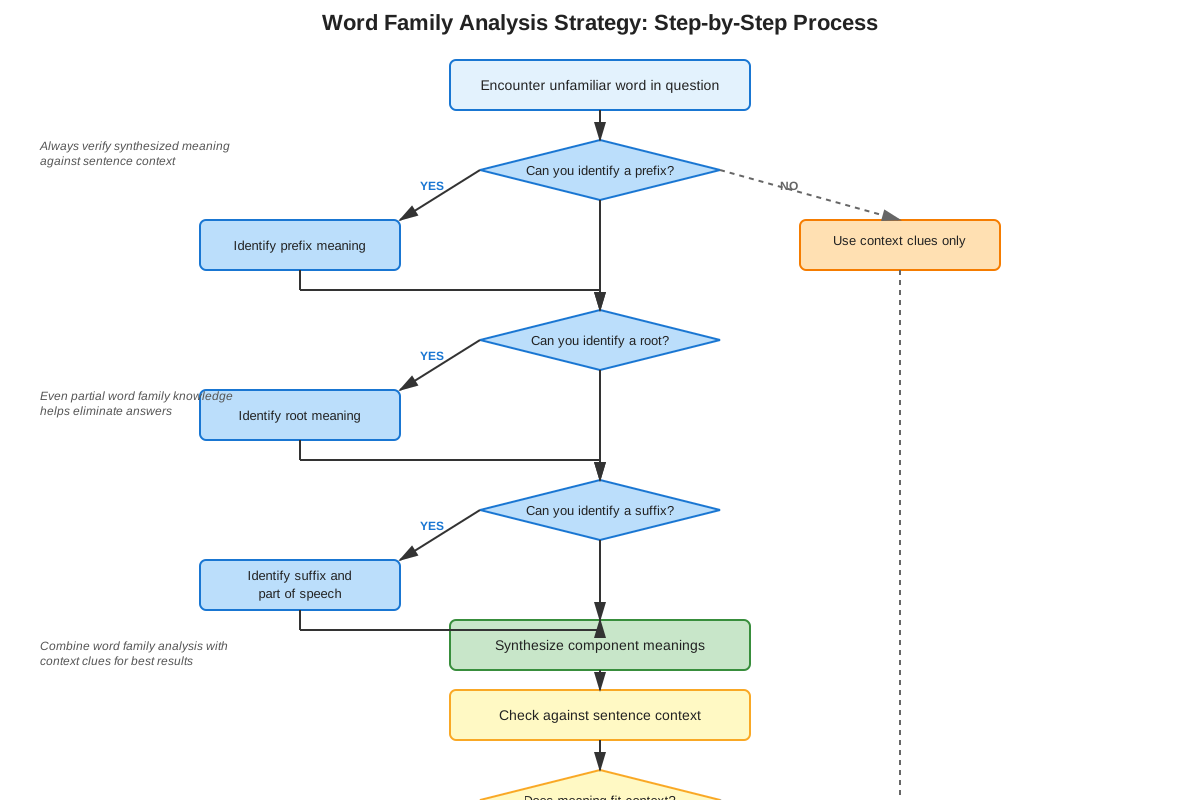
When encountering unfamiliar vocabulary on the GRE, follow this process:
- Identify recognizable components (2-3 seconds): Scan for familiar prefixes, roots, or suffixes
- Construct a rough meaning (3-5 seconds): Combine component meanings into a general concept
- Check context (5-7 seconds): Verify that your constructed meaning fits the sentence logic
- Eliminate incompatible choices (5-10 seconds): Remove answers that contradict your understanding
- Select or narrow to two choices (3-5 seconds): Choose the best match or prepare to guess strategically
Trigger Words and Phrases
Certain question structures signal that word family knowledge will be particularly valuable:
- "Despite," "although," "while": Indicate contrast, suggesting you need opposite-meaning words (watch for negation prefixes)
- "Because," "since," "therefore": Indicate logical continuation, suggesting words with compatible meanings
- Technical or academic contexts: Passages about science, philosophy, or formal topics heavily feature Latin/Greek-derived vocabulary amenable to word family analysis
- Formal or archaic-sounding words: Words like "circumlocution," "perspicacity," or "verisimilitude" almost always break down into analyzable components
Process of Elimination Strategies
Word family knowledge enables powerful elimination even with partial understanding:
- Eliminate based on prefix alone: If context requires a negative meaning, eliminate all words with positive prefixes (bene-, eu-, pro-)
- Eliminate based on part of speech: If the blank requires an adjective, eliminate words with noun suffixes (-tion, -ment, -ness)
- Eliminate based on semantic field: If context involves communication, prioritize words with roots like "dict," "loc," "verb," "log"
- Eliminate obvious opposites first: In Sentence Equivalence, immediately eliminate any word that's clearly opposite to the context, then analyze remaining choices
Time Allocation
For vocabulary-heavy questions:
- Spend 5-10 seconds on word family analysis before reading all answer choices in detail
- Don't spend more than 30 seconds trying to decode a single word—if you can't break it down quickly, use context and elimination
- Prioritize questions where you recognize 3+ answer choices—these offer better odds than questions with entirely unfamiliar vocabulary
- Mark and return to questions where word family analysis yields ambiguous results; fresh perspective often helps
Exam Tip: If you can eliminate even one answer choice through word family analysis, your guessing odds improve from 20% to 25% (or 33% if you eliminate two). This seemingly small improvement compounds significantly across multiple questions.
Memory Techniques
Root Family Mnemonics
BENE-BON (good): "Ben is a bonafide good guy" → benevolent, benefit, bonus, bonhomie
MAL-MALE (bad): "Maleficent is malevolent" → malady, malicious, malfunction, malediction
DICT (speak): "Dick dictates what everyone says" → dictate, predict, contradict, verdict, edict
DUC-DUCT (lead): "The duck duct-taped the leader" → deduce, induce, conduct, abduct, conducive
SPEC-SPECT (look): "Spectacles help you spectate" → inspect, spectator, perspective, circumspect, introspection
Prefix Visualization
CIRCUM- (around): Visualize a circus tent with a circumference going around it → circumvent (go around), circumlocution (talk around), circumspect (look around carefully)
RETRO- (backward): Picture a retro 1980s scene looking backward in time → retrospective (looking back), retrograde (moving backward), retroactive (applying backward in time)
TRANS- (across): Imagine transportation moving across distances → transcend (go across/beyond), transpose (place across), translucent (light going across)
Suffix Function Acronym: "NAVA"
- Noun suffixes: -tion, -ment, -ness, -ity, -ance/-ence
- Adjective suffixes: -able/-ible, -ous, -ive, -al, -ful, -less
- Verb suffixes: -ate, -ify, -ize, -en
- Adverb suffix: -ly
The "Family Tree" Technique
For high-frequency roots, create mental family trees:
                    DICT (speak)
                        |
        ________________|________________
        |               |               |
    pre-DICT        contra-DICT     bene-DICT-ion
   (speak before)  (speak against)  (speak good of)
        |               |               |
    predict-ABLE    contradict-ORY   benediction
This visualization reinforces how prefixes and suffixes modify the core root meaning while maintaining the family relationship.
Opposite Pairs Memory
Learn roots in contrasting pairs to double retention:
- BENE (good) ↔ MAL (bad)
- PRO (forward) ↔ RETRO (backward)
- PHIL (love) ↔ PHOB (fear)
- EU (good) ↔ DYS (bad)
- MACRO (large) ↔ MICRO (small)
Summary
Word families represent the most efficient strategy for expanding GRE vocabulary, enabling test-takers to decode thousands of unfamiliar words by recognizing approximately 150-200 common roots, prefixes, and suffixes. Rather than memorizing isolated definitions, students who master word family analysis can deconstruct complex academic vocabulary into recognizable components, generating rough meanings that context then refines. The systematic approach involves identifying familiar elements (roots like "dict" for speak, prefixes like "circum-" for around, suffixes like "-ous" for adjectives), combining these elements into hypothetical meanings, and verifying against sentence context. This strategy proves particularly powerful for Text Completion and Sentence Equivalence questions, where nuanced vocabulary distinctions determine correct answers. Success requires understanding that prefixes typically modify meaning while suffixes change part of speech, that Latin and Greek roots dominate formal academic vocabulary, and that word family analysis works best when combined with contextual clues and strategic elimination. Mastering this topic transforms vocabulary study from overwhelming memorization into systematic pattern recognition, making it an essential foundation for GRE Verbal Reasoning success.
Key Takeaways
- Word families multiply vocabulary knowledge exponentially: Learning one root like "dict" (speak) unlocks predict, contradict, dictate, edict, and verdict simultaneously
- Systematic deconstruction follows a pattern: Identify prefix → identify root → identify suffix → combine meanings → verify with context
- Prefixes signal relationships and modifications: Negation (in-, dis-), direction (pre-, retro-), and degree (omni-, semi-) provide crucial meaning clues
- Context and word families work together: Word family analysis generates hypotheses; context confirms or refines them
- The 100 most common roots enable decoding of 60% of challenging GRE vocabulary, making focused study of high-frequency elements more valuable than broad memorization
- Part of speech recognition through suffixes enables grammatical elimination: Knowing that "-tion" creates nouns helps eliminate choices that don't fit grammatically
- Even partial word family knowledge improves guessing odds: Recognizing a single prefix or root enables strategic elimination, significantly improving performance on difficult questions
Related Topics
Etymology and Word Origins: Understanding the historical development of English vocabulary from Latin, Greek, French, and Germanic sources deepens word family knowledge and explains spelling patterns and meaning shifts.
Context Clues and Inference: The complementary skill to word family analysis, using surrounding text to determine word meaning when structural analysis is insufficient or ambiguous.
Connotation vs. Denotation: Distinguishing between literal meanings (often revealed through word families) and emotional associations (requiring contextual and cultural knowledge) refines vocabulary precision.
Synonym and Antonym Relationships: Word families often generate natural synonym groups (benevolent/beneficent) and antonym pairs (benevolent/malevolent), essential for Sentence Equivalence questions.
Academic Vocabulary Across Disciplines: Specialized terminology in sciences, humanities, and social sciences frequently employs Greek and Latin roots, making word family knowledge transferable to Reading Comprehension passages.
Practice CTA
Now that you understand the systematic approach to word families, it's time to apply this knowledge to authentic GRE-style questions. The practice questions and flashcards will challenge you to deconstruct unfamiliar words under timed conditions, reinforcing the recognition patterns that lead to automatic, confident vocabulary analysis on test day. Remember: every unfamiliar word you encounter is an opportunity to practice your word family skills. Approach the practice materials with curiosity rather than anxiety—you now have a proven system for unlocking meaning from even the most intimidating vocabulary. Your investment in mastering this foundational skill will pay dividends across every section of the Verbal Reasoning test.
Sign up free to keep reading
Create a free AnvayaPrep account to finish this GRE guide on Word families — plus flashcards and practice questions.