Overview
Antonyms represent one of the most fundamental vocabulary relationships tested on the GRE Verbal Reasoning section. While the current GRE format does not include standalone antonym questions as older versions did, understanding antonym relationships remains absolutely critical for success on Text Completion, Sentence Equivalence, and Reading Comprehension questions. The ability to quickly recognize words with opposite meanings enables test-takers to eliminate incorrect answer choices, understand contrasting ideas in passages, and select contextually appropriate vocabulary in completion questions.
Mastering GRE antonyms requires more than simply memorizing word pairs; it demands understanding the nuances of opposition, including gradations of contrast (mild versus extreme opposites), contextual variations in meaning, and the ability to recognize antonymous relationships even when words are not perfect opposites. The GRE frequently tests sophisticated vocabulary where the antonym relationship may be subtle or context-dependent, requiring students to think critically about word meanings rather than relying on rote memorization.
Within the broader Verbal Reasoning framework, antonym knowledge intersects with synonym recognition, contextual vocabulary usage, and logical reasoning about word relationships. Students who excel at identifying antonyms demonstrate strong command of vocabulary nuance, an essential skill that underlies performance across all GRE Verbal question types. This topic serves as a bridge between basic vocabulary acquisition and advanced verbal reasoning, making it a high-yield area for focused study.
Learning Objectives
- [ ] Identify when Antonyms is being tested
- [ ] Explain the core rule or strategy behind Antonyms
- [ ] Apply Antonyms to GRE-style questions accurately
- [ ] Distinguish between different degrees of opposition (absolute vs. relative antonyms)
- [ ] Recognize context-dependent antonym relationships in complex sentences
- [ ] Utilize antonym knowledge to eliminate incorrect answer choices efficiently
- [ ] Construct mental networks of related antonym pairs to enhance vocabulary retention
Prerequisites
- Basic vocabulary foundation: Understanding common English words and their definitions is essential because antonym recognition builds upon existing word knowledge
- Parts of speech recognition: Identifying whether words function as nouns, verbs, adjectives, or adverbs helps determine appropriate antonym pairs, as antonyms must share the same part of speech
- Context clue interpretation: The ability to derive word meaning from surrounding text enables recognition of antonym relationships in sentence-level questions
- Logical reasoning fundamentals: Understanding opposition and contrast as logical relationships provides the conceptual framework for antonym identification
Why This Topic Matters
Antonym knowledge appears throughout the GRE Verbal Reasoning section, though not always explicitly labeled. In Text Completion questions, approximately 30-40% include contrast signals (such as "however," "despite," or "although") that require selecting words with opposite or contrasting meanings. Sentence Equivalence questions frequently test whether students can identify two synonymous words that both contrast with a concept mentioned in the sentence. Even Reading Comprehension passages regularly present opposing viewpoints, contrasting theories, or antithetical concepts that require understanding antonymous relationships.
Beyond the exam, antonym mastery enhances critical thinking and communication skills. Professional writing, academic discourse, and analytical reasoning all depend on the ability to articulate contrasts, present opposing viewpoints, and understand nuanced differences in meaning. Legal reasoning, scientific methodology, and business strategy frequently require identifying what something is not as clearly as what it is—a skill directly supported by strong antonym knowledge.
The GRE specifically values antonym understanding because it demonstrates vocabulary depth rather than breadth alone. Knowing that "loquacious" means talkative is useful; recognizing that "taciturn" represents its opposite shows sophisticated command of vocabulary relationships. This depth of understanding correlates strongly with graduate-level reading comprehension and analytical writing abilities, making it a valid predictor of academic success.
Core Concepts
Definition and Types of Antonyms
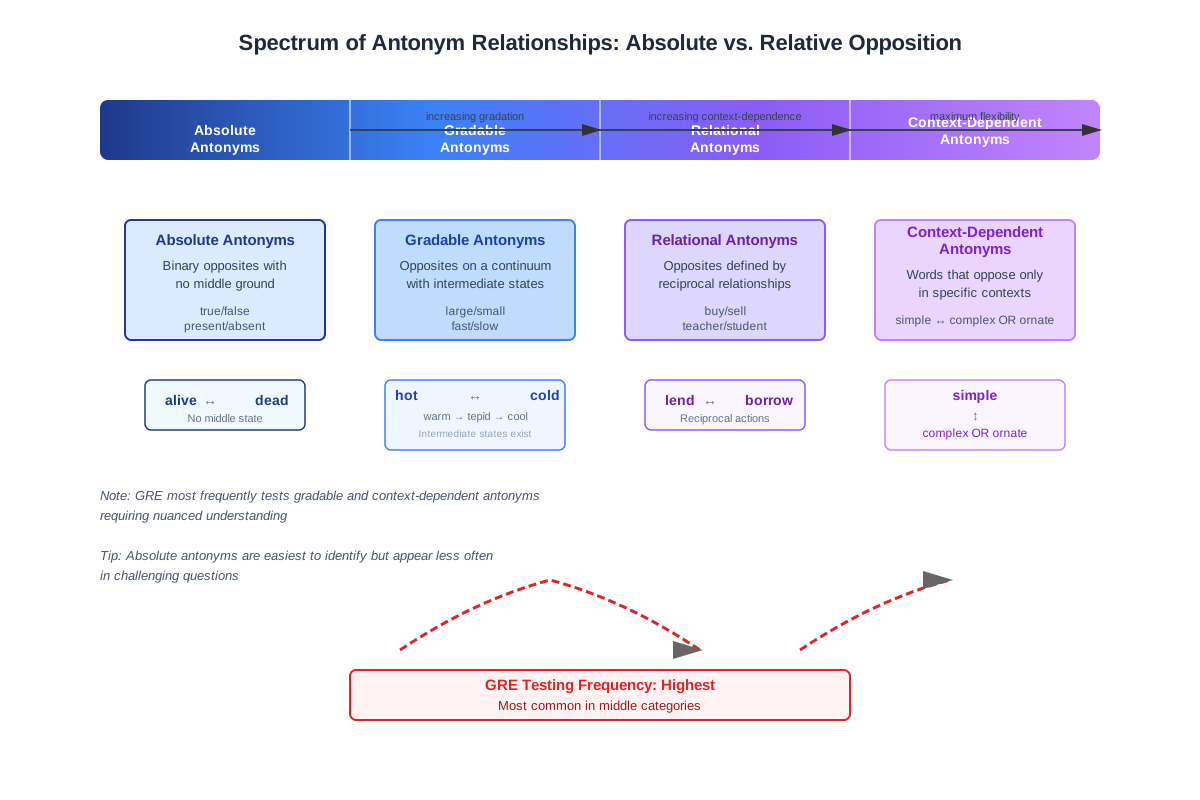
Antonyms are words with opposite or contrasting meanings. However, opposition exists on a spectrum, and the GRE tests understanding of various antonym types. Complementary antonyms represent absolute opposites with no middle ground (alive/dead, present/absent). Gradable antonyms exist on a continuum with intermediate states (hot/cold, with warm and cool between them). Relational antonyms define reciprocal relationships (teacher/student, predator/prey). Understanding these distinctions prevents errors when evaluating answer choices that may be related but not truly opposite.
The GRE particularly favors gradable antonyms because they test vocabulary nuance. Consider "parsimonious" (extremely frugal) versus "prodigal" (wastefully extravagant). These represent opposite extremes of spending behavior, but intermediate terms like "frugal," "moderate," and "generous" exist between them. Test questions may present a moderately opposite word alongside an extremely opposite word, requiring students to select the degree of opposition that matches the context.
Context-Dependent Opposition
Many words have multiple meanings, making antonym relationships context-dependent. The word "sanction" can mean either to approve or to penalize—making its antonym either "prohibit" or "reward" depending on usage. The GRE exploits this ambiguity by presenting sentences where context determines which meaning applies. Students must read carefully to identify the intended meaning before selecting an antonym.
Connotation also affects antonym relationships. While "thin" and "fat" are basic antonyms, "svelte" and "corpulent" carry different connotative weights despite representing similar opposition. The GRE tests whether students recognize that antonyms must match not only in denotative opposition but also in register, formality, and connotative intensity.
Structural Patterns in Antonym Formation
Recognizing prefixes that create antonyms accelerates vocabulary acquisition. Common negating prefixes include:
| Prefix | Meaning | Example Pair |
|---|---|---|
| un- | not | happy/unhappy |
| in-/im-/il-/ir- | not | capable/incapable |
| dis- | opposite of | agree/disagree |
| mis- | wrongly | understand/misunderstand |
| non- | not | sense/nonsense |
| a-/an- | without | typical/atypical |
However, the GRE rarely tests simple prefix-based antonyms. Instead, it presents sophisticated vocabulary where antonym relationships derive from entirely different root words (ebullient/morose, garrulous/laconic). Students should use prefix knowledge as a foundation but must develop broader vocabulary to succeed.
Degree and Intensity Matching
Effective antonym selection requires matching intensity levels. "Dislike" and "love" are not precise antonyms because they differ in intensity; "dislike/like" and "hate/love" represent better pairings. The GRE tests this concept by offering answer choices that oppose the target word but at inappropriate intensity levels.
Consider the word "revere" (to regard with deep respect). Possible opposites include "disrespect," "scorn," "disdain," and "despise." While all represent negative attitudes, "despise" best matches the intensity of "revere" because both represent extreme positions on the respect spectrum. Questions testing this concept require students to evaluate not just direction of opposition but magnitude.
Antonyms in Sentence Completion
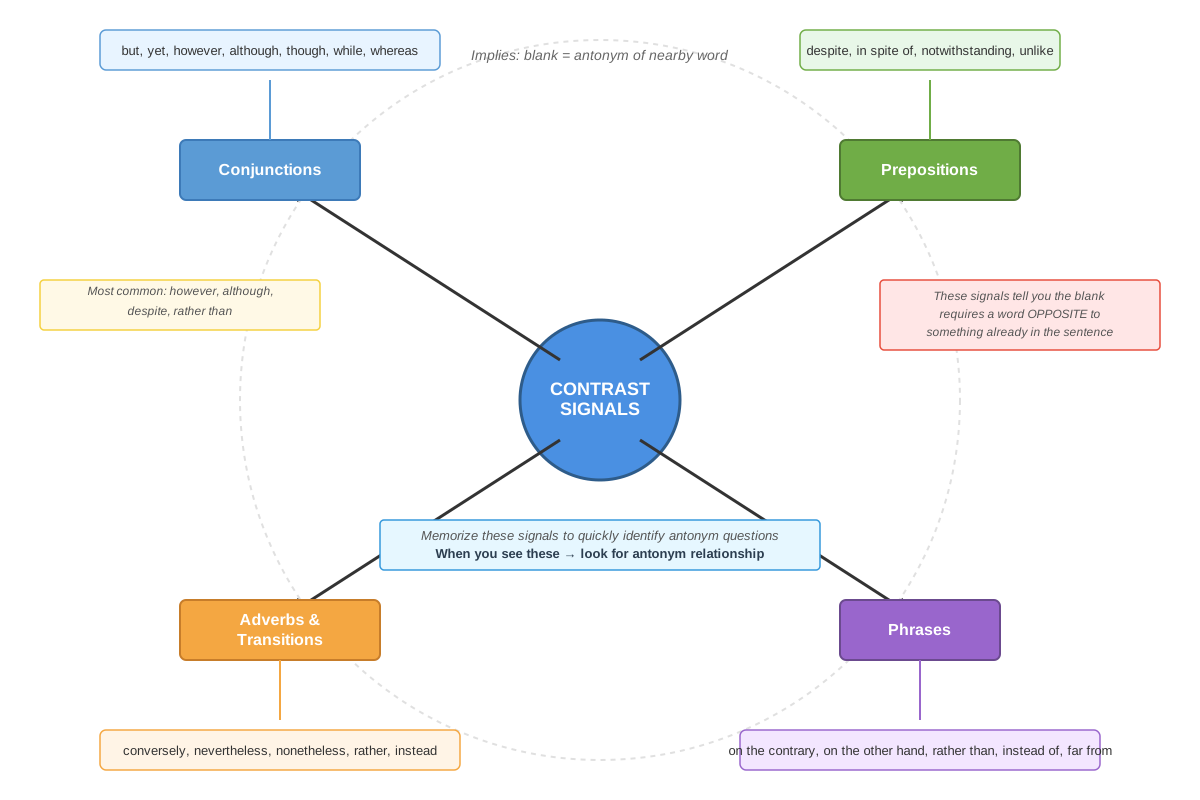
In Text Completion and Sentence Equivalence questions, antonym relationships often appear through contrast signals:
- Adversative conjunctions: but, yet, however, nevertheless, nonetheless
- Concessive phrases: although, though, even though, despite, in spite of
- Contrasting transitions: on the other hand, conversely, in contrast, whereas
- Negation structures: not, rather than, instead of, far from
When these signals appear, the correct answer frequently contrasts with or opposes a word or concept elsewhere in the sentence. For example: "Despite his reputation for _____, the professor proved remarkably approachable." The contrast signal "despite" indicates the blank requires an antonym of "approachable," such as "aloofness" or "austerity."
Building Antonym Networks
Rather than memorizing isolated word pairs, effective GRE preparation involves constructing semantic networks where multiple related antonyms cluster around central concepts. For the concept of "talkativeness," students should know:
- Talkative side: loquacious, garrulous, voluble, verbose, effusive
- Quiet side: taciturn, reticent, laconic, reserved, terse
This network approach enables flexible thinking when encountering unfamiliar words. If a question uses "voluble" and the student doesn't immediately recall its meaning, recognizing it clusters with other "talkative" words provides contextual support.
Concept Relationships
Antonym knowledge connects directly to synonym recognition—understanding what a word means requires knowing both what it is similar to and what it opposes. These two relationships form complementary pathways to vocabulary mastery. When students encounter an unfamiliar word, identifying its antonyms often clarifies its meaning as effectively as finding synonyms.
The relationship flows as follows: Basic vocabulary knowledge → Recognition of semantic fields → Understanding of opposition within fields → Antonym identification → Application in context-dependent questions. Each stage builds upon the previous, with antonym mastery representing an advanced stage of vocabulary development.
Antonym understanding also supports logical reasoning skills tested throughout Verbal Reasoning. Recognizing opposition enables students to identify contrasting viewpoints in Reading Comprehension passages, understand argument structure in critical reasoning, and detect logical relationships in complex sentences. This makes antonym study a high-leverage activity that improves performance across multiple question types.
High-Yield Facts
⭐ Contrast signals (however, despite, although, yet, nevertheless) in Text Completion questions indicate that the correct answer will likely oppose or contrast with another word in the sentence.
⭐ Antonyms must share the same part of speech—the opposite of the adjective "generous" is "stingy," not the noun "miser."
⭐ Gradable antonyms (hot/cold, large/small) are more commonly tested than complementary antonyms (alive/dead) because they allow for nuanced vocabulary testing.
⭐ Intensity matching is critical—the antonym of "adore" is "detest," not merely "dislike," because both represent extreme positions.
⭐ Context determines meaning for words with multiple definitions, making the appropriate antonym context-dependent (sanction can mean approve or penalize).
- Connotation matters—"slender" and "emaciated" both mean thin, but their antonyms differ because "emaciated" carries negative connotation requiring a more positive opposite.
- Relational antonyms (teacher/student, predator/prey) define reciprocal relationships rather than simple opposition.
- Register and formality should match between antonym pairs—"loquacious/taciturn" represents appropriate pairing, while "loquacious/quiet" mismatches formality levels.
- Prefix-based antonyms (happy/unhappy) rarely appear on the GRE, which favors sophisticated vocabulary with distinct root words.
- Semantic fields organize vocabulary into related concepts, with antonyms representing opposite poles within the same field.
- Sentence Equivalence questions often require selecting two words that are synonymous to each other while both contrasting with a concept in the sentence.
- Absolute terms (perfect, unique, infinite) technically lack true antonyms because they represent extremes, though the GRE may test imperfect opposites.
Quick check — test yourself on Antonyms so far.
Try Flashcards →Common Misconceptions
Misconception: Any word with opposite meaning qualifies as an appropriate antonym for GRE questions.
Correction: Effective antonyms must match in part of speech, intensity level, register, and connotation. "Happy" and "sadness" are not functional antonyms because they differ in part of speech; "happy" and "miserable" work better than "happy" and "sad" because they match intensity.
Misconception: Antonym questions disappeared from the GRE, making antonym study unnecessary.
Correction: While standalone antonym questions no longer appear, antonym relationships remain central to Text Completion, Sentence Equivalence, and Reading Comprehension questions. Understanding antonyms is more important than ever because it must be applied in context rather than in isolation.
Misconception: Memorizing antonym lists guarantees success on vocabulary questions.
Correction: The GRE tests contextual application of vocabulary knowledge. Students must understand how antonym relationships function in complex sentences, not just recall isolated word pairs. Context clues and sentence structure often matter more than pure memorization.
Misconception: Words formed by adding negative prefixes (un-, in-, dis-) always create true antonyms.
Correction: Prefix negation creates contradiction but not always true opposition. "Unhappy" means "not happy" but doesn't necessarily mean "sad"—it could indicate neutrality. True antonyms represent positive opposition, not mere negation.
Misconception: If two words are related, one must be the antonym of the other.
Correction: Many word relationships exist beyond synonymy and antonymy. "Doctor" and "patient" are related through a professional relationship, not opposition. "Cause" and "effect" are related sequentially, not antonymously. Students must distinguish opposition from other semantic relationships.
Misconception: The most extreme opposite is always the correct answer.
Correction: The correct antonym must match the intensity of the original word. For "like," the answer is "dislike," not "hate." For "love," the answer is "hate," not "dislike." Matching intensity levels is as important as identifying opposition.
Worked Examples
Example 1: Text Completion with Contrast Signal
Question: "Although the committee's initial response was _____, further investigation revealed significant concerns that could not be ignored."
Answer choices: (A) enthusiastic (B) tepid (C) hostile (D) ambivalent (E) favorable
Solution Process:
- Identify the contrast signal: "Although" indicates the blank will contrast with what follows.
- Determine what follows: "significant concerns that could not be ignored" suggests problems and negativity.
- Identify the required contrast: If later findings were negative, the initial response must have been positive or unconcerned.
- Evaluate intensity: "significant concerns" is moderately strong, so the antonym should be moderately positive, not extremely so.
- Eliminate choices:
- (A) enthusiastic—too positive; doesn't create appropriate contrast
- (B) tepid—means lukewarm; doesn't contrast with concerns
- (C) hostile—same direction as concerns; no contrast
- (D) ambivalent—means uncertain; doesn't create clear contrast
- (E) favorable—creates appropriate contrast with concerns
Answer: (E) favorable
Connection to learning objectives: This example demonstrates identifying when antonyms are tested (through contrast signals), explaining the strategy (finding the contrasting concept), and applying it accurately (selecting the appropriately opposed term).
Example 2: Sentence Equivalence with Antonym Relationship
Question: "Despite her reputation for _____, the author's latest work was surprisingly accessible to general readers."
Answer choices: (A) obscurity (B) clarity (C) prolixity (D) brevity (E) abstruseness (F) popularity
Solution Process:
- Identify the contrast signal: "Despite" and "surprisingly" both indicate contrast.
- Determine the contrasting concept: "accessible to general readers" means easy to understand.
- Identify the required opposition: The blank should mean difficult to understand or not accessible.
- Find two synonyms that both oppose "accessible":
- (A) obscurity—means difficult to understand; opposes accessible ✓
- (B) clarity—means easy to understand; same direction as accessible ✗
- (C) prolixity—means wordiness; related but not directly opposite to accessible
- (D) brevity—means conciseness; doesn't oppose accessible
- (E) abstruseness—means difficult to understand; opposes accessible ✓
- (F) popularity—relates to fame, not comprehensibility
- Verify the pair: Both "obscurity" and "abstruseness" mean difficult to understand and create appropriate contrast with "accessible."
Answer: (A) and (E)
Connection to learning objectives: This example shows how Sentence Equivalence questions require finding two synonyms that both function as antonyms to a concept in the sentence, demonstrating sophisticated application of antonym relationships.
Exam Strategy
Recognition Triggers
When approaching GRE Verbal questions, immediately scan for contrast indicators that signal antonym relationships:
- Adversative conjunctions: but, yet, however, nevertheless, nonetheless, still
- Concessive structures: although, though, even though, while, whereas
- Prepositional contrasts: despite, in spite of, notwithstanding
- Explicit contrast: on the other hand, conversely, in contrast, rather than
- Negation: not, no longer, far from, anything but
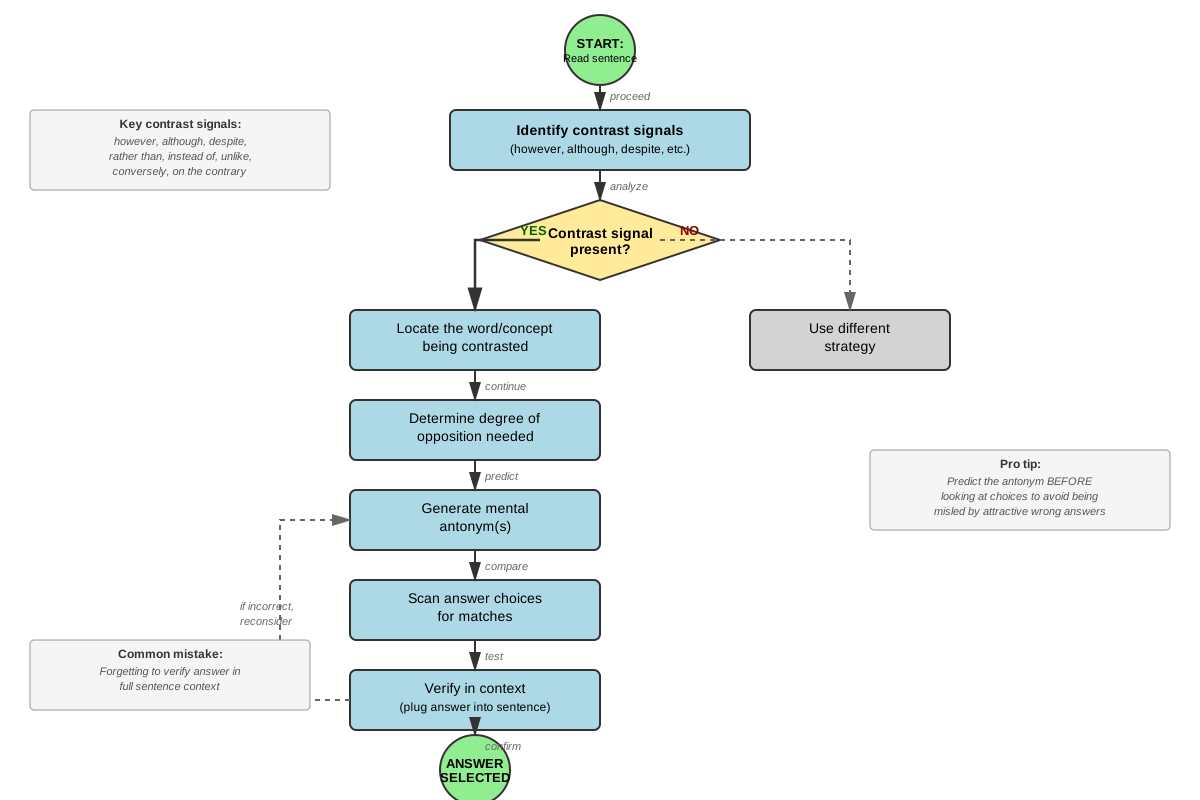
Exam Tip: When you spot a contrast signal, immediately identify what concept is being contrasted. The blank will require a word that opposes or contrasts with that concept.
Process of Elimination Strategy
- Identify the target concept that the blank should oppose or contrast with
- Determine the direction (if the target is positive, the blank should be negative, or vice versa)
- Eliminate same-direction choices that agree with rather than oppose the target
- Eliminate intensity mismatches that oppose the target but at inappropriate strength
- Verify remaining choices by substituting them into the sentence
Time Allocation
For Text Completion and Sentence Equivalence questions involving antonym relationships:
- 15-20 seconds: Read the sentence and identify contrast signals
- 20-30 seconds: Determine what concept requires opposition
- 30-45 seconds: Evaluate answer choices and eliminate
- 10-15 seconds: Verify your selection makes logical sense
Total time per question should not exceed 90 seconds. If you cannot identify the antonym relationship within 45 seconds, mark the question and return to it after completing easier questions.
Common Traps to Avoid
Trap 1: Related but not opposite—The GRE includes answer choices semantically related to the target word but not truly opposite (e.g., offering "teacher" when "student" is needed, when the correct answer might be "ignoramus").
Trap 2: Partial opposition—Some choices oppose one aspect of a word's meaning but not its core sense. For "benevolent" (kindly and generous), "stingy" only opposes the generous aspect, while "malevolent" opposes the entire concept.
Trap 3: Register mismatch—Formal words require formal antonyms. Don't select "mean" as the opposite of "magnanimous"; choose "petty" or "ungenerous" instead.
Memory Techniques
The COIN Mnemonic for Antonym Evaluation
Context: Does the sentence context support opposition?
Opposition: Is the relationship truly opposite, not just different?
Intensity: Do the words match in strength and degree?
Nature: Do they share part of speech, register, and connotation?
Visualization Strategy: The Spectrum Technique
For gradable antonyms, visualize a horizontal spectrum with extreme opposites at each end and related terms in between:
Taciturn ← Reticent ← Reserved | Talkative → Loquacious → Garrulous
(extreme)   (moderate)  (mild)  |  (mild)     (moderate)   (extreme)
This visualization helps match intensity levels and understand where words fall on the opposition spectrum.
Clustering Technique
Group antonym pairs around central concepts:
WEALTH cluster:
- Positive: affluent, prosperous, opulent, wealthy
- Negative: impoverished, destitute, indigent, penurious
SPEECH cluster:
- Talkative: loquacious, garrulous, voluble, verbose
- Quiet: taciturn, reticent, laconic, terse
EMOTION cluster:
- Positive: ebullient, exuberant, jubilant, elated
- Negative: morose, melancholy, despondent, dejected
The "Opposite Day" Technique
When encountering an unfamiliar word in a sentence with a contrast signal, imagine "opposite day" where everything means its reverse. This mental flip helps identify what quality the blank requires even when you don't know specific vocabulary.
Summary
Antonym mastery represents a critical skill for GRE Verbal Reasoning success, appearing throughout Text Completion, Sentence Equivalence, and Reading Comprehension questions. While standalone antonym questions no longer exist, understanding opposition relationships enables students to recognize contrast signals, eliminate incorrect answers, and select contextually appropriate vocabulary. Effective antonym knowledge extends beyond memorizing word pairs to understanding degrees of opposition, matching intensity levels, recognizing context-dependent meanings, and applying antonym relationships within complex sentence structures. Students must distinguish between complementary, gradable, and relational antonyms while ensuring that antonym pairs match in part of speech, register, connotation, and formality. Success requires building semantic networks of related vocabulary, recognizing structural patterns in antonym formation, and developing strategies for identifying when antonym relationships are being tested through contrast signals and adversative structures.
Key Takeaways
- Contrast signals (however, despite, although) are the primary indicators that antonym relationships are being tested in sentence-level questions
- Intensity matching is as important as directional opposition—antonyms must oppose at equivalent strength levels
- Context determines meaning for polysemous words, making the appropriate antonym context-dependent
- Semantic networks of related antonyms are more valuable than isolated word pairs for flexible application
- Part of speech, register, and connotation must align between antonym pairs for them to function effectively in GRE questions
- Process of elimination using antonym knowledge accelerates question solving and improves accuracy
- Antonym understanding supports performance across all Verbal Reasoning question types, not just vocabulary questions
Related Topics
Synonyms and Word Relationships: Understanding synonymy complements antonym knowledge, as both represent fundamental semantic relationships. Mastering antonyms enables more sophisticated synonym recognition by clarifying what words are not.
Context Clues and Vocabulary in Context: Antonym relationships often provide context clues for determining unknown word meanings. This topic builds directly on antonym mastery by applying it to reading comprehension.
Text Completion Strategies: Advanced text completion techniques leverage antonym knowledge to decode complex sentences with multiple blanks and layered contrast structures.
Sentence Equivalence Advanced Techniques: This topic extends antonym application by requiring students to find synonym pairs that both oppose concepts in the sentence, representing the highest level of antonym skill integration.
Reading Comprehension: Argument Structure: Understanding how authors present contrasting viewpoints and opposing theories requires recognizing antonymous concepts at the paragraph and passage level.
Practice CTA
Now that you understand the fundamental principles of antonym relationships and their application to GRE questions, it's time to reinforce this knowledge through active practice. Attempt the practice questions associated with this topic, focusing on identifying contrast signals, matching intensity levels, and applying the COIN evaluation framework. Use the flashcards to build your semantic networks of related antonym clusters, and challenge yourself to explain why incorrect answer choices fail the antonym test. Remember that antonym mastery develops through repeated application in varied contexts—each practice question strengthens your ability to recognize and apply these relationships under timed conditions. Your investment in mastering this high-yield topic will pay dividends across all Verbal Reasoning question types!
Sign up free to keep reading
Create a free AnvayaPrep account to finish this GRE guide on Antonyms — plus flashcards and practice questions.