Overview
Developing reasons is a fundamental skill tested in the GRE Analytical Writing section, particularly within the "Analyze an Issue" task. This competency involves constructing logical, persuasive arguments by generating well-supported reasons that defend or challenge a given position. When test-takers encounter an issue prompt, they must not only state their stance but also provide multiple, distinct reasons that justify their viewpoint. Each reason should be substantive, logically sound, and supported by relevant examples, evidence, or explanations that demonstrate critical thinking.
The ability to develop strong reasons separates mediocre essays from high-scoring ones. GRE graders specifically evaluate whether test-takers can articulate clear reasons that directly address the prompt, maintain logical coherence throughout the essay, and provide sufficient depth in their argumentation. GRE developing reasons requires more than simply listing points—it demands that each reason be fully elaborated with specific details, real-world applications, hypothetical scenarios, or logical extensions that demonstrate sophisticated analytical thinking.
Within the broader context of Analytical Writing, developing reasons serves as the structural backbone of persuasive argumentation. While thesis statements establish the writer's position and introductions frame the discussion, the body paragraphs built around well-developed reasons constitute the essay's substantive content. This skill connects directly to other essential competencies such as providing relevant examples, maintaining logical flow, addressing counterarguments, and drawing meaningful conclusions. Mastering the art of developing reasons enables test-takers to construct essays that demonstrate the complex reasoning and analytical depth that GRE graders seek.
Learning Objectives
- [ ] Identify when Developing reasons is being tested in GRE Analytical Writing prompts
- [ ] Explain the core rule or strategy behind Developing reasons in essay construction
- [ ] Apply Developing reasons to GRE-style questions accurately and effectively
- [ ] Generate at least three distinct, non-overlapping reasons for any given issue position
- [ ] Elaborate each reason with specific examples, evidence, or logical extensions
- [ ] Distinguish between strong, exam-worthy reasons and weak, superficial arguments
- [ ] Organize reasons in a logical sequence that builds persuasive momentum
Prerequisites
- Basic essay structure: Understanding of introduction, body paragraphs, and conclusion is essential because developing reasons occurs primarily within the body paragraph framework
- Thesis statement construction: Ability to articulate a clear position is necessary because reasons must directly support the stated thesis
- Paragraph organization: Knowledge of topic sentences and supporting details is required because each reason typically anchors its own paragraph
- Critical thinking fundamentals: Capacity to analyze claims and evaluate evidence is foundational because developing reasons demands logical analysis
Why This Topic Matters
In professional and academic contexts, the ability to develop compelling reasons underpins persuasive writing, policy analysis, grant proposals, research justifications, and strategic recommendations. Employers value professionals who can articulate multiple perspectives on complex issues and support their recommendations with well-reasoned arguments. This skill translates directly to business cases, legal briefs, academic papers, and leadership communications.
On the GRE specifically, developing reasons appears in 100% of Analyze an Issue tasks, making it one of the most consistently tested skills in the Analytical Writing section. The scoring rubric explicitly evaluates whether essays "develop and support main ideas with relevant reasons and/or examples." Essays that score in the 5-6 range (out of 6) consistently demonstrate "insightful reasons" and "compelling examples," while essays scoring 3-4 typically show "limited development" or "inadequate reasons." The difference between a score of 4.0 and 5.5 often hinges on the quality and depth of reason development.
Common manifestations in exam passages include prompts that ask test-takers to discuss the extent to which they agree or disagree with a statement, evaluate a recommendation, or consider the implications of a policy. Regardless of the specific prompt format, all require the systematic development of multiple reasons that justify the writer's position. Graders specifically look for essays that present 2-4 well-developed reasons rather than 5-6 superficially addressed points.
Core Concepts
What Constitutes a Well-Developed Reason
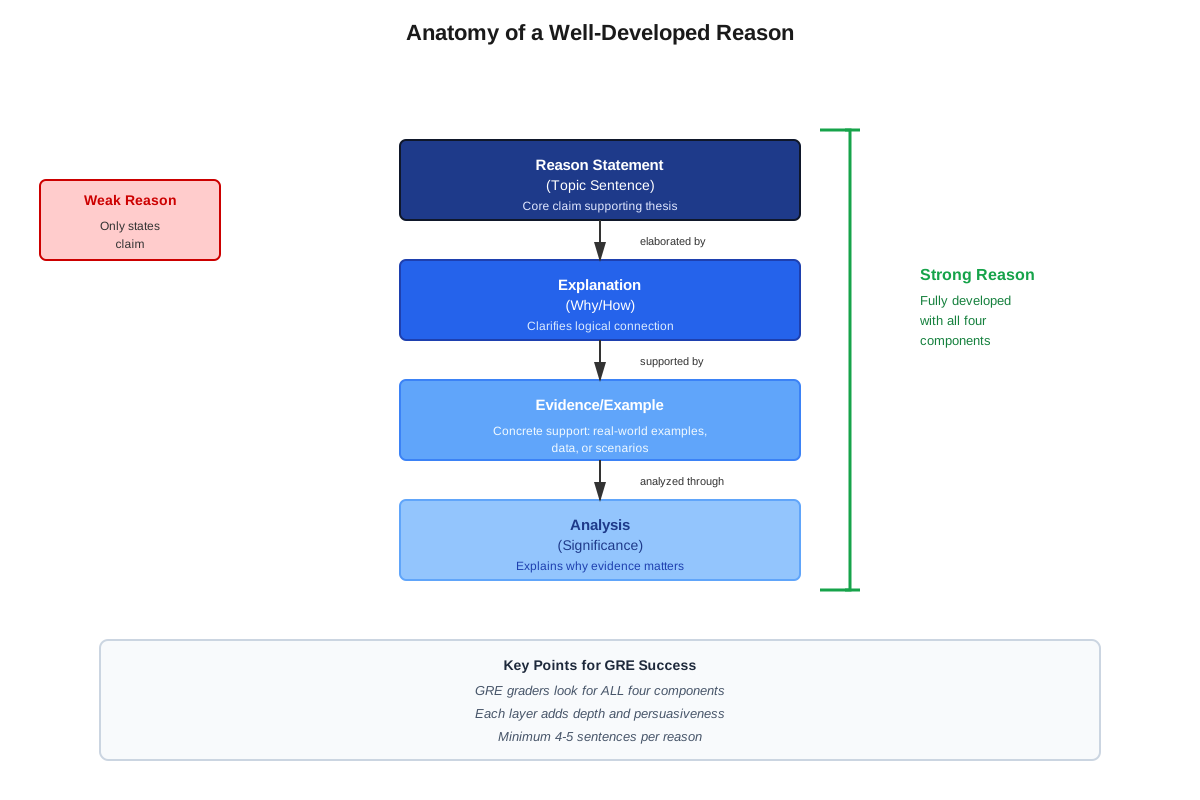
A developing reasons approach in GRE Analytical Writing involves creating substantive arguments that explain why a particular position is valid or preferable. A well-developed reason consists of three essential components: a clear claim that supports the thesis, logical explanation of how this claim relates to the broader argument, and specific evidence or examples that illustrate the point. Unlike simple assertions, developed reasons demonstrate causal relationships, explore implications, and anticipate potential objections.
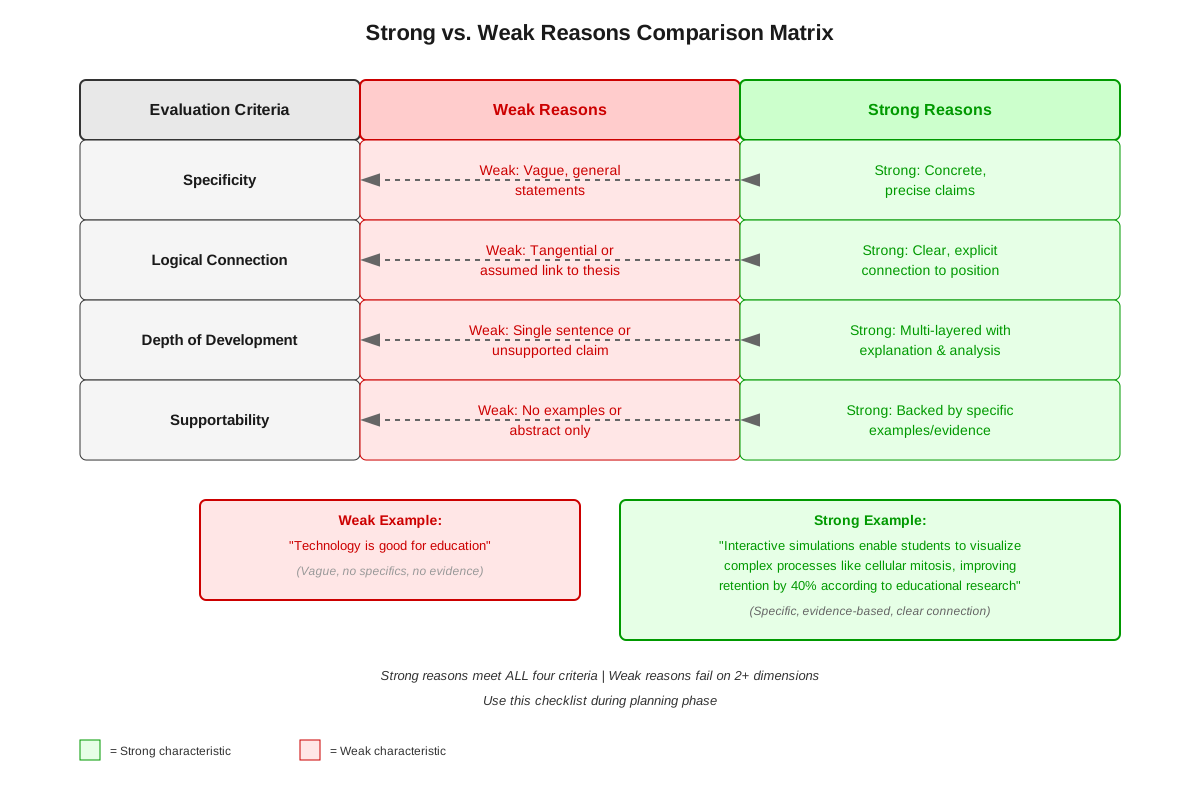
The distinction between an underdeveloped and well-developed reason is crucial for exam success:
| Underdeveloped Reason | Well-Developed Reason |
|---|---|
| "Technology improves education." | "Technology improves education by providing personalized learning experiences that adapt to individual student needs. For instance, adaptive learning platforms like Khan Academy adjust difficulty levels based on student performance, ensuring that learners neither feel overwhelmed nor under-challenged. This individualization was impossible in traditional classroom settings where one teacher managed 30+ students simultaneously." |
| "Experience matters more than education." | "Professional experience often provides practical skills that formal education cannot replicate. While a business degree teaches theoretical frameworks, managing a retail store during peak holiday season teaches crisis management, personnel conflict resolution, and real-time decision-making under pressure—competencies that emerge only through direct application rather than classroom discussion." |
The Three-Layer Development Model
Effective reason development follows a three-layer structure that ensures sufficient depth and persuasiveness:
- Claim Layer: State the reason clearly and directly, ensuring it explicitly supports your thesis
- Explanation Layer: Elaborate on why this reason is valid, exploring the logical connections and causal mechanisms
- Evidence Layer: Provide concrete examples, data, scenarios, or illustrations that demonstrate the reason in action
This layered approach prevents the common pitfall of listing multiple shallow reasons without adequate support. A single reason developed through all three layers is more persuasive and demonstrates stronger analytical thinking than three reasons that only reach the claim layer.
Types of Reasons That Strengthen Arguments
Different categories of reasons serve distinct persuasive functions. Understanding these types helps test-takers generate diverse arguments:
Consequentialist reasons focus on outcomes and results. These arguments emphasize what will happen if a position is adopted or rejected. Example: "Implementing flexible work schedules increases employee productivity because workers can align their tasks with their peak energy periods."
Principled reasons appeal to values, ethics, or fundamental beliefs. These arguments ground positions in moral or philosophical frameworks. Example: "Mandatory voting undermines democratic freedom because genuine democracy requires the right to abstain as much as the right to participate."
Pragmatic reasons emphasize feasibility, efficiency, or practical considerations. These arguments address implementation realities. Example: "Universal basic income faces insurmountable funding challenges, as even a modest $1,000 monthly payment to all adults would require tax increases that would eliminate the net benefit for most recipients."
Comparative reasons demonstrate why one option is superior to alternatives. These arguments explicitly weigh competing approaches. Example: "Investing in public transportation infrastructure yields greater economic returns than highway expansion because transit systems serve higher population densities and generate commercial development around stations."
Depth Versus Breadth in Reason Development
A critical strategic decision in GRE essays involves choosing between developing fewer reasons deeply or addressing more reasons superficially. Research on high-scoring essays reveals a clear pattern: depth consistently outperforms breadth. Essays that thoroughly develop 2-3 reasons with rich examples and nuanced analysis score higher than essays that mention 4-5 reasons with minimal elaboration.
This principle reflects the scoring rubric's emphasis on "insightful" and "compelling" development. Graders can assess analytical sophistication only when writers provide sufficient detail to demonstrate complex thinking. A paragraph that explores multiple dimensions of a single reason—considering contexts where it applies strongly, acknowledging limitations, and providing varied examples—showcases critical thinking far more effectively than a paragraph that merely states three separate points.
Connecting Reasons to the Prompt
Every reason must demonstrably address the specific prompt rather than discussing the general topic. This precision requires careful attention to the prompt's exact wording and scope. For instance, if a prompt asks whether "governments should prioritize environmental protection over economic growth," a reason about "the importance of clean air" is too general, while "environmental regulations that prevent industrial pollution create long-term economic benefits by reducing healthcare costs and preserving natural resources for sustainable industries" directly addresses the government prioritization question.
Effective test-takers repeatedly reference prompt language within their reason development, using phrases like "This demonstrates why [prompt concept]..." or "This example illustrates the extent to which [prompt claim]..." These explicit connections ensure graders recognize the relevance of each reason.
Anticipating and Addressing Counterarguments
Sophisticated reason development acknowledges potential objections and explains why the primary argument remains stronger despite these concerns. This technique, called concession and refutation, demonstrates nuanced thinking that elevates essay scores. Rather than ignoring opposing viewpoints, high-scoring essays briefly acknowledge them within reason development before explaining why they don't undermine the main argument.
For example: "While critics argue that standardized testing provides objective measures of student achievement, this apparent objectivity masks significant cultural biases in question construction and assumes that all students have equal test preparation access—assumptions that undermine the tests' validity as fair assessment tools."
Concept Relationships
The skill of developing reasons sits at the intersection of multiple Analytical Writing competencies. Thesis construction → provides the position → that reasons must support. Each reason functions as a mini-argument that reinforces the overarching thesis, creating a hierarchical relationship where the thesis makes a broad claim and reasons provide the specific justifications.
Developing reasons → requires → providing examples and evidence. Reasons establish the logical framework, while examples supply the concrete illustrations that make abstract arguments tangible and persuasive. This relationship is symbiotic: reasons without examples remain theoretical and unconvincing, while examples without clear reasons appear disconnected and fail to build coherent arguments.
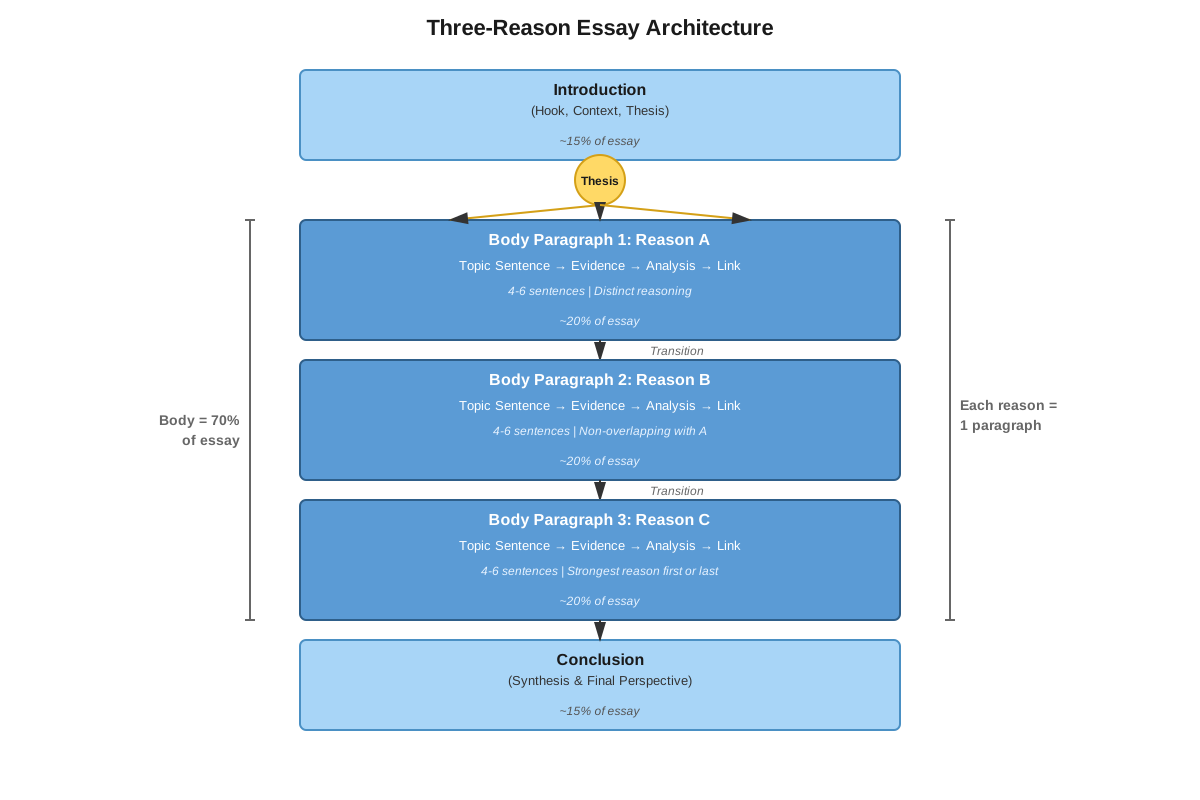
Paragraph organization → structures → reason presentation. Typically, each major reason occupies its own body paragraph, with the topic sentence stating the reason and subsequent sentences providing explanation and evidence. This structural relationship ensures clarity and prevents the essay from becoming a disorganized collection of points.
Logical transitions → connect → multiple reasons into a cohesive argument. Words and phrases like "furthermore," "additionally," "more importantly," and "beyond this consideration" signal to readers that the essay is building a cumulative case through multiple supporting reasons.
Counterargument acknowledgment → strengthens → primary reasons by demonstrating comprehensive analysis. When writers address potential objections within their reason development, they show awareness of complexity and strengthen their arguments by preemptively defending against criticism.
Quick check — test yourself on Developing reasons so far.
Try Flashcards →High-Yield Facts
⭐ The GRE Analytical Writing rubric explicitly evaluates "development and support of ideas with relevant reasons and examples"—this appears in every score level description
⭐ Essays scoring 5-6 typically develop 2-3 reasons thoroughly rather than mentioning 4-5 reasons superficially
⭐ Each reason should occupy approximately 80-120 words (4-6 sentences) to demonstrate adequate development
⭐ Reasons must directly address the specific prompt wording, not just the general topic area
⭐ The most effective reasons combine logical explanation with concrete, specific examples
- Reasons should be distinct and non-overlapping; redundant reasons suggest limited analytical range
- Effective reason development includes explanation of causal mechanisms, not just assertion of relationships
- High-scoring essays often acknowledge counterarguments within reason development to demonstrate nuanced thinking
- Reasons organized from strongest to weakest or in logical progression create more persuasive essays than randomly ordered points
- Generic reasons that could apply to multiple prompts are less effective than reasons tailored to the specific issue presented
Common Misconceptions
Misconception: More reasons always create stronger essays → Correction: Quality of development matters far more than quantity of reasons. An essay with two thoroughly developed reasons will outscore an essay with five superficially mentioned points. GRE graders specifically look for depth of analysis, which requires sufficient space and attention for each reason.
Misconception: Reasons and examples are the same thing → Correction: Reasons are logical arguments that explain why a position is valid, while examples are specific illustrations that demonstrate reasons in action. A reason might be "Remote work increases productivity," while an example would be "A Stanford study found that call center employees working from home completed 13% more calls than office-based counterparts." The reason provides the claim; the example provides the evidence.
Misconception: Every reason must be absolutely true and universally applicable → Correction: Reasons should be plausible and well-supported, but acknowledging limitations or contexts where they apply more strongly demonstrates sophisticated thinking. Phrases like "in many cases," "particularly when," or "especially for" show nuanced understanding rather than oversimplified thinking.
Misconception: Developing reasons means making paragraphs longer by adding more sentences → Correction: Development means adding substantive content—explanation of mechanisms, specific examples, exploration of implications, or consideration of contexts. Simply adding more sentences with redundant information or vague generalizations doesn't constitute genuine development.
Misconception: Reasons should avoid acknowledging any opposing viewpoints → Correction: Sophisticated reason development often includes brief acknowledgment of potential counterarguments followed by explanation of why the primary argument remains stronger. This technique, called concession and refutation, demonstrates comprehensive analysis and strengthens rather than weakens the overall argument.
Misconception: All reasons should be equally developed within an essay → Correction: While all reasons should meet a minimum threshold of development, strategic writers often develop their strongest or most complex reason more thoroughly than others. This creates a hierarchy that emphasizes the most compelling aspects of the argument.
Worked Examples
Example 1: Developing a Reason for an Education Policy Prompt
Prompt: "Universities should require all students to take courses outside their major field of study."
Underdeveloped Approach:
"Students should take courses outside their major because it makes them well-rounded. Being well-rounded is important for getting jobs. Therefore, universities should require diverse coursework."
Well-Developed Approach:
"Requiring interdisciplinary coursework prepares students for the increasingly complex problems they will face in professional contexts, which rarely respect academic boundaries. Consider the challenge of developing sustainable urban transportation systems—a problem that simultaneously involves engineering (vehicle and infrastructure design), economics (cost-benefit analysis and funding models), sociology (understanding commuter behavior and equity concerns), and environmental science (emissions impact and resource consumption). A civil engineer who has studied only technical subjects might design an efficient transit system that fails because it ignores how people actually make transportation choices or inadvertently disadvantages low-income communities. By requiring students to engage with diverse disciplines, universities ensure graduates can recognize when problems extend beyond their primary expertise and collaborate effectively with professionals from other fields. This interdisciplinary competence has become essential as organizations increasingly form cross-functional teams to address multifaceted challenges."
Analysis: The well-developed version includes all three layers: (1) Claim—interdisciplinary coursework prepares students for complex problems; (2) Explanation—professional problems don't respect academic boundaries and require multiple perspectives; (3) Evidence—specific example of urban transportation planning that illustrates how multiple disciplines must integrate. The development also explores implications (collaboration skills, recognizing expertise limits) that demonstrate sophisticated thinking.
Example 2: Developing a Reason for a Technology and Society Prompt
Prompt: "The widespread use of social media has had a predominantly negative impact on society."
Underdeveloped Approach:
"Social media causes mental health problems. Studies show that people who use social media more are more depressed. This proves social media is bad for society."
Well-Developed Approach:
"Social media platforms fundamentally alter social comparison processes in ways that undermine psychological well-being, particularly among adolescents and young adults. Traditional social comparison occurred within limited contexts—comparing oneself to classmates, neighbors, or colleagues—and included exposure to both positive and negative aspects of others' lives. Social media, however, creates constant exposure to carefully curated highlight reels from hundreds or thousands of connections, establishing unrealistic benchmarks for success, appearance, and lifestyle. A teenager scrolling through Instagram encounters an endless stream of peers' vacation photos, achievement announcements, and filtered selfies, creating the illusion that everyone else leads a more exciting, attractive, and successful life. Research by psychologist Jean Twenge demonstrates that rates of depression and anxiety among teenagers increased sharply after 2012—precisely when smartphone ownership and social media use became ubiquitous—with the strongest correlations appearing among heavy users. This psychological impact extends beyond individual well-being to affect societal mental health infrastructure, as counseling services and healthcare systems struggle to address the surge in anxiety and depression cases."
Analysis: This developed reason moves beyond simple assertion to explain the mechanism (altered social comparison processes), provides specific context (curated highlight reels versus complete life pictures), offers a concrete example (teenager on Instagram), cites relevant research (Twenge's findings with specific timing), and explores broader implications (impact on healthcare systems). The development demonstrates analytical depth by explaining how and why the negative impact occurs rather than simply asserting that it exists.
Exam Strategy
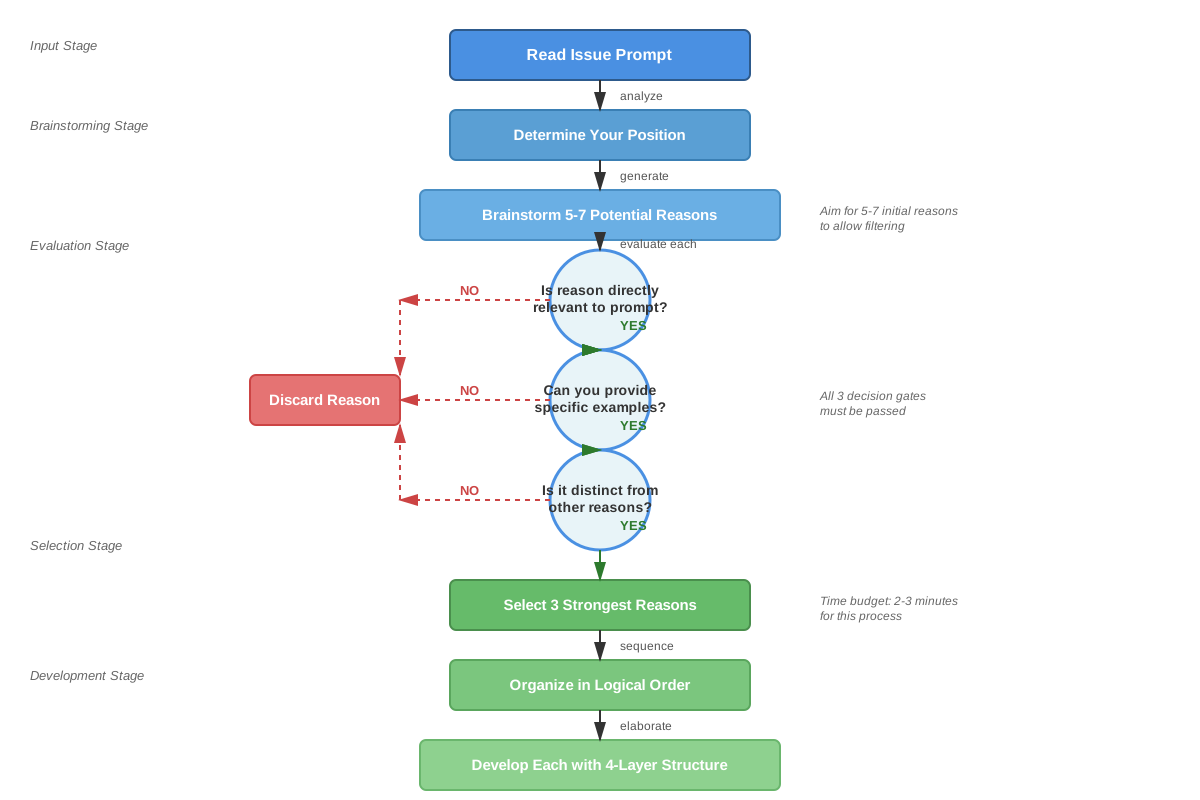
When approaching GRE Analyze an Issue tasks, allocate approximately 3-4 minutes to brainstorming reasons before beginning to write. This planning phase prevents the common mistake of starting with one reason and discovering mid-essay that additional strong reasons don't come to mind. During brainstorming, generate 4-5 potential reasons, then select the 2-3 strongest for development.
Trigger phrases that signal the need for reason development include: "To what extent do you agree or disagree," "Discuss the extent to which," "Evaluate this recommendation," and "Consider the implications." These phrases explicitly request that test-takers provide justified positions, which requires well-developed reasons.
Apply the "So what?" test to each reason during planning. After stating a potential reason, ask "So what? Why does this matter?" If you can't immediately articulate why the reason is significant and how it supports your thesis, it likely needs more development or should be replaced with a stronger alternative.
Use paragraph budgeting to ensure adequate development. In a 30-minute essay, allocate approximately 6-8 minutes per body paragraph. If you plan to develop three reasons, you have roughly 20 minutes for body paragraphs, meaning 6-7 minutes each. This time constraint naturally limits you to 2-3 well-developed reasons rather than attempting to address more.
Employ transitional scaffolding to signal reason development. Begin each body paragraph with a clear topic sentence that states the reason: "First, [policy/position] [verb] because [reason]." Follow with explanation sentences that begin with phrases like "This occurs because," "The mechanism involves," or "Specifically, this means." Then introduce examples with "For instance," "Consider the case of," or "This principle appears in."
When time runs short, prioritize depth over breadth. If you realize you have time for only two well-developed reasons instead of the three you planned, fully develop two rather than rushing through all three superficially. Graders reward thorough development of fewer points over cursory treatment of many.
Memory Techniques
Use the acronym CEED to remember the components of well-developed reasons:
- Claim: State the reason clearly
- Explanation: Elaborate on why it's valid
- Evidence: Provide specific examples
- Depth: Explore implications and contexts
Visualize reasons as trees rather than seeds. A seed (underdeveloped reason) is just a small point. A tree (well-developed reason) has roots (logical foundation), a trunk (main explanation), branches (different aspects or contexts), and leaves (specific examples). This metaphor reminds test-takers that development means growing ideas in multiple dimensions.
Remember the "Rule of 100": Each major reason should occupy approximately 100 words. This guideline helps prevent both underdevelopment (30-40 words) and excessive elaboration that leaves no time for additional reasons (200+ words).
Use the "Because-Therefore-For Example" chain as a development template:
- "Universities should require diverse coursework because [reason]"
- "Therefore, students will [implication/outcome]"
- "For example, [specific illustration]"
This chain ensures you move from claim through explanation to evidence.
Summary
Developing reasons constitutes the core analytical skill tested in GRE Analytical Writing's Analyze an Issue task. This competency requires test-takers to generate multiple distinct arguments that support their thesis, then elaborate each reason through logical explanation and specific evidence. Well-developed reasons demonstrate depth rather than breadth, with high-scoring essays typically presenting 2-3 thoroughly developed arguments rather than 4-5 superficially mentioned points. Each reason should include three layers: a clear claim that supports the thesis, explanation of why this claim is valid and how it relates to the broader argument, and concrete examples or evidence that illustrate the point. Effective reason development addresses the specific prompt language rather than just the general topic, explores causal mechanisms and implications, and often acknowledges potential counterarguments to demonstrate nuanced thinking. The ability to develop compelling reasons separates essays scoring in the 5-6 range from those scoring 3-4, as graders specifically evaluate whether ideas are supported with "insightful reasons" and "compelling examples" versus "limited development."
Key Takeaways
- Depth consistently outperforms breadth: Two thoroughly developed reasons score higher than four superficially mentioned points
- Each reason requires three layers: claim, explanation, and evidence—all three must be present for adequate development
- Reasons must directly address the specific prompt wording, not just discuss the general topic area
- Well-developed reasons occupy 80-120 words (approximately one substantial paragraph) and take 6-8 minutes to write
- The GRE rubric explicitly evaluates reason development at every score level, making this skill essential for achieving competitive scores
- Effective reasons explain mechanisms and explore implications rather than simply asserting relationships
- Acknowledging counterarguments within reason development demonstrates sophisticated analysis and strengthens rather than weakens arguments
Related Topics
Providing Relevant Examples: This skill complements developing reasons by supplying the concrete illustrations that make abstract arguments persuasive. Mastering reason development creates the framework that examples fill with specific content.
Organizing Essay Structure: Understanding how to arrange multiple reasons within a coherent essay structure ensures that well-developed reasons contribute to an overall persuasive argument rather than appearing as disconnected points.
Addressing Counterarguments: This advanced skill builds on reason development by incorporating opposing viewpoints into the argument structure, demonstrating comprehensive analysis.
Analyzing Argument Tasks: While Analyze an Issue requires developing reasons to support your position, Analyze an Argument requires identifying flaws in someone else's reasoning—a complementary analytical skill that reinforces understanding of what constitutes strong versus weak reasoning.
Practice CTA
Now that you understand the principles and strategies behind developing reasons, apply this knowledge through focused practice. Attempt the practice questions designed specifically for this topic, paying particular attention to creating the three-layer structure (claim, explanation, evidence) for each reason you develop. Use the flashcards to reinforce key concepts and test your ability to distinguish well-developed from underdeveloped reasons. Remember that developing reasons is a skill that improves with deliberate practice—each essay you write provides an opportunity to strengthen your ability to construct compelling, well-supported arguments. Your investment in mastering this high-yield skill will directly translate to improved Analytical Writing scores and stronger persuasive writing abilities that extend far beyond the GRE.
Sign up free to keep reading
Create a free AnvayaPrep account to finish this GRE guide on Developing reasons — plus flashcards and practice questions.