Overview
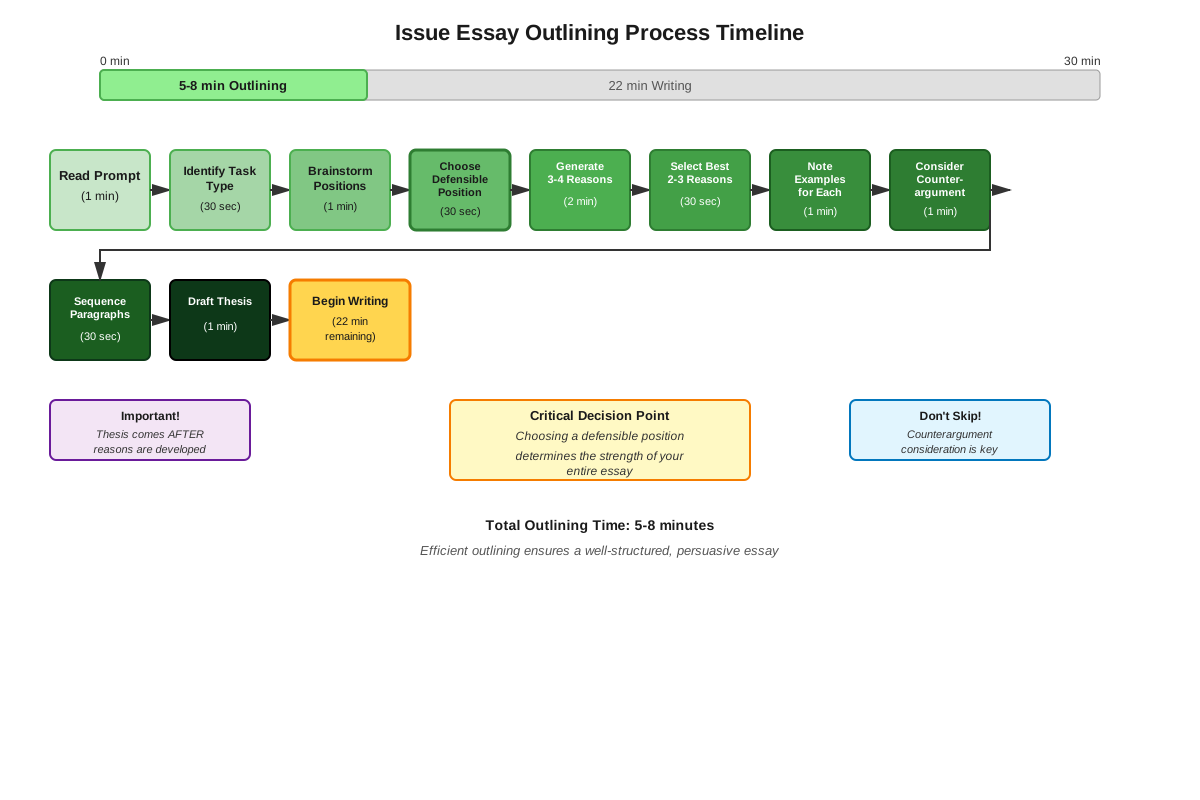
The issue essay outline is the structural blueprint that transforms a GRE test-taker's ideas into a coherent, persuasive analytical essay. Within the Analyze an Issue task, students receive a claim or recommendation about a topic of general interest and must develop a position on the issue, supporting their stance with reasons and examples. The outline serves as the critical planning phase that occurs before writing begins, typically consuming 5-8 minutes of the 30-minute time allocation. This preparatory work determines whether an essay will achieve a score of 3 or a score of 6.
Mastering the GRE issue essay outline is essential because it directly impacts every scoring dimension the GRE evaluators use: the clarity of the position, the quality of reasoning, the organization of ideas, and the effectiveness of support. Without a solid outline, even students with strong writing skills produce essays that meander, contradict themselves, or fail to address the prompt's specific instructions. The outline functions as both a roadmap during the writing process and a quality-control mechanism that ensures all necessary components appear in the final essay.
The issue essay outline connects to broader Analytical Writing concepts by serving as the practical application of critical thinking, argument analysis, and persuasive writing principles. While the Argument essay requires students to critique someone else's reasoning, the Issue essay demands that students construct their own logical framework—making the outline even more crucial. The outline bridges the gap between understanding what makes a strong argument and actually producing one under timed conditions.
Learning Objectives
- [ ] Identify when Issue essay outline is being tested
- [ ] Explain the core rule or strategy behind Issue essay outline
- [ ] Apply Issue essay outline to GRE-style questions accurately
- [ ] Construct a complete five-paragraph outline within 5-8 minutes
- [ ] Evaluate whether an outline adequately addresses the specific task instructions
- [ ] Adapt outline structure based on different issue prompt types and complexity levels
Prerequisites
- Basic essay structure knowledge: Understanding of introduction, body paragraphs, and conclusion enables students to organize their outline logically
- Thesis statement construction: The ability to articulate a clear position forms the foundation of the entire outline
- Paragraph development principles: Knowing how to support a claim with evidence ensures each outline section has substance
- Time management fundamentals: Awareness of how to allocate 30 minutes across planning, writing, and revision makes the outline phase purposeful rather than rushed
Why This Topic Matters
The issue essay outline represents one of the highest-yield investments of study time for the Analytical Writing section. Research on GRE scoring patterns reveals that essays with clear organizational structure consistently score 1-2 points higher than essays with equivalent ideas but poor organization. The outline is the tool that creates this structure.
On the GRE, the Analyze an Issue task appears as the first or second essay (order varies by test administration), and every test-taker receives exactly one issue prompt. The prompt presents a claim about topics ranging from education and technology to government and society, followed by specific instructions that dictate how to approach the issue. These instructions might ask students to discuss the extent of agreement, consider circumstances under which the recommendation might be adopted, or explore implications and consequences. The outline must respond to these specific instructions—not just the general claim.
In practical terms, the outline phase determines whether a student can complete a full essay within 30 minutes. Students who skip outlining or spend only 1-2 minutes on it frequently run out of time, produce incomplete essays, or realize mid-writing that their argument doesn't work. Conversely, students who invest 5-8 minutes in a detailed outline write faster, more confidently, and produce more coherent essays. The outline also serves as a safeguard against writer's block; when students know exactly what comes next, they maintain momentum throughout the writing process.
Core Concepts
The Five-Component Outline Structure
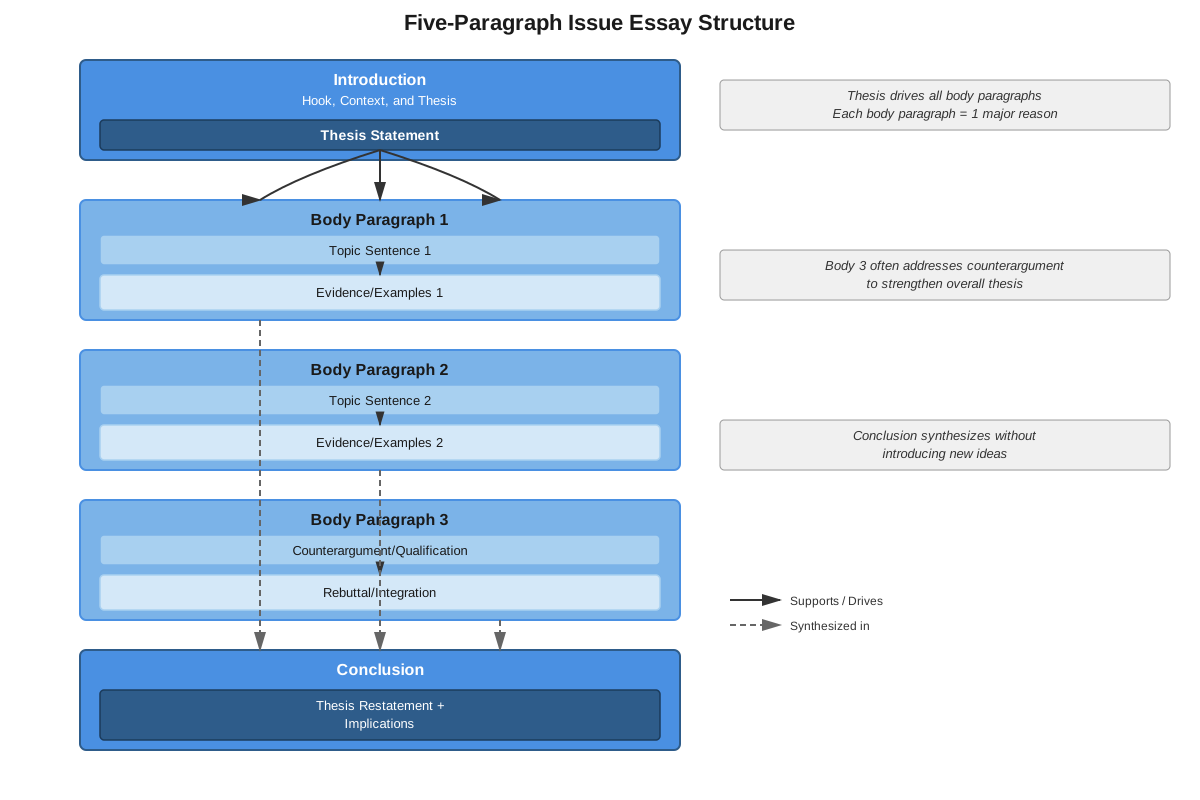
The standard issue essay outline consists of five major components that map to the five paragraphs of a well-developed GRE essay. This structure provides sufficient depth to earn top scores while remaining achievable within time constraints.
Component 1: Introduction with Thesis
The outline's first element captures the essay's opening strategy. This includes:
- A brief context statement or hook (1 sentence)
- The thesis statement that clearly articulates the position
- A preview of the main supporting points (optional but helpful)
Component 2-4: Three Body Paragraphs
Each body paragraph in the outline should contain:
- A topic sentence that states one main reason supporting the thesis
- 2-3 supporting points, examples, or pieces of evidence
- A brief note about how this paragraph connects to the thesis
Component 5: Conclusion
The conclusion outline includes:
- Restatement of thesis in fresh language
- Synthesis of main points
- Final thought or broader implication (optional)
Thesis Development Within the Outline
The thesis represents the most critical element of the GRE issue essay outline. A strong thesis must accomplish three objectives: take a clear position, acknowledge complexity, and preview the essay's direction.
Position Clarity: The thesis cannot be neutral or fence-sitting. Even when the prompt asks about "the extent to which you agree," the thesis must stake out a definable position (strongly agree, mostly agree with reservations, agree only in limited circumstances, etc.).
Complexity Acknowledgment: Top-scoring essays recognize that most issues have multiple dimensions. The outline should reflect this through a thesis that includes qualifiers, conditions, or acknowledgment of counterarguments. For example: "While technology has revolutionized education in many positive ways, its benefits are most pronounced in well-resourced schools, and over-reliance on digital tools can undermine critical thinking skills."
Directional Preview: The thesis should implicitly or explicitly signal what the body paragraphs will discuss, creating a logical flow from outline to essay.
Addressing Specific Task Instructions
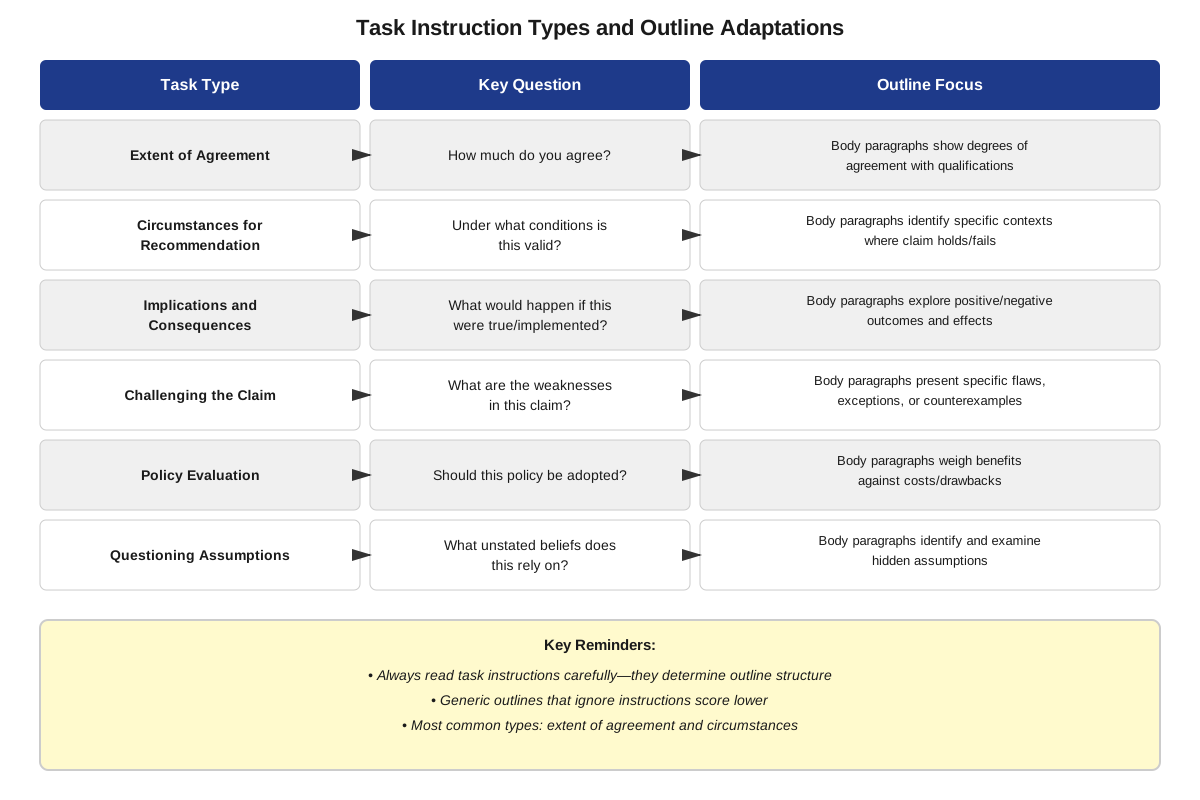
GRE issue prompts include specific instructions that fundamentally shape the outline structure. The six most common instruction types are:
| Instruction Type | Outline Focus | Example Approach |
|---|---|---|
| Discuss extent of agreement | Degree of support with conditions | "Agree strongly, but with two important exceptions..." |
| Consider circumstances | Situations where claim holds/fails | Body paragraphs organized by different contexts |
| Explore consequences | Implications if recommendation adopted | Each paragraph examines different outcome |
| Evaluate challenges | Obstacles to implementation | Identify and analyze 2-3 major challenges |
| Question assumptions | Unstated premises of the claim | Each paragraph challenges one assumption |
| Consider competing views | Alternative perspectives | Present and evaluate multiple viewpoints |
The outline must explicitly respond to these instructions. A common error is outlining a generic "agree/disagree" essay when the prompt asks for something more specific.
Evidence and Example Selection
During the outline phase, students should identify specific examples that will support each body paragraph. These examples can draw from:
- Historical events: Well-known occurrences that illustrate the point
- Current events: Recent news or trends (kept general enough to remain relevant)
- Hypothetical scenarios: "Consider a situation where..." constructions
- Personal observation: General observations about society, education, or human behavior
- Logical reasoning: Cause-and-effect chains or principle-based arguments
The outline should include brief notes about which type of evidence will appear in each paragraph. For instance: "Body Para 2: Historical example - Industrial Revolution's impact on labor; Logical reasoning - automation patterns."
Counterargument Integration
High-scoring essays acknowledge and address opposing viewpoints. The outline should designate where counterarguments will appear, typically using one of three strategies:
- Dedicated paragraph: One body paragraph presents and refutes the main counterargument
- Integrated approach: Each body paragraph acknowledges a relevant objection before explaining why the thesis still holds
- Conclusion acknowledgment: The conclusion recognizes limitations or alternative perspectives
The outline should note: "Para 3: Counterargument - some argue technology isolates students; Refutation - evidence shows collaborative tools increase interaction."
Outline Notation Systems
Effective outlines use shorthand that captures ideas quickly without full sentences. Common notation approaches include:
- Bullet points with sub-bullets: Main idea followed by indented supporting points
- Abbreviated phrases: "Tech → ed benefits" rather than "Technology provides educational benefits"
- Symbols: Arrows (→) for causation, plus signs (+) for advantages, minus signs (-) for disadvantages
- Keywords only: "Intro: tech/ed, qualified support, 3 contexts" followed by "BP1: resource-rich schools, examples: tablets, coding"
The goal is capturing enough detail to guide writing without consuming excessive time.
Concept Relationships
The issue essay outline serves as the central organizing concept that connects multiple Analytical Writing skills. The relationship flows as follows:
Prompt Analysis → Outline Creation → Essay Writing → Revision
Prompt analysis (understanding the claim and specific instructions) directly determines outline structure. The outline then guides every sentence of the essay writing phase, ensuring coherence and preventing tangents. Finally, the outline serves as a checklist during revision—students can quickly verify that each outlined element appears in the draft.
Within the outline itself, the thesis drives all other components. The relationship map looks like:
Thesis Statement → Body Paragraph Topics → Supporting Evidence → Counterargument Placement → Conclusion Synthesis
Each body paragraph topic must directly support the thesis. The supporting evidence must substantiate each body paragraph's topic sentence. Counterarguments must engage with the thesis position. The conclusion must synthesize the body paragraphs in service of the thesis.
The outline also connects to time management principles: the more detailed the outline, the faster the writing phase proceeds. This inverse relationship means that investing 7 minutes in outlining might reduce writing time from 20 minutes to 15 minutes, while producing a better essay. The outline essentially front-loads the cognitive work of organization, leaving the writing phase for execution rather than simultaneous planning and writing.
High-Yield Facts
⭐ The issue essay outline should consume 5-8 minutes of the 30-minute time limit, representing approximately 20-25% of total time
⭐ The thesis statement must take a clear position; neutral or purely descriptive thesis statements cannot earn scores above 3
⭐ Every GRE issue prompt includes specific task instructions that must be addressed in the outline structure
⭐ High-scoring outlines include at least one counterargument or acknowledgment of complexity
⭐ Each body paragraph in the outline should contain 2-3 distinct supporting points or examples
- The standard five-paragraph structure (introduction, three body paragraphs, conclusion) works for 90% of GRE issue prompts
- Outlines should use abbreviated notation rather than complete sentences to maximize efficiency
- The outline serves as a quality-control checkpoint before writing begins; if the outline doesn't address the prompt, the essay won't either
- Students who create detailed outlines complete their essays more frequently than those who begin writing immediately
- The outline should explicitly note where transitions between ideas will occur
- Examples in the outline can be noted with just 2-3 words ("Industrial Revolution," "modern smartphones") rather than full descriptions
- The conclusion outline should be the briefest section, typically containing just 2-3 bullet points
Quick check — test yourself on Issue essay outline so far.
Try Flashcards →Common Misconceptions
Misconception: Outlining wastes valuable writing time that should be spent drafting the essay.
Correction: Research on GRE performance shows that students who outline write faster and produce more organized essays. The 5-8 minutes invested in outlining typically saves 5-10 minutes during writing by eliminating false starts, reorganization, and writer's block.
Misconception: The outline should contain complete sentences that can be copied directly into the essay.
Correction: Effective outlines use abbreviated notation and keywords. Writing complete sentences during the outline phase duplicates effort and consumes too much time. The outline captures ideas and structure; the writing phase develops these into full prose.
Misconception: A good outline follows the same structure regardless of the specific prompt instructions.
Correction: The six different types of task instructions (discuss extent of agreement, consider circumstances, explore consequences, etc.) require different outline structures. An outline that works for "discuss the extent to which you agree" will not adequately address a prompt asking to "consider the challenges to implementation."
Misconception: The outline must include three body paragraphs—no more, no fewer.
Correction: While three body paragraphs represent the standard and most manageable structure, complex prompts might warrant four body paragraphs, and simpler prompts might work with two substantial paragraphs. The outline should reflect the natural divisions of the argument, not an arbitrary number.
Misconception: Once the outline is complete, it cannot be modified during the writing process.
Correction: The outline is a flexible guide, not a rigid contract. If a better example or stronger argument occurs during writing, students should adapt. However, major structural changes during writing usually indicate inadequate outlining and should be avoided.
Misconception: The outline should present both sides of the issue equally to appear balanced.
Correction: The GRE issue essay requires a clear position, not neutral reporting. While acknowledging counterarguments strengthens the essay, the outline should dedicate most space to supporting the thesis position. A 70-30 or 80-20 split (thesis support versus counterargument) is appropriate.
Worked Examples
Worked Example 1: Technology and Education Prompt
Prompt: "The best way to improve education is to increase teachers' salaries."
Specific Instructions: Write a response in which you discuss the extent to which you agree or disagree with the claim. In developing and supporting your position, be sure to address the most compelling reasons and/or examples that could be used to challenge your position.
Outline Process:
Step 1: Analyze the prompt and instructions
- Claim: Teacher salary increases = best educational improvement
- Task: Discuss extent of agreement (not simple yes/no)
- Must address counterarguments explicitly
Step 2: Develop thesis position
Position: Mostly disagree—salary increases help but aren't "the best" way; multiple factors matter more
Step 3: Create detailed outline
INTRO
- Hook: Ed reform = complex, no single solution
- Thesis: While competitive salaries attract/retain quality teachers, calling this "the best" improvement oversimplifies; curriculum quality, class size, parental involvement equally/more important
- Preview: Will examine salary benefits, then more impactful factors

BODY PARA 1: Salary increases DO help (concession)
- Topic: Higher pay attracts talented candidates
- Evidence:
  * Teaching shortage in low-paying states
  * Finland example - competitive pay + prestige
- Limitation: But pay alone insufficient (transition to next para)

BODY PARA 2: Curriculum quality more fundamental
- Topic: What teachers teach > how much they earn
- Evidence:
  * Outdated textbooks undermine even great teachers
  * Singapore success - curriculum investment
  * Logic: Bad curriculum + high pay = expensive bad teaching

BODY PARA 3: Class size and resources critical
- Topic: Teacher effectiveness depends on manageable workload
- Evidence:
  * 35-student classes vs 15-student classes
  * Teacher burnout despite good pay
  * Resources: tech, materials, support staff

BODY PARA 4: Counterargument addressed
- Counter: Some argue pay is foundational - without it, can't attract people to implement other reforms
- Refutation: True but insufficient; many well-paid teachers in failing schools; must be combined approach
- Synthesis: Pay is necessary but not sufficient condition

CONCLUSION
- Restate: Salary increases valuable but not "best" single solution
- Synthesis: Education improvement requires systemic approach
- Final thought: Policymakers should avoid silver-bullet thinking
Step 4: Verify outline addresses requirements
- ✓ Clear position on extent of agreement (mostly disagree)
- ✓ Counterargument explicitly addressed (Body Para 4)
- ✓ Multiple supporting reasons (3 body paragraphs)
- ✓ Specific examples noted for each paragraph
Worked Example 2: Government Regulation Prompt
Prompt: "Governments should place few, if any, restrictions on scientific research and development."
Specific Instructions: Write a response in which you discuss the extent to which you agree or disagree with the recommendation and explain your reasoning for the position you take. In developing and supporting your position, describe specific circumstances in which adopting the recommendation would or would not be advantageous and explain how these examples shape your position.
Outline Process:
Step 1: Analyze prompt and instructions
- Recommendation: Minimal government restrictions on science
- Task: Discuss agreement AND describe specific circumstances (key requirement)
- Must explain how circumstances shape position
Step 2: Develop thesis position
Position: Qualified agreement—depends on research type and potential consequences; freedom generally good but not absolute
Step 3: Create detailed outline
INTRO
- Hook: Scientific progress drives human advancement
- Thesis: Agree with minimal restrictions for most research, but ethical oversight necessary when human subjects, bioweapons, or irreversible environmental damage involved
- Preview: Circumstances determine appropriate regulation level

BODY PARA 1: Circumstances favoring minimal restriction
- Topic: Basic research, theoretical work benefits from freedom
- Examples:
  * Pure mathematics, astronomy - no harm potential
  * Tech innovation - overregulation stifles (internet development)
- Advantage: Faster progress, unexpected discoveries
- Connection: These circumstances support the recommendation

BODY PARA 2: Circumstances requiring moderate oversight
- Topic: Human subject research needs ethical review
- Examples:
  * Medical trials - informed consent essential
  * Psychology experiments - protection from harm
  * Historical abuses: Tuskegee, Nazi experiments
- Advantage of regulation: Prevents exploitation while allowing research
- Connection: These circumstances modify the recommendation

BODY PARA 3: Circumstances demanding strict restriction
- Topic: Existential risk research requires heavy regulation
- Examples:
  * Bioweapons, engineered pathogens
  * Nuclear weapons research
  * Potentially irreversible genetic modifications
- Disadvantage of unrestricted research: Catastrophic outcomes
- Connection: These circumstances contradict the recommendation

CONCLUSION
- Restate: Support recommendation with important exceptions
- Synthesis: Regulation level should match risk level
- Final thought: Balance innovation freedom with responsibility
Step 4: Verify outline addresses requirements
- ✓ Position on extent of agreement (qualified agreement)
- ✓ Specific circumstances described (three different contexts)
- ✓ Explanation of how circumstances shape position (each para connects back)
- ✓ Advantages/disadvantages of recommendation explored
Exam Strategy
Approaching Issue Essay Questions
When the issue prompt appears on screen, follow this systematic approach:
Minutes 0-2: Prompt Analysis
- Read the claim twice
- Read the specific instructions three times (these are frequently overlooked)
- Identify the instruction type (extent of agreement, circumstances, consequences, etc.)
- Note any absolute language in the claim ("best," "only," "never," "always") that invites qualification
Minutes 2-8: Outline Creation
- Spend 30 seconds deciding your position (don't agonize—pick a defensible stance)
- Write your thesis statement in the outline
- Brainstorm 4-5 supporting points; select the strongest 3
- Identify 1-2 counterarguments
- Assign examples to each body paragraph
- Verify the outline addresses the specific instructions
Minutes 8-25: Writing
- Follow the outline sequentially
- Develop each outlined point into 3-5 sentences
- Use transition phrases between paragraphs
- If a better idea emerges, incorporate it without major restructuring
Minutes 25-30: Revision
- Check that each body paragraph connects to the thesis
- Verify the specific instructions were addressed
- Fix obvious grammatical errors
- Ensure the conclusion doesn't introduce new arguments
Trigger Words and Phrases
Watch for these instruction-specific triggers that dictate outline structure:
- "Extent to which you agree": Requires a qualified position (strongly agree, mostly agree with exceptions, etc.)
- "Circumstances in which": Demands situation-based organization (body paragraphs organized by different contexts)
- "Consequences of adopting": Needs outcome-focused structure (paragraphs examining different results)
- "Challenges to implementation": Requires problem-identification structure
- "Most compelling reasons that could challenge": Explicitly demands counterargument inclusion
- "Assumptions": Needs assumption-identification and evaluation structure
Process-of-Elimination for Outline Quality
Before beginning to write, evaluate the outline using these criteria. If any answer is "no," revise the outline:
- Does the thesis take a clear position? (Not "there are pros and cons")
- Does each body paragraph directly support the thesis?
- Have I addressed the specific task instructions, not just the general claim?
- Do I have at least 2 examples or pieces of evidence per body paragraph?
- Have I acknowledged at least one counterargument or complexity?
- Can I write 4-5 sentences about each outlined point?
Time Allocation Advice
The 5-8 minute outline window is optimal, but adjust based on prompt complexity:
- Simple, familiar topics: 5 minutes outlining, 22 minutes writing, 3 minutes revision
- Complex or unfamiliar topics: 8 minutes outlining, 19 minutes writing, 3 minutes revision
- If struggling with position: Don't exceed 10 minutes on outline; pick a defensible stance even if not your strongest preference
Exam Tip: If you reach minute 10 and haven't finished outlining, begin writing with whatever outline you have. An incomplete essay scores worse than an essay with a less-than-perfect structure.
Memory Techniques
The THESIS Acronym for Outline Quality
Take a clear position (not neutral)
Honor the specific instructions (not just the claim)
Evidence for each body paragraph (2-3 pieces)
Structure with 5 components (intro, 3 body, conclusion)
Include counterargument (acknowledge complexity)
Support flows from thesis (every paragraph connects)
The 5-8-3 Rule
5 components in the outline (intro, body 1, body 2, body 3, conclusion)
8 minutes maximum for outline creation
3 supporting points per body paragraph
Visualization Strategy: The Essay Tree
Visualize the outline as a tree:
- Trunk: Thesis statement (everything grows from this)
- Three main branches: Body paragraphs (major support structures)
- Leaves on each branch: Examples and evidence (specific details)
- Roots: Counterarguments and complexity (grounding the argument in reality)
This image reinforces that the thesis supports everything else, and that a tree with weak roots (no counterargument) or sparse leaves (no examples) won't thrive.
The "Circumstance Sort" for Instruction-Following
When the prompt asks about circumstances, mentally sort ideas into three bins:
- Green bin: Circumstances where the claim strongly holds
- Yellow bin: Circumstances where the claim partially holds
- Red bin: Circumstances where the claim fails
Each bin becomes a body paragraph, ensuring the outline addresses the specific instruction.
Summary
The issue essay outline is the structural foundation that transforms a GRE test-taker's analytical thinking into a coherent, high-scoring essay. This planning phase, consuming 5-8 minutes of the 30-minute time limit, determines the essay's organization, ensures all prompt requirements are addressed, and accelerates the writing process. A strong outline contains five components: an introduction with a clear thesis, three body paragraphs with specific supporting evidence, and a synthesizing conclusion. The thesis must take a definable position while acknowledging complexity, and the entire outline must respond to the specific task instructions—not merely the general claim. High-scoring outlines include counterarguments, assign specific examples to each body paragraph, and use efficient notation rather than complete sentences. Students who master the issue essay outline write faster, produce more organized essays, and consistently score higher than those who begin writing without adequate planning. The outline serves simultaneously as a roadmap during writing and a quality-control mechanism that prevents common errors like failing to address the prompt, losing coherence, or running out of time.
Key Takeaways
- The issue essay outline should consume 5-8 minutes and include five components: introduction with thesis, three body paragraphs with evidence, and conclusion
- The thesis statement must take a clear position (not neutral) while acknowledging complexity or conditions
- Every outline must explicitly address the specific task instructions (extent of agreement, circumstances, consequences, etc.), not just respond to the general claim
- High-scoring outlines include at least one counterargument or acknowledgment of opposing viewpoints
- Each body paragraph should contain 2-3 specific supporting points, examples, or pieces of evidence noted in abbreviated form
- The outline serves as both a planning tool and a quality-control checkpoint—if the outline doesn't address the prompt, the essay won't either
- Students who create detailed outlines write faster and produce more coherent essays than those who begin drafting immediately
Related Topics
Thesis Statement Construction: Developing the central claim that drives the entire issue essay; mastering outline structure enables more sophisticated thesis development that previews the essay's organization.
Counterargument Integration: Techniques for acknowledging and refuting opposing viewpoints; the outline determines where and how counterarguments appear in the essay structure.
Evidence Selection and Development: Choosing and elaborating on examples that support the thesis; the outline identifies which evidence to use, while this skill develops that evidence into persuasive prose.
Transition Strategies: Creating coherent flow between paragraphs and ideas; the outline establishes the logical sequence that transitions must connect.
Time Management for Analytical Writing: Allocating 30 minutes across planning, writing, and revision; mastering the outline phase is the foundation of effective time management.
Practice CTA
Now that you understand the structure and strategy behind the issue essay outline, it's time to apply these concepts to actual GRE prompts. The practice questions will challenge you to create outlines under timed conditions, addressing different instruction types and complexity levels. The flashcards will reinforce the key components, common errors, and strategic approaches you've learned. Remember: the outline is where high scores are built. Invest the time to master this skill, and you'll write with confidence and clarity on test day. Begin practicing now—your improved Analytical Writing score awaits!
Sign up free to keep reading
Create a free AnvayaPrep account to finish this GRE guide on Issue essay outline — plus flashcards and practice questions.