Overview
Choosing examples is one of the most critical skills tested in the GRE Analytical Writing section, particularly in the "Analyze an Issue" task. This skill involves selecting relevant, specific, and persuasive evidence to support your position on a given prompt. The quality of your examples directly impacts your essay's score, as GRE graders evaluate not just your writing mechanics but also the depth and relevance of your supporting evidence. Strong examples demonstrate critical thinking, breadth of knowledge, and the ability to connect abstract ideas to concrete instances.
The GRE Analytical Writing section requires test-takers to construct well-reasoned arguments within strict time constraints. While many students focus on structure and grammar, GRE choosing examples often determines the difference between a score of 4.0 and 5.5. Effective examples must be specific enough to be credible, relevant enough to support your thesis, and diverse enough to demonstrate comprehensive thinking. Generic or vague examples—such as "many people believe" or "throughout history"—fail to convince graders and suggest superficial analysis.
Understanding how to choose examples connects directly to other Analytical Writing concepts, including thesis development, paragraph organization, and logical reasoning. Your examples serve as the evidence layer of your argument structure, transforming abstract claims into concrete demonstrations. This skill also relates to the "Analyze an Argument" task, where you must identify and evaluate the examples used by others. Mastering example selection enhances your overall analytical writing capability and prepares you for the rigorous thinking required throughout the GRE.
Learning Objectives
- [ ] Identify when Choosing examples is being tested
- [ ] Explain the core rule or strategy behind Choosing examples
- [ ] Apply Choosing examples to GRE-style questions accurately
- [ ] Evaluate the relative strength of different example types for specific prompts
- [ ] Generate multiple example categories within time constraints
- [ ] Distinguish between specific, credible examples and vague generalizations
- [ ] Adapt example selection strategies to different issue prompt types
Prerequisites
- Basic essay structure: Understanding introduction, body paragraphs, and conclusion organization is essential because examples must be integrated into a coherent argumentative framework
- Thesis statement construction: Knowing how to formulate a clear position is necessary because examples must directly support your stated thesis
- Time management fundamentals: Basic awareness of the 30-minute time limit matters because example selection must occur during the planning phase without consuming excessive time
- Reading comprehension: The ability to analyze the issue prompt accurately ensures that chosen examples actually address the question being asked
Why This Topic Matters
In real-world contexts, the ability to support arguments with relevant evidence is fundamental to professional communication, academic writing, policy analysis, and persuasive discourse. Whether drafting business proposals, writing research papers, or engaging in public debate, professionals must substantiate claims with concrete examples. The GRE tests this skill because graduate programs require students who can think critically and support their positions with appropriate evidence.
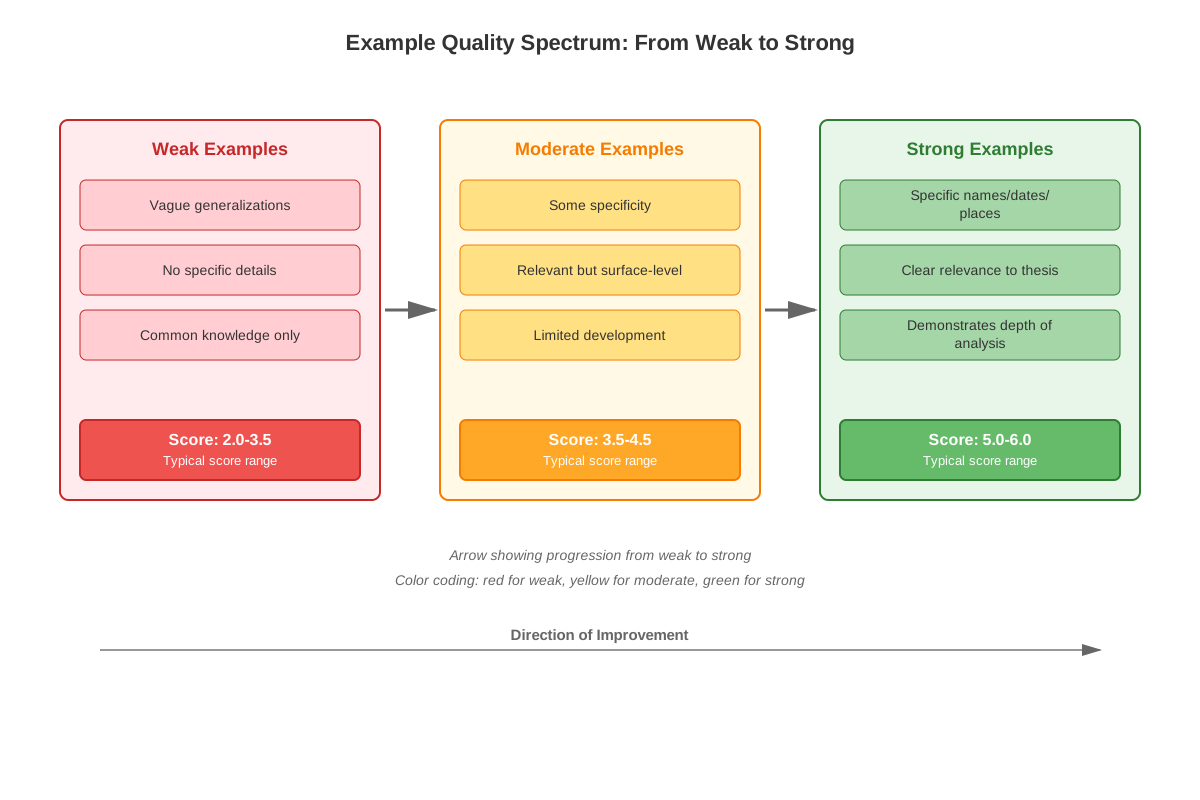
On the GRE, example selection appears in every "Analyze an Issue" essay, which constitutes 50% of your Analytical Writing score. ETS graders explicitly evaluate "the extent to which you develop your ideas" and "support for ideas," both of which depend heavily on example quality. Statistical analysis of high-scoring essays reveals that those receiving 5.0-6.0 scores consistently feature specific, varied, and well-integrated examples, while essays scoring below 4.0 typically rely on vague generalizations or irrelevant anecdotes.
The "Analyze an Issue" task presents prompts across diverse domains—education, technology, politics, arts, science—requiring test-takers to draw examples from multiple knowledge areas. Common prompt types include policy recommendations, comparative evaluations, and causal claims. Regardless of prompt type, graders assess whether your examples are relevant, specific, and effectively support your position. This topic appears in 100% of Issue essays, making it the highest-yield skill to master for this section.
Core Concepts
The STAR Framework for Example Selection
The STAR framework provides a systematic approach to choosing examples: Specific, Timely, Appropriate, and Relevant. Each criterion ensures your examples meet GRE grading standards.
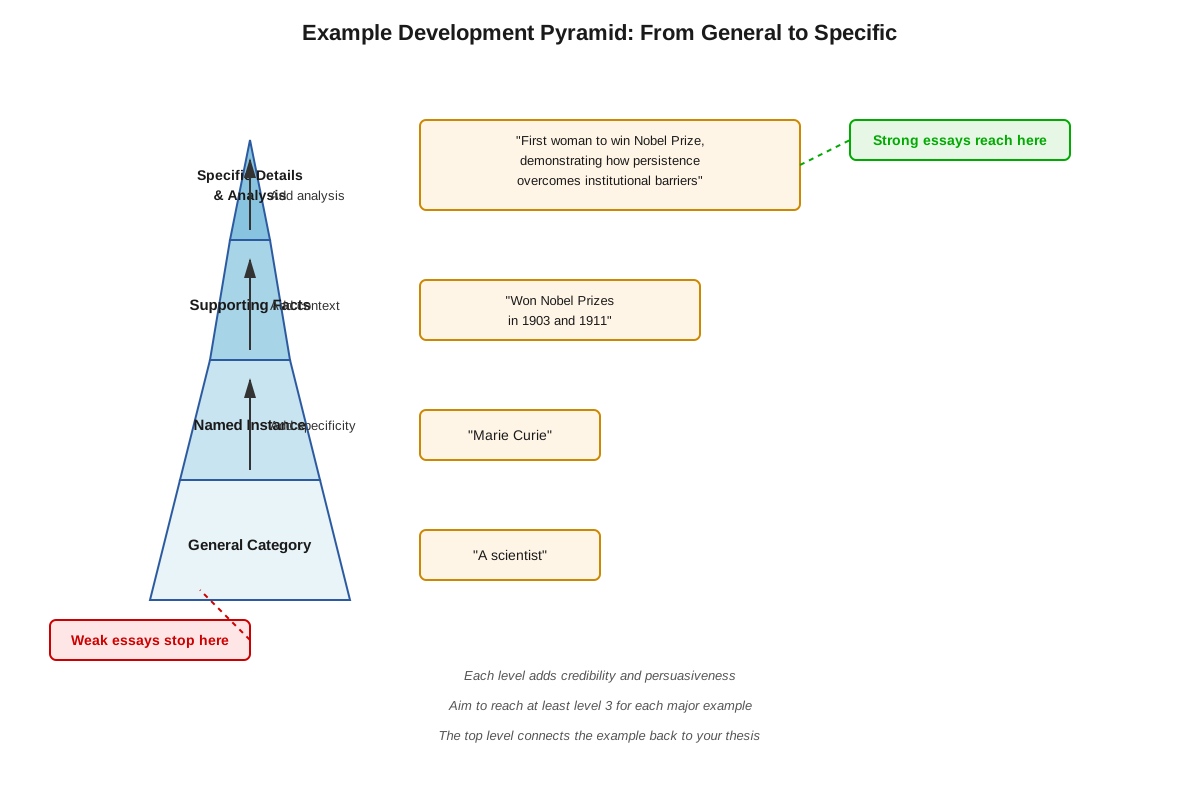
Specific examples include concrete details—names, dates, places, or quantifiable information—rather than vague references. Instead of writing "a famous scientist made important discoveries," a specific example states "Marie Curie's isolation of radium in 1902 revolutionized medical treatment." Specificity signals genuine knowledge and makes arguments more persuasive.
Timely examples demonstrate current awareness and historical perspective. While classic examples (Ancient Rome, the Industrial Revolution) remain valid, incorporating recent events or contemporary figures shows intellectual engagement. Balance historical and modern examples to demonstrate breadth.
Appropriate examples match the prompt's scope and tone. For prompts about education policy, examples from educational contexts (Finland's school system, charter school outcomes) are more appropriate than tangentially related business examples. Appropriateness also means avoiding controversial examples that might alienate graders or distract from your argument.
Relevant examples directly support your specific claim within each paragraph. An example about technological innovation is relevant when discussing progress but irrelevant when discussing environmental conservation unless you explicitly connect the two. Each example must clearly advance your thesis.
Categories of Examples
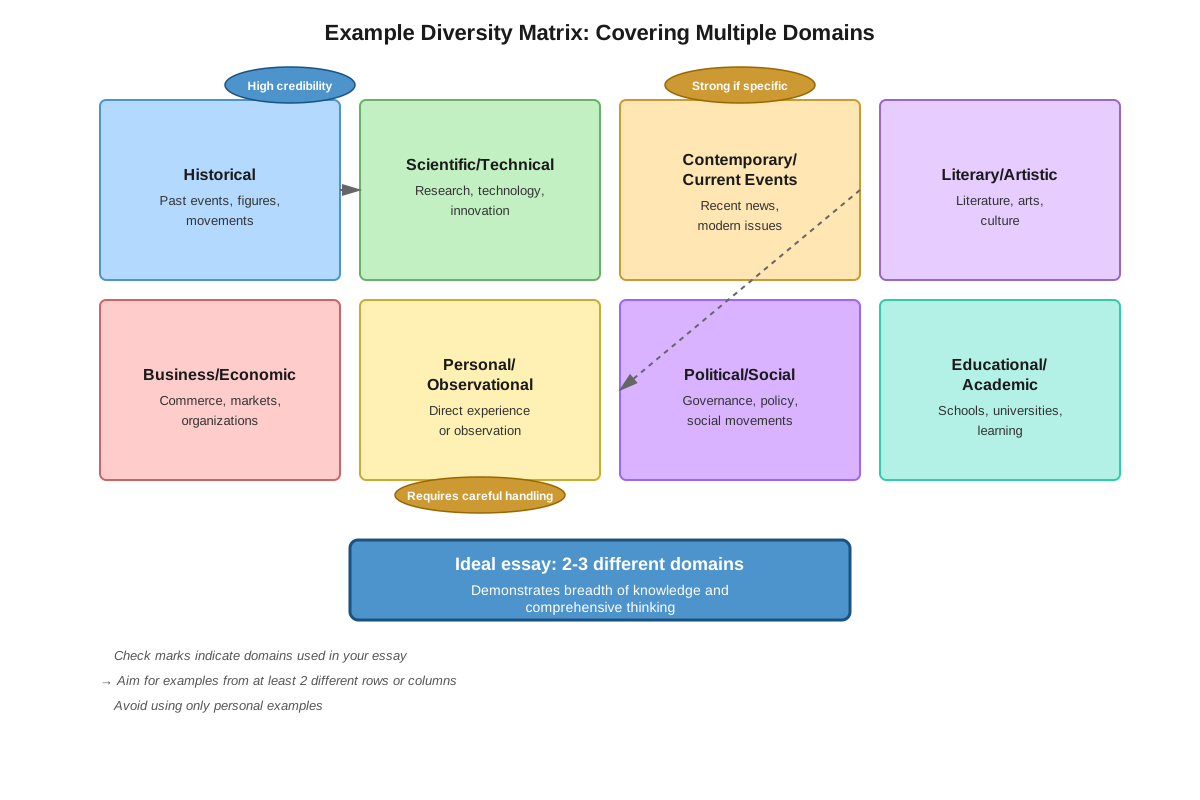
Understanding example categories helps you diversify your evidence and demonstrate comprehensive thinking. The GRE rewards essays that draw from multiple domains.
| Example Category | Description | Strengths | Limitations |
|---|---|---|---|
| Historical Events | Significant occurrences from the past | Demonstrates knowledge depth; provides temporal perspective | Can seem dated if overused; requires accuracy |
| Contemporary Issues | Current events and recent developments | Shows relevance and engagement; resonates with graders | May date quickly; requires careful handling of controversial topics |
| Scientific/Technological | Discoveries, innovations, research findings | Provides objective evidence; demonstrates analytical thinking | Can be too technical; must be explained clearly |
| Personal/Observational | Individual experiences or witnessed phenomena | Adds authenticity; can be highly specific | May seem limited in scope; must connect to broader implications |
| Literary/Artistic | Works of literature, art, film, music | Shows cultural literacy; provides nuanced examples | Must be well-known enough to be credible; avoid obscure references |
| Business/Economic | Corporate case studies, market trends, economic policies | Demonstrates practical thinking; often quantifiable | Can seem narrow; must connect to broader themes |
The Depth vs. Breadth Strategy
When planning your essay, you face a strategic choice: develop fewer examples in greater depth or present more examples with less elaboration. Both approaches can succeed, but understanding their trade-offs is essential.
Depth-focused strategy involves selecting 2-3 examples and exploring each thoroughly. This approach allows you to explain mechanisms, discuss implications, and demonstrate sophisticated analysis. For instance, if arguing that government funding drives innovation, you might deeply analyze the Manhattan Project, explaining how federal investment, coordinated research, and urgency combined to achieve atomic fission. This strategy works well when you have strong knowledge of specific cases and when the prompt invites nuanced analysis.
Breadth-focused strategy involves presenting 4-6 examples with briefer treatment. This approach demonstrates wide-ranging knowledge and makes your argument seem universally applicable. Using the same prompt, you might briefly cite the Manhattan Project, NASA's Apollo program, DARPA's internet development, and NIH medical research funding. This strategy works well when you need to establish a pattern or when individual examples might seem like anomalies.
Most high-scoring essays employ a balanced approach: 3-4 examples with moderate development. This provides sufficient depth to demonstrate analysis while showing breadth of knowledge. Typically, one example receives extended treatment (4-5 sentences) while others receive moderate development (2-3 sentences each).
The Relevance Chain
Every example must connect clearly to your argument through what we call the relevance chain: Example → Explanation → Connection → Claim. This four-step process ensures your examples actually support your thesis rather than merely decorating your essay.
- Example: Present the specific instance with concrete details
- Explanation: Clarify what happened or what the example demonstrates
- Connection: Explicitly link the example to your paragraph's main point
- Claim: Show how this supports your overall thesis
For instance, if your thesis argues that competition drives innovation:
- Example: "When SpaceX entered the aerospace industry in 2002..."
- Explanation: "...the company developed reusable rocket technology that dramatically reduced launch costs from $10,000 to $2,000 per kilogram."
- Connection: "This innovation occurred specifically because SpaceX competed with established contractors who had little incentive to reduce costs."
- Claim: "Thus, competitive pressure directly catalyzed technological advancement that monopolistic conditions had failed to produce."
Without this explicit chain, examples become disconnected illustrations rather than persuasive evidence.
Example Adaptation Strategies
The same example can support different arguments depending on how you frame it. This example adaptation skill is crucial because you cannot predict every prompt, but you can prepare flexible examples that work across multiple contexts.
Consider the example of Finland's education system. This can support arguments about:
- Teacher quality: Finland requires master's degrees for teachers
- Standardized testing: Finland uses minimal standardized testing yet achieves high outcomes
- Educational equity: Finland's system reduces achievement gaps between socioeconomic groups
- Curriculum flexibility: Finnish schools emphasize student autonomy and interdisciplinary learning
By understanding multiple dimensions of your prepared examples, you can adapt them to various prompts. This strategy is more efficient than memorizing separate examples for every possible topic.
Avoiding Generic Examples
Generic examples are the most common weakness in GRE essays. These vague references lack specificity and fail to demonstrate genuine knowledge. Common generic examples include:
- "Throughout history, many leaders..."
- "Studies have shown..."
- "In today's society..."
- "A famous person once said..."
- "Everyone knows that..."
These phrases signal to graders that you lack specific knowledge. Transform generic examples into specific ones by adding concrete details. Instead of "many companies have succeeded through innovation," write "Apple's introduction of the iPhone in 2007 transformed the mobile phone industry, increasing the company's market capitalization from $73 billion to over $2 trillion."
The specificity principle applies even to hypothetical examples. If you must use a hypothetical scenario, make it detailed and realistic rather than vague. Instead of "imagine a student who studies hard," write "consider a student who dedicates three hours daily to mathematics practice, works through 50 problems weekly, and seeks tutoring for challenging concepts."
Concept Relationships
The concepts within choosing examples form an interconnected system. The STAR framework provides evaluation criteria that help you assess examples from your category knowledge. Once you've selected examples using these criteria, you apply the depth vs. breadth strategy to determine how many examples to include and how thoroughly to develop each. The relevance chain then guides how you integrate each example into your paragraph structure, ensuring clear connections between evidence and claims. Finally, example adaptation and avoiding generic examples represent quality control measures that refine your selection.
This topic connects to prerequisite knowledge in several ways. Your thesis statement determines which examples are relevant—you cannot choose appropriate examples without a clear position. Essay structure dictates where examples appear and how they're organized within body paragraphs. Time management constrains how many examples you can develop within 30 minutes.
The relationship map flows as follows:
Prompt Analysis → Thesis Formation → Example Category Selection → STAR Evaluation → Depth/Breadth Decision → Relevance Chain Integration → Quality Control (Specificity Check) → Final Essay
This topic also enables progression to advanced Analytical Writing skills, including counterargument integration (where you must choose examples that represent opposing views) and nuanced analysis (where you explore limitations and complexities within your examples).
High-Yield Facts
⭐ GRE graders explicitly evaluate "support for ideas" as a primary scoring criterion, making example quality directly impact your score
⭐ Specific examples with concrete details (names, dates, numbers) score significantly higher than vague generalizations
⭐ Essays scoring 5.0+ typically include 3-4 well-developed examples rather than many superficial ones
⭐ Examples must be explicitly connected to your thesis through clear explanation—implicit connections are insufficient
⭐ Drawing examples from multiple categories (historical, contemporary, scientific, etc.) demonstrates breadth of knowledge
- Personal examples are acceptable if they're specific and connect to broader implications beyond individual experience
- Hypothetical examples can work if they're detailed and realistic, but real-world examples are generally stronger
- You don't need perfect factual accuracy for historical examples—reasonable approximations are acceptable if the core point is valid
- Contemporary examples (within the last 5-10 years) should be balanced with historical examples to show both relevance and depth
- Examples from popular culture (films, books, music) are valid if they're well-known and appropriately connected to your argument
- The same example can appear in multiple essays if adapted to different prompts—you don't need entirely unique examples for each practice essay
- Graders prefer depth of analysis over quantity of examples—two thoroughly explained examples outperform five superficial ones
Quick check — test yourself on Choosing examples so far.
Try Flashcards →Common Misconceptions
Misconception: Only historical or academic examples are appropriate for the GRE → Correction: The GRE accepts examples from diverse sources including business, technology, personal observation, and popular culture, provided they're specific and relevant. What matters is the quality of analysis, not the source domain.
Misconception: You must have perfect factual accuracy for all examples → Correction: While accuracy is important, graders understand time constraints and accept reasonable approximations. If you remember that a significant event occurred "in the early 2000s" rather than the exact year, that's acceptable. The analytical connection matters more than perfect dates.
Misconception: Personal examples are too informal or weak for the GRE → Correction: Personal examples can be highly effective if they're specific, demonstrate broader implications, and connect clearly to your thesis. An example about observing teaching methods in your own education can support arguments about educational policy if properly framed.
Misconception: More examples always lead to higher scores → Correction: Quality trumps quantity. An essay with six superficial examples will score lower than one with three well-developed examples that include explanation, analysis, and clear connections to the thesis. Graders value depth of reasoning over breadth of references.
Misconception: You should memorize a bank of examples for every possible topic → Correction: This approach is inefficient and often leads to forced, irrelevant examples. Instead, develop a flexible set of 8-10 examples that you understand deeply and can adapt to various prompts. Understanding multiple dimensions of each example is more valuable than memorizing many examples superficially.
Misconception: Examples must come from serious or academic contexts → Correction: Examples from business, sports, entertainment, or everyday life are equally valid if they're specific and well-analyzed. An example about how streaming services changed entertainment consumption patterns can effectively support arguments about technological disruption or market competition.
Misconception: You should avoid controversial examples entirely → Correction: While extremely divisive current political issues should be handled carefully, you can reference controversial topics if you analyze them objectively and focus on relevant aspects. The key is maintaining an analytical rather than emotional tone and ensuring the example serves your argument rather than becoming a distraction.
Worked Examples
Worked Example 1: Technology and Education Prompt
Prompt: "Some people believe that technology has made learning more accessible and effective, while others argue that it has created distractions and reduced deep thinking. Discuss which view aligns more closely with your perspective."
Position: Technology has generally enhanced learning accessibility and effectiveness despite some drawbacks.
Example Selection Process:
Step 1 - Category Brainstorming: Consider examples from education (online courses), technology (specific platforms), personal observation (learning experiences), and research (studies on educational outcomes).
Step 2 - STAR Evaluation:
- Khan Academy: Specific (founded 2008, 120 million users), Timely (contemporary and relevant), Appropriate (directly about education technology), Relevant (demonstrates accessibility)
- MIT OpenCourseWare: Specific (launched 2001, 2,500+ courses), Timely (established but ongoing), Appropriate (educational access), Relevant (shows democratization of elite education)
- Smartphone distraction studies: Specific (can cite research findings), Timely (current concern), Appropriate (addresses counterargument), Relevant (acknowledges limitations)
Step 3 - Depth/Breadth Decision: Use three examples with moderate development—two supporting the main position and one acknowledging the counterargument.
Step 4 - Relevance Chain for Khan Academy:
"Khan Academy, founded in 2008, exemplifies technology's democratizing effect on education [Example]. The platform provides free, high-quality instructional videos across mathematics, science, and humanities to over 120 million users worldwide, including students in remote areas with limited access to qualified teachers [Explanation]. This technological solution directly addresses educational inequality by making expert instruction available regardless of geographic location or economic status [Connection]. Thus, technology has measurably increased learning accessibility in ways that traditional classroom models could never achieve at this scale [Claim]."
Quality Check: This example is specific (names, dates, numbers), clearly connected to the thesis about accessibility, and demonstrates genuine knowledge rather than vague generalization.
Worked Example 2: Leadership and Collaboration Prompt
Prompt: "Effective leadership requires the ability to make decisions independently rather than relying on group consensus. Discuss the extent to which you agree or disagree with this statement."
Position: Effective leadership requires balancing independent decision-making with collaborative input, depending on context.
Example Selection Process:
Step 1 - Category Brainstorming: Consider historical leaders (political, military), business leaders (corporate decisions), scientific collaboration (research teams), and crisis management (emergency decisions).
Step 2 - STAR Evaluation:
- NASA's Apollo 13 mission: Specific (1970, Gene Kranz, specific technical problem), Timely (historical but well-known), Appropriate (demonstrates both independent and collaborative leadership), Relevant (shows context-dependent leadership)
- Kodak's digital photography decision: Specific (1975 invention, 2012 bankruptcy), Timely (relevant business case), Appropriate (shows consequences of leadership approach), Relevant (demonstrates risks of isolated decision-making)
Step 3 - Depth/Breadth Decision: Use two examples with deep development to show nuanced analysis of when each approach works.
Step 4 - Relevance Chain for Apollo 13:
"The Apollo 13 mission crisis in 1970 demonstrates how effective leadership integrates both independent authority and collaborative problem-solving [Example]. When an oxygen tank exploded en route to the moon, Flight Director Gene Kranz made the immediate independent decision to abort the lunar landing—a choice requiring swift, authoritative action without time for extensive consultation [Explanation]. However, solving the technical challenges of returning the crew safely required Kranz to coordinate input from hundreds of engineers, each contributing specialized expertise to problems like carbon dioxide buildup and power conservation [Connection]. This case illustrates that leadership effectiveness depends on recognizing which situations demand decisive independence versus collaborative expertise [Claim]."
Quality Check: This example demonstrates the nuanced position (neither extreme), includes specific details that show genuine knowledge, and explicitly connects to the thesis through clear analysis.
Exam Strategy
Pre-Exam Preparation
Develop a personal example bank of 8-12 examples you understand deeply across multiple categories: 2-3 historical events, 2-3 contemporary issues, 2-3 business/technology cases, 1-2 scientific developments, and 1-2 personal observations. For each example, write a 3-4 sentence summary including specific details (names, dates, outcomes) and note 3-4 different arguments it could support.
During the Exam: The 5-Minute Planning Phase
Allocate the first 5 minutes of your 30-minute essay to planning, with 2-3 minutes dedicated to example selection:
- Minute 1: Read the prompt carefully and formulate your thesis
- Minutes 2-3: Brainstorm potential examples across categories; list 5-6 possibilities
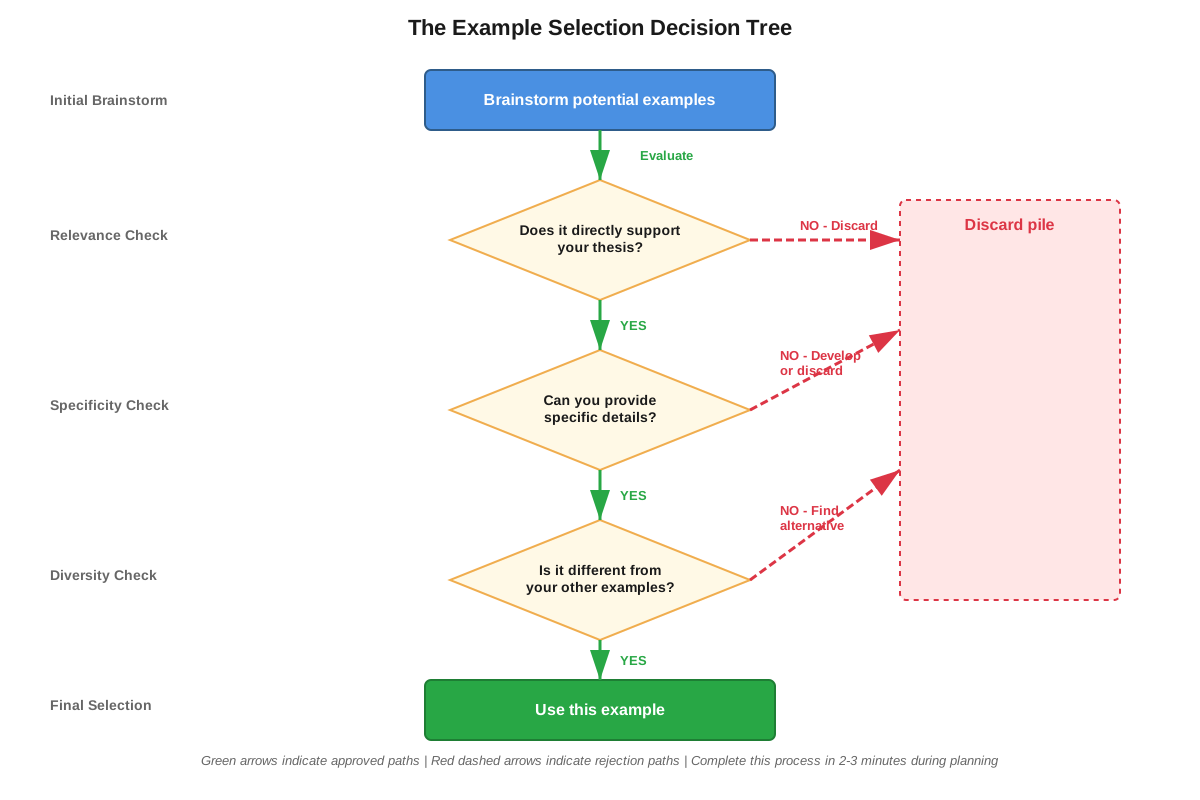
- Minute 4: Apply STAR criteria to evaluate your options; select your strongest 3-4
- Minute 5: Sketch a brief outline showing where each example will appear
Trigger Words in Prompts
Certain prompt phrases signal which types of examples will be most effective:
- "Throughout history..." or "Over time...": Requires historical examples showing change or patterns
- "In modern society..." or "Today...": Prioritize contemporary examples
- "In fields such as...": The prompt suggests relevant domains; draw examples from those areas
- "Consider the consequences...": Focus on examples with clear outcomes or results
- "Some people believe... while others...": Prepare examples supporting both perspectives to show balanced thinking
Process of Elimination for Example Selection
When choosing between multiple potential examples, eliminate those that:
- Lack specificity: If you can only describe it vaguely, choose a different example
- Require excessive explanation: If the example needs more than 2 sentences of background, it may consume too much time
- Seem forced or tangential: If the connection to your thesis isn't immediately clear, the example probably isn't relevant enough
- Are too controversial: If the example might trigger strong emotional reactions unrelated to your argument, select a safer option
- Duplicate your other examples: If two examples make essentially the same point, keep the stronger one and find a different angle
Time Allocation
Within your 25 minutes of writing time (after 5 minutes of planning):
- Introduction with thesis: 3-4 minutes
- Body paragraph 1 with primary example: 6-7 minutes
- Body paragraph 2 with secondary example(s): 6-7 minutes
- Body paragraph 3 with additional example or counterargument: 5-6 minutes (optional, depending on your depth/breadth strategy)
- Conclusion: 2-3 minutes
- Review: 1-2 minutes
Each example should take approximately 2-4 minutes to write, including the relevance chain explanation.
Emergency Strategies
If you're struggling to generate examples during the exam:
- Adapt from the prompt: Sometimes the prompt itself suggests examples or domains to explore
- Use hypothetical scenarios: Create a detailed, realistic hypothetical example if you cannot recall a specific real-world case
- Draw from recent reading: Think about articles, books, or content you've encountered recently
- Consider your own field: Use examples from your academic major or professional experience
- Simplify and specify: Take a general idea and add specific details to make it concrete
Memory Techniques
The STAR Mnemonic
Remember the evaluation criteria with STAR:
- Specific details (names, dates, numbers)
- Timely and relevant to current or historical context
- Appropriate to the prompt's domain and scope
- Relevant to your specific thesis and paragraph claim
The 3-D Visualization
Visualize your examples as having three dimensions:
- Depth: How thoroughly you explain and analyze each example
- Diversity: How many different categories your examples represent
- Direction: How clearly each example points toward your thesis
Picture your essay as a three-dimensional structure where examples provide support beams—they must be strong (depth), varied (diversity), and properly aligned (direction).
The CHAMP Acronym for Example Categories
Remember to draw from diverse categories using CHAMP:
- Contemporary events
- Historical occurrences
- Academic/scientific developments
- Market/business cases
- Personal observations
The Connection Chain Phrase
Memorize this transition phrase structure to ensure you always complete the relevance chain:
"This example of [X] demonstrates [Y] because [Z], which supports the broader claim that [thesis]."
Practice inserting your examples into this template until the connection pattern becomes automatic.
Summary
Choosing examples effectively is the cornerstone of high-scoring GRE Analytical Writing essays. The skill involves selecting specific, relevant evidence that supports your thesis while demonstrating breadth of knowledge and depth of analysis. The STAR framework—Specific, Timely, Appropriate, Relevant—provides evaluation criteria for assessing potential examples. Successful test-takers draw from multiple categories including historical events, contemporary issues, scientific developments, business cases, and personal observations, adapting flexible examples to various prompts rather than memorizing rigid example-prompt pairings. The depth versus breadth strategy requires balancing thorough development of fewer examples against broader coverage with less elaboration, with most high-scoring essays employing 3-4 moderately developed examples. Every example must follow the relevance chain—presenting the example, explaining what it demonstrates, connecting it explicitly to your paragraph's point, and showing how it supports your overall thesis. Avoiding generic examples by including concrete details transforms vague references into persuasive evidence. During the exam, allocate 2-3 minutes of your planning phase to example selection, applying STAR criteria to choose your strongest options and sketching how each will integrate into your essay structure.
Key Takeaways
- Example quality directly impacts your Analytical Writing score—graders explicitly evaluate "support for ideas" as a primary criterion
- Specificity is non-negotiable—include concrete details like names, dates, and numbers rather than vague generalizations
- The STAR framework (Specific, Timely, Appropriate, Relevant) provides systematic criteria for evaluating potential examples
- Diversity demonstrates breadth—draw examples from multiple categories (historical, contemporary, scientific, business, personal) to show comprehensive thinking
- Explicit connections are essential—follow the relevance chain (Example → Explanation → Connection → Claim) to ensure examples actually support your thesis
- Depth trumps quantity—three well-developed examples with thorough analysis outperform six superficial references
- Flexible preparation is more efficient—develop 8-12 examples you understand deeply and can adapt to various prompts rather than memorizing rigid example-topic pairings
Related Topics
Thesis Development: Mastering example selection enables more sophisticated thesis construction because you can formulate positions based on the evidence you're confident you can provide. Understanding your example bank helps you take nuanced positions rather than extreme stances.
Paragraph Organization: Once you've chosen strong examples, you must integrate them effectively into paragraph structure, including topic sentences, evidence presentation, analysis, and transitions. Example selection and paragraph development work together to create coherent arguments.
Counterargument Integration: Advanced essays acknowledge opposing viewpoints, which requires choosing examples that represent alternative perspectives. This skill builds on basic example selection by adding the complexity of representing views you don't fully endorse.
Analyze an Argument Task: While the "Analyze an Issue" task requires you to generate your own examples, the "Analyze an Argument" task requires evaluating examples provided by others. Understanding what makes examples strong or weak in your own writing helps you critique examples in argument analysis.
Time Management Under Pressure: Effective example selection must occur within strict time constraints. Mastering this topic enables more efficient planning phases, leaving more time for writing and revision.
Practice CTA
Now that you understand the principles of choosing examples for GRE Analytical Writing, it's time to apply these strategies to actual practice. Work through the practice questions to test your ability to generate, evaluate, and integrate examples under timed conditions. Use the flashcards to reinforce the STAR framework and example categories until they become automatic. Remember that example selection is a skill that improves with deliberate practice—each essay you write is an opportunity to refine your judgment about which examples work best for different prompts. The difference between a good essay and a great essay often comes down to the quality of your examples, so invest the time to master this high-yield skill. Your ability to support arguments with specific, relevant evidence will serve you not only on test day but throughout your graduate studies and professional career.
Sign up free to keep reading
Create a free AnvayaPrep account to finish this GRE guide on Choosing examples — plus flashcards and practice questions.