Overview
Taking a position is the foundational skill required for success on the GRE Analytical Writing "Analyze an Issue" task. This essay prompt requires test-takers to develop a clear, defensible stance on a complex issue and support that position with well-reasoned arguments, relevant examples, and logical analysis. Unlike other writing tasks that may allow for neutral exploration, the GRE explicitly requires examinees to stake out a position and defend it persuasively. The ability to articulate and support a clear viewpoint distinguishes high-scoring essays (5.0-6.0) from mediocre ones (3.0-3.5).
The GRE taking a position skill extends beyond simply stating an opinion. It encompasses the strategic selection of a defensible stance, the development of compelling supporting arguments, the acknowledgment of counterarguments, and the maintenance of logical consistency throughout a 30-minute timed essay. Test-takers must demonstrate intellectual sophistication by recognizing the complexity of issues while still committing to a clear position. This balance—between acknowledging nuance and maintaining argumentative clarity—represents the core challenge of this task.
Within the broader Analytical Writing section, taking a position serves as the organizational backbone for the entire Issue essay. It determines the thesis statement, guides paragraph development, influences example selection, and shapes the conclusion. Mastery of this skill directly impacts performance on related competencies including argument development, evidence selection, counterargument integration, and essay organization. Without a clear, well-articulated position, even sophisticated reasoning and eloquent prose will fail to achieve a high score.
Learning Objectives
- [ ] Identify when Taking a position is being tested
- [ ] Explain the core rule or strategy behind Taking a position
- [ ] Apply Taking a position to GRE-style questions accurately
- [ ] Evaluate the defensibility of different positions on complex issues
- [ ] Construct a nuanced thesis statement that acknowledges complexity while maintaining clarity
- [ ] Distinguish between positions that are too extreme and those that are appropriately qualified
- [ ] Integrate counterarguments while preserving the strength of the primary position
Prerequisites
- Basic essay structure: Understanding of introduction, body paragraphs, and conclusion is essential because position-taking must be integrated into standard essay architecture
- Thesis statement construction: Ability to write clear, specific thesis statements provides the foundation for articulating a position effectively
- Logical reasoning fundamentals: Familiarity with basic argument structure (claim, evidence, warrant) enables the support of positions with sound reasoning
- Reading comprehension: Capacity to understand complex prompts ensures accurate interpretation of the issue before taking a position
Why This Topic Matters
Taking a position is not merely an academic exercise—it reflects a critical real-world skill. Professionals across fields must regularly stake out positions on complex issues: business leaders defend strategic decisions, policymakers advocate for legislation, researchers argue for particular interpretations of data, and educators take stances on pedagogical approaches. The ability to commit to a viewpoint while acknowledging complexity demonstrates intellectual maturity and practical decision-making capacity that graduate programs value highly.
On the GRE, the "Analyze an Issue" task appears as one of two Analytical Writing essays and directly tests position-taking in 100% of Issue prompts. The scoring rubric explicitly evaluates whether the essay "presents a clear and insightful position on the issue" (6.0 score descriptor) or "presents a position on the issue" (4.0 score descriptor). Essays that fail to take a clear position typically score 3.0 or below, regardless of writing quality. Statistical analysis of GRE essays reveals that position clarity correlates more strongly with high scores than vocabulary sophistication or sentence complexity.
Common manifestations in exam passages include prompts that present controversial claims ("Government funding should prioritize space exploration over social programs"), comparative statements ("Technology has done more harm than good to human relationships"), or policy recommendations ("Universities should require all students to study abroad"). Each format demands that test-takers move beyond description or analysis to advocacy—selecting and defending a specific viewpoint within the 30-minute time constraint.
Core Concepts
Understanding What "Taking a Position" Means
Taking a position means committing to a specific, defensible viewpoint on the issue presented in the prompt. This commitment must be explicit, appearing clearly in the thesis statement and maintained consistently throughout the essay. A position is not merely an observation about the issue or an acknowledgment that "both sides have merit"—it represents a judgment about which perspective is more valid, more important, or more applicable given specific conditions.
The GRE evaluates position-taking on three dimensions: clarity (can readers immediately identify your stance?), specificity (does your position address the particular issue in the prompt?), and consistency (do you maintain this position throughout the essay?). High-scoring essays demonstrate all three qualities simultaneously.
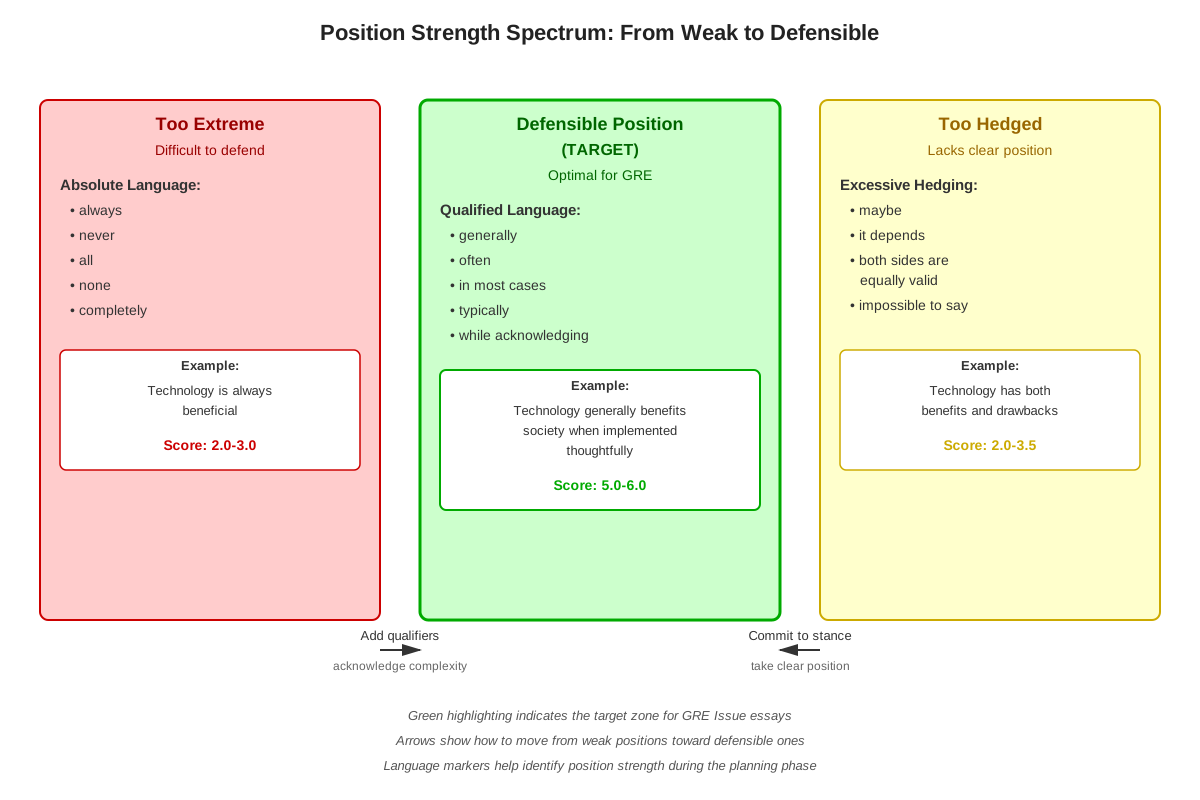
The Spectrum of Position Strength
Positions exist on a spectrum from absolute to qualified:
| Position Type | Characteristics | Example | GRE Effectiveness |
|---|---|---|---|
| Absolute | Unqualified agreement/disagreement | "The claim is entirely correct" | Low (oversimplifies) |
| Strong | Clear stance with minor exceptions | "The claim is largely valid, though exceptions exist in X context" | High |
| Moderate | Balanced position with conditions | "The claim holds true when Y conditions apply" | High |
| Weak | Heavily qualified or conditional | "The claim might be true depending on numerous factors" | Medium |
| Neutral | No clear commitment | "Both perspectives have validity" | Very Low |
For GRE purposes, strong and moderate positions typically yield the highest scores because they demonstrate intellectual sophistication while maintaining argumentative clarity. Absolute positions risk appearing simplistic, while neutral positions fail to meet the task requirements.
Crafting an Effective Thesis Statement
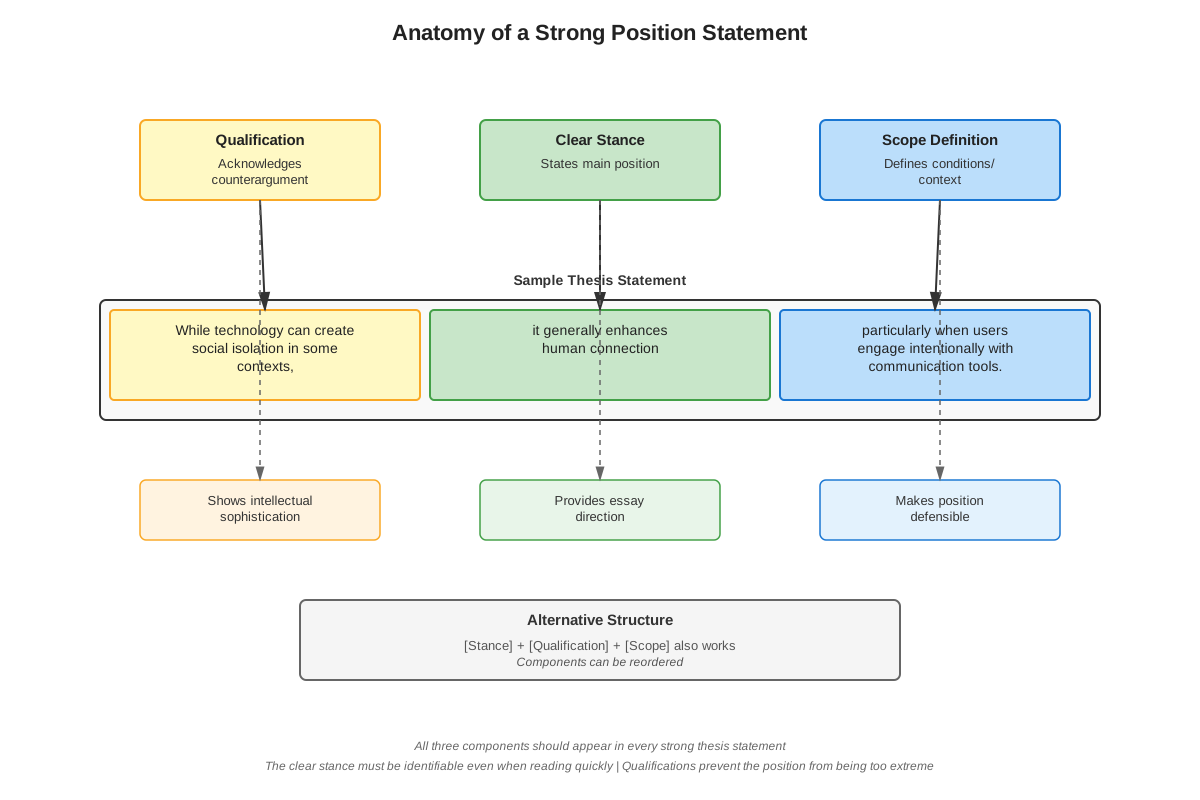
The thesis statement serves as the explicit articulation of your position. Effective thesis statements for the Issue task contain three elements:
- Clear stance indicator: Words like "largely," "primarily," "generally," "should," or "must" signal your position
- Scope definition: Acknowledgment of the issue's complexity or specification of conditions
- Preview of reasoning: Brief indication of why you hold this position
Example prompt: "Claim: Universities should eliminate letter grades and adopt pass/fail systems."
Weak thesis: "This claim has both advantages and disadvantages that deserve consideration."
- Fails to take a position; remains neutral
Strong thesis: "While pass/fail systems may reduce student stress, universities should retain letter grades because they provide essential feedback for improvement, enable meaningful differentiation for employers and graduate programs, and motivate consistent academic effort."
- Clear disagreement with the claim
- Acknowledges one benefit of the opposing view
- Provides three specific reasons for the position
Strategic Position Selection
Test-takers often wonder whether they should agree or disagree with the prompt's claim. The answer: choose the position you can defend most effectively within 30 minutes, not necessarily the position you personally believe. Consider these strategic factors:
Defensibility: Can you generate 2-3 strong supporting arguments quickly?
Example availability: Can you think of specific, relevant examples from history, current events, literature, or personal observation?
Counterargument management: Can you acknowledge opposing views without undermining your position?
Prompt language: Does the prompt use absolute language ("always," "never," "all") that invites qualification or partial disagreement?
Maintaining Position Consistency
Once established, your position must remain consistent throughout the essay. This doesn't mean ignoring counterarguments—in fact, acknowledging opposing views strengthens your essay—but rather ensuring that counterarguments are ultimately subordinated to your main position.
Consistency techniques:
- Use transitional phrases that maintain hierarchy: "While critics argue X, this concern is outweighed by Y"
- Return to thesis language in topic sentences
- Frame counterarguments as exceptions or special cases rather than equal alternatives
- Conclude by reaffirming your position with synthesis of main arguments
Qualifying Your Position Appropriately
Sophisticated positions acknowledge complexity without abandoning clarity. Qualification involves specifying conditions, contexts, or limitations under which your position applies. This demonstrates critical thinking while maintaining argumentative force.
Qualification strategies:
- Contextual: "In developed nations with robust social safety nets, this policy would succeed, though developing nations face different constraints"
- Temporal: "Historically, this approach proved effective, but contemporary circumstances require modification"
- Scope-based: "For undergraduate education, this principle holds, whereas graduate programs demand different considerations"
- Degree-based: "The claim is largely accurate, though exceptions exist in specialized fields"
The key is ensuring qualifications refine rather than retract your position. Each qualification should clarify the boundaries of your argument, not introduce ambiguity about your fundamental stance.
Concept Relationships
The skill of taking a position serves as the foundation for all other Issue essay competencies. The relationship flows hierarchically:
Position Selection → determines → Thesis Statement → guides → Argument Development → requires → Evidence Selection → necessitates → Example Integration
Simultaneously, position-taking connects laterally to Counterargument Acknowledgment: a strong position must anticipate and address opposing views, creating a bidirectional relationship where counterarguments both challenge and ultimately reinforce the primary position.
The relationship to prerequisite knowledge operates as follows: Logical Reasoning provides the tools for evaluating which positions are defensible, while Thesis Construction offers the mechanism for articulating the selected position. Essay Structure determines where and how the position appears throughout the essay (introduction, topic sentences, conclusion).
Within the broader Analytical Writing section, taking a position on the Issue task contrasts with the "Analyze an Argument" task, where test-takers must remain neutral and evaluate rather than advocate. This distinction highlights that position-taking is task-specific, not a universal requirement for all analytical writing.
High-Yield Facts
⭐ The GRE Issue task explicitly requires test-takers to take a position; neutral essays score 3.0 or below regardless of writing quality
⭐ The thesis statement must appear in the introduction and clearly articulate the position using explicit stance indicators
⭐ Qualified positions (acknowledging complexity while maintaining clarity) typically score higher than absolute positions
⭐ Position consistency throughout the essay is evaluated more heavily than the particular position chosen
⭐ Acknowledging counterarguments strengthens rather than weakens a position when properly subordinated
- The position should directly address the specific claim in the prompt, not a generalized version of the topic
- Strategic position selection based on defensibility matters more than personal belief
- Topic sentences should connect back to the thesis, reinforcing position consistency
- Prompts using absolute language ("always," "never") often invite qualified disagreement
- The conclusion must reaffirm the position, not introduce ambiguity or new stances
- Positions can be conditional (applying in certain contexts) while remaining clear and defensible
- High-scoring essays demonstrate intellectual sophistication by recognizing issue complexity while maintaining argumentative commitment
Quick check — test yourself on Taking a position so far.
Try Flashcards →Common Misconceptions
Misconception: Taking a position means ignoring counterarguments or opposing viewpoints
→ Correction: Strong positions explicitly acknowledge counterarguments but demonstrate why the primary position remains more valid, creating more persuasive and sophisticated essays
Misconception: The GRE rewards balanced, neutral essays that give equal weight to both sides
→ Correction: The task explicitly requires taking a position; essays that remain neutral or conclude "both sides are equally valid" fail to meet task requirements and score poorly
Misconception: Test-takers must choose the position they personally believe
→ Correction: Strategic position selection based on defensibility, available examples, and time constraints is more important than personal conviction; the GRE evaluates argumentation, not sincerity
Misconception: Qualifying a position makes it weak or unclear
→ Correction: Appropriate qualification demonstrates intellectual sophistication and critical thinking; the key is ensuring qualifications refine rather than retract the core position
Misconception: Once a position is stated in the thesis, it doesn't need to be reinforced
→ Correction: Position consistency requires explicit reinforcement through topic sentences, transitional phrases, and conclusion; readers should never wonder what stance the essay takes
Misconception: Stronger language (absolute terms) creates stronger positions
→ Correction: Absolute positions often appear simplistic and are harder to defend; moderate positions with clear stance indicators typically score higher
Misconception: The position can evolve or change as the essay develops
→ Correction: Position shifts signal unclear thinking and undermine essay coherence; the position established in the thesis must remain consistent throughout
Worked Examples
Example 1: Technology and Education Prompt
Prompt: "Claim: The increasing use of technology in classrooms has done more harm than good to student learning."
Step 1 - Analyze the prompt
- Absolute claim ("more harm than good")
- Invites qualification or partial disagreement
- Requires consideration of both benefits and drawbacks
Step 2 - Brainstorm positions
- Option A: Strongly agree (technology is harmful)
- Option B: Strongly disagree (technology is beneficial)
- Option C: Qualified disagreement (technology is generally beneficial but has specific drawbacks)
Step 3 - Evaluate defensibility
- Option A: Difficult to defend given widespread evidence of technology benefits
- Option B: Risks oversimplification; ignores legitimate concerns
- Option C: Most defensible; allows acknowledgment of complexity while maintaining clear stance
Step 4 - Construct thesis
"While excessive screen time and digital distraction present legitimate concerns, classroom technology has generally benefited student learning by enabling personalized instruction, providing access to vast information resources, and developing essential digital literacy skills required for modern careers."
Step 5 - Verify position clarity
✓ Clear stance: Disagrees with claim (technology has done more good than harm)
✓ Qualification: Acknowledges concerns ("legitimate concerns")
✓ Specificity: Provides three concrete reasons
✓ Consistency potential: Can develop three body paragraphs supporting this position while addressing counterarguments
Application to essay structure:
- Body paragraph 1: Personalized instruction benefits (position support)
- Body paragraph 2: Information access advantages (position support)
- Body paragraph 3: Digital literacy development (position support)
- Counterargument integration: Acknowledge screen time concerns but explain mitigation strategies
- Conclusion: Reaffirm that benefits outweigh drawbacks
Example 2: Government Funding Prompt
Prompt: "Claim: Government funding should prioritize practical research with immediate applications over theoretical research with uncertain future benefits."
Step 1 - Analyze the prompt
- Comparative claim (practical vs. theoretical)
- Forces choice between two priorities
- "Should" indicates policy recommendation
Step 2 - Consider strategic factors
- Historical examples available for both positions
- Theoretical research has produced unexpected practical benefits (internet, GPS, medical advances)
- Can argue for balanced approach while still taking clear position
Step 3 - Select position
Qualified disagreement: "Government funding should maintain substantial support for theoretical research despite uncertain applications"
Step 4 - Construct thesis
"Although practical research delivers immediate societal benefits, government funding must continue prioritizing theoretical research because such inquiry has historically generated transformative technologies, addresses questions beyond market incentives, and creates the foundational knowledge that enables future practical applications."
Step 5 - Develop supporting structure
- Argument 1: Historical examples (internet from ARPANET, GPS from relativity theory, medical imaging from particle physics)
- Argument 2: Market failure—private sector won't fund research without clear profit potential
- Argument 3: Foundational knowledge creates possibilities for future practical research
- Counterargument acknowledgment: Practical research importance, but not at theoretical research's expense
- Position maintenance: Use phrases like "while practical research matters, theoretical research remains essential"
Position consistency check:
- Introduction: Clear prioritization of theoretical research
- Body paragraphs: Each supports theoretical research value
- Counterargument: Acknowledges practical research benefits but subordinates to main position
- Conclusion: Reaffirms theoretical research priority
Exam Strategy
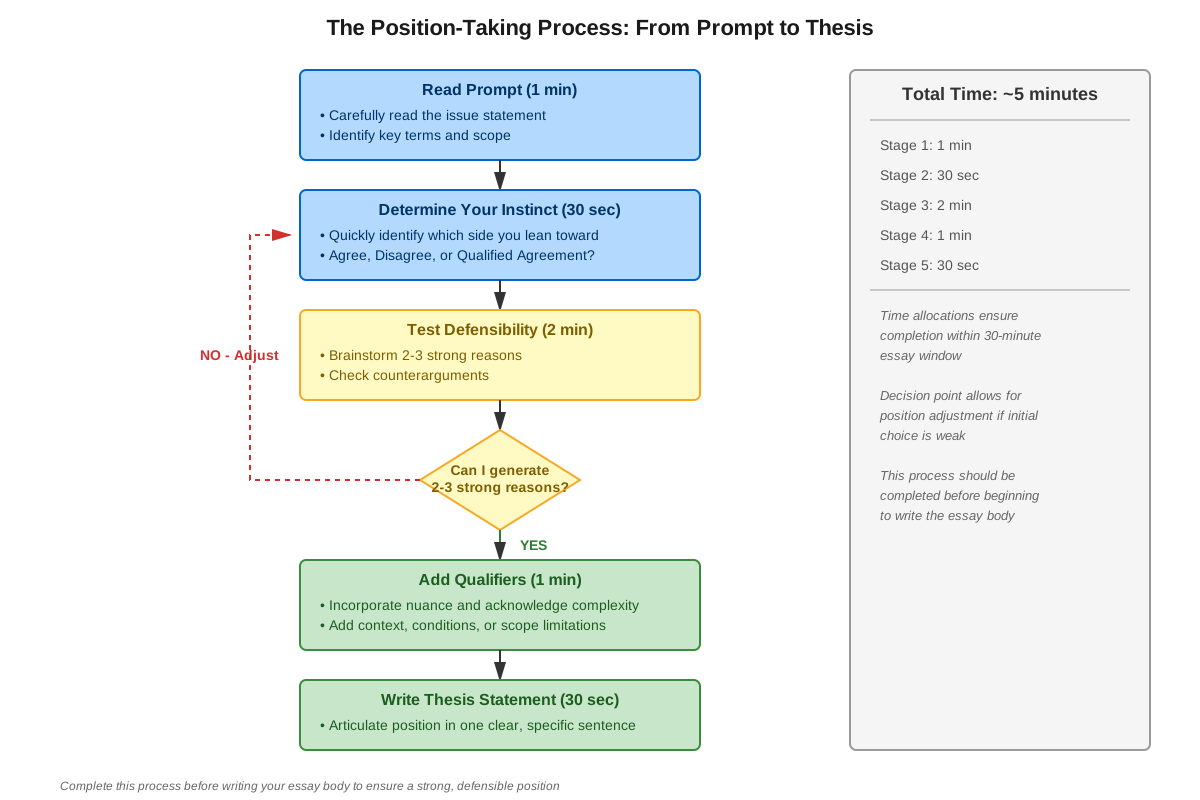
Rapid Position Selection Process (3-4 minutes)
When the Issue prompt appears, use this systematic approach:
- Read carefully: Identify the exact claim, noting absolute language or qualifiers
- Brainstorm quickly: List 2-3 arguments for agreement and 2-3 for disagreement (30 seconds each)
- Evaluate examples: Which position allows you to generate specific, relevant examples quickly?
- Choose strategically: Select the position with stronger arguments and better examples, not necessarily your personal view
- Commit fully: Once selected, don't second-guess; invest remaining time in development
Trigger Words and Phrases
Prompt language that invites qualified positions:
- "Always," "never," "all," "none" → Usually too absolute; consider partial disagreement
- "Should," "must," "ought to" → Policy recommendations requiring clear advocacy
- "More important than," "primarily," "mainly" → Comparative claims requiring prioritization
- "In all cases," "without exception" → Invites identification of exceptions
Thesis language that signals clear positions:
- "Largely," "generally," "primarily," "predominantly" → Strong but qualified agreement
- "While X, ultimately Y" → Acknowledges complexity while maintaining stance
- "Should," "must," "requires" → Clear advocacy language
- "More/less important," "outweighs," "supersedes" → Comparative position indicators
Process-of-Elimination for Position Selection
Eliminate positions that:
- Require specialized knowledge you don't possess
- Depend on examples you can't quickly recall
- Force you to defend absolute claims against obvious counterexamples
- Leave you uncertain about how to develop supporting arguments
Favor positions that:
- Allow you to use familiar examples (historical events, current issues, literature)
- Enable acknowledgment of complexity while maintaining clarity
- Connect to your brainstormed arguments naturally
- Feel defensible within the 30-minute constraint
Time Allocation
- Minutes 0-4: Read prompt, brainstorm, select position, outline thesis
- Minutes 4-8: Write introduction with clear thesis statement
- Minutes 8-24: Develop body paragraphs supporting position (5-6 minutes each)
- Minutes 24-28: Write conclusion reaffirming position
- Minutes 28-30: Proofread, ensuring position consistency
Exam Tip: If you realize mid-essay that your position is difficult to defend, don't switch positions. Instead, qualify your existing position more carefully and acknowledge limitations. Position consistency matters more than position perfection.
Memory Techniques
CLEAR Position Acronym
Commit to a specific stance (no neutrality)
Language must signal your position explicitly
Exceptions can be acknowledged (qualification strengthens)
Arguments must support your position consistently
Reaffirm your position in conclusion
Thesis Construction Formula
Position Statement + Qualification + Because + Reason 1, Reason 2, and Reason 3
Example: "Universities should [position] retain letter grades, although [qualification] pass/fail systems reduce stress, because [reasons] grades provide feedback, enable differentiation, and motivate effort."
The "Stance Sandwich" Visualization
Imagine your essay as a sandwich:
- Top bread: Introduction with clear position
- Filling: Body paragraphs supporting position (with counterargument as "seasoning")
- Bottom bread: Conclusion reaffirming position
The position (bread) holds everything together; without it, the essay falls apart.
Position Consistency Check: "ECHO"
Every paragraph should Echo the thesis
Counterarguments are Contained, not equal
Heading (topic sentences) Harks back to position
Outro (conclusion) Overtly restates stance
Summary
Taking a position on the GRE Analyze an Issue task requires test-takers to commit to a clear, defensible stance on a complex issue and maintain that position consistently throughout a 30-minute essay. This skill encompasses strategic position selection based on defensibility and available examples, construction of an explicit thesis statement with appropriate qualification, development of supporting arguments that reinforce the position, acknowledgment of counterarguments without undermining the primary stance, and reaffirmation of the position in the conclusion. High-scoring essays demonstrate intellectual sophistication by recognizing issue complexity while maintaining argumentative clarity—typically through qualified positions that specify conditions or contexts rather than absolute claims. The position serves as the organizational backbone for the entire essay, determining argument development, example selection, and structural coherence. Success requires understanding that position clarity and consistency correlate more strongly with high scores than the particular position chosen, enabling strategic rather than personal decision-making during the exam.
Key Takeaways
- Taking a position is mandatory: Neutral essays that give equal weight to both sides fail to meet task requirements and score 3.0 or below
- Qualified positions demonstrate sophistication: Acknowledging complexity while maintaining clarity typically scores higher than absolute positions
- Strategic selection matters more than personal belief: Choose the position you can defend most effectively within 30 minutes, not necessarily what you personally think
- Position consistency is crucial: The stance established in the thesis must be reinforced through topic sentences, maintained through counterargument acknowledgment, and reaffirmed in the conclusion
- Counterarguments strengthen positions: Acknowledging opposing views demonstrates critical thinking when properly subordinated to the main position
- Explicit language signals positions: Use clear stance indicators ("largely," "should," "primarily") rather than ambiguous phrasing
- The thesis statement is the position's home: This single sentence must explicitly articulate your stance, making it immediately clear to readers where you stand
Related Topics
Argument Development: Once a position is established, test-takers must develop compelling arguments that support that stance through logical reasoning and relevant evidence. Mastering position-taking enables more focused argument construction.
Evidence and Example Selection: The position determines which examples are relevant and persuasive. Understanding how to take a position clarifies which historical events, current issues, or personal observations effectively support the thesis.
Counterargument Integration: Sophisticated essays acknowledge opposing viewpoints while maintaining the primary position. This skill builds directly on position-taking by requiring test-takers to subordinate counterarguments to their main stance.
Essay Organization and Structure: The position serves as the organizational principle for the entire essay, determining paragraph order, topic sentence construction, and conclusion content. Strong position-taking enables clearer structural decisions.
Thesis Statement Refinement: Advanced thesis construction involves not just stating a position but qualifying it appropriately, previewing reasoning, and establishing scope—all skills that deepen position-taking mastery.
Practice CTA
Now that you understand the principles and strategies of taking a position on the GRE Analyze an Issue task, it's time to apply this knowledge through deliberate practice. Attempt the practice questions to test your ability to identify defensible positions quickly, construct clear thesis statements, and maintain position consistency throughout full essays. Use the flashcards to reinforce key concepts like qualification strategies, stance indicators, and position evaluation criteria. Remember: position-taking is a skill that improves with practice. Each prompt you analyze strengthens your ability to commit to a stance confidently and defend it persuasively under time pressure. Your success on the Analytical Writing section begins with mastering this foundational skill—start practicing today!
Sign up free to keep reading
Create a free AnvayaPrep account to finish this GRE guide on Taking a position — plus flashcards and practice questions.