Overview
Brainstorming examples is a critical pre-writing strategy for the GRE Analytical Writing section, particularly for the Analyze an Issue task. This technique involves rapidly generating specific, concrete examples that support or challenge the given claim before beginning to write the essay. Strong examples form the backbone of a high-scoring GRE essay, providing the evidence needed to develop nuanced arguments and demonstrate critical thinking. Without effective brainstorming, test-takers often produce vague, abstract essays that lack the specificity scorers seek.
The ability to quickly generate relevant examples under timed conditions separates average essays from those scoring in the 5.0-6.0 range. GRE brainstorming examples requires both breadth (generating multiple examples across different domains) and depth (selecting examples that can be developed with sufficient detail). This skill directly impacts essay quality because examples serve as the concrete evidence that transforms general claims into persuasive arguments. Test-takers who master this technique can confidently approach any issue prompt, knowing they can generate the supporting material needed for a compelling response.
Within the broader Analytical Writing framework, brainstorming examples bridges the gap between understanding the prompt and drafting the essay. It connects to other essential skills including prompt analysis, thesis development, and paragraph organization. The examples generated during brainstorming become the foundation for body paragraphs, helping writers maintain focus and coherence throughout their response. This topic is particularly important because it addresses one of the most common weaknesses in GRE essays: insufficient or poorly chosen supporting evidence.
Learning Objectives
- [ ] Identify when Brainstorming examples is being tested
- [ ] Explain the core rule or strategy behind Brainstorming examples
- [ ] Apply Brainstorming examples to GRE-style questions accurately
- [ ] Generate at least 5-7 diverse examples within 3-4 minutes for any given issue prompt
- [ ] Evaluate the relevance and specificity of potential examples before selecting them for essay development
- [ ] Categorize examples by domain (historical, contemporary, personal, hypothetical) to ensure variety
- [ ] Adapt brainstorming techniques to different types of issue prompts (policy, education, technology, etc.)
Prerequisites
- Understanding of the GRE Analyze an Issue task format: Necessary to know what type of examples the task requires and how they will be evaluated
- Basic essay structure knowledge: Essential for understanding where and how examples will be integrated into the essay framework
- Prompt analysis skills: Required to identify the key claims and assumptions that examples must address
- Time management fundamentals: Important for allocating appropriate time to brainstorming without compromising writing time
Why This Topic Matters
Brainstorming examples is not merely an academic exercise—it reflects the real-world skill of supporting arguments with concrete evidence, a competency essential in graduate-level writing, professional communication, and critical analysis. In academic settings, the ability to quickly recall relevant examples from various domains demonstrates intellectual breadth and analytical agility. Professionals across fields regularly need to support recommendations with specific cases, precedents, or data points, making this a transferable skill beyond test preparation.
On the GRE, the Analyze an Issue task appears as one of two Analytical Writing prompts, and examples are explicitly evaluated in the scoring rubric. Essays scoring 5.0 or higher consistently feature "well-chosen examples" that are "developed with appropriate detail." According to ETS scoring guidelines, essays lacking specific examples rarely score above 4.0, regardless of writing quality. Approximately 100% of high-scoring essays include at least 2-3 well-developed examples, making this the most reliable predictor of essay success.
The topic appears in every single Analyze an Issue prompt, though the domains from which examples should be drawn vary. Prompts may focus on education policy, technological advancement, governmental decision-making, business practices, or social issues. The ability to brainstorm examples across these diverse domains ensures test-takers can respond effectively to any prompt they encounter. Common prompt types that particularly demand strong examples include those asking about the effects of policies, the validity of generalizations, and the relative importance of competing values.
Core Concepts
The Purpose of Examples in Analytical Writing
Examples serve multiple critical functions in GRE essays. First, they provide concrete evidence that transforms abstract arguments into persuasive reasoning. Rather than simply stating "technology can have negative effects," a strong example might reference "the documented increase in adolescent anxiety and depression correlated with social media usage, as demonstrated in studies of Instagram's impact on teenage girls." Second, examples demonstrate the writer's intellectual range and ability to draw connections across domains. Third, they provide the specific detail that allows scorers to evaluate the depth of the writer's thinking.
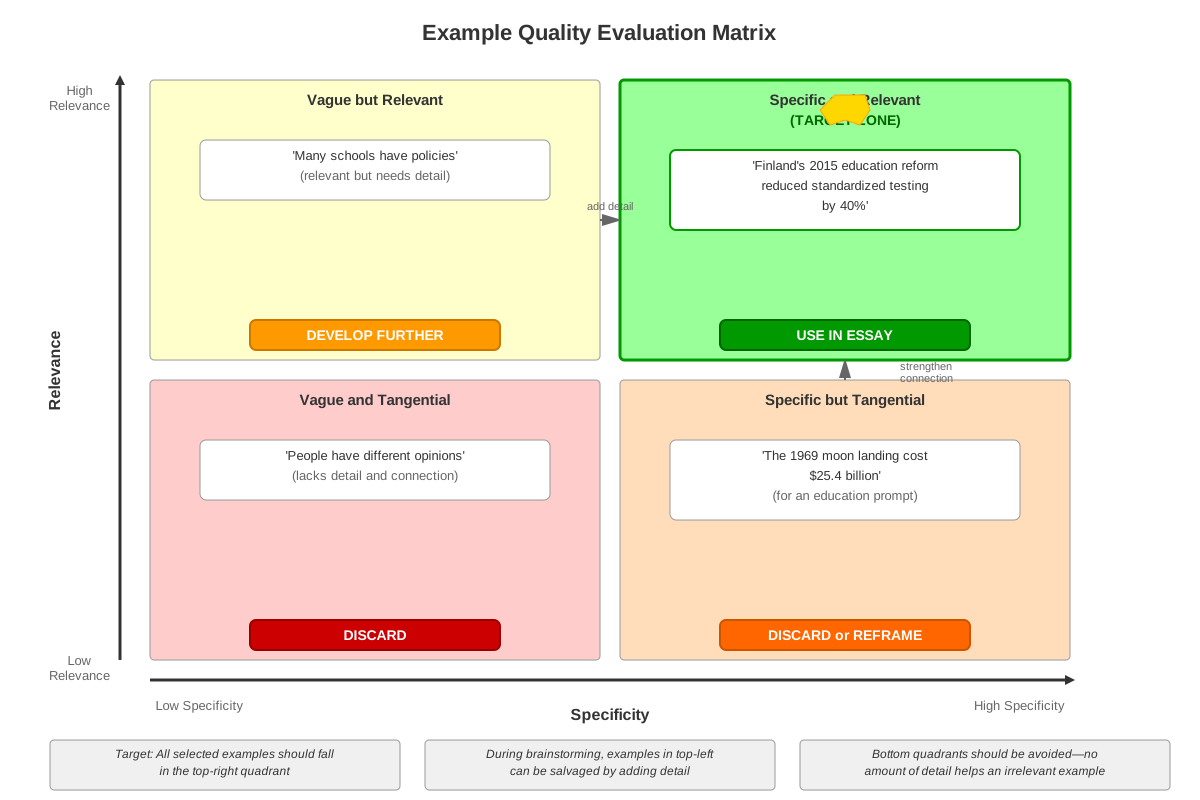
The most effective examples possess three key characteristics: relevance (directly addressing the prompt's claim), specificity (including concrete details rather than vague generalities), and development potential (offering enough complexity to sustain analysis). A relevant example directly supports or challenges the position being argued. A specific example includes names, dates, places, or particular circumstances rather than broad categories. An example with development potential allows the writer to explore implications, causes, effects, or counterarguments.
The Brainstorming Process
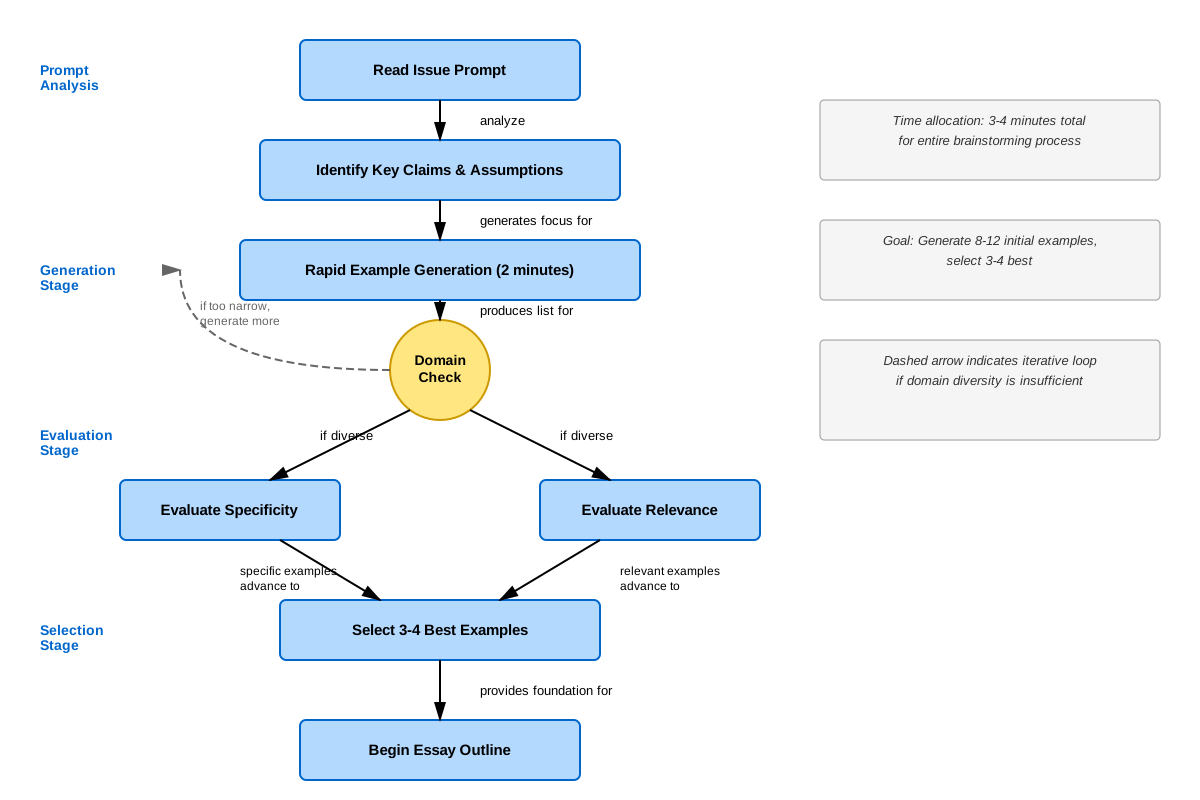
The brainstorming examples process should follow a structured approach to maximize efficiency under timed conditions. The recommended sequence includes:
- Read and analyze the prompt (30-45 seconds): Identify the core claim and any qualifications or conditions
- Determine your position (15-30 seconds): Decide whether to agree, disagree, or take a nuanced stance
- Generate examples rapidly (2-3 minutes): List potential examples without self-censoring
- Evaluate and select (30-45 seconds): Choose the 2-3 strongest examples for development
- Note key details (30 seconds): Jot down specific facts or aspects to include when writing
During the rapid generation phase, quantity matters more than quality. The goal is to activate different areas of knowledge and create options. Test-takers should aim for at least 5-7 potential examples, knowing that only 2-3 will be used. This abundance allows for strategic selection based on which examples offer the most development potential.
Categories of Examples
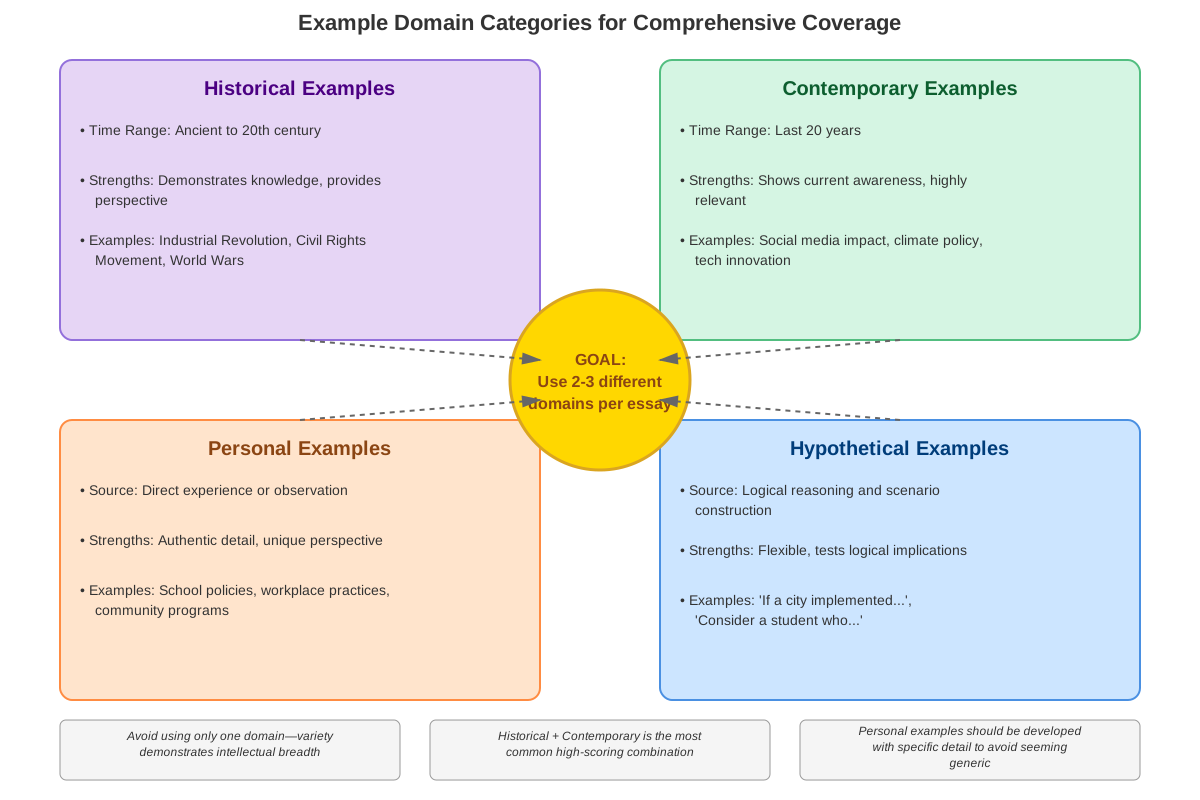
Effective brainstorming draws from multiple domains to ensure variety and demonstrate intellectual breadth. The main categories include:
| Category | Description | Strengths | Limitations |
|---|---|---|---|
| Historical | Events, figures, or movements from the past | Demonstrates knowledge; often well-known to scorers | Can feel overused; requires accurate details |
| Contemporary | Recent events, current policies, modern figures | Shows awareness of current issues; highly relevant | May date quickly; scorers may have different knowledge |
| Scientific/Technical | Research findings, technological developments | Provides empirical evidence; appears authoritative | Requires accurate representation; can be complex |
| Literary/Cultural | Books, films, artistic movements | Accessible; allows for nuanced analysis | May seem less "serious" than other domains |
| Personal/Observational | Individual experiences or witnessed phenomena | Authentic; allows for detailed description | Can appear less rigorous; must be developed carefully |
| Hypothetical | Thought experiments or imagined scenarios | Flexible; can be tailored precisely to prompt | Weakest type; should be used sparingly |
Strong essays typically draw from at least two different categories, demonstrating the ability to support arguments from multiple perspectives. For instance, an essay about education policy might include both historical examples (the GI Bill's impact on American higher education) and contemporary examples (Finland's education reforms).
Domain-Specific Example Banks
Successful test-takers develop mental "example banks" across common GRE domains. These banks serve as starting points for brainstorming:
Education: Brown v. Board of Education, Montessori method, Finland's education system, standardized testing debates, online learning during COVID-19, the Socratic method, vocational vs. liberal arts education
Technology: Social media's impact on democracy, artificial intelligence in healthcare, the digital divide, automation and employment, privacy concerns with data collection, the printing press revolution, smartphone addiction
Government/Policy: The New Deal, environmental regulations, healthcare systems (various countries), voting rights legislation, infrastructure investment, public-private partnerships, regulatory capture
Business/Economics: The 2008 financial crisis, monopolistic practices (Standard Oil, modern tech companies), corporate social responsibility, gig economy, income inequality, entrepreneurship, globalization effects
Science/Medicine: Vaccine development, climate change research, the scientific method's limitations, ethical considerations in research, peer review process, replication crisis, public health campaigns
Adapting Examples to Different Positions
A sophisticated brainstorming technique involves recognizing that the same example can support different positions depending on how it's framed and analyzed. For instance, the example of "Finland's education system" could support multiple arguments:
- Supporting reduced standardized testing: Finland's minimal testing correlates with high international performance
- Supporting teacher autonomy: Finnish teachers have significant curricular freedom, contributing to system success
- Challenging universal applicability: Finland's homogeneous population and small size may limit transferability
- Supporting increased education funding: Finland's investment in teacher training and resources enables their approach
This flexibility means that effective brainstorming focuses not just on generating examples, but on understanding how to deploy them strategically based on the position being argued.
The Specificity Spectrum
Examples exist on a spectrum from vague to highly specific. Consider these variations addressing technology's impact:
- Vague: "Technology can be harmful to young people"
- General: "Social media has negative effects on teenagers"
- Specific: "Instagram's internal research revealed that 32% of teenage girls felt worse about their bodies after using the platform"
- Highly Specific: "Facebook whistleblower Frances Haugen's 2021 testimony revealed that Instagram's internal research showed significant harm to teenage girls' mental health, yet the company continued prioritizing engagement over user wellbeing"
GRE essays scoring 5.0+ typically operate at the "specific" or "highly specific" level. During brainstorming, test-takers should push themselves to recall specific names, dates, statistics, or circumstances that elevate examples from general to specific.
Concept Relationships
The brainstorming examples process connects directly to prompt analysis, as the examples generated must address the specific claim being evaluated. Without accurate prompt analysis, brainstormed examples may be irrelevant or tangential. The relationship flows: Prompt Analysis → Position Development → Example Brainstorming → Example Selection → Essay Outlining.
Within the brainstorming process itself, the concepts form a hierarchy: Example Categories (the domains from which examples are drawn) → Specific Examples (the particular cases or instances) → Example Details (the specific facts or circumstances that make examples concrete). This hierarchy guides the brainstorming process from broad to narrow, ensuring both variety and specificity.
The connection between brainstorming and essay organization is bidirectional. The examples generated during brainstorming often suggest the essay's organizational structure (each major example becoming a body paragraph), while the intended structure influences which examples are selected (choosing examples that complement rather than duplicate each other).
Brainstorming examples also relates to counterargument development. Strong examples can be analyzed from multiple perspectives, and the brainstorming process should include considering how examples might be challenged or reinterpreted. This relationship ensures that the essay demonstrates sophisticated thinking rather than one-dimensional analysis.
High-Yield Facts
⭐ Essays scoring 5.0+ on the GRE consistently include at least 2-3 well-developed, specific examples
⭐ The brainstorming phase should take 3-4 minutes maximum, representing approximately 10% of total writing time
⭐ Examples drawn from at least two different domains (historical, contemporary, scientific, etc.) demonstrate stronger intellectual range
⭐ Specific details (names, dates, statistics, locations) elevate examples from adequate to excellent
⭐ The same example can support different positions depending on how it's framed and analyzed
- Hypothetical examples are the weakest type and should only be used when no concrete examples are available
- Personal examples can be effective if developed with sufficient detail and connected to broader implications
- Overused examples (e.g., Hitler, Einstein) are not automatically problematic if analyzed with sophistication
- Examples should be distributed throughout the essay rather than concentrated in a single paragraph
- The quality of example development matters more than the quantity of examples included
- Examples from recent events (within 5 years) demonstrate current awareness but must be described accurately
- Scientific or statistical examples should be represented accurately; approximations are acceptable if acknowledged
- Cultural or literary examples are equally valid as historical or scientific examples when properly developed
Quick check — test yourself on Brainstorming examples so far.
Try Flashcards →Common Misconceptions
Misconception: Only historical examples are appropriate for GRE essays → Correction: Contemporary examples, scientific findings, personal observations, and even well-developed hypothetical scenarios can all be effective. The key is specificity and relevance, not the time period from which the example is drawn.
Misconception: More examples always lead to higher scores → Correction: Quality and development matter far more than quantity. An essay with two thoroughly analyzed examples will outscore an essay with five superficially mentioned examples. Depth of analysis is more valuable than breadth of examples.
Misconception: Examples must be 100% factually accurate to be acceptable → Correction: While accuracy is important, minor errors in dates or details rarely impact scores significantly. Scorers evaluate the reasoning and analysis more than factual precision. However, major factual errors or completely fabricated examples can undermine credibility.
Misconception: Personal examples are too informal for the GRE → Correction: Personal examples can be highly effective when they include specific details and are analyzed in terms of broader implications. The key is developing them with the same rigor as other example types, connecting personal observation to the larger issue being discussed.
Misconception: Brainstorming should continue until the perfect examples are found → Correction: Brainstorming is time-limited and should end after 3-4 minutes regardless of whether "perfect" examples have been identified. Adequate examples developed well will always outscore perfect examples that leave insufficient time for writing and revision.
Misconception: Examples must directly prove the thesis → Correction: Examples can also be used to explore complexity, acknowledge counterarguments, or demonstrate nuanced thinking. An example that initially seems to challenge your position can be analyzed to ultimately support it, demonstrating sophisticated reasoning.
Misconception: Obscure examples impress scorers more than common ones → Correction: Scorers value clear, well-developed examples over obscure references. A commonly known example (like the Industrial Revolution) analyzed with depth and sophistication will score higher than an obscure example mentioned superficially.
Worked Examples
Worked Example 1: Education Policy Prompt
Prompt: "The best way to improve education is to increase teacher salaries to attract more talented individuals to the profession."
Brainstorming Process:
Step 1 - Analyze prompt (30 seconds): The claim suggests a causal relationship between teacher salaries and education quality, mediated by attracting talent. Key assumptions: salary is the primary factor in career choice, talented individuals aren't currently teaching, higher salaries will improve outcomes.
Step 2 - Determine position (20 seconds): Take a nuanced stance—salary matters but isn't sufficient alone.
Step 3 - Rapid generation (2.5 minutes):
- Finland: high teacher salaries + rigorous training + professional respect
- Teach for America: attracts talented graduates despite lower pay (mission-driven)
- Singapore: competitive teacher salaries + selective recruitment + ongoing development
- U.S. private schools: sometimes pay less than public but attract teachers through other factors
- Medical profession: high salaries attract talent, but also requires extensive training/support
- South Korea: high teacher respect/status even when salaries moderate
- Charter schools: variable pay but sometimes attract innovative teachers
- Japan: teaching as prestigious profession, moderate salaries
Step 4 - Evaluate and select (40 seconds):
- Select: Finland (comprehensive approach including salary)
- Select: Teach for America (counterexample showing salary isn't only factor)
- Select: Singapore (successful model combining salary with other elements)
- Reject: Private schools (less specific, harder to develop)
- Reject: Medical profession (too different from teaching context)
Step 5 - Note key details (30 seconds):
- Finland: teachers require master's degree, salaries competitive with other professions, only top 10% of graduates accepted
- TFA: attracts Ivy League graduates for 2-year commitments, mission-driven despite ~$40K starting salary
- Singapore: teachers in top 30% of graduates, competitive pay, 100 hours annual professional development
Result: Three diverse, specific examples ready for development, drawn from different geographical contexts, supporting a nuanced argument that salary is important but must be combined with other factors.
Worked Example 2: Technology Prompt
Prompt: "As technology advances, people are becoming more isolated from one another."
Brainstorming Process:
Step 1 - Analyze prompt (35 seconds): Claims a negative correlation between technological advancement and human connection. Assumes technology inherently isolates, doesn't consider how technology might facilitate connection.
Step 2 - Determine position (25 seconds): Disagree with the absolute claim—technology has mixed effects, both isolating and connecting.
Step 3 - Rapid generation (2.5 minutes):
- Social media: connects distant friends but reduces face-to-face interaction
- COVID-19 pandemic: Zoom/video calls maintained connections during lockdowns
- Online gaming communities: create new forms of social connection
- Smartphone use: people on phones in public spaces, ignoring physical surroundings
- Dating apps: new way to meet partners, but commodifies relationships
- Remote work: reduces office social interaction but enables geographic flexibility
- Support groups online: connect people with rare conditions/experiences
- Texting vs. calling: easier communication but potentially shallower
- Virtual reality: immersive but potentially escapist
- Elderly and technology: video calls with distant grandchildren
Step 4 - Evaluate and select (45 seconds):
- Select: COVID-19 pandemic/video calls (recent, powerful counterexample)
- Select: Online support communities (demonstrates technology creating connection impossible otherwise)
- Select: Smartphone use in public (supports isolation aspect, provides balance)
- Reject: Dating apps (complex, harder to develop clearly)
- Reject: Virtual reality (less universally familiar)
Step 5 - Note key details (35 seconds):
- COVID: Zoom daily active users increased from 10M (Dec 2019) to 300M (April 2020), maintained family/work connections
- Online support: Rare disease communities (e.g., PatientsLikeMe), mental health forums connect people who might otherwise be isolated
- Smartphones: Studies showing decreased conversation among strangers, "alone together" phenomenon
Result: Three balanced examples supporting a nuanced position, including both supporting and challenging evidence for the prompt's claim, demonstrating sophisticated analysis.
Exam Strategy
When approaching the Analyze an Issue task, allocate exactly 3-4 minutes to brainstorming examples before beginning to write. Set a mental timer and force yourself to move to outlining even if you feel you haven't found "perfect" examples. The examples you have after 3-4 minutes are sufficient if you develop them well.
Trigger words in prompts that signal heavy reliance on examples include: "the best way," "always," "never," "most important," "primarily," and "the main reason." These absolute or superlative claims require concrete evidence to support or challenge effectively. When you see these triggers, recognize that your essay will need particularly strong examples to demonstrate the claim's validity or limitations.
Process-of-elimination for example selection: After generating 5-7 potential examples, eliminate those that are: (1) too similar to each other, (2) too vague or general, (3) outside your knowledge comfort zone (you can't recall specific details), or (4) tangentially related rather than directly relevant. The remaining 2-3 examples should be your focus.
Time allocation strategy: If you have 30 minutes total for the essay, use approximately: 1 minute for prompt analysis, 3-4 minutes for brainstorming examples, 2 minutes for outlining, 20 minutes for drafting, and 3-4 minutes for revision. The brainstorming phase is non-negotiable—skipping it leads to weaker essays that lack concrete support.
Domain diversity tactic: Consciously aim for examples from different categories. If your first example is historical, make your second contemporary or scientific. This diversity signals intellectual range to scorers and prevents the essay from feeling one-dimensional.
The "so what?" test: After generating each potential example, ask "So what? How does this specifically address the prompt?" If you can't immediately articulate the connection, the example may be tangential. This quick test during brainstorming prevents selecting examples that seem relevant but prove difficult to connect during writing.
Backup example strategy: Always brainstorm at least one more example than you plan to use. If you plan to develop two examples in your essay, brainstorm three. This backup ensures that if you struggle to develop one example during writing, you have an alternative ready.
Memory Techniques
SPHERE mnemonic for example categories to ensure diversity:
- Scientific/Statistical
- Personal/Observational
- Historical
- Economic/Business
- Recent/Contemporary
- Educational/Cultural
During brainstorming, mentally cycle through SPHERE to trigger examples from different domains.
The "Three Ts" for example quality:
- True (accurate or plausibly accurate)
- Tied (directly connected to the prompt)
- Thorough (includes specific details for development)
Before selecting an example, verify it meets all three Ts.
Visualization technique: Imagine a mental filing cabinet with drawers labeled by domain (History, Science, Current Events, Personal Experience, etc.). During brainstorming, visualize opening each drawer and scanning its contents. This spatial memory technique helps access stored knowledge more efficiently under pressure.
The "Name-Date-Place" rule: For each example you select, immediately note at least one specific name, date, or place. This ensures you have the concrete details needed for specificity. For instance, don't just write "Finland education," write "Finland education - master's degree requirement, top 10% of graduates."
Acronym for brainstorming sequence: RAPID
- Read prompt carefully
- Analyze claim and assumptions
- Position yourself (agree/disagree/nuanced)
- Inventory examples (generate 5-7)
- Decide on best 2-3
This acronym keeps the brainstorming process structured and efficient.
Summary
Brainstorming examples is the foundational skill for producing high-scoring GRE Analyze an Issue essays. The process involves rapidly generating 5-7 potential examples within 3-4 minutes, then strategically selecting the 2-3 strongest for development. Effective examples possess three critical qualities: relevance to the prompt's specific claim, specificity through concrete details (names, dates, statistics), and sufficient complexity for analytical development. Strong brainstorming draws from multiple domains—historical, contemporary, scientific, personal, and cultural—demonstrating intellectual breadth. The technique requires both quantity (generating multiple options) and quality (selecting examples with development potential). Test-takers should develop mental "example banks" across common GRE domains while remaining flexible enough to adapt examples to different positions and prompts. The brainstorming phase directly determines essay quality, as examples provide the concrete evidence that transforms abstract arguments into persuasive reasoning. Mastering this skill under timed conditions separates adequate essays from those scoring in the 5.0-6.0 range.
Key Takeaways
- Allocate exactly 3-4 minutes to brainstorming examples before writing; this investment pays dividends in essay quality
- Generate 5-7 potential examples rapidly, then select the 2-3 strongest based on relevance, specificity, and development potential
- Draw examples from at least two different domains (historical, contemporary, scientific, personal) to demonstrate intellectual range
- Specific details (names, dates, statistics, locations) are non-negotiable for high-scoring essays; push beyond vague generalities
- The same example can support different positions depending on framing and analysis; flexibility is key
- Quality of example development matters far more than quantity; two thoroughly analyzed examples outscore five superficial mentions
- Develop mental "example banks" across common GRE domains (education, technology, government, business, science) for efficient recall under pressure
Related Topics
Thesis Development: After brainstorming examples, the next step is crafting a clear thesis that your examples will support. Mastering example generation enables more confident thesis statements because you know you have the evidence to back up your claims.
Body Paragraph Organization: Each major example typically becomes a body paragraph. Understanding how to structure paragraphs around examples—introducing the example, providing specific details, and analyzing its implications—builds directly on brainstorming skills.
Counterargument Integration: Advanced essays use examples to acknowledge and address counterarguments. Once comfortable generating examples for your position, you can brainstorm examples that challenge your thesis and then refute or qualify them.
Prompt Analysis Techniques: Effective brainstorming depends on accurate prompt analysis. Deepening your ability to identify claims, assumptions, and key terms in prompts will improve the relevance of your brainstormed examples.
Time Management Strategies: Brainstorming is one component of overall time management for the Analytical Writing section. Studying comprehensive time allocation strategies will help you balance brainstorming with outlining, drafting, and revision.
Practice CTA
Now that you understand the strategies and techniques for brainstorming examples, it's time to apply this knowledge through deliberate practice. Attempt the practice questions associated with this topic, challenging yourself to generate 5-7 diverse examples within 3-4 minutes for each prompt. Use the flashcards to reinforce the categories of examples and quality criteria. Remember: brainstorming is a skill that improves dramatically with practice. Each prompt you work with expands your mental example bank and increases your confidence. The investment you make now in developing this skill will pay off with higher scores and more confident, persuasive essays on test day. Start practicing today—your future self will thank you!
Sign up free to keep reading
Create a free AnvayaPrep account to finish this GRE guide on Brainstorming examples — plus flashcards and practice questions.