Overview
The body paragraph structure is the architectural foundation of a high-scoring GRE Analytical Writing essay. While the introduction and conclusion frame your argument, the body paragraphs carry the substantive weight of your analysis, providing the evidence, reasoning, and depth that scorers evaluate most carefully. Each body paragraph must function as a self-contained unit of argumentation while simultaneously advancing your overall thesis in a coherent, logical progression.
On the GRE Analyze an Issue task, test-takers have 30 minutes to construct a persuasive essay that takes a position on a complex issue and supports that position with relevant reasons and examples. The GRE body paragraph structure directly determines whether an essay achieves a score of 3 (adequate) or 5-6 (insightful and compelling). ETS scorers specifically look for "well-developed" paragraphs that explore the complexities and implications of the issue, not merely surface-level assertions. A well-structured body paragraph demonstrates critical thinking by presenting a clear point, supporting it with specific evidence, explaining the reasoning that connects evidence to claim, and acknowledging nuance or counterarguments.
Understanding body paragraph structure is inseparable from mastering other Analytical Writing concepts. The thesis statement in your introduction creates the roadmap that your body paragraphs must follow. Each body paragraph's topic sentence must directly support one aspect of that thesis. Transitions between paragraphs ensure coherence across the essay. The depth of analysis within each paragraph—how thoroughly you explain your reasoning—determines whether your essay demonstrates the sophisticated thinking required for top scores. Without mastering body paragraph structure, even the most brilliant ideas will appear disorganized and unconvincing to GRE scorers.
Learning Objectives
- [ ] Identify when body paragraph structure is being tested
- [ ] Explain the core rule or strategy behind body paragraph structure
- [ ] Apply body paragraph structure to GRE-style questions accurately
- [ ] Construct topic sentences that clearly connect to the thesis statement
- [ ] Develop supporting evidence with specific, relevant examples
- [ ] Integrate counterarguments or complications within body paragraphs to demonstrate nuanced thinking
- [ ] Evaluate sample body paragraphs and diagnose structural weaknesses
Prerequisites
- Basic essay structure: Understanding of introduction, body, and conclusion components is essential because body paragraphs must fit within the larger essay architecture
- Thesis statement construction: Ability to craft a clear position statement is necessary because each body paragraph must support one aspect of the thesis
- Paragraph unity: Familiarity with the concept that each paragraph should focus on one main idea ensures coherent body paragraph development
- Analytical reasoning: Capacity to connect evidence to claims through logical explanation is fundamental to developing persuasive body paragraphs
Why This Topic Matters
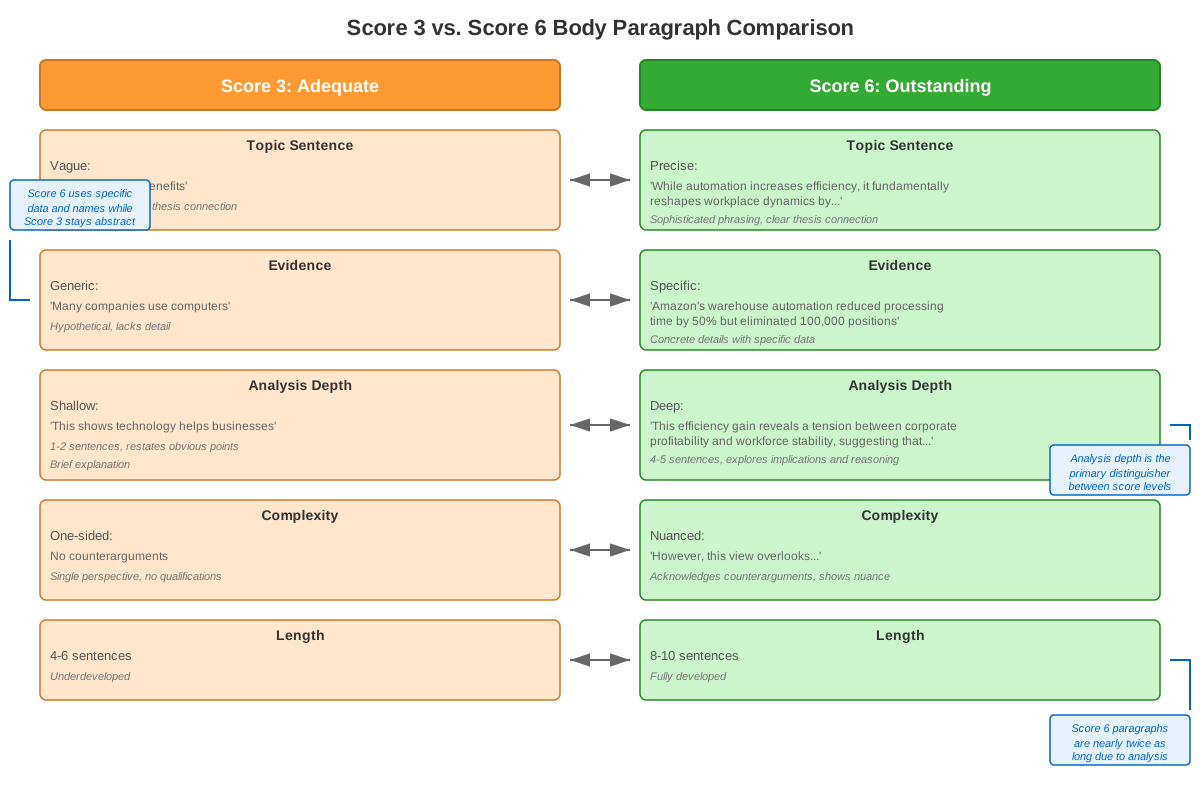
Body paragraph structure represents approximately 70-80% of your GRE Analytical Writing score. While introductions and conclusions matter, ETS scoring rubrics explicitly emphasize "well-developed" body paragraphs that "explore the complexities and implications" of the issue. Essays that receive scores of 5 or 6 consistently demonstrate sophisticated body paragraph organization, while essays scoring 3 or below typically exhibit underdeveloped paragraphs that merely list points without thorough explanation.
In real-world applications, the ability to structure persuasive paragraphs translates directly to graduate school success. Research papers, grant proposals, literature reviews, and dissertation chapters all require the same skills: presenting a claim, supporting it with evidence, explaining the reasoning, and acknowledging complexity. Professionals in law, business, education, and policy analysis use these paragraph-building skills daily when writing briefs, reports, proposals, and analyses.
On the GRE Analyze an Issue task, body paragraph structure appears in every single essay prompt. The task explicitly requires test-takers to "develop and support your ideas with reasons and/or examples from your experience, observations, or reading." This directive essentially describes what happens in body paragraphs. Scorers evaluate whether paragraphs contain clear topic sentences, relevant supporting details, thorough explanations of reasoning, and consideration of counterarguments or complications. Essays that score 4 or above typically contain 2-4 well-developed body paragraphs, each following a consistent internal structure.
Core Concepts
The TEEL Framework
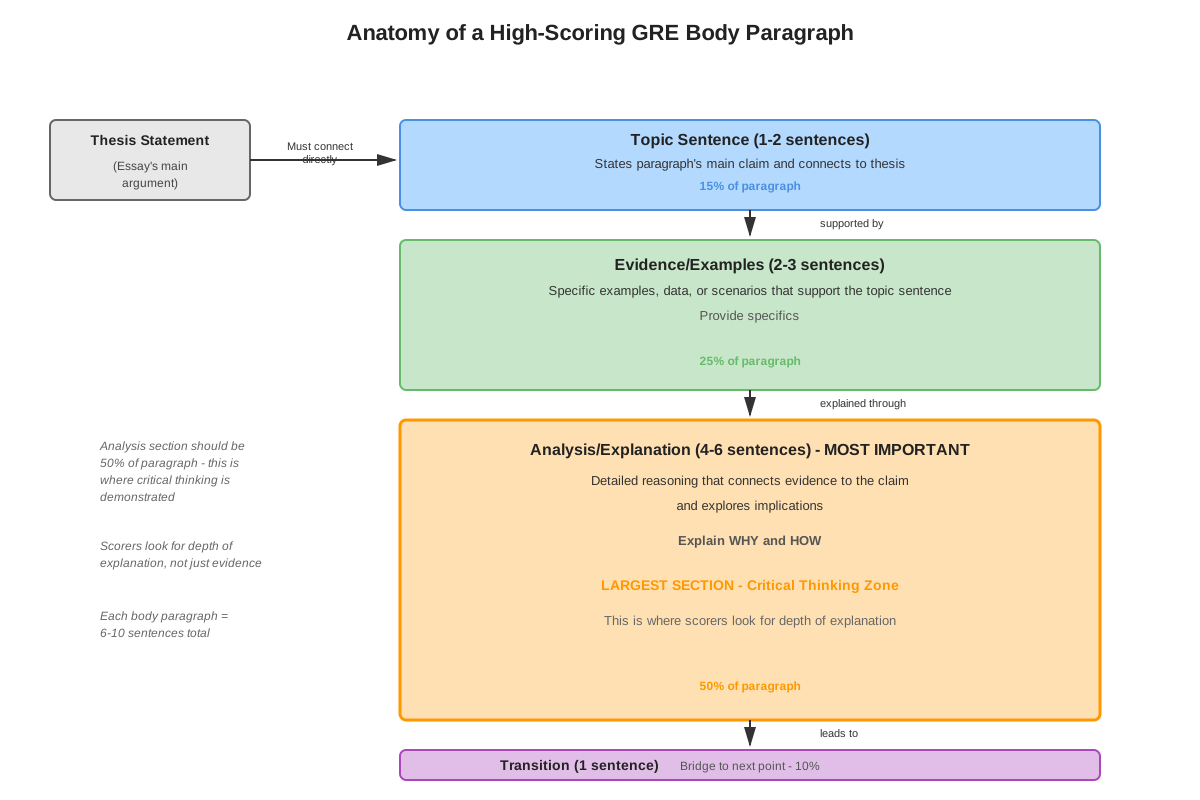
The most effective body paragraph structure for GRE essays follows the TEEL framework: Topic sentence, Evidence/Example, Explanation, and Link. This structure ensures each paragraph contains all necessary components while maintaining focus on a single main idea.
The topic sentence serves as the paragraph's thesis statement, presenting the main point that supports one aspect of your overall argument. It should be specific enough to guide the paragraph's development but broad enough to require elaboration. For example: "Educational institutions that prioritize standardized test scores often neglect the development of creative thinking skills that are essential for innovation."
Evidence or examples provide concrete support for your topic sentence. On the GRE, these typically come from personal observation, historical events, current affairs, literature, or hypothetical scenarios. The key is specificity—vague generalities weaken your argument. Instead of "many companies value creativity," write "Google's famous '20% time' policy, which allowed engineers to spend one day per week on passion projects, generated innovations like Gmail and Google News."
Explanation represents the most critical component that separates high-scoring from mediocre essays. This is where you analyze how your evidence supports your claim, explore implications, and demonstrate sophisticated thinking. Many test-takers present evidence and then immediately move to the next point, leaving scorers to infer the connection. Strong explanation explicitly articulates the reasoning: "This policy demonstrates that when institutions create space for exploration beyond standardized metrics, they unlock creative potential that rigid evaluation systems would suppress."
The link connects the paragraph back to your thesis and creates a transition to the next idea. This ensures coherence across your essay and reminds scorers how each paragraph advances your overall argument.
The Claim-Evidence-Reasoning Pattern
An alternative framework that achieves similar results is the Claim-Evidence-Reasoning (CER) pattern, commonly used in academic writing. This structure emphasizes the logical progression from assertion to proof to analysis.
The claim functions identically to the topic sentence—it states what you will prove in this paragraph. The evidence provides factual support, data, examples, or expert testimony. The reasoning explains why the evidence supports the claim, addressing potential objections and exploring implications.
This pattern works particularly well when you need to present multiple pieces of evidence for a single claim. For instance, if your claim is that "technological advancement often creates unforeseen social problems," you might present evidence about social media's impact on mental health, then explain the reasoning, followed by additional evidence about automation's effect on employment, with corresponding reasoning.
Paragraph Length and Development
GRE body paragraphs should typically contain 5-8 sentences or approximately 100-150 words. This length allows sufficient development without becoming unwieldy under time pressure. Paragraphs shorter than 4 sentences usually lack adequate explanation, while paragraphs exceeding 10 sentences often lose focus or try to cover multiple ideas.
Development depth matters more than length. A well-developed paragraph thoroughly explores one idea rather than superficially addressing multiple points. Consider this progression:
Underdeveloped: "Technology helps education. Students can access information online. This improves learning."
Adequately developed: "Technology enhances educational access by democratizing information. Students in remote areas can now access lectures from leading universities through platforms like Coursera and edX, opportunities previously available only to those who could afford elite institutions. This technological shift reduces educational inequality."
Fully developed: "Technology enhances educational access by democratizing information, though this benefit depends on addressing the digital divide. Students in remote areas can now access lectures from leading universities through platforms like Coursera and edX, opportunities previously available only to those who could afford elite institutions. However, this technological promise remains unfulfilled for students lacking reliable internet access or devices. Therefore, while technology possesses the potential to reduce educational inequality, realizing this potential requires concurrent investment in infrastructure and ensuring equitable access to digital resources."
Integrating Counterarguments
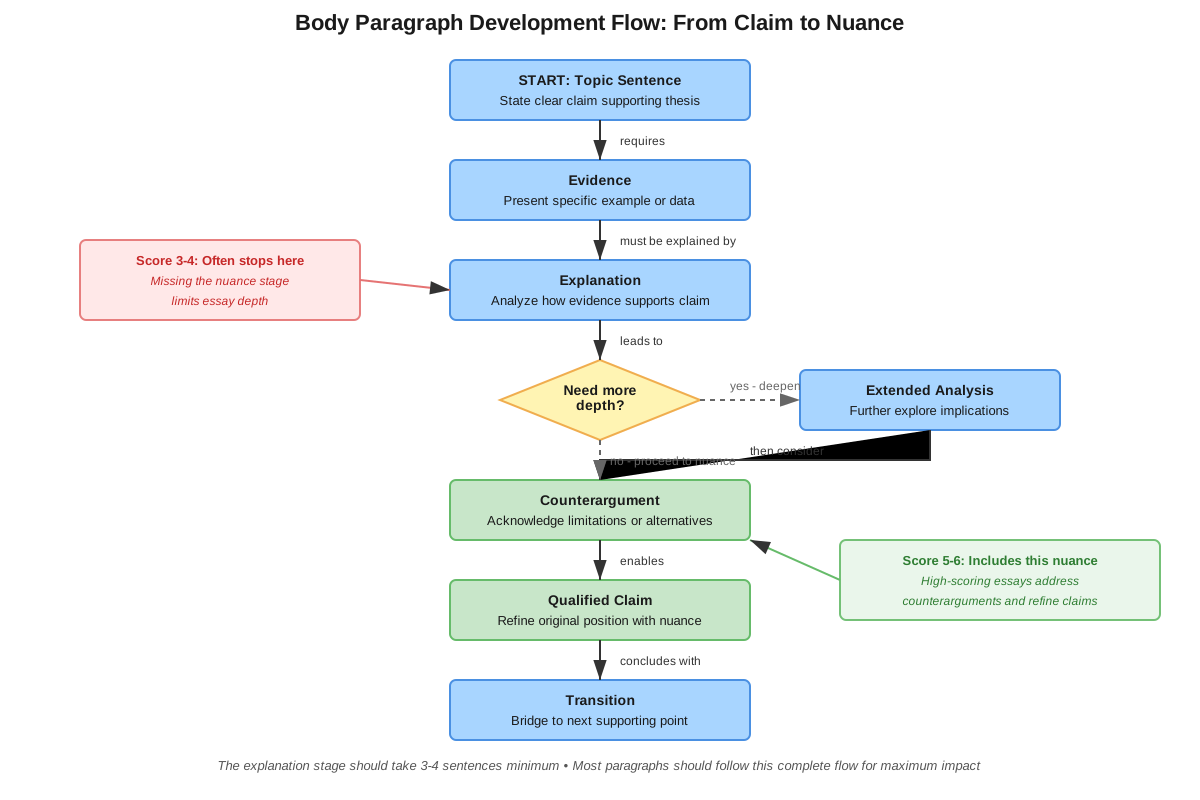
High-scoring GRE essays demonstrate nuanced thinking by acknowledging complexity, limitations, or counterarguments within body paragraphs. This doesn't mean contradicting your thesis—rather, it shows you've considered multiple perspectives before reaching your conclusion.
Three effective approaches for integrating counterarguments include:
- Acknowledge-then-refute: Present an opposing view, then explain why your position remains stronger
- Qualify your claim: Identify conditions under which your argument applies or limitations to your position
- Concede-and-extend: Admit a valid point from the opposition, then show how your argument still holds or addresses a more important concern
For example: "While critics correctly note that standardized tests provide objective comparison across diverse student populations, this benefit comes at the cost of narrowing curriculum to testable content, ultimately limiting the educational breadth that students receive."
Transitions and Coherence
Effective body paragraphs don't exist in isolation—they connect to each other through strategic transitions. Transitional phrases at the beginning of paragraphs signal the relationship between ideas:
- Addition: Furthermore, Moreover, Additionally, In addition
- Contrast: However, Conversely, On the other hand, Nevertheless
- Causation: Consequently, Therefore, As a result, Thus
- Example: For instance, To illustrate, Specifically, Consider
- Sequence: First, Second, Finally, Subsequently
Beyond transitional words, conceptual bridges create coherence by referencing ideas from previous paragraphs. For instance, if your first body paragraph discusses economic benefits of a policy, your second might begin: "Beyond these economic advantages, the policy also generates significant social benefits..."
The Two-Paragraph vs. Three-Paragraph Approach
Test-takers often wonder whether to write two longer, more developed body paragraphs or three shorter ones. Both approaches can succeed, depending on your argument's complexity and writing speed.
| Approach | Advantages | Disadvantages | Best For |
|---|---|---|---|
| Two body paragraphs | Allows deeper development; more thorough explanation; easier to maintain focus | Requires strong time management; less structural variety | Complex arguments requiring extensive explanation; slower writers |
| Three body paragraphs | Provides more opportunities to demonstrate range; easier to organize multiple supporting points | Risk of superficial development; requires efficient writing | Arguments with distinct supporting reasons; faster writers |
The key is ensuring adequate development regardless of paragraph number. Two paragraphs of 150 words each are superior to three paragraphs of 60 words each.
Concept Relationships
The components of body paragraph structure form an interdependent system. The topic sentence establishes the paragraph's scope, which determines what evidence is relevant. The evidence requires explanation to connect it meaningfully to the topic sentence. The explanation must reference both the evidence and the topic sentence to create logical coherence. Finally, the link connects the entire paragraph back to the thesis statement from the introduction.
This internal structure connects to broader essay organization: Introduction (thesis statement) → Body Paragraph 1 (supporting reason 1) → Body Paragraph 2 (supporting reason 2) → Body Paragraph 3 (supporting reason 3 or counterargument acknowledgment) → Conclusion (synthesis). Each body paragraph's topic sentence must directly support the thesis, creating a logical chain of reasoning throughout the essay.
Body paragraph structure also relates to the prerequisite concept of paragraph unity. Each paragraph should develop one main idea (stated in the topic sentence) without digressing into unrelated points. This unity principle ensures that readers can follow your argument's progression without confusion.
The relationship between body paragraphs and the overall essay can be visualized as: Thesis Statement → [Topic Sentence 1 + Evidence + Explanation + Link] → [Topic Sentence 2 + Evidence + Explanation + Link] → [Topic Sentence 3 + Evidence + Explanation + Link] → Conclusion. Each arrow represents a logical connection that must be clear to readers.
Quick check — test yourself on Body paragraph structure so far.
Try Flashcards →High-Yield Facts
⭐ Body paragraphs constitute 70-80% of your Analytical Writing score, making them the most important component of your essay.
⭐ The TEEL framework (Topic sentence, Evidence, Explanation, Link) provides a reliable structure for developing coherent, persuasive body paragraphs.
⭐ Explanation is the most commonly underdeveloped component in GRE essays—scorers specifically look for analysis that connects evidence to claims.
⭐ Each body paragraph should contain 5-8 sentences or approximately 100-150 words to ensure adequate development without losing focus.
⭐ Topic sentences must directly support your thesis statement and present a specific claim that the paragraph will develop.
- Evidence should be specific and concrete rather than vague or general—names, dates, and details strengthen your argument.
- High-scoring essays acknowledge complexity or counterarguments within body paragraphs, demonstrating nuanced thinking.
- Transitions between body paragraphs create coherence and help scorers follow your argument's logical progression.
- Two well-developed body paragraphs are superior to three underdeveloped ones—depth matters more than quantity.
- The claim-evidence-reasoning pattern provides an alternative framework that achieves similar results to TEEL.
- Body paragraphs should maintain unity by focusing on one main idea without digressing into unrelated points.
- Linking sentences at the end of body paragraphs connect back to the thesis and create bridges to subsequent paragraphs.
Common Misconceptions
Misconception: Body paragraphs should simply list multiple examples without explanation.
Correction: Listing examples without analysis produces shallow essays that score 3 or below. High-scoring essays thoroughly explain how each example supports the claim, exploring implications and demonstrating critical thinking. One well-explained example is more valuable than three unexplained ones.
Misconception: Every body paragraph must follow the exact same structure in the exact same order.
Correction: While consistency helps, effective writers adapt structure to their argument's needs. Some paragraphs might begin with a provocative example before stating the topic sentence, while others might integrate counterarguments mid-paragraph. The key is ensuring all components (claim, evidence, explanation) appear somewhere in the paragraph.
Misconception: Longer body paragraphs always receive higher scores.
Correction: Length without substance doesn't impress scorers. A concise, well-developed paragraph that thoroughly explains its reasoning outperforms a lengthy paragraph filled with repetition or irrelevant details. Quality of development matters more than word count.
Misconception: Personal examples are less valuable than historical or literary examples.
Correction: GRE scorers value specificity and relevance, not the source of examples. A detailed personal observation that clearly supports your argument is more effective than a vague reference to a historical event. The key is how well you explain the example's connection to your claim.
Misconception: Acknowledging counterarguments in body paragraphs weakens your position.
Correction: Addressing opposing views demonstrates sophisticated thinking and actually strengthens your argument by showing you've considered multiple perspectives. Essays that score 5-6 typically acknowledge complexity rather than presenting one-sided arguments.
Misconception: Topic sentences should be complex and contain multiple ideas.
Correction: Effective topic sentences present one clear claim that the paragraph will develop. Complexity belongs in the explanation, not the topic sentence. A focused topic sentence helps maintain paragraph unity and guides your development.
Worked Examples
Example 1: Analyzing and Improving an Underdeveloped Paragraph
Prompt: "The best way to teach is to praise positive actions and ignore negative ones."
Underdeveloped paragraph:
"Praising positive actions works well in teaching. When students receive praise, they feel motivated. Teachers should use this approach. It makes students want to learn more. This is why praise is effective."
Analysis of weaknesses:
- Topic sentence is vague and doesn't present a specific claim
- No concrete evidence or examples provided
- Explanation consists of unsupported assertions rather than reasoning
- No acknowledgment of complexity or limitations
- No link back to thesis or forward to next idea
- Only 5 sentences but lacks development depth
Improved paragraph using TEEL structure:
"While praising positive actions can effectively reinforce desired behaviors in young children, this approach becomes insufficient for older students who require more nuanced feedback to develop complex skills. Elementary school teachers successfully use positive reinforcement to encourage basic behaviors like raising hands before speaking or completing homework assignments—the immediate praise creates clear associations between actions and rewards. However, as students advance to higher-level thinking tasks, they need constructive criticism to identify specific areas for improvement. A high school student writing an analytical essay, for instance, benefits more from targeted feedback about weak thesis statements or insufficient evidence than from generic praise about effort. Therefore, while positive reinforcement plays a valuable role in education, effective teaching requires balancing praise with constructive guidance that helps students understand not just what they did right, but how to improve what they did wrong."
What makes the improved version stronger:
- Clear topic sentence presenting a specific, nuanced claim
- Concrete example (elementary school hand-raising)
- Contrasting example showing limitations (high school essay writing)
- Thorough explanation of reasoning connecting examples to claim
- Acknowledgment of complexity (praise works in some contexts but not others)
- Link back to broader argument about teaching effectiveness
Example 2: Constructing a Body Paragraph from Scratch
Prompt: "Governments should place few, if any, restrictions on scientific research and development."
Step 1: Develop a topic sentence supporting your thesis
Assume your thesis argues for moderate restrictions. Your topic sentence might be: "Unrestricted scientific research poses significant ethical risks, as demonstrated by historical cases where lack of oversight led to human rights violations."
Step 2: Select specific evidence
Choose the Tuskegee Syphilis Study (1932-1972) as your primary example, where researchers withheld treatment from African American men to study disease progression without informed consent.
Step 3: Explain the reasoning thoroughly
Connect the example to your claim by explaining how lack of restrictions enabled the abuse, the harm caused, and why this demonstrates the need for oversight.
Step 4: Add nuance or acknowledge complexity
Recognize that restrictions can slow beneficial research, but argue this cost is justified.
Step 5: Link to thesis and transition
Connect back to your argument for moderate restrictions and preview your next point.
Complete paragraph:
"Unrestricted scientific research poses significant ethical risks, as demonstrated by historical cases where lack of oversight led to human rights violations. The Tuskegee Syphilis Study, conducted by the U.S. Public Health Service from 1932 to 1972, exemplifies these dangers: researchers withheld available treatment from African American men to observe the disease's natural progression, causing unnecessary suffering and death without informed consent. This forty-year study continued precisely because insufficient restrictions existed to protect human subjects from exploitation in the name of scientific knowledge. While critics of research restrictions correctly note that oversight requirements can slow potentially beneficial discoveries, this cost is justified when weighed against the alternative—a system where researchers' pursuit of knowledge can override basic human rights and dignity. The Tuskegee case ultimately led to federal regulations requiring informed consent and institutional review boards, restrictions that have prevented similar abuses without halting scientific progress. Thus, rather than eliminating restrictions entirely, governments should maintain ethical oversight that protects human welfare while still permitting valuable research to proceed."
Exam Strategy
When approaching the Analyze an Issue task, allocate your 30 minutes strategically: 2-3 minutes planning, 23-25 minutes writing, 2-3 minutes reviewing. During the writing phase, spend approximately 6-8 minutes on each body paragraph if writing three, or 10-12 minutes each if writing two.
Trigger words in prompts that signal the need for well-structured body paragraphs include: "develop and support your ideas," "provide reasons and examples," "explain your views," and "discuss the extent to which you agree or disagree." These phrases explicitly require the evidence and explanation that body paragraphs provide.
Process-of-elimination approach for self-evaluation: After writing each body paragraph, quickly check:
- Does it have a clear topic sentence? (If no, add one)
- Does it contain specific evidence? (If no, add details)
- Does it explain how evidence supports the claim? (If no, add 2-3 sentences of reasoning)
- Does it connect to the thesis? (If no, add a linking sentence)
Time-saving strategies for body paragraph construction:
- Use your planning time to outline each body paragraph's main point and example
- Write topic sentences for all body paragraphs before developing any single paragraph fully
- If running short on time, prioritize explanation over additional examples—one well-explained example outperforms three unexplained ones
- Use transitional phrases at paragraph beginnings to create coherence efficiently
Red flags that indicate structural problems:
- Paragraphs shorter than 4 sentences (likely underdeveloped)
- Paragraphs containing multiple unrelated examples (lacks unity)
- Absence of words like "because," "therefore," "this demonstrates," or "consequently" (insufficient explanation)
- Topic sentences that don't clearly connect to your thesis (organizational problem)
Exam Tip: If you find yourself running out of time, write a strong topic sentence and one well-explained example rather than rushing through multiple underdeveloped points. Scorers reward depth over breadth.
Memory Techniques
TEEL Mnemonic: "Tell them what you'll prove, Evidence to back it up, Explain why it matters, Link it all together." This reminds you of all four essential components.
The 3-E Rule: Every body paragraph needs three types of E's: Example (evidence), Explanation (reasoning), and Extension (link to thesis). If you're missing any E, your paragraph is incomplete.
Visualization strategy: Picture each body paragraph as a hamburger—the topic sentence and link are the buns (holding everything together), while the evidence and explanation are the filling (providing substance). Just as a hamburger needs both buns and filling, your paragraph needs both structure and content.
The "So What?" Test: After writing evidence, ask yourself "So what?" If you can't immediately answer how the evidence supports your claim, you need more explanation. Keep asking "So what?" until you've thoroughly explained the connection.
Acronym for transitions: FACE your next paragraph—Furthermore (addition), Although (contrast), Consequently (causation), Especially (emphasis). This helps you remember to include transitional phrases.
The Rule of Three: Each body paragraph should have at least three sentences of explanation for every piece of evidence. This ensures adequate development and prevents superficial analysis.
Summary
Body paragraph structure forms the foundation of high-scoring GRE Analytical Writing essays, accounting for 70-80% of your score. Effective body paragraphs follow the TEEL framework (Topic sentence, Evidence, Explanation, Link) or the similar Claim-Evidence-Reasoning pattern, ensuring each paragraph presents a clear point, supports it with specific examples, thoroughly explains the reasoning connecting evidence to claim, and links back to the thesis. The most critical component is explanation—many test-takers present evidence without analyzing how it supports their argument, resulting in superficial essays that score 3 or below. High-scoring essays contain 2-3 well-developed body paragraphs of 100-150 words each, acknowledge complexity or counterarguments to demonstrate nuanced thinking, and use transitions to create coherence across paragraphs. Mastering body paragraph structure requires understanding that depth of development matters more than quantity of examples, that topic sentences must directly support the thesis, and that every paragraph should maintain unity by focusing on one main idea while thoroughly exploring its implications.
Key Takeaways
- TEEL framework (Topic, Evidence, Explanation, Link) provides a reliable structure for developing coherent, persuasive body paragraphs that scorers reward
- Explanation is the most critical and commonly underdeveloped component—thoroughly analyze how your evidence supports your claim rather than assuming the connection is obvious
- Each body paragraph should contain 5-8 sentences (100-150 words) to ensure adequate development without losing focus or wasting time
- Topic sentences must directly support your thesis statement and present one specific claim that the paragraph will develop
- Two well-developed body paragraphs outperform three superficial ones—prioritize depth of analysis over quantity of points
- Acknowledge complexity or counterarguments within body paragraphs to demonstrate the nuanced thinking that distinguishes scores of 5-6 from lower scores
- Use specific, concrete evidence with names, dates, and details rather than vague generalities to strengthen your argument's persuasiveness
Related Topics
Thesis Statement Construction: Mastering body paragraph structure enables you to write more effective thesis statements because you'll understand what claims you can actually develop and support within 30 minutes. Your thesis should preview the main points that your body paragraphs will explore.
Transitions and Coherence: Once you've mastered individual paragraph structure, studying transitions helps you connect paragraphs into a unified essay where each idea flows logically to the next, creating the coherence that scorers explicitly evaluate.
Counterargument Integration: Advanced body paragraph techniques include sophisticated ways to acknowledge and address opposing viewpoints, demonstrating the complex thinking that distinguishes top-scoring essays.
Evidence Selection and Development: Deepening your understanding of what constitutes effective evidence and how to develop examples thoroughly will strengthen your body paragraphs and increase your score.
Time Management for Analytical Writing: Learning to construct well-structured body paragraphs efficiently under time pressure requires specific strategies for planning, drafting, and revising within the 30-minute limit.
Practice CTA
Now that you understand the principles of effective body paragraph structure, it's time to apply these concepts through deliberate practice. Attempt the practice questions to test your ability to identify strong versus weak body paragraphs, construct topic sentences that support a thesis, and develop evidence with thorough explanation. Use the flashcards to reinforce the TEEL framework and key structural principles until they become automatic. Remember: body paragraph structure is a skill that improves dramatically with focused practice. Each essay you write is an opportunity to refine your ability to present claims, support them with evidence, explain your reasoning thoroughly, and create the coherent, well-developed paragraphs that GRE scorers reward with top scores. Your investment in mastering this foundational skill will pay dividends not just on test day, but throughout your graduate education and professional career.
Sign up free to keep reading
Create a free AnvayaPrep account to finish this GRE guide on Body paragraph structure — plus flashcards and practice questions.