Overview
Understanding the prompt is the foundational skill for success on the GRE Analytical Writing section, particularly for the Analyze an Issue task. This critical competency involves carefully reading, dissecting, and interpreting the issue statement and its accompanying instructions to ensure that the essay response directly addresses what the test asks. Many test-takers underestimate this step, rushing into writing without fully grasping the nuances of the prompt, which inevitably leads to off-topic responses that receive low scores regardless of writing quality. The ability to accurately decode what the prompt is asking—including identifying the central claim, recognizing the specific instruction, and understanding the scope of the required analysis—forms the bedrock upon which all other analytical writing skills rest.
The importance of GRE understanding the prompt cannot be overstated: even the most eloquent, well-structured essay will receive a failing score if it does not respond to the actual question posed. The GRE evaluators explicitly state that responses must address the specific task instructions, and failure to do so is one of the most common reasons for low scores. This skill requires active, strategic reading rather than passive skimming, demanding that test-takers identify key terms, recognize limiting qualifiers, and distinguish between what the prompt states versus what it implies.
Within the broader context of Analytical Writing, understanding the prompt serves as the gateway skill that enables all subsequent tasks: developing a position, organizing arguments, selecting relevant examples, and crafting a coherent response. Without proper prompt analysis, even advanced skills in argumentation and rhetoric become misdirected. This topic directly connects to thesis development, argument structure, and evidence selection—all of which must align precisely with the prompt's requirements to achieve a high score.
Learning Objectives
- [ ] Identify when Understanding the prompt is being tested
- [ ] Explain the core rule or strategy behind Understanding the prompt
- [ ] Apply Understanding the prompt to GRE-style questions accurately
- [ ] Distinguish between different types of task instructions and their specific requirements
- [ ] Analyze prompts to identify limiting qualifiers, scope boundaries, and implicit assumptions
- [ ] Evaluate whether a given thesis statement appropriately addresses the prompt's specific demands
- [ ] Deconstruct complex issue statements into their component claims and underlying premises
Prerequisites
- Basic reading comprehension skills: The ability to understand complex sentences and identify main ideas is essential for parsing prompt language accurately.
- Familiarity with argumentative writing structure: Understanding how claims, reasons, and evidence function helps in recognizing what the prompt asks the writer to produce.
- Knowledge of the GRE Analytical Writing format: Awareness of the two essay types (Analyze an Issue and Analyze an Argument) prevents confusion about task requirements.
Why This Topic Matters
Understanding the prompt is not merely an academic exercise—it represents a transferable skill applicable to professional communication, academic research, and critical thinking in any field. In real-world contexts, professionals must regularly interpret directives, respond to specific questions in proposals, and address precise requirements in reports. The ability to identify exactly what is being asked and tailor responses accordingly distinguishes effective communicators from those who provide tangential or irrelevant information.
On the GRE specifically, prompt comprehension appears in 100% of Analytical Writing tasks—it is tested in every single essay question. The scoring rubric explicitly evaluates whether responses "address the specific task instructions," making this the first criterion graders assess. Statistical analysis of low-scoring essays reveals that approximately 40-50% fail primarily due to inadequate prompt analysis rather than poor writing mechanics. The most common manifestation involves test-takers writing generally about the topic without addressing the specific instruction (such as "discuss the extent to which you agree or disagree" versus "discuss which view more closely aligns with your position").
Exam passages test this skill through varied instruction types, including: evaluating the reasonableness of a recommendation, discussing circumstances under which a claim would or would not hold true, examining implications of adopting a policy, and analyzing conditions that would strengthen or weaken a position. Each instruction type demands a different analytical approach, making prompt recognition essential for strategic response planning.
Core Concepts
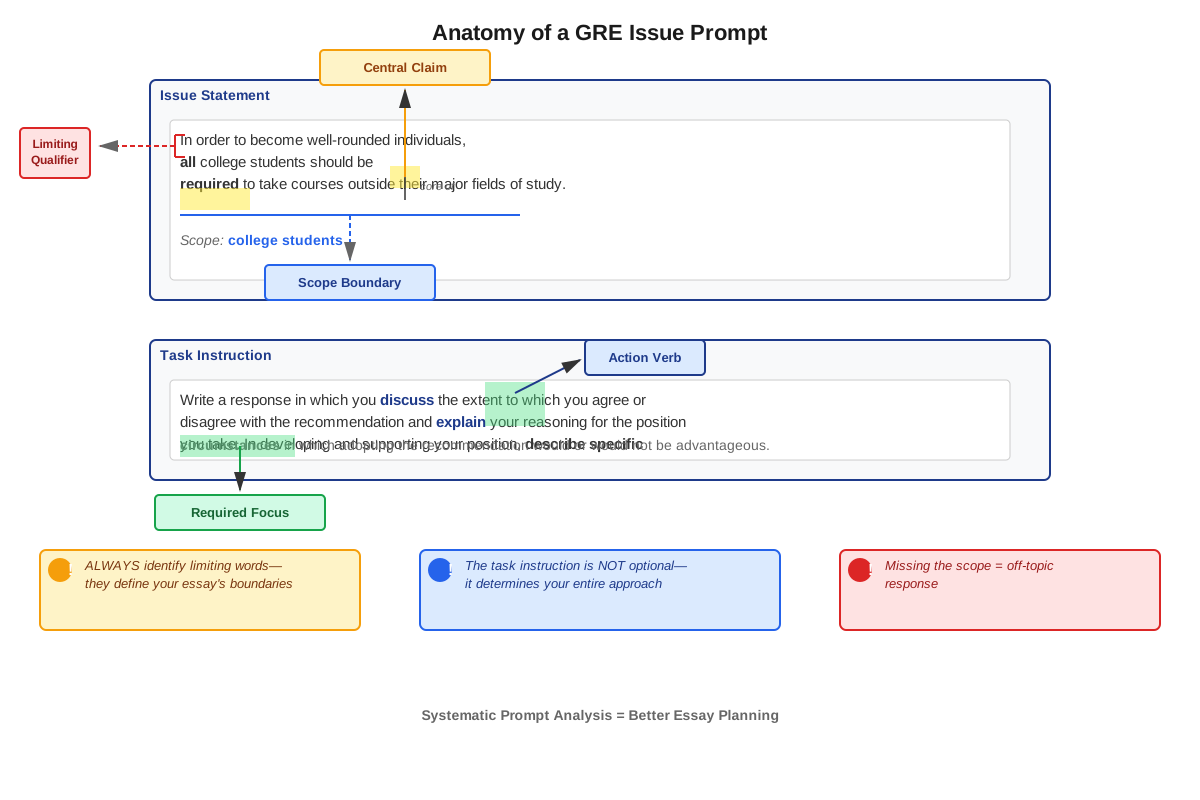
The Anatomy of a GRE Issue Prompt
Every GRE Analyze an Issue prompt consists of two essential components: the issue statement and the specific instructions. The issue statement presents a claim, recommendation, or policy position on a topic of general interest—often related to education, government, technology, or society. This statement may be presented as a declarative assertion, a recommendation for action, or a comparative claim. The specific instructions then direct how the test-taker should engage with that issue statement, defining the analytical task to be performed.
Understanding this two-part structure is crucial because many test-takers focus exclusively on the issue statement while neglecting the instructions. For example, an issue statement might read: "The best way to teach is to praise positive actions and ignore negative ones." However, the instructions could vary dramatically:
- "Write a response discussing the extent to which you agree or disagree with the recommendation and explain your reasoning."
- "Write a response discussing the extent to which you agree or disagree with the claim and the reason on which that claim is based."
- "Write a response discussing your views on the policy and explain your reasoning for the position you take."
Each instruction requires a fundamentally different analytical approach, even though the issue statement remains identical.
Identifying Key Components Within the Issue Statement
Effective prompt analysis requires breaking down the issue statement into its constituent parts. Most issue statements contain several identifiable elements:
The central claim or recommendation: This is the main assertion being made. Identifying this precisely prevents scope creep and ensures the response remains focused.
Limiting qualifiers: Words like "best," "only," "always," "never," "most," and "should" significantly constrain the claim's scope. These qualifiers are often the most important words in the prompt because they define the boundaries of agreement or disagreement.
Implicit assumptions: Many issue statements rest on unstated premises. Recognizing these assumptions allows for deeper analysis and more sophisticated argumentation.
Domain or context specifications: Some prompts limit their claims to specific contexts (e.g., "in education," "for young people," "in democratic societies"), which must be respected in the response.
Consider this example: "Universities should require every student to take a variety of courses outside their major field of study." The central claim is about university requirements. The limiting qualifier "every" makes this an absolute statement. The implicit assumption is that exposure to diverse subjects benefits students. The domain is clearly higher education, not K-12 or professional training.
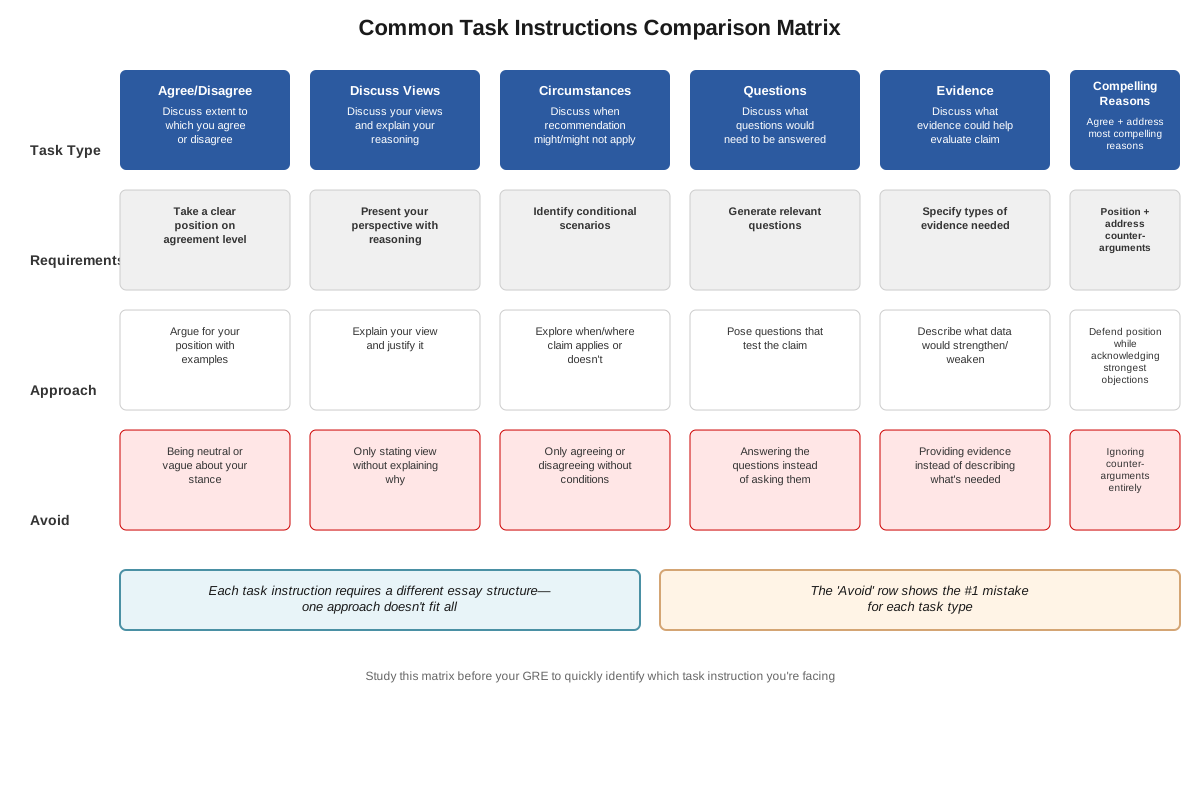
Decoding the Six Common Instruction Types
The GRE employs six primary instruction types for the Analyze an Issue task, each demanding a distinct analytical approach:
| Instruction Type | What It Requires | Key Focus |
|---|---|---|
| Agree/Disagree with Recommendation | Take a position on a suggested course of action | Evaluate the recommendation's merit and feasibility |
| Agree/Disagree with Claim | Take a position on a statement of fact or value | Assess the claim's validity and supporting logic |
| Agree/Disagree with Claim and Reason | Evaluate both the conclusion and its justification | Analyze whether the reason adequately supports the claim |
| Discuss Views on Policy | Examine a policy's merits and drawbacks | Consider multiple perspectives and implications |
| Discuss Circumstances | Identify when a claim holds true or fails | Explore contextual factors and boundary conditions |
| Compare Two Views | Analyze which perspective is more defensible | Weigh competing positions against each other |
Each instruction type establishes different success criteria. For "agree/disagree" instructions, the response must clearly state a position. For "discuss circumstances," the response must identify specific conditions rather than simply agreeing or disagreeing. Misidentifying the instruction type leads to structural misalignment between what the prompt asks and what the essay delivers.
Recognizing Scope and Boundaries
One of the most sophisticated aspects of prompt understanding involves recognizing what falls within and outside the prompt's scope. The GRE deliberately crafts prompts with specific boundaries, and high-scoring responses respect these limits while low-scoring responses often drift into tangential territory.
Explicit scope markers include phrases like "in the field of education," "for young people," "in democratic societies," or "regarding technological innovation." These markers define the domain within which arguments must operate.
Implicit scope boundaries emerge from the prompt's language and context. For instance, a prompt about "government funding for the arts" implicitly concerns public policy and resource allocation, not private philanthropy or individual artistic choices.
Temporal scope may be specified or implied. Some prompts focus on current conditions, others on historical patterns, and still others on future implications.
Effective prompt analysis involves asking: What topics are clearly within scope? What related topics are outside scope? What level of specificity does the prompt demand?
The Role of Task Instructions in Shaping Response Structure
The specific instructions don't merely tell test-takers what to write about—they fundamentally determine the essay's organizational structure. An instruction to "discuss circumstances under which the recommendation would or would not be adopted" requires a different structural approach than an instruction to "explain your reasons for agreeing or disagreeing."
For position-based instructions (agree/disagree), the essay typically follows a classical argumentative structure: clear thesis, supporting reasons, evidence, and counterargument consideration.
For circumstance-based instructions, the essay requires a more analytical structure: identification of relevant factors, examination of how these factors influence the claim's validity, and discussion of boundary conditions.
For comparative instructions, the essay demands a balanced structure: fair representation of both views, criteria for evaluation, and reasoned judgment about which perspective is stronger.
Understanding these structural implications during the prompt analysis phase enables efficient planning and prevents mid-essay reorganization.
Concept Relationships
The concepts within prompt understanding form a hierarchical relationship: Recognizing the two-part structure (issue statement + instructions) serves as the foundation. This recognition enables identifying key components within each part, which in turn allows for decoding instruction types and recognizing scope boundaries. These analytical steps collectively inform structural planning, which determines how the essay will be organized.
Prompt understanding connects directly to prerequisite knowledge of argumentative writing structure because the prompt's requirements dictate which structural elements are necessary. It also enables progression to thesis development—a clear thesis can only emerge from clear prompt comprehension. Similarly, evidence selection depends on understanding what the prompt considers relevant, and counterargument development requires knowing what positions the prompt asks the writer to consider.
The relationship can be mapped as:
Prompt Analysis → identifies → Required Task → determines → Essay Structure → guides → Thesis Formulation → directs → Argument Development → informs → Evidence Selection
This linear progression demonstrates why prompt understanding must be mastered before other analytical writing skills can be effectively applied.
High-Yield Facts
⭐ Every GRE Analyze an Issue prompt consists of two parts: the issue statement and the specific instructions—both must be addressed for a passing score.
⭐ The six instruction types require fundamentally different analytical approaches and essay structures.
⭐ Limiting qualifiers like "best," "only," "always," and "never" are often the most important words in the prompt because they define the scope of the claim.
⭐ Responses that fail to address the specific task instructions receive scores in the 0-2 range regardless of writing quality.
⭐ The prompt's scope boundaries (explicit and implicit) determine what topics and examples are relevant versus tangential.
- Issue statements often contain implicit assumptions that can be productively examined in the response.
- The same issue statement paired with different instructions requires completely different essays.
- Temporal scope (past, present, future) may be specified or implied and affects argument development.
- Domain specifications (education, government, technology) limit the contexts within which arguments must operate.
- Comparative instruction types require balanced treatment of multiple perspectives before taking a position.
- Circumstance-based instructions demand identification of specific conditions rather than simple agreement or disagreement.
- The prompt never asks for personal anecdotes or experiences—all examples should be hypothetical, historical, or observational.
Quick check — test yourself on Understanding the prompt so far.
Try Flashcards →Common Misconceptions
Misconception: The issue statement is the only part of the prompt that matters; the instructions are just formatting guidance.
Correction: The specific instructions are equally important as the issue statement and define the analytical task. Two essays on the same issue statement with different instructions should look fundamentally different in structure and focus.
Misconception: "Discuss the extent to which you agree or disagree" means the writer must be balanced and present both sides equally.
Correction: This instruction asks for a clear position with supporting reasoning. While acknowledging counterarguments strengthens the essay, the response should clearly favor one side rather than remaining neutral.
Misconception: Understanding the prompt means identifying the general topic (e.g., "education" or "technology").
Correction: Understanding the prompt requires identifying the specific claim, the limiting qualifiers, the implicit assumptions, and the precise analytical task—not just the general subject area.
Misconception: If the prompt asks about "universities," it's acceptable to write primarily about K-12 education since they're both educational contexts.
Correction: Scope boundaries must be respected. A prompt about universities requires examples and arguments specific to higher education; drifting into K-12 contexts demonstrates inadequate prompt analysis.
Misconception: The prompt is asking for the writer's personal opinion, so any response that expresses a viewpoint is acceptable.
Correction: The prompt asks for a reasoned analytical response to a specific task. Personal opinions must be supported with logical reasoning and relevant examples that directly address the instruction type.
Misconception: Longer, more complex prompts are harder and require more sophisticated responses.
Correction: Prompt length doesn't correlate with difficulty. Shorter prompts may actually be more challenging because they provide less guidance about scope and context. All prompts require the same analytical rigor.
Worked Examples
Example 1: Complete Prompt Analysis
Prompt: "The best way to teach—whether as an educator, employer, or parent—is to praise positive actions and ignore negative ones. Write a response in which you discuss the extent to which you agree or disagree with the claim. In developing and supporting your position, be sure to address the most compelling reasons and/or examples that could be used to challenge your position."
Step 1: Identify the Issue Statement
The issue statement is: "The best way to teach—whether as an educator, employer, or parent—is to praise positive actions and ignore negative ones."
Step 2: Break Down the Issue Statement Components
- Central claim: Positive reinforcement alone (praising good actions while ignoring bad ones) is the optimal teaching method
- Limiting qualifier: "best" makes this an absolute claim about superiority over all other methods
- Domain specification: Teaching contexts broadly defined (education, workplace, parenting)
- Implicit assumptions: (1) Positive reinforcement is effective; (2) Addressing negative actions is either ineffective or counterproductive; (3) The same approach works across all teaching contexts
Step 3: Identify the Instruction Type
"Discuss the extent to which you agree or disagree with the claim" = Agree/Disagree with Claim instruction type.
Step 4: Note Special Requirements
The instruction includes: "be sure to address the most compelling reasons and/or examples that could be used to challenge your position." This requires explicit counterargument consideration.
Step 5: Determine Scope Boundaries
- Within scope: Teaching methods, positive vs. negative reinforcement, effectiveness across different teaching contexts (education, workplace, parenting)
- Outside scope: Non-teaching relationships, punishment systems unrelated to teaching, detailed psychological theories
Step 6: Plan Response Structure
Based on this analysis, an effective response would:
- State a clear position (likely partial agreement/disagreement given the absolute nature of "best")
- Provide 2-3 reasons supporting the position
- Explicitly address the strongest counterarguments
- Use examples from education, workplace, or parenting contexts
- Acknowledge that context matters (challenging the one-size-fits-all implication)
Resulting Thesis Example: "While praising positive actions is undoubtedly valuable in teaching contexts, the claim that ignoring negative actions represents the 'best' approach oversimplifies the complex dynamics of effective instruction, particularly in situations where negative behaviors pose safety risks or where learners require corrective feedback to improve."
Example 2: Distinguishing Between Similar Prompts
Prompt A: "Governments should place few, if any, restrictions on scientific research and development. Write a response in which you discuss the extent to which you agree or disagree with the recommendation and explain your reasoning for the position you take."
Prompt B: "Governments should place few, if any, restrictions on scientific research and development. Write a response in which you discuss which view more closely aligns with your own position and explain your reasoning for the position you take. In developing and supporting your position, you should address both of the views presented."
Analysis:
Both prompts share the same issue statement but have different instructions, requiring fundamentally different responses.
Prompt A Analysis:
- Instruction type: Agree/Disagree with Recommendation
- Required approach: Take a clear position on whether governments should minimize restrictions
- Structure: State position → Provide reasons → Support with examples → Address counterarguments
- Focus: The writer's position and its justification
Prompt B Analysis:
- Instruction type: Compare Two Views (implied: minimal restrictions vs. substantial restrictions)
- Required approach: Identify two contrasting positions, evaluate both, then state which aligns more closely with the writer's view
- Structure: Present View 1 → Present View 2 → Evaluate both → State which is closer to writer's position → Explain reasoning
- Focus: Balanced treatment of both perspectives before taking a position
Key Difference: Prompt A allows the writer to immediately stake out a position and defend it. Prompt B requires explicit discussion of both minimal-restriction and substantial-restriction views before indicating which is more defensible. An essay written for Prompt A would be structurally inappropriate for Prompt B and vice versa.
Exam Strategy
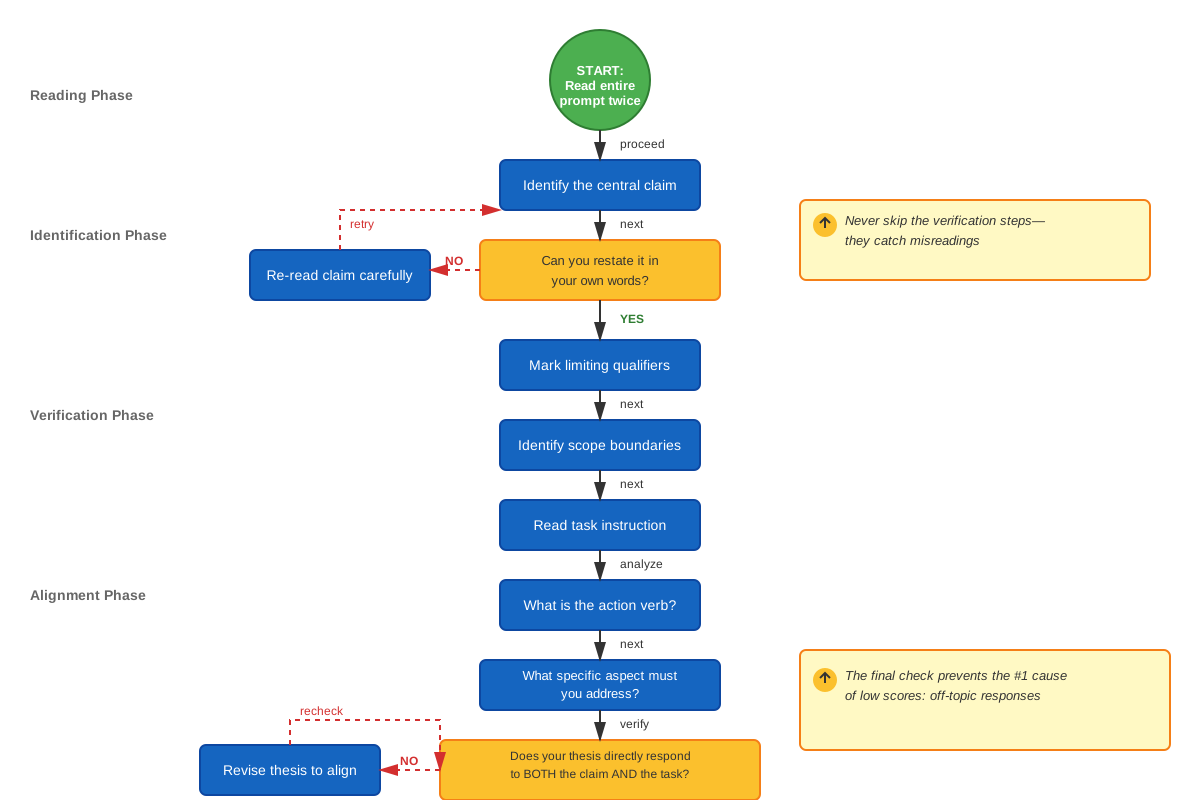
The 2-Minute Prompt Analysis Protocol
Before writing a single sentence of the essay, invest 2 minutes in systematic prompt analysis:
- Read the entire prompt twice: First for general understanding, second for precise details
- Underline or mentally note the instruction type: Identify which of the six instruction types applies
- Circle limiting qualifiers: Mark words like "best," "only," "all," "never," "should"
- Identify scope boundaries: Note any domain specifications or contextual limits
- Paraphrase the prompt in your own words: This ensures genuine comprehension rather than superficial reading
Trigger Words and Phrases
Certain words in prompts signal specific analytical requirements:
Absolute qualifiers ("best," "only," "always," "never") → These invite nuanced disagreement by identifying exceptions or contexts where the absolute claim fails
Comparative terms ("more," "better," "superior") → These require comparative analysis rather than simple evaluation
Modal verbs ("should," "must," "ought") → These signal recommendations or prescriptions requiring evaluation of desirability and feasibility
Conditional language ("if," "when," "under circumstances") → These indicate circumstance-based instructions requiring identification of relevant conditions
Scope limiters ("in education," "for young people," "in democratic societies") → These define the boundaries within which arguments must operate
Process-of-Elimination for Prompt Analysis
When uncertain about what the prompt asks, use elimination:
- Eliminate general topic identification: The prompt never asks merely "write about education" or "discuss technology"—it always specifies a particular analytical task
- Eliminate personal narrative: If your interpretation would lead to personal storytelling, it's incorrect
- Eliminate responses that ignore the instructions: If your planned response addresses the issue statement but not the specific instruction, revise your understanding
- Eliminate scope violations: If your interpretation would lead to discussing topics clearly outside the prompt's domain, reconsider
Time Allocation
- Prompt analysis: 2 minutes
- Planning: 3-4 minutes (enabled by clear prompt understanding)
- Writing: 23-25 minutes
- Revision: 3-4 minutes
Investing time in prompt analysis prevents the costly mistake of writing an off-topic essay that must be abandoned and restarted.
Exam Tip: If you find yourself 10 minutes into writing and uncertain whether you're addressing the prompt, stop and re-analyze. It's better to lose 10 minutes than to complete an off-topic essay.
Memory Techniques
The PISTA Mnemonic for Prompt Analysis
Prompt has two parts (issue + instructions)
Instruction type determines structure
Scope boundaries must be respected
Task-specific requirements must be met
Assumptions in the issue statement can be examined
The "Two-Part Test" Visualization
Visualize the prompt as a two-chambered box:
┌─────────────────────┐
│  ISSUE STATEMENT    │ ← What to think about
│  (The Topic)        │
├─────────────────────┤
│  INSTRUCTIONS       │ ← How to think about it
│  (The Task)         │
└─────────────────────┘
Both chambers must be opened and examined for complete understanding.
The "Qualifier Spotlight" Technique
Imagine a spotlight illuminating the most important word in the prompt—usually a limiting qualifier. This word often determines whether you'll agree, disagree, or partially agree with the claim.
The Six Instruction Types Acronym: "ACCPCC"
Agree/Disagree with Recommendation
Claim (Agree/Disagree)
Claim and Reason (Agree/Disagree)
Policy (Discuss Views)
Circumstances (Discuss When)
Compare Two Views
Summary
Understanding the prompt is the essential first step in producing a successful GRE Analyze an Issue essay. This skill involves recognizing that every prompt consists of two critical parts—the issue statement and the specific instructions—and that both must be thoroughly analyzed before writing begins. Effective prompt analysis requires identifying the central claim, recognizing limiting qualifiers that define scope, understanding implicit assumptions, and determining which of the six instruction types applies. Each instruction type demands a different analytical approach and essay structure, making accurate identification crucial for success. The prompt's scope boundaries, both explicit and implicit, determine what topics and examples are relevant, preventing tangential responses that fail to address the actual question. Test-takers must invest time in systematic prompt analysis, using strategies like the 2-minute analysis protocol and attention to trigger words, to ensure their responses directly address what the GRE asks rather than what they assume it asks. Mastery of prompt understanding enables all subsequent analytical writing skills and prevents the most common cause of low scores: writing a well-crafted essay that fails to answer the actual question posed.
Key Takeaways
- Every GRE Issue prompt has two essential parts: the issue statement (what to think about) and the specific instructions (how to think about it)—both must be addressed
- The six instruction types require fundamentally different essay structures; misidentifying the instruction type leads to structural failure
- Limiting qualifiers like "best," "only," and "always" are often the most important words because they define the claim's scope and invite nuanced analysis
- Scope boundaries (explicit and implicit) determine what topics are relevant; respecting these boundaries demonstrates sophisticated prompt comprehension
- Investing 2 minutes in systematic prompt analysis prevents the costly error of writing an off-topic essay
- Responses that fail to address the specific task instructions receive failing scores regardless of writing quality
- The prompt never asks for personal anecdotes—all analysis should be reasoned and supported with logical examples
Related Topics
Thesis Development: After understanding what the prompt asks, the next step is crafting a clear, defensible thesis statement that directly responds to the specific instruction. Mastery of prompt understanding ensures the thesis addresses the actual question.
Argument Structure and Organization: Different instruction types require different organizational patterns. Understanding the prompt enables selection of the appropriate structure for the required analytical task.
Evidence Selection and Example Development: Prompt analysis reveals what types of evidence are relevant and within scope, preventing the inclusion of tangential examples that weaken the response.
Counterargument and Concession: Some instruction types explicitly require addressing opposing views. Prompt understanding identifies when and how counterarguments should be incorporated.
Time Management for Analytical Writing: Efficient prompt analysis enables faster, more confident planning and writing, improving overall time management during the essay section.
Practice CTA
Now that you understand the critical importance of prompt analysis and the strategies for decoding GRE Issue prompts, it's time to apply these skills. Attempt the practice questions to test your ability to identify instruction types, recognize scope boundaries, and distinguish between similar prompts. Use the flashcards to reinforce the six instruction types and common trigger words. Remember: every minute invested in mastering prompt understanding pays dividends across every essay you write. The difference between a score of 3 and a score of 5 often comes down to whether you answered the question that was actually asked. You've got this!
Sign up free to keep reading
Create a free AnvayaPrep account to finish this GRE guide on Understanding the prompt — plus flashcards and practice questions.