Overview
The qualified thesis represents one of the most sophisticated and high-scoring approaches to the GRE Analytical Writing "Analyze an Issue" task. Unlike an absolute or unqualified thesis that takes a completely one-sided stance, a qualified thesis acknowledges the complexity and nuance inherent in most real-world issues by incorporating conditions, limitations, or exceptions into the central argument. This approach demonstrates critical thinking maturity that GRE graders specifically look for when awarding scores in the 5.0–6.0 range.
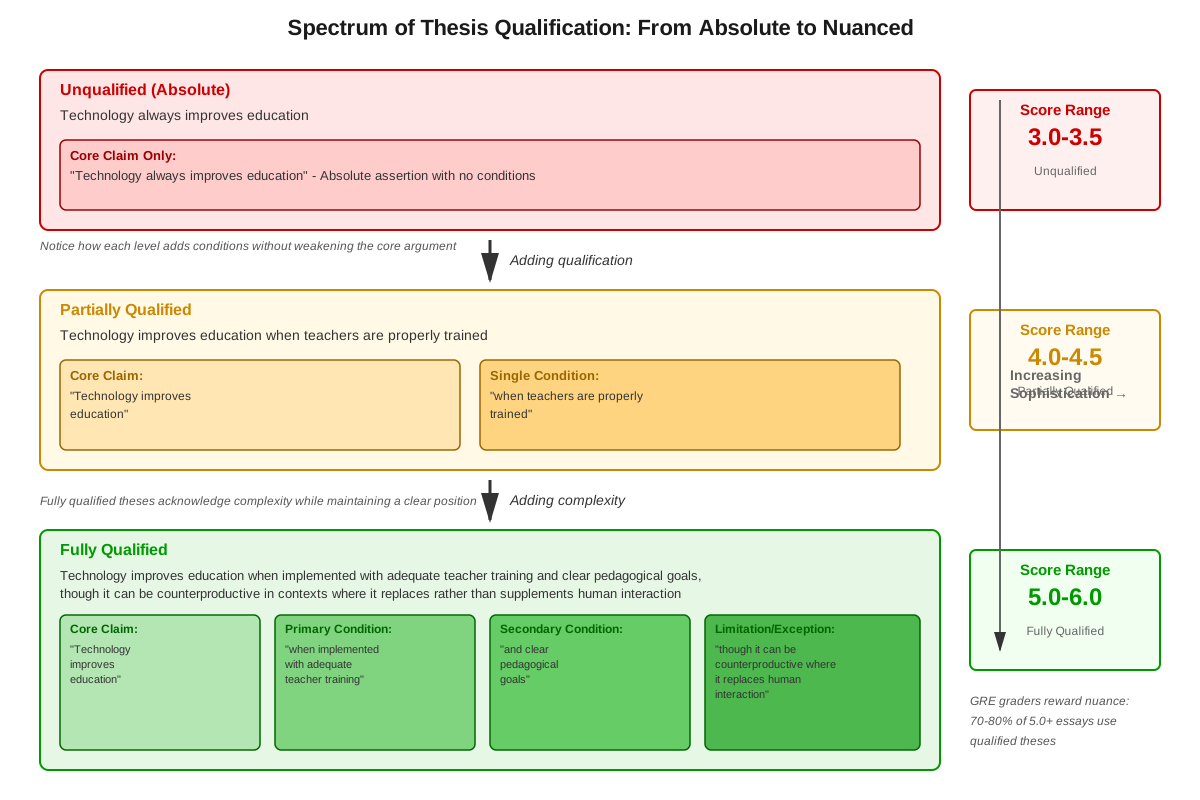
Mastering the GRE qualified thesis is essential because it allows test-takers to construct more defensible, intellectually honest arguments that resist easy counterarguments. When an issue prompt asks whether "technology always improves education" or "competition is necessary for excellence," an absolute "yes" or "no" position becomes vulnerable to obvious exceptions. A qualified thesis, however, might argue that "technology improves education when implemented with adequate teacher training and clear pedagogical goals, but can be counterproductive when used merely as a substitute for human interaction." This nuanced position is both more accurate and more impressive to evaluators.
Within the broader Analytical Writing framework, the qualified thesis serves as the foundation upon which the entire essay structure rests. It connects directly to paragraph development (each body paragraph explores one aspect of the qualification), evidence selection (examples must support the nuanced position), and counterargument handling (the qualification itself often preemptively addresses potential objections). Understanding how to craft and support a qualified thesis elevates an essay from competent to exceptional, making this one of the highest-yield topics for score improvement in the Analytical Writing section.
Learning Objectives
- [ ] Identify when Qualified thesis is being tested
- [ ] Explain the core rule or strategy behind Qualified thesis
- [ ] Apply Qualified thesis to GRE-style questions accurately
- [ ] Distinguish between qualified and unqualified thesis statements in sample essays
- [ ] Construct qualified thesis statements that incorporate appropriate conditions and limitations
- [ ] Evaluate the strength and defensibility of various qualified thesis formulations
- [ ] Integrate qualifying language naturally without weakening argumentative force
Prerequisites
- Basic thesis statement construction: Understanding what makes a thesis clear, specific, and arguable is necessary before adding qualifications to it
- Logical reasoning fundamentals: Recognizing cause-effect relationships, necessary vs. sufficient conditions, and basic logical structures enables effective qualification
- Issue prompt analysis: The ability to identify the core claim, implicit assumptions, and scope of an issue prompt determines what aspects require qualification
- Paragraph organization principles: Since each qualification typically requires dedicated development, understanding topic sentences and paragraph unity is essential
Why This Topic Matters
In professional and academic contexts, the ability to take nuanced positions distinguishes sophisticated thinkers from simplistic ones. Policymakers, researchers, and business leaders rarely deal in absolutes; they must weigh competing considerations, acknowledge limitations, and propose conditional solutions. The qualified thesis mirrors this real-world complexity, preparing students for the kind of analytical writing expected in graduate programs and professional settings.
On the GRE specifically, the qualified thesis appears as a distinguishing feature in approximately 70-80% of essays scoring 5.0 or higher, according to analysis of published sample essays. The official scoring rubric explicitly rewards "a nuanced position on the issue" and "thoughtful consideration of the complexities and implications of the issue." These phrases directly describe what a qualified thesis accomplishes. Issue prompts are deliberately designed to resist simple yes/no answers—they typically include absolute language ("always," "never," "only") or sweeping generalizations that invite qualification.
Common manifestations in exam passages include prompts that present extreme positions ("The best way to teach is..."), universal claims ("All leaders must..."), or binary choices ("Should society prioritize X or Y?"). Each of these structures creates an opportunity—indeed, almost a necessity—for qualification. Test-takers who recognize these patterns and respond with appropriately nuanced theses consistently outperform those who take absolute positions.
Core Concepts
Definition and Structure of a Qualified Thesis
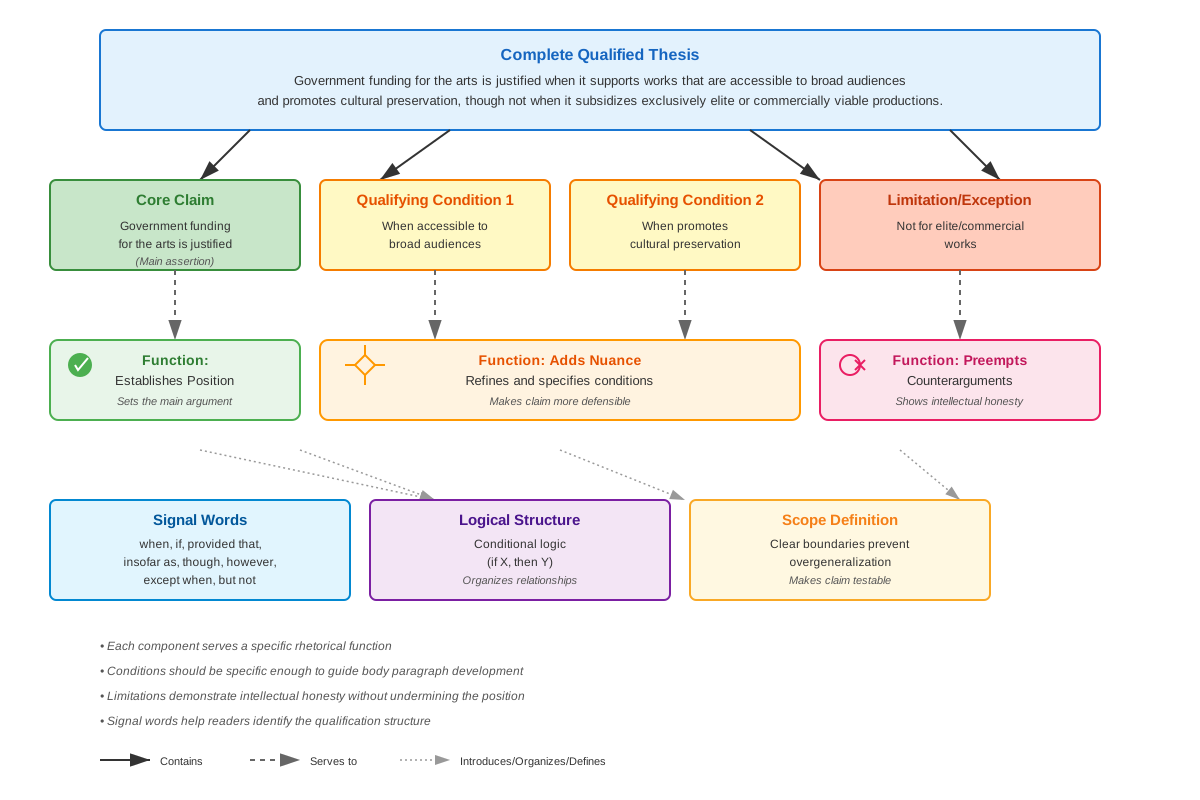
A qualified thesis is a position statement that includes explicit conditions, limitations, contexts, or exceptions that define when, where, how, or to what extent the main claim holds true. Rather than asserting "X is true" or "X is false," it asserts "X is true under conditions A, B, and C" or "X is generally true, except when Y occurs." The qualification transforms a vulnerable absolute claim into a defensible conditional one.
The structural components of a qualified thesis typically include:
- The core position: The fundamental stance on the issue
- The qualifying language: Words and phrases that introduce conditions (when, if, provided that, in cases where, to the extent that)
- The specific conditions or limitations: The circumstances that define the scope of the claim
- Optional: Acknowledgment of exceptions: Explicit recognition of cases where the position doesn't apply
For example, consider the prompt: "The best ideas arise from passionate interest in commonplace things." An unqualified thesis might state: "Passionate interest in commonplace things produces the best ideas." A qualified thesis would state: "While passionate interest in commonplace things can generate innovative ideas by encouraging deep observation and fresh perspectives, the best ideas typically require combining this passionate attention with formal knowledge, diverse experiences, and systematic methodology."
Types of Qualifications
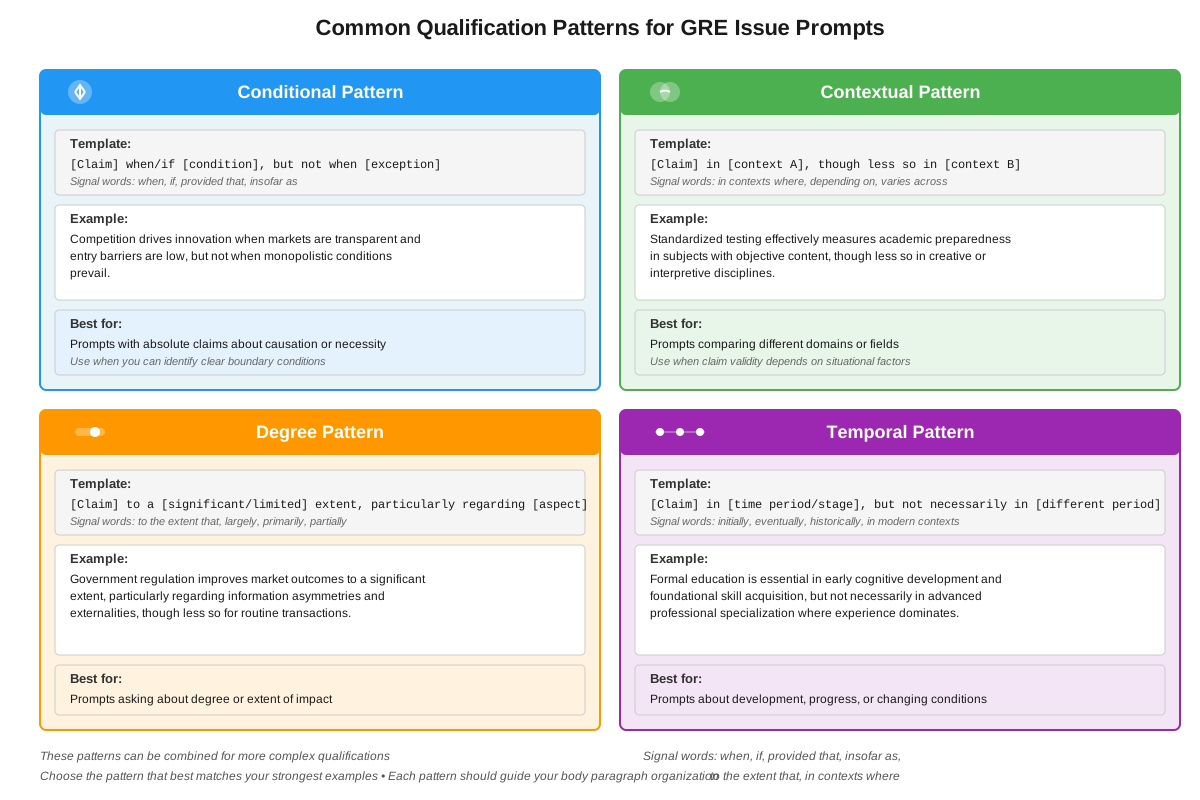
Different issue prompts call for different qualification strategies. Understanding these types helps test-takers select the most appropriate approach:
| Qualification Type | Description | Example Language | Best Used When |
|---|---|---|---|
| Conditional | Specifies circumstances under which the claim is valid | "when," "if," "provided that," "in cases where" | The claim's validity depends on specific conditions |
| Degree-based | Acknowledges the claim is partially but not entirely true | "to some extent," "largely," "in many cases," "often" | The claim has merit but isn't universal |
| Contextual | Limits the claim to particular domains or situations | "in educational settings," "for developing nations," "during economic downturns" | The claim applies differently across contexts |
| Temporal | Restricts the claim to certain time periods or stages | "in the initial phases," "over the long term," "historically" | The claim's validity changes over time |
| Comparative | Positions the claim relative to alternatives | "more than," "compared to," "rather than" | Multiple options exist with varying merit |
Balancing Nuance and Clarity
A common challenge with qualified theses is maintaining argumentative strength while adding complexity. The qualification should enhance the thesis's defensibility without making it so hedged that it lacks a clear position. This balance requires careful word choice and structural clarity.
Effective qualification maintains a clear stance: "Democratic governance produces better long-term outcomes than authoritarian systems when supported by strong institutions, an educated citizenry, and economic stability, though authoritarian systems may implement necessary reforms more quickly in crisis situations."
Over-qualification obscures the position: "Democratic governance might sometimes produce potentially better outcomes in some situations, though this depends on many factors and authoritarian systems could also work in certain cases."
The key difference lies in specificity and commitment. An effective qualified thesis still takes a definite position—it simply defines the boundaries of that position precisely. The writer remains committed to a viewpoint while acknowledging its scope.
Strategic Placement and Development
The qualified thesis typically appears at the end of the introductory paragraph, following context-setting and prompt analysis. However, the qualification itself must be developed throughout the essay. Each qualifying condition or limitation generally requires dedicated treatment in the body paragraphs.
For a thesis with three qualifying conditions, a typical essay structure might be:
- Introduction: Present the qualified thesis
- Body Paragraph 1: Develop the first qualifying condition with examples and reasoning
- Body Paragraph 2: Develop the second qualifying condition
- Body Paragraph 3: Develop the third qualifying condition or address the most significant exception
- Conclusion: Synthesize how the qualifications work together to support the nuanced position
This structure ensures that the qualification isn't merely cosmetic language in the thesis but represents a genuine analytical framework that organizes the entire argument.
Qualifying Language and Rhetorical Sophistication
The specific words and phrases used to introduce qualifications significantly impact how the thesis is perceived. Sophisticated qualifying language demonstrates command of academic discourse:
High-level qualifying phrases:
- "While X holds true in many contexts, it proves less applicable when..."
- "The extent to which X succeeds depends primarily on..."
- "Although X represents a valid concern, it must be balanced against..."
- "X proves most effective when combined with..."
- "The relationship between X and Y is mediated by..."
Phrases to avoid (they weaken rather than qualify):
- "I think that maybe..."
- "It could be argued that possibly..."
- "In my opinion, sometimes..."
- "Perhaps in some ways..."
The difference lies in confidence and precision. Strong qualifying language adds nuance without suggesting uncertainty about the position itself.
Concept Relationships
The qualified thesis functions as the central organizing principle that connects multiple elements of the Analytical Writing task. It emerges from careful issue prompt analysis, which reveals the absolute or extreme language that invites qualification. The process of identifying what to qualify requires logical reasoning skills to recognize unstated assumptions and potential counterexamples.
Once formulated, the qualified thesis directly determines essay organization. Each qualification or condition becomes a topic for body paragraph development, creating a natural structure. The thesis also guides evidence selection—examples must specifically illustrate the conditions under which the claim holds or fails, rather than simply supporting a one-sided argument.
The relationship flows as follows:
Prompt Analysis → identifies extreme/absolute claims → Logical Reasoning → recognizes conditions and exceptions → Qualified Thesis Formation → establishes scope and limitations → Paragraph Organization → develops each qualification → Evidence Selection → supports conditional claims → Counterargument Handling → addresses exceptions already acknowledged in thesis
This interconnected system means that mastering the qualified thesis simultaneously improves multiple aspects of essay performance. The qualification itself often preempts counterarguments, making the counterargument section more sophisticated—rather than defending against objections, the writer can explain why certain exceptions don't undermine the overall qualified position.
High-Yield Facts
⭐ A qualified thesis acknowledges conditions, limitations, or contexts that define when or how the main claim is valid, rather than making an absolute assertion.
⭐ Essays scoring 5.0-6.0 on the GRE typically employ qualified theses, while lower-scoring essays more often take absolute positions.
⭐ The most common qualifying structures use "when," "if," "provided that," "to the extent that," and "in cases where" to introduce conditions.
⭐ Each qualification or condition in the thesis should receive dedicated development in a body paragraph with specific examples.
⭐ Effective qualification strengthens an argument by making it more defensible, not weaker by hedging.
- Issue prompts containing "always," "never," "only," "all," or "best" particularly invite qualified thesis responses.
- A qualified thesis can acknowledge merit in opposing viewpoints while still maintaining a clear position.
- The qualification should appear in the thesis statement itself, not merely in the conclusion or as an afterthought.
- Temporal qualifications (addressing how claims change over time) are particularly effective for prompts about progress, technology, or social change.
- Contextual qualifications (limiting claims to specific domains) work well for prompts about education, governance, or cultural practices.
- Over-qualification that includes too many conditions can make a thesis unfocused and difficult to develop adequately in a 30-minute essay.
- The strongest qualified theses specify 2-3 clear conditions rather than vague hedging language like "sometimes" or "in some ways."
- Comparative qualifications ("X is more effective than Y for achieving Z") allow for nuanced positions on binary-choice prompts.
- A qualified thesis should still be arguable—someone could reasonably disagree with the specific conditions or limitations proposed.
- The qualification often addresses the most obvious counterargument to an absolute position, demonstrating anticipation of objections.
Quick check — test yourself on Qualified thesis so far.
Try Flashcards →Common Misconceptions
Misconception: A qualified thesis is the same as being uncertain or wishy-washy about a position.
Correction: A qualified thesis represents a definite, confident position that happens to be nuanced rather than absolute. It demonstrates intellectual sophistication by recognizing that most real-world claims are conditional. The writer remains fully committed to the qualified position—for example, firmly arguing that "technology improves education when properly implemented" is a strong stance, not a weak one.
Misconception: Qualifying a thesis means giving equal weight to both sides of an issue.
Correction: A qualified thesis still takes a clear side; it simply defines the boundaries of that position. In the thesis "Democratic systems generally produce better outcomes than authoritarian ones, though they may struggle during immediate crises," the writer clearly favors democratic systems—the qualification about crises doesn't create a balanced, neutral position but rather acknowledges a specific limitation.
Misconception: Any use of words like "sometimes" or "often" creates a qualified thesis.
Correction: Effective qualification requires specific conditions or contexts, not just vague hedging language. "Competition sometimes benefits society" is weak and vague. "Competition benefits society when regulated to prevent monopolistic practices and when balanced with cooperative frameworks for public goods" is specifically qualified with clear conditions.
Misconception: The qualification should appear only in the conclusion after presenting the main argument.
Correction: The qualified thesis must appear in the introduction and organize the entire essay. Each body paragraph should develop one aspect of the qualification. Introducing nuance only in the conclusion makes the essay appear inconsistent or suggests the writer didn't plan the argument effectively.
Misconception: More qualifications always make a thesis stronger.
Correction: A thesis with too many qualifications becomes unfocused and impossible to develop adequately in a timed essay. Two to three well-chosen qualifications that can each receive a full paragraph of development are more effective than five or six conditions mentioned briefly. Quality and specificity of qualification matter more than quantity.
Misconception: Qualified theses are only appropriate for certain types of prompts.
Correction: While prompts with absolute language particularly invite qualification, virtually any issue prompt benefits from a nuanced approach. Even prompts that seem to ask for a simple choice ("Should society prioritize X or Y?") can be answered with qualification ("Society should prioritize X in contexts A and B, while prioritizing Y in contexts C and D").
Worked Examples
Example 1: Technology and Education Prompt
Prompt: "As people rely more and more on technology to solve problems, the ability of humans to think for themselves will surely deteriorate."
Analysis Process:
First, identify the absolute language: "surely deteriorate" suggests an inevitable, universal outcome. This extreme claim invites qualification. Consider: Are there conditions under which technology enhances rather than deteriorates thinking? What factors determine technology's impact?
Weak Unqualified Thesis: "Technology does not deteriorate human thinking ability."
This absolute counter-claim is as vulnerable as the original prompt—it's easy to find examples where technology does reduce certain cognitive skills.
Effective Qualified Thesis: "While excessive reliance on technology for routine cognitive tasks can atrophy certain mental skills, technology actually enhances human thinking capacity when used as a tool for accessing information, modeling complex systems, and collaborating across distances, provided that education systems teach critical evaluation of technological outputs rather than passive consumption."
Why This Works:
- Acknowledges the concern: "excessive reliance... can atrophy certain mental skills" shows the writer recognizes validity in the prompt's worry
- States a clear position: "actually enhances human thinking capacity" takes a definite stance
- Specifies conditions: "when used as a tool for..." and "provided that education systems..." define exactly when the positive outcome occurs
- Provides structure: The thesis naturally organizes into body paragraphs about (1) the atrophy concern, (2) enhancement through information access and collaboration, and (3) the crucial role of education in determining outcomes
Body Paragraph Development:
Paragraph 1 would address the legitimate concern with specific examples (GPS reducing spatial reasoning, calculators reducing mental math ability) while noting these are specific skills, not overall thinking capacity.
Paragraph 2 would provide examples of enhancement (scientists using modeling software to test hypotheses, researchers accessing global databases, teams collaborating on complex problems).
Paragraph 3 would explain why education determines the outcome, with examples of programs that teach critical evaluation versus those that don't.
Example 2: Leadership and Consensus Prompt
Prompt: "The best leaders are those who encourage feedback from the people whom they lead."
Analysis Process:
The absolute language here is "best" and the implied "always" (no exceptions mentioned). Consider: Are there situations where seeking feedback is counterproductive? What factors make feedback valuable or not?
Weak Unqualified Thesis: "Leaders should always encourage feedback."
This simply agrees with the prompt without adding analytical value or demonstrating critical thinking.
Effective Qualified Thesis: "Leaders who encourage feedback from their teams generally make better decisions and build stronger organizations, particularly in complex, knowledge-intensive fields where distributed expertise exceeds any individual's knowledge; however, effective leadership also requires the judgment to distinguish between situations demanding collaborative input and those requiring swift, decisive action without consultation, as well as the skill to synthesize diverse feedback into coherent direction rather than allowing decision-making to devolve into directionless consensus-seeking."
Why This Works:
- Takes a clear position: Agrees that feedback generally improves leadership
- Specifies contexts: "particularly in complex, knowledge-intensive fields" defines where this is most true
- Acknowledges limitations: Recognizes situations requiring swift action without consultation
- Adds sophistication: Distinguishes between seeking feedback and being paralyzed by it
- Demonstrates critical thinking: Shows understanding that the same action (seeking feedback) can be positive or negative depending on execution
Body Paragraph Development:
Paragraph 1 would explain why feedback improves decisions in complex environments, with examples from business or military contexts where distributed knowledge matters.
Paragraph 2 would address crisis situations or time-sensitive decisions where consultation is impractical, with historical examples.
Paragraph 3 would distinguish between leaders who synthesize feedback effectively (like Lincoln's "team of rivals") versus those who become paralyzed by conflicting input.
Exam Strategy
Recognizing Qualification Opportunities
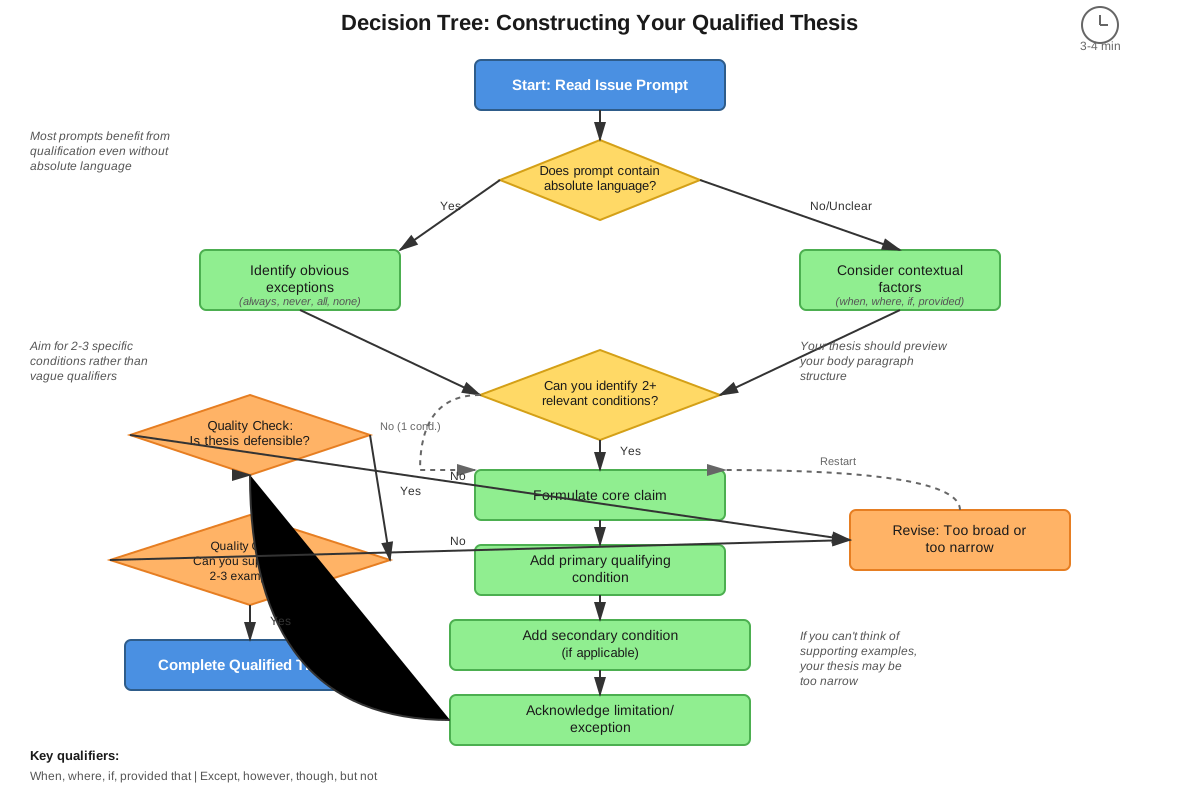
During the initial prompt analysis (first 2-3 minutes), actively look for these trigger patterns that signal qualification opportunities:
- Absolute language: "always," "never," "only," "all," "none," "every," "best," "worst," "must," "cannot"
- Universal claims: Statements that apply to all people, all situations, or all times
- Binary choices: "Should X or Y?" prompts that present false dichotomies
- Causal certainty: "X causes Y" or "X will result in Y" without acknowledging mediating factors
- Value judgments: "X is more important than Y" without specifying contexts
Exam Tip: If you can immediately think of an obvious exception to the prompt's claim, that exception should probably become part of your qualification.
Thesis Construction Process
Use this systematic approach during your planning phase (minutes 3-5):
- Identify your general position: Do you mostly agree, mostly disagree, or see merit in both sides?
- List 2-3 conditions or contexts: When is your position most true? When does it face challenges?
- Draft the thesis: Combine your position with your conditions using qualifying language
- Test for structure: Can each condition become a body paragraph? If not, revise.
- Check for clarity: Would a reader understand your exact position? If not, make it more specific.
Time Allocation
In a 30-minute essay:
- Minutes 1-5: Analyze prompt and construct qualified thesis
- Minutes 6-23: Write body paragraphs developing each qualification
- Minutes 24-28: Write introduction and conclusion
- Minutes 29-30: Proofread
Note that more time goes to planning the qualified thesis than to planning an absolute thesis, but this investment pays off in easier paragraph development and higher scores.
Common Pitfalls to Avoid
Pitfall 1: Adding qualification only in the conclusion
- Solution: State the qualified thesis in the introduction and develop it throughout
Pitfall 2: Using vague qualifying language without specific conditions
- Solution: Replace "sometimes" and "often" with "when X occurs" or "in contexts where Y"
Pitfall 3: Creating so many qualifications that none receives adequate development
- Solution: Limit to 2-3 qualifications that can each get a full paragraph
Pitfall 4: Qualifying so much that your position becomes unclear
- Solution: Maintain a clear stance; qualification defines scope, not uncertainty
Memory Techniques
The SCOPE Acronym
Remember what makes an effective qualified thesis using SCOPE:
- Specific conditions (not vague hedging)
- Clear position (still takes a definite stance)
- Organizing principle (structures the essay)
- Paragraph-ready (each qualification can be developed)
- Exceptions acknowledged (addresses counterarguments)
The "When-Where-How" Framework
When constructing qualifications quickly under time pressure, ask:
- When is this claim true? (temporal/conditional)
- Where is this claim true? (contextual/domain-specific)
- How is this claim true? (degree/mechanism)
At least one of these questions will generate useful qualifications for any prompt.
Visualization: The Umbrella Concept
Picture your thesis as an umbrella. An unqualified thesis is a tiny umbrella that only covers one spot—easy to attack from other angles. A qualified thesis is a large umbrella with clearly defined edges—it covers more ground and you've explicitly stated where the coverage ends, making it harder to attack because you've already acknowledged the boundaries.
The "Yes, But..." Starter
If struggling to formulate a qualification, start with "Yes, but..." or "While X is true, Y is also true when..." This natural language pattern often leads to effective qualified theses that can be refined into more sophisticated phrasing.
Summary
The qualified thesis represents the hallmark of sophisticated analytical writing on the GRE, distinguishing high-scoring essays through nuanced positioning that acknowledges complexity while maintaining clear argumentation. Rather than taking absolute stances vulnerable to obvious counterexamples, qualified theses incorporate specific conditions, limitations, or contexts that define when and how claims hold true. This approach directly addresses the GRE scoring rubric's emphasis on "nuanced positions" and "thoughtful consideration of complexities." Effective qualification requires identifying absolute language in prompts, determining relevant conditions through logical analysis, and constructing thesis statements that specify 2-3 clear qualifications using precise language like "when," "provided that," or "to the extent that." Each qualification must receive dedicated development in body paragraphs with supporting examples. The key to success lies in balancing nuance with clarity—adding sophistication without hedging or obscuring the central position. Mastering this skill transforms essays from competent to exceptional, consistently elevating scores into the 5.0-6.0 range.
Key Takeaways
- A qualified thesis takes a definite position while specifying the conditions, contexts, or limitations under which that position holds true
- Prompts containing absolute language ("always," "never," "best," "only") particularly invite and reward qualified thesis responses
- Effective qualification requires 2-3 specific conditions that can each receive full paragraph development, not vague hedging language
- The qualified thesis should appear in the introduction and organize the entire essay structure, with each body paragraph developing one aspect of the qualification
- Qualification strengthens arguments by making them more defensible and demonstrates the critical thinking sophistication that GRE graders reward with scores of 5.0-6.0
- The SCOPE framework (Specific, Clear, Organizing, Paragraph-ready, Exceptions) helps evaluate whether a qualified thesis is effective
- Balancing nuance with clarity is essential—the thesis must remain understandable and committed to a position while acknowledging complexity
Related Topics
Counterargument and Rebuttal: Mastering qualified theses naturally leads to more sophisticated counterargument handling, since qualifications often preemptively address objections. Understanding how to acknowledge opposing views while maintaining your position builds directly on qualification skills.
Evidence Selection and Development: Once a qualified thesis is established, selecting examples that specifically illustrate the conditions and contexts becomes crucial. This topic explores how to choose and develop evidence that supports nuanced positions rather than one-sided arguments.
Logical Reasoning and Assumptions: Deeper study of logical structures, necessary versus sufficient conditions, and assumption identification enhances the ability to construct precise qualifications. This advanced topic strengthens the analytical foundation underlying effective qualified theses.
Essay Organization and Paragraph Structure: Understanding how qualified theses determine essay architecture helps optimize the development of complex arguments within time constraints. This topic addresses how to structure multi-paragraph development of conditional claims.
Practice CTA
Now that you understand the principles and strategies behind qualified theses, it's time to apply this knowledge through deliberate practice. Attempt the practice questions to test your ability to identify qualification opportunities, construct effective qualified theses, and distinguish strong from weak qualifications. Use the flashcards to reinforce key concepts and qualifying language patterns. Remember that mastering this skill significantly impacts your Analytical Writing score—the investment in practice will yield substantial returns. Each practice prompt you analyze strengthens your ability to recognize patterns and construct nuanced arguments under time pressure. Your path to a top-tier GRE Analytical Writing score depends on transforming this conceptual understanding into automatic, confident execution.
Sign up free to keep reading
Create a free AnvayaPrep account to finish this GRE guide on Qualified thesis — plus flashcards and practice questions.