Overview
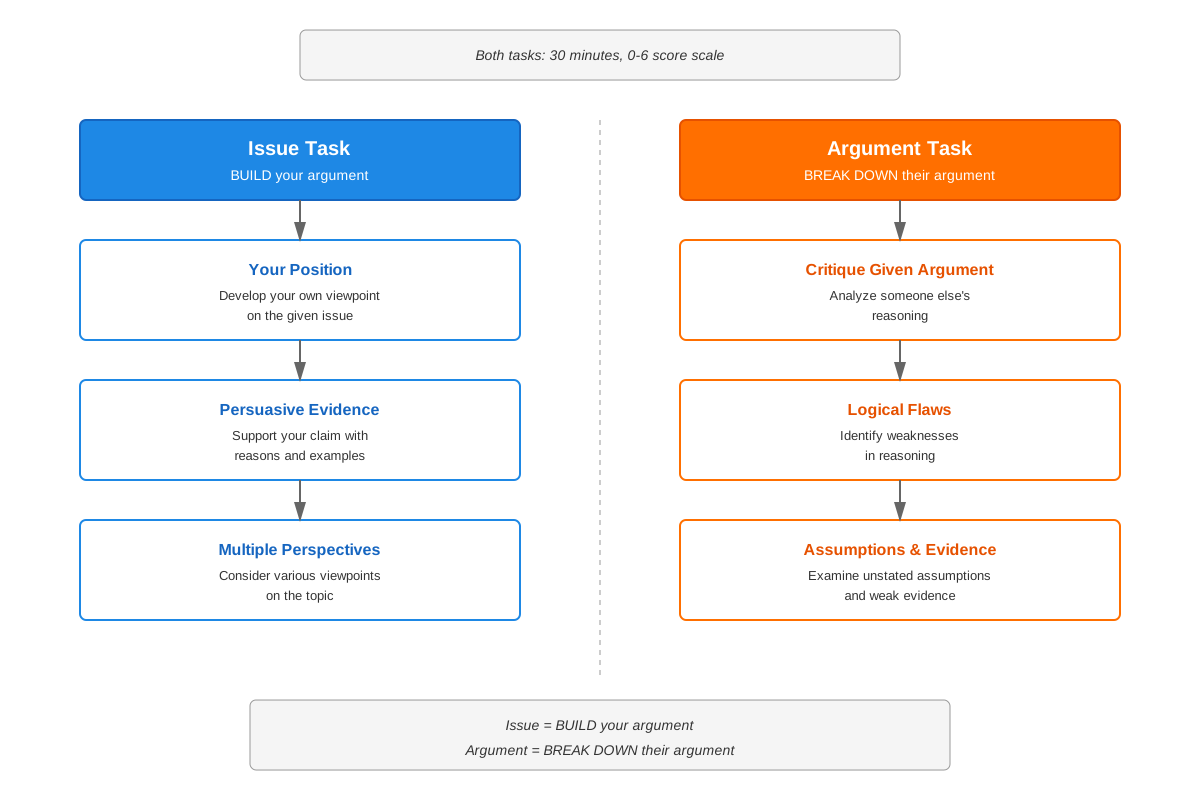
The issue task overview represents one of the two essay types on the GRE Analytical Writing section, requiring test-takers to construct a persuasive argument in response to a general statement or claim about a topic of broad interest. Unlike the Argument task, which asks students to critique someone else's reasoning, the Issue task demands that examinees develop and defend their own position on a controversial topic. This fundamental distinction makes understanding the GRE issue task overview essential for achieving a competitive score on the Analytical Writing measure, which is reported on a 0–6 scale in half-point increments.
The Issue task presents a statement about a topic—ranging from education and technology to politics and culture—and asks test-takers to evaluate the statement from multiple perspectives before articulating and supporting their own viewpoint. Students have 30 minutes to plan and compose a response that demonstrates critical thinking, coherent organization, and facility with standard written English. The task assesses not whether students agree or disagree with the prompt, but rather how effectively they can construct a nuanced argument supported by relevant reasons and examples.
Mastering the Issue task overview provides the foundation for all subsequent Analytical Writing preparation. This topic connects directly to essay structure, argumentation strategies, evidence selection, and time management—all critical components of GRE success. Understanding what the Issue task measures, how it's scored, and what specific instructions accompany each prompt enables students to approach this section strategically rather than reactively, maximizing their score potential within the strict time constraints.
Learning Objectives
- [ ] Identify when Issue task overview is being tested
- [ ] Explain the core rule or strategy behind Issue task overview
- [ ] Apply Issue task overview to GRE-style questions accurately
- [ ] Distinguish between the Issue task and Argument task requirements
- [ ] Analyze the six specific instructions that may accompany Issue prompts
- [ ] Evaluate sample responses using official GRE scoring criteria
- [ ] Construct a time-management plan for the 30-minute Issue task window
Prerequisites
- Basic essay structure knowledge: Understanding introductions, body paragraphs, and conclusions is essential because the Issue task requires organizing ideas into a coherent written response
- Fundamental argumentation concepts: Familiarity with claims, evidence, and reasoning helps students construct persuasive positions
- Standard written English proficiency: The task assumes competence in grammar, syntax, and vocabulary at the undergraduate level
- Critical thinking skills: The ability to consider multiple perspectives on complex issues forms the foundation of Issue task success
Why This Topic Matters
The Issue task carries significant weight in graduate admissions decisions across numerous fields. While some programs place minimal emphasis on Analytical Writing scores, many competitive programs—particularly in humanities, social sciences, education, and law—view the writing score as a critical indicator of a candidate's ability to communicate complex ideas effectively. Programs often use the Analytical Writing score as a threshold filter, eliminating candidates who fall below a certain benchmark before reviewing other application materials.
On the GRE, the Issue task appears as the first or second essay in the Analytical Writing section, which always occurs at the beginning of the exam. Every test-taker receives exactly one Issue prompt selected from the published pool of approximately 150 topics available on the ETS website. This transparency allows for strategic preparation, as students can familiarize themselves with the range of topics and practice developing positions on various issues before test day. The Issue task accounts for 50% of the Analytical Writing score, with the Argument task comprising the other 50%.
In real-world applications, the skills assessed by the Issue task—constructing coherent arguments, supporting claims with relevant evidence, considering alternative viewpoints, and communicating ideas clearly under time pressure—directly translate to graduate-level academic work. Research papers, grant proposals, policy briefs, and professional communications all require the same fundamental competencies. Employers and academic institutions value these transferable skills, making Issue task mastery relevant far beyond the GRE itself.
Core Concepts
Task Structure and Format
The Issue task presents test-takers with a prompt consisting of two components: a statement or claim about a topic of general interest, and specific instructions that direct how to approach the response. The statement typically expresses a position on a controversial or debatable topic, such as "The best way to teach is to praise positive actions and ignore negative ones" or "Governments should focus on solving the immediate problems of today rather than on trying to solve the anticipated problems of the future."
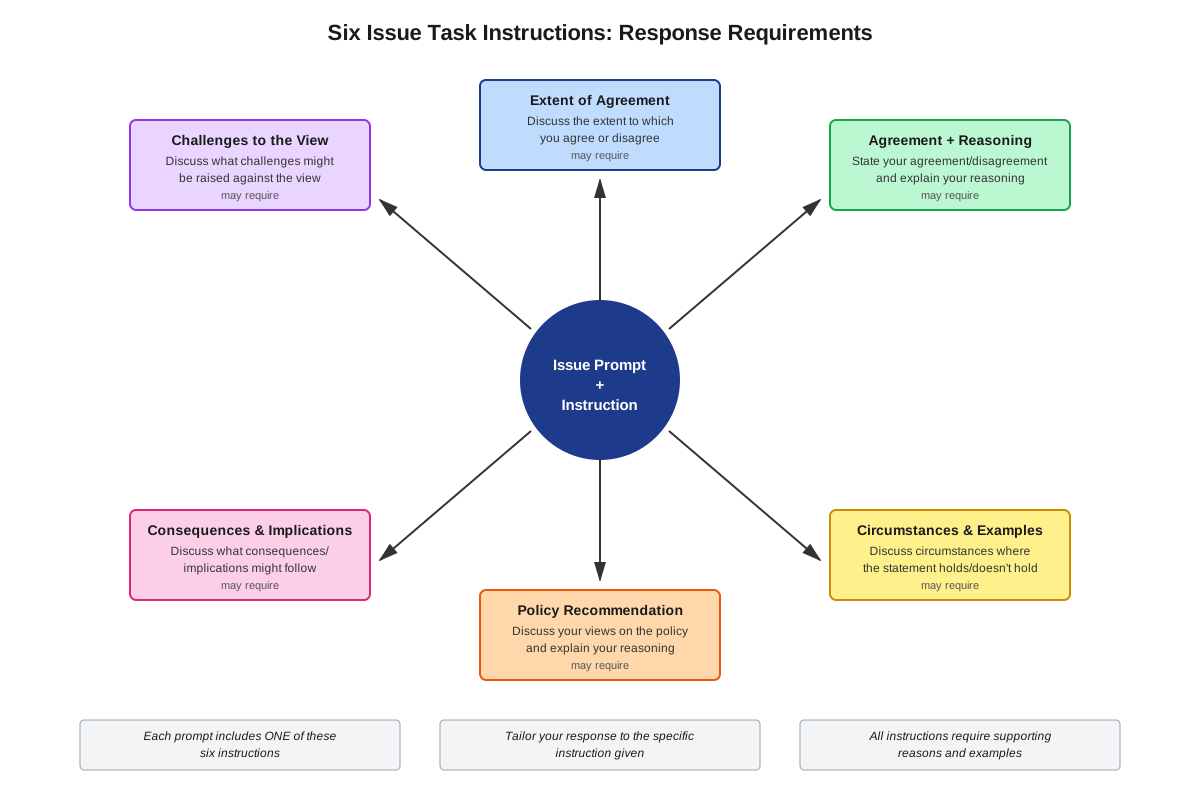
Each prompt includes one of six possible instruction sets that specify the lens through which students should address the issue:
- Write a response discussing the extent to which you agree or disagree with the statement and explain your reasoning
- Write a response discussing the extent to which you agree or disagree with the recommendation and explain your reasoning
- Write a response discussing the extent to which you agree or disagree with the claim and explain your reasoning
- Write a response discussing which view more closely aligns with your own position and explain your reasoning
- Write a response discussing the extent to which you agree or disagree with the claim and the reason on which that claim is based
- Write a response discussing your views on the policy and explain your reasoning
Understanding these instruction variations is crucial because they subtly alter the task requirements. For instance, instruction type 5 requires addressing both a claim and its underlying reasoning, demanding a more complex analytical approach than simply agreeing or disagreeing with a single statement.
Scoring Criteria
The Issue task is evaluated by trained human raters using a holistic scoring rubric that assesses responses on a 0–6 scale. Each essay receives two independent scores, which are then averaged (if they differ by more than one point, a third rater adjudicates). The final Analytical Writing score combines the Issue and Argument task scores and is reported in half-point increments.
| Score Level | Key Characteristics |
|---|---|
| 6 (Outstanding) | Articulates a clear, insightful position; develops ideas cogently with compelling reasons and examples; maintains excellent organization; demonstrates superior facility with language |
| 5 (Strong) | Presents a thoughtful, well-developed position; supports ideas with relevant reasons and examples; demonstrates good organization; shows facility with language with occasional minor errors |
| 4 (Adequate) | Presents a competent analysis; develops position with relevant reasons and examples; demonstrates adequate organization; shows sufficient control of language with some errors |
| 3 (Limited) | Demonstrates some competence but is flawed; vague or limited in developing position; weak in organization or language control |
| 2 (Seriously Flawed) | Demonstrates serious weaknesses; unclear or seriously limited in presenting position; disorganized; contains frequent errors that interfere with meaning |
| 1 (Fundamentally Deficient) | Demonstrates fundamental deficiencies in analytical writing skills |
| 0 | Off-topic, in a foreign language, merely copies the prompt, or consists of keystroke characters |
The rubric emphasizes critical thinking (the quality of ideas and analysis), organization (logical structure and coherence), and language use (clarity, variety, and grammatical correctness). Notably, scorers do not evaluate whether they agree with the test-taker's position—only how effectively that position is articulated and defended.
Essential Components of a Strong Response
A high-scoring Issue essay typically includes several key elements that work together to create a persuasive, well-reasoned argument:
Clear Position Statement: The essay must articulate a specific, defensible position on the issue within the introduction. Ambiguous or fence-sitting positions typically receive lower scores because they fail to demonstrate decisive critical thinking. The position need not be absolute agreement or disagreement; nuanced positions (e.g., "The statement holds true in most cases, but important exceptions exist") often score well when properly developed.
Logical Organization: Ideas should progress in a coherent sequence, with each paragraph serving a clear purpose in advancing the overall argument. Effective transitions connect ideas both within and between paragraphs, creating a seamless flow that guides readers through the reasoning process.
Relevant Reasons and Examples: Each main point requires support through specific reasons, examples, or evidence. These supporting elements may draw from personal experience, observation, academic knowledge, current events, or hypothetical scenarios. The key is relevance and specificity—vague generalizations weaken arguments, while concrete details strengthen them.
Consideration of Complexity: High-scoring essays acknowledge that most issues involve nuance and complexity. This might include addressing counterarguments, identifying contexts where the claim holds or fails, or recognizing competing values and priorities. Demonstrating intellectual sophistication through nuanced analysis distinguishes strong responses from merely adequate ones.
Facility with Language: While perfect grammar is not required, essays must communicate ideas clearly and effectively. Varied sentence structure, precise vocabulary, and minimal errors that interfere with meaning characterize strong responses. The writing should demonstrate the language control expected of graduate-level students.
Time Management Framework
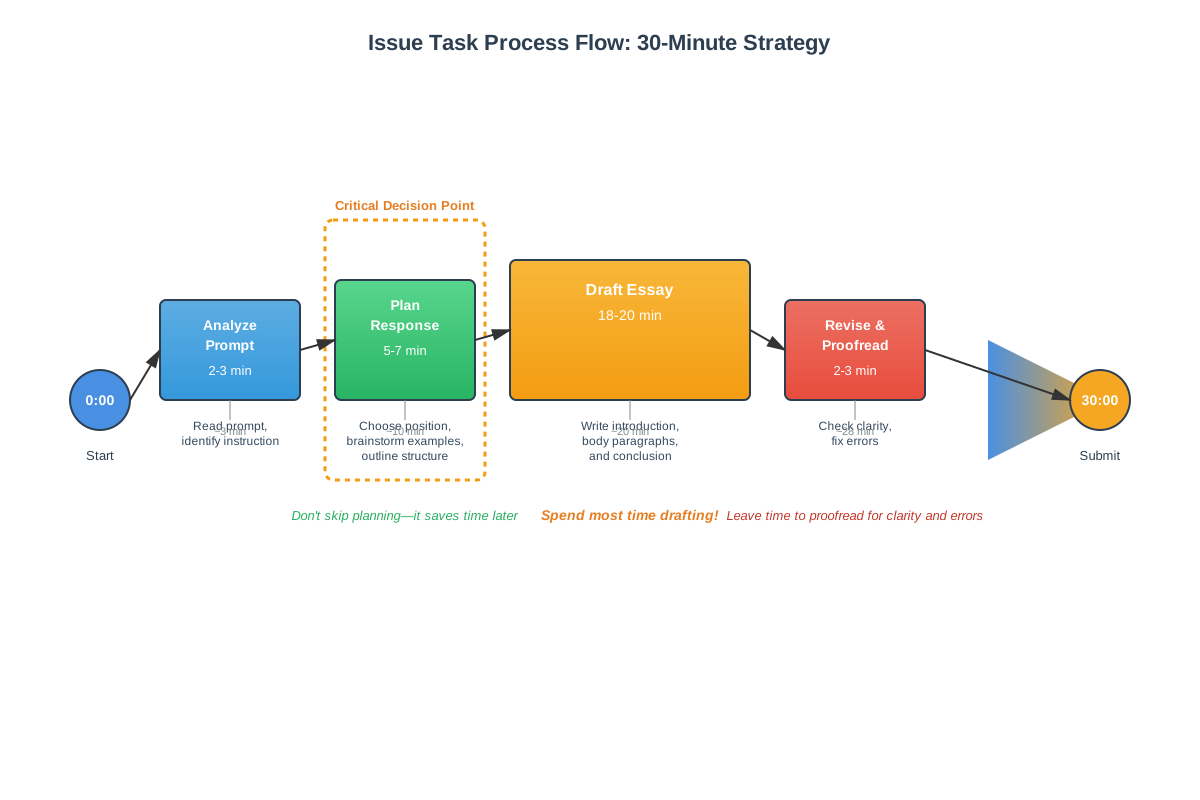
The 30-minute time limit creates significant pressure, making strategic time allocation essential. A recommended framework divides the time as follows:
- Minutes 1-5: Read and analyze the prompt; brainstorm ideas; decide on a position; outline the essay structure
- Minutes 6-25: Write the essay, including introduction, body paragraphs (typically 2-4), and conclusion
- Minutes 26-30: Review and edit for clarity, coherence, and errors
This framework ensures adequate planning time while leaving a buffer for revision. Many test-takers make the mistake of beginning to write immediately, resulting in disorganized essays that lack clear direction. The initial planning phase, though it may feel like "wasted" writing time, actually increases efficiency by providing a roadmap for composition.
The Pool of Issue Topics
ETS publishes the complete pool of Issue topics on its website, providing unprecedented transparency for test preparation. The approximately 150 prompts span diverse categories including:
- Education and learning
- Government and politics
- Technology and innovation
- Arts and culture
- Science and research
- Social issues and values
- Leadership and authority
- Competition and cooperation
While memorizing responses to all topics is neither feasible nor advisable (scorers can detect pre-written essays), familiarizing oneself with the topic pool offers strategic advantages. Students can identify themes that recur across multiple prompts, develop flexible examples that apply to various topics, and practice generating positions on unfamiliar issues quickly.
Concept Relationships
The Issue task overview serves as the foundational concept for the entire "Analyze an Issue" unit, connecting directly to every subsequent topic in the curriculum. Understanding the task structure, scoring criteria, and essential components enables students to approach more specific skills—such as developing thesis statements, constructing body paragraphs, and incorporating examples—with clear purpose and direction.
The relationship flows as follows: Issue Task Overview → establishes requirements and expectations → Thesis Development → guides the creation of → Body Paragraph Structure → which requires → Evidence Selection and Integration → all of which must be executed within → Time Management Strategies → and evaluated against → Scoring Rubric Understanding.
The Issue task also relates to prerequisite knowledge in critical ways. Basic essay structure provides the architectural framework that Issue responses must follow, while argumentation concepts supply the logical tools for constructing persuasive positions. Critical thinking skills enable the nuanced analysis that distinguishes high-scoring responses, and standard written English proficiency ensures ideas are communicated effectively.
Understanding the distinction between the Issue task and the Argument task is particularly important. While both assess analytical writing, they require fundamentally different approaches: the Issue task demands construction of an original argument, while the Argument task requires deconstruction of someone else's reasoning. Confusing these tasks leads to off-topic responses that receive low scores regardless of writing quality.
High-Yield Facts
⭐ The Issue task always appears first or second in the GRE, as part of the Analytical Writing section that begins the exam
⭐ Test-takers have exactly 30 minutes to plan, write, and review their Issue essay
⭐ The complete pool of approximately 150 Issue topics is published on the ETS website and available for review before test day
⭐ Each Issue prompt includes one of six specific instruction sets that direct how to approach the response
⭐ Scorers evaluate critical thinking, organization, and language use—not whether they agree with the test-taker's position
- The Issue task accounts for 50% of the Analytical Writing score, which is reported separately from Verbal and Quantitative scores
- Two trained human raters independently score each essay on a 0–6 scale; scores are averaged and combined with the Argument task score
- High-scoring essays (5-6) demonstrate clear positions, logical organization, relevant support, consideration of complexity, and strong language control
- The median Analytical Writing score across all test-takers is approximately 3.5, with scores of 5.0 or higher placing students in roughly the top 10%
- Essays are typed on a basic word processor with limited functionality (no spell-check, grammar-check, or formatting options beyond cut, copy, and paste)
- Scorers spend approximately 2-3 minutes reading each essay, making clarity and organization crucial for communicating ideas quickly
- Length alone does not determine scores, but high-scoring essays typically range from 400-600 words, reflecting thorough development of ideas
Quick check — test yourself on Issue task overview so far.
Try Flashcards →Common Misconceptions
Misconception: The Issue task requires test-takers to agree or disagree completely with the prompt statement. → Correction: Nuanced positions that partially agree or identify contexts where the claim holds or fails often score higher than absolute positions, as they demonstrate sophisticated critical thinking and recognition of complexity.
Misconception: Personal examples are less valuable than academic or historical examples. → Correction: The source of examples matters less than their relevance and specificity. A detailed personal anecdote that directly supports a point is more effective than a vague reference to a historical event. Scorers evaluate how well examples support the argument, not their origin.
Misconception: The Issue task tests knowledge of specific topics, so students must study facts about education, technology, politics, etc. → Correction: The Issue task assesses analytical writing and reasoning skills, not content knowledge. While general awareness helps generate examples, the task focuses on how effectively students construct and support arguments, regardless of the specific topic.
Misconception: Longer essays automatically receive higher scores. → Correction: While thorough development typically requires adequate length, scorers evaluate quality over quantity. A concise, well-organized 400-word essay can outscore a rambling 700-word response that lacks focus and coherence. Effective development, not word count, determines scores.
Misconception: Perfect grammar and vocabulary are required for high scores. → Correction: The scoring rubric allows for "occasional minor errors" even at the highest score levels. While serious or frequent errors that interfere with meaning lower scores, the emphasis is on clear communication and idea development rather than flawless mechanics.
Misconception: The introduction and conclusion are less important than body paragraphs. → Correction: The introduction establishes the essay's direction and position, while the conclusion provides closure and reinforces the main argument. Weak introductions leave scorers uncertain about the essay's purpose, and abrupt endings without conclusions suggest incomplete development. All components contribute to the overall score.
Misconception: Using sophisticated vocabulary and complex sentences always improves scores. → Correction: Clarity trumps complexity. Forced or misused vocabulary and convoluted sentence structures that obscure meaning actually lower scores. Effective language use means communicating ideas precisely and clearly, which sometimes requires simple, direct expression.
Worked Examples
Example 1: Analyzing an Issue Prompt
Prompt: "The best way to teach—whether as an educator, employer, or parent—is to praise positive actions and ignore negative ones."
Instructions: Write a response in which you discuss the extent to which you agree or disagree with the claim. In developing and supporting your position, be sure to address the most compelling reasons and/or examples that could be used to challenge your position.
Analysis Process:
Step 1 - Understand the Claim: The prompt asserts that positive reinforcement alone (praising good actions while ignoring bad ones) represents the optimal teaching approach across all contexts (education, employment, parenting).
Step 2 - Identify Key Terms: "Best way" suggests an absolute claim; "praise positive actions" indicates positive reinforcement; "ignore negative ones" means withholding attention or correction for mistakes or misbehavior; "whether as an educator, employer, or parent" broadens the claim across contexts.
Step 3 - Consider Multiple Perspectives:
- Supporting view: Positive reinforcement builds confidence, encourages repetition of desired behaviors, and creates supportive learning environments
- Challenging view: Ignoring negative actions may allow harmful behaviors to continue unchecked; some situations require direct correction for safety or ethical reasons
- Nuanced view: The effectiveness of this approach may depend on context, the severity of negative actions, and the learner's developmental stage
Step 4 - Develop a Position: "While positive reinforcement is a valuable teaching tool that should be emphasized, completely ignoring negative actions is neither practical nor advisable in many situations. The best teaching approach balances praise for positive behaviors with appropriate, constructive responses to negative ones."
Step 5 - Plan Supporting Points:
- Positive reinforcement effectively motivates learners and builds confidence (support the claim's partial validity)
- Ignoring dangerous or harmful behaviors can lead to serious consequences (challenge the absolute nature of the claim)
- Constructive feedback on mistakes facilitates learning and improvement (offer alternative approach)
- Context matters—the approach should vary based on the situation and learner (demonstrate nuanced thinking)
Step 6 - Address Counterarguments: Acknowledge that excessive criticism can be demotivating and that positive reinforcement has strong research support, but argue that this doesn't justify completely ignoring negative actions.
This analysis process demonstrates how to move from reading the prompt to developing a clear, defensible position supported by relevant reasons—the foundation of a strong Issue essay.
Example 2: Evaluating Response Quality
Prompt: "Governments should focus on solving the immediate problems of today rather than on trying to solve the anticipated problems of the future."
Sample Response Excerpt (Introduction and first body paragraph):
"The statement that governments should prioritize immediate problems over future ones presents a false dichotomy. Effective governance requires balancing short-term needs with long-term planning, as many of today's crises stem from yesterday's failure to anticipate future challenges. While addressing urgent current problems is undeniably important, completely neglecting future concerns would be shortsighted and ultimately harmful to citizens' welfare.
Consider climate change as a compelling example of why future-focused planning is essential. Decades ago, when scientists first warned about greenhouse gas emissions, governments faced a choice: address the anticipated future problem through policy changes, or focus exclusively on immediate economic concerns. Many governments chose the latter, prioritizing short-term economic growth over environmental regulation. Today, those same nations face the immediate problems of extreme weather events, rising sea levels, and climate-related disasters—problems that are far more costly and difficult to address than preventive measures would have been. This example illustrates how ignoring anticipated future problems transforms them into immediate crises that demand even greater resources to solve."
Evaluation:
Strengths:
- Clear position statement that acknowledges complexity ("false dichotomy," "balancing")
- Specific, relevant example (climate change) that directly supports the main argument
- Logical connection between the example and the broader point (failure to plan ahead creates worse immediate problems)
- Sophisticated reasoning that demonstrates critical thinking
- Clear, effective language with varied sentence structure
Areas for Development:
- Could more explicitly address the instruction to discuss "extent of agreement/disagreement"
- Might benefit from acknowledging legitimate reasons why governments prioritize immediate problems
- Could strengthen the transition between the position statement and the example
Likely Score Range: This excerpt demonstrates characteristics of a 5-6 response—clear position, strong development, relevant example, and effective language use. The full essay's score would depend on whether subsequent paragraphs maintain this quality and adequately address counterarguments.
Exam Strategy
Approaching Issue Prompts Systematically
When the Issue prompt appears on screen, resist the urge to begin writing immediately. Instead, invest 4-5 minutes in strategic planning:
- Read the entire prompt twice: First for general understanding, second to identify the specific instruction set
- Identify the claim's key terms: Circle or mentally note words that define the scope and nature of the claim
- Brainstorm quickly: Spend 60-90 seconds generating initial reactions, examples, and perspectives
- Choose a defensible position: Select a stance you can support with specific reasons and examples
- Outline the structure: Jot down 3-4 main points and supporting examples in logical order
Trigger Words and Phrases
Certain words in Issue prompts signal important aspects of the claim that require attention:
- Absolute terms ("always," "never," "all," "only," "best," "worst"): These suggest opportunities to challenge the claim by identifying exceptions or contexts where it doesn't hold
- Comparative terms ("more," "less," "better," "worse"): These require evaluating relative merits and may benefit from acknowledging trade-offs
- Causal language ("because," "leads to," "results in," "causes"): These indicate claims about cause-effect relationships that may require examining alternative explanations
- Scope indicators ("in all cases," "for everyone," "in every situation"): These define how broadly the claim applies and where limitations might exist
Process-of-Elimination for Position Selection
When uncertain about which position to take, eliminate options strategically:
- Eliminate positions you cannot support: If you lack relevant examples or reasons for a particular stance, choose a different position
- Eliminate extreme positions unless strongly justified: Absolute agreement or disagreement is harder to defend than nuanced positions
- Eliminate positions that ignore the instruction: If the prompt asks you to address counterarguments, don't choose a position that makes this difficult
Time Allocation Discipline
Strict time management prevents common pitfalls:
- Set mental checkpoints: By minute 5, you should be writing; by minute 20, you should be starting your conclusion; by minute 26, you should be reviewing
- If planning takes longer than 5 minutes, start writing: An imperfect plan executed is better than a perfect plan that leaves insufficient writing time
- Reserve the final 3-4 minutes for review: This buffer allows you to catch errors, add transitions, and ensure your conclusion is complete
- If running short on time, prioritize completing your conclusion: An essay without a conclusion appears unfinished and may score lower
Maximizing Scorer Impact
Remember that scorers spend only 2-3 minutes reading each essay. Maximize impact by:
- Front-loading your position: State your main argument clearly in the introduction so scorers immediately understand your stance
- Using topic sentences: Begin each body paragraph with a clear statement of its main point
- Providing specific examples: Concrete details are more memorable and persuasive than abstract generalizations
- Maintaining coherence: Use transitions to guide scorers through your reasoning
- Ending strongly: A clear conclusion that reinforces your position leaves a positive final impression
Memory Techniques
The PACED Framework for Issue Essays
Position: State a clear, defensible stance on the issue
Acknowledge: Recognize complexity and address counterarguments
Connect: Link examples and reasons explicitly to your main argument
Elaborate: Develop ideas thoroughly with specific details
Demonstrate: Show sophisticated thinking through nuanced analysis
This acronym helps students remember the essential components of high-scoring responses during the pressure of test day.
The Six Instructions Mnemonic
To remember the six instruction types, use: "RRCPVP" (Recommend, Reason, Claim, Policy, View, Position)
While the exact wording varies, recognizing that instructions ask you to discuss:
- Recommendations
- Reasons underlying claims
- Claims themselves
- Policies
- Views (comparing two perspectives)
- Positions (extent of agreement)
Visualization for Organization
Picture your essay as a bridge connecting your position (one side) to your conclusion (the other side). Each body paragraph is a support pillar that must be firmly grounded in specific examples (the foundation) and must connect clearly to the main structure (through topic sentences and transitions). This visual metaphor helps maintain organizational coherence.
The "3-2-1" Rule for Examples
For each main point, aim to provide:
- 3 sentences of explanation or analysis
- 2 specific details or pieces of evidence
- 1 explicit connection back to your thesis
This ratio ensures adequate development without excessive length, helping students gauge when they've sufficiently supported a point.
Summary
The Issue task overview encompasses the fundamental knowledge required to approach the GRE's Analyze an Issue essay strategically and effectively. This task presents test-takers with a claim about a topic of general interest and one of six specific instruction sets, requiring them to construct and defend a position within 30 minutes. Success depends on understanding the scoring criteria—which emphasize critical thinking, organization, and language use rather than agreement with any particular viewpoint—and implementing a systematic approach that includes adequate planning time, clear position articulation, logical organization, relevant supporting examples, acknowledgment of complexity, and effective language use. The complete pool of Issue topics is published on the ETS website, allowing strategic preparation, though the task fundamentally assesses analytical writing skills rather than content knowledge. High-scoring responses demonstrate nuanced thinking, specific development, and coherent structure, typically ranging from 400-600 words and earning scores of 5-6 on the 0-6 scale. Mastering the Issue task overview provides the foundation for all subsequent Analytical Writing preparation and directly impacts graduate admissions prospects across numerous fields.
Key Takeaways
- The Issue task requires constructing and defending an original position on a claim, distinct from the Argument task's focus on critiquing existing reasoning
- Six different instruction sets may accompany Issue prompts, each subtly altering the response requirements and requiring careful attention
- Scorers evaluate critical thinking quality, organizational coherence, and language facility—not whether they agree with the test-taker's position
- Effective time management allocates 4-5 minutes for planning, 20 minutes for writing, and 3-4 minutes for review within the 30-minute limit
- High-scoring essays demonstrate clear positions, logical organization, specific supporting examples, acknowledgment of complexity, and strong language control
- The complete pool of approximately 150 Issue topics is available on the ETS website, enabling strategic familiarization with topic categories and themes
- Nuanced positions that recognize complexity and address counterarguments typically score higher than absolute agreement or disagreement
Related Topics
Thesis Development for Issue Essays: Building on the Issue task overview, this topic explores strategies for crafting clear, defensible thesis statements that effectively frame the entire essay and guide development of supporting paragraphs.
Body Paragraph Structure and Development: This topic examines how to construct well-organized body paragraphs that advance the overall argument through topic sentences, supporting evidence, analysis, and transitions—skills essential for executing the Issue task effectively.
Evidence Selection and Integration: Understanding how to choose relevant examples from personal experience, current events, history, or hypothetical scenarios, and how to integrate them smoothly into the essay to support main points.
Addressing Counterarguments: This advanced topic focuses on techniques for acknowledging and responding to opposing viewpoints, demonstrating the intellectual sophistication that distinguishes high-scoring responses.
Time Management and Essay Planning: Practical strategies for maximizing efficiency within the 30-minute constraint, including outlining techniques, pacing strategies, and revision priorities.
Practice CTA
Now that you've mastered the foundational concepts of the Issue task overview, it's time to apply this knowledge through deliberate practice. Access the practice questions to work with authentic GRE-style Issue prompts, and use the flashcards to reinforce key concepts, scoring criteria, and strategic approaches. Remember that analytical writing is a skill that improves with practice—each essay you write strengthens your ability to think critically, organize ideas coherently, and express arguments persuasively under time pressure. Your investment in mastering the Issue task will pay dividends not only on test day but throughout your graduate studies and professional career. Begin practicing today to build the confidence and competence that lead to top scores!
Sign up free to keep reading
Create a free AnvayaPrep account to finish this GRE guide on Issue task overview — plus flashcards and practice questions.