Overview
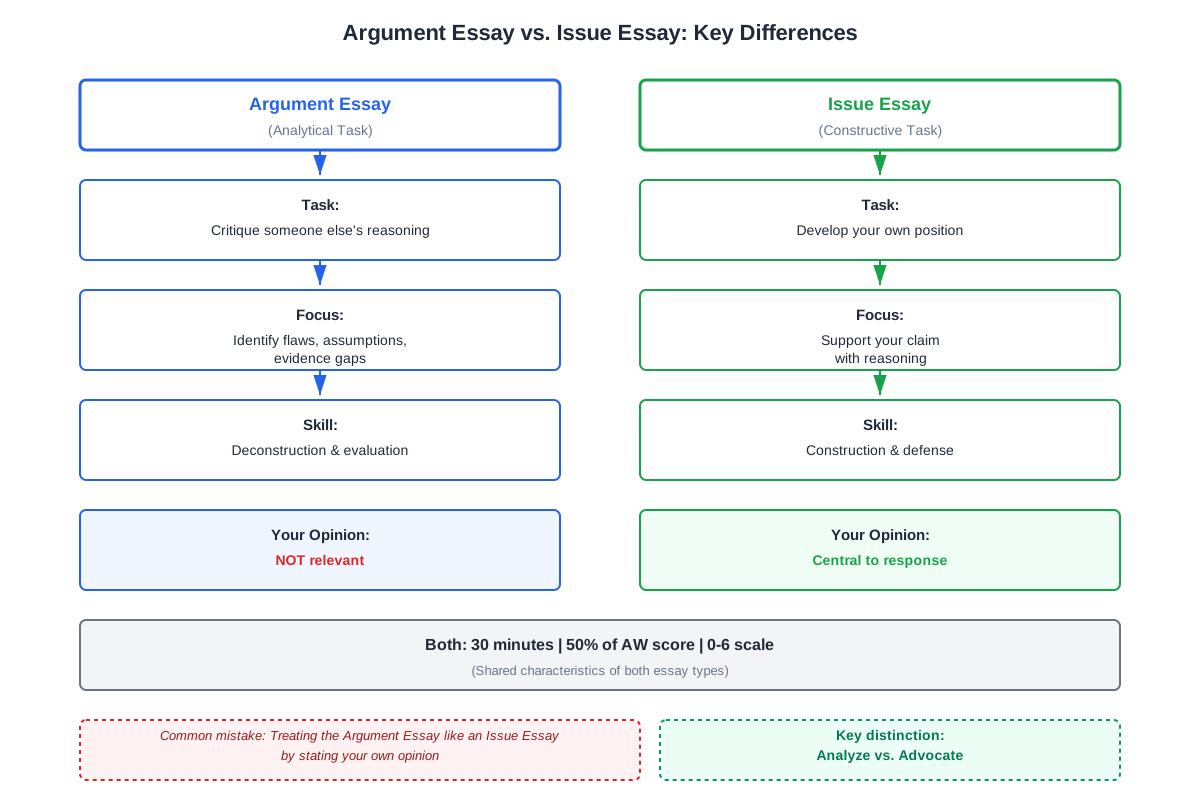
The argument task overview is one of two essay types in the GRE Analytical Writing section, and it represents a critical component of graduate school admissions. Unlike the Issue Essay, which asks test-takers to develop their own position on a topic, the Argument Essay requires students to analyze someone else's reasoning and identify logical flaws, unsupported assumptions, and weaknesses in evidence. This task assesses critical thinking skills that are fundamental to graduate-level academic work, where students must evaluate research claims, assess the validity of arguments, and identify gaps in reasoning.
The GRE argument task overview encompasses understanding the task's structure, scoring criteria, and analytical approach. Test-takers receive a brief argument (typically 100-150 words) that presents a conclusion supported by evidence and reasoning. The task is not to agree or disagree with the argument, but rather to critique how well the evidence supports the conclusion. This requires identifying unstated assumptions, evaluating the logical connections between premises and conclusions, and suggesting what additional evidence would strengthen or weaken the argument. Mastering this task is essential because it directly demonstrates the analytical and writing skills that graduate programs value.
Within the broader Analytical Writing section, the Argument Essay complements the Issue Essay by testing different cognitive skills. While the Issue Essay measures the ability to construct and defend a position, the Argument Essay measures the ability to deconstruct and evaluate reasoning. Together, these tasks provide admissions committees with a comprehensive picture of an applicant's writing abilities, critical thinking skills, and readiness for graduate-level discourse. The Argument Essay typically appears as either the first or second essay in the Analytical Writing section, and students have exactly 30 minutes to plan, write, and revise their response.
Learning Objectives
- [ ] Identify when Argument task overview is being tested
- [ ] Explain the core rule or strategy behind Argument task overview
- [ ] Apply Argument task overview to GRE-style questions accurately
- [ ] Analyze the structure of a GRE argument to identify its conclusion, premises, and assumptions
- [ ] Evaluate the quality and relevance of evidence presented in an argument
- [ ] Construct a well-organized critique that addresses multiple logical flaws
- [ ] Articulate specific questions or additional evidence that would strengthen or weaken an argument
Prerequisites
- Basic understanding of logical reasoning: Familiarity with premises, conclusions, and how arguments are structured is essential for identifying where reasoning breaks down
- Fundamental writing skills: The ability to organize ideas into coherent paragraphs with clear topic sentences and supporting details enables effective communication of the critique
- Reading comprehension: The capacity to quickly understand complex passages and identify main ideas allows efficient analysis within the 30-minute time constraint
- Awareness of common logical fallacies: Recognition of patterns like correlation-causation errors, hasty generalizations, and false analogies accelerates the identification of flaws
Why This Topic Matters
The Argument Essay appears on every administration of the GRE and accounts for 50% of the Analytical Writing score, which is reported separately on a 0-6 scale in half-point increments. Graduate programs across disciplines—from humanities to STEM fields—use this score to assess applicants' ability to think critically and communicate effectively. Many programs set minimum Analytical Writing score thresholds, and a strong performance can distinguish candidates in competitive applicant pools.
Beyond the immediate exam context, the skills tested in the Argument Essay have direct real-world applications. Graduate students must regularly evaluate research methodologies, assess the validity of published findings, identify gaps in literature reviews, and critique theoretical frameworks. Professionals in fields ranging from law to business analytics to public policy must analyze proposals, identify unstated assumptions in strategic plans, and evaluate evidence quality. The ability to systematically deconstruct arguments and identify logical weaknesses is fundamental to informed decision-making and scholarly discourse.
On the GRE, the Argument Essay consistently tests several recurring patterns: arguments that confuse correlation with causation, arguments that rely on unrepresentative samples, arguments that assume past trends will continue unchanged, and arguments that fail to consider alternative explanations. Test-takers encounter arguments drawn from business scenarios, public policy proposals, educational recommendations, and community planning situations. The task always follows the same format: analyze the argument's reasoning, identify assumptions, and discuss what evidence would make the argument more or less convincing.
Core Concepts
The Argument Task Structure
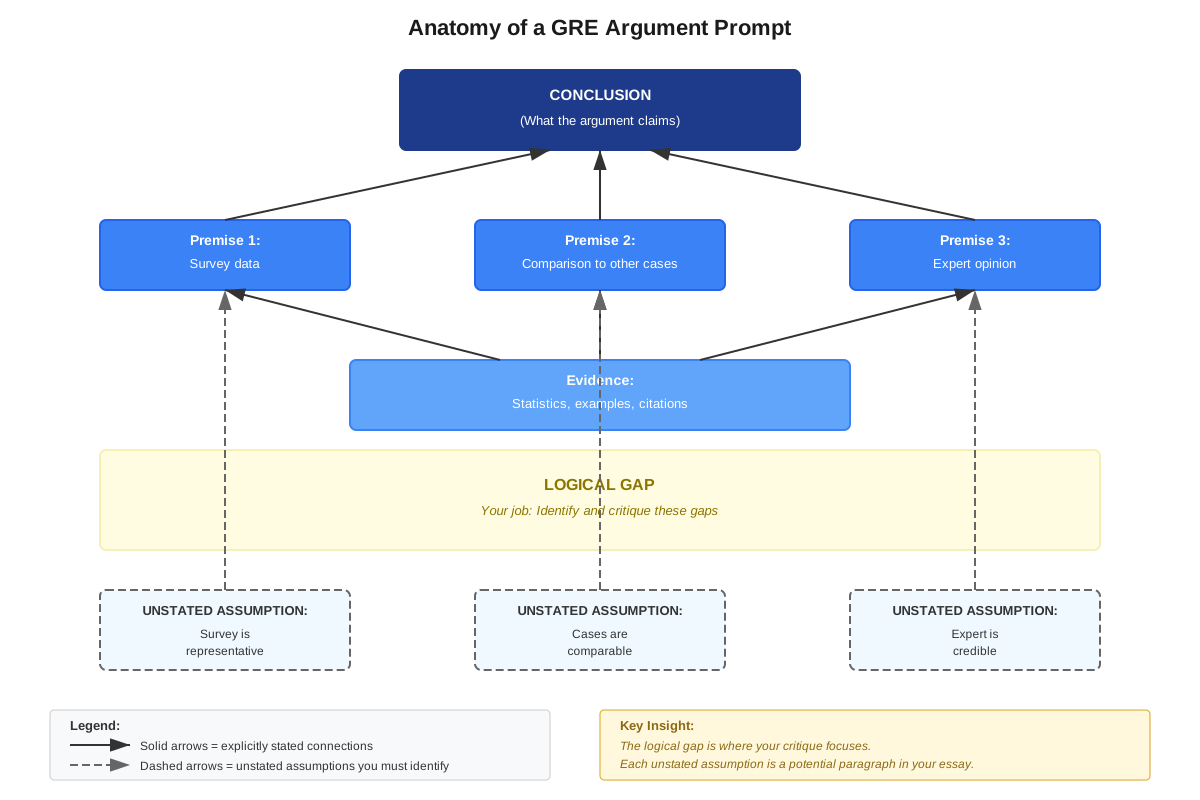
The argument task overview begins with understanding the consistent format of every prompt. Each argument presents a conclusion—a claim or recommendation the author wants readers to accept—supported by premises (evidence, facts, or observations). Between these premises and the conclusion lie assumptions: unstated beliefs that must be true for the reasoning to work. The test-taker's job is to identify these assumptions and explain why they might not hold, thereby weakening the argument.
The prompt always includes specific instructions that guide the analysis. The most common instruction asks test-takers to "discuss what questions would need to be answered in order to decide whether the recommendation is likely to have the predicted result." Other variations ask students to "discuss what evidence is needed to evaluate the argument" or "discuss what questions would need to be answered to determine whether the advice and prediction are reasonable." While the wording varies, all instructions fundamentally ask for the same analysis: identify logical gaps and explain what additional information would strengthen or weaken the reasoning.
Identifying Assumptions
Assumptions are the unstated connections between evidence and conclusion. They represent beliefs the argument takes for granted without providing supporting evidence. For example, if an argument states "Sales of organic produce increased 20% last year, so our supermarket should expand its organic section," the assumption is that the trend will continue, that the increase applies to this specific market, and that increased sales justify the expansion costs.
Effective assumption identification requires asking: "What must be true for this evidence to support this conclusion?" Strong essays identify multiple distinct assumptions rather than variations of the same assumption. Test-takers should look for assumptions about:
- Representativeness: Does a sample accurately reflect a larger population?
- Causation: Does correlation actually indicate a causal relationship?
- Temporal stability: Will current conditions persist into the future?
- Comparability: Are compared groups actually similar in relevant ways?
- Feasibility: Can a proposed solution actually be implemented as described?
Evaluating Evidence Quality
Not all evidence equally supports a conclusion. The Argument Essay requires assessing whether the evidence provided is relevant, sufficient, and representative. Relevant evidence directly relates to the conclusion; sufficient evidence provides adequate support for the claim's scope; representative evidence accurately reflects the population or situation in question.
Common evidence weaknesses include:
- Vague statistics: "Many residents support the proposal" lacks specificity
- Outdated information: Five-year-old data may not reflect current conditions
- Biased sources: Surveys of self-selected respondents may not represent broader opinions
- Incomplete comparisons: Comparing two groups without controlling for confounding variables
- Anecdotal evidence: Single examples don't establish general patterns
The Critique Structure
A high-scoring Argument Essay follows a clear organizational pattern. The introduction briefly summarizes the argument and presents a thesis stating that the argument relies on questionable assumptions and requires additional evidence. The body paragraphs (typically 3-4) each focus on one major logical flaw, explaining the assumption, why it might not hold, and what evidence would address the weakness. The conclusion synthesizes the critique and reinforces that without addressing these issues, the argument remains unconvincing.
Each body paragraph should follow this structure:
- Identify the assumption: State what the argument takes for granted
- Explain the problem: Describe why this assumption might be false
- Provide specific examples: Illustrate scenarios where the assumption fails
- Suggest evidence: Specify what information would strengthen or weaken the argument
Common Logical Flaws
The GRE recycles certain logical patterns across different argument topics. Recognizing these patterns accelerates analysis:
| Logical Flaw | Description | Example |
|---|---|---|
| Correlation-Causation | Assumes correlation proves causation | "Crime decreased after streetlight installation, so lights reduced crime" |
| Hasty Generalization | Draws broad conclusions from limited evidence | "Three customers complained, so most customers are dissatisfied" |
| False Analogy | Assumes different situations are comparable | "This policy worked in City A, so it will work in City B" |
| Appeal to Tradition | Assumes past success guarantees future success | "This method worked for 20 years, so it will continue working" |
| False Dichotomy | Presents only two options when more exist | "Either we expand or we lose market share" |
| Unrepresentative Sample | Generalizes from biased or small samples | "Survey of website visitors shows customer satisfaction" |
Scoring Criteria
GRE essay readers evaluate Argument Essays on four dimensions:
- Analysis of the argument: Identifies and examines important features of the argument, including assumptions and evidence quality
- Organization and focus: Presents ideas in a logical sequence with clear connections between points
- Language use and conventions: Demonstrates facility with standard written English, varied sentence structure, and precise vocabulary
- Support and development: Develops ideas fully with relevant examples and explanations
Essays scoring 5-6 (the highest range) demonstrate sophisticated analysis, identifying multiple distinct flaws and explaining their implications thoroughly. They maintain clear organization throughout and use language precisely. Essays scoring 3-4 show competent analysis but may miss some important assumptions or develop ideas less fully. Essays scoring 1-2 demonstrate limited analysis, poor organization, or significant language problems.
Concept Relationships
The core concepts within the argument task overview form an interconnected analytical framework. Identifying assumptions serves as the foundation for all other analytical work—without recognizing what the argument takes for granted, test-takers cannot effectively evaluate evidence quality or suggest improvements. This assumption identification directly enables evaluating evidence quality, as each piece of evidence can be assessed based on whether it adequately supports the assumptions it's meant to validate.
The relationship flows as follows: Argument Structure Recognition → Assumption Identification → Evidence Evaluation → Critique Organization → Effective Essay Composition. Understanding common logical flaws accelerates assumption identification by providing pattern recognition shortcuts. When a test-taker recognizes a correlation-causation pattern, they immediately know to question whether the relationship is truly causal and what alternative explanations might exist.
The critique structure serves as the organizational framework that transforms analytical insights into a coherent essay. Each identified assumption becomes a body paragraph, and the evidence evaluation determines what specific questions or information to suggest. Finally, awareness of scoring criteria guides decisions about depth of analysis, organizational clarity, and language precision throughout the writing process.
These concepts connect to broader Analytical Writing skills: the logical reasoning required for assumption identification parallels the evidence evaluation needed in the Issue Essay, while the organizational principles apply across all academic writing contexts. The critical thinking skills developed through argument analysis transfer directly to graduate-level research evaluation and professional decision-making.
High-Yield Facts
⭐ The Argument Essay always requires critique, never agreement or disagreement with the conclusion—the task is to analyze reasoning quality, not to take a position on the topic.
⭐ Every GRE argument contains multiple logical flaws—high-scoring essays identify and develop at least three distinct weaknesses.
⭐ Assumptions are unstated connections between evidence and conclusion—they represent what must be true for the reasoning to work.
⭐ The most common logical flaw on the GRE is confusing correlation with causation—arguments frequently assume that because two things occur together, one causes the other.
⭐ Effective critiques specify what evidence would strengthen or weaken the argument—vague suggestions like "more research is needed" score lower than specific questions like "What percentage of residents actually use the proposed facility?"
- The Argument Essay is always 30 minutes long, regardless of which essay appears first in the Analytical Writing section.
- Arguments typically range from 100-150 words and present scenarios from business, education, public policy, or community planning contexts.
- The prompt instructions vary slightly across different argument prompts, but all fundamentally ask for the same type of analysis.
- High-scoring essays typically range from 400-600 words, though length alone doesn't determine the score.
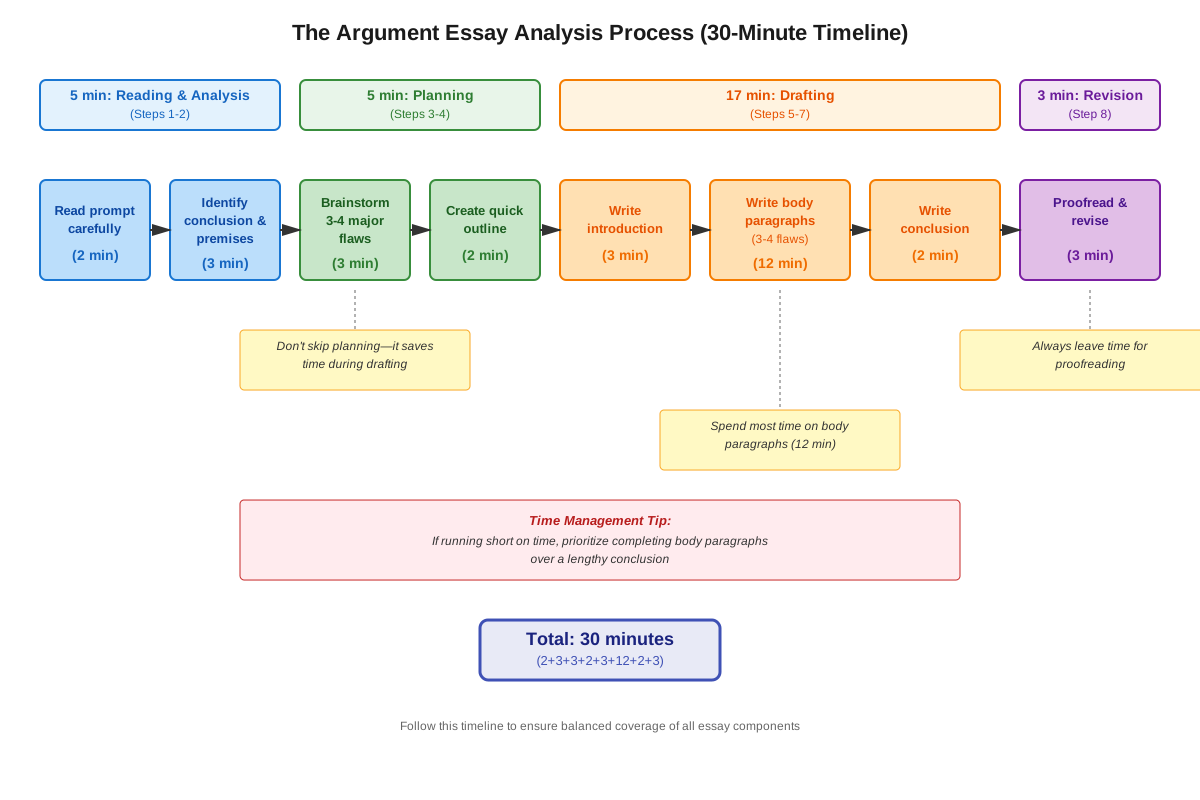
- Test-takers should spend approximately 5 minutes analyzing the argument, 20 minutes writing, and 5 minutes reviewing and editing.
- The argument provided is always flawed—there is no such thing as a "good" argument on the GRE Argument Essay.
- Readers spend approximately 2-3 minutes evaluating each essay, so clarity and organization are essential for communicating analytical insights quickly.
- The same argument prompt may appear with different instructions, requiring slightly different analytical emphases.
Quick check — test yourself on Argument task overview so far.
Try Flashcards →Common Misconceptions
Misconception: The Argument Essay asks test-takers to agree or disagree with the conclusion.
Correction: The task requires analyzing the quality of reasoning, not taking a position on the topic. Test-takers should never state whether they personally agree with the argument's conclusion.
Misconception: Identifying one major flaw thoroughly is better than discussing multiple flaws.
Correction: High-scoring essays identify and develop multiple distinct logical weaknesses. A single-flaw essay, no matter how well developed, cannot demonstrate the sophisticated analysis required for top scores.
Misconception: The argument must be completely destroyed to receive a high score.
Correction: The goal is balanced, thoughtful critique that acknowledges what evidence would strengthen the argument. Overly aggressive or dismissive critiques that ignore the argument's potential validity score lower than nuanced analyses.
Misconception: Using sophisticated vocabulary and complex sentences automatically improves the score.
Correction: Clarity and precision matter more than vocabulary complexity. Readers value clear communication of analytical insights over unnecessarily complicated language that obscures meaning.
Misconception: The introduction and conclusion are less important than body paragraphs.
Correction: Organization and focus account for a significant portion of the score. A clear thesis in the introduction and effective synthesis in the conclusion demonstrate the organizational skills that distinguish high-scoring essays.
Misconception: Personal examples and experiences strengthen the critique.
Correction: The Argument Essay requires analyzing the given argument's logic, not introducing outside information or personal anecdotes. All analysis should focus on the evidence and reasoning provided in the prompt.
Misconception: Longer essays always receive higher scores.
Correction: While very brief essays typically score lower, length alone doesn't determine quality. A focused 400-word essay with sophisticated analysis outscores a rambling 700-word essay with superficial observations.
Worked Examples
Example 1: Business Recommendation Argument
Argument: "The following appeared in a memo from the director of marketing at Maxtech Corporation: 'Three years ago, we began offering our employees free membership to the local fitness center. Since then, employee sick days have decreased by 15%. To further improve employee health and reduce healthcare costs, we should now require all employees to participate in the fitness program.'"
Analysis Process:
Step 1: Identify the conclusion
The conclusion is the recommendation: Maxtech should require all employees to participate in the fitness program to improve health and reduce costs.
Step 2: Identify the premises
- Maxtech offered free fitness center membership three years ago
- Sick days decreased by 15% since then
Step 3: Identify assumptions
- The fitness program caused the sick day reduction (correlation-causation)
- The 15% decrease is significant and not due to other factors
- Voluntary participation will translate to mandatory participation benefits
- Employees who don't currently participate would benefit from forced participation
- The cost of mandatory participation won't exceed healthcare savings
Step 4: Develop the critique
Body Paragraph 1 - Causation Assumption:
The argument assumes the fitness program caused the sick day reduction, but correlation doesn't prove causation. Other factors might explain the decrease: perhaps Maxtech implemented a new sick leave policy, hired healthier employees, or improved workplace safety during the same period. Additionally, broader trends like a particularly mild flu season could account for fewer sick days. To strengthen this argument, Maxtech would need to provide evidence that employees who used the fitness center took fewer sick days than those who didn't, controlling for other variables like age and pre-existing health conditions.
Body Paragraph 2 - Mandatory Participation Assumption:
The argument assumes that forcing non-participants to join will produce the same benefits as voluntary participation. However, employees who chose to join likely already valued fitness and would have exercised regardless of the free membership. Forcing reluctant employees to participate might not improve their health and could decrease morale, potentially increasing stress-related absences. The argument would be stronger if it provided evidence about why current non-participants don't use the facility—if cost is the barrier, free membership already addresses this; if time or interest is the issue, mandatory participation won't solve the underlying problem.
Body Paragraph 3 - Cost-Benefit Assumption:
The argument assumes the benefits will outweigh the costs without providing financial analysis. Mandatory participation would require enforcement mechanisms, potentially additional staff time, and might necessitate expanding facility capacity if current facilities can't accommodate all employees. The 15% sick day reduction might not translate to significant healthcare cost savings if the reduced sick days were for minor illnesses that don't generate substantial medical expenses. To evaluate this recommendation, Maxtech needs to calculate the actual healthcare cost savings from the sick day reduction and compare them to the full costs of mandatory participation.
Example 2: Public Policy Argument
Argument: "The following appeared in a letter to the editor of a local newspaper: 'Five years ago, the city of Grandville installed speed cameras at ten intersections. Traffic accidents at those intersections decreased by 30%. To improve traffic safety throughout the city, Grandville should install speed cameras at all major intersections.'"
Analysis Process:
Step 1: Identify the conclusion
Grandville should install speed cameras at all major intersections to improve citywide traffic safety.
Step 2: Identify the premises
- Speed cameras were installed at ten intersections five years ago
- Accidents at those intersections decreased by 30%
Step 3: Identify key assumptions
- The cameras caused the accident reduction
- The ten intersections are representative of all major intersections
- Conditions that made cameras effective at those locations apply citywide
- The 30% reduction is statistically significant and not due to chance
- Drivers haven't simply shifted dangerous behavior to non-camera intersections
Step 4: Develop the critique
The argument assumes the cameras caused the accident reduction, but other factors might explain the decrease. Perhaps those ten intersections underwent additional safety improvements like better lighting, clearer signage, or road redesign. The city might have increased police presence in those areas or implemented driver education campaigns. Additionally, citywide traffic patterns might have changed—perhaps a new highway reduced traffic volume through those intersections. To strengthen this argument, the city would need to compare accident rates at camera-equipped intersections with similar intersections without cameras during the same period, controlling for other safety interventions.
The argument also assumes the ten original intersections represent all major intersections, but this might not be true. The cameras might have been installed at particularly dangerous intersections where specific factors—such as poor visibility, confusing lane markings, or high pedestrian traffic—contributed to accidents. If cameras were placed at the worst intersections, the 30% improvement might not be replicable at safer intersections where speeding isn't the primary accident cause. The argument would be more convincing if it provided information about why those ten intersections were selected and whether their characteristics match other major intersections citywide.
Exam Strategy
Approach the task systematically: Spend the first 3-5 minutes reading the argument carefully and brainstorming logical flaws. Create a quick outline identifying 3-4 distinct assumptions before beginning to write. This planning time prevents mid-essay realization that all body paragraphs address the same flaw from different angles.
Watch for trigger words and phrases that signal logical vulnerabilities:
- "Since then" or "after" → potential correlation-causation confusion
- "Similar to" or "like" → potential false analogy
- "Survey shows" or "poll indicates" → potential sampling bias
- "Will continue" or "trend suggests" → assumption about future conditions
- "Only" or "must" → potential false dichotomy
- "Many" or "most" → vague quantification requiring scrutiny
Use the process of elimination for assumption identification: If stuck, systematically ask: What assumptions does this argument make about causation? About representativeness? About future conditions? About feasibility? This structured approach ensures comprehensive analysis even under time pressure.
Allocate time strategically: Aim for 5 minutes planning, 20 minutes writing (approximately 5 minutes per body paragraph), and 5 minutes reviewing. If running short on time, write a brief conclusion that restates the thesis rather than leaving the essay without closure. An incomplete body paragraph is less damaging than no conclusion.
Prioritize clarity over complexity: Readers evaluate dozens of essays per session and appreciate clear, direct communication. Use straightforward language and explicit transitions ("First," "Additionally," "Furthermore") to guide readers through the analysis. Each body paragraph should begin with a clear topic sentence identifying which assumption it addresses.
Develop each flaw thoroughly: Rather than listing many flaws superficially, develop 3-4 flaws with specific examples and evidence suggestions. Each body paragraph should explain not just what the assumption is, but why it might be false and what specific information would address the weakness.
Exam Tip: The argument is always flawed—never waste time trying to determine if the argument is actually sound. Focus analytical energy on identifying which flaws to discuss and how to develop them effectively.
Memory Techniques
CAFE mnemonic for common logical flaws:
- Correlation-Causation confusion
- Analogy (false comparisons)
- Future assumptions (past trends continuing)
- Evidence quality (sampling, vagueness, bias)
The "Three Questions" framework for analyzing any argument:
- "What does this evidence actually prove?" (vs. what the argument claims it proves)
- "What else could explain this?" (alternative explanations)
- "What's missing?" (gaps in evidence or reasoning)
ASSUME acronym for assumption categories:
- Alternative explanations ruled out
- Sample representativeness
- Stability of conditions over time
- Unstated connections between evidence and conclusion
- Measurement validity and reliability
- External factors controlled for
Visualization strategy: Picture the argument as a bridge with the evidence as one side and the conclusion as the other. Assumptions are the support beams holding up the bridge. The essay's job is to identify which support beams are weak or missing, causing the bridge to be unstable.
The "So What?" test: After identifying an assumption, ask "So what if this assumption is false?" If the answer is "the conclusion might not follow," it's a strong assumption to discuss. If the answer is "the conclusion still might be true," find a more central assumption.
Summary
The GRE Argument Essay requires test-takers to analyze the logical structure of a brief argument, identify unstated assumptions, evaluate evidence quality, and explain what additional information would strengthen or weaken the reasoning. Unlike the Issue Essay, this task demands critique rather than position-taking—the goal is to assess how well evidence supports a conclusion, not to agree or disagree with the conclusion itself. Successful essays identify multiple distinct logical flaws, develop each flaw with specific examples and evidence suggestions, and maintain clear organization throughout. The most common logical patterns include correlation-causation confusion, unrepresentative samples, false analogies, and assumptions that past conditions will persist unchanged. High-scoring essays demonstrate sophisticated analysis by explaining not just what assumptions exist, but why they might be false and what specific evidence would address the weaknesses. Test-takers should allocate approximately 5 minutes to planning, 20 minutes to writing, and 5 minutes to reviewing, ensuring sufficient time to develop 3-4 body paragraphs thoroughly. The scoring criteria emphasize analysis quality, organizational clarity, idea development, and language facility—all of which require systematic approach and practice to master within the 30-minute time constraint.
Key Takeaways
- The Argument Essay always requires analyzing reasoning quality, never agreeing or disagreeing with the conclusion
- Every GRE argument contains multiple logical flaws; high-scoring essays identify and develop at least three distinct weaknesses
- Assumptions are unstated connections between evidence and conclusion—identifying them is the foundation of effective critique
- The most frequently tested logical flaw is correlation-causation confusion, followed by unrepresentative samples and false analogies
- Effective critiques specify what evidence would strengthen or weaken the argument rather than making vague suggestions
- Organization matters significantly—clear thesis, focused body paragraphs with topic sentences, and synthesizing conclusion distinguish high-scoring essays
- Time management is critical: plan for 5 minutes, write for 20 minutes, and review for 5 minutes to ensure complete, polished essays
Related Topics
Issue Essay: The other Analytical Writing task requires constructing and defending a position on a broad issue, complementing the analytical skills developed in the Argument Essay. Mastering argument analysis strengthens the ability to anticipate counterarguments in Issue Essays.
Logical Reasoning (Verbal Section): Many Verbal Reasoning questions test similar skills—identifying assumptions, evaluating evidence, and recognizing logical flaws—making Argument Essay preparation valuable for the entire exam.
Reading Comprehension: The ability to quickly identify main ideas, supporting evidence, and logical structure transfers directly from argument analysis to efficient passage reading.
Critical Reasoning in Graduate Studies: The analytical framework developed for the Argument Essay applies directly to evaluating research methodologies, assessing literature reviews, and critiquing theoretical frameworks in graduate coursework.
Practice CTA
Now that you understand the comprehensive framework for analyzing GRE arguments, it's time to apply these concepts to actual practice prompts. Work through the practice questions to identify assumptions, evaluate evidence, and construct well-organized critiques. Use the flashcards to reinforce recognition of common logical flaws and assumption patterns. Remember that argument analysis is a skill that improves dramatically with deliberate practice—each argument you analyze strengthens your pattern recognition and speeds your identification of logical weaknesses. Approach practice systematically, timing yourself to build the pacing skills essential for exam success. Your investment in mastering this task will pay dividends not just on test day, but throughout your graduate studies and professional career.
Sign up free to keep reading
Create a free AnvayaPrep account to finish this GRE guide on Argument task overview — plus flashcards and practice questions.