Overview
Survey assumptions represent one of the most frequently tested logical reasoning patterns in the GRE Analytical Writing section, particularly in the Argument Essay task. When an argument relies on survey data to support its conclusion, it inherently makes several assumptions about the survey's design, implementation, and interpretation. These assumptions—if flawed—can severely undermine the argument's validity. Understanding how to identify and critique these assumptions is essential for achieving a high score on the Argument Essay, where test-takers must analyze the logical soundness of a given argument rather than state their own opinion.
The GRE Argument Essay presents a brief argument that contains logical flaws, and students must identify and explain these weaknesses. Arguments based on survey data appear with remarkable frequency because they provide rich opportunities for multiple types of logical errors. A survey-based argument might assume that respondents answered honestly, that the sample was representative, that the questions were unbiased, or that the results remain relevant over time. Each of these assumptions, when left unexamined, creates a vulnerability in the argument's reasoning chain.
Mastering gre survey assumptions connects directly to broader Analytical Writing skills, including evidence evaluation, causal reasoning analysis, and the identification of unstated premises. Survey-based arguments often intersect with sampling errors, representativeness issues, and statistical interpretation problems. By developing expertise in recognizing survey assumptions, students build a transferable analytical framework applicable to numerous argument types, strengthening their overall performance on the Argument Essay and enhancing their critical thinking capabilities for graduate-level academic work.
Learning Objectives
- [ ] Identify when Survey assumptions is being tested in GRE Argument Essay prompts
- [ ] Explain the core rule or strategy behind Survey assumptions and their logical vulnerabilities
- [ ] Apply Survey assumptions analysis to GRE-style questions accurately and comprehensively
- [ ] Distinguish between different categories of survey assumptions (sampling, methodology, interpretation)
- [ ] Construct well-organized paragraphs that effectively critique survey-based reasoning
- [ ] Evaluate the relative strength of different survey-related flaws within a single argument
- [ ] Generate specific, relevant alternative explanations that expose survey assumption weaknesses
Prerequisites
- Basic logical reasoning: Understanding of premises, conclusions, and how evidence supports claims is essential because survey assumption analysis requires identifying the gap between data and conclusion
- Argument structure recognition: Ability to distinguish between evidence and claims enables students to pinpoint where survey data functions within an argument's logical chain
- Fundamental statistics concepts: Basic familiarity with terms like "sample," "population," and "bias" provides the vocabulary necessary for articulating survey-related flaws
- GRE Argument Essay format: Knowledge of the task requirements (analyzing flaws rather than agreeing/disagreeing) ensures students approach survey assumptions with the correct analytical framework
Why This Topic Matters
Survey-based arguments appear in approximately 30-40% of GRE Argument Essay prompts, making this one of the highest-yield topics for test preparation. The Educational Testing Service (ETS) favors survey scenarios because they efficiently incorporate multiple logical vulnerabilities within a compact argument structure. A single survey-based prompt might contain flaws related to sampling methodology, question design, response interpretation, temporal relevance, and generalization—providing ample material for a comprehensive analytical essay.
In real-world contexts, professionals across business, policy, education, and research fields regularly encounter survey data and must evaluate its reliability before making decisions. Graduate programs value students who can critically assess empirical evidence, recognize methodological limitations, and avoid drawing unwarranted conclusions from imperfect data. The analytical skills developed through survey assumption analysis transfer directly to academic literature reviews, research design, and evidence-based decision-making.
On the GRE, survey assumptions typically appear in arguments about business decisions (customer satisfaction surveys), policy recommendations (community opinion polls), educational changes (student feedback surveys), or market research (consumer preference studies). The argument will present survey results as decisive evidence for a conclusion, and the test-taker's task is to identify and explain the unstated assumptions that, if false, would weaken the argument's logical force. Recognizing the standard patterns of survey-based reasoning enables rapid identification of multiple substantive flaws, supporting the development of a well-organized, high-scoring essay.
Core Concepts
Definition of Survey Assumptions
A survey assumption is an unstated premise that must be true for survey data to validly support an argument's conclusion. When an argument cites survey results as evidence, it implicitly assumes certain conditions about how the survey was conducted, who participated, how questions were framed, and how results should be interpreted. These assumptions bridge the gap between the raw survey data (the evidence) and the broader claim the argument makes (the conclusion). If any critical assumption proves false, the argument's logical foundation weakens significantly.
For example, if an argument states "A survey of 100 residents showed 80% support for the new park, therefore the community overwhelmingly favors this project," it assumes the 100 respondents represent the broader community, that they answered honestly, that the question was neutrally worded, and that their current opinions will persist. Each assumption represents a potential vulnerability.
Categories of Survey Assumptions
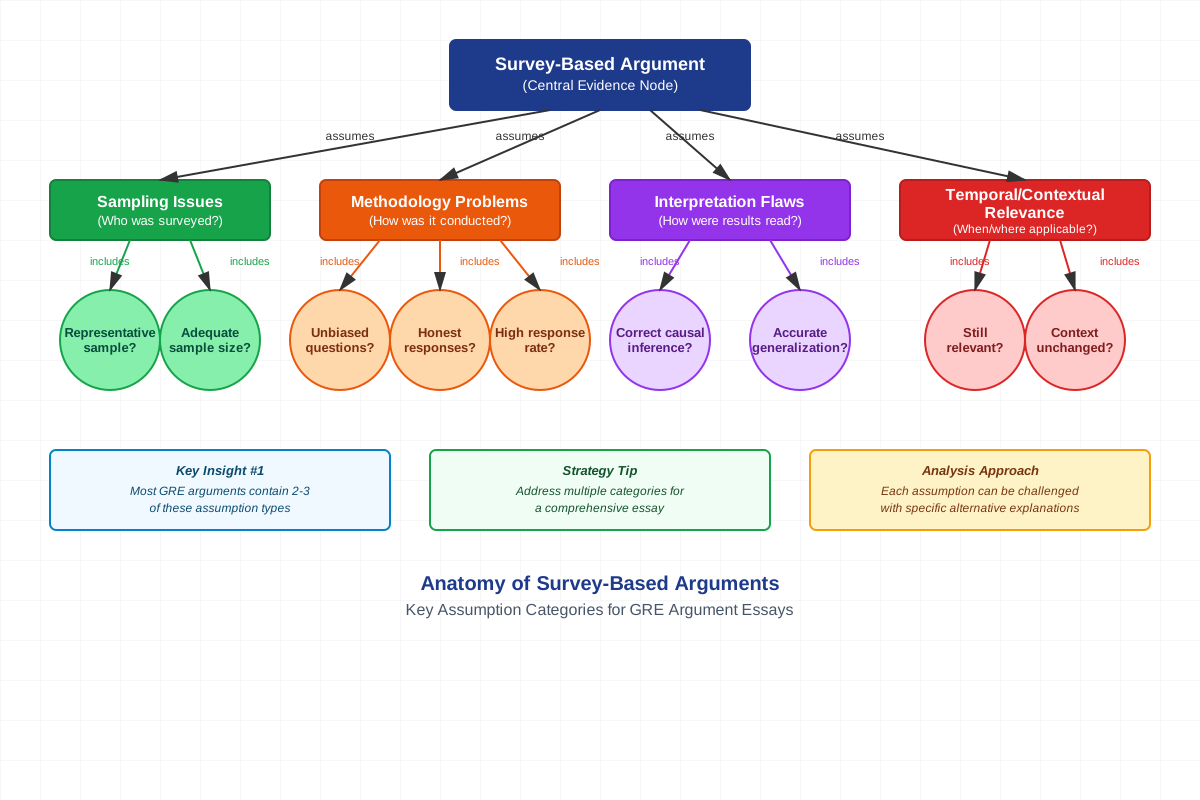
Survey assumptions fall into several distinct categories, each addressing a different aspect of survey methodology and interpretation:
| Category | Focus Area | Key Questions |
|---|---|---|
| Sampling Assumptions | Who was surveyed | Is the sample representative? Was it large enough? Was selection random? |
| Methodology Assumptions | How the survey was conducted | Were questions unbiased? Was the format appropriate? Were conditions controlled? |
| Response Assumptions | Participant behavior | Did people answer honestly? Did they understand questions? Was response rate adequate? |
| Interpretation Assumptions | Data analysis | Are results being generalized appropriately? Are correlations treated as causation? |
| Temporal Assumptions | Time relevance | Do past results predict future conditions? Have circumstances changed? |
Sampling Assumptions
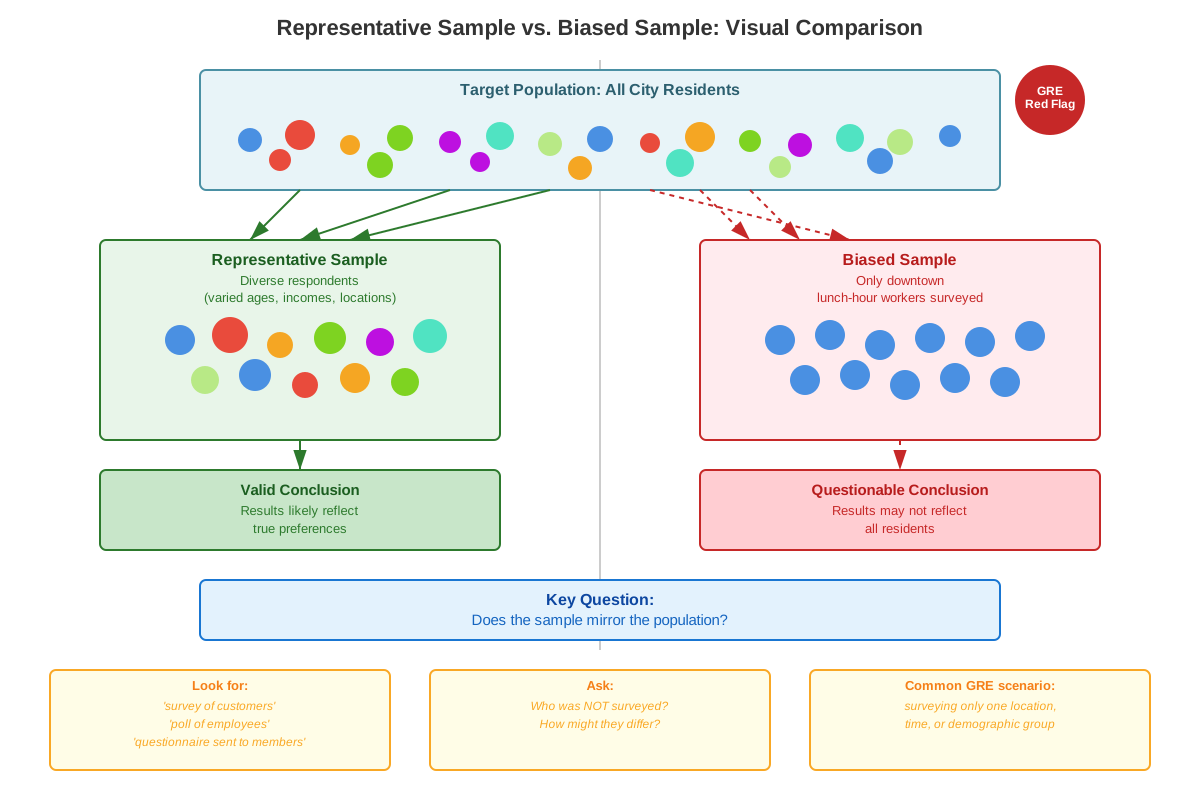
Sampling assumptions concern whether the surveyed group accurately represents the population about which conclusions are drawn. The most fundamental sampling assumption is representativeness—the idea that survey respondents mirror the characteristics, opinions, and behaviors of the broader group. Arguments frequently assume that a small sample reflects a large population without justification.
Common sampling assumption flaws include:
- Self-selection bias: When participation is voluntary, respondents may differ systematically from non-respondents (those with strong opinions may be more likely to participate)
- Convenience sampling: Surveying only easily accessible individuals (e.g., people at a specific location or time) may exclude important demographic segments
- Inadequate sample size: Small samples may not capture population diversity or may be vulnerable to random variation
- Non-random selection: Systematic selection methods may introduce bias (e.g., surveying only email subscribers or only daytime visitors)
For instance, if an argument claims "A survey of shoppers at the downtown mall found 90% prefer Brand X, so Brand X dominates the regional market," it assumes downtown mall shoppers represent all regional consumers—ignoring potential differences in demographics, shopping preferences, or brand loyalty between mall shoppers and the general population.
Methodology Assumptions
Methodology assumptions relate to how the survey was designed and administered. Even with a representative sample, flawed survey methods can produce unreliable data. The argument assumes the survey was conducted in a manner that yields valid, unbiased responses.
Critical methodological concerns include:
- Question wording: Assumes questions were neutrally phrased rather than leading or loaded (e.g., "Do you support the beneficial new policy?" versus "Do you support the new policy?")
- Question clarity: Assumes respondents understood what was being asked and that terms were unambiguous
- Response options: Assumes available answers adequately captured the range of possible opinions (not forcing false dichotomies)
- Survey format: Assumes the medium (phone, online, in-person) didn't influence responses
- Interviewer effects: For non-anonymous surveys, assumes interviewer presence or identity didn't bias responses
An argument stating "A telephone survey found 70% of residents oppose the tax increase" assumes the telephone format didn't systematically exclude certain demographics (those without landlines, those who don't answer unknown numbers) and that people answered honestly despite potential social desirability bias.
Response Assumptions
Response assumptions address participant behavior and the reliability of their answers. Arguments assume that people who took the survey responded honestly, thoughtfully, and accurately—assumptions that may not hold in practice.
Key response-related assumptions include:
- Honesty: Respondents provided truthful answers rather than socially desirable responses
- Accuracy: Participants accurately recalled information or predicted their future behavior
- Engagement: Respondents took the survey seriously rather than answering randomly or carelessly
- Comprehension: Participants understood questions as intended
- Response rate: The percentage of people who completed the survey was high enough that non-respondents don't differ significantly from respondents
For example, an argument claiming "A survey shows 85% of employees are satisfied with workplace conditions, proving our company has excellent morale" assumes employees answered honestly despite potential fear of repercussions, that satisfaction ratings accurately reflect true feelings, and that the 15% who didn't respond (or weren't surveyed) don't hold significantly different views.
Interpretation and Generalization Assumptions
Interpretation assumptions concern how survey results are analyzed and applied. Even valid survey data can be misinterpreted or overgeneralized. Arguments often assume that survey findings support broader conclusions than the data actually warrant.
Common interpretation issues include:
- Overgeneralization: Extending findings beyond the surveyed population (e.g., from customers to all potential customers, from current students to future students)
- Temporal projection: Assuming current opinions will persist into the future
- Correlation versus causation: Treating survey correlations as causal relationships
- Statistical significance: Assuming observed differences are meaningful rather than due to chance
- Context transfer: Applying results from one context to a different situation
An argument asserting "Last year's student survey showed 60% wanted extended library hours, so implementing this change will increase student satisfaction this year" assumes student preferences haven't changed, that the same students are still enrolled, that extended hours will actually be used, and that this single change will measurably impact overall satisfaction.
Temporal Assumptions
Temporal assumptions relate to the time dimension of survey data. Arguments frequently cite past survey results to support claims about present conditions or future actions, assuming temporal stability that may not exist.
Temporal concerns include:
- Relevance decay: Opinions, preferences, and conditions change over time
- Changed circumstances: External factors may have altered the situation since the survey
- Predictive validity: Past attitudes may not predict future behavior
- Seasonal or cyclical effects: Survey timing may have captured atypical conditions
For instance, "A 2020 survey found residents opposed new development, so the current proposal will face community resistance" assumes opinions haven't shifted due to economic changes, population turnover, or evolving community needs in the intervening years.
Concept Relationships
The various categories of survey assumptions interconnect to form a comprehensive framework for evaluating survey-based arguments. Sampling assumptions form the foundation—if the sample is fundamentally unrepresentative, even perfect methodology cannot produce valid conclusions about the broader population. Methodology assumptions build upon sampling, as a representative sample still requires unbiased questions and appropriate survey design to yield reliable data.
Response assumptions interact with both sampling and methodology: self-selection bias (sampling) may correlate with dishonest responses (response behavior), while leading questions (methodology) directly influence response honesty and accuracy. Interpretation assumptions represent the final logical step, determining whether even valid survey data supports the specific conclusion drawn.
Temporal assumptions cut across all other categories, as time can undermine representativeness (population composition changes), methodology (question relevance shifts), response patterns (social norms evolve), and interpretation (contextual factors transform).
The relationship flow: Representative Sample → Valid Methodology → Honest/Accurate Responses → Appropriate Interpretation → Temporally Relevant Application → Sound Conclusion. Weakness at any point breaks the logical chain, and GRE arguments typically contain vulnerabilities at multiple points, providing rich material for analysis.
This framework connects to broader Argument Essay concepts including evidence evaluation (assessing whether evidence actually supports claims), alternative explanations (identifying other factors that could account for survey results), and assumption identification (recognizing unstated premises). Survey assumptions also relate to sampling errors, statistical reasoning, and causal analysis—all common elements in GRE Argument Essay prompts.
High-Yield Facts
⭐ Survey-based arguments appear in 30-40% of GRE Argument Essay prompts, making this the highest-yield single topic for preparation.
⭐ The most common survey assumption flaw is representativeness—assuming the surveyed group mirrors the population about which conclusions are drawn.
⭐ Self-selection bias occurs when voluntary participation means respondents differ systematically from non-respondents, undermining sample representativeness.
⭐ Question wording assumptions are frequently testable—arguments assume questions were neutrally phrased rather than leading or ambiguous.
⭐ Response rate matters: arguments typically ignore the possibility that non-respondents hold significantly different views than respondents.
- Survey timing assumptions are often overlooked by test-takers but represent high-value critique opportunities—past results may not reflect current conditions.
- Arguments frequently conflate correlation with causation when interpreting survey data showing relationships between variables.
- Small sample sizes create vulnerability to random variation and may not capture population diversity, yet arguments often treat limited samples as definitive.
- Honesty assumptions are particularly relevant for surveys on sensitive topics where social desirability bias may influence responses.
- Generalization assumptions involve extending findings beyond the original survey context—from surveyed customers to all potential customers, from one location to all locations.
- Response format (anonymous versus identified, online versus in-person) can systematically influence answers, yet arguments assume format neutrality.
- Temporal assumptions include both relevance decay (opinions change over time) and predictive validity (stated intentions may not match future behavior).
Quick check — test yourself on Survey assumptions so far.
Try Flashcards →Common Misconceptions
Misconception: Survey assumptions only matter if the sample size is mentioned as small.
Correction: Sample size is just one of many potential survey flaws. Even large samples can be unrepresentative if selection was biased, and arguments can be vulnerable to methodology, response, interpretation, and temporal assumptions regardless of sample size. Focus on representativeness, not just size.
Misconception: If a survey flaw is mentioned, it must be thoroughly explained in multiple paragraphs.
Correction: Effective Argument Essays identify multiple distinct flaws with clear but concise explanations. Spending excessive time on one survey assumption limits the ability to address other vulnerabilities. Aim for 3-5 well-developed flaws rather than exhaustive treatment of one issue.
Misconception: Survey assumptions are separate from other argument flaws, so an essay should have a "survey paragraph" distinct from other analysis.
Correction: Survey assumptions often interconnect with causal reasoning, alternative explanations, and other logical issues. Organize essays by distinct logical flaws rather than by flaw type, and recognize that survey problems may support multiple lines of critique.
Misconception: Pointing out that "the survey might be biased" is sufficient critique.
Correction: High-scoring essays provide specific analysis: explain how the survey might be biased, why this matters for the conclusion, and what alternative explanations become possible. Vague assertions of potential bias score lower than concrete, developed analysis.
Misconception: All survey assumptions are equally important to address.
Correction: Some assumptions are more central to an argument's logic than others. Prioritize flaws that most directly undermine the connection between evidence and conclusion. A representativeness problem that completely invalidates generalization is more critical than a minor question-wording concern.
Worked Examples
Example 1: Business Decision Argument
Prompt: "A survey of 200 customers who visited our store last month found that 75% were satisfied with their experience. Additionally, 60% of respondents said they would recommend our store to friends. Therefore, we should expand our business by opening three new locations in neighboring towns, as customer satisfaction is clearly high and word-of-mouth marketing will drive success in new markets."
Analysis:
This argument relies heavily on survey data to justify a significant business expansion, making several critical survey assumptions:
Sampling Representativeness: The argument assumes the 200 surveyed customers represent all current customers and, more problematically, potential customers in neighboring towns. The sample consists only of people who actually visited the store—excluding potential customers who chose competitors or who don't shop in this category at all. Furthermore, customers who visited "last month" may differ from typical customers if that month had unusual characteristics (holiday shopping, special promotions, seasonal factors). Most critically, the argument generalizes from customers in the current location to potential customers in "neighboring towns," assuming demographic, economic, and competitive conditions are identical across locations.
Response Honesty and Accuracy: The survey assumes customers answered honestly about satisfaction and future behavior. However, people often provide socially desirable responses, especially in non-anonymous surveys or when interacting with store representatives. More importantly, stated intentions ("would recommend") frequently don't match actual behavior—customers may express willingness to recommend without actually doing so. The argument treats these stated intentions as reliable predictors of actual word-of-mouth marketing.
Temporal Relevance: The survey data is from "last month," but the expansion decision concerns future performance. The argument assumes conditions that produced satisfaction last month will persist—ignoring potential changes in product quality, staff, management, competition, or customer expectations. By the time new stores open, factors influencing satisfaction may have shifted significantly.
Interpretation and Causation: Even if satisfaction is genuinely high, the argument assumes this will translate to success in new markets. It overlooks that satisfaction among existing customers doesn't guarantee the ability to attract new customers in different locations, where brand recognition may be lower and established competitors may be stronger. The causal chain from "current customer satisfaction" to "new location success" involves numerous unstated assumptions.
Alternative Explanations: The 75% satisfaction rate means 25% were not satisfied—a substantial minority the argument ignores. Additionally, the 60% recommendation rate means 40% would not recommend the store, suggesting potential problems the argument dismisses. These figures might actually indicate mediocre rather than exceptional performance, depending on industry standards.
This analysis demonstrates how a single survey-based argument contains multiple vulnerabilities across different assumption categories, providing ample material for a comprehensive essay.
Example 2: Policy Recommendation Argument
Prompt: "A recent survey of 500 residents found that 68% believe traffic congestion has worsened over the past year. The same survey showed that 55% support building a new highway bypass. Therefore, the city council should prioritize highway construction in next year's budget, as residents have clearly identified traffic as the primary concern and endorsed the proposed solution."
Analysis:
This argument uses survey data to justify a major policy decision, making several problematic assumptions:
Sampling and Representativeness: The argument assumes 500 surveyed residents represent the entire city's population. However, the survey method isn't specified—if conducted online, it may exclude residents without internet access or technological literacy, potentially skewing toward younger, more affluent demographics. If conducted via phone, it may miss residents who work during calling hours or don't answer unknown numbers. The argument also assumes current residents' views should determine policy, ignoring that highway construction affects future residents, commuters from outside the city, and businesses.
Question Design and Interpretation: The survey asked whether congestion has "worsened," which is subjective and may be influenced by recent experiences rather than objective traffic data. Residents might perceive worsening congestion due to temporary construction, seasonal variation, or increased personal driving, even if overall traffic patterns haven't changed significantly. The 68% figure might reflect perception rather than reality.
Support Versus Priority: Even if 55% support the bypass, the argument assumes this constitutes strong endorsement warranting budget prioritization. However, 55% is barely a majority, meaning 45% either oppose or are neutral—hardly a mandate. The argument doesn't indicate whether residents were asked to rank priorities or simply whether they support this single option. Residents might support the bypass while considering other issues (education, public safety, infrastructure maintenance) more urgent.
Alternative Solutions: The survey apparently asked only about one specific solution (highway bypass). The argument assumes residents have evaluated and rejected alternatives, but they may simply not have been presented with options like public transportation improvements, traffic signal optimization, telecommuting incentives, or congestion pricing. Support for the bypass doesn't mean it's the best or most cost-effective solution.
Temporal and Practical Considerations: The argument assumes current opinions will remain stable through the planning, approval, and construction process, which for highway projects typically spans years. Public opinion may shift as costs become clearer, environmental impacts are assessed, or alternative solutions are proposed. Additionally, the argument assumes that building the bypass will actually solve the perceived congestion problem—a causal assumption separate from the survey data itself.
This example illustrates how policy arguments based on surveys require scrutiny of both the survey methodology and the logical leap from survey results to policy recommendations.
Exam Strategy
Rapid Identification Triggers
When reading a GRE Argument Essay prompt, watch for these trigger phrases that signal survey-based reasoning:
- "A survey of [group] found/showed/revealed..."
- "According to a recent poll..."
- "[X]% of respondents indicated/reported/stated..."
- "A study of [sample] demonstrated..."
- "Feedback from [group] suggests..."
- "When asked about [topic], [X]% said..."
The presence of numerical percentages or specific sample sizes (e.g., "200 customers," "500 residents") strongly indicates survey-based evidence requiring assumption analysis.
Systematic Analysis Approach
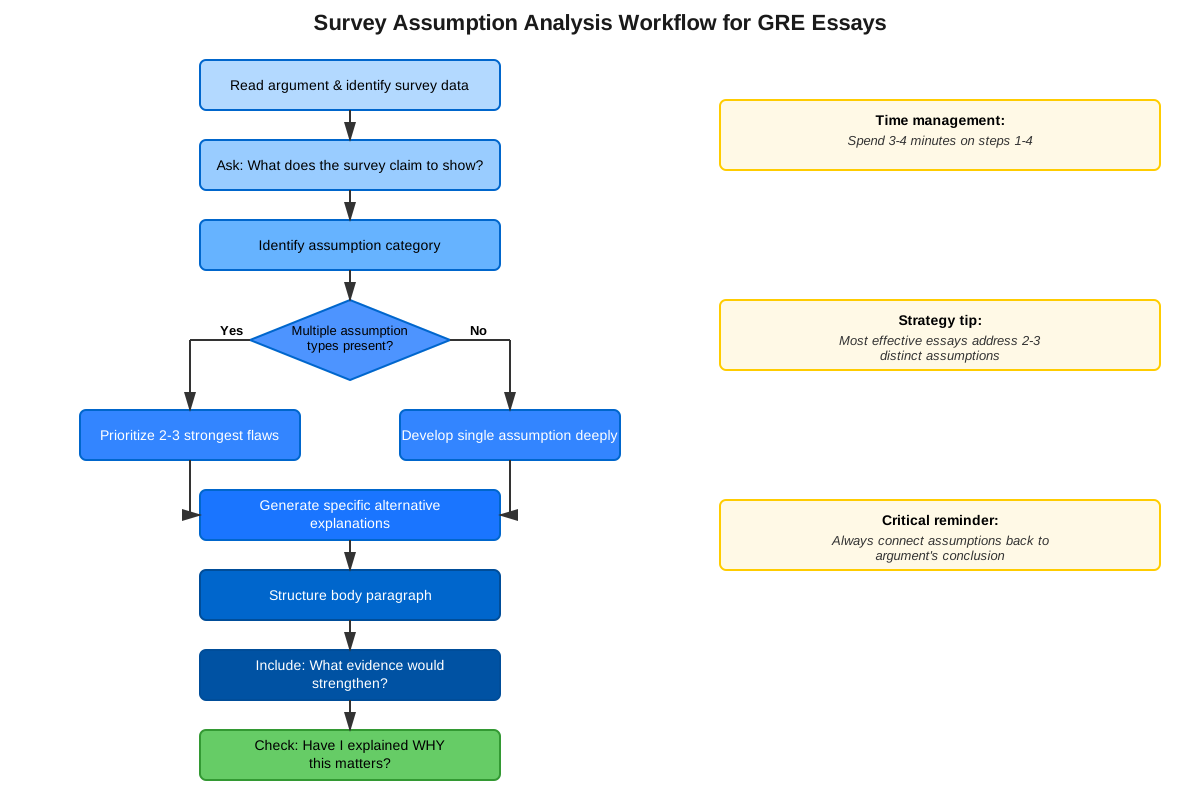
Use this four-step process to efficiently analyze survey assumptions:
- Identify the survey details: Who was surveyed? How many? When? What was asked?
- Identify the conclusion: What claim does the argument make based on the survey?
- Map the logical gap: What must be true about the survey for it to support that specific conclusion?
- Generate specific alternatives: What could be wrong with the survey that would undermine the conclusion?
Time Allocation
In the 30-minute Argument Essay timeframe:
- Minutes 0-5: Read prompt, identify argument structure, note survey details and conclusion
- Minutes 5-10: Brainstorm 3-5 distinct flaws (aim for at least 2 survey-related assumptions)
- Minutes 10-25: Write essay with introduction, 3-4 body paragraphs (each addressing one major flaw), and conclusion
- Minutes 25-30: Proofread for clarity and grammar
Don't spend more than 2-3 minutes specifically on survey assumption identification—these flaws should emerge naturally during general argument analysis.
Paragraph Development Strategy
For survey-based flaws, use this structure:
- Identify the assumption: "The argument assumes the surveyed [group] represents [broader population]..."
- Explain why it matters: "This assumption is critical because the conclusion depends on..."
- Provide specific alternatives: "However, the sample may be unrepresentative if [specific scenario]..."
- Connect to conclusion: "If [alternative] is true, then the conclusion that [claim] is significantly weakened because..."
Process of Elimination for Multiple Flaws
When an argument contains numerous potential survey flaws, prioritize based on:
- Centrality: Which assumption most directly connects the survey evidence to the conclusion?
- Specificity: Which flaw can you explain most concretely with specific alternative scenarios?
- Independence: Choose flaws that represent distinct logical problems rather than variations of the same issue
Avoid writing multiple paragraphs that essentially repeat "the sample might not be representative" in different words. Instead, address representativeness once, then move to methodology, response, or interpretation issues.
Common Trap Avoidance
Don't: Simply list possible survey problems without explanation
Do: Explain how each flaw specifically undermines this argument's logic
Don't: Assume every survey is fatally flawed
Do: Acknowledge that surveys can be valid while explaining what this argument fails to establish
Don't: Propose elaborate alternative explanations unrelated to survey methodology
Do: Focus alternatives on survey-specific issues (sampling, methodology, response, interpretation)
Memory Techniques
SAMPLE Acronym for Survey Assumption Categories
Sampling - Is the group representative?
Accuracy - Did people answer truthfully and correctly?
Methodology - Were questions unbiased and clear?
Projection - Do past results predict future conditions?
Logic - Does the data actually support the conclusion?
Extension - Is generalization to other groups justified?
The "Four R's" of Survey Critique
- Representative: Does the sample mirror the population?
- Reliable: Were methods sound and consistent?
- Responsive: Did people answer honestly and thoughtfully?
- Relevant: Do results apply to the conclusion's context?
Visualization Strategy
Picture a survey as a bridge connecting evidence (survey data) to conclusion (argument's claim). Each assumption is a support beam:
- Sampling beam: Connects surveyed group to broader population
- Methodology beam: Ensures data quality and validity
- Response beam: Guarantees honest, accurate answers
- Interpretation beam: Links data to specific conclusion
- Temporal beam: Maintains relevance across time
If any beam is weak or missing, the bridge cannot reliably support the conclusion. This mental image helps identify which "beams" (assumptions) the argument fails to establish.
Question Cascade Technique
When analyzing survey-based arguments, mentally ask this cascade of questions:
- Who? → Who was surveyed? (Sampling)
- How? → How was the survey conducted? (Methodology)
- Truly? → Did they answer honestly? (Response)
- When? → When was this survey done? (Temporal)
- Therefore? → Does this data support this conclusion? (Interpretation)
This sequence ensures comprehensive coverage of survey assumption categories.
Summary
Survey assumptions represent critical unstated premises in arguments that rely on survey data to support conclusions. These assumptions span five main categories: sampling (whether respondents represent the broader population), methodology (whether survey design was sound and unbiased), response (whether participants answered honestly and accurately), interpretation (whether data analysis and generalization are appropriate), and temporal relevance (whether past results apply to current or future conditions). GRE Argument Essays frequently feature survey-based reasoning because it efficiently incorporates multiple logical vulnerabilities within compact prompts. Successful analysis requires identifying which specific assumptions the argument makes, explaining why each matters for the conclusion, and providing concrete alternative scenarios that would undermine the argument if true. High-scoring essays address multiple distinct survey-related flaws with specific, well-developed analysis rather than vague assertions of potential bias. The key to mastering survey assumptions is recognizing that even valid survey data may not support a given conclusion if critical assumptions about representativeness, methodology, honesty, interpretation, or temporal stability prove false. This analytical framework transfers directly to graduate-level research evaluation and evidence-based reasoning.
Key Takeaways
- Survey-based arguments appear in 30-40% of GRE Argument Essay prompts, making survey assumptions the highest-yield topic for preparation
- Representativeness is the most fundamental and frequently tested survey assumption—arguments routinely assume surveyed groups mirror broader populations without justification
- Survey assumptions fall into five categories: sampling, methodology, response, interpretation, and temporal relevance, each offering distinct critique opportunities
- Effective analysis requires specificity—explain exactly how survey flaws undermine the particular conclusion rather than making vague claims about potential bias
- Multiple survey flaws typically exist in a single argument, providing material for comprehensive essays that address 3-5 distinct logical problems
- Connect survey critiques to the conclusion—always explain why a survey flaw matters for the specific claim the argument makes
- Balance breadth and depth—address several different survey assumptions with clear explanations rather than exhaustively analyzing a single flaw
Related Topics
Sampling Errors and Statistical Reasoning: Deeper exploration of how sample size, selection methods, and random variation affect data reliability, building on the sampling assumptions covered here to address more complex statistical arguments.
Causal Reasoning and Correlation: Survey data often shows correlations that arguments treat as causal relationships; mastering causal analysis enhances the ability to critique interpretation assumptions in survey-based arguments.
Evidence Evaluation and Sufficiency: Broader framework for assessing whether any type of evidence (not just surveys) adequately supports a conclusion, with survey assumptions representing one specific application of evidence evaluation principles.
Alternative Explanations: Systematic approach to generating plausible scenarios that account for evidence without accepting the argument's conclusion—a skill that directly supports survey assumption analysis by identifying what else could explain survey results.
Temporal Reasoning and Prediction: Analysis of arguments that project past or present conditions into the future, closely related to temporal assumptions in survey-based reasoning but applicable to broader argument types.
Practice CTA
Now that you've mastered the conceptual framework for survey assumptions, it's time to apply this knowledge to actual GRE-style prompts. The practice questions and flashcards will reinforce your ability to rapidly identify survey-based reasoning, systematically analyze assumptions across all five categories, and construct well-organized, high-scoring essay responses. Remember that survey assumptions appear in nearly 40% of Argument Essay prompts—your investment in practicing this topic will pay dividends on test day. Approach each practice argument by asking: Who was surveyed? How? Did they answer honestly? When? And does this data actually support the conclusion? With consistent practice, this analytical framework will become automatic, enabling you to produce sophisticated critiques efficiently within the 30-minute time limit. You've built the foundation—now strengthen it through deliberate practice!
Sign up free to keep reading
Create a free AnvayaPrep account to finish this GRE guide on Survey assumptions — plus flashcards and practice questions.