Overview
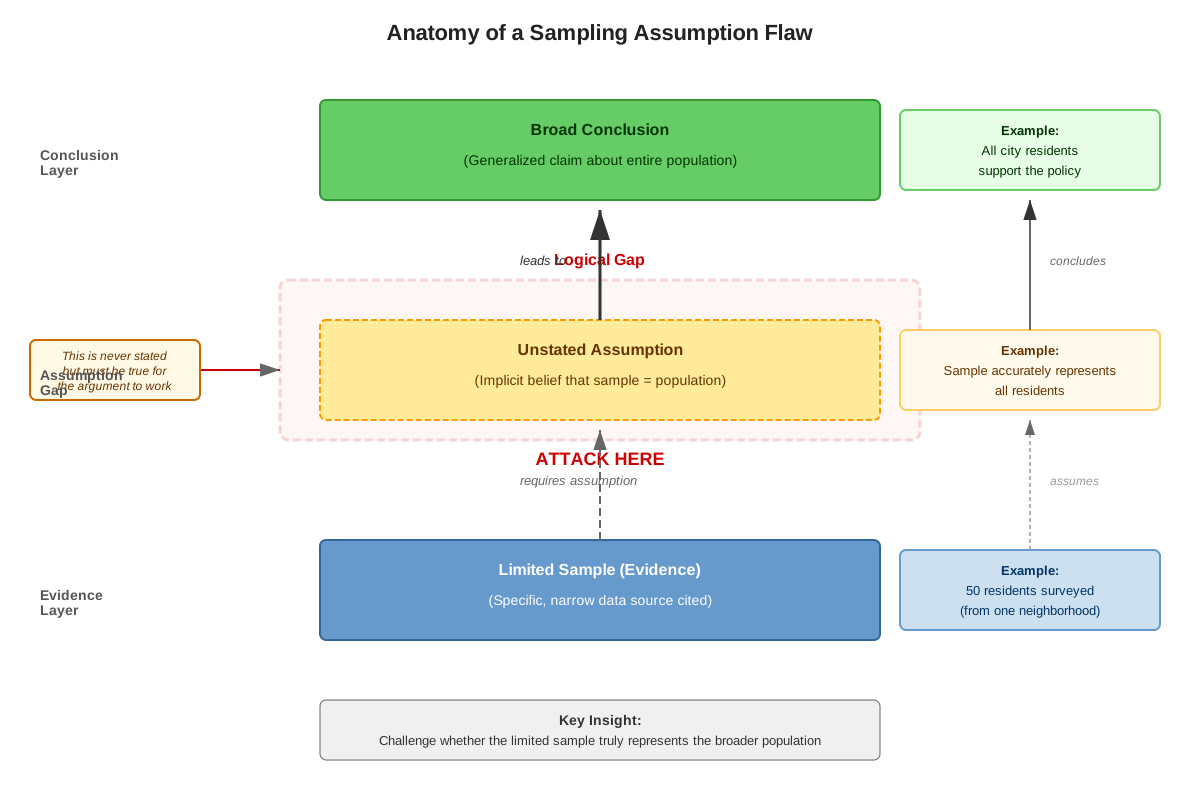
Sampling assumptions represent one of the most frequently tested logical flaws in the GRE Analytical Writing Argument Essay. When an argument draws conclusions about a larger population based on evidence from a smaller subset, it relies on sampling assumptions—the implicit belief that the sample accurately represents the whole. These assumptions are critical vulnerabilities that test-takers must identify and critique to achieve high scores. Understanding GRE sampling assumptions requires recognizing when an argument generalizes from limited data, whether that data comes from surveys, studies, polls, or anecdotal observations.
The GRE Argument Essay consistently presents passages where authors make sweeping claims based on insufficient or potentially biased samples. For instance, an argument might conclude that "all residents of a city support a new policy" based solely on responses from a small neighborhood survey, or claim that "a product will succeed nationally" based on sales data from a single test market. Recognizing these logical gaps and articulating why they weaken the argument separates average essays from those scoring in the 5.0-6.0 range.
Sampling assumptions connect intimately with other argument analysis skills, including representativeness evaluation, statistical reasoning, and evidence assessment. They form the foundation for understanding how data quality affects conclusion validity—a principle that extends beyond the GRE into academic research, business decision-making, and critical thinking in everyday life. Mastering this topic enables students to systematically dismantle weak arguments and demonstrate sophisticated analytical reasoning.
Learning Objectives
- [ ] Identify when Sampling assumptions is being tested in GRE Argument Essay prompts
- [ ] Explain the core rule or strategy behind Sampling assumptions and why they matter
- [ ] Apply Sampling assumptions to GRE-style questions accurately and comprehensively
- [ ] Distinguish between representative and biased samples in argument passages
- [ ] Articulate specific ways that sampling flaws undermine an argument's logical structure
- [ ] Generate concrete alternative explanations that expose sampling weaknesses
- [ ] Construct well-developed paragraphs that critique sampling assumptions using appropriate evidence and reasoning
Prerequisites
- Basic logical reasoning: Understanding how premises support conclusions is essential because sampling assumptions represent a specific type of logical gap between evidence and claims.
- Familiarity with argument structure: Recognizing the difference between evidence, assumptions, and conclusions allows students to pinpoint where sampling issues create vulnerabilities.
- General GRE Argument Essay format: Knowing the task requirements (analyzing an argument's logical soundness rather than agreeing or disagreeing) provides the framework for applying sampling critiques effectively.
Why This Topic Matters
Sampling assumptions appear in approximately 40-50% of GRE Argument Essay prompts, making them among the most high-yield topics for test preparation. The Educational Testing Service (ETS) frequently constructs arguments around surveys, studies, polls, focus groups, and observational data—all contexts where sampling issues naturally arise. Students who can quickly identify and thoroughly analyze sampling flaws gain a significant competitive advantage.
In real-world applications, sampling assumptions underpin scientific research, market analysis, public policy decisions, and medical studies. Graduate programs value students who can critically evaluate whether research findings generalize beyond their original samples. This skill proves essential in fields ranging from psychology and sociology to business analytics and public health.
On the GRE, sampling assumptions typically appear in arguments that: (1) generalize from survey results to broader populations, (2) apply findings from one location or demographic to another, (3) use volunteer or self-selected respondents, (4) rely on small sample sizes, or (5) fail to account for temporal changes between when data was collected and when conclusions are drawn. Recognizing these patterns enables rapid identification during the exam's 30-minute time constraint.
Core Concepts
Definition of Sampling Assumptions
A sampling assumption occurs when an argument implicitly assumes that a sample (subset) accurately represents a larger population (whole) without providing evidence that the sample is truly representative. The argument treats characteristics, behaviors, or opinions observed in the sample as if they necessarily apply to the entire group. This assumption becomes problematic when the sample differs systematically from the population in ways that affect the conclusion's validity.
For example, if an argument claims "Most city residents support the new parking regulations" based on a survey of downtown business owners, it assumes business owners' views match those of all residents—an assumption that may be false if business owners have different interests than residential homeowners, commuters, or suburban dwellers.
Types of Sampling Problems
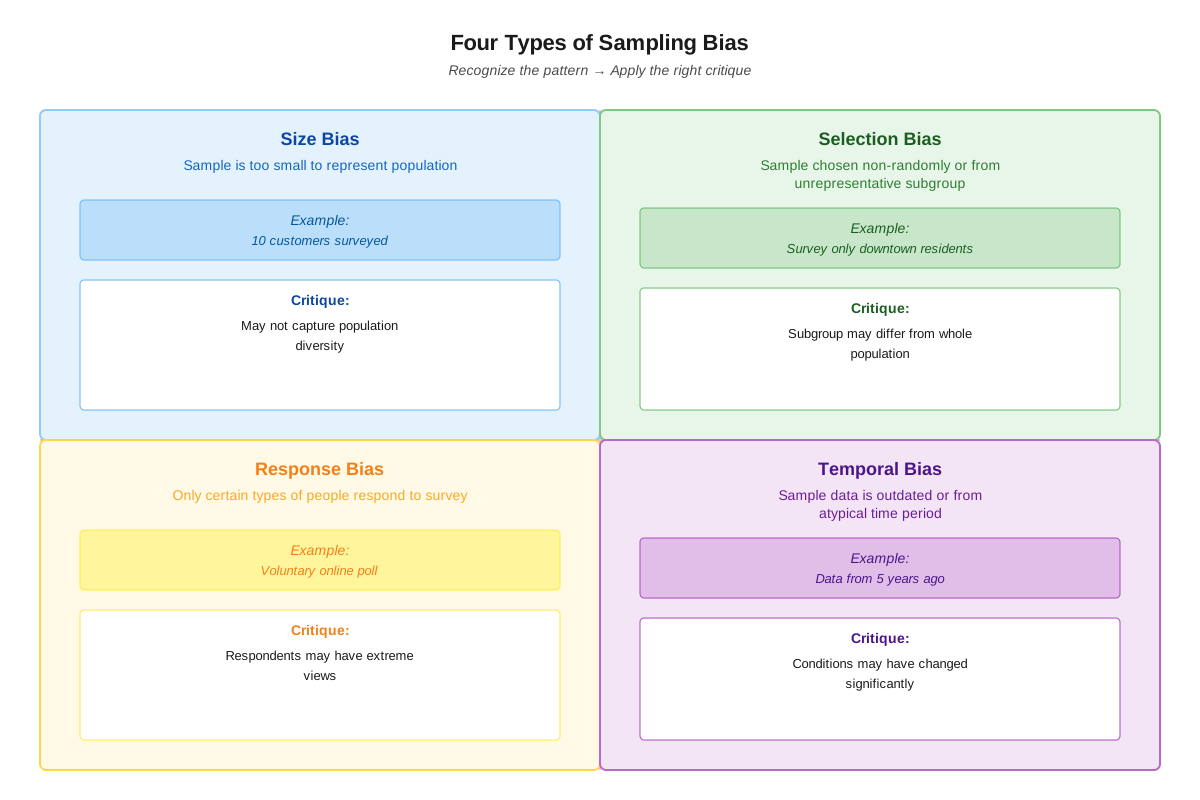
Sample Size Issues: Arguments sometimes draw broad conclusions from extremely small samples. A study involving 10 participants cannot reliably predict behavior patterns for millions of people. Small samples increase the likelihood that random variation or outliers will distort results, making generalizations unreliable.
Selection Bias: This occurs when the method of choosing participants systematically excludes certain groups or overrepresents others. Common forms include:
- Volunteer bias: People who choose to participate may differ from those who decline (volunteers might be more motivated, have stronger opinions, or have more free time)
- Convenience sampling: Selecting easily accessible participants (like surveying only people at a shopping mall during weekday afternoons excludes working professionals)
- Self-selection: When respondents opt into surveys, those with extreme views often participate disproportionately
Demographic Mismatch: The sample may differ from the target population in age, income, education, location, or other relevant characteristics. An argument claiming a product will succeed nationally based on sales in wealthy suburban areas assumes those areas represent all markets—ignoring urban, rural, and lower-income consumers.
Temporal Assumptions: Arguments often assume that sample data collected in the past remains valid for current or future conclusions. A survey from five years ago may not reflect current opinions, especially regarding technology, social issues, or economic conditions.
The Representativeness Principle
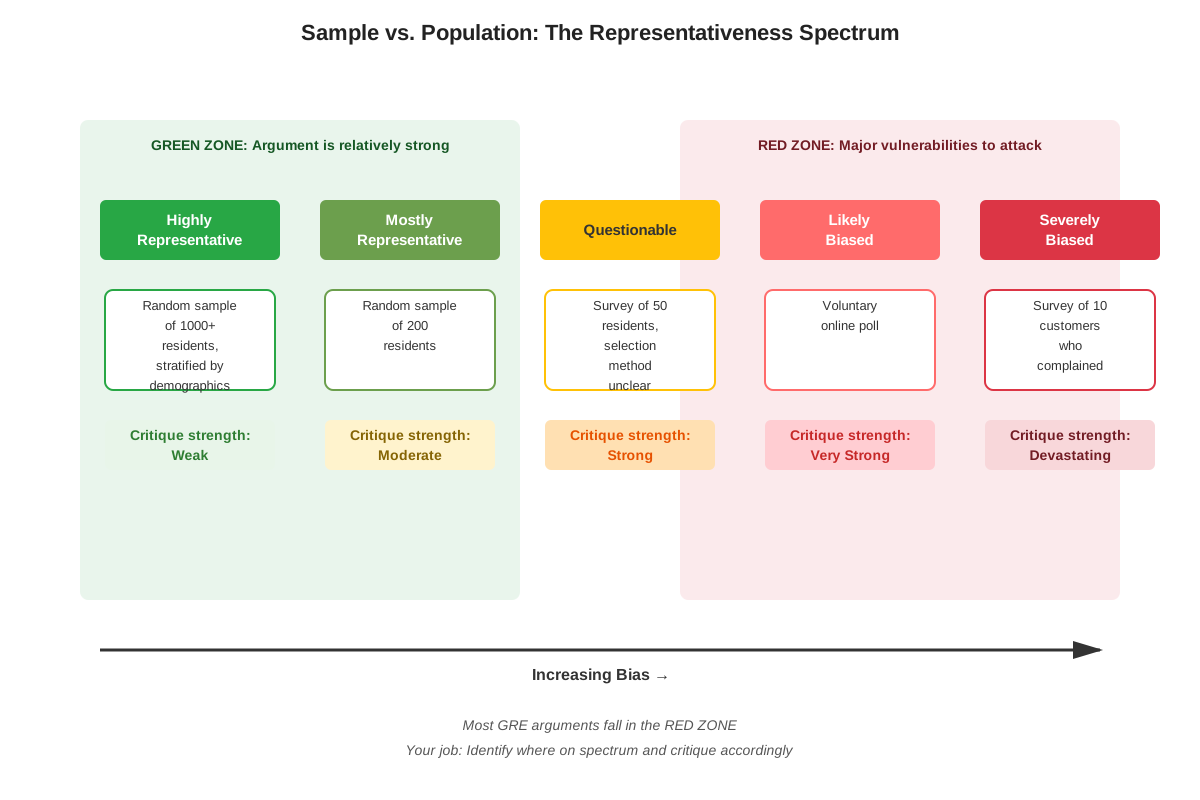
For a sample to support generalizations, it must be representative—meaning its characteristics proportionally match those of the larger population across all relevant dimensions. Achieving representativeness typically requires:
- Random selection: Every member of the population has an equal chance of inclusion
- Adequate size: Sufficient participants to minimize random error
- Demographic alignment: Sample composition mirrors population composition
- Relevant characteristics: The sample matches the population on factors that affect the measured outcome
| Sample Type | Representativeness | Reliability for Generalization |
|---|---|---|
| Random, large, demographically matched | High | Strong |
| Convenience sample, moderate size | Low to Moderate | Weak |
| Self-selected volunteers | Low | Very Weak |
| Small sample from single location | Very Low | Unreliable |
Response Rate and Non-Response Bias
Even well-designed samples can suffer from non-response bias when many selected participants don't respond. If only 15% of surveyed individuals reply, the 85% who didn't respond might hold systematically different views. Arguments rarely acknowledge this limitation, assuming respondents represent all those surveyed.
Identifying Sampling Assumptions in Arguments
Look for these trigger patterns:
- Evidence from surveys, polls, studies, or questionnaires
- Phrases like "a recent survey found," "respondents indicated," or "participants reported"
- Generalizations from specific locations to broader areas
- Claims about "most people," "residents," or "consumers" based on subset data
- Comparisons between groups where sampling methods differ
Critiquing Sampling Assumptions
Effective critiques should:
- Identify the sample: Specify exactly who was surveyed or studied
- Identify the population: Clarify the broader group to which conclusions are applied
- Explain the gap: Articulate specific ways the sample might differ from the population
- Provide alternatives: Suggest how these differences could produce misleading results
- Recommend improvements: Describe what information would strengthen the argument
Concept Relationships
Sampling assumptions connect directly to evidence evaluation—the broader skill of assessing whether provided support justifies conclusions. When a sample is unrepresentative, the evidence quality diminishes, weakening the entire argument structure. This relationship flows as: Weak Sample → Unreliable Evidence → Unsupported Conclusion.
Sampling issues often interact with causal reasoning flaws. An argument might claim a program caused improved outcomes based on a sample of voluntary participants, but both sampling bias (volunteers differ from non-volunteers) and causation problems (other factors might explain improvements) simultaneously weaken the logic.
The concept also relates to statistical reasoning, particularly understanding that correlation in a sample doesn't guarantee correlation in the population, and that sample-based predictions require representativeness. Additionally, sampling assumptions connect to temporal assumptions—old sample data may not reflect current populations due to changing demographics, attitudes, or circumstances.
Relationship Map:
Unrepresentative Sample → Biased Evidence → Weakened Support for Conclusion → Alternative Explanations Become Plausible → Argument Requires Additional Evidence to Establish Representativeness
High-Yield Facts
- ⭐ Sampling assumptions appear in approximately 40-50% of GRE Argument Essay prompts, making them the most frequently tested logical flaw category
- ⭐ Volunteer and self-selected samples are inherently biased because participants differ systematically from non-participants in motivation, interest, or opinion strength
- ⭐ Small sample sizes cannot reliably support broad generalizations about large populations due to increased random variation
- ⭐ Geographic sampling limitations are critical—data from one city, region, or country rarely represents other locations with different demographics, economies, or cultures
- ⭐ Temporal gaps between data collection and conclusion application create sampling problems when populations change over time
- Arguments assuming survey respondents represent all surveyed individuals ignore non-response bias
- Convenience samples (people at specific locations or times) systematically exclude those not present
- Demographic mismatches (age, income, education differences) between samples and populations invalidate generalizations
- Response rates below 50% raise serious questions about representativeness
- Arguments rarely provide evidence that samples are representative—this absence is the assumption to critique
- Comparing two groups requires both samples to be representative of their respective populations
- Online surveys systematically exclude populations without internet access or technological literacy
Quick check — test yourself on Sampling assumptions so far.
Try Flashcards →Common Misconceptions
Misconception: Any sample, regardless of size or selection method, can support conclusions about larger populations. → Correction: Only representative samples—those matching the population's relevant characteristics through proper selection methods—can reliably support generalizations. Biased or small samples may produce misleading results.
Misconception: If a survey includes many respondents, the sample must be representative. → Correction: Sample size alone doesn't ensure representativeness. A survey of 10,000 volunteers or convenience participants remains biased. Both adequate size AND proper selection methods are necessary.
Misconception: Sampling assumptions only matter when arguments explicitly mention surveys or studies. → Correction: Sampling issues arise whenever arguments generalize from any subset to a larger group, including anecdotal evidence ("several customers complained"), test markets, pilot programs, or observations from specific locations.
Misconception: Critiquing sampling assumptions means proving the sample is definitely unrepresentative. → Correction: The task is identifying that representativeness is assumed without evidence, then explaining plausible ways the sample might differ from the population. Absolute proof isn't required—reasonable doubt suffices.
Misconception: All sampling problems are equally important to discuss in an essay. → Correction: Prioritize the most obvious and consequential sampling flaws. A 30-minute essay should focus on 2-3 major issues with thorough development rather than superficially listing every possible problem.
Misconception: Mentioning that "the sample might not be representative" provides sufficient critique. → Correction: Strong essays specify exactly how the sample might differ from the population and explain why those differences matter for the conclusion. Generic statements earn minimal credit.
Worked Examples
Example 1: Restaurant Survey Argument
Argument: "A recent survey of 200 customers at Riverside Restaurant found that 85% preferred the new menu items over the old ones. Therefore, the restaurant should permanently replace the old menu with the new items to maximize customer satisfaction."
Analysis:
Step 1 - Identify the sample: The sample consists of 200 customers who dined at Riverside Restaurant during the survey period and chose to respond.
Step 2 - Identify the population: The argument applies findings to all current and future Riverside customers.
Step 3 - Identify sampling assumptions:
- The 200 respondents represent all restaurant customers
- Customers who completed surveys don't differ from those who didn't
- Current customers represent future customers
- The sample includes diverse customer segments (lunch vs. dinner, weekday vs. weekend, regulars vs. first-timers)
Step 4 - Explain potential problems:
First, the survey likely suffers from self-selection bias. Customers who voluntarily complete restaurant surveys may have stronger opinions (either very positive or very negative) than typical diners. If the new menu particularly appealed to enthusiastic respondents while average customers felt neutral, the 85% figure overstates general preference.
Second, the sample may not include customers who stopped visiting due to the menu change. If the new menu alienated certain customer segments who now dine elsewhere, surveying only current customers creates survivorship bias—measuring only those who accepted the changes.
Third, the argument provides no information about when or how the survey was conducted. If administered only during dinner service, it excludes lunch customers who might have different preferences. If conducted during the new menu's first week, it captures novelty effects rather than sustained preferences.
Step 5 - Strengthen the argument:
The argument would be stronger with evidence that: (1) the sample included diverse customer segments across different times and days, (2) the response rate was high, indicating respondents represent all surveyed customers, (3) the restaurant tracked whether customer volume changed after the menu switch, and (4) follow-up surveys confirmed sustained preference over time.
Example 2: City-Wide Policy Argument
Argument: "A survey of 500 residents in the downtown Riverside district found that 70% support implementing paid parking throughout the city. The city council should therefore approve the paid parking proposal, as it clearly has strong public support."
Analysis:
Step 1 - Identify the sample: 500 residents from the downtown district.
Step 2 - Identify the population: All city residents (implied by "throughout the city").
Step 3 - Identify sampling assumptions:
- Downtown residents' views represent all city residents
- The 500 respondents represent all downtown residents
- Factors affecting parking opinions are uniform across neighborhoods
Step 4 - Explain potential problems:
The most critical flaw involves geographic sampling bias. Downtown residents likely have systematically different relationships with parking than residents of other neighborhoods. Downtown dwellers may rely more on public transportation, walking, or existing paid parking structures, making them more accepting of paid parking expansion. Conversely, suburban residents who drive downtown for work or shopping would bear the policy's costs without the benefits downtown residents experience (reduced congestion in their neighborhood, improved parking availability near their homes).
Additionally, the argument assumes the 500 respondents represent downtown residents generally. If the survey was conducted online, it excludes residents without internet access—potentially older or lower-income populations who might oppose paid parking due to financial concerns. If conducted via phone during business hours, it oversamples retirees and undersamples working professionals.
The argument also contains a temporal assumption. Current support doesn't guarantee future support once residents experience paid parking's actual costs and inconveniences. Initial survey responses may reflect abstract approval that would diminish with implementation.
Step 5 - Strengthen the argument:
The city council should commission a stratified random sample that proportionally represents all city neighborhoods, demographic groups, and parking user types (commuters, residents, shoppers, business owners). The survey should also assess whether support varies by neighborhood distance from downtown and whether respondents understand the policy's specific costs and implementation details.
Exam Strategy
Rapid Identification Triggers
When reading the argument, immediately flag these phrases that signal potential sampling issues:
- "A survey/poll/study found..."
- "Respondents indicated..."
- "Customers who participated..."
- "A sample of..."
- "Residents of [specific location]..."
- "According to a recent questionnaire..."
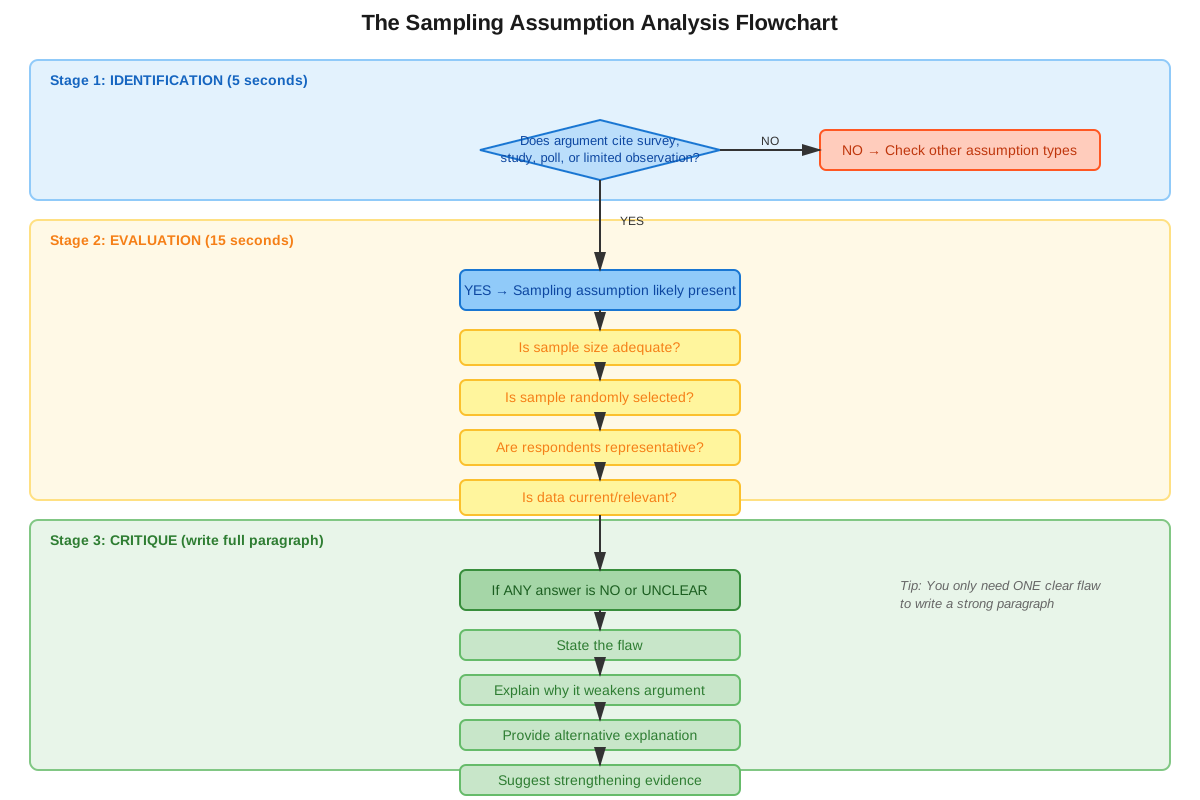
Systematic Analysis Process
- Locate the evidence source (30 seconds): Identify exactly who was surveyed, studied, or observed
- Identify the conclusion scope (30 seconds): Determine the population to which findings are applied
- Spot the mismatch (60 seconds): List 2-3 specific ways the sample might differ from the population
- Develop one thoroughly (5-7 minutes): Choose the most significant sampling flaw and write a complete paragraph explaining how it weakens the argument
Paragraph Structure Template
Use this structure for sampling assumption paragraphs:
- Topic sentence: Identify the specific sampling assumption
- Explain the gap: Describe how the sample differs from the population
- Consequence: Explain why this difference undermines the conclusion
- Alternative explanation: Show how different results might emerge with a representative sample
- Strengthening suggestion: Briefly note what evidence would address the problem
Time Allocation
In a 30-minute essay:
- Spend 2-3 minutes identifying all major flaws (including sampling issues)
- Allocate 5-7 minutes per body paragraph
- Develop 2-3 major flaws thoroughly rather than listing many superficially
- If sampling is the most obvious flaw, make it your first or second body paragraph
Process of Elimination for Multiple Flaws
When an argument contains several logical problems:
- Prioritize sampling issues if: The argument heavily relies on survey/study data, the sample is obviously small or biased, or geographic/demographic mismatches are clear
- Deprioritize sampling issues if: The sample seems reasonably representative, or other flaws (causation, comparison problems) are more glaring
- Combine with other flaws: Sampling issues often interact with statistical reasoning or temporal assumptions—mentioning these connections demonstrates sophisticated analysis
Memory Techniques
SAMPLE Acronym for Common Problems
- Size: Is the sample too small?
- Access: Does the selection method exclude certain groups?
- Match: Do sample demographics match the population?
- Participation: Is there volunteer or self-selection bias?
- Location: Does geographic sampling limit generalization?
- Era: Is the data too old to apply currently?
Visualization Strategy
Picture a target with concentric circles: The bullseye represents the sample, outer rings represent the broader population. Ask: "Does the bullseye accurately reflect the entire target?" If the sample comes from only one section (one neighborhood, one demographic, one time period), it's like measuring only the top-left portion of the target and claiming it represents the whole.
The "Who's Missing?" Question
Always ask: "Who's NOT in this sample?" This simple question reveals:
- Non-respondents (those who didn't complete surveys)
- Excluded demographics (wrong age, income, location)
- Future populations (if data is old)
- Alternative locations (if geographically limited)
Summary
Sampling assumptions represent critical logical vulnerabilities in GRE Argument Essays, appearing in approximately half of all prompts. These assumptions occur when arguments generalize from samples to populations without establishing representativeness. Effective analysis requires identifying the specific sample and population, explaining concrete ways they might differ, and articulating how these differences undermine conclusions. Common sampling problems include small sample sizes, volunteer and self-selection bias, demographic mismatches, geographic limitations, and temporal gaps between data collection and application. Strong essays don't merely mention that samples "might not be representative" but instead develop specific, plausible alternative explanations showing how unrepresentative samples could produce misleading results. Mastering sampling assumptions enables students to systematically critique data-based arguments and demonstrate the sophisticated analytical reasoning that earns scores in the 5.0-6.0 range.
Key Takeaways
- Sampling assumptions appear in 40-50% of GRE Argument Essays, making them the highest-yield topic for preparation
- Always identify both the sample (who was studied) and the population (who the conclusion applies to), then explain specific mismatches
- Volunteer, self-selected, and convenience samples are inherently biased and cannot reliably represent broader populations
- Small samples, geographic limitations, and old data create additional representativeness problems
- Strong critiques explain HOW sampling flaws undermine conclusions and WHAT alternative explanations become plausible
- Use the SAMPLE acronym (Size, Access, Match, Participation, Location, Era) to systematically check for sampling issues
- Develop 1-2 sampling flaws thoroughly rather than superficially listing many problems
Related Topics
Statistical Reasoning and Data Interpretation: Understanding how sampling assumptions interact with statistical claims, correlation versus causation, and numerical evidence evaluation builds comprehensive argument analysis skills.
Survey Design and Methodology: Deeper knowledge of proper survey construction, question bias, and response rate implications strengthens the ability to critique research-based arguments.
Comparison and Analogy Flaws: Many arguments compare samples from different populations, requiring analysis of whether both samples are representative and comparable—combining sampling assumptions with comparison reasoning.
Temporal Assumptions: Since sampling issues often involve outdated data, mastering temporal reasoning complements sampling analysis and enables identification of multiple interconnected flaws.
Practice CTA
Now that you understand sampling assumptions thoroughly, test your mastery with practice questions that simulate actual GRE Argument Essay prompts. Focus on identifying sampling issues within 60 seconds, then practice writing complete analytical paragraphs that explain specific representativeness problems. The flashcards will reinforce rapid recognition of sampling triggers and common flaw patterns. Consistent practice transforms this knowledge into the automatic analytical skills that produce high-scoring essays under time pressure. You've built the foundation—now apply it to achieve your target score!
Sign up free to keep reading
Create a free AnvayaPrep account to finish this GRE guide on Sampling assumptions — plus flashcards and practice questions.