Overview
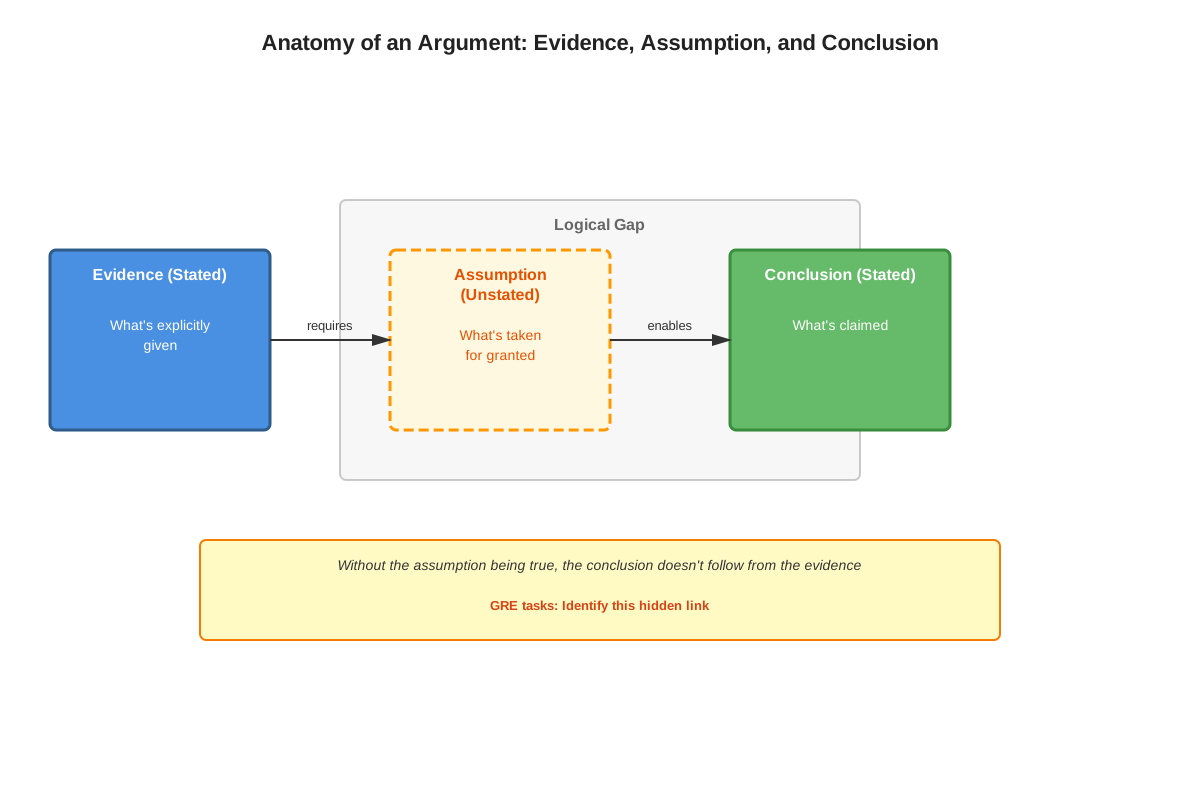
Identifying assumptions is a critical analytical skill tested extensively in the GRE Analytical Writing section, particularly in the Argument Essay (formerly known as the "Analyze an Argument" task). This skill requires test-takers to recognize unstated premises that connect an argument's evidence to its conclusion. An assumption is a missing logical link—something the author takes for granted without explicitly stating it. Without these assumptions being true, the argument's reasoning collapses. Mastering this skill is essential because the GRE Argument Essay explicitly asks students to examine the unstated assumptions underlying a given argument and explain how these assumptions affect the argument's validity.
The ability to identify assumptions distinguishes high-scoring test-takers from average performers. When an argument presents evidence and draws a conclusion, there are always gaps in reasoning—logical leaps that the author makes without justification. GRE identifying assumptions requires students to pinpoint these gaps precisely and articulate why they matter. For instance, if an argument claims "Sales increased after we hired a new marketing director, so the new director caused the sales increase," the unstated assumption is that no other factors could have caused the sales increase. Recognizing this assumption allows test-takers to critique the argument effectively.
Within the broader context of Analytical Writing, identifying assumptions connects directly to evaluating evidence, recognizing logical fallacies, and constructing counterarguments. It serves as the foundation for the entire Argument Essay task, as students must identify multiple assumptions, explain their significance, and discuss what additional evidence would strengthen or weaken the argument. This skill also transfers to the Issue Essay, where understanding assumptions helps students anticipate counterarguments and build more nuanced positions.
Learning Objectives
- [ ] Identify when Identifying assumptions is being tested in GRE Argument Essay prompts
- [ ] Explain the core rule or strategy behind Identifying assumptions and how assumptions function in logical reasoning
- [ ] Apply Identifying assumptions to GRE-style questions accurately and systematically
- [ ] Distinguish between explicit premises and implicit assumptions in complex arguments
- [ ] Evaluate the impact of questionable assumptions on argument validity
- [ ] Generate multiple alternative explanations that challenge an argument's assumptions
- [ ] Articulate how specific evidence could test or validate unstated assumptions
Prerequisites
- Basic logical reasoning: Understanding the structure of arguments (premises, conclusions, evidence) is essential because assumptions fill gaps between these components
- Causal reasoning fundamentals: Recognizing cause-and-effect relationships helps identify when authors assume causation without sufficient justification
- Reading comprehension skills: The ability to extract main ideas and supporting details from complex passages enables students to identify what is stated versus what is assumed
- Analytical Writing task familiarity: Understanding the Argument Essay format and scoring criteria provides context for why assumption identification matters
Why This Topic Matters
In real-world contexts, identifying assumptions is fundamental to critical thinking in business, law, medicine, and academia. Professionals must evaluate proposals, research findings, and policy recommendations by examining their underlying assumptions. A business plan assuming continued market growth, a medical study assuming patient compliance, or a legal argument assuming witness credibility all rest on assumptions that may or may not hold true. The ability to identify and question these assumptions prevents costly errors and strengthens decision-making.
On the GRE, assumption identification appears in virtually every Argument Essay prompt—which constitutes 50% of the Analytical Writing score. According to ETS data, the Argument Essay is scored on how well students identify and analyze the reasoning in arguments, with assumption identification being the primary analytical skill assessed. Test-takers who systematically identify 3-5 key assumptions and explain their implications typically score in the 5-6 range (90th percentile and above), while those who miss assumptions or identify them superficially score in the 3-4 range.
Common manifestations in GRE passages include: arguments about business decisions (assuming market conditions will remain stable), recommendations based on surveys (assuming respondents are representative), predictions based on trends (assuming trends will continue), and causal claims based on correlations (assuming no alternative causes exist). The test consistently presents arguments with multiple identifiable assumptions, rewarding students who can systematically uncover these logical gaps.
Core Concepts
What Is an Assumption?
An assumption is an unstated premise that must be true for an argument's conclusion to follow logically from its evidence. It represents a gap in reasoning—something the author believes or takes for granted without providing evidence. Assumptions are neither stated explicitly nor supported with data; they are the invisible bridges connecting what the author says to what the author concludes.
Consider this simple argument: "The restaurant was empty on Tuesday night, so the food must be bad." The stated evidence is the empty restaurant; the conclusion is that the food quality is poor. The unstated assumption is that restaurant occupancy directly reflects food quality—that no other factors (day of the week, location, pricing, marketing, weather, competition) could explain the empty restaurant. This assumption must be true for the conclusion to be valid.
Types of Assumptions in GRE Arguments
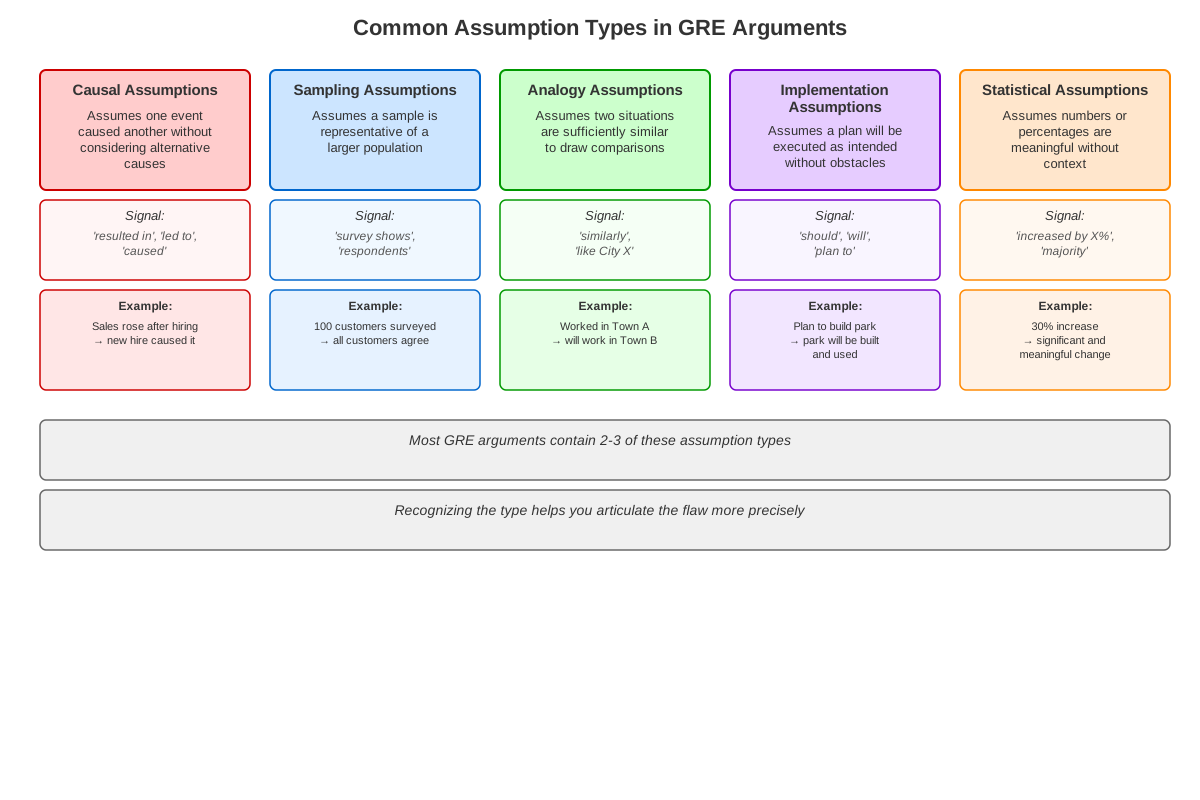
Causal assumptions occur when arguments claim one event caused another without ruling out alternative explanations. The author assumes that correlation implies causation or that the stated cause is the only possible explanation. Example: "Crime decreased after the new police chief was hired, so the new chief's policies reduced crime." This assumes no other factors (economic changes, demographic shifts, seasonal variations) caused the decrease.
Representativeness assumptions appear when arguments generalize from a sample to a population. The author assumes the sample accurately represents the larger group. Example: "A survey of our email subscribers showed 80% satisfaction, so most customers are satisfied." This assumes email subscribers represent all customers—that non-subscribers have similar satisfaction levels.
Feasibility assumptions involve claims about future actions or implementations. The author assumes that proposed plans can be executed as intended without obstacles. Example: "Building a new highway will reduce commute times." This assumes construction can be completed on schedule, funding will remain available, and increased road capacity won't attract more drivers (induced demand).
Comparison assumptions emerge when arguments draw parallels between different situations. The author assumes the compared situations are sufficiently similar. Example: "City A reduced traffic by adding bike lanes, so City B should do the same." This assumes the cities have comparable geography, climate, population density, and cycling culture.
Temporal assumptions relate to claims about past trends continuing into the future. The author assumes conditions will remain stable. Example: "Our company grew 10% annually for five years, so we'll continue this growth." This assumes market conditions, competition, and consumer preferences won't change.
The Assumption Identification Process
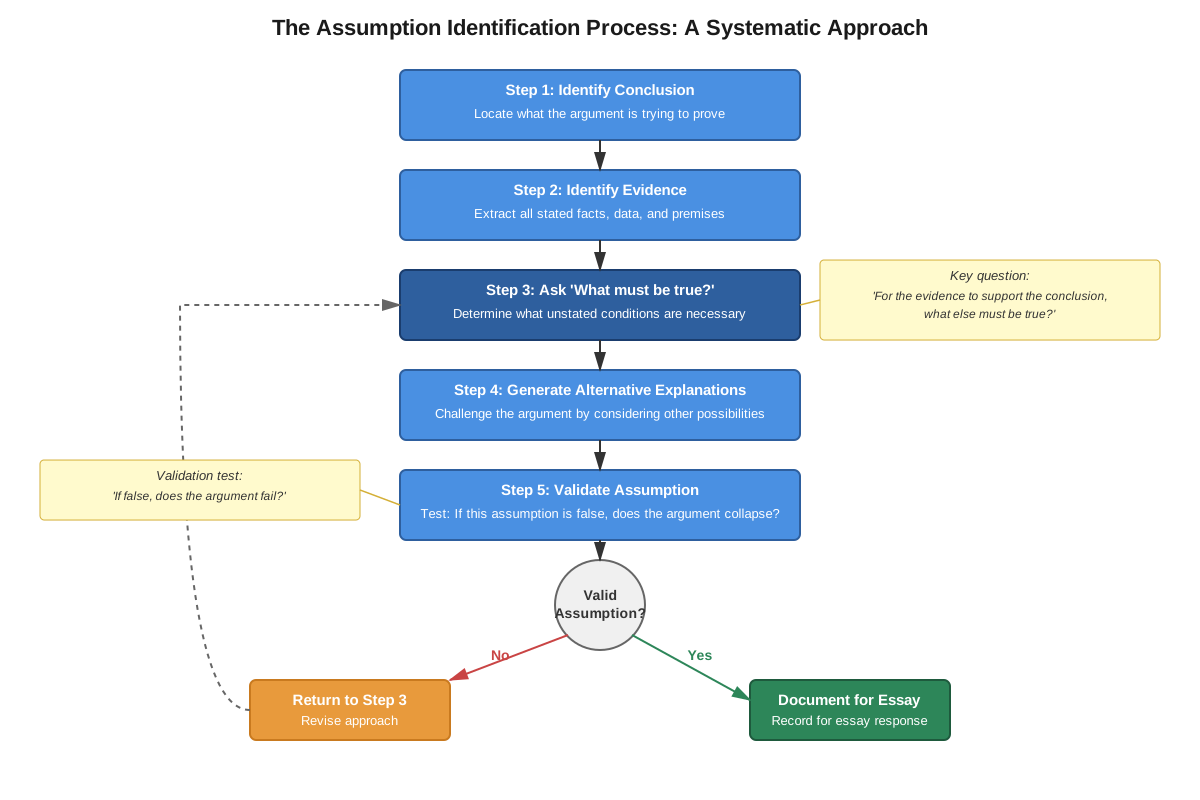
The systematic approach to identifying assumptions follows these steps:
- Identify the conclusion: Determine what the argument is trying to prove or recommend
- Identify the evidence: List all stated facts, data, and premises
- Find the gap: Ask "What must be true for this evidence to support this conclusion?"
- Articulate the assumption: State the unstated premise explicitly
- Test the assumption: Consider what would happen if the assumption were false
This process transforms vague intuitions about argument weaknesses into precise analytical statements. For example, given the argument "Employee productivity increased after we installed new software, so the software improved productivity," the process yields:
- Conclusion: The software improved productivity
- Evidence: Productivity increased after software installation
- Gap: Connection between timing and causation
- Assumption: No other factors caused the productivity increase; the software was the sole cause
- Test: If productivity increased due to seasonal factors, new training, or different personnel, the assumption fails
Recognizing Assumption Indicators
Certain argument structures signal assumptions. Causal language without sufficient evidence ("therefore," "consequently," "as a result," "led to") often indicates causal assumptions. Predictive language ("will," "should," "is likely to") suggests temporal or feasibility assumptions. Comparative language ("similarly," "likewise," "just as") points to comparison assumptions. Generalization language ("most," "typically," "generally") indicates representativeness assumptions.
Arguments that jump from specific evidence to broad conclusions almost always contain assumptions. Arguments that recommend actions based on past events assume future conditions will resemble past conditions. Arguments citing surveys or studies assume the research methodology was sound and the sample representative.
The Negation Test
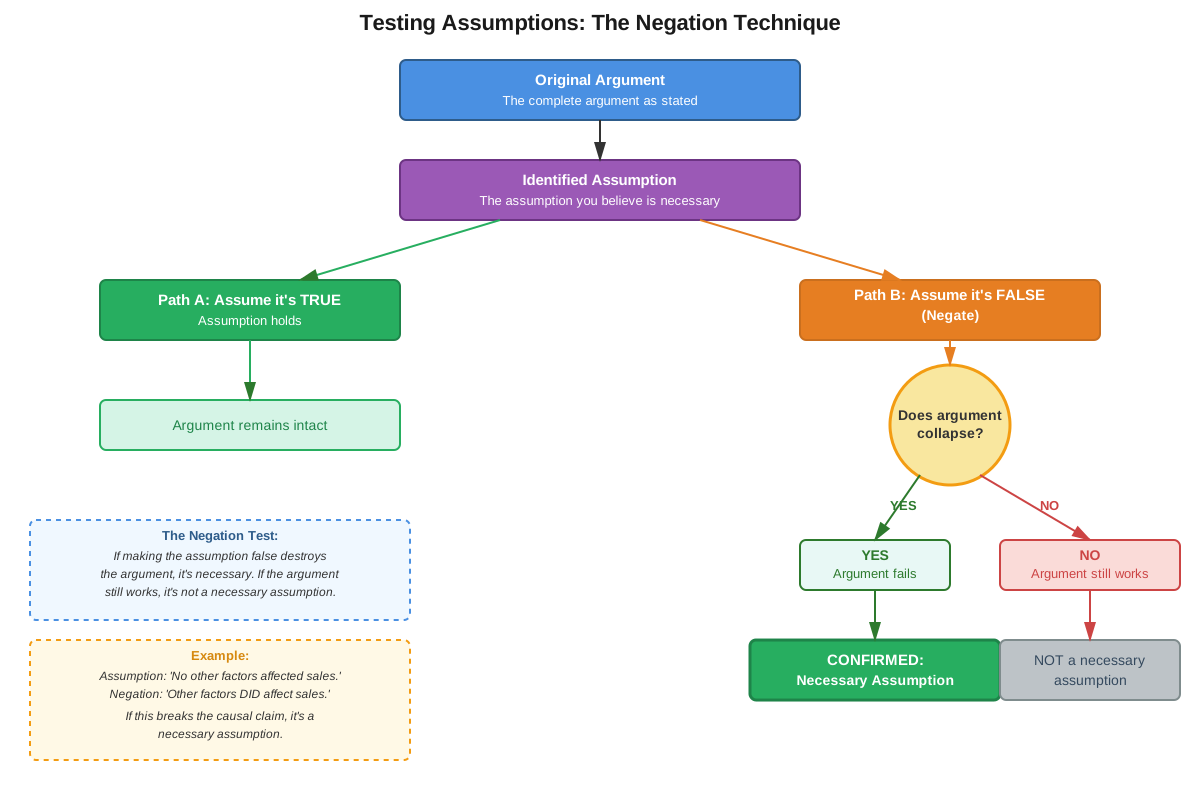
A powerful technique for verifying assumptions is the negation test: negate the suspected assumption and see if the argument falls apart. If negating the statement destroys the argument's logic, it's a genuine assumption. If the argument still works, it's not a necessary assumption.
Example argument: "Sales increased in stores that extended hours, so all stores should extend hours." Suspected assumption: "The stores that extended hours are representative of all stores." Negation: "The stores that extended hours are NOT representative of all stores (perhaps they were in unique locations or markets)." Result: The argument collapses—if the test stores aren't representative, the recommendation doesn't follow. This confirms the assumption.
Assumptions vs. Explicit Premises
Students must distinguish between what arguments state and what they assume. Explicit premises are directly stated in the argument text. Assumptions are never stated but are necessary for the logic to work. The GRE tests this distinction by presenting arguments where some information is given and other critical information is missing.
| Feature | Explicit Premise | Assumption |
|---|---|---|
| Stated in text | Yes | No |
| Supported by evidence | Often | Never |
| Necessary for conclusion | Yes | Yes |
| Subject to questioning | Less vulnerable | Highly vulnerable |
| Visibility | Obvious | Requires analysis |
Concept Relationships
The concepts within assumption identification form a hierarchical structure: understanding what assumptions are (foundational concept) → enables recognizing different types of assumptions (categorical knowledge) → which supports applying the identification process (procedural skill) → leading to effective use of the negation test (advanced technique) → culminating in distinguishing assumptions from explicit premises (mastery-level discrimination).
Assumption identification connects to prerequisite topics through logical reasoning (assumptions are unstated premises in argument structure) and causal reasoning (many assumptions involve causal claims). It relates to subsequent topics including evaluating evidence (assumptions reveal what evidence is missing), identifying logical fallacies (many fallacies rest on faulty assumptions), and constructing counterarguments (challenging assumptions is the primary method of critique).
The relationship map flows as follows: Argument Structure → provides framework for → Identifying Assumptions → which enables → Evaluating Argument Validity → which supports → Writing Effective Critiques → which produces → High-Scoring Argument Essays. Each assumption identified opens multiple analytical pathways: explaining why the assumption matters, describing evidence that would test it, and discussing alternative explanations if the assumption fails.
High-Yield Facts
- ⭐ Every GRE Argument Essay prompt contains multiple identifiable assumptions that must be analyzed for a high score
- ⭐ Assumptions are unstated premises that connect evidence to conclusions; they are never explicitly mentioned in the argument text
- ⭐ The most common assumption types on the GRE are causal assumptions (assuming correlation proves causation) and representativeness assumptions (assuming samples represent populations)
- ⭐ The negation test reliably identifies true assumptions: if negating a statement destroys the argument, it's a necessary assumption
- ⭐ High-scoring essays identify 3-5 specific assumptions and explain their impact on argument validity
- Arguments that recommend actions based on past results assume future conditions will resemble past conditions
- Temporal assumptions (trends will continue) appear in approximately 40% of GRE Argument prompts
- Comparison assumptions (what worked in one context will work in another) require examining whether compared situations are truly analogous
- Feasibility assumptions (plans can be implemented as proposed) are often overlooked but appear in most recommendation-based arguments
- Arguments citing surveys or studies assume the research methodology was sound, the sample was representative, and respondents answered honestly
- The phrase "therefore" or "thus" without sufficient connecting evidence almost always signals an assumption
- Alternative explanations directly challenge assumptions by showing the conclusion could be false even if the evidence is true
Quick check — test yourself on Identifying assumptions so far.
Try Flashcards →Common Misconceptions
Misconception: Assumptions are the same as conclusions or main points of the argument.
Correction: Assumptions are unstated premises that support the conclusion. The conclusion is what the argument tries to prove; assumptions are the hidden logical links that must be true for the proof to work. If an argument states something explicitly, it's not an assumption.
Misconception: Any weakness in an argument is an assumption.
Correction: Assumptions are specifically unstated premises necessary for the logic to work. Other weaknesses might include insufficient evidence, biased sources, or logical fallacies. An assumption is always something the author takes for granted without stating or proving it.
Misconception: Identifying assumptions means finding what the author forgot to mention.
Correction: Assumptions aren't oversights; they're logical necessities. Every argument has assumptions because no argument can state every premise. The task is identifying which unstated premises are most critical to the argument's validity, not listing everything the author didn't say.
Misconception: If something seems likely to be true, it's not an assumption.
Correction: Even if an assumption seems reasonable or probable, it's still an assumption if it's unstated and necessary for the argument. The GRE tests the ability to identify logical gaps regardless of whether the assumptions seem plausible. A "reasonable" assumption is still vulnerable to challenge.
Misconception: Assumptions only appear in arguments with obvious flaws.
Correction: All arguments contain assumptions, even strong ones. The difference is that strong arguments rest on more reasonable assumptions while weak arguments depend on questionable assumptions. The analytical task is identifying assumptions in any argument, then evaluating whether those assumptions are warranted.
Misconception: The more assumptions identified, the better the essay score.
Correction: Quality matters more than quantity. Identifying 3-4 significant assumptions and thoroughly explaining their implications scores higher than listing 10 assumptions superficially. The GRE rewards depth of analysis, not mere identification.
Worked Examples
Example 1: Business Recommendation Argument
Argument: "The Apex Corporation's profits declined 15% last year while employee satisfaction scores also decreased. To restore profitability, Apex should implement programs to improve employee satisfaction."
Step 1 - Identify the conclusion: Apex should implement employee satisfaction programs to restore profitability.
Step 2 - Identify the evidence: Profits declined 15%; employee satisfaction scores decreased; both events occurred in the same year.
Step 3 - Find the gaps and articulate assumptions:
Assumption 1 (Causal): The decrease in employee satisfaction caused the profit decline, rather than both being effects of a common cause or unrelated events. The argument assumes correlation implies causation. If profits declined due to market conditions, increased competition, or product obsolescence—factors that might also decrease employee morale—then improving satisfaction wouldn't restore profitability.
Assumption 2 (Temporal): The relationship between employee satisfaction and profitability that existed in the past will continue in the future. The argument assumes that improving satisfaction now will have the same effect on profits that high satisfaction presumably had previously. If market conditions have changed, this relationship might not hold.
Assumption 3 (Feasibility): Employee satisfaction programs can be implemented effectively and will actually improve satisfaction. The argument assumes the proposed solution is practical and will work as intended. If employees are dissatisfied due to factors beyond management control (industry-wide issues, economic conditions), programs might not improve satisfaction.
Assumption 4 (Exclusivity): No other factors contributed significantly to the profit decline, or if they did, addressing employee satisfaction is the most effective response. The argument assumes this is the right problem to solve. If profits declined primarily due to pricing issues, product quality, or market changes, focusing on employee satisfaction might not be the optimal strategy.
Step 4 - Apply the negation test: If we negate Assumption 1 ("Employee satisfaction did NOT cause the profit decline"), the argument fails—there would be no reason to expect satisfaction programs to restore profitability. This confirms it's a necessary assumption.
Connection to learning objectives: This example demonstrates how to systematically identify multiple assumption types (causal, temporal, feasibility) and explains their impact on argument validity, directly addressing the core learning objectives.
Example 2: Survey-Based Argument
Argument: "A recent survey of Riverside residents found that 75% support building a new sports stadium. The city council should therefore approve the stadium project, as it clearly has strong public support."
Step 1 - Identify the conclusion: The city council should approve the stadium project.
Step 2 - Identify the evidence: A survey showed 75% of respondents support the stadium.
Step 3 - Find the gaps and articulate assumptions:
Assumption 1 (Representativeness): The survey respondents accurately represent all Riverside residents. The argument assumes the sample wasn't biased. If the survey only reached certain demographics (homeowners, specific neighborhoods, people who answer phone surveys), the 75% figure might not reflect actual city-wide opinion. Perhaps the survey was conducted at a sports event, or only reached people with strong opinions who chose to respond.
Assumption 2 (Methodology): The survey was conducted properly with neutral questions and reliable methods. The argument assumes the survey design didn't bias results. If questions were leading ("Do you support bringing economic growth and entertainment to Riverside through a new stadium?"), the 75% support might be artificially inflated.
Assumption 3 (Informed Opinion): Survey respondents had sufficient information to make informed judgments. The argument assumes people understood the full implications—costs, tax impacts, location, traffic effects. If respondents didn't know the stadium would require tax increases or would be built in a residential area, their support might change with more information.
Assumption 4 (Relevance): Public opinion should be the primary factor in the decision. The argument assumes that majority support justifies approval. It doesn't consider whether the project is financially viable, environmentally sound, or legally permissible. Even with 75% support, the council might have valid reasons to reject the project.
Assumption 5 (Stability): Public opinion will remain stable through the approval and construction process. The argument assumes current support will persist. If the survey was conducted during a winning sports season or before cost details were public, support might decrease.
Step 4 - Apply the negation test: Negating Assumption 1 ("The survey respondents do NOT accurately represent all residents") undermines the argument—if the sample is biased, the 75% figure doesn't indicate "strong public support" city-wide, and the conclusion doesn't follow.
Connection to learning objectives: This example shows how a single piece of evidence (survey results) can rest on multiple assumptions, demonstrating the need to examine arguments from multiple angles and generate alternative explanations that challenge assumptions.
Exam Strategy
When approaching GRE Argument Essay prompts, allocate the first 3-4 minutes to reading and analyzing the argument structure. Use this time to identify the conclusion, list the evidence, and note 3-5 potential assumptions. Don't begin writing until these assumptions are clear, as they form the backbone of the essay.
Trigger words and phrases that signal assumptions include: "therefore," "thus," "consequently," "as a result," "will lead to," "should," "must," "clearly," "obviously," and "it follows that." These words indicate logical leaps where assumptions hide. When you see these triggers, immediately ask "What must be true for this conclusion to follow?"
Process-of-elimination approach: If struggling to identify assumptions, use these questions systematically:
- Does the argument claim causation? → Look for causal assumptions (alternative causes, reverse causation)
- Does it cite a survey, study, or sample? → Look for representativeness assumptions
- Does it make predictions or recommendations? → Look for temporal and feasibility assumptions
- Does it compare different situations? → Look for comparison assumptions (analogous conditions)
- Does it generalize from specific cases? → Look for representativeness assumptions
Time allocation: Spend 3-4 minutes analyzing, 2 minutes outlining (listing assumptions and their implications), 20-22 minutes writing (approximately 5-6 minutes per assumption with 3-4 assumptions total), and 2-3 minutes reviewing. This ensures sufficient depth of analysis rather than superficial coverage of many points.
Exam Tip: The strongest essays don't just identify assumptions—they explain why each assumption matters. After stating an assumption, immediately explain: "If this assumption is false, then [specific consequence for the argument]." This demonstrates analytical depth.
Paragraph structure strategy: Dedicate one body paragraph to each major assumption. Begin with a clear topic sentence identifying the assumption, explain why it's necessary for the argument, discuss what would happen if it's false, and suggest what evidence would test it. This structure ensures comprehensive analysis of each assumption.
Common trap: Don't confuse identifying assumptions with agreeing or disagreeing with the conclusion. The task is analyzing the reasoning, not taking a position on the issue. Even if you personally support building a stadium or hiring a marketing director, your essay should objectively examine whether the argument's logic is sound.
Memory Techniques
CASTR mnemonic for the five most common assumption types:
- Causal (correlation ≠ causation)
- Analogy/comparison (situations are similar)
- Sample representativeness (sample = population)
- Temporal (trends continue)
- Realizability/feasibility (plans work as intended)
When analyzing any argument, mentally run through CASTR to ensure you've considered all major assumption categories.
The "Bridge" visualization: Picture the argument as two islands—Evidence Island and Conclusion Island. Assumptions are invisible bridges connecting them. Your task is making the invisible bridges visible. If you remove a bridge (negate an assumption), can you still get from evidence to conclusion? If not, you've found a necessary assumption.
The "What if?" technique: For every piece of evidence, ask "What if this doesn't mean what the author thinks it means?" This question naturally leads to assumptions. "Sales increased after hiring a new director—what if the increase wasn't because of the director?" This generates the assumption that the director caused the increase.
The "Alternative Explanation" acronym - OCEAN:
- Other causes (for causal claims)
- Changed conditions (for temporal claims)
- Exceptional sample (for generalizations)
- Assumptions about feasibility (for recommendations)
- Non-analogous situations (for comparisons)
Summary
Identifying assumptions is the cornerstone skill for GRE Argument Essay success, requiring test-takers to uncover unstated premises that connect evidence to conclusions. Assumptions represent logical gaps—things the author takes for granted without proof. The five primary assumption types are causal (assuming correlation proves causation), representativeness (assuming samples represent populations), temporal (assuming trends continue), feasibility (assuming plans work as intended), and comparison (assuming situations are analogous). The systematic identification process involves isolating the conclusion, listing evidence, finding gaps in reasoning, articulating unstated premises, and applying the negation test to verify assumptions. High-scoring essays identify 3-5 specific assumptions and thoroughly explain their implications for argument validity, including what evidence would test each assumption and what alternative explanations exist if assumptions fail. Mastering this skill requires practice distinguishing between explicit premises and implicit assumptions, recognizing trigger words that signal logical leaps, and systematically analyzing arguments from multiple analytical angles.
Key Takeaways
- Assumptions are unstated premises necessary for an argument's conclusion to follow logically from its evidence; they are never explicitly stated in the argument text
- The five high-yield assumption types are causal, representativeness, temporal, feasibility, and comparison—memorize CASTR to check for all types
- Use the negation test to verify assumptions: if negating a statement destroys the argument, it's a necessary assumption
- High-scoring essays analyze 3-5 assumptions in depth rather than superficially listing many assumptions
- Every assumption analysis should explain: (1) why the assumption is necessary, (2) what happens if it's false, and (3) what evidence would test it
- Trigger words like "therefore," "thus," "will," and "should" signal logical leaps where assumptions hide
- The systematic process—identify conclusion, list evidence, find gaps, articulate assumptions, test with negation—ensures comprehensive analysis
Related Topics
Evaluating Evidence Quality: After identifying assumptions, the next skill involves assessing whether available evidence adequately supports claims or whether additional evidence is needed. This builds directly on assumption identification by examining what information would validate or invalidate unstated premises.
Logical Fallacies: Many common fallacies (post hoc ergo propter hoc, hasty generalization, false analogy) are essentially flawed assumptions. Understanding assumption identification provides the foundation for recognizing these specific reasoning errors.
Constructing Counterarguments: Challenging assumptions is the primary method of critiquing arguments. Once assumptions are identified, students can develop counterarguments by proposing alternative explanations and questioning whether assumptions are warranted.
Alternative Explanations: This advanced skill involves generating multiple scenarios that could explain the evidence without accepting the argument's conclusion, directly challenging the argument's assumptions about causation and correlation.
Practice CTA
Now that you understand the systematic approach to identifying assumptions, it's time to apply these strategies to actual GRE-style arguments. The practice questions and flashcards will reinforce your ability to quickly spot assumption types, apply the negation test, and articulate why assumptions matter. Remember: assumption identification is a skill that improves dramatically with deliberate practice. Each argument you analyze strengthens your pattern recognition and analytical speed. Approach the practice materials with the goal of not just finding assumptions, but explaining their significance—this depth of analysis is what distinguishes top-scoring essays. You've built the foundation; now build the expertise through focused practice!
Sign up free to keep reading
Create a free AnvayaPrep account to finish this GRE guide on Identifying assumptions — plus flashcards and practice questions.