Overview
The ability to identify and articulate alternative explanations stands as one of the most critical skills tested in the GRE Analytical Writing section, particularly in the Argument Essay. When the GRE presents an argument, it typically contains a conclusion drawn from a set of premises. However, the argument often fails to consider other plausible explanations for the observed phenomena or data. Your task as a test-taker is to recognize these gaps in reasoning and demonstrate that the conclusion may not be the only—or even the most likely—interpretation of the evidence presented.
Understanding gre alternative explanations is essential because approximately 60-70% of Argument Essay prompts contain flaws related to insufficient consideration of other possible causes or interpretations. The test-makers deliberately construct arguments that jump to conclusions without ruling out competing explanations. A strong essay doesn't simply criticize the argument as "weak" or "flawed"—it systematically identifies specific alternative explanations that could account for the evidence, thereby demonstrating sophisticated critical thinking. This skill directly measures your ability to evaluate complex reasoning, a competency highly valued in graduate-level academic work.
Within the broader framework of Analytical Writing, alternative explanations connect intimately with other critical reasoning concepts such as causal reasoning, evidence evaluation, and assumption identification. While assumption analysis asks "What must be true for this argument to work?", alternative explanation analysis asks "What else could explain these observations?" Both skills work together to create a comprehensive critique of argumentative reasoning. Mastering alternative explanations also strengthens your ability to identify correlation-causation errors, sampling problems, and temporal reasoning flaws—all common features of GRE Argument Essay prompts.
Learning Objectives
- [ ] Identify when Alternative explanations is being tested
- [ ] Explain the core rule or strategy behind Alternative explanations
- [ ] Apply Alternative explanations to GRE-style questions accurately
- [ ] Generate at least three distinct alternative explanations for any given argument scenario
- [ ] Distinguish between relevant and irrelevant alternative explanations in the context of an argument
- [ ] Articulate how alternative explanations weaken the original argument's conclusion
- [ ] Integrate alternative explanations seamlessly into a well-structured Argument Essay
Prerequisites
- Basic logical reasoning: Understanding the structure of arguments (premises, conclusions, assumptions) is necessary because alternative explanations target the logical gap between evidence and conclusion
- Correlation vs. causation: Recognizing that two events occurring together doesn't prove one caused the other is fundamental, as many alternative explanations involve different causal relationships
- Evidence evaluation: The ability to assess what evidence actually proves versus what it merely suggests helps determine when alternative explanations are viable
- Argument structure analysis: Identifying the main conclusion and supporting premises allows you to pinpoint exactly where alternative explanations apply
Why This Topic Matters
In real-world contexts, the ability to consider alternative explanations is fundamental to sound decision-making across all professional fields. Scientists must rule out competing hypotheses before accepting a theory. Business leaders must consider multiple explanations for market trends before committing resources. Policy makers must evaluate various causes of social phenomena before implementing solutions. The GRE tests this skill because graduate programs require students who can think critically about complex problems rather than accepting the first plausible explanation they encounter.
On the GRE Argument Essay, alternative explanations appear in approximately 65-75% of all prompts, making this the single most frequently tested critical reasoning skill. The test presents arguments about business decisions, public policy, scientific studies, or social trends, and these arguments consistently fail to consider other plausible interpretations of their evidence. A typical prompt might describe increased sales after a marketing campaign and conclude the campaign caused the increase—without considering seasonal trends, competitor actions, economic conditions, or demographic shifts as alternative explanations.
Common manifestations include: arguments that attribute a single cause to an observed effect without considering multiple contributing factors; arguments that assume a correlation indicates a specific causal direction without considering reverse causation or third variables; arguments that generalize from limited data without considering sampling bias or unrepresentative conditions; and arguments that predict future outcomes based on past trends without considering changed circumstances. Recognizing these patterns allows you to quickly identify where alternative explanations apply and structure your essay accordingly.
Core Concepts
Definition and Fundamental Principle
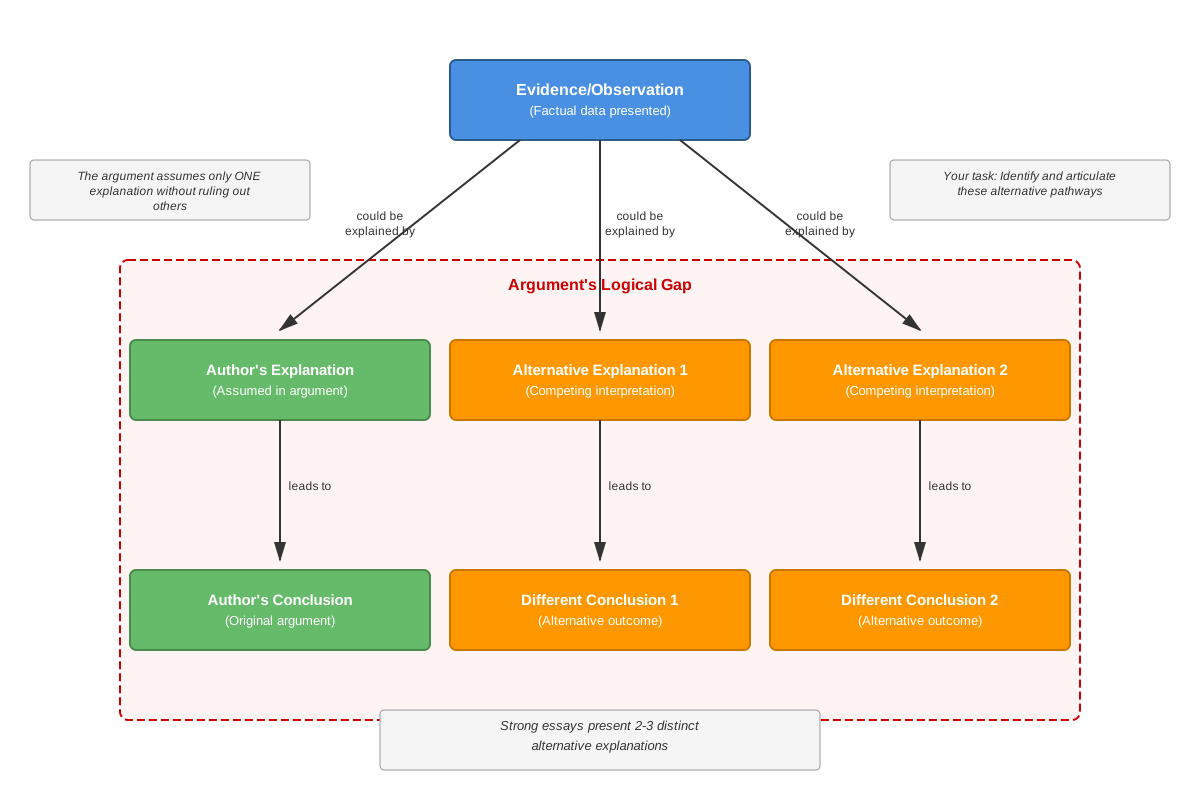
Alternative explanations are plausible interpretations of evidence or observations that differ from the conclusion presented in an argument. When an argument claims that X caused Y or that X explains Y, an alternative explanation suggests that Z (or A, B, or C) could also account for the observed phenomenon. The fundamental principle is that evidence can often be explained by multiple causes or interpretations, and a strong argument must either rule out these alternatives or acknowledge their possibility.
The core weakness in arguments vulnerable to alternative explanations is insufficient justification for preferring one explanation over others. The argument author observes a phenomenon, proposes an explanation, but fails to demonstrate why their explanation is more likely than competing interpretations. This represents a logical gap between evidence and conclusion—the evidence may be accurate, but it doesn't uniquely support the stated conclusion.
Types of Alternative Explanations
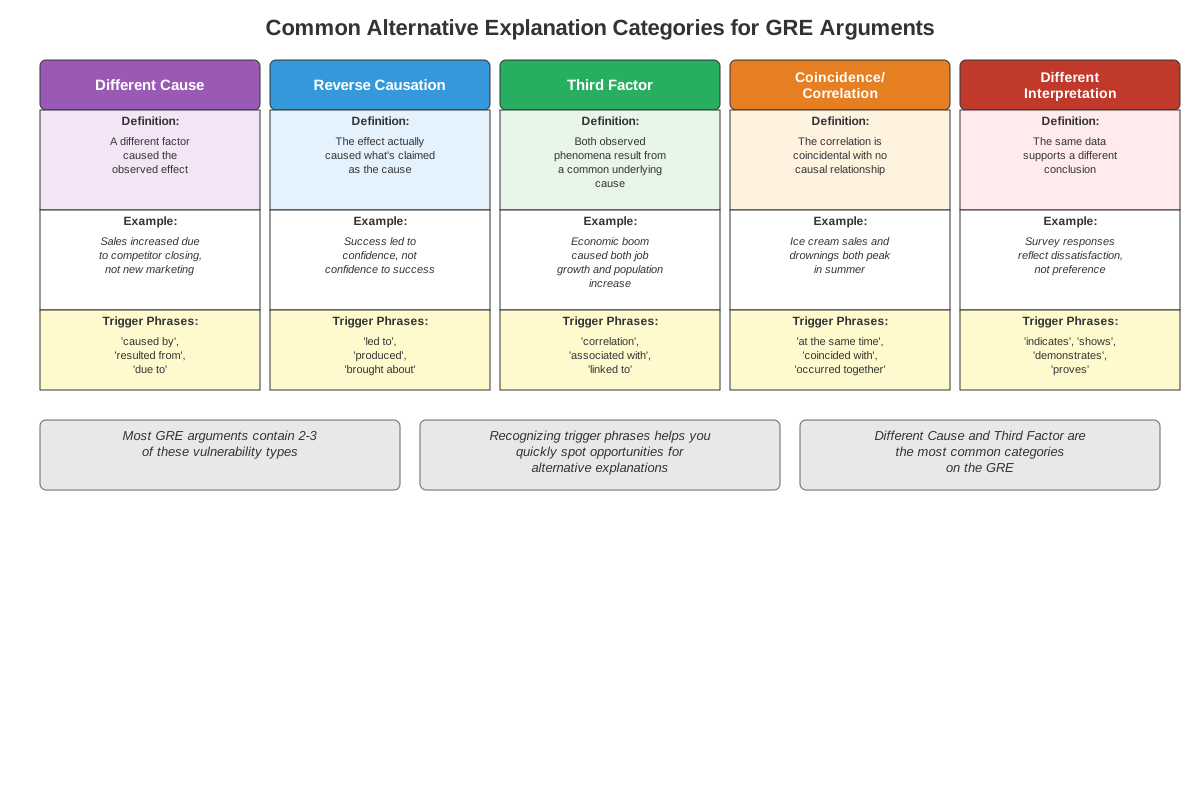
Different categories of alternative explanations appear regularly on the GRE, and recognizing these types helps you generate relevant critiques quickly:
| Type | Description | Example Context |
|---|---|---|
| Alternative Cause | A different factor caused the observed effect | Sales increased due to economic recovery, not the new marketing campaign |
| Reverse Causation | The supposed effect actually caused the supposed cause | People with health problems join gyms (not: gyms cause health problems) |
| Third Variable | An unmentioned factor caused both observed phenomena | Warm weather increased both ice cream sales and crime rates |
| Coincidence | Events occurred together by chance, not causally | Company profits rose the same year a new CEO started, but unrelated |
| Multiple Contributing Factors | Several causes combined to produce the effect | Student performance improved due to new curriculum AND smaller classes AND better teachers |
| Sampling Bias | The observed sample differs systematically from the population | Survey respondents were unusually enthusiastic customers, not representative |
The Mechanism of Weakening Arguments
Alternative explanations weaken arguments through a specific logical mechanism: they demonstrate that the conclusion is not necessarily true even if all the premises are accurate. This is crucial—you're not claiming the argument's evidence is false or that its conclusion is definitely wrong. Instead, you're showing that the evidence is consistent with multiple interpretations, making the specific conclusion drawn less certain.
Consider this structure:
- Premise: After implementing policy X, outcome Y occurred
- Conclusion: Policy X caused outcome Y
- Alternative explanation: Factor Z also changed during this period and could have caused outcome Y
The alternative explanation doesn't prove the conclusion wrong—policy X might indeed have caused Y. However, it demonstrates that the argument hasn't established its conclusion because it hasn't ruled out Z as a cause. The evidence (Y occurred after X) is equally consistent with both explanations, so the argument fails to justify preferring its interpretation.
Generating Relevant Alternative Explanations
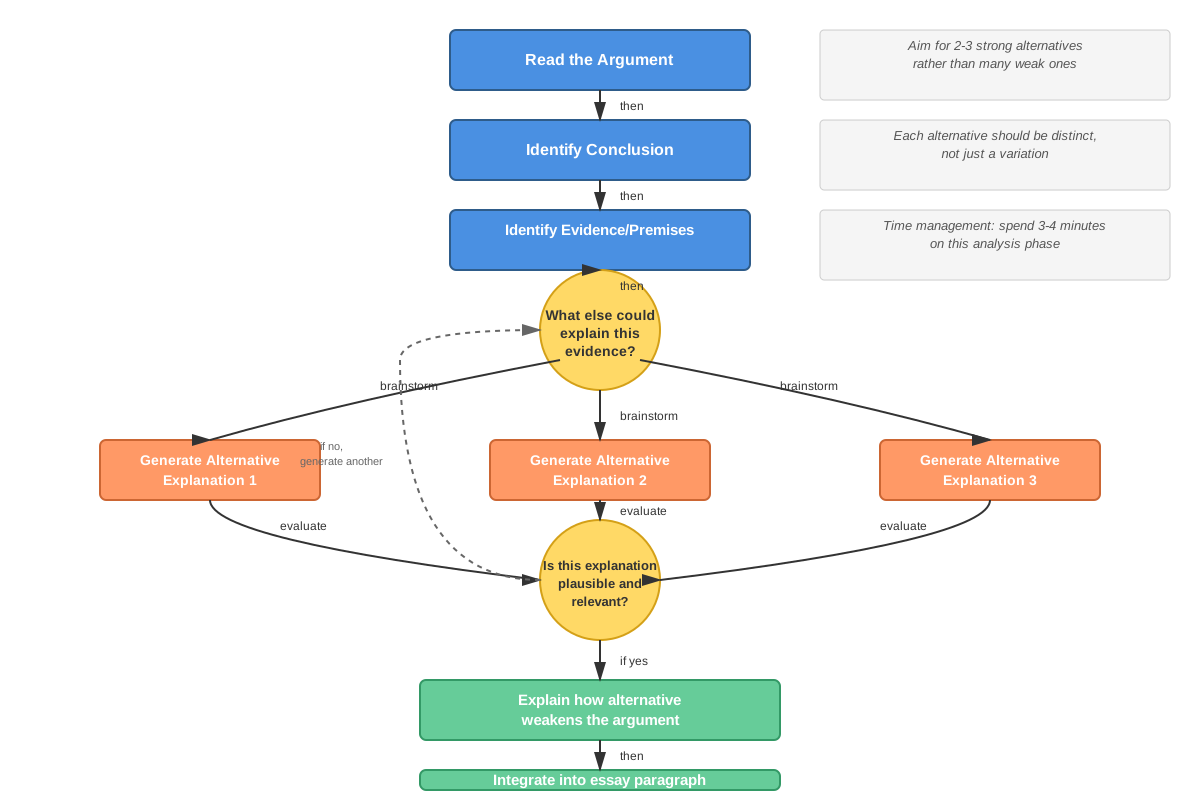
The process of generating strong alternative explanations follows a systematic approach:
- Identify the conclusion: What specific claim is the argument making?
- Identify the evidence: What observations or data support this claim?
- Identify the logical gap: What assumption connects evidence to conclusion?
- Ask "What else?": What other factors could explain the evidence?
- Test relevance: Does this alternative actually explain the same evidence?
- Test plausibility: Is this alternative reasonable in the given context?
Strong alternative explanations are specific, relevant, and plausible. Weak alternatives are vague ("maybe something else happened"), irrelevant (explaining different evidence than what the argument presents), or implausible (requiring unlikely scenarios). For example, if an argument claims a restaurant's new menu increased profits, a strong alternative might be "a major competitor closed nearby, redirecting customers to this restaurant." A weak alternative would be "maybe aliens influenced customer behavior"—technically possible but not plausibly relevant.
Context-Specific Alternative Explanations
Different argument contexts suggest particular types of alternative explanations:
Business/Economic Arguments: Consider market conditions, competitor actions, seasonal variations, economic cycles, demographic changes, technological shifts, and regulatory changes. If an argument attributes business success or failure to a single decision, alternative explanations might involve external market forces beyond the company's control.
Scientific/Medical Arguments: Consider placebo effects, natural recovery, regression to the mean, selection bias, confounding variables, and measurement errors. If an argument claims a treatment caused improvement, alternative explanations might involve spontaneous recovery or participants' expectations.
Social/Policy Arguments: Consider demographic trends, cultural shifts, economic conditions, enforcement changes, reporting changes, and concurrent policies. If an argument claims a policy caused a social change, alternative explanations might involve broader societal trends occurring simultaneously.
Survey/Study Arguments: Consider response bias, sampling methodology, question wording, timing effects, and non-response patterns. If an argument draws conclusions from survey data, alternative explanations might involve unrepresentative samples or biased response patterns.
Integration with Argument Structure
Alternative explanations most commonly address causal claims and explanatory claims in arguments. When you see language like "caused," "resulted in," "led to," "explains why," "accounts for," or "is responsible for," the argument is making a claim particularly vulnerable to alternative explanations. Your essay should explicitly connect the alternative explanation to the specific causal claim, showing how it undermines the argument's reasoning.
The strength of your critique depends not just on identifying alternatives but on explaining their impact. After presenting an alternative explanation, articulate how it weakens the argument: "If the sales increase resulted from the competitor's closure rather than the new marketing campaign, then the argument's recommendation to expand the campaign would be misguided, as it would invest resources in a strategy that wasn't actually responsible for the success."
Concept Relationships
Alternative explanations connect fundamentally to assumptions in argument analysis. Every alternative explanation corresponds to an implicit assumption the argument makes. When an argument assumes X caused Y, it implicitly assumes that Z, A, and B did not cause Y. Identifying alternative explanations is essentially identifying unstated assumptions that the argument fails to justify. This relationship means that skills in assumption identification directly enhance your ability to generate alternative explanations, and vice versa.
The relationship to evidence evaluation is equally important. Alternative explanations demonstrate that evidence is underdetermining—the same evidence can support multiple conclusions. This connects to the broader principle that strong arguments require not just evidence for their conclusion but evidence that distinguishes their conclusion from competing interpretations. When you identify alternative explanations, you're essentially showing that the argument's evidence fails this stronger test.
Alternative explanations also relate closely to scope and representation issues. Many alternative explanations arise because the argument generalizes from limited or unrepresentative data. For instance, if an argument concludes that a teaching method is effective based on one school's results, alternative explanations might involve unique characteristics of that school's student population, resources, or context. This connects alternative explanation analysis to skills in identifying sampling problems and overgeneralization.
The conceptual flow operates as follows: Argument structure analysis → identifies the conclusion and evidence → Assumption identification → reveals what must be true for the reasoning to work → Alternative explanation generation → shows what else could be true that would break the reasoning → Evidence evaluation → assesses whether the evidence actually rules out alternatives → Argument critique → articulates how alternatives weaken the conclusion.
High-Yield Facts
⭐ Alternative explanations are the most frequently tested concept in GRE Argument Essays, appearing in approximately 65-75% of prompts
⭐ A strong alternative explanation must account for the same evidence the argument presents, not different or hypothetical evidence
⭐ Alternative explanations don't need to prove the argument wrong—they only need to show the conclusion isn't necessarily true
⭐ Causal claims are the most vulnerable to alternative explanations, particularly when arguments observe correlation and infer causation
⭐ Multiple alternative explanations strengthen your essay more than a single alternative, demonstrating comprehensive critical thinking
- Alternative explanations are most effective when they're specific and contextually relevant rather than vague possibilities
- Temporal sequence (X happened before Y) doesn't rule out alternative explanations—many factors could have changed simultaneously
- The phrase "could be explained by" or "might result from" signals you're presenting an alternative explanation
- Alternative explanations often involve external factors the argument fails to consider (market conditions, demographic trends, etc.)
- Reverse causation is a specific type of alternative explanation where the supposed effect actually caused the supposed cause
- Third-variable explanations suggest an unmentioned factor caused both observed phenomena
- Alternative explanations should be integrated throughout your essay, not isolated in a single paragraph
- The strongest essays explain why each alternative explanation matters—how it specifically undermines the argument's reasoning
- Survey-based arguments are particularly vulnerable to alternative explanations involving sampling bias and response patterns
- Arguments that attribute success or failure to a single factor almost always ignore alternative explanations involving multiple contributing causes
Quick check — test yourself on Alternative explanations so far.
Try Flashcards →Common Misconceptions
Misconception: Alternative explanations must prove the argument's conclusion is false → Correction: Alternative explanations only need to show the conclusion isn't necessarily true given the evidence. The argument might still be correct, but it hasn't proven its case because it hasn't ruled out other plausible interpretations. Your task is to demonstrate insufficient justification, not to disprove the conclusion.
Misconception: Any imaginable possibility counts as a valid alternative explanation → Correction: Alternative explanations must be plausible and relevant to the specific context. Suggesting that "maybe the data was fabricated" or "perhaps aliens interfered" doesn't constitute effective analysis. Strong alternatives are reasonable possibilities that someone familiar with the context would genuinely consider.
Misconception: Alternative explanations are the same as assumptions → Correction: While related, these are distinct concepts. An assumption is something the argument takes for granted as true; an alternative explanation is a different interpretation of the evidence that the argument fails to rule out. However, every alternative explanation does correspond to an assumption the argument makes (the assumption that this alternative isn't the case).
Misconception: You should only present one alternative explanation per argument → Correction: Strong essays typically present multiple alternative explanations, demonstrating comprehensive analysis. Different aspects of an argument may be vulnerable to different alternatives, and showing multiple possibilities strengthens your critique by demonstrating the argument's evidence is consistent with many interpretations.
Misconception: Alternative explanations should focus on questioning the evidence's accuracy → Correction: Alternative explanations accept the evidence as accurate but offer different interpretations of what it means or what caused it. Questioning whether the evidence is true is a different type of critique (evidence evaluation). Alternative explanations show that even if the evidence is completely accurate, it doesn't uniquely support the stated conclusion.
Misconception: Longer, more detailed alternative explanations are always better → Correction: Clarity and relevance matter more than length. A concise, specific alternative explanation that directly addresses the argument's reasoning is more effective than a lengthy, vague possibility. Focus on explaining how the alternative undermines the specific logical connection between evidence and conclusion.
Worked Examples
Example 1: Business Argument
Argument: "The Riverside Restaurant introduced a new menu featuring locally-sourced ingredients six months ago. Since then, the restaurant's profits have increased by 30%. Therefore, other restaurants in the area should also switch to locally-sourced ingredients to increase their profits."
Analysis Process:
Step 1 - Identify the conclusion: Other restaurants should switch to locally-sourced ingredients to increase profits.
Step 2 - Identify the evidence: Riverside's profits increased 30% after introducing locally-sourced ingredients.
Step 3 - Identify the causal claim: The new menu with locally-sourced ingredients caused the profit increase.
Step 4 - Generate alternative explanations:
Alternative Explanation 1 - External Market Factor: A major competitor restaurant may have closed during this six-month period, redirecting their customer base to Riverside. This would increase Riverside's profits regardless of menu changes. If this alternative is true, other restaurants switching to locally-sourced ingredients wouldn't experience similar profit increases because they wouldn't benefit from the competitor's closure.
Alternative Explanation 2 - Seasonal Variation: The six-month period may have coincided with peak tourist season or favorable weather conditions that generally increase restaurant traffic in the area. Riverside's profits might increase during this period every year, regardless of menu composition. If this explains the increase, the timing is coincidental rather than causal, and the recommendation lacks justification.
Alternative Explanation 3 - Multiple Concurrent Changes: Riverside may have implemented other changes simultaneously with the menu update—perhaps they hired a new chef, launched a marketing campaign, renovated their dining room, or improved service training. Any of these factors could explain the profit increase, either independently or in combination with the menu change. Without isolating the menu's specific impact, the argument cannot justify attributing the success to locally-sourced ingredients.
Alternative Explanation 4 - Economic Conditions: The local economy may have improved during this period, increasing disposable income and dining-out frequency across the population. This would boost restaurant profits generally, not specifically because of Riverside's menu changes.
Step 5 - Explain the impact: These alternative explanations collectively demonstrate that the evidence (profit increase following menu change) is consistent with multiple interpretations. The argument assumes the menu change caused the increase, but hasn't ruled out external factors, timing coincidences, or other internal changes. Without evidence that isolates the menu's specific effect, the recommendation that other restaurants adopt similar changes is inadequately supported.
Example 2: Survey-Based Argument
Argument: "A recent survey of Greenville residents found that 75% of respondents support building a new sports stadium downtown. The survey was distributed through the city's sports newsletter. Based on these results, the city council should approve funding for the stadium, as it clearly has strong public support."
Analysis Process:
Step 1 - Identify the conclusion: The city council should approve stadium funding because it has strong public support.
Step 2 - Identify the evidence: 75% of survey respondents support the stadium.
Step 3 - Identify the claim: The survey results accurately represent general public opinion in Greenville.
Step 4 - Generate alternative explanations for the survey results:
Alternative Explanation 1 - Sampling Bias: The survey was distributed through the city's sports newsletter, meaning respondents were self-selected individuals already interested in sports. This population likely has much stronger support for a sports stadium than the general public. The 75% support rate might reflect sports enthusiasts' opinions rather than representative public opinion. If the general population were surveyed through random sampling, support might be significantly lower—perhaps even a minority position.
Alternative Explanation 2 - Non-Response Bias: Even among sports newsletter recipients, those who bothered to complete and return the survey may have been disproportionately those with strong opinions about the stadium (either strongly for or against). If supporters were more motivated to respond than those with neutral or mildly negative views, the 75% figure would overestimate actual support levels even within the sports-interested population.
Alternative Explanation 3 - Question Wording Effects: The survey questions may have been worded in ways that encouraged positive responses. For example, if questions emphasized potential benefits ("Would you support a stadium that brings jobs and entertainment?") without mentioning costs or drawbacks, responses would skew more positive than if questions were neutrally worded or included cost information.
Alternative Explanation 4 - Timing and Context: The survey may have been conducted shortly after a major sporting event or positive sports-related news that temporarily elevated enthusiasm for sports facilities. Public opinion on such projects often fluctuates based on recent events, and a survey conducted at a different time might yield different results.
Step 5 - Explain the impact: These alternative explanations demonstrate that the 75% support figure cannot be reliably interpreted as representing general public opinion. The sampling method virtually guarantees responses from a sports-enthusiastic subset of the population, and various response biases may further distort results. The argument's recommendation to approve funding based on "strong public support" is inadequately justified because the evidence doesn't actually establish what the general public thinks. A representative survey using random sampling would be necessary to support the conclusion.
Exam Strategy
When approaching GRE Argument Essay prompts, implement this systematic process for identifying and utilizing alternative explanations:
Trigger Words and Phrases: Watch for causal language that signals vulnerability to alternative explanations: "caused," "resulted in," "led to," "explains," "accounts for," "is responsible for," "due to," "because of," "consequently," and "therefore." Also watch for temporal language that implies causation: "after," "following," "since," "subsequently." These phrases often indicate the argument is inferring causation from correlation or temporal sequence without ruling out alternatives.
The "What Else?" Technique: After identifying the argument's main causal or explanatory claim, systematically ask "What else could explain this evidence?" Consider categories: external factors (market conditions, weather, economic trends), internal factors the argument doesn't mention (other changes occurring simultaneously), sampling or measurement issues (for data-based arguments), and temporal coincidences (events happening together by chance).
The Specificity Principle: Generic alternative explanations like "other factors might be involved" score lower than specific, contextually relevant alternatives. When you identify a possible alternative, develop it with specific details from the argument's context. Instead of "economic factors might explain this," write "an economic recession in the region might have reduced consumer spending across all retail categories, explaining the sales decline without reference to the store's pricing strategy."
The Multiple Alternatives Strategy: Plan to present 2-4 distinct alternative explanations in your essay rather than focusing on just one. This demonstrates comprehensive critical thinking and makes your critique more robust. Different paragraphs can address different aspects of the argument, each with relevant alternatives. However, ensure each alternative is well-developed rather than simply listing many superficial possibilities.
Integration Throughout: Don't isolate alternative explanations in a single paragraph. Instead, integrate them throughout your essay as you address different aspects of the argument. Your introduction might note that the argument fails to consider alternative explanations; body paragraphs can each present specific alternatives related to different claims; and your conclusion can emphasize how these alternatives collectively undermine the argument's reasoning.
The "So What?" Follow-Up: After presenting each alternative explanation, explicitly state its impact on the argument. Use phrases like: "If this alternative explanation is correct, then the argument's recommendation would be misguided because..." or "This possibility undermines the conclusion by showing that..." This demonstrates sophisticated analysis rather than mere observation.
Time Allocation: Spend approximately 2-3 minutes during your planning phase specifically brainstorming alternative explanations. This upfront investment pays dividends by providing clear content for your body paragraphs. Aim to identify 3-4 strong alternatives during planning, knowing you'll develop 2-3 of them fully in your essay.
Process of Elimination for Relevance: When generating alternatives during planning, quickly test each one: Does it explain the same evidence the argument presents? Is it plausible in this context? Does it actually undermine the specific conclusion? Eliminate alternatives that fail these tests before you start writing.
Memory Techniques
The CAST Mnemonic for types of alternative explanations:
- Confounding variables (third factors affecting both observed phenomena)
- Alternative causes (different factors producing the observed effect)
- Sampling issues (unrepresentative data collection)
- Temporal coincidence (events occurring together by chance, not causally)
The "Three Buckets" Visualization: Picture three buckets labeled "Internal," "External," and "Measurement." When generating alternatives, mentally place possibilities in these buckets:
- Internal bucket: Other changes within the organization/system the argument doesn't mention
- External bucket: Outside factors (market, economy, weather, demographics, competitors)
- Measurement bucket: How data was collected, who was surveyed, what was measured
The "What Changed?" Question Chain:
- What changed? (Identify the observed effect)
- What does the argument say changed it? (Identify the claimed cause)
- What else changed at the same time? (Generate alternatives)
- What was already changing before? (Consider trends and trajectories)
- What might have been measured differently? (Consider methodology)
The Acronym SCOPE for survey-based arguments:
- Sampling method (who was surveyed?)
- Context and timing (when was it conducted?)
- Option wording (how were questions phrased?)
- Participation bias (who chose to respond?)
- External validity (does sample represent population?)
The "Reverse It" Technique: When you see a causal claim (X caused Y), immediately consider: Could Y have caused X instead? This automatically generates one alternative explanation (reverse causation) and trains your mind to question assumed causal directions.
Summary
Alternative explanations represent the cornerstone of effective GRE Argument Essay analysis, appearing in the majority of prompts and offering the richest opportunities for demonstrating critical thinking. The fundamental principle is that evidence can typically be explained by multiple interpretations, and strong arguments must either rule out competing explanations or acknowledge their possibility. When an argument observes a correlation or temporal sequence and infers a specific causal relationship, it becomes vulnerable to alternative explanations that account for the same evidence through different mechanisms—external factors, reverse causation, third variables, coincidence, or multiple contributing causes. Your task is not to prove the argument wrong but to demonstrate that its conclusion isn't necessarily true given the evidence, because that evidence is consistent with other plausible interpretations. Effective application requires generating specific, contextually relevant alternatives rather than vague possibilities, explaining how each alternative undermines the argument's reasoning, and integrating multiple alternatives throughout your essay to demonstrate comprehensive analysis. Mastering this skill requires systematic practice in asking "What else could explain this?" and developing the habit of considering external factors, concurrent changes, sampling issues, and temporal coincidences whenever arguments make causal or explanatory claims.
Key Takeaways
- Alternative explanations demonstrate that evidence is consistent with multiple interpretations, showing the argument's conclusion isn't necessarily true even if the evidence is accurate
- Causal claims using language like "caused," "resulted in," or "led to" are the most vulnerable to alternative explanation critiques
- Strong alternative explanations are specific, contextually relevant, and plausible—not vague or far-fetched possibilities
- Multiple alternative explanations strengthen your essay more effectively than a single alternative, demonstrating comprehensive critical thinking
- Always explain the impact of each alternative—how it specifically undermines the argument's reasoning and conclusion
- Alternative explanations commonly involve external factors (market conditions, economic trends), concurrent changes the argument doesn't mention, sampling bias in data collection, or temporal coincidence rather than causation
- The goal is not to prove the argument wrong but to show it hasn't adequately justified its conclusion by ruling out other plausible interpretations
Related Topics
Assumptions in Argument Analysis: Every alternative explanation corresponds to an assumption the argument makes (that this alternative isn't the case). Mastering alternative explanations naturally strengthens your ability to identify unstated assumptions, and vice versa. These skills work together to create comprehensive argument critiques.
Evidence Evaluation and Sufficiency: Alternative explanations demonstrate that evidence is insufficient to support a conclusion because it doesn't distinguish that conclusion from competing interpretations. This connects to broader skills in assessing what evidence actually proves versus what it merely suggests.
Causal Reasoning and Correlation-Causation Errors: Alternative explanations are the primary tool for critiquing arguments that confuse correlation with causation. Understanding various types of causal relationships (direct causation, reverse causation, common cause, coincidence) enables more sophisticated alternative explanation generation.
Sampling and Generalization Issues: Many alternative explanations for survey-based or study-based arguments involve sampling bias or unrepresentative data. Mastering alternative explanations enhances your ability to evaluate whether conclusions can be generalized from the evidence presented.
Argument Structure and Logical Gaps: Alternative explanations target the logical gap between premises and conclusion. Understanding how arguments are structured—and where they make logical leaps—is essential for identifying where alternative explanations apply most effectively.
Practice CTA
Now that you've mastered the concept of alternative explanations, it's time to apply this knowledge to actual GRE-style prompts. The practice questions and flashcards will help you develop the quick pattern recognition and systematic analysis skills necessary for exam success. Remember, generating alternative explanations is a skill that improves dramatically with practice—each prompt you analyze strengthens your ability to quickly identify causal claims, generate relevant alternatives, and articulate their impact on the argument's reasoning. Approach each practice question by asking "What else could explain this evidence?" and challenge yourself to generate multiple specific, contextually relevant alternatives. Your ability to think critically about arguments will serve you not just on test day, but throughout your graduate studies and professional career. Start practicing now to build the confidence and competence that lead to top scores!
Sign up free to keep reading
Create a free AnvayaPrep account to finish this GRE guide on Alternative explanations — plus flashcards and practice questions.