Overview
Weak evidence is one of the most frequently tested logical flaws in the GRE Analytical Writing section, particularly in the Argument Essay. When an argument relies on weak evidence, it means the support provided for the conclusion is insufficient, irrelevant, unrepresentative, or otherwise inadequate to justify the claims being made. Understanding how to identify and critique weak evidence is essential for achieving a high score on the Argument Essay, as nearly every prompt contains at least one instance where the author draws conclusions from questionable or incomplete data.
The ability to recognize weak evidence demonstrates critical thinking skills that extend far beyond standardized testing. In academic research, business decision-making, and everyday reasoning, distinguishing between strong and weak evidence is fundamental to sound judgment. On the GRE, test-makers deliberately construct arguments that appear superficially convincing but rest on shaky evidentiary foundations. Students who can systematically identify these weaknesses and articulate specific concerns about the evidence will consistently outperform those who offer only vague criticisms.
GRE weak evidence connects to broader Analytical Writing concepts including logical fallacies, assumptions, and alternative explanations. While assumptions involve unstated premises that must be true for an argument to work, weak evidence concerns the stated support that fails to adequately justify the conclusion. Recognizing weak evidence often reveals underlying assumptions and opens pathways to suggesting what additional evidence would strengthen the argument—a key component of high-scoring essays.
Learning Objectives
- [ ] Identify when weak evidence is being tested in GRE Argument Essay prompts
- [ ] Explain the core rule or strategy behind recognizing and critiquing weak evidence
- [ ] Apply weak evidence analysis to GRE-style questions accurately
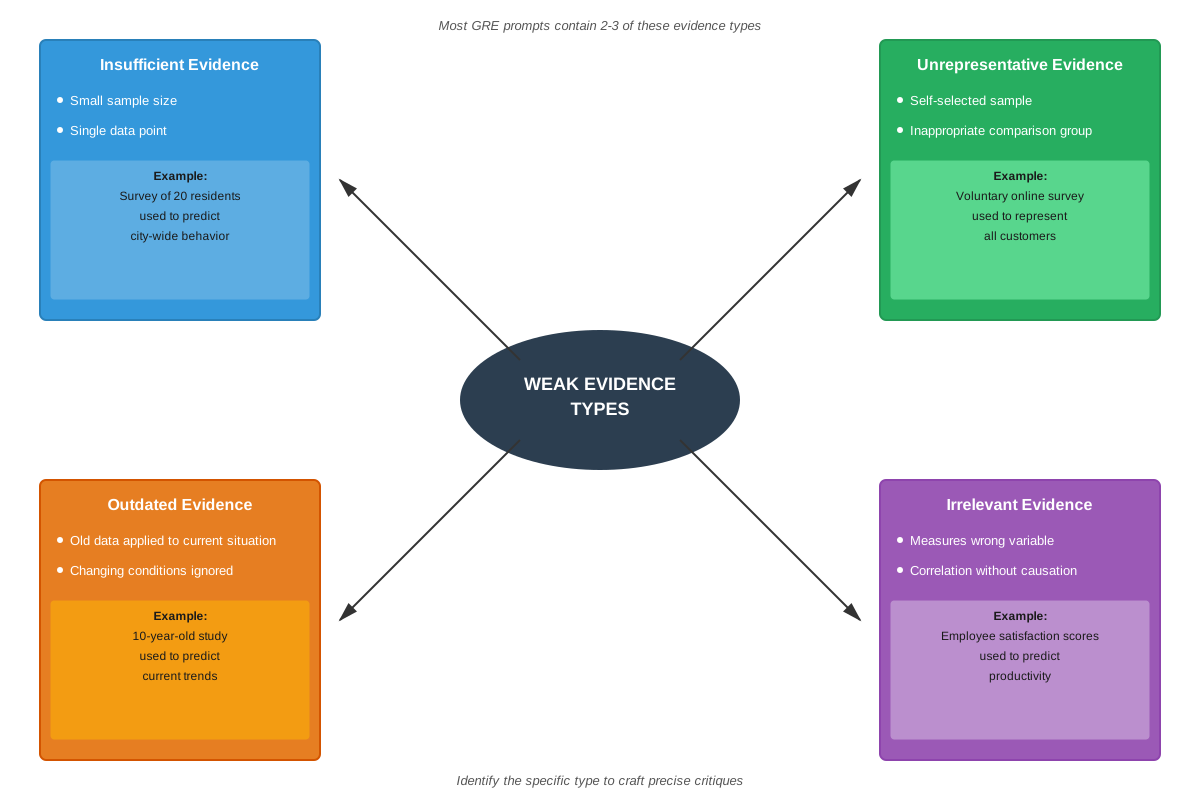
- [ ] Distinguish between different types of weak evidence (insufficient, unrepresentative, outdated, irrelevant)
- [ ] Generate specific alternative explanations that expose why evidence is weak
- [ ] Articulate what additional evidence would be needed to strengthen an argument
- [ ] Integrate weak evidence critique into a well-organized, coherent essay response
Prerequisites
- Basic argument structure: Understanding premises, conclusions, and how evidence functions to support claims is essential because weak evidence analysis requires identifying what role each piece of information plays in the argument
- Logical reasoning fundamentals: Familiarity with cause-and-effect relationships and correlation versus causation helps recognize when evidence fails to establish the claimed connections
- GRE Argument Essay format: Knowledge of the essay task requirements ensures that weak evidence critique is presented in the appropriate analytical framework expected by graders
Why This Topic Matters
Weak evidence appears in approximately 85-90% of all GRE Argument Essay prompts, making it the single most important analytical skill for this section. The Educational Testing Service (ETS) deliberately constructs arguments that rely on questionable surveys, small sample sizes, outdated information, or irrelevant comparisons. Students who can systematically identify and explain these evidentiary weaknesses typically score in the 5-6 range (out of 6), while those who miss these issues or provide only superficial critique rarely exceed a score of 4.
In real-world applications, the ability to evaluate evidence quality is crucial for academic research, where distinguishing between robust and weak studies determines the validity of conclusions. Business professionals must assess market research data, financial projections, and competitive intelligence—all of which can suffer from the same evidentiary weaknesses tested on the GRE. Legal reasoning, medical decision-making, and policy analysis all depend on rigorous evidence evaluation.
On the exam, weak evidence typically appears in several common forms: arguments citing surveys without methodological details, claims based on a single example or case study, conclusions drawn from outdated data, comparisons between dissimilar groups, or causal claims supported only by correlational evidence. Recognizing these patterns allows test-takers to quickly identify vulnerabilities and structure their essays around the most significant weaknesses.
Core Concepts
Definition of Weak Evidence
Weak evidence refers to any information presented in support of a conclusion that is insufficient, inappropriate, or inadequate to justify that conclusion. Evidence can be weak for multiple reasons: it may be too limited in scope, unrepresentative of the relevant population, outdated, irrelevant to the specific claim, or ambiguous in its implications. The key principle is that even if the evidence is factually accurate, it may still be weak if it fails to provide adequate support for the specific conclusion being drawn.
The GRE tests this concept by presenting arguments where the evidence-to-conclusion gap is substantial but not immediately obvious. Test-takers must analyze whether the evidence, even if true, actually supports the inference the author makes. This requires distinguishing between what the evidence demonstrates and what the argument claims it demonstrates.
Types of Weak Evidence
Insufficient Sample Size
Arguments often rely on evidence from too few cases to support broad generalizations. For example, an argument might conclude that "all residents prefer the new park design" based on interviews with only five people. The sample is too small to represent the diverse opinions of an entire community. On the GRE, this frequently appears as conclusions about entire populations drawn from limited surveys or a handful of examples.
Unrepresentative Samples
Even when sample sizes seem adequate, the sample may not represent the relevant population. An argument claiming that "students at University X prefer online learning" based on a survey of only computer science majors would suffer from this weakness—computer science students may have different preferences than humanities or science majors. The evidence comes from a biased subset that doesn't reflect the diversity of the whole group.
Outdated Evidence
Arguments sometimes rely on data that is too old to support current conclusions. An argument about current consumer preferences based on a survey from ten years ago would be weak because preferences, technology, and market conditions change over time. The GRE frequently includes arguments citing studies or data from several years prior without acknowledging that circumstances may have changed.
Irrelevant Evidence
Evidence can be factually accurate but simply not relevant to the conclusion. An argument claiming that "Restaurant Y will be profitable" supported by evidence that "the owner has 20 years of experience" contains irrelevant evidence—experience doesn't directly predict profitability without information about location, competition, menu pricing, and market demand.
Vague or Ambiguous Evidence
Arguments may cite evidence without sufficient specificity to evaluate its strength. Phrases like "a recent survey," "many residents," or "experts agree" provide no concrete information about methodology, sample size, or the actual proportion of people involved. This vagueness prevents proper evaluation and often masks serious weaknesses.
The Evidence-Conclusion Gap
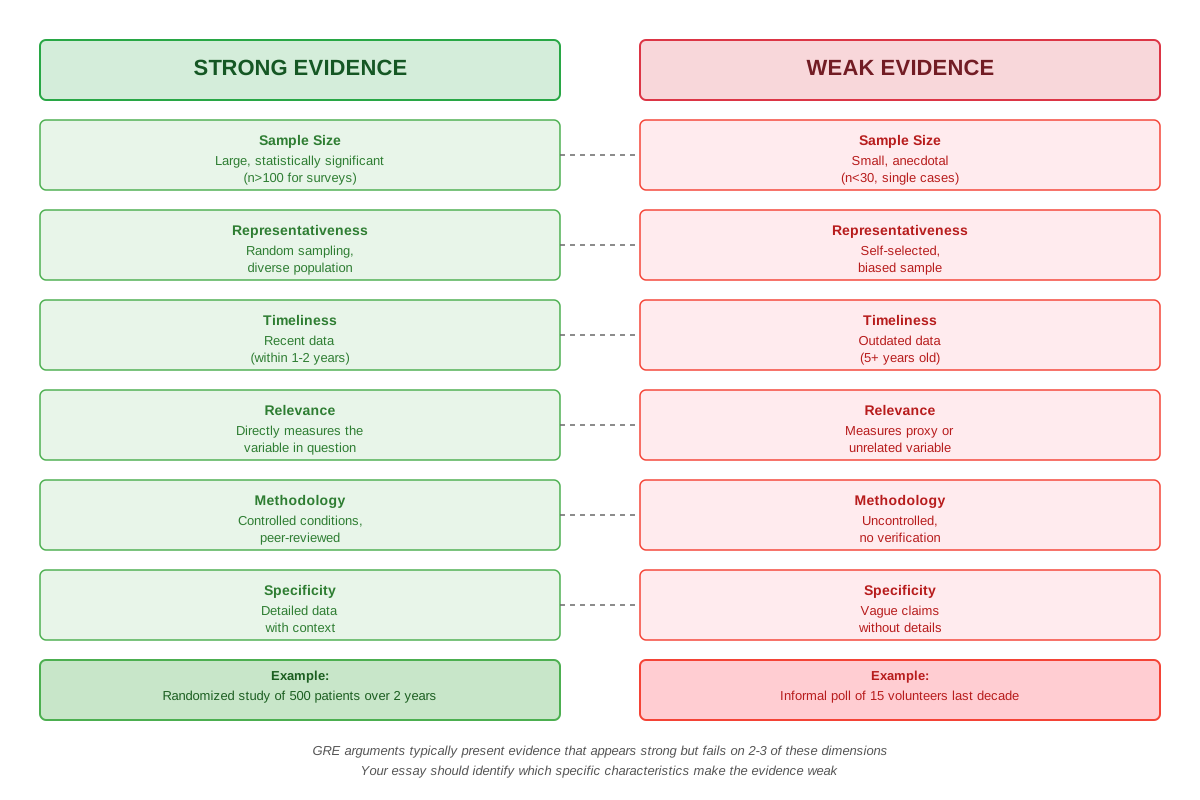
The fundamental issue with weak evidence is the evidence-conclusion gap—the logical distance between what the evidence actually demonstrates and what the argument claims it proves. Strong arguments minimize this gap by providing evidence that directly, specifically, and sufficiently supports each claim. Weak arguments leave large gaps that require multiple unstated assumptions to bridge.
| Strong Evidence | Weak Evidence |
|---|---|
| Representative sample of relevant population | Small or biased sample |
| Recent, current data | Outdated information |
| Directly relevant to specific claim | Tangentially related or irrelevant |
| Specific, verifiable details | Vague, ambiguous references |
| Multiple independent sources | Single source or anecdote |
| Appropriate methodology disclosed | No methodological information |
Identifying Weak Evidence in GRE Prompts
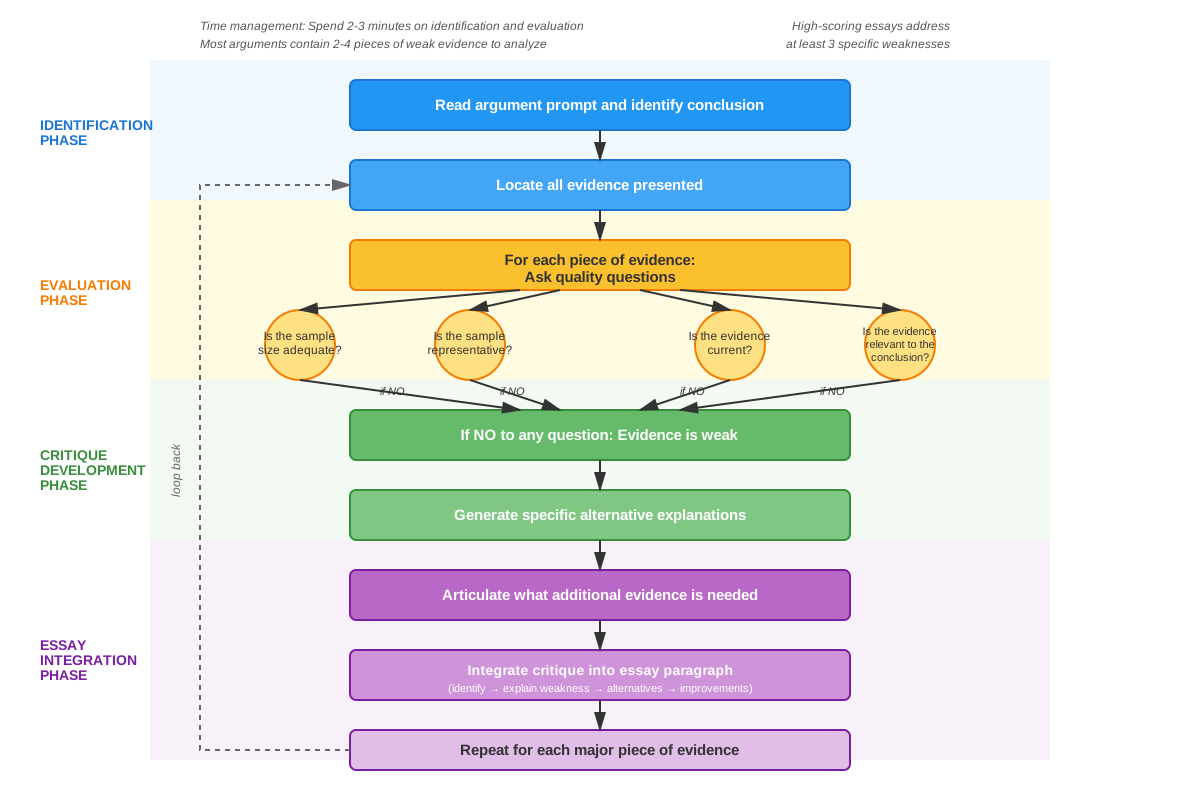
To systematically identify weak evidence, apply this analytical framework:
- Identify each piece of evidence presented in the argument
- Determine what conclusion that evidence is meant to support
- Ask critical questions: Is the evidence sufficient? Representative? Current? Relevant? Specific?
- Consider alternative explanations for the evidence that would undermine the conclusion
- Articulate what additional evidence would be needed to strengthen the argument
This process transforms vague feelings that "something seems wrong" into specific, articulated critiques that demonstrate sophisticated analytical thinking—exactly what GRE graders reward.
Common Evidence Weaknesses in GRE Arguments
Survey-based evidence frequently appears with undisclosed methodology, response rates, or question wording. An argument might cite "a survey showing 70% support" without revealing whether the survey had a 10% response rate (suggesting non-response bias) or used leading questions.
Analogical evidence compares two situations and assumes what worked in one will work in another. These comparisons often ignore crucial differences. An argument claiming "City A's parking policy will work in City B" may overlook differences in population density, public transportation availability, or commuting patterns.
Causal evidence often confuses correlation with causation. An argument noting that "ice cream sales and drowning rates both increase in summer" and concluding that "ice cream causes drowning" illustrates this weakness—both are caused by a third factor (warm weather) rather than one causing the other.
Temporal evidence assumes that because one event preceded another, it caused it (post hoc fallacy). An argument claiming "crime decreased after the new mayor took office, therefore the mayor's policies reduced crime" ignores other potential causes like economic changes or demographic shifts.
Concept Relationships
Weak evidence connects directly to assumptions because insufficient evidence requires assuming that the limited information provided is representative, current, and relevant. When evidence is weak, the argument must assume more to bridge the gap between evidence and conclusion. For example, if an argument cites a survey of 50 people to make claims about 50,000, it assumes those 50 are perfectly representative—a significant unstated assumption.
The relationship flows as follows: Weak Evidence → Creates Larger Assumptions → Enables Alternative Explanations → Suggests Needed Additional Evidence. Each weakness in evidence opens multiple alternative explanations for the data. If a survey has a low response rate, perhaps only those with extreme opinions responded. If data is outdated, perhaps conditions have changed. These alternatives directly undermine the argument's conclusion.
Weak evidence also relates to scope problems in arguments. When evidence is drawn from a narrow context but conclusions are applied broadly, both a scope error and an evidence weakness exist. An argument using data from one demographic group to make claims about all demographics suffers from both unrepresentative evidence and inappropriate scope expansion.
Understanding weak evidence enables recognition of what would strengthen an argument—a component of high-scoring essays. If evidence is weak because of small sample size, the essay can suggest "a larger, more comprehensive survey." If evidence is outdated, recommend "current data from the past year." This demonstrates not just critical thinking but constructive analytical ability.
High-Yield Facts
⭐ Weak evidence appears in approximately 85-90% of GRE Argument Essay prompts, making it the most frequently tested logical flaw
⭐ Survey evidence without disclosed methodology, sample size, or response rate should always be questioned
⭐ Evidence from one group, time period, or location cannot automatically support conclusions about different groups, times, or locations
⭐ Correlation does not establish causation—evidence showing two things occur together does not prove one causes the other
⭐ Vague quantifiers like "many," "several," or "numerous" often mask insufficient evidence
- Evidence that is factually true can still be weak if it doesn't adequately support the specific conclusion drawn
- Outdated evidence (typically more than 2-3 years old for business/social claims) may not reflect current conditions
- A single example or case study cannot support broad generalizations about entire populations
- Evidence about one aspect of a situation (e.g., popularity) doesn't necessarily support conclusions about different aspects (e.g., profitability)
- The absence of evidence against a claim is not the same as evidence supporting the claim
- Expert opinion without disclosed credentials, methodology, or consensus among experts is weak evidence
- Evidence that something happened after an intervention doesn't prove the intervention caused it without ruling out alternative explanations
Quick check — test yourself on Weak evidence so far.
Try Flashcards →Common Misconceptions
Misconception: If evidence is factually accurate, it cannot be weak → Correction: Evidence can be completely true but still insufficient, unrepresentative, or irrelevant to the conclusion. A survey of five people might accurately report those five opinions but still be too small to support claims about thousands.
Misconception: Pointing out that evidence is "weak" or "insufficient" is enough for a high-scoring essay → Correction: High-scoring essays must specifically explain WHY evidence is weak, what alternative explanations exist, and what additional evidence would strengthen the argument. Generic statements about weakness demonstrate limited analytical depth.
Misconception: All survey evidence is automatically weak → Correction: Surveys can provide strong evidence if they use representative samples, appropriate methodology, adequate sample sizes, and high response rates. The task is to identify when specific surveys lack these qualities, not to dismiss all survey evidence categorically.
Misconception: Weak evidence means the conclusion is definitely false → Correction: Weak evidence means the conclusion is not adequately supported by the information provided. The conclusion might still be true, but the argument fails to prove it. The GRE tests argument evaluation, not truth determination.
Misconception: Longer essays that mention many types of weak evidence always score higher → Correction: Quality matters more than quantity. A focused essay that thoroughly analyzes 2-3 major evidence weaknesses with specific examples and alternative explanations will outscore a superficial essay that lists many weaknesses without depth.
Misconception: Evidence from experts or authorities cannot be questioned → Correction: Expert evidence can be weak if the experts' credentials are unclear, if there's no consensus among experts, if the expertise doesn't match the specific claim, or if the expert opinion is outdated or based on limited information.
Worked Examples
Example 1: Restaurant Profitability Argument
Prompt: "The following appeared in a business magazine: 'A recent survey of 50 customers at Pasta Palace found that 80% rated their meals as excellent. Additionally, the restaurant's owner has 15 years of experience in the food industry. Therefore, investors should expect Pasta Palace to be highly profitable in the coming year.'"
Analysis:
Step 1 - Identify the evidence: (1) Survey of 50 customers showing 80% rated meals as excellent; (2) Owner has 15 years of experience
Step 2 - Identify the conclusion: Pasta Palace will be highly profitable in the coming year
Step 3 - Evaluate evidence strength:
The survey evidence is weak for several reasons. First, 50 customers represents a very small sample that may not be representative of the broader customer base or potential customers. We don't know how these 50 were selected—they might be regular customers who already love the restaurant, creating selection bias. Second, the survey measures meal quality, not profitability factors. Even if meals are excellent, the restaurant could be unprofitable due to high costs, poor location, inadequate marketing, or excessive competition. Third, we lack crucial survey details: When was it conducted? What was the response rate? How were questions worded?
The owner's experience is largely irrelevant evidence. While experience might contribute to quality, it doesn't directly predict profitability. An experienced owner could still face market conditions, financial challenges, or location problems that prevent profitability. This evidence doesn't address pricing strategy, cost management, market demand, or competitive positioning—all crucial to profitability.
Step 4 - Alternative explanations: The 80% satisfaction rating might come from a small group of loyal regulars who don't represent typical customers. The restaurant might be losing money despite quality meals due to high rent, expensive ingredients, or low customer volume. The owner's experience might be in a different type of restaurant or market.
Step 5 - Needed additional evidence: To strengthen this argument, we would need: financial data showing revenue, costs, and profit margins; market research on customer demand and competition; information about location, pricing, and customer volume; details about the survey methodology and representativeness; evidence that the owner's specific experience relates to this type of restaurant and market.
Example 2: City Traffic Reduction Argument
Prompt: "Five years ago, City A implemented a congestion pricing policy charging drivers to enter downtown during peak hours. Since then, traffic has decreased by 15%. City B should implement the same policy to reduce its traffic problems."
Analysis:
Step 1 - Identify the evidence: City A implemented congestion pricing five years ago and experienced a 15% traffic decrease
Step 2 - Identify the conclusion: City B should implement the same policy and expect similar results
Step 3 - Evaluate evidence strength:
This argument relies on analogical evidence that is weak because it assumes City A and City B are sufficiently similar. The evidence doesn't establish that the cities share relevant characteristics: population size, public transportation availability, commuting patterns, economic conditions, or geographic layout. City A might have extensive subway systems making it easy for drivers to switch to transit, while City B might lack alternatives. The cities might have different proportions of commuters versus local traffic.
The temporal evidence is also weak. The argument assumes the congestion pricing caused the 15% reduction, but this is a post hoc reasoning error. The traffic decrease might result from other factors: economic recession reducing commuting, increased remote work, new public transportation options, population shifts to suburbs, or road construction forcing route changes. Without controlling for these alternative explanations, we cannot attribute the decrease to the pricing policy.
Additionally, the evidence is five years old. Current conditions in City A might be different—traffic might have returned to previous levels, or new factors might have emerged. Using five-year-old data to predict current policy outcomes is questionable.
Step 4 - Alternative explanations: City A's traffic might have decreased due to economic downturn, new transit options, demographic changes, or multiple factors unrelated to pricing. City B might lack the characteristics that made the policy work in City A.
Step 5 - Needed additional evidence: To strengthen this argument, we would need: detailed comparison of relevant characteristics between City A and City B (public transit, commuting patterns, geography); evidence that the pricing policy specifically caused the traffic reduction in City A, not other factors; current data on City A's traffic patterns; information about whether City B residents have viable alternatives to driving; studies of congestion pricing outcomes in multiple cities with varying characteristics.
Exam Strategy
When approaching GRE Argument Essay prompts, use this systematic process to identify and analyze weak evidence:
Trigger words and phrases that signal potential evidence weaknesses include:
- "A recent survey" (without specific details)
- "Many people," "several residents," "numerous customers" (vague quantifiers)
- "A study showed" (without methodology or source)
- "Five years ago," "in the past" (potentially outdated)
- "Similarly," "likewise," "just as" (analogical reasoning that may ignore differences)
- "After implementing X, Y occurred" (potential post hoc reasoning)
- "Experts believe," "it is widely known" (appeal to authority without specifics)
Time allocation strategy: Spend 2-3 minutes in your initial reading specifically identifying each piece of evidence and asking: "Is this sufficient? Representative? Current? Relevant? Specific?" This upfront investment prevents vague, generic critique and enables focused, specific analysis.
Process-of-elimination for evidence evaluation: For each piece of evidence, systematically ask:
- Sufficiency: Is there enough evidence? (Sample size, number of examples)
- Representativeness: Does the evidence represent the relevant population?
- Currency: Is the evidence current enough for the conclusion?
- Relevance: Does this evidence actually relate to this specific conclusion?
- Specificity: Are concrete details provided, or is the evidence vague?
Exam Tip: Don't just identify that evidence is weak—explain the specific consequences. "The survey of 50 people is too small" is weaker than "The survey of only 50 people may not represent the diverse opinions of the city's 50,000 residents, particularly if those 50 were not randomly selected or if certain demographic groups were underrepresented."
Paragraph organization strategy: Dedicate one body paragraph to each major evidence weakness. Within each paragraph: (1) identify the specific evidence, (2) explain why it's weak, (3) provide alternative explanations, (4) suggest what additional evidence would help. This structure demonstrates thorough, organized analytical thinking.
Balance depth and breadth: Better to thoroughly analyze 2-3 major evidence weaknesses than superficially mention 5-6. Graders reward depth of analysis over quantity of points.
Memory Techniques
SIRRS Mnemonic for evaluating evidence quality:
- Sufficient: Is there enough evidence?
- Independent: Is evidence from multiple sources or just one?
- Representative: Does the sample represent the relevant population?
- Relevant: Does this evidence actually support this specific conclusion?
- Specific: Are concrete details provided, or is it vague?
The "So What?" Test: After identifying evidence, ask "So what? Does this actually prove the conclusion?" This simple question reveals evidence-conclusion gaps.
Visualization Strategy: Picture the evidence as a bridge between premises and conclusion. Weak evidence creates a rickety bridge with missing planks—visualize the gaps where assumptions must fill in. This makes abstract logical weaknesses concrete and memorable.
The Three Ts for temporal evidence evaluation:
- Timing: When was the evidence collected?
- Trends: Have conditions changed since then?
- Transferability: Can old evidence support current conclusions?
CAVE Acronym for common weak evidence patterns:
- Correlation assumed to be causation
- Analogies between dissimilar situations
- Vague quantifiers and ambiguous references
- Extrapolation from small or biased samples
Summary
Weak evidence represents the most frequently tested analytical skill in the GRE Argument Essay, appearing in nearly 90% of prompts. Evidence is weak when it is insufficient, unrepresentative, outdated, irrelevant, or vague—failing to adequately support the conclusion drawn from it. Success on this topic requires moving beyond generic statements that evidence is "weak" to specific analysis of why particular evidence fails to support particular conclusions. The key analytical framework involves identifying each piece of evidence, determining what conclusion it supposedly supports, evaluating its sufficiency and relevance, generating alternative explanations that undermine the evidence-conclusion link, and articulating what additional evidence would strengthen the argument. High-scoring essays demonstrate this systematic approach through focused body paragraphs that thoroughly analyze major evidence weaknesses rather than superficially listing many flaws. Understanding weak evidence also reveals the assumptions arguments make and the alternative explanations that exist—interconnected concepts that together form the foundation of strong GRE Argument Essay performance.
Key Takeaways
- Weak evidence is the most frequently tested flaw in GRE Argument Essays, appearing in approximately 85-90% of prompts
- Evidence can be factually true but still weak if it's insufficient, unrepresentative, outdated, irrelevant, or vague relative to the conclusion
- High-scoring essays specifically explain WHY evidence is weak and WHAT consequences this weakness has for the argument
- The SIRRS framework (Sufficient, Independent, Representative, Relevant, Specific) provides a systematic method for evaluating evidence quality
- Survey evidence without disclosed methodology, sample size, and response rate should always be questioned
- Analogical evidence comparing different situations often ignores crucial differences that undermine the comparison
- Alternative explanations that account for the evidence without supporting the conclusion demonstrate sophisticated analytical thinking
Related Topics
Assumptions in Arguments: Understanding weak evidence naturally leads to identifying the unstated assumptions that arguments make to bridge evidence-conclusion gaps. When evidence is weak, arguments must assume more to reach their conclusions.
Alternative Explanations: Weak evidence enables multiple alternative explanations for the data presented. Mastering evidence evaluation enhances the ability to generate compelling alternatives that undermine arguments.
Causal Reasoning: Many instances of weak evidence involve causal claims supported only by correlational data. Deeper study of causal reasoning builds on evidence evaluation skills.
Survey and Statistical Reasoning: Understanding survey methodology, sampling techniques, and statistical concepts strengthens the ability to evaluate survey-based evidence—one of the most common evidence types on the GRE.
Argument Structure and Scope: Weak evidence often relates to scope problems where evidence from narrow contexts supports broad conclusions. These topics interconnect to form comprehensive argument analysis skills.
Practice CTA
Now that you understand how to identify and analyze weak evidence, it's time to apply these skills to actual GRE-style prompts. The practice questions and flashcards will help you recognize evidence weaknesses quickly and articulate specific, sophisticated critiques. Remember: the difference between a score of 4 and a score of 6 often comes down to the specificity and depth of your evidence analysis. Each practice attempt strengthens your analytical instincts and builds the systematic approach that leads to consistent high performance. Start practicing now to transform these concepts into automatic skills you can deploy under timed conditions!
Sign up free to keep reading
Create a free AnvayaPrep account to finish this GRE guide on Weak evidence — plus flashcards and practice questions.