Overview
The missing information concept is one of the most critical analytical skills tested in the GRE Analytical Writing section, particularly in the Argument Essay (legacy format). When evaluating an argument, test-takers must identify gaps in reasoning where crucial data, evidence, or context has been omitted. These gaps prevent readers from fully assessing whether the argument's conclusion logically follows from its premises. The ability to spot gre missing information demonstrates sophisticated critical thinking—a core competency that graduate programs value highly.
Understanding missing information goes beyond simply finding flaws in an argument. It requires recognizing what additional evidence would be necessary to strengthen or weaken the author's position. On the GRE, arguments are deliberately constructed with informational gaps that create logical vulnerabilities. Students who master this skill can systematically analyze any argument by asking: "What essential facts or data would I need to know before accepting this conclusion?" This analytical framework applies not only to standardized testing but also to academic research, professional decision-making, and everyday reasoning.
The missing information concept connects intimately with other Analytical Writing skills, including assumption identification, evidence evaluation, and alternative explanation consideration. While assumptions represent unstated beliefs that bridge premises to conclusions, missing information refers to concrete facts, data, or context that—if provided—would allow for more accurate assessment of the argument's validity. Together, these analytical tools form the foundation of effective argument critique, which is precisely what the GRE Argument Essay demands.
Learning Objectives
- [ ] Identify when Missing information is being tested in GRE Argument Essay prompts
- [ ] Explain the core rule or strategy behind Missing information analysis
- [ ] Apply Missing information identification to GRE-style questions accurately
- [ ] Distinguish between missing information and unstated assumptions in arguments
- [ ] Generate specific questions that would reveal missing information in a given argument
- [ ] Evaluate how different types of missing information affect argument strength
- [ ] Construct well-organized essay paragraphs that address missing information systematically
Prerequisites
- Basic argument structure: Understanding premises, conclusions, and how claims connect is essential because missing information analysis requires identifying where logical gaps exist between these components.
- Evidence types: Familiarity with statistical data, anecdotal evidence, expert testimony, and causal claims helps recognize what kinds of information might be absent.
- Logical reasoning fundamentals: Basic knowledge of valid and invalid reasoning patterns enables students to spot where additional information would clarify logical relationships.
Why This Topic Matters
Missing information analysis represents approximately 40-50% of the analytical work required in a high-scoring GRE Argument Essay. Every argument prompt contains multiple informational gaps by design, and identifying these gaps demonstrates the critical thinking skills that graduate programs seek in candidates. Students who excel at spotting missing information typically score in the 5.0-6.0 range on the Analytical Writing section, while those who overlook these gaps rarely exceed 4.0.
In real-world applications, the ability to identify missing information proves invaluable across disciplines. Medical professionals must recognize when patient histories lack crucial details before making diagnoses. Business analysts must identify absent market data before recommending strategies. Researchers must acknowledge limitations in their datasets. Legal professionals must recognize when cases lack supporting evidence. The GRE tests this skill because graduate-level work demands it constantly.
On the exam, missing information appears in every Argument Essay prompt through various manifestations: surveys without demographic details, comparisons lacking baseline data, causal claims without consideration of alternative factors, recommendations based on incomplete cost-benefit analyses, and projections that ignore relevant trends. Recognizing these patterns allows test-takers to systematically deconstruct any argument they encounter.
Core Concepts
Definition of Missing Information
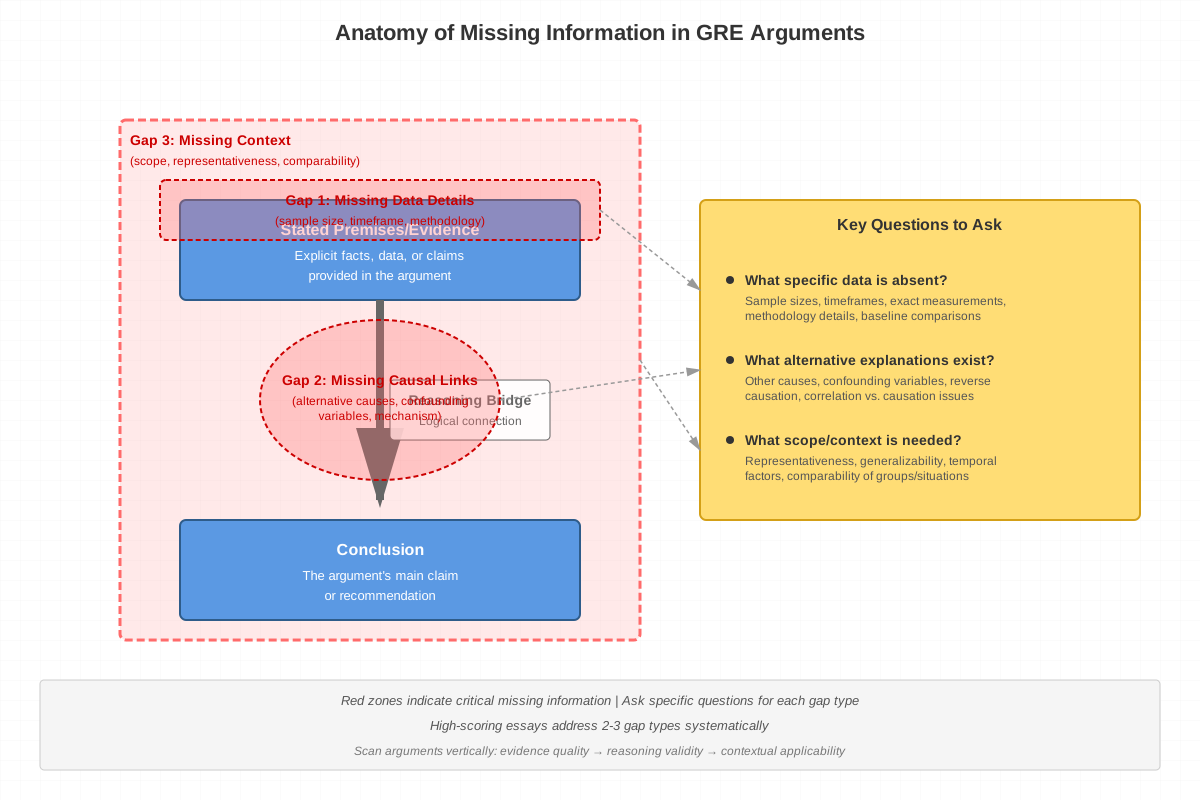
Missing information refers to specific facts, data, context, or evidence that an argument fails to provide but that would be necessary to properly evaluate the argument's logical strength. Unlike assumptions (which are unstated beliefs), missing information consists of concrete, verifiable details that could theoretically be obtained through research, observation, or investigation. When information is missing, readers cannot determine whether the argument's reasoning is sound because critical pieces of the evidentiary puzzle remain absent.
For example, if an argument claims "Restaurant revenues increased 20% after implementing a new menu," the missing information might include: the time period measured, whether the increase exceeded industry trends, whether costs also increased, and whether the increase was sustained or temporary. Each piece of missing information represents a question that must be answered before the argument's strength can be assessed.
Types of Missing Information
Different categories of missing information appear regularly on the GRE, and recognizing these patterns accelerates analysis:
| Type | Description | Example Question to Ask |
|---|---|---|
| Quantitative Details | Specific numbers, percentages, or measurements | What were the actual sample sizes? What percentage responded? |
| Temporal Information | Time frames, durations, or chronological context | Over what period was this measured? When did this occur? |
| Comparative Baselines | Reference points for comparison | Compared to what? What was the previous rate? |
| Demographic Data | Characteristics of populations studied | Who exactly was surveyed? Are they representative? |
| Alternative Factors | Other variables that might explain results | What else changed during this period? |
| Implementation Details | How plans would actually be executed | What are the specific costs? What resources are required? |
| Scope and Scale | Extent or magnitude of phenomena | How widespread is this? Does it apply to all cases? |
The Missing Information Framework
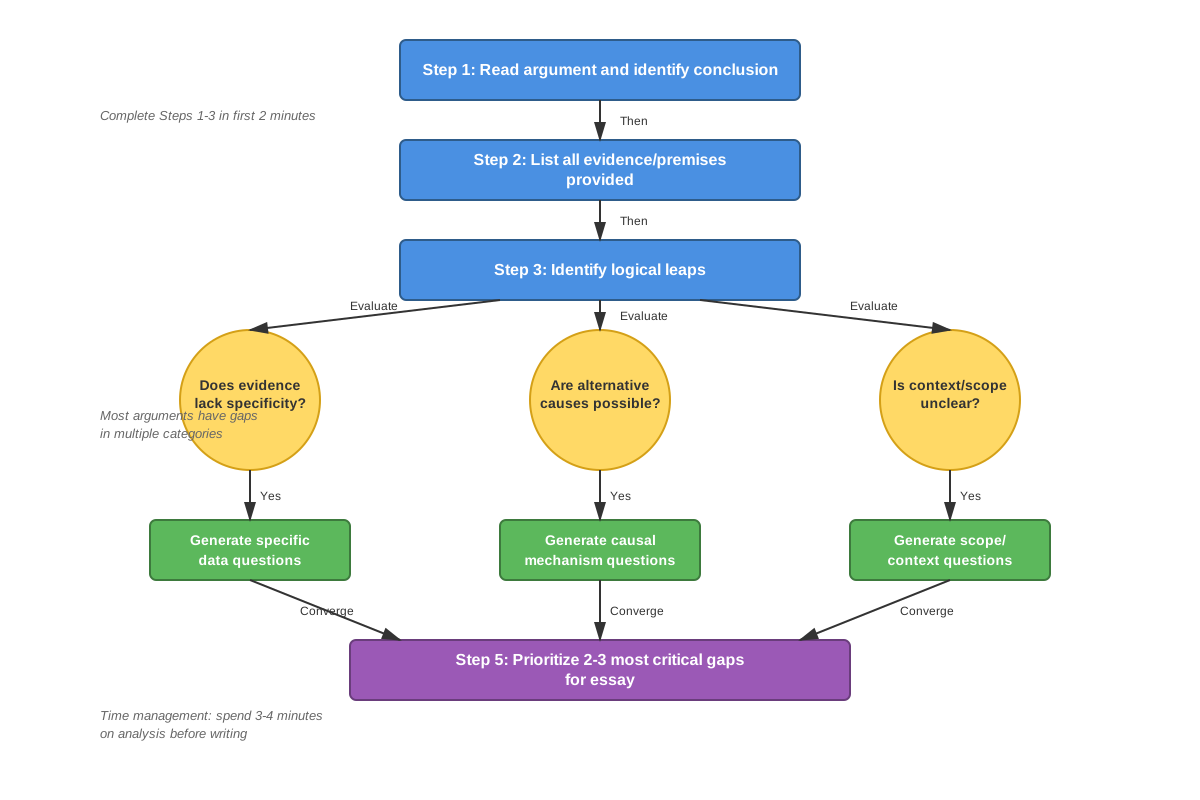
To systematically identify missing information in any GRE argument, apply this four-step framework:
- Identify the conclusion: Determine exactly what the argument is trying to prove or recommend.
- Map the evidence: List each piece of evidence or reasoning the argument provides to support its conclusion.
- Question each connection: For every piece of evidence, ask "What additional information would I need to know to determine if this evidence actually supports the conclusion?"
- Prioritize gaps: Focus on the most significant missing information—details that would most dramatically affect the argument's validity if revealed.
This framework transforms missing information analysis from an intuitive skill into a systematic process that can be applied consistently under time pressure.
Missing Information vs. Assumptions
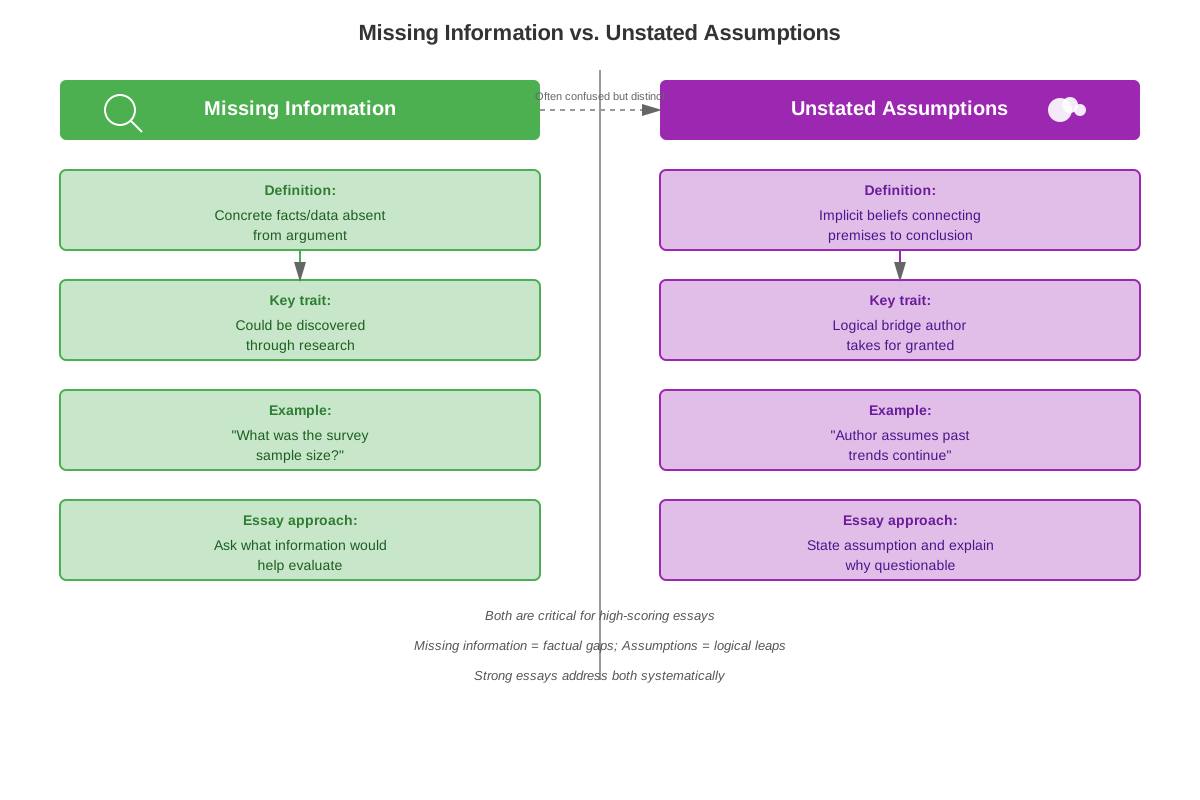
A crucial distinction exists between missing information and assumptions, though they often work together in arguments. Assumptions are unstated beliefs or premises that the argument takes for granted—they represent logical leaps the author makes without explicit justification. Missing information, by contrast, consists of concrete facts or data that are absent but could be provided.
Consider this argument: "Because City A has more police officers per capita than City B, City A must be safer." The assumption here is that more police officers cause lower crime rates. The missing information includes: actual crime statistics for both cities, whether the police forces are equally effective, what other safety factors exist, and whether the cities are otherwise comparable. The assumption represents a logical belief; the missing information represents concrete data that could verify or refute that belief.
Strategic Questions for Revealing Missing Information
Effective missing information analysis relies on asking targeted questions. These question types consistently reveal informational gaps:
- Representativeness questions: "Is this sample/case typical of the larger population?"
- Causation questions: "What other factors might explain this correlation?"
- Comparison questions: "What is the relevant baseline or control group?"
- Implementation questions: "What are the practical costs, risks, or obstacles?"
- Temporal questions: "Has this pattern been consistent over time?"
- Scope questions: "Does this apply to all relevant cases or only some?"
Each question type targets a specific category of information that arguments frequently omit, allowing for comprehensive analysis even under exam time constraints.
Concept Relationships
Missing information analysis connects directly to assumption identification because assumptions often arise precisely where information is missing. When an argument lacks data about alternative explanations, it must assume no significant alternatives exist. When an argument omits cost information, it assumes costs are manageable. The relationship flows: Missing Information → Creates Need for → Assumptions → Which May Be → Unwarranted.
The concept also relates to evidence evaluation, as missing information determines whether provided evidence is sufficient. Provided Evidence + Missing Information = Complete Picture. Without identifying what's missing, students cannot accurately assess what's present.
Furthermore, missing information analysis enables alternative explanation consideration. When temporal information is missing, alternative timelines become possible. When demographic data is absent, alternative population characteristics become plausible. The relationship: Missing Information → Allows for → Alternative Explanations → Which Weaken → Original Argument.
Finally, missing information directly supports the construction of essay body paragraphs. Each significant piece of missing information can anchor a paragraph that explains: (1) what information is absent, (2) why it matters, and (3) how different answers would affect the argument's strength. This creates the structure: Missing Information → Generates → Essay Organization → Leading to → Higher Scores.
High-Yield Facts
⭐ Every GRE Argument Essay prompt contains multiple pieces of missing information by design—identifying 3-5 significant gaps is typically sufficient for a high-scoring essay.
⭐ Missing information differs from assumptions: missing information consists of concrete, verifiable facts that are absent, while assumptions are unstated beliefs the argument takes for granted.
⭐ The most common types of missing information on the GRE include: survey details (response rates, sample representativeness), temporal context (time frames, trend duration), and comparative baselines (control groups, previous rates).
⭐ Effective missing information analysis asks "What would I need to know to evaluate this claim?" rather than simply stating "This argument lacks information."
⭐ Missing information about alternative explanations appears in virtually every GRE argument—authors consistently fail to address other factors that might explain observed correlations.
- Arguments that recommend actions almost always omit implementation details such as costs, resources required, potential obstacles, and unintended consequences.
- When arguments cite surveys or studies, they typically omit crucial methodological details: sample size, selection methods, response rates, question wording, and demographic characteristics.
- Temporal missing information includes not just time frames but also whether patterns are consistent, whether they represent long-term trends, and whether they account for seasonal variations.
- Arguments comparing two entities (cities, companies, time periods) routinely omit information about relevant differences that might explain observed disparities.
- Missing information about scope and scale—whether findings apply broadly or only to specific cases—appears frequently in generalization-based arguments.
- Causal arguments consistently omit information about confounding variables, reverse causation possibilities, and the strength of observed correlations.
Quick check — test yourself on Missing information so far.
Try Flashcards →Common Misconceptions
Misconception: Missing information means the argument is automatically wrong or invalid. → Correction: Missing information means the argument cannot be properly evaluated yet. The absent information might strengthen or weaken the argument depending on what it reveals. The point is that judgment must be suspended until the information is provided.
Misconception: Any information not mentioned in the argument counts as "missing information." → Correction: Only information that is relevant to evaluating the argument's logical strength qualifies as significant missing information. Tangential or peripheral details that wouldn't affect the conclusion's validity should not be the focus of analysis.
Misconception: Identifying missing information means simply listing what the argument doesn't mention. → Correction: Effective missing information analysis explains why each absent piece of information matters and how different possible answers would affect the argument's strength. The analysis must connect the gap to the argument's logical validity.
Misconception: Missing information and assumptions are the same thing. → Correction: Assumptions are unstated beliefs or logical leaps the argument makes, while missing information consists of concrete facts or data that are absent. An argument might assume that a correlation implies causation (assumption) while failing to provide information about alternative causal factors (missing information).
Misconception: More missing information identified always means a better essay. → Correction: Quality matters more than quantity. Thoroughly analyzing 3-4 significant pieces of missing information produces stronger essays than superficially mentioning 8-10 gaps. Depth of analysis trumps breadth of coverage.
Worked Examples
Example 1: Restaurant Revenue Argument
Argument: "The Riverside Restaurant should adopt the same menu changes that the Downtown Diner implemented last year. After the Downtown Diner introduced healthier options and reduced portion sizes, their revenues increased by 15%. Riverside Restaurant would likely see similar financial benefits from these changes."
Analysis Process:
Step 1 - Identify Conclusion: Riverside Restaurant should make the same menu changes as Downtown Diner.
Step 2 - Map Evidence: Downtown Diner made menu changes (healthier options, smaller portions) and saw 15% revenue increase.
Step 3 - Question Each Connection:
Missing Information #1: What was the time frame for this 15% increase? If the increase occurred over five years, it might reflect general market growth rather than menu changes. If it occurred in one month, it might be a temporary spike. Without temporal context, we cannot assess whether the increase is meaningful or sustainable.
Missing Information #2: How did Downtown Diner's revenue increase compare to industry trends? If all restaurants in the area saw 20% increases due to economic growth or population increases, then Downtown Diner's 15% increase actually represents underperformance. We need comparative baseline data to evaluate whether the menu changes were beneficial or detrimental.
Missing Information #3: Are the two restaurants comparable in relevant ways? Information about their locations, customer demographics, existing menus, price points, and competitive environments is missing. If Riverside serves a different clientele or operates in a different market context, the same changes might produce different results.
Missing Information #4: What were the costs of implementing these changes? Revenue increases don't necessarily translate to profit increases. If the healthier ingredients cost significantly more, or if the smaller portions required expensive menu redesigns and staff retraining, the net financial impact might be negative despite revenue growth.
Step 4 - Prioritize: The most critical missing information is the comparative baseline (#2) and restaurant comparability (#3), as these most directly affect whether the evidence supports the conclusion.
Example 2: Employee Productivity Argument
Argument: "To increase productivity, Acme Corporation should allow employees to work from home two days per week. A recent survey found that 78% of employees believe they would be more productive working from home. Additionally, companies that have implemented remote work policies report higher employee satisfaction scores."
Analysis Process:
Missing Information #1: What was the survey methodology? We don't know the sample size, response rate, how questions were worded, or whether respondents were representative of all Acme employees. If only 50 employees out of 500 responded, or if the question was leading, the 78% figure might not reflect actual employee sentiment.
Missing Information #2: Does employee belief about productivity match actual productivity? The survey measures what employees think would happen, not what actually happens. We need information about actual productivity measurements (output, quality, efficiency) from companies that implemented remote work, not just employee perceptions.
Missing Information #3: Which companies implemented remote work, and are they comparable to Acme? The argument mentions "companies" generically without specifying their industries, sizes, or types of work. Remote work might increase productivity for software developers but decrease it for collaborative design teams. Without information about comparability, we cannot assess relevance.
Missing Information #4: What is the relationship between satisfaction and productivity? The argument shifts from productivity (the stated goal) to satisfaction (the provided evidence). We need information about whether higher satisfaction actually correlates with higher productivity, or whether these are independent variables.
Missing Information #5: What are the potential costs and challenges of implementation? Information about technology requirements, communication difficulties, management challenges, and impact on company culture is absent. Even if productivity increases, the net benefit depends on implementation costs and potential drawbacks.
This example demonstrates how arguments often contain multiple layers of missing information, each requiring separate analysis.
Exam Strategy
When approaching GRE Argument Essay prompts, implement this strategic process for missing information analysis:
Time Allocation: Spend 2-3 minutes of your planning time specifically identifying missing information. Create a quick list of 4-6 gaps, then select the 3-4 most significant ones to develop in your essay. This upfront investment prevents mid-essay scrambling for ideas.
Trigger Words to Watch For: Certain phrases signal likely missing information:
- "A survey found..." (missing: methodology, sample details, response rates)
- "Studies show..." (missing: which studies, sample sizes, controls)
- "Compared to..." (missing: baseline data, relevant differences)
- "Will result in..." (missing: implementation details, alternative outcomes)
- "Because of..." (missing: alternative explanations, confounding factors)
- "Should adopt..." (missing: costs, obstacles, contextual differences)
The "What Would I Need to Know?" Test: For each piece of evidence, ask yourself: "If I were a skeptical decision-maker, what additional information would I demand before accepting this conclusion?" This question consistently reveals missing information that matters.
Paragraph Structure Strategy: Organize each body paragraph around one significant piece of missing information using this template:
- Identify what information is missing
- Explain why this information is necessary for evaluation
- Describe how different possible answers would strengthen or weaken the argument
- Connect back to the overall conclusion
Process of Elimination for Planning: When brainstorming missing information, eliminate gaps that are:
- Too tangential to affect the conclusion
- So obvious they don't demonstrate analytical thinking
- Impossible to obtain or purely speculative
- Redundant with other gaps you've identified
Focus instead on missing information that creates genuine uncertainty about the argument's validity.
Exam Tip: The highest-scoring essays don't just identify missing information—they explain the logical significance of each gap and explore how different answers would affect the argument differently. Always complete the analysis by showing you understand why the gap matters.
Memory Techniques
QCTSAD Mnemonic for types of missing information:
- Quantitative details (numbers, percentages, measurements)
- Comparative baselines (what to compare against)
- Temporal information (time frames, durations)
- Scope and scale (how widespread, how many cases)
- Alternative factors (other explanations)
- Demographic data (who was studied, are they representative)
The "Three W's" Visualization: Picture three large question marks labeled:
- What is missing? (Identify the specific absent information)
- Why does it matter? (Explain the logical significance)
- What if it were different? (Explore how various answers would affect the argument)
This visualization reminds you that complete missing information analysis requires all three components.
The "Evidence Interrogation" Technique: Imagine you're a detective interrogating each piece of evidence in the argument. Ask: "Where were you?" (temporal), "Who else was there?" (alternative factors), "Can anyone verify your story?" (comparative data), and "What aren't you telling me?" (scope limitations). This anthropomorphization makes systematic questioning more memorable.
SCAM Acronym for common missing information patterns:
- Survey details (methodology, representativeness)
- Costs and consequences (implementation details)
- Alternatives (other explanations, confounding factors)
- Measurement context (baselines, time frames, comparisons)
Summary
Missing information analysis forms the cornerstone of effective GRE Argument Essay writing. This skill requires identifying specific facts, data, or context that arguments fail to provide but that would be necessary to evaluate their logical strength. Unlike assumptions (unstated beliefs), missing information consists of concrete, verifiable details whose absence creates uncertainty about an argument's validity. The most common types include quantitative details, temporal information, comparative baselines, demographic data, alternative factors, implementation details, and scope limitations. Effective analysis doesn't merely list what's absent—it explains why each gap matters and explores how different possible answers would strengthen or weaken the argument. By systematically questioning each piece of evidence using frameworks like "What would I need to know to evaluate this claim?", test-takers can consistently identify the 3-5 significant informational gaps that high-scoring essays address. This analytical skill translates directly to graduate-level work, where recognizing limitations in evidence and data is essential for sound reasoning and decision-making.
Key Takeaways
- Missing information consists of concrete, verifiable facts or data that arguments omit but that are necessary for proper evaluation—distinct from assumptions, which are unstated beliefs.
- Every GRE Argument Essay prompt contains multiple informational gaps by design; identifying and thoroughly analyzing 3-4 significant gaps typically suffices for high scores.
- The six most common types of missing information are: quantitative details, temporal context, comparative baselines, demographic data, alternative explanations, and implementation details (QCTSAD).
- Effective analysis requires three components: identifying what's missing, explaining why it matters, and exploring how different answers would affect the argument's strength.
- Strategic question types that consistently reveal missing information include representativeness, causation, comparison, implementation, temporal, and scope questions.
- Missing information analysis connects directly to essay organization—each significant gap can anchor a well-developed body paragraph.
- The highest-scoring essays demonstrate sophisticated thinking by showing how the same missing information could strengthen or weaken the argument depending on what it reveals.
Related Topics
Assumption Identification: Understanding unstated beliefs in arguments complements missing information analysis, as assumptions often arise where information is absent. Mastering missing information provides the foundation for recognizing what arguments take for granted.
Evidence Evaluation: Assessing the quality and relevance of provided evidence builds naturally from missing information analysis, as recognizing what's absent helps determine whether what's present is sufficient.
Alternative Explanations: Identifying other possible causes or interpretations relies heavily on recognizing missing information about confounding variables, temporal sequences, and comparative contexts.
Argument Structure Analysis: Understanding how premises connect to conclusions enables more precise identification of where informational gaps create logical vulnerabilities.
Essay Organization and Development: The missing information concept provides a practical framework for structuring body paragraphs and developing coherent analytical essays.
Practice CTA
Now that you've mastered the concept of missing information analysis, it's time to apply these skills to authentic GRE-style arguments. The practice questions and flashcards will help you internalize the patterns of informational gaps that appear repeatedly on the exam. Remember: identifying missing information is a systematic skill, not an intuitive talent. With deliberate practice using the frameworks and strategies you've learned, you'll develop the analytical precision that distinguishes high-scoring essays. Each practice argument you analyze strengthens your ability to quickly spot gaps and articulate their significance—skills that will serve you not just on test day, but throughout your graduate education and professional career. Start practicing now to transform these concepts into automatic analytical habits.
Sign up free to keep reading
Create a free AnvayaPrep account to finish this GRE guide on Missing information — plus flashcards and practice questions.