Overview
Evaluating evidence is a cornerstone skill for the GRE Analytical Writing section, particularly for the Argument Essay. This critical thinking competency requires test-takers to assess the quality, relevance, and sufficiency of evidence presented in an argument, identifying logical gaps and questionable assumptions. On the GRE, evaluating evidence goes beyond simply identifying what evidence exists—it demands that students analyze whether the evidence actually supports the conclusion drawn, whether alternative explanations exist, and what additional information would strengthen or weaken the argument's validity.
The ability to evaluate evidence systematically distinguishes high-scoring essays from mediocre ones. The GRE Argument Essay presents a brief passage containing a conclusion supported by various pieces of evidence, and test-takers must critique the logical soundness of that argument. Success requires recognizing when evidence is insufficient, irrelevant, unrepresentative, or based on questionable assumptions. This skill directly impacts scoring on the Analytical Writing Assessment, where essays are evaluated on how well they identify and analyze flaws in reasoning.
Within the broader Analytical Writing framework, evaluating evidence connects intimately with identifying assumptions, recognizing logical fallacies, and constructing coherent critiques. While other aspects of the Argument Essay focus on organization and writing quality, gre evaluating evidence forms the intellectual foundation—the substance of the analysis itself. Mastering this topic enables students to dissect arguments methodically, articulate specific weaknesses, and demonstrate the sophisticated reasoning that earns scores of 5 or 6 on the 0-6 scale.
Learning Objectives
- [ ] Identify when Evaluating evidence is being tested in GRE Argument Essay prompts
- [ ] Explain the core rule or strategy behind Evaluating evidence in logical arguments
- [ ] Apply Evaluating evidence to GRE-style questions accurately and systematically
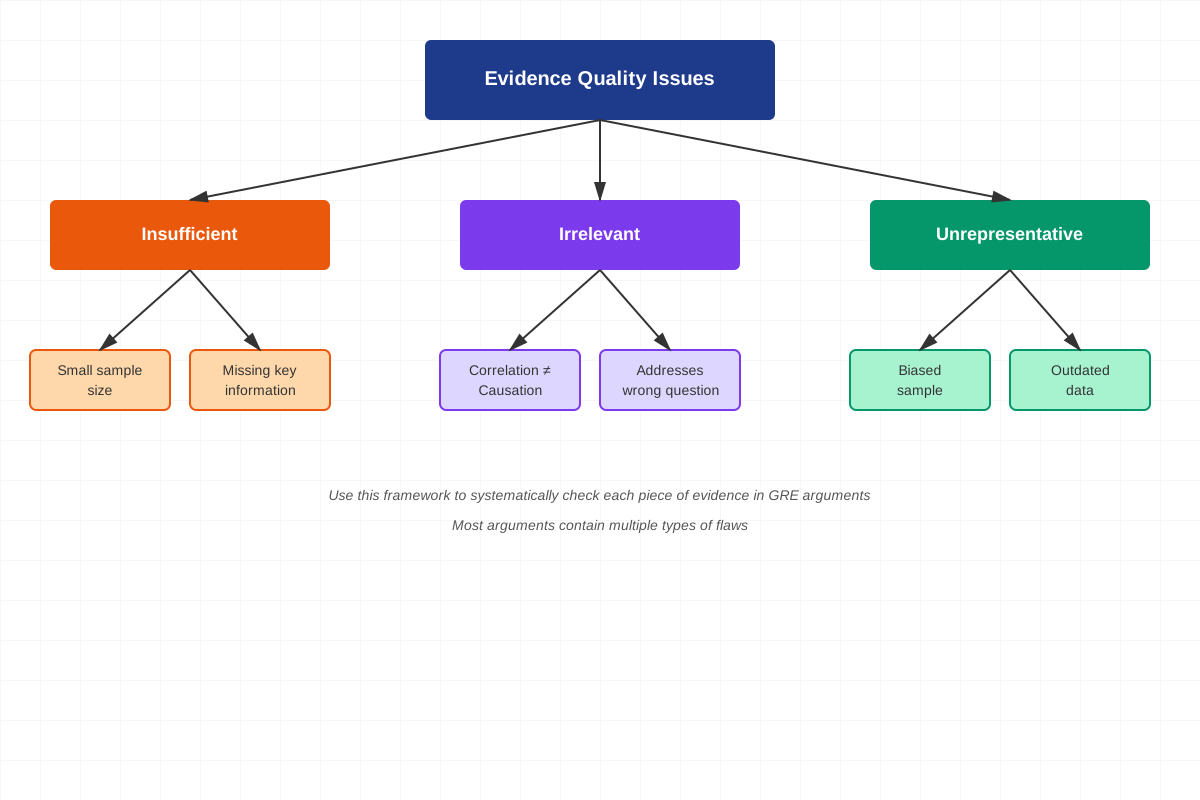
- [ ] Distinguish between different types of evidence quality issues (insufficient, irrelevant, unrepresentative)
- [ ] Generate specific questions that expose weaknesses in an argument's evidentiary support
- [ ] Evaluate whether proposed evidence would strengthen or weaken a given argument
- [ ] Construct well-reasoned paragraphs that analyze evidence critically while maintaining appropriate tone
Prerequisites
- Basic logical reasoning: Understanding of premises, conclusions, and how arguments are structured is essential for identifying what counts as evidence versus what is being claimed.
- Reading comprehension: The ability to parse complex passages quickly and accurately enables identification of the argument's components before evaluation can begin.
- Understanding of causation vs. correlation: Recognizing when arguments incorrectly assume causation helps identify a major category of evidence problems.
- Familiarity with the GRE Argument Essay format: Knowing the task requirements and scoring rubric ensures that evidence evaluation is presented in the expected analytical framework.
Why This Topic Matters
In real-world contexts, evaluating evidence is fundamental to informed decision-making across professional fields. Business leaders assess market research data before strategic decisions, medical professionals evaluate clinical evidence before treatment recommendations, and policymakers scrutinize studies before implementing regulations. The critical thinking skills developed through evidence evaluation transfer directly to graduate-level coursework, where students must assess research quality, identify methodological limitations, and construct evidence-based arguments.
On the GRE specifically, evidence evaluation appears in 100% of Argument Essay prompts—it is not optional content but the central task. The Argument Essay consistently presents flawed reasoning that requires systematic critique, and the scoring rubric explicitly rewards "insightful analysis of the argument's line of reasoning and use of evidence." Test statistics show that essays scoring 5 or 6 (the top two scores) consistently demonstrate sophisticated evidence analysis, while essays scoring 3 or below typically offer only superficial or generic critiques.
Common manifestations in GRE passages include: surveys with questionable representativeness, statistical correlations presented as causal relationships, analogies between dissimilar situations, expert opinions without credentials specified, temporal sequences assumed to indicate causation, and generalizations from limited samples. Recognizing these patterns enables rapid identification of analytical opportunities during the 30-minute essay time limit.
Core Concepts
What Constitutes Evidence
Evidence refers to any information, data, facts, examples, or observations presented to support a claim or conclusion. In GRE arguments, evidence typically includes survey results, statistical data, expert testimony, historical examples, analogies, or observed patterns. However, not all evidence is created equal—the quality and appropriateness of evidence determine its persuasive power.
Strong evidence possesses several characteristics: relevance (directly relates to the conclusion), sufficiency (adequate in quantity and scope), representativeness (accurately reflects the population or situation in question), reliability (comes from credible sources using sound methods), and recency (current enough to remain applicable). When evaluating evidence on the GRE, test-takers must assess each of these dimensions.
The Four Primary Evidence Quality Issues
| Evidence Problem | Definition | GRE Example |
|---|---|---|
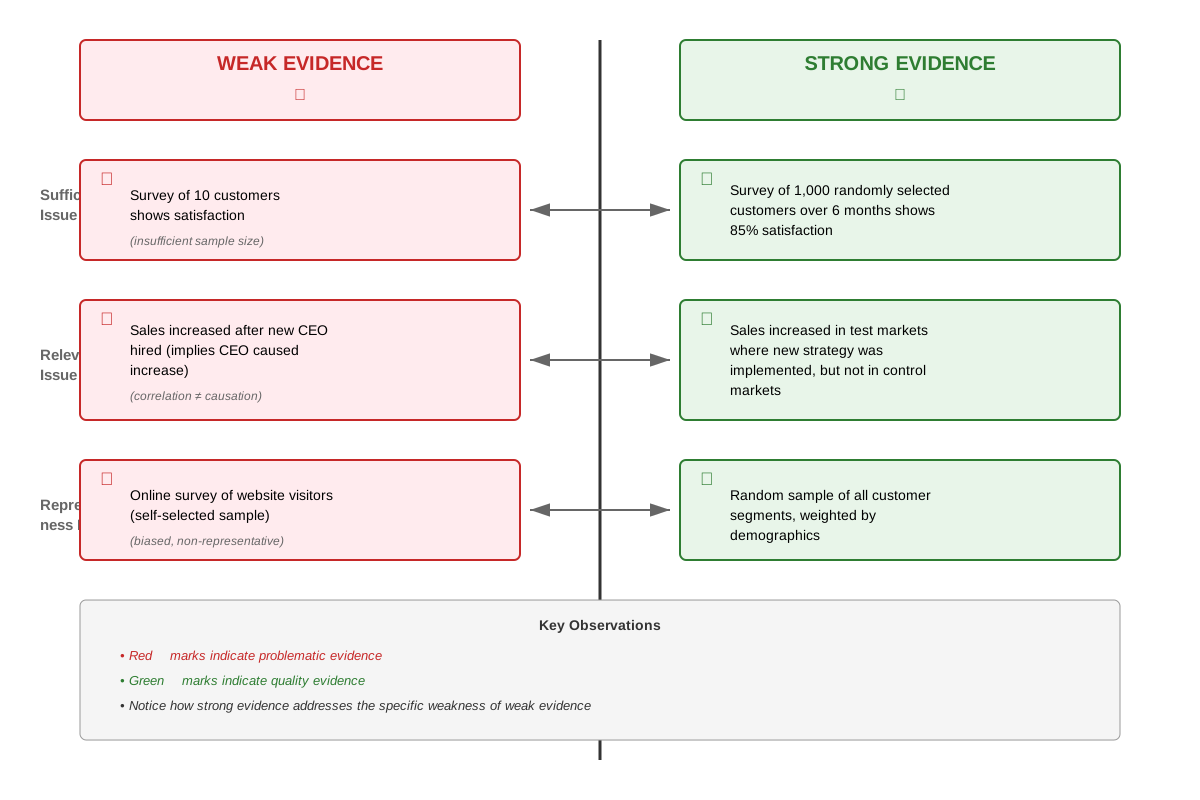
| Insufficient Evidence | Too little data to support the broad conclusion | A single customer complaint used to conclude all customers are dissatisfied |
| Irrelevant Evidence | Information that doesn't actually address the conclusion | Citing a company's revenue growth to argue its products are high-quality |
| Unrepresentative Evidence | Sample or data that doesn't reflect the broader population | Surveying only morning customers to draw conclusions about all customers |
| Unreliable Evidence | Data from questionable sources or methods | Anonymous online survey with no verification of respondents |
Evaluating Survey Evidence
Surveys appear frequently in GRE arguments and present multiple evaluation opportunities. When analyzing survey evidence, consider:
- Sample size: Is the number of respondents adequate for the conclusion's scope?
- Sample selection: How were respondents chosen? Was selection random or biased?
- Response rate: What percentage of those surveyed actually responded? Low response rates introduce self-selection bias.
- Question wording: Were questions neutral or leading? Biased questions produce unreliable data.
- Timing: When was the survey conducted? Circumstances may have changed.
- Representativeness: Do respondents match the population about which conclusions are drawn?
For example, if an argument claims "most residents support the new policy" based on a survey, critical questions include: How many residents were surveyed? How were they selected? What was the response rate? Were the questions neutrally worded? Do the respondents represent the demographic composition of all residents?
Evaluating Causal Claims
Arguments frequently present correlations as evidence of causation—a classic logical error. When two phenomena occur together or in sequence, the argument may assume one causes the other without adequate justification. Evaluating evidence for causal claims requires considering:
- Alternative causes: What other factors could explain the observed effect?
- Reverse causation: Could the supposed effect actually cause the supposed cause?
- Coincidence: Might both phenomena result from a third factor, or occur together by chance?
- Temporal relationship: Does the supposed cause actually precede the effect?
For instance, if an argument states "After the city installed new streetlights, crime decreased 15%, proving that better lighting reduces crime," evidence evaluation would note that correlation doesn't establish causation. Other factors (increased police presence, demographic changes, economic improvements, seasonal variations) could explain the crime reduction. The evidence doesn't rule out alternative explanations.
Evaluating Analogical Evidence
Arguments often use analogies—claiming that because two situations are similar in some ways, they will be similar in the relevant way. Evaluating analogical evidence requires assessing whether the situations are sufficiently similar in relevant respects.
Key questions include:
- What are the significant similarities between the compared situations?
- What are the significant differences?
- Are the differences relevant to the conclusion being drawn?
- Is the comparison appropriate in scope and context?
If an argument claims "City A implemented a recycling program and reduced waste by 30%, so City B should implement the same program," evidence evaluation would examine whether the cities are comparable in relevant ways: population size, demographics, existing waste management infrastructure, climate, industrial composition, and resident attitudes toward environmental initiatives.
The "What Would Strengthen/Weaken" Framework
A powerful approach to evaluating evidence involves identifying what additional information would make the argument more or less convincing. This framework helps pinpoint exactly what's missing or questionable in the current evidence.
For any argument, ask:
- What assumptions does this argument make about the evidence?
- What additional data would confirm or refute these assumptions?
- What alternative explanations need to be ruled out?
- What information about methodology, context, or circumstances is missing?
This approach transforms evidence evaluation from vague criticism ("this survey might be flawed") to specific, analytical critique ("information about the survey's response rate and sample selection method would help determine whether the results represent all customers or only those with strong opinions who chose to respond").
Distinguishing Evidence from Assumptions
A critical skill in evidence evaluation is recognizing the difference between what the argument explicitly states as evidence and what it implicitly assumes. Assumptions are unstated premises that must be true for the evidence to support the conclusion. While related to evidence evaluation, identifying assumptions focuses on logical gaps, whereas evaluating evidence focuses on the quality and appropriateness of information actually presented.
For example, if an argument states "Sales of Product X increased 40% after we lowered the price, so price reductions increase revenue," the evidence is the sales increase. The assumptions include: the price reduction caused the increase (not other factors like seasonality or marketing), increased sales volume compensates for lower per-unit profit, and the pattern will continue. Evidence evaluation would question whether the data adequately supports the causal claim and whether the time period examined is sufficient.
Concept Relationships
The concepts within evidence evaluation form an interconnected analytical framework. Evidence quality assessment (sufficient, relevant, representative, reliable) provides the foundation for identifying specific problems. These problems then inform the causal analysis and analogical reasoning evaluation, which represent common argument structures requiring specialized scrutiny. The strengthen/weaken framework synthesizes all previous concepts by articulating what additional evidence would address identified weaknesses.
This topic connects to prerequisite knowledge of logical reasoning by applying general principles of validity to specific evidence types. It builds toward identifying assumptions by revealing what must be true (but isn't proven) for weak evidence to support its conclusion. Evidence evaluation also enables recognizing logical fallacies, as many fallacies involve evidence misuse (hasty generalization, false cause, weak analogy).
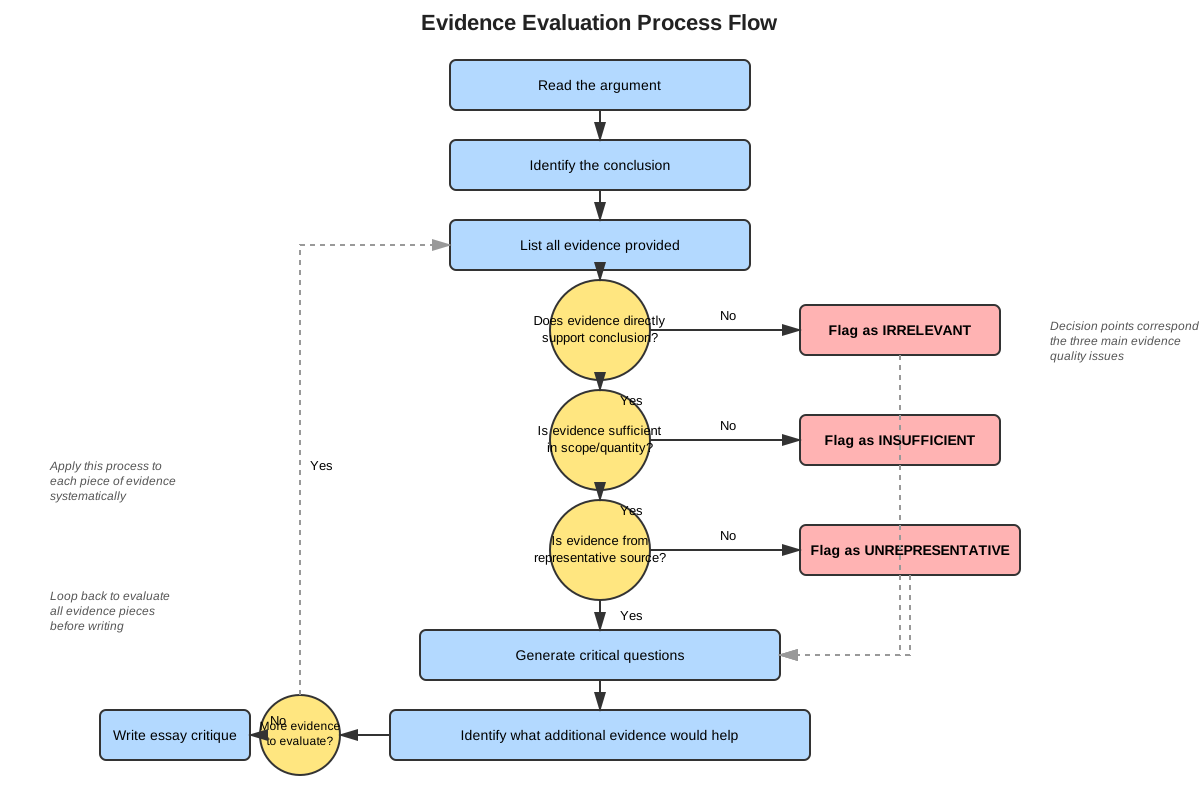
The relationship map flows as follows:
Argument Structure Recognition → Evidence Identification → Quality Assessment (sufficient? relevant? representative? reliable?) → Specific Problem Identification → Alternative Explanation Generation → Strengthen/Weaken Analysis → Written Critique Construction
High-Yield Facts
⭐ Evidence evaluation appears in 100% of GRE Argument Essays—it is the core analytical task, not an optional element.
⭐ Survey evidence requires examining six factors: sample size, selection method, response rate, question wording, timing, and representativeness.
⭐ Correlation does not establish causation—arguments presenting temporal or statistical correlation as causal evidence contain a fundamental flaw requiring analysis.
⭐ Unrepresentative samples are among the most common evidence problems in GRE arguments, particularly surveys of self-selected respondents.
⭐ The strengthen/weaken framework (identifying what additional information would help evaluate the argument) demonstrates sophisticated analysis and earns higher scores.
- Evidence can be problematic in multiple ways simultaneously—insufficient AND unrepresentative, for example.
- Analogies require similarity in relevant respects, not just any similarities—superficial commonalities don't justify conclusions.
- Low response rates introduce self-selection bias—only those with strong opinions may respond, skewing results.
- Expert testimony requires evaluation of credentials, potential bias, and whether consensus exists in the field.
- Statistical evidence requires context—a "50% increase" means different things if the baseline is 2 versus 2,000.
- Temporal sequence alone doesn't prove causation—"post hoc ergo propter hoc" (after this, therefore because of this) is a logical fallacy.
- Evidence from one time period or location may not generalize to other contexts without justification.
- The absence of evidence is not evidence of absence—arguments sometimes assume that because something wasn't mentioned, it doesn't exist.
Quick check — test yourself on Evaluating evidence so far.
Try Flashcards →Common Misconceptions
Misconception: Any criticism of evidence is sufficient for a strong essay.
Correction: Generic criticisms like "the survey might be biased" earn low scores. Strong essays provide specific, detailed analysis of exactly how and why the evidence is problematic, with concrete examples of what information would address the weakness.
Misconception: The goal is to prove the argument's conclusion is false.
Correction: The task is to evaluate the logical soundness of the reasoning, not to disprove the conclusion. An argument can have a true conclusion but still be logically flawed if the evidence doesn't adequately support it. Focus on the connection between evidence and conclusion, not the conclusion's truth value.
Misconception: Longer essays with more criticisms automatically score higher.
Correction: Quality trumps quantity. A well-developed analysis of 2-3 major evidence problems scores higher than superficial mention of 5-6 issues. Depth of analysis matters more than breadth of coverage.
Misconception: Evidence evaluation requires specialized knowledge of the topic discussed.
Correction: GRE arguments are designed to be analyzed using general reasoning skills, not domain expertise. The flaws are logical, not factual. Test-takers should focus on reasoning structure, not whether claims are factually true in the real world.
Misconception: If evidence is relevant, it's sufficient to support the conclusion.
Correction: Evidence can be relevant but still insufficient in scope or quantity. One relevant example doesn't justify a sweeping generalization. Evidence must be both relevant AND adequate in amount and representativeness.
Misconception: Identifying that evidence is weak is enough—no need to explain implications.
Correction: Strong essays explain why the weakness matters—how it undermines the conclusion, what alternative explanations become possible, and what the argument fails to rule out. Connect evidence problems to their logical consequences.
Worked Examples
Example 1: Evaluating Survey Evidence
GRE-Style Argument Prompt:
"A recent survey of Parkville residents showed that 75% support building a new sports complex. The survey was conducted online and advertised through the local sports club's newsletter. Based on this overwhelming support, the city council should approve funding for the complex."
Step 1: Identify the Evidence
The evidence is a survey showing 75% support. The conclusion is that the city council should approve funding.
Step 2: Assess Evidence Quality Dimensions
- Sample selection: The survey was advertised through a sports club newsletter—this creates selection bias. People interested in sports are more likely to see the advertisement and respond. This sample is unrepresentative of all Parkville residents.
- Response rate: Not mentioned. Online surveys typically have low response rates, and those who respond often have stronger opinions than non-respondents (self-selection bias).
- Sample size: Not specified. "75%" sounds impressive but could represent 75 out of 100 respondents in a city of 50,000 residents.
- Question wording: Not provided. Leading questions could inflate support.
Step 3: Identify Alternative Explanations and Missing Information
The argument assumes the survey respondents represent all residents, but the evidence doesn't support this. Alternative explanation: Only sports enthusiasts, who would benefit most from the complex, responded to the survey advertised through sports club channels.
Step 4: Apply Strengthen/Weaken Framework
Information that would strengthen the argument:
- The survey used random sampling of all residents
- The response rate was high (e.g., 70%+)
- Demographic analysis showed respondents matched the city's population composition
- Questions were neutrally worded and tested for bias
Information that would weaken the argument:
- Only 200 people responded out of 50,000 residents
- 90% of respondents were sports club members
- Non-sports club members showed only 40% support
Step 5: Construct Written Analysis
"The argument relies on survey evidence that suffers from serious representativeness problems. By advertising the survey through a sports club newsletter, the city ensured that respondents would be disproportionately interested in sports facilities—precisely the group most likely to support the complex. This sampling method introduces selection bias that undermines the claim of 'overwhelming support' among all residents. Without information about the total number of respondents, the response rate, or whether the sample's demographics match the city's population, the 75% figure cannot be assumed to represent general public opinion. Additionally, the online format may exclude residents without internet access or technological proficiency, further skewing results. To properly evaluate this argument, one would need evidence that the survey used random sampling of all residents, achieved a high response rate, and that support remained high across different demographic groups, not just sports enthusiasts."
Example 2: Evaluating Causal Evidence
GRE-Style Argument Prompt:
"Since Omega Corporation implemented flexible work schedules two years ago, employee productivity has increased by 20% and turnover has decreased by 15%. Other companies seeking to improve performance should adopt flexible scheduling."
Step 1: Identify the Evidence and Causal Claim
Evidence: Productivity increased 20%, turnover decreased 15% after flexible scheduling implementation. Causal claim: Flexible scheduling caused these improvements.
Step 2: Evaluate the Causal Connection
The argument presents a temporal correlation (flexible scheduling preceded improvements) as evidence of causation. This commits the "post hoc ergo propter hoc" fallacy—assuming that because B followed A, A caused B.
Step 3: Generate Alternative Explanations
Multiple factors could explain the improvements:
- Economic conditions: If the economy improved during this period, employees might have been more motivated and less likely to seek other jobs regardless of scheduling
- Other policy changes: Omega might have implemented salary increases, better benefits, new management, or improved technology simultaneously
- Industry trends: The entire industry might have experienced productivity gains due to technological advances
- Selection effects: Less productive employees might have left during the transition, artificially inflating average productivity
- Measurement changes: The company might have changed how it measures productivity
Step 4: Assess Generalizability
Even if flexible scheduling did cause improvements at Omega, the recommendation for "other companies" assumes:
- Omega is representative of other companies
- Omega's industry, size, workforce composition, and work type are similar to other companies
- The same factors that made flexible scheduling successful at Omega exist elsewhere
These assumptions lack evidentiary support.
Step 5: Apply Strengthen/Weaken Framework
To strengthen: Evidence that companies with similar characteristics that implemented flexible scheduling experienced similar improvements, while comparable companies without flexible scheduling did not; data ruling out alternative explanations; information about Omega's specific circumstances that made flexible scheduling effective.
To weaken: Evidence that Omega also implemented other major changes during this period; data showing industry-wide improvements regardless of scheduling policies; information that Omega's workforce or industry has unique characteristics.
Step 6: Construct Written Analysis
"The argument's causal claim rests on weak evidence that fails to establish that flexible scheduling caused the observed improvements. The temporal correlation—improvements following implementation—is insufficient to prove causation without ruling out alternative explanations. During the two-year period, numerous other factors could have influenced productivity and turnover: economic conditions, technological improvements, management changes, compensation adjustments, or industry-wide trends. The argument provides no evidence that these alternative causes were absent or controlled for. Furthermore, even if flexible scheduling contributed to Omega's success, the recommendation for 'other companies' assumes Omega is representative—an assumption unsupported by evidence. Companies differ in industry, size, work type, and workforce characteristics, all of which could affect whether flexible scheduling produces similar results. To properly evaluate this argument, one would need evidence from controlled studies comparing similar companies with and without flexible scheduling, data ruling out confounding variables, and information about what specific circumstances at Omega made flexible scheduling effective."
Exam Strategy
Rapid Evidence Identification Process
Within the first 3-4 minutes of reading the argument, systematically identify:
- The main conclusion
- Each piece of evidence presented
- The type of evidence (survey, statistic, analogy, expert opinion, etc.)
Use this categorization to trigger specific evaluation frameworks—surveys require the six-factor analysis, causal claims require alternative explanation generation, analogies require similarity assessment.
Trigger Words for Evidence Problems
Watch for these phrases that signal evidence quality issues:
- "A recent survey/study/poll" → Examine representativeness, sample size, methodology
- "After X, Y occurred" → Evaluate causal assumption, generate alternative explanations
- "Similar to/Like/Just as" → Assess analogy's relevance and similarity in key respects
- "Experts suggest/Studies show" → Question source credibility, consensus, potential bias
- "Increased/Decreased by X%" → Examine baseline, context, time frame, measurement method
- "Most/Many/Several" → Quantify vagueness, assess sufficiency of sample
The Three-Paragraph Structure for Evidence Analysis
Paragraph 1: Identify the specific evidence and explain what assumption it requires to support the conclusion.
Paragraph 2: Explain why this assumption is questionable—what alternative explanations exist, what information is missing, or why the evidence might not be representative/sufficient/relevant.
Paragraph 3: Apply the strengthen/weaken framework—what specific additional information would help evaluate whether the evidence actually supports the conclusion.
This structure ensures depth of analysis rather than superficial criticism.
Time Allocation
- 5 minutes: Read, analyze, and outline (identify 2-3 major evidence problems)
- 20 minutes: Write (introduction, 2-3 body paragraphs analyzing evidence, conclusion)
- 5 minutes: Review and edit
Resist the temptation to identify every possible flaw. Focus on developing 2-3 major evidence problems thoroughly rather than mentioning 5-6 superficially.
Process of Elimination for Evidence Quality
When evaluating evidence, systematically ask:
- Is it sufficient in quantity and scope? (If no, you've found a flaw)
- Is it relevant to the specific conclusion? (If no, you've found a flaw)
- Is it representative of the population/situation in question? (If no, you've found a flaw)
- Is it reliable in source and methodology? (If no, you've found a flaw)
Any "no" answer provides material for analysis. Prioritize the most significant flaws for your essay.
Memory Techniques
The SURR Acronym for Evidence Quality
Sufficient - Adequate in quantity and scope
Unrepresentative - Sample doesn't match population (note: starts with "un" for the negative)
Relevant - Actually addresses the conclusion
Reliable - Trustworthy source and sound methodology
Visualize evidence as a SURR-ounding wall supporting a conclusion—if any section is weak, the wall cannot support the structure.
The Six Survey Questions Mnemonic: "SSRQTR"
Think "Sister" with extra letters:
- Sample size
- Selection method
- Response rate
- Question wording
- Timing
- Representativeness
The Causation Checklist: "ARCT"
When evaluating causal claims, remember to check for:
- Alternative causes
- Reverse causation
- Coincidence/common cause
- Temporal relationship
Visualize an "ARC" of possible explanations that the argument hasn't ruled out, plus checking the Time sequence.
The Analogy Assessment: "SRSC"
For analogical reasoning:
- Similarities - What's similar?
- Relevant? - Are similarities relevant to the conclusion?
- Significant differences - What differs?
- Consequences - Do differences undermine the analogy?
Summary
Evaluating evidence constitutes the central analytical task of the GRE Argument Essay, requiring systematic assessment of whether information presented actually supports the argument's conclusion. Strong evidence evaluation examines sufficiency (adequate quantity and scope), relevance (direct connection to the conclusion), representativeness (accurately reflects the population or situation), and reliability (credible sources and sound methods). Common evidence problems include unrepresentative surveys with selection bias or low response rates, causal claims based on mere correlation without ruling out alternative explanations, and weak analogies that ignore relevant differences between compared situations. The most effective analytical approach applies the strengthen/weaken framework, identifying specific additional information that would help evaluate the argument's validity. This demonstrates sophisticated reasoning beyond generic criticism. Success requires moving past superficial observations to detailed, specific analysis that explains exactly why evidence is problematic and what logical consequences follow. High-scoring essays develop 2-3 major evidence problems thoroughly rather than superficially mentioning many flaws, connecting each weakness to its impact on the argument's logical soundness.
Key Takeaways
- Evaluating evidence is not optional—it appears in 100% of GRE Argument Essays and forms the core of what the task requires
- Evidence quality depends on four dimensions: sufficiency, relevance, representativeness, and reliability (remember: SURR)
- Survey evidence requires systematic examination of six factors: sample size, selection method, response rate, question wording, timing, and representativeness
- Correlation never establishes causation—always generate alternative explanations for observed relationships
- The strengthen/weaken framework (identifying what additional information would help evaluate the argument) demonstrates sophisticated analysis and earns higher scores
- Depth beats breadth—thoroughly analyzing 2-3 major evidence problems scores higher than superficially mentioning many flaws
- Connect evidence problems to logical consequences—explain why the weakness matters and how it undermines the conclusion
Related Topics
Identifying Assumptions: Building on evidence evaluation, this topic focuses on recognizing unstated premises that arguments require. Mastering evidence evaluation provides the foundation for assumption identification, as assumptions often involve what evidence fails to establish.
Recognizing Logical Fallacies: Many fallacies involve evidence misuse—hasty generalization, false cause, and weak analogy all represent specific evidence problems. Understanding evidence evaluation enables systematic fallacy recognition.
Constructing Alternative Explanations: This advanced skill extends evidence evaluation by generating competing hypotheses that the argument fails to rule out. Strong evidence evaluation naturally leads to alternative explanation development.
Argument Structure Analysis: Understanding how premises, evidence, and conclusions connect provides the framework within which evidence evaluation operates. This foundational skill enables more sophisticated evidence critique.
Practice CTA
Now that you've mastered the principles of evaluating evidence, it's time to apply these concepts to actual GRE-style arguments. The practice questions and flashcards will reinforce your ability to rapidly identify evidence problems, apply the SURR framework, and construct sophisticated analyses under timed conditions. Remember: evidence evaluation is a skill that improves with deliberate practice. Each practice argument you analyze strengthens your pattern recognition and analytical speed, building the confidence and competence needed for test day success. Your investment in mastering this high-yield topic will pay dividends across every Argument Essay you encounter.
Sign up free to keep reading
Create a free AnvayaPrep account to finish this GRE guide on Evaluating evidence — plus flashcards and practice questions.