Overview
Causal assumptions represent one of the most frequently tested logical reasoning patterns in the GRE Analytical Writing section, particularly in the Argument Essay. When an argument claims that one event or condition causes another, it relies on underlying assumptions about the causal relationship that may or may not be valid. Understanding how to identify and critique these assumptions is essential for achieving a high score on the Argument Essay, where test-takers must analyze the logical soundness of a given argument rather than present their own opinion.
The GRE Argument Essay presents a brief passage containing a recommendation or conclusion supported by evidence. Most arguments contain multiple logical flaws, and gre causal assumptions consistently appear as one of the primary vulnerability points. These assumptions occur when an author observes a correlation between two phenomena and concludes that one causes the other without adequately ruling out alternative explanations. The ability to recognize when causation is being assumed rather than proven, and to articulate what additional evidence would strengthen or weaken the causal claim, directly determines essay quality.
Within the broader Analytical Writing framework, causal reasoning connects to other critical thinking skills including evidence evaluation, alternative explanation generation, and logical sufficiency assessment. Mastering causal assumptions provides a foundation for understanding related logical flaws such as confusing correlation with causation, overlooking confounding variables, and failing to establish temporal precedence. This topic serves as a gateway to sophisticated argument analysis that distinguishes high-scoring essays from mediocre ones.
Learning Objectives
- [ ] Identify when Causal assumptions is being tested in GRE Argument Essay prompts
- [ ] Explain the core rule or strategy behind Causal assumptions and why they represent logical vulnerabilities
- [ ] Apply Causal assumptions analysis to GRE-style questions accurately and comprehensively
- [ ] Distinguish between correlation and causation in argument passages
- [ ] Generate at least three alternative explanations for any observed correlation
- [ ] Articulate specific evidence that would strengthen or weaken a causal claim
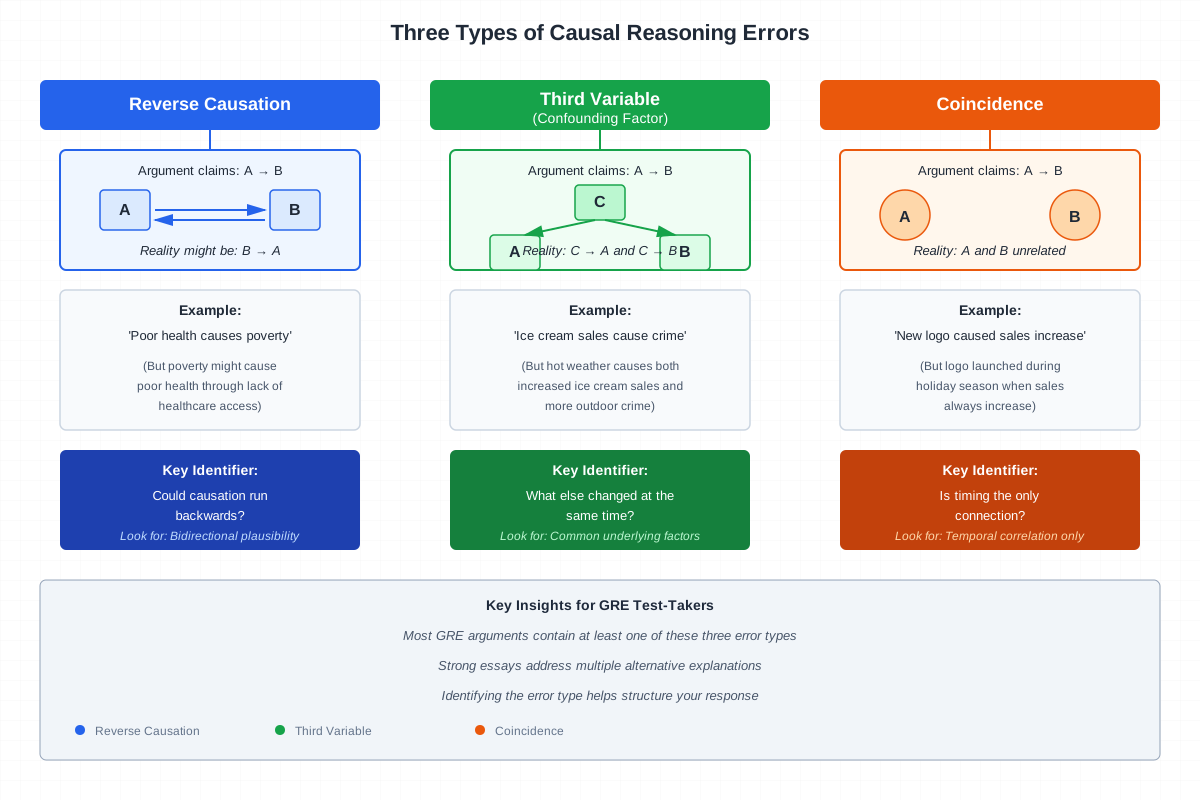
- [ ] Recognize the different types of causal reasoning errors (reverse causation, third variable, coincidence)
Prerequisites
- Basic logical reasoning: Understanding of premises, conclusions, and how arguments are structured is necessary to identify where causal claims appear within an argument's logical chain.
- Correlation vs. causation distinction: Familiarity with the fundamental difference between two things happening together versus one causing the other provides the conceptual foundation for this topic.
- Evidence evaluation skills: The ability to assess whether given evidence adequately supports a claim is essential for determining when causal assumptions are unwarranted.
- Argument Essay format knowledge: Understanding the task requirements (analyzing rather than agreeing/disagreeing) ensures proper application of causal assumption analysis.
Why This Topic Matters
Causal reasoning pervades everyday decision-making, policy formation, and scientific inquiry. In business contexts, executives must determine whether marketing campaigns actually cause sales increases or merely correlate with seasonal trends. In healthcare, distinguishing between treatments that cause improvement versus those that coincidentally accompany natural recovery can be life-or-death. The GRE tests this critical thinking skill because graduate programs require students who can evaluate research claims, assess policy recommendations, and avoid logical fallacies in their own work.
On the GRE Analytical Writing section, approximately 60-70% of Argument Essay prompts contain at least one significant causal assumption. These prompts frequently appear in contexts involving business recommendations, policy proposals, survey interpretations, and trend analyses. The official GRE scoring rubric explicitly rewards essays that "identify and analyze important features of the argument," and causal assumptions consistently represent the most important logical vulnerabilities in test passages.
Common manifestations include: arguments claiming that a new policy caused observed improvements when other factors may be responsible; business recommendations based on correlations between practices and success without establishing causation; survey results suggesting one variable causes another when the relationship might be reversed or explained by a third factor; and temporal sequences where earlier events are assumed to cause later ones without ruling out coincidence or common causes.
Core Concepts
The Nature of Causal Claims
A causal claim asserts that one phenomenon (the cause) brings about or produces another phenomenon (the effect). In formal logic, causation requires three conditions: temporal precedence (the cause precedes the effect), correlation (the cause and effect occur together), and elimination of alternative explanations (no other factor better explains the relationship). GRE arguments typically establish the first two conditions but fail to satisfy the third, creating a logical vulnerability.
When an argument states or implies causation based solely on correlation or temporal sequence, it makes an assumption—an unstated premise that must be true for the conclusion to follow logically. The assumption is that no alternative explanation accounts for the observed relationship. This assumption is almost always questionable because multiple causal structures can produce the same observable correlation.
Four Primary Causal Structures
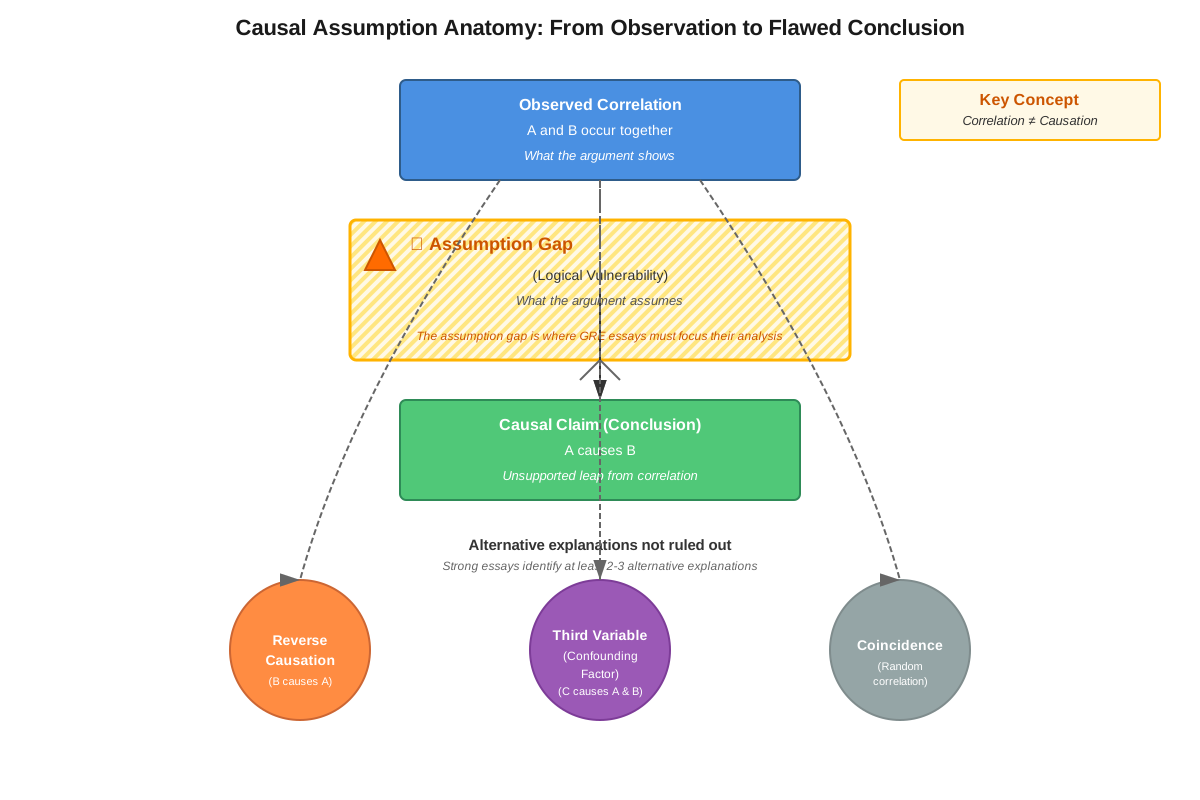
Understanding the different ways two correlated variables might actually relate helps identify what an argument assumes:
| Causal Structure | Description | Example |
|---|---|---|
| Direct Causation (A → B) | Variable A directly causes Variable B | Argument's claimed relationship |
| Reverse Causation (B → A) | Variable B actually causes Variable A | The supposed effect causes the supposed cause |
| Common Cause (C → A and B) | Third variable C causes both A and B | Both are effects of an overlooked factor |
| Coincidence | No causal relationship; correlation is accidental | Random chance or limited sample |
When an argument claims direct causation (A → B), it assumes the other three structures don't apply. This assumption is rarely justified by the evidence provided.
Correlation Without Causation
The most fundamental causal assumption error involves treating correlation (two variables occurring together) as proof of causation (one variable producing the other). Statistical correlation indicates only that variables change together; it provides no information about whether one causes the other, both are caused by something else, or the relationship is coincidental.
GRE arguments frequently present data showing two phenomena occurring simultaneously or in sequence, then conclude one causes the other. For example: "Since the city implemented parking restrictions, downtown business revenue has declined 15%. Therefore, the parking restrictions caused the revenue decline." This argument observes a temporal correlation but assumes away alternative explanations like economic recession, new competition, or changing consumer preferences.
Alternative Explanations
The strength of a causal claim depends on how thoroughly alternative explanations have been ruled out. Alternative explanations are other factors that could account for the observed correlation without the claimed causal relationship being true. Generating alternative explanations is the primary analytical task in addressing causal assumptions.
Effective alternative explanations should be:
- Plausible: Realistic possibilities, not far-fetched scenarios
- Specific: Concrete factors relevant to the argument's context
- Sufficient: Capable of fully explaining the observed correlation
- Independent: Not requiring the original causal claim to be true
For the parking restriction example, plausible alternatives include: economic downturn affecting all businesses, major employer relocating from downtown, new shopping center opening in suburbs, or seasonal variation in business patterns.
Reverse Causation
Reverse causation occurs when the supposed effect actually causes the supposed cause, inverting the argument's causal claim. This represents a particularly powerful critique because it accepts the correlation but challenges the causal direction.
Consider: "Companies with generous employee benefits programs report higher productivity. Therefore, implementing generous benefits will increase productivity." This assumes benefits cause productivity, but reverse causation is equally plausible: highly productive companies generate more revenue, enabling them to afford generous benefits. The correlation exists, but the causal arrow may point the opposite direction.
Third Variable Problems
A third variable (also called a confounding variable or common cause) is an overlooked factor that causes both observed phenomena, creating a correlation without direct causation between them. This is often the most sophisticated critique of causal reasoning.
Example: "Students who eat breakfast score higher on standardized tests. Therefore, eating breakfast improves test performance." A third variable critique would note that family socioeconomic status might cause both regular breakfast consumption (families with resources and stability) and higher test scores (through better schools, tutoring, less stress), making the breakfast-score correlation spurious.
Temporal Sequence Assumptions
Arguments often assume that because Event A preceded Event B, Event A caused Event B. This logical fallacy (post hoc ergo propter hoc—"after this, therefore because of this") ignores that temporal sequence alone doesn't establish causation.
GRE arguments exploit this by presenting before-and-after scenarios: "After the town installed speed cameras, traffic accidents decreased 20%." The argument assumes the cameras caused the decrease, but alternatives include: increased police presence, road improvements, demographic changes, or regression to the mean (accidents were unusually high before the cameras).
Necessary vs. Sufficient Conditions
Causal claims sometimes confuse necessary conditions (required for an effect but not alone sufficient to produce it) with sufficient conditions (alone capable of producing the effect). An argument might show that successful companies have Factor X and conclude that Factor X causes success, when Factor X might be necessary but not sufficient—many other factors must also be present.
Concept Relationships
The core concepts within causal assumptions form an interconnected analytical framework. Correlation without causation serves as the foundational principle, establishing that observed relationships don't inherently prove causal direction. This principle generates three specific alternative structures: reverse causation (inverted causal arrow), third variable (common cause), and coincidence (no causal relationship).
Alternative explanations function as the practical application mechanism for these theoretical structures. When analyzing an argument, identifying the causal claim triggers the search for alternative explanations, which are systematically generated by considering reverse causation possibilities, potential third variables, and coincidental factors.
Temporal sequence assumptions represent a special case where arguments use time order as evidence for causation. Critiquing these requires applying the general alternative explanation framework specifically to before-and-after scenarios.
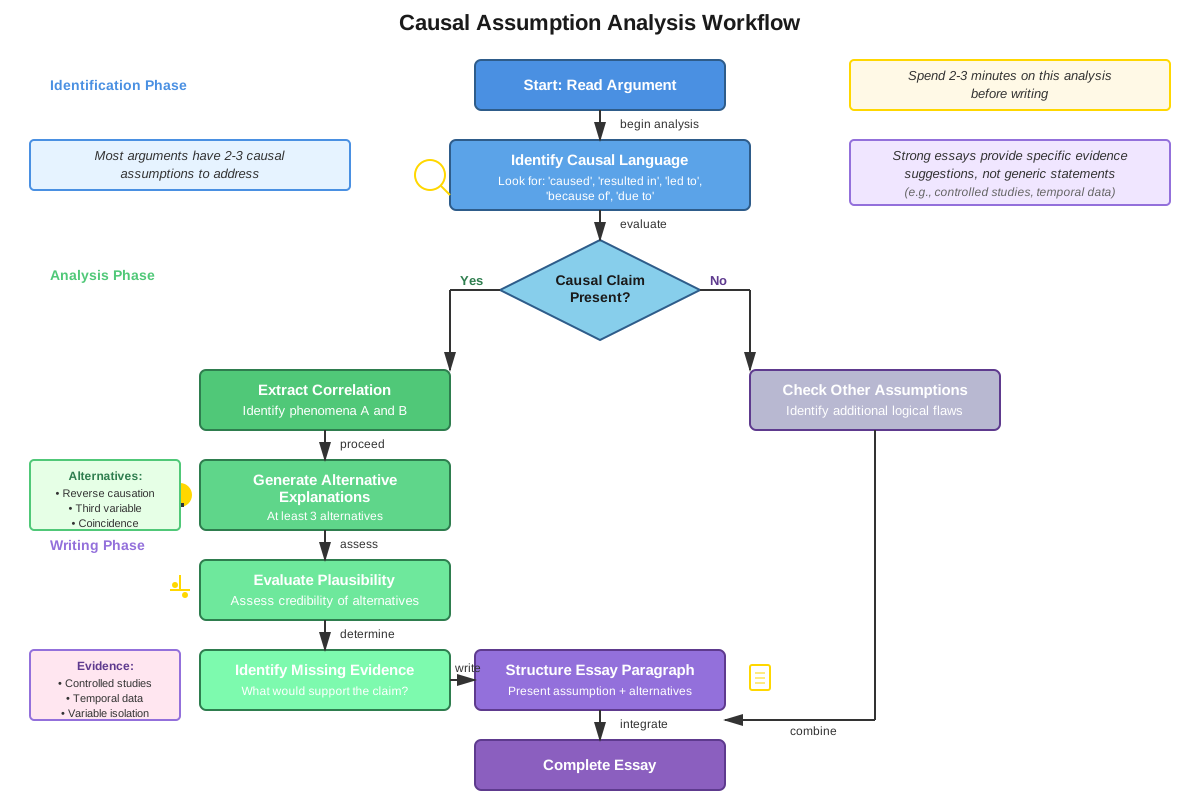
The relationship map flows as follows:
Causal Claim in Argument → Recognize Correlation ≠ Causation → Generate Alternative Explanations → Consider Reverse Causation + Third Variables + Coincidence → Articulate Assumptions → Suggest Strengthening Evidence
This analytical sequence connects to prerequisite knowledge of argument structure (identifying claims and evidence) and enables progression to more advanced topics like statistical reasoning and survey methodology critique.
High-Yield Facts
⭐ Correlation between two variables never, by itself, proves that one causes the other—additional evidence is always required to establish causation.
⭐ Approximately 60-70% of GRE Argument Essay prompts contain at least one significant causal assumption, making this the most frequently tested logical flaw.
⭐ Reverse causation is always a viable alternative explanation when an argument claims A causes B based on their correlation.
⭐ Temporal precedence (A before B) is necessary but not sufficient for causation—many arguments incorrectly treat time sequence as proof of causation.
⭐ Third variable explanations are particularly strong critiques because they explain the observed correlation while completely undermining the causal claim.
- Arguments claiming causation based on a single correlation make at least three assumptions: no reverse causation, no third variable, and not coincidental.
- The phrase "therefore" or "thus" often signals a causal conclusion that may rest on unwarranted assumptions.
- Strengthening a causal argument requires evidence that rules out alternative explanations, not just additional correlations.
- Causal assumptions appear most frequently in business recommendation arguments, policy proposal arguments, and survey interpretation arguments.
- High-scoring essays identify the specific causal assumption, explain why it's questionable, generate 2-3 concrete alternative explanations, and describe evidence that would help evaluate the causal claim.
- The assumption is not that correlation exists (that's usually given as evidence) but that the correlation reflects the specific causal relationship claimed.
- Multiple causal claims in a single argument should each be analyzed separately, as they may rest on different assumptions.
Quick check — test yourself on Causal assumptions so far.
Try Flashcards →Common Misconceptions
Misconception: If two things are correlated, there must be some causal relationship between them, even if the direction is unclear.
Correction: Correlation can result from coincidence, especially with small samples or selective time periods. Additionally, both variables might be effects of a third cause without any direct causal relationship between them.
Misconception: Identifying a causal assumption means simply stating "correlation doesn't equal causation."
Correction: Effective analysis requires explaining specifically what the argument assumes (what alternative explanations it rules out), why that assumption is questionable, and what evidence would help evaluate it. Generic statements about correlation and causation earn minimal credit.
Misconception: Reverse causation and third variable are the same type of alternative explanation.
Correction: Reverse causation maintains a direct causal relationship between the two variables but inverts the direction (B causes A instead of A causes B). Third variable introduces a completely different factor C that causes both A and B, meaning neither directly causes the other.
Misconception: Temporal sequence (A happened before B) makes causation more likely than simple correlation.
Correction: While temporal precedence is necessary for causation, it doesn't make causation significantly more probable. Many non-causal factors can explain why B followed A, including coincidence, seasonal patterns, or both being effects of an earlier cause C.
Misconception: To critique a causal assumption, you must prove the argument's causal claim is false.
Correction: The task is to show the argument's reasoning is insufficient—that the evidence doesn't adequately support the causal conclusion because alternative explanations haven't been ruled out. The causal claim might be true, but the argument hasn't proven it.
Misconception: More examples of the correlation strengthen the causal claim.
Correction: Additional instances of correlation don't address the fundamental issue: whether the correlation reflects the claimed causal relationship or an alternative structure. A thousand examples of A and B occurring together don't prove A causes B if both are actually caused by C.
Worked Examples
Example 1: Business Recommendation Argument
Prompt: "The following appeared in a memo from the director of marketing at Maxtech Corporation: 'Over the past three years, companies in our industry that have adopted flexible work-from-home policies have seen their stock prices increase by an average of 15%, while companies without such policies have seen increases of only 5%. Therefore, Maxtech should immediately implement a flexible work-from-home policy to boost our stock price.'"
Analysis:
Step 1 - Identify the causal claim: The argument concludes that implementing work-from-home policies will cause Maxtech's stock price to increase, based on correlation between such policies and stock price increases at other companies.
Step 2 - Recognize the assumption: The argument assumes that work-from-home policies caused the stock price increases at those companies, rather than some alternative explanation accounting for the correlation.
Step 3 - Generate alternative explanations:
Reverse causation: Companies with rising stock prices (due to other successful business factors) may have more resources and confidence to implement flexible policies. The stock success enables the policy rather than resulting from it.
Third variable: Companies that adopt progressive work policies might also be industry leaders in innovation, technology adoption, and management quality—factors that actually drive stock price increases. The work-from-home policy is a symptom of good management, not a cause of stock success.
Coincidence/Selection bias: The three-year period might coincidentally favor companies that happened to have these policies for unrelated reasons. Perhaps these companies operate in growing market segments, while companies without such policies serve declining segments.
Step 4 - Articulate strengthening evidence: The argument would be strengthened by evidence that companies' stock prices increased specifically after implementing work-from-home policies (not before), that similar companies without other advantages saw increases after adopting such policies, and that the correlation holds across different market conditions and company types.
Step 5 - Connect to learning objective: This example demonstrates how to identify causal assumptions (the policy causes stock increases), explain why the assumption is questionable (multiple alternative explanations exist), and apply systematic analysis to a GRE-style argument.
Example 2: Policy Proposal Argument
Prompt: "The following appeared in a letter to the editor of a local newspaper: 'Five years ago, our town installed brighter streetlights throughout the downtown area. Since then, the number of reported crimes in downtown has decreased by 30%. Meanwhile, the residential neighborhoods, which still have the old dim streetlights, have seen crime rates remain constant. Clearly, installing brighter streetlights reduces crime. Therefore, the town should install brighter streetlights in all residential neighborhoods to reduce crime there as well.'"
Analysis:
Step 1 - Identify the causal claim: The argument claims that brighter streetlights caused the 30% crime reduction downtown and will cause similar reductions in residential areas.
Step 2 - Recognize the assumptions: The argument assumes (1) the streetlights caused the downtown crime reduction, and (2) factors that affected downtown crime will similarly affect residential crime.
Step 3 - Generate alternative explanations for the downtown correlation:
Third variable - economic development: Downtown areas that invest in infrastructure improvements like streetlights often simultaneously experience economic revitalization, increased foot traffic, more businesses, and greater police presence—any of which could reduce crime more than lighting alone.
Third variable - demographic changes: The downtown population or visitor demographics may have changed over five years (gentrification, new residential developments, changing business mix), bringing populations with different crime patterns.
Temporal coincidence: The five-year period might coincide with citywide crime reduction efforts (increased police funding, community programs, economic improvement) that affected downtown more than residential areas for reasons unrelated to streetlights.
Reporting changes: The decrease in "reported crimes" might reflect changes in reporting behavior or police recording practices rather than actual crime reduction.
Step 4 - Address the second assumption: Even if streetlights did reduce downtown crime, residential neighborhoods differ fundamentally from downtown areas in population density, activity patterns, crime types, and environmental factors. What works in a commercial district may not transfer to residential contexts.
Step 5 - Articulate strengthening evidence: Evidence that crime decreased specifically on streets with new lights but not on adjacent streets with old lights, that similar lighting improvements in other towns' residential areas reduced crime, and that other factors (police presence, economic conditions, demographics) remained constant during the five-year period would strengthen the argument.
Connection to learning objectives: This example illustrates identifying causal assumptions in policy contexts, distinguishing between correlation and causation, generating multiple specific alternative explanations, and recognizing that causal relationships in one context don't automatically transfer to different contexts.
Exam Strategy
Recognition Triggers
Watch for these phrases that signal causal claims requiring assumption analysis:
- "Therefore," "thus," "consequently," "as a result"
- "Caused by," "due to," "because of," "led to"
- "Will result in," "will lead to," "will produce"
- "Since [Event A], [Event B] occurred"
- Recommendations based on observed correlations
Systematic Analysis Process
- Identify the causal claim (30 seconds): What does the argument claim causes what? Underline or note the supposed cause and effect.
- Check for evidence of causation (30 seconds): Does the argument provide anything beyond correlation or temporal sequence? Usually, it doesn't.
- Generate alternatives (2-3 minutes): Systematically consider:
- Could reverse causation apply?
- What third variables might cause both phenomena?
- Could this be coincidental or due to selection bias?
- Select the strongest alternatives (1 minute): Choose 2-3 alternatives that are most plausible and specific to the argument's context.
- Articulate the assumption (in your essay): "The argument assumes that [causal claim] rather than [alternative explanation]."
Time Allocation
In a 30-minute Argument Essay, allocate approximately:
- 5 minutes: Reading and identifying all logical flaws (including causal assumptions)
- 3-4 minutes: Developing causal assumption analysis (if it's a major flaw)
- 5-7 minutes: Writing the causal assumption paragraph(s)
- Remaining time: Other flaws, introduction, and conclusion
Paragraph Structure for Causal Assumptions
An effective paragraph addressing causal assumptions should include:
- Identification: State the causal claim the argument makes
- Assumption: Explain what the argument assumes about this relationship
- Alternatives: Present 2-3 specific alternative explanations
- Evidence: Describe what evidence would help evaluate the causal claim
- Impact: Explain how this assumption affects the argument's conclusion
Common Traps to Avoid
- Don't simply state "correlation doesn't equal causation" without explaining specifically what the argument assumes and why it's questionable
- Don't propose far-fetched alternative explanations (alien intervention, conspiracy theories)—stick to plausible, realistic alternatives
- Don't claim the argument's causal claim is definitely false—only that it's inadequately supported
- Don't forget to explain how addressing the assumption would strengthen or weaken the argument
Memory Techniques
The "CRTC" Framework for Causal Analysis
Correlation observed
Reverse causation possible?
Third variable possible?
Coincidence possible?
This acronym helps systematically generate alternative explanations for any causal claim.
The Three Questions Mnemonic
When you see a causal claim, ask:
- "Backwards?" (Could causation be reversed?)
- "Behind?" (Could something behind both explain the correlation?)
- "By chance?" (Could this be coincidental?)
Visualization Strategy
Picture the argument's causal claim as an arrow: A → B
Then visualize three alternative arrow patterns:
- Reverse: B → A
- Third variable: C → A and C → B
- No arrows: A and B floating separately (coincidence)
This mental image helps quickly generate the three main alternative explanation types.
The "ASSUME" Acronym for Essay Writing
Articulate the causal claim
State what's assumed
Suggest alternatives (reverse, third variable, coincidence)
Undermine the reasoning by explaining why alternatives are plausible
Mention evidence that would help evaluate the claim
Explain the impact on the conclusion
Summary
Causal assumptions represent the most frequently tested logical vulnerability in GRE Argument Essays, appearing in 60-70% of prompts. When arguments claim that one phenomenon causes another based solely on correlation or temporal sequence, they assume away alternative explanations—specifically, that causation isn't reversed, that no third variable causes both phenomena, and that the correlation isn't coincidental. Effective analysis requires identifying the specific causal claim, explaining what the argument assumes, generating 2-3 plausible alternative explanations grounded in the argument's context, and describing evidence that would strengthen or weaken the causal claim. The key insight is that correlation, even strong correlation with temporal precedence, never alone proves causation; additional evidence ruling out alternatives is always required. Mastering causal assumption analysis provides a reliable framework for addressing the majority of GRE Argument Essay prompts and forms the foundation for sophisticated critical thinking about evidence and inference.
Key Takeaways
- Correlation never proves causation by itself—arguments claiming causation based on correlation always make assumptions about alternative explanations
- The three primary alternatives to any causal claim are reverse causation, third variable, and coincidence—systematically consider each when analyzing arguments
- Effective analysis requires specific, plausible alternative explanations, not generic statements about correlation and causation
- Temporal sequence (A before B) doesn't significantly strengthen causal claims—many non-causal factors can explain why B followed A
- Causal assumptions appear in approximately 60-70% of GRE Argument Essay prompts, making this the highest-yield topic for preparation
- High-scoring essays identify the assumption, explain why it's questionable, generate concrete alternatives, and describe strengthening evidence—all four components are necessary
- The task is showing the argument's reasoning is insufficient, not proving the causal claim is false—the claim might be true but inadequately supported
Related Topics
Statistical Reasoning and Survey Methodology: Many causal claims rest on statistical evidence or survey results. Understanding sampling bias, response rates, and statistical significance helps evaluate whether the evidence adequately supports causal conclusions. Mastering causal assumptions provides the logical framework for assessing these quantitative claims.
Analogy and Comparison Reasoning: Arguments often claim that because a causal relationship exists in one context, it will exist in another. Analyzing these requires both causal assumption skills (does the relationship exist in the first context?) and comparison reasoning (are the contexts sufficiently similar?).
Necessary and Sufficient Conditions: Advanced causal reasoning involves distinguishing between factors required for an outcome versus factors that guarantee an outcome. This builds on basic causal assumption analysis by adding logical precision about the nature of causal relationships.
Evidence Evaluation and Strengthening/Weakening: Understanding what evidence would help evaluate causal claims connects directly to questions about what would strengthen or weaken arguments—a common question type across GRE sections.
Practice CTA
Now that you understand how to identify and analyze causal assumptions—the most frequently tested logical flaw on the GRE Argument Essay—it's time to apply these skills to practice questions. Work through the practice prompts to reinforce your ability to recognize causal claims, generate alternative explanations, and articulate assumptions clearly. Use the flashcards to memorize the key frameworks (CRTC, the three questions) and trigger phrases. Remember: every practice essay strengthens your analytical instincts and builds the confidence needed to excel on test day. The difference between a mediocre score and a top score often comes down to how thoroughly you address causal assumptions—so make this skill automatic through deliberate practice.
Sign up free to keep reading
Create a free AnvayaPrep account to finish this GRE guide on Causal assumptions — plus flashcards and practice questions.