Overview
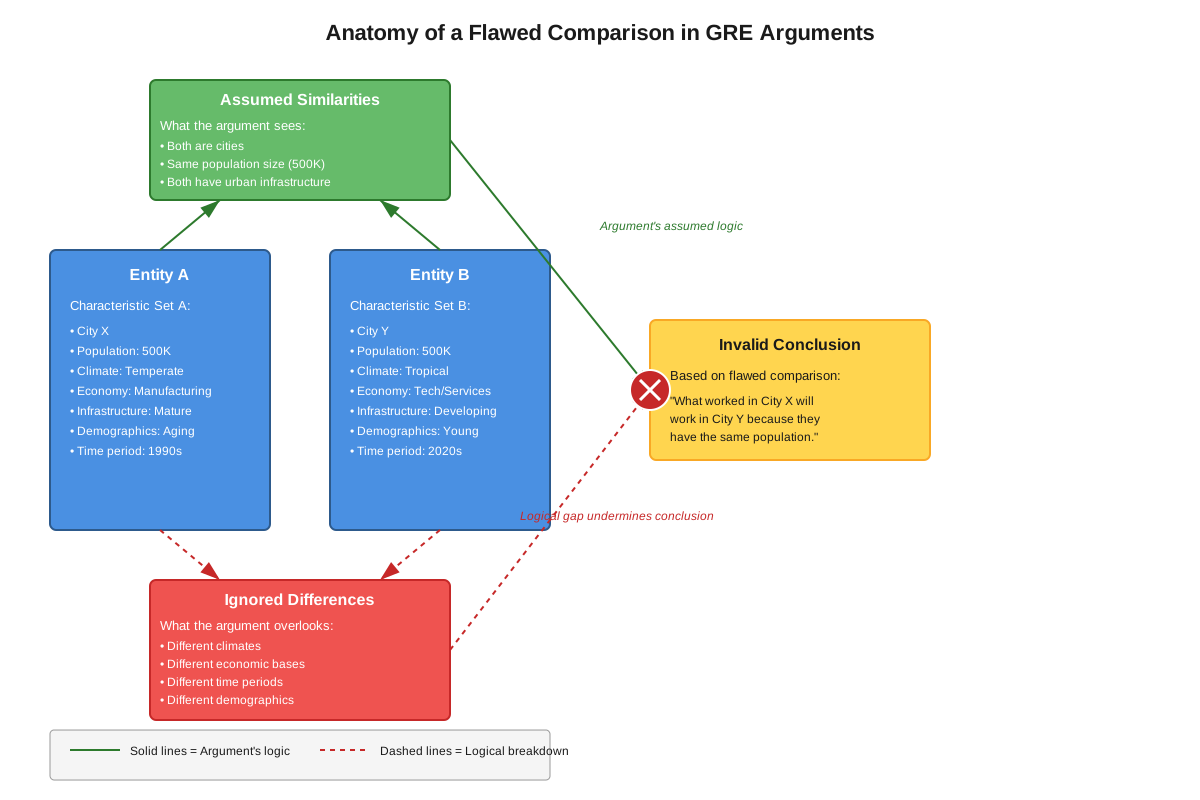
Flawed comparisons represent one of the most frequently tested logical fallacies in the GRE Analytical Writing section, particularly in the Argument Essay. When an argument relies on a comparison between two or more entities—whether they are groups, time periods, locations, or situations—the validity of that comparison becomes a critical point of analysis. A comparison is flawed when it assumes that two things are sufficiently similar to warrant comparison while ignoring significant differences that could invalidate the conclusion drawn from that comparison.
Understanding GRE flawed comparisons is essential because these logical errors appear in approximately 40-50% of Argument Essay prompts. The GRE test makers deliberately construct arguments that draw conclusions based on comparisons between dissimilar entities, expecting test-takers to identify why these comparisons fail to support the argument's conclusion. Students who can quickly recognize and articulate the problems with flawed comparisons gain a significant advantage, as this skill directly translates to higher scores in the Analytical Writing section.
Within the broader context of Analytical Writing, flawed comparisons connect to fundamental principles of logical reasoning and evidence evaluation. This topic relates closely to other common argument flaws such as hasty generalizations, false analogies, and insufficient evidence. Mastering flawed comparisons strengthens overall critical thinking skills and provides a framework for systematically dismantling weak arguments—a core competency the GRE measures across multiple sections.
Learning Objectives
- [ ] Identify when flawed comparisons is being tested in GRE Argument Essay prompts
- [ ] Explain the core rule or strategy behind flawed comparisons and why they undermine arguments
- [ ] Apply flawed comparisons analysis to GRE-style questions accurately and comprehensively
- [ ] Distinguish between valid and invalid comparisons based on relevant similarities and differences
- [ ] Articulate specific questions that expose the weaknesses in flawed comparisons
- [ ] Construct well-developed paragraphs that analyze flawed comparisons using appropriate evidence and reasoning
- [ ] Recognize the various forms flawed comparisons take across different argument contexts
Prerequisites
- Basic logical reasoning: Understanding how premises support conclusions is necessary to identify when comparative evidence fails to provide adequate support
- Argument structure analysis: Recognizing the components of an argument (premises, assumptions, conclusions) enables identification of where flawed comparisons appear in the logical chain
- Critical reading skills: The ability to read arguments carefully and identify implicit assumptions is essential for detecting unstated similarities that comparisons assume
- Fundamental writing proficiency: Expressing analytical ideas clearly is required to articulate why specific comparisons are problematic
Why This Topic Matters
Flawed comparisons appear in real-world contexts constantly—from business decisions based on competitor analysis to policy recommendations drawn from other jurisdictions' experiences. Marketing campaigns compare products, medical treatments are evaluated against alternatives, and educational reforms are justified by pointing to other schools or districts. The ability to evaluate whether these comparisons are valid protects against faulty reasoning in professional, academic, and personal decision-making contexts.
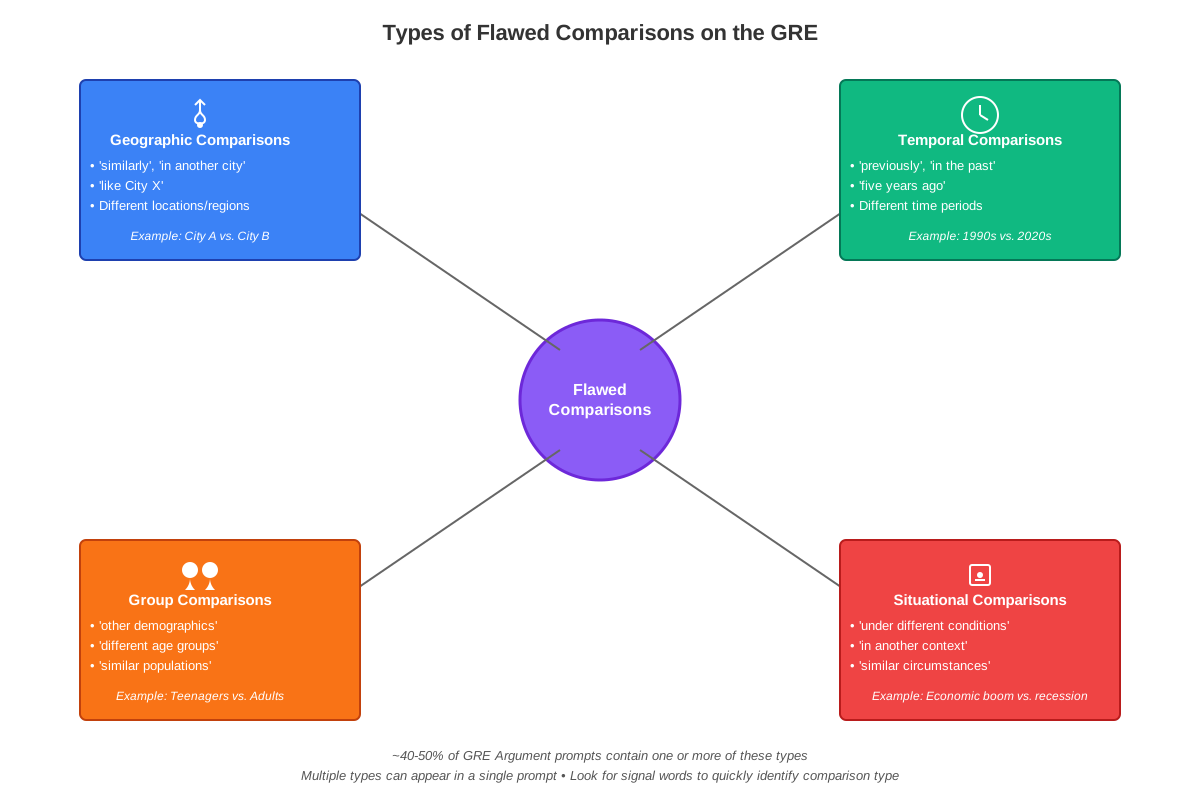
On the GRE specifically, flawed comparisons appear in 40-50% of Argument Essay prompts, making this one of the highest-yield topics for test preparation. These prompts typically present arguments that compare different groups (e.g., two cities, two companies, two time periods) and draw conclusions assuming the groups are sufficiently similar. The GRE awards higher scores to essays that identify multiple flaws, and flawed comparisons often provide rich material for analysis because they involve multiple dimensions of difference.
Common manifestations in GRE passages include: comparing past and present conditions while ignoring changed circumstances; comparing different geographic locations without accounting for demographic or cultural differences; comparing different groups of people without considering relevant characteristics; and comparing different products, services, or policies without acknowledging contextual factors that might affect outcomes. Test-takers who recognize these patterns can quickly identify analytical opportunities and structure their essays more effectively.
Core Concepts
Definition of Flawed Comparisons
A flawed comparison occurs when an argument draws a conclusion by comparing two or more entities while failing to establish that these entities are sufficiently similar in relevant respects. The flaw lies not in making comparisons per se—comparisons can provide valuable evidence—but in assuming similarity without justification or ignoring significant differences that could invalidate the comparison's usefulness.
For a comparison to validly support a conclusion, the compared entities must be similar in ways that are relevant to the conclusion being drawn. This is the critical test: even if two things share some characteristics, if they differ in ways that matter to the argument's conclusion, the comparison fails to provide strong support.
Types of Flawed Comparisons
Temporal Comparisons (Past vs. Present)
Arguments frequently compare past conditions to present circumstances, assuming that what worked before will work now or that past trends will continue. These comparisons are flawed when they ignore:
- Changed economic conditions
- Technological advances
- Demographic shifts
- Altered competitive landscapes
- Different regulatory environments
- Cultural or social changes
Example: "Five years ago, our company increased profits by reducing staff. Therefore, we should reduce staff again to increase profits now." This comparison assumes current conditions match those of five years ago, ignoring potential changes in market demand, competition, or operational efficiency.
Geographic Comparisons (Different Locations)
Arguments often compare different cities, regions, or countries, concluding that what succeeded in one location will succeed in another. These comparisons fail when they overlook:
- Population size and density differences
- Demographic composition variations
- Economic conditions and income levels
- Cultural preferences and values
- Climate and geographic features
- Existing infrastructure
- Legal and regulatory frameworks
Example: "City A implemented a bike-sharing program successfully, so City B should implement the same program." This comparison is flawed if City B has different weather patterns, urban density, public transportation infrastructure, or cycling culture.
Group Comparisons (Different Populations)
Arguments may compare different groups of people—customers, employees, students, residents—assuming that what applies to one group applies to another. Critical differences include:
- Age and generational characteristics
- Income and socioeconomic status
- Education levels
- Cultural backgrounds
- Preferences and values
- Prior experiences
- Motivations and goals
Example: "Teenagers responded positively to our advertising campaign, so senior citizens will also respond positively." This ignores fundamental differences in media consumption, values, and purchasing behavior between age groups.
Product or Service Comparisons
Arguments comparing different products, services, or policies often assume transferability of results without considering:
- Different features or quality levels
- Price point differences
- Target market variations
- Brand reputation and recognition
- Distribution channels
- Complementary products or services
- Implementation contexts
The Relevance Principle
The key to evaluating comparisons is the relevance principle: differences matter only if they are relevant to the conclusion. Not every difference invalidates a comparison—only those differences that could plausibly affect the outcome being predicted or explained.
| Comparison Type | Potentially Relevant Differences | Less Relevant Differences |
|---|---|---|
| Two restaurants | Location, cuisine type, price range, target demographic | Owner's name, building color, number of letters in name |
| Two time periods | Economic conditions, technology, regulations, demographics | Specific calendar dates, day of week |
| Two cities | Population size, climate, infrastructure, culture | Geographic coordinates, city founding date |
| Two products | Features, price, quality, brand reputation | Packaging color (unless relevant to marketing) |
Identifying Assumed Similarities
Flawed comparisons rest on unstated assumptions about similarity. When analyzing an argument, identify what the comparison assumes:
- Explicit comparison: What entities are being compared?
- Implicit assumption: What similarities does the argument assume exist?
- Potential differences: What differences might exist that the argument ignores?
- Relevance assessment: How might these differences affect the conclusion?
The Burden of Proof
In logical analysis, the argument bears the burden of establishing that a comparison is valid. The argument must provide evidence that compared entities are similar in relevant respects. When an argument simply asserts a comparison without justification, it commits the flaw of assuming similarity without proof.
Concept Relationships
Flawed comparisons connect to several other logical fallacies and analytical concepts. Understanding these relationships strengthens overall argument analysis skills.
Flawed Comparisons → Hasty Generalizations: Both involve drawing conclusions from insufficient evidence. A flawed comparison is essentially a hasty generalization that assumes one case (the comparison entity) provides adequate evidence for conclusions about another case.
Flawed Comparisons → False Analogies: These concepts overlap significantly. A false analogy is a type of flawed comparison where the argument draws parallels between fundamentally different situations. All false analogies involve flawed comparisons, though not all flawed comparisons are presented as explicit analogies.
Flawed Comparisons → Unwarranted Assumptions: Every flawed comparison rests on unwarranted assumptions about similarity. Identifying flawed comparisons requires uncovering these hidden assumptions.
Flawed Comparisons → Insufficient Evidence: When an argument relies on a flawed comparison, it suffers from insufficient evidence because the comparison fails to provide strong support for the conclusion.
Prerequisite: Argument Structure → Flawed Comparisons: Understanding how premises support conclusions enables recognition of when comparative evidence fails to provide adequate support.
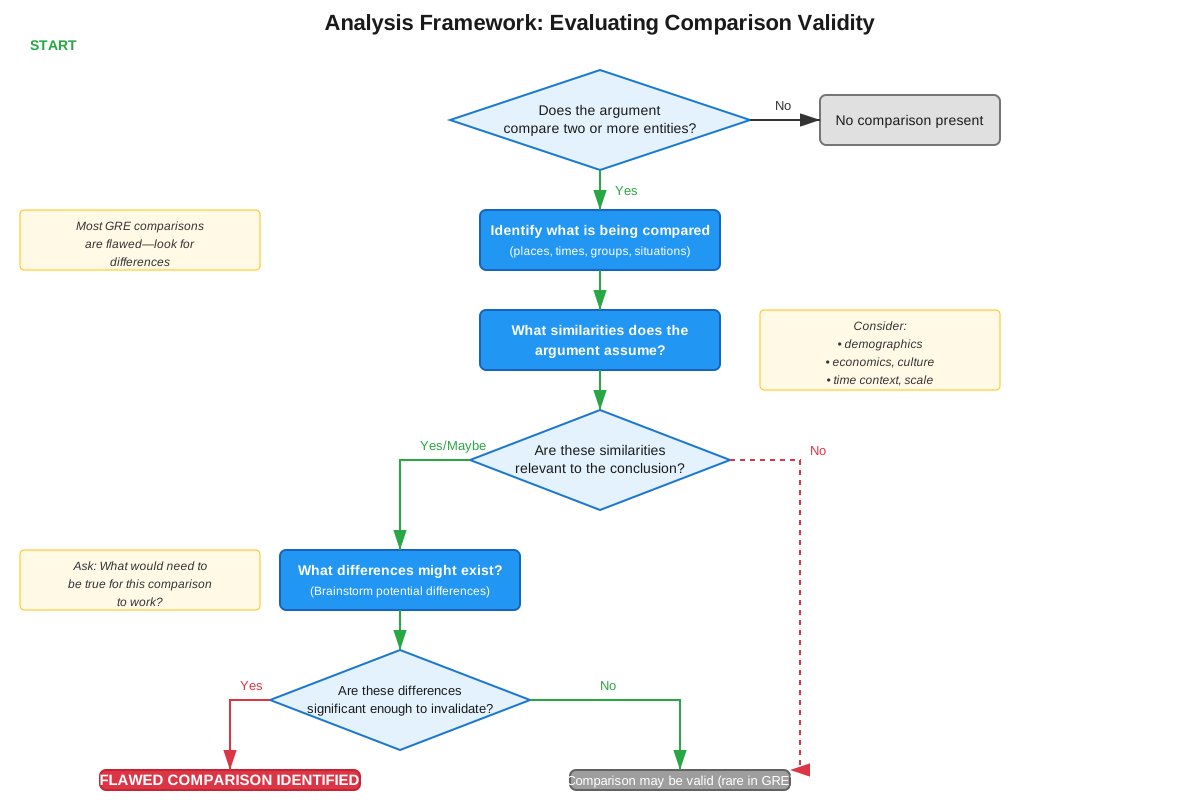
The analytical process flows: Identify argument structure → Locate comparative claims → Assess assumed similarities → Evaluate relevance of differences → Articulate the flaw → Explain impact on conclusion.
High-Yield Facts
⭐ Flawed comparisons appear in 40-50% of GRE Argument Essay prompts, making them one of the most frequently tested logical flaws.
⭐ A comparison is flawed when it assumes similarity in relevant respects without providing evidence that the compared entities are actually similar in those ways.
⭐ Not all differences matter—only differences relevant to the argument's conclusion invalidate a comparison.
⭐ Temporal comparisons (past vs. present) are especially common and often ignore changed circumstances, technology, or conditions.
⭐ Geographic comparisons must account for demographic, cultural, economic, and infrastructural differences between locations.
- Flawed comparisons often involve implicit rather than explicit claims, requiring careful reading to identify.
- The argument bears the burden of proving similarity; the analyst's job is to identify what evidence is missing.
- Multiple dimensions of difference can exist simultaneously, providing rich material for essay development.
- Effective analysis of flawed comparisons requires specific examples of how differences could affect outcomes.
- Comparisons between groups must consider whether the groups share relevant characteristics related to the conclusion.
- Even if two entities are similar in some respects, they may differ in ways that matter more to the conclusion.
- Flawed comparisons often combine with other logical flaws, such as causal reasoning errors or sampling problems.
Quick check — test yourself on Flawed comparisons so far.
Try Flashcards →Common Misconceptions
Misconception: Any comparison in an argument is automatically flawed.
Correction: Comparisons can provide valid evidence when the compared entities are demonstrably similar in relevant respects. The flaw exists only when significant relevant differences are ignored or when similarity is assumed without justification.
Misconception: Identifying a flawed comparison simply requires listing any differences between compared entities.
Correction: Effective analysis requires explaining why specific differences are relevant to the argument's conclusion. Irrelevant differences do not constitute valid criticisms.
Misconception: Flawed comparisons only occur when comparing obviously different things.
Correction: The most challenging flawed comparisons involve entities that appear similar on the surface but differ in subtle yet important ways. Two restaurants, two cities, or two time periods may seem comparable but have crucial differences.
Misconception: Pointing out that "the argument assumes the situations are comparable" is sufficient analysis.
Correction: Strong GRE essays must go further, specifying what similarities the argument assumes, what differences might exist, and how these differences could affect the conclusion. Generic statements earn lower scores.
Misconception: Flawed comparisons are the same as false analogies in all cases.
Correction: While closely related, false analogies typically involve more elaborate parallels between different domains (e.g., comparing a business to a sports team), while flawed comparisons may involve simpler comparisons within the same domain (e.g., two businesses) that still fail due to relevant differences.
Misconception: If an argument provides any information about the compared entities, the comparison cannot be flawed.
Correction: Even when an argument provides some information, it may still fail to establish similarity in the most relevant respects. The question is whether sufficient evidence exists to justify the comparison, not whether any evidence exists.
Worked Examples
Example 1: Restaurant Comparison
Argument: "The Pasta Palace restaurant in downtown Millville increased its profits by 30% after adding a lunch buffet. Therefore, the Seafood Shack restaurant in coastal Baytown should also add a lunch buffet to increase its profits."
Analysis Process:
Step 1 - Identify the comparison: The argument compares Pasta Palace in Millville to Seafood Shack in Baytown, concluding that what worked for one will work for the other.
Step 2 - Identify assumed similarities: The argument assumes these restaurants are similar enough that the lunch buffet strategy will transfer successfully. It assumes similar customer bases, locations, competitive environments, and operational contexts.
Step 3 - Identify potential relevant differences:
- Location type: Downtown vs. coastal location may attract different customer types (office workers vs. tourists)
- Cuisine type: Pasta vs. seafood may have different cost structures and buffet feasibility
- Customer demographics: Different cities may have different population characteristics
- Competition: The competitive landscape may differ between locations
- Existing offerings: The restaurants may have different current menu structures
- Price points: The restaurants may target different market segments
Step 4 - Explain relevance: A downtown location likely attracts office workers seeking quick, affordable lunch options—ideal for a buffet. A coastal location may attract tourists or dinner customers less interested in lunch buffets. Seafood is typically more expensive and perishable than pasta, making buffet economics different. These differences directly affect whether a lunch buffet would succeed.
Step 5 - Articulate the flaw: The argument fails to establish that Seafood Shack operates in a context similar enough to Pasta Palace to warrant expecting similar results. Without evidence that the restaurants share relevant characteristics—customer base, location type, cuisine economics, and competitive environment—the comparison provides weak support for the recommendation.
Connection to learning objectives: This example demonstrates how to identify flawed comparisons (Objective 1), explains why the comparison fails (Objective 2), and shows the analytical process for GRE-style arguments (Objective 3).
Example 2: Temporal Comparison
Argument: "Ten years ago, Techville's unemployment rate decreased after the city government reduced business taxes. Currently, Techville faces high unemployment again. Therefore, the city should reduce business taxes now to decrease unemployment."
Analysis Process:
Step 1 - Identify the comparison: The argument compares Techville ten years ago to Techville today, assuming that the same policy will produce the same results.
Step 2 - Identify assumed similarities: The argument assumes current economic conditions, business environment, and labor market dynamics are similar to those of ten years ago.
Step 3 - Identify potential relevant differences:
- Economic conditions: The broader economy may be in a different phase (recession vs. growth)
- Technology: Automation and technological change may have altered labor needs
- Industry composition: The types of businesses in Techville may have changed
- Workforce skills: The match between worker skills and employer needs may differ
- Competition: Other cities' tax policies may have changed, affecting competitiveness
- Regulatory environment: Other regulations affecting business may have changed
- Causes of unemployment: The reasons for current unemployment may differ from past causes
Step 4 - Explain relevance: If current unemployment stems from automation replacing workers, tax cuts may not create jobs. If the workforce lacks skills for available positions, tax policy won't address the mismatch. If the broader economy is in recession, local tax cuts may have limited impact. The effectiveness of tax reduction depends on why unemployment is high and whether businesses would hire more workers if taxes were lower—factors that may differ substantially from ten years ago.
Step 5 - Articulate the flaw: The argument assumes without justification that current conditions match those of a decade ago. Economic, technological, and social changes over ten years could fundamentally alter whether tax reduction would effectively reduce unemployment. The comparison fails to account for potentially significant differences between the two time periods.
Connection to learning objectives: This example illustrates temporal comparisons (a specific type of flawed comparison), demonstrates the analytical framework, and shows how to develop a comprehensive critique suitable for a GRE essay.
Exam Strategy
Recognition Triggers
Watch for these trigger phrases that signal potential flawed comparisons:
- "Similarly..." / "Likewise..."
- "Just as [X] did..." / "Like [X]..."
- "In the same way..."
- "[Time period] ago, [X] happened, so..."
- "In [other location], [X] worked, therefore..."
- "Other [groups/companies/cities] have..."
- Comparisons between past and present
- Comparisons between different locations
- Comparisons between different groups
Systematic Analysis Approach
Use this four-step process for analyzing flawed comparisons on the GRE:
- Identify: What two (or more) entities are being compared?
- Assume: What similarities does the argument assume exist?
- Differ: What relevant differences might exist?
- Impact: How could these differences affect the conclusion?
Essay Development Strategy
When writing about flawed comparisons, structure paragraphs using this framework:
Opening sentence: Identify the comparison and state that it's problematic.
Explanation: Explain what similarities the argument assumes.
Differences: Provide 2-3 specific, relevant differences that might exist.
Consequences: Explain how each difference could undermine the conclusion.
Strengthening: Suggest what evidence would be needed to validate the comparison.
Exam Tip: Spend 30-45 seconds identifying all comparisons in the argument before you begin writing. Many arguments contain multiple comparisons, and identifying them all ensures comprehensive analysis.
Time Allocation
For a 30-minute Argument Essay:
- 2-3 minutes: Reading and identifying flaws (including comparisons)
- 5-6 minutes: Planning (outline which comparisons to discuss)
- 18-20 minutes: Writing (typically 1-2 paragraphs on flawed comparisons)
- 3-4 minutes: Reviewing and editing
Scoring Optimization
Higher-scoring essays on flawed comparisons:
- Specify exactly what is being compared (don't just say "the argument makes a comparison")
- Articulate the assumed similarities explicitly
- Provide concrete examples of how differences could affect outcomes
- Explain the logical connection between differences and the conclusion
- Avoid generic language like "the situations might be different"
- Use sophisticated vocabulary: "demographic composition," "temporal context," "contextual factors," "relevant dimensions"
Memory Techniques
The COMPARE Acronym
Use COMPARE to remember key dimensions of difference to consider:
- Context (surrounding circumstances)
- Operations (how things function)
- Market (economic conditions, competition)
- Population (demographic characteristics)
- Age (time period, temporal factors)
- Region (geographic, cultural factors)
- Environment (regulatory, technological, social conditions)
The Three Questions Technique
Memorize these three questions to ask about any comparison:
- "What's being compared?" (Identify the entities)
- "What's assumed similar?" (Uncover implicit assumptions)
- "What might differ that matters?" (Find relevant differences)
Visualization Strategy
Picture a bridge connecting two islands. The argument claims you can walk across the bridge from Island A (the comparison case) to Island B (the situation in question). Your job is to identify the gaps in the bridge—the missing evidence about similarity. Each relevant difference is a missing plank that makes the bridge unsafe.
The Relevance Filter
Remember: "Different ≠ Relevant"
Not every difference matters. Use this mental filter: "Would this difference plausibly affect the outcome the argument predicts?" If yes, it's relevant; if no, it's not worth discussing.
Summary
Flawed comparisons represent a critical analytical skill for GRE Argument Essays, appearing in approximately half of all prompts. A comparison is flawed when an argument assumes that two or more entities are similar in relevant respects without providing adequate evidence for that similarity, or when it ignores significant differences that could invalidate the comparison. The key to analyzing flawed comparisons lies in identifying what the argument compares, articulating what similarities it assumes, specifying relevant differences that might exist, and explaining how those differences could undermine the conclusion. Common types include temporal comparisons (past vs. present), geographic comparisons (different locations), and group comparisons (different populations). Effective GRE essays on this topic go beyond merely noting that a comparison exists; they provide specific, detailed analysis of why the comparison fails to support the argument's conclusion, what evidence would be needed to validate the comparison, and how the identified differences could lead to different outcomes. Mastering flawed comparisons requires understanding the relevance principle—that only differences relevant to the conclusion matter—and developing the ability to articulate these analytical insights clearly and persuasively within the time constraints of the exam.
Key Takeaways
- Flawed comparisons appear in 40-50% of GRE Argument Essays, making them essential to master for test success
- A comparison is flawed when it assumes similarity without evidence or ignores relevant differences between compared entities
- Only relevant differences matter—differences must plausibly affect the conclusion to constitute valid criticisms
- Common comparison types include temporal (past vs. present), geographic (different locations), and group (different populations) comparisons
- Effective analysis requires specificity: identify exactly what's compared, what's assumed, what differs, and why it matters
- Use the four-step process: Identify → Assume → Differ → Impact for systematic analysis
- Strong essays explain consequences: show how differences could lead to different outcomes, not just that differences exist
Related Topics
False Analogies: While closely related to flawed comparisons, false analogies involve more elaborate parallels between different domains. Mastering flawed comparisons provides the foundation for analyzing false analogies.
Hasty Generalizations: Understanding flawed comparisons helps recognize when arguments generalize from insufficient or inappropriate examples, as both involve drawing conclusions from inadequate evidence.
Unwarranted Assumptions: Every flawed comparison rests on unwarranted assumptions about similarity. Developing skill in identifying these assumptions strengthens overall argument analysis.
Causal Reasoning Errors: Flawed comparisons often combine with causal reasoning problems, particularly when arguments compare situations to suggest that what caused an outcome in one case will cause the same outcome in another.
Survey and Sampling Issues: When arguments compare survey results or samples from different populations, both sampling methodology and flawed comparison issues may arise simultaneously.
Practice CTA
Now that you understand flawed comparisons comprehensively, you're ready to apply this knowledge to practice questions. The concepts covered here—identifying comparisons, assessing relevance, and articulating specific differences—will become more intuitive with practice. Attempt the practice questions to reinforce your understanding, and use the flashcards to memorize key trigger phrases and analytical frameworks. Remember that recognizing flawed comparisons quickly and analyzing them thoroughly can significantly boost your Analytical Writing score. Each practice essay you write strengthens your ability to spot these patterns and articulate sophisticated critiques under time pressure. You've built a strong foundation—now put it into action!
Sign up free to keep reading
Create a free AnvayaPrep account to finish this GRE guide on Flawed comparisons — plus flashcards and practice questions.