Overview
Divisibility rules are fundamental shortcuts that allow test-takers to determine whether one integer divides evenly into another without performing long division. On the GRE Quantitative Reasoning section, these rules serve as powerful time-saving tools that can transform complex arithmetic problems into simple pattern-recognition tasks. Rather than calculating 4,536 ÷ 9 through traditional division, understanding divisibility rules enables instant recognition that 4,536 is divisible by 9 because the sum of its digits (4+5+3+6=18) is divisible by 9.
The importance of gre divisibility rules extends far beyond simple division problems. These rules form the foundation for solving questions involving factors, multiples, prime factorization, remainders, and number properties—topics that collectively account for approximately 15-20% of GRE Quantitative questions. Mastery of divisibility rules accelerates problem-solving speed, reduces calculation errors, and often reveals elegant solution paths that bypass tedious computation entirely.
Within the broader Quantitative Reasoning framework, divisibility rules connect arithmetic fundamentals to more advanced topics including greatest common divisors (GCD), least common multiples (LCM), modular arithmetic, and algebraic factoring. They also underpin data interpretation questions where recognizing divisibility patterns helps identify valid answer choices quickly. For competitive test-takers aiming for scores above the 160 threshold, automatic recall and application of these rules is non-negotiable.
Learning Objectives
- [ ] Identify when Divisibility rules is being tested
- [ ] Explain the core rule or strategy behind Divisibility rules
- [ ] Apply Divisibility rules to GRE-style questions accurately
- [ ] Determine divisibility by 2, 3, 4, 5, 6, 8, 9, 10, and 11 within 10 seconds per number
- [ ] Combine multiple divisibility rules to solve complex factor and multiple problems
- [ ] Recognize when divisibility rules can eliminate incorrect answer choices efficiently
Prerequisites
- Basic arithmetic operations: Addition, subtraction, multiplication, and division form the computational foundation for understanding why divisibility rules work
- Place value understanding: Recognizing ones, tens, hundreds places enables comprehension of digit-based divisibility tests
- Integer properties: Distinguishing between positive integers, negative integers, and zero is essential since divisibility rules apply specifically to integers
- Factor and multiple concepts: Understanding that divisibility is equivalent to saying "one number is a factor of another" or "one number is a multiple of another"
Why This Topic Matters
Divisibility rules represent one of the highest-yield topics in GRE preparation relative to time invested. These rules appear directly in approximately 8-12% of Quantitative Reasoning questions and indirectly support solving another 10-15% of problems involving number properties, data sufficiency, and quantitative comparison formats.
In real-world applications, divisibility rules underpin computer science algorithms, cryptography systems, quality control processes (sampling every nth item), scheduling problems (rotating shifts), and financial calculations (equal distribution of resources). The mental math skills developed through divisibility practice enhance overall numerical fluency valuable in business, research, and everyday decision-making.
On the GRE specifically, divisibility rules appear in multiple question formats: Problem Solving questions asking "How many integers between X and Y are divisible by Z?", Quantitative Comparison questions comparing expressions involving factors or multiples, and Data Sufficiency questions where determining divisibility helps evaluate statement sufficiency. The test frequently embeds divisibility within word problems about grouping objects, scheduling events, or analyzing data patterns. Questions may ask about remainders (the complement of divisibility), require finding the greatest common factor, or test understanding of when a product or sum maintains divisibility properties.
Core Concepts
Fundamental Definition of Divisibility
An integer a is divisible by an integer b (where b ≠ 0) if and only if there exists an integer k such that a = b × k. Equivalently, when a is divided by b, the remainder is zero. This relationship means b is a factor of a, and a is a multiple of b. Understanding this bidirectional relationship is crucial: asking "Is 24 divisible by 6?" is identical to asking "Is 6 a factor of 24?" or "Is 24 a multiple of 6?"
Divisibility by 2
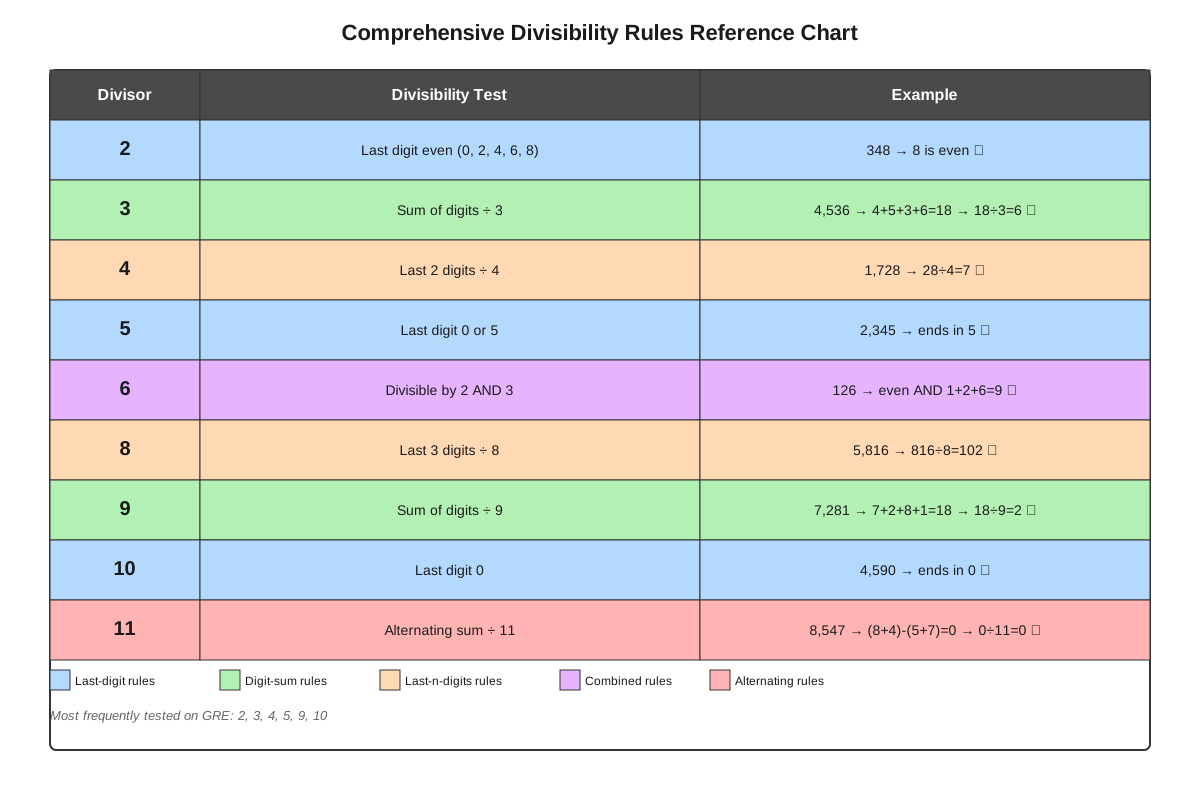
A number is divisible by 2 if and only if its last digit (ones place) is even: 0, 2, 4, 6, or 8. This rule works because 10, 100, 1000, and all higher place values are divisible by 2, so only the ones digit determines overall divisibility.
Examples:
- 3,746 is divisible by 2 (ends in 6)
- 8,291 is not divisible by 2 (ends in 1)
Divisibility by 3
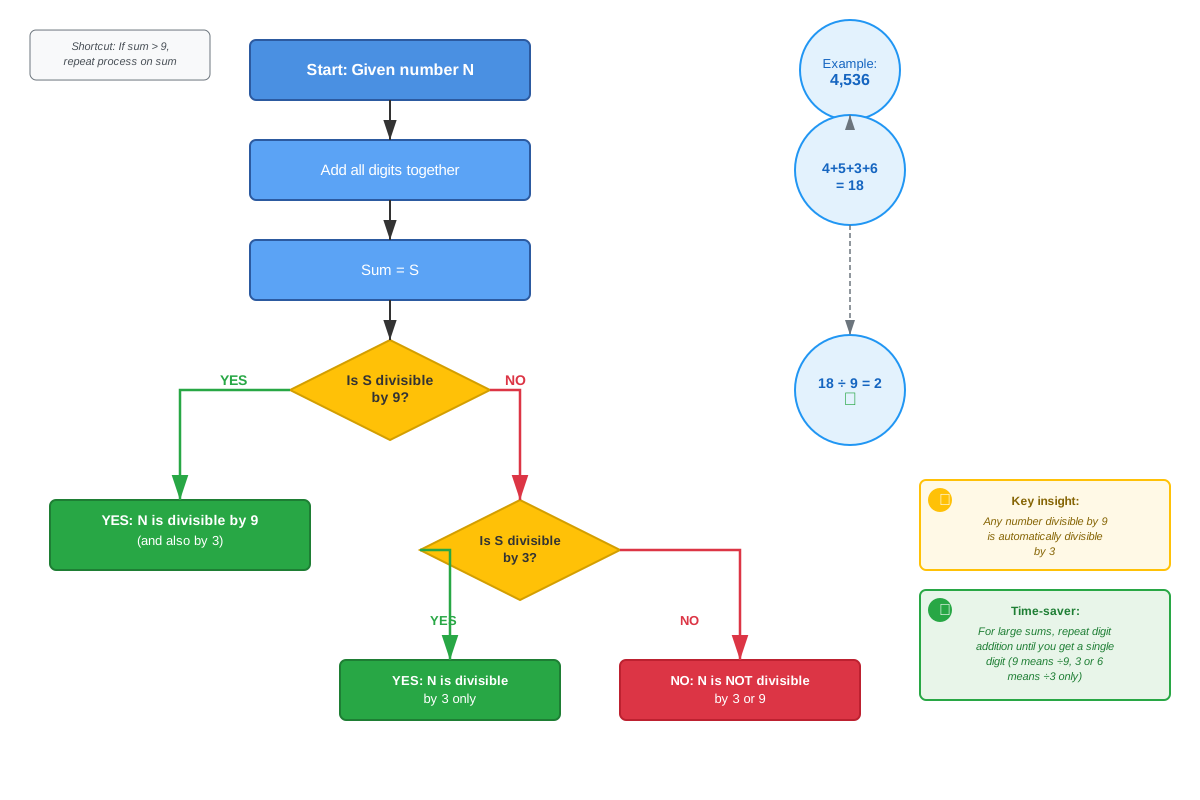
A number is divisible by 3 if and only if the sum of its digits is divisible by 3. This remarkable property stems from the fact that 10 ≡ 1 (mod 3), meaning 10 leaves remainder 1 when divided by 3, as do 100, 1000, and all powers of 10.
Examples:
- 5,427: Sum = 5+4+2+7 = 18, and 18÷3 = 6, so 5,427 is divisible by 3
- 8,134: Sum = 8+1+3+4 = 16, and 16÷3 has remainder 1, so 8,134 is not divisible by 3
Iterative application: If the digit sum is large, apply the rule repeatedly. For 9,876: 9+8+7+6=30, then 3+0=3, which is divisible by 3.
Divisibility by 4
A number is divisible by 4 if and only if its last two digits form a number divisible by 4. Since 100 is divisible by 4 (and therefore all multiples of 100), only the tens and ones places matter.
Examples:
- 7,316 is divisible by 4 because 16÷4 = 4
- 5,422 is not divisible by 4 because 22÷4 = 5.5
Quick check: Memorize that 00, 04, 08, 12, 16, 20, 24, 28, 32, 36, 40, 44, 48, 52, 56, 60, 64, 68, 72, 76, 80, 84, 88, 92, 96 are all divisible by 4.
Divisibility by 5
A number is divisible by 5 if and only if its last digit is 0 or 5. This is the simplest divisibility rule and follows from 10 being divisible by 5.
Examples:
- 8,945 is divisible by 5
- 7,623 is not divisible by 5
Divisibility by 6
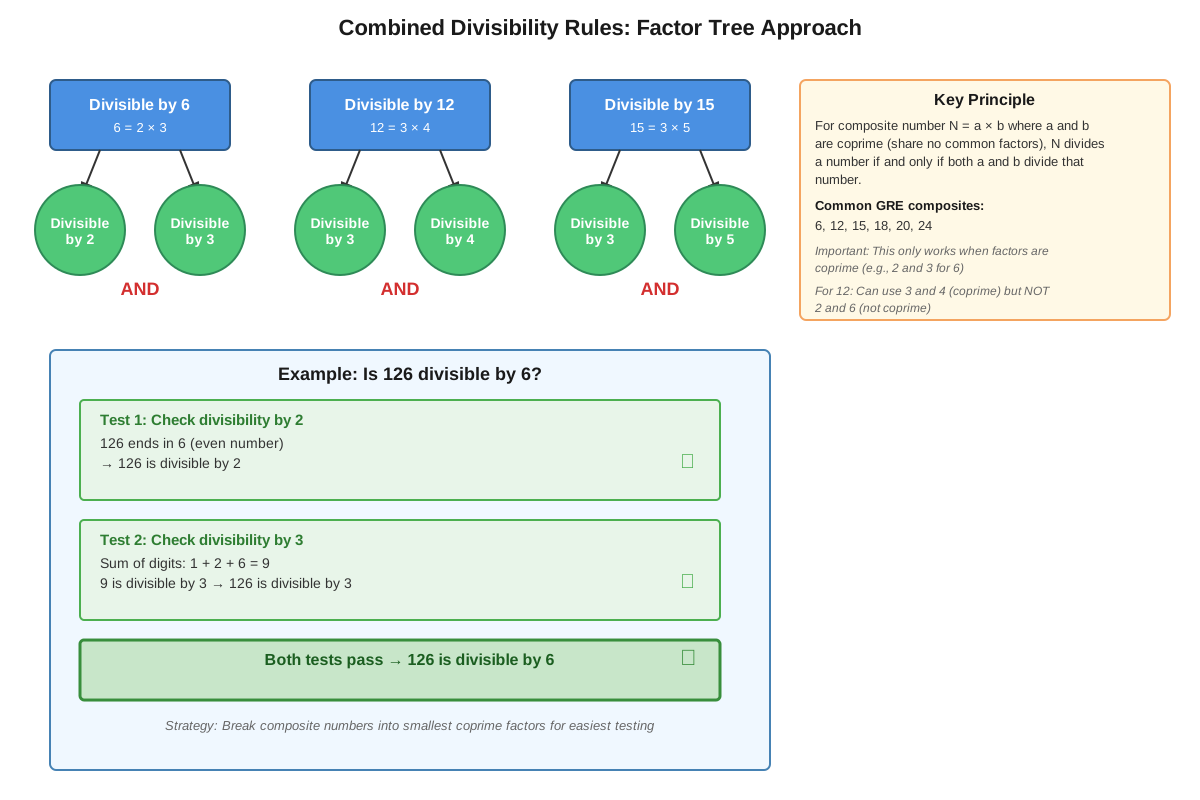
A number is divisible by 6 if and only if it is divisible by both 2 and 3. Since 6 = 2 × 3 and 2 and 3 are coprime (share no common factors), a number must satisfy both conditions.
Examples:
- 4,536: Last digit is 6 (divisible by 2), digit sum is 4+5+3+6=18 (divisible by 3), so divisible by 6
- 4,532: Last digit is 2 (divisible by 2), but digit sum is 14 (not divisible by 3), so not divisible by 6
Divisibility by 8
A number is divisible by 8 if and only if its last three digits form a number divisible by 8. Since 1000 is divisible by 8, only the last three digits determine divisibility.
Examples:
- 15,624 is divisible by 8 because 624÷8 = 78
- 23,418 is not divisible by 8 because 418÷8 = 52.25
Alternative method: Halve the last three digits twice; if the result is a whole number, the original is divisible by 8.
Divisibility by 9
A number is divisible by 9 if and only if the sum of its digits is divisible by 9. This follows the same principle as divisibility by 3, since 10 ≡ 1 (mod 9).
Examples:
- 7,362: Sum = 7+3+6+2 = 18, and 18÷9 = 2, so divisible by 9
- 5,437: Sum = 5+4+3+7 = 19, not divisible by 9
Key distinction: Every number divisible by 9 is also divisible by 3, but not vice versa.
Divisibility by 10
A number is divisible by 10 if and only if its last digit is 0. This is immediate since 10 = 2 × 5.
Divisibility by 11
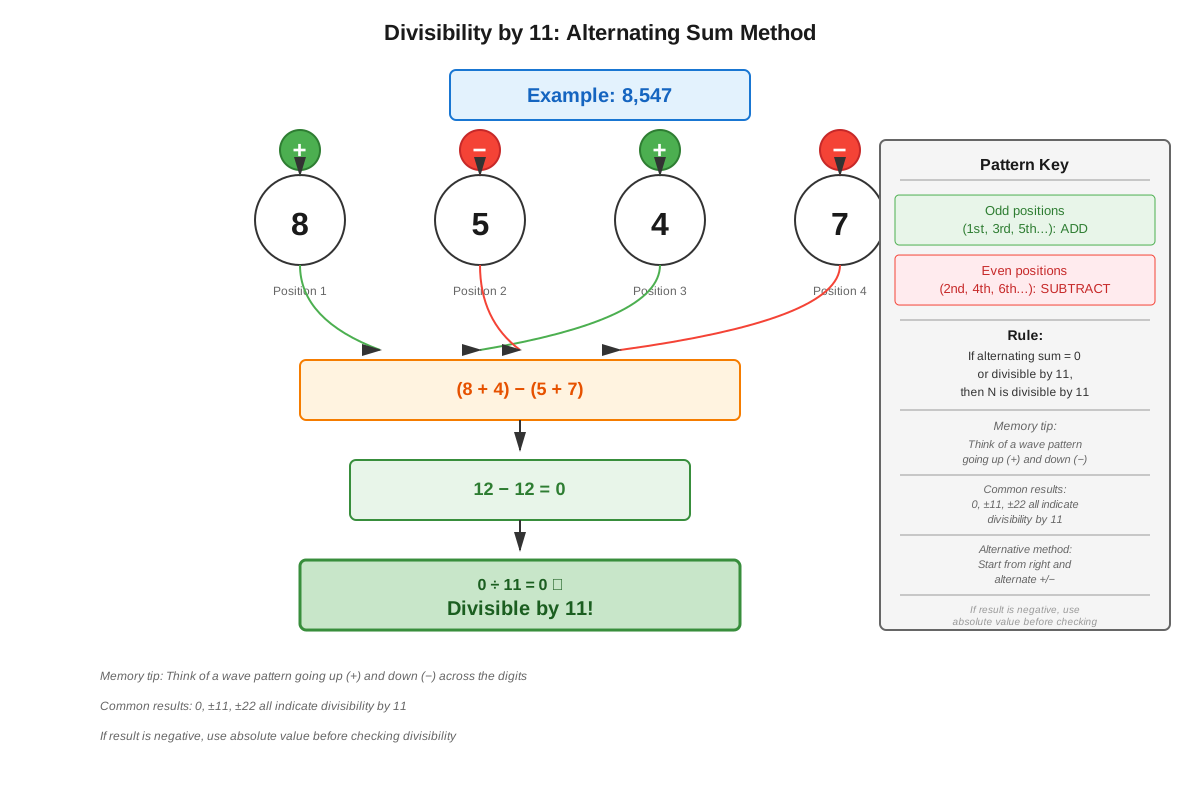
A number is divisible by 11 if and only if the alternating sum of its digits is divisible by 11. Starting from the right, subtract and add alternately.
Examples:
- 8,437: 7-3+4-8 = 0, and 0 is divisible by 11, so 8,437 is divisible by 11
- 5,291: 1-9+2-5 = -11, and -11 is divisible by 11, so 5,291 is divisible by 11
- 7,346: 6-4+3-7 = -2, not divisible by 11
Pattern recognition: For two-digit numbers, divisibility by 11 means both digits are the same (11, 22, 33, etc.).
Composite Divisibility Rules
For divisibility by composite numbers not covered above, use prime factorization:
- Divisibility by 12: Must be divisible by both 3 and 4 (since 12 = 3 × 4 and gcd(3,4)=1)
- Divisibility by 15: Must be divisible by both 3 and 5 (since 15 = 3 × 5)
- Divisibility by 18: Must be divisible by both 2 and 9 (since 18 = 2 × 9)
Divisibility Properties
Several algebraic properties extend divisibility rules:
- Transitivity: If a|b and b|c, then a|c
- Linear combination: If a|b and a|c, then a|(bx + cy) for any integers x and y
- Product rule: If a|b, then a|(b×c) for any integer c
- Sum/difference: If a|b and a|c, then a|(b±c)
Concept Relationships
The divisibility rules form a hierarchical network based on prime factorization. At the foundation lie the prime divisibility rules (2, 3, 5, 7, 11), which cannot be reduced further. These prime rules combine to create composite divisibility rules through multiplication: the rule for 6 emerges from combining rules for 2 and 3, while the rule for 10 combines rules for 2 and 5.
Relationship map:
- Prime rules (2, 3, 5, 11) → Composite rules (4=2², 6=2×3, 8=2³, 9=3², 10=2×5, 12=2²×3, 15=3×5, 18=2×3²)
- Digit sum rules (3, 9) → Share common mechanism based on modular arithmetic
- Last-digit rules (2, 5, 10) → Simplest pattern recognition
- Last-digits rules (4, 8) → Extension of last-digit concept
- Alternating sum rule (11) → Unique mechanism requiring subtraction
Divisibility rules connect backward to prerequisite topics including place value (explaining why last-digit rules work), basic arithmetic (computing digit sums), and factor/multiple definitions (providing the conceptual foundation). They connect forward to advanced topics including GCD/LCM calculations (finding common factors), prime factorization (decomposing numbers), modular arithmetic (remainder patterns), and algebraic factoring (identifying common factors in expressions).
Quick check — test yourself on Divisibility rules so far.
Try Flashcards →High-Yield Facts
⭐ A number divisible by 9 is automatically divisible by 3, but not vice versa (since 9 = 3²)
⭐ For divisibility by 6, check both 2 and 3 separately—the number must pass both tests
⭐ The divisibility rule for 4 uses only the last two digits, not the entire number
⭐ Divisibility by 8 requires checking the last three digits, which can be tested by dividing by 8 or halving twice
⭐ The alternating sum for divisibility by 11 starts from the ones place: ones - tens + hundreds - thousands...
- A number ending in 0 is divisible by both 2, 5, and 10 simultaneously
- If a number is divisible by both 4 and 3, it must be divisible by 12
- Zero is divisible by every non-zero integer (since 0 = k × 0 for any k)
- Divisibility by 7 has no simple digit-based rule practical for the GRE; use actual division or elimination
- The sum of digits can be repeatedly applied: if 9+8+7+6=30, check 3+0=3 for divisibility by 3
- Negative numbers follow the same divisibility rules as their positive counterparts
- For divisibility by 15, a number must end in 0 or 5 AND have a digit sum divisible by 3
- If the last three digits of a number are 000, the number is divisible by 8 (and also 2, 4, 5, 10)
Common Misconceptions
Misconception: A number divisible by 3 is also divisible by 9 → Correction: Divisibility by 9 is stricter than divisibility by 3. While 12 is divisible by 3 (digit sum = 3), it is not divisible by 9. The relationship only works in reverse: divisibility by 9 guarantees divisibility by 3.
Misconception: To check divisibility by 4, just look at the last digit → Correction: Divisibility by 4 requires examining the last TWO digits. For example, 318 ends in 8 (even), but 18÷4 = 4.5, so 318 is not divisible by 4. Only checking the last digit tests divisibility by 2.
Misconception: The alternating sum for divisibility by 11 can start from either end → Correction: The alternating sum must follow a consistent pattern. The standard convention starts from the ones place (right side): ones - tens + hundreds - thousands. Starting from the left would give incorrect results for some numbers.
Misconception: If a number is divisible by 2 and 4, it must be divisible by 8 → Correction: Divisibility by 4 already implies divisibility by 2 (since 4 = 2²), but neither guarantees divisibility by 8. For example, 12 is divisible by both 2 and 4 but not by 8. To be divisible by 8, the last three digits must form a number divisible by 8.
Misconception: Divisibility rules work for decimals and fractions → Correction: Divisibility rules apply exclusively to integers. The concept of "divisible" requires that both the dividend and divisor are integers and that the quotient is also an integer with no remainder. Asking if 7.5 is divisible by 2.5 is meaningless in this context.
Misconception: A number divisible by 6 and 4 must be divisible by 24 → Correction: This is only true if 6 and 4 were coprime, but they share a common factor of 2. The number 12 is divisible by both 6 and 4 but not by 24. To guarantee divisibility by 24 = 2³ × 3, check divisibility by 8 (not just 4) and by 3.
Worked Examples
Example 1: Multi-Step Divisibility Problem
Question: How many positive integers less than 500 are divisible by both 6 and 8?
Solution:
Step 1: Recognize that "divisible by both 6 and 8" means divisible by their least common multiple (LCM).
Step 2: Find LCM(6, 8):
- 6 = 2 × 3
- 8 = 2³
- LCM = 2³ × 3 = 24
Step 3: Count multiples of 24 less than 500:
- Divide: 500 ÷ 24 = 20.83...
- Since we need integers less than 500, take the floor: 20
Step 4: Verify with divisibility rules:
- 24 is divisible by 6 (even and digit sum 2+4=6 is divisible by 3) ✓
- 24 is divisible by 8 (last three digits = 024, and 24÷8=3) ✓
Answer: 20 positive integers
Connection to learning objectives: This problem requires identifying that divisibility rules are being tested (Objective 1), applying the rules for 6 and 8 (Objective 3), and combining multiple rules to solve a complex problem (Objective 5).
Example 2: Quantitative Comparison with Divisibility
Question:
Column A: The number of integers between 100 and 200 that are divisible by 9
Column B: The number of integers between 200 and 300 that are divisible by 11
Solution:
Column A Analysis:
Step 1: Find the first integer ≥ 100 divisible by 9:
- 100 ÷ 9 = 11.11..., so start with 9 × 12 = 108
Step 2: Find the last integer ≤ 200 divisible by 9:
- 200 ÷ 9 = 22.22..., so end with 9 × 22 = 198
Step 3: Count: From 12 to 22 inclusive = 22 - 12 + 1 = 11 integers
Verify using divisibility rule: 108 has digit sum 1+0+8=9 (divisible by 9) ✓
Column B Analysis:
Step 1: Find the first integer ≥ 200 divisible by 11:
- 200 ÷ 11 = 18.18..., so start with 11 × 19 = 209
Step 2: Find the last integer ≤ 300 divisible by 11:
- 300 ÷ 11 = 27.27..., so end with 11 × 27 = 297
Step 3: Count: From 19 to 27 inclusive = 27 - 19 + 1 = 9 integers
Verify using divisibility rule: 209 has alternating sum 9-0+2=11 (divisible by 11) ✓
Comparison: Column A (11) > Column B (9)
Answer: Column A is greater
Connection to learning objectives: This demonstrates identifying divisibility testing in quantitative comparison format (Objective 1), explaining the core strategies for divisibility by 9 and 11 (Objective 2), and applying rules accurately to eliminate answer choices (Objective 6).
Exam Strategy
Recognition Triggers
Watch for these trigger phrases that signal divisibility rule application:
- "divisible by"
- "evenly divided"
- "is a multiple of"
- "is a factor of"
- "leaves no remainder"
- "how many integers between X and Y"
- "what is the remainder when" (complement of divisibility)
Systematic Approach
- Identify the divisor: Determine which number(s) you're testing divisibility by
- Select the appropriate rule: Match the divisor to its rule (2, 3, 4, 5, 6, 8, 9, 10, or 11)
- Apply efficiently: Use only the relevant digits (last digit, last two, last three, or digit sum)
- Verify if time permits: For critical calculations, double-check using a different method
Process of Elimination
- Eliminate by last digit first: If testing divisibility by 2, 5, or 10, scan answer choices and eliminate those with impossible last digits
- Use digit sum for 3 and 9: Quickly calculate digit sums mentally to eliminate non-divisible options
- Combine rules for composite numbers: When testing divisibility by 6, 12, 15, or 18, eliminate options that fail any component test
- Check extremes: For "how many" questions, verify the boundary cases to avoid off-by-one errors
Time Allocation
- Simple divisibility check: 5-10 seconds per number
- Counting multiples in a range: 30-45 seconds
- Complex multi-step problems: 60-90 seconds
- If a divisibility rule doesn't exist (e.g., for 7 or 13): Consider alternative approaches like prime factorization, actual division, or answer choice testing rather than spending time deriving a rule
GRE Tip: When a problem involves divisibility by 7, 13, or other primes without simple rules, the question likely tests a different concept (like prime factorization or systematic counting) rather than expecting you to perform complex division.
Memory Techniques
Mnemonic for Common Divisibility Rules
"2-5-10 End, 3-9 Sum, 4-8 Back, 11 Alternate"
- 2-5-10 End: These three check the last digit only
- 3-9 Sum: These two use digit sum
- 4-8 Back: These look backward from the end (2 and 3 digits respectively)
- 11 Alternate: Uses alternating sum
Visualization for Divisibility by 6
Picture a triangle with vertices labeled 2, 3, and 6. To reach 6, you must pass through both 2 and 3. This visualizes that divisibility by 6 requires satisfying both component rules.
Acronym for Last-Digit Rules
"TFTFN" (pronounced "tiff-ten") for divisibility by Two, Five, Ten checks Final Number (last digit).
Pattern Memory for Divisibility by 4
Remember that quarters (25 cents) relate to 4 quarters per dollar. The last two digits must form a number divisible by 4, just as you need 4 quarters. Common endings: 00, 04, 08, 12, 16, 20, 24, 28, 32, 36, 40, 44, 48, 52, 56, 60, 64, 68, 72, 76, 80, 84, 88, 92, 96.
Rhyme for Divisibility by 11
"Alternate the signs from right to left, if eleven divides, you've passed the test"
This reminds you to start from the ones place and alternate addition and subtraction.
Summary
Divisibility rules provide efficient shortcuts for determining whether one integer divides evenly into another without performing long division. These rules leverage patterns in the decimal number system: last-digit rules work for 2, 5, and 10; last-two-digits for 4; last-three-digits for 8; digit-sum rules for 3 and 9; and alternating digit sum for 11. Composite number divisibility (like 6, 12, 15) requires checking multiple prime factor conditions simultaneously. On the GRE, these rules appear in approximately 8-12% of questions directly and support solving another 10-15% involving factors, multiples, and number properties. Mastery requires not just memorizing the rules but recognizing when they apply, combining them for composite divisors, and using them strategically to eliminate wrong answers. The most frequently tested rules involve 2, 3, 4, 5, 6, 8, 9, and 10, with divisibility by 11 appearing occasionally in higher-difficulty questions. Automatic application of these rules saves critical time and reduces computational errors.
Key Takeaways
- Divisibility rules transform division problems into pattern recognition, saving 30-60 seconds per question
- The digit-sum rules for 3 and 9 are among the most powerful and frequently tested on the GRE
- Composite number divisibility requires checking all prime factor conditions: 6 needs both 2 and 3, 12 needs both 3 and 4
- Last-digit rules (2, 5, 10) are the fastest to apply and should be checked first when eliminating answer choices
- Divisibility by 4 and 8 requires checking the last two and three digits respectively, not just the last digit
- The alternating sum rule for 11 is unique and must start from the ones place (right side)
- When no simple divisibility rule exists (7, 13), the question likely tests a different concept like prime factorization or systematic counting
Related Topics
Prime Factorization: Breaking numbers into prime components directly applies divisibility rules, as determining whether a number is divisible by a composite requires checking divisibility by its prime factors. Mastering divisibility rules makes prime factorization faster and more intuitive.
Greatest Common Divisor (GCD) and Least Common Multiple (LCM): These concepts rely heavily on understanding common factors and multiples, which are fundamentally about divisibility. The techniques learned here enable efficient GCD and LCM calculation.
Remainders and Modular Arithmetic: Divisibility is the special case where the remainder is zero. Understanding divisibility rules provides the foundation for analyzing remainder patterns and solving modular arithmetic problems.
Number Properties and Integer Constraints: Many GRE problems involving even/odd analysis, consecutive integers, or digit problems require quick divisibility checks as intermediate steps.
Data Sufficiency Questions: Divisibility rules help evaluate whether given information is sufficient to determine factors, multiples, or specific number properties without complete calculation.
Practice CTA
Now that you've mastered the divisibility rules, it's time to cement your understanding through active practice. Attempt the practice questions associated with this topic, focusing on applying the rules under timed conditions to simulate actual GRE pressure. Use the flashcards to drill the individual rules until recognition becomes automatic—your goal is to identify and apply the correct rule within 5 seconds. Remember, every question you solve using divisibility rules instead of long division saves you valuable time that can be allocated to more challenging problems. The difference between a good score and a great score often comes down to these efficient shortcuts. Start practicing now, and watch your speed and accuracy soar!
Sign up free to keep reading
Create a free AnvayaPrep account to finish this GRE guide on Divisibility rules — plus flashcards and practice questions.