Overview
Remainders represent one of the most frequently tested arithmetic concepts on the GRE Quantitative Reasoning section. When one integer is divided by another and the division is not exact, the amount "left over" is the remainder. While this concept may seem elementary at first glance, the GRE tests remainders in sophisticated ways that require deep conceptual understanding rather than simple calculation. Questions involving remainders often appear disguised within word problems, pattern recognition tasks, and algebraic expressions, making them challenging for even well-prepared test-takers.
Understanding GRE remainders is essential because these questions test mathematical reasoning, pattern recognition, and the ability to work with modular arithmetic—skills that underpin more complex quantitative concepts. Remainder problems frequently combine with other arithmetic topics such as divisibility rules, prime factorization, and number properties, creating multi-layered questions that separate high scorers from average performers. The GRE particularly favors remainder questions because they can be constructed at various difficulty levels and efficiently assess a test-taker's numerical intuition.
The relationship between remainders and broader Quantitative Reasoning concepts is fundamental. Remainders connect directly to divisibility (a number is divisible by another when the remainder is zero), modular arithmetic (the mathematical system built on remainders), cyclical patterns (which emerge from remainder sequences), and even coordinate geometry (where remainder concepts help solve problems involving repeating patterns). Mastering remainders provides a foundation for understanding how integers behave under division and prepares students for advanced problem-solving scenarios that appear throughout the GRE.
Learning Objectives
- [ ] Identify when Remainders is being tested
- [ ] Explain the core rule or strategy behind Remainders
- [ ] Apply Remainders to GRE-style questions accurately
- [ ] Calculate remainders efficiently using multiple methods (long division, subtraction, and modular arithmetic)
- [ ] Recognize and solve cyclical pattern problems based on remainder sequences
- [ ] Determine remainders of products, sums, and powers without performing complete calculations
- [ ] Apply the Chinese Remainder Theorem concepts to solve systems of remainder equations
Prerequisites
- Basic division operations: Understanding how to divide integers is fundamental since remainders are defined as what's left after division
- Multiplication and subtraction fluency: These operations are used in the standard algorithm for finding remainders and in verification steps
- Understanding of integers and whole numbers: Remainders only exist in the context of integer division, making this distinction critical
- Divisibility rules: Knowledge of when numbers divide evenly helps identify when remainders are zero versus non-zero
- Basic algebraic manipulation: Many GRE remainder problems present situations algebraically rather than with concrete numbers
Why This Topic Matters
Remainders appear in numerous real-world contexts, from determining what day of the week a future date falls on (using modular arithmetic with base 7) to distributing items evenly among groups and calculating the last digit of large exponential expressions. Computer science relies heavily on modular arithmetic for cryptography, hash functions, and algorithm design. Time calculations (12-hour and 24-hour clocks), calendar systems, and even music theory all employ remainder concepts as foundational principles.
On the GRE, remainder questions appear with notable frequency—typically 1-3 questions per Quantitative Reasoning section. These questions manifest in several formats: direct calculation problems, word problems involving distribution or grouping, pattern recognition tasks requiring identification of cyclical behavior, and algebraic problems where remainders must be expressed symbolically. The GRE particularly favors questions that combine remainders with other concepts, such as "What is the remainder when the sum of three consecutive integers is divided by 3?" or problems involving the units digit of large powers (which is fundamentally a remainder problem).
Exam passages and questions commonly embed remainder concepts within scenarios about scheduling (rotating shifts, repeating events), distribution (dividing objects among people with some left over), and number properties (finding integers that satisfy specific remainder conditions). The test writers deliberately construct questions where brute-force calculation is time-prohibitive, rewarding students who understand remainder patterns and properties rather than those who simply compute mechanically.
Core Concepts
The Fundamental Definition of Remainders
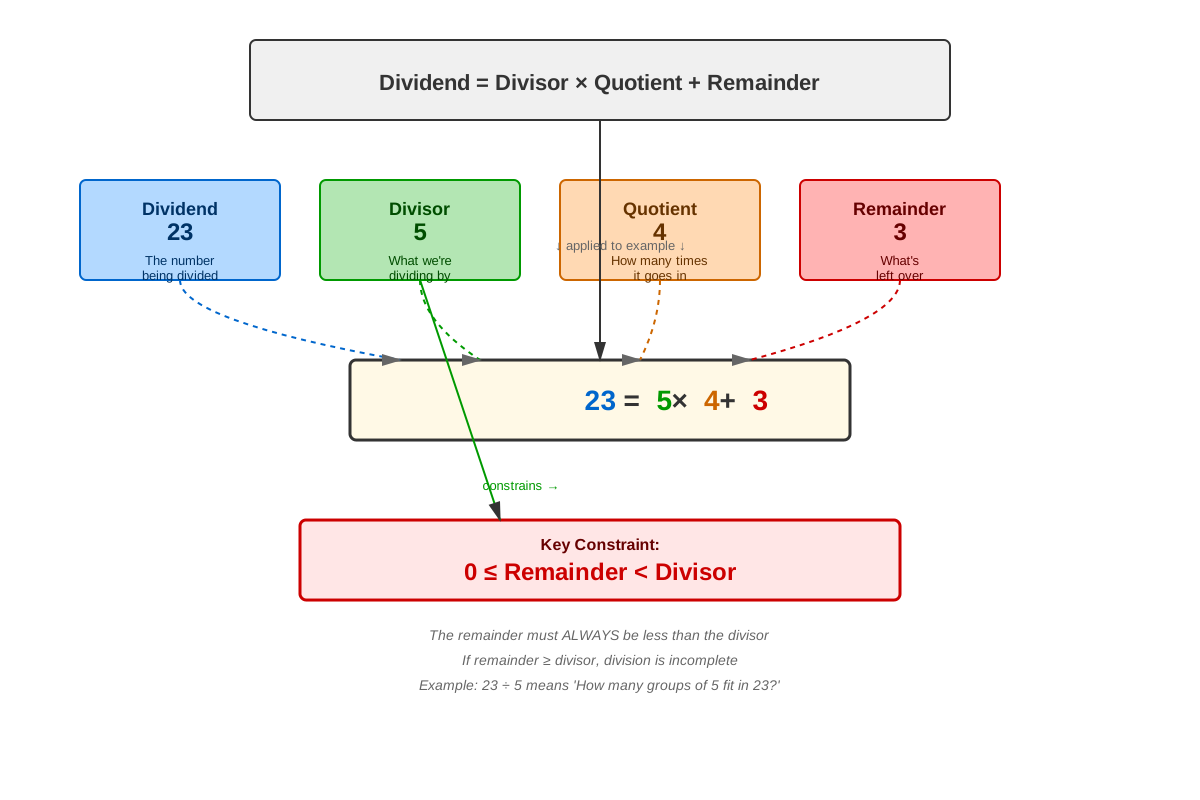
When an integer dividend is divided by a positive integer divisor, the result can be expressed as a quotient (the whole number of times the divisor fits into the dividend) plus a remainder (the amount left over). This relationship is formally expressed as:
Dividend = (Divisor × Quotient) + RemainderThe remainder must always satisfy two conditions: it must be a non-negative integer, and it must be strictly less than the divisor. For example, when 23 is divided by 5, we get 23 = (5 × 4) + 3, where 4 is the quotient and 3 is the remainder. The remainder cannot be 5 or greater because that would mean another complete group of 5 could be extracted from the dividend.
This fundamental equation is the key to solving virtually all GRE remainder problems. When questions ask "What is the remainder when N is divided by D?" they are asking for the value R in the equation N = (D × Q) + R, where 0 ≤ R < D.
Calculating Remainders: Multiple Methods
Method 1: Long Division
The traditional approach involves performing long division and identifying what's left after extracting all complete groups. For 47 ÷ 6: 6 goes into 47 seven times (6 × 7 = 42), leaving 47 - 42 = 5 as the remainder.
Method 2: Repeated Subtraction
Subtract the divisor repeatedly until the result is less than the divisor. For 47 ÷ 6: 47 - 6 - 6 - 6 - 6 - 6 - 6 - 6 = 5. While inefficient for large numbers, this method reinforces the conceptual meaning of remainders.
Method 3: Modular Arithmetic Notation
Mathematicians write "47 ≡ 5 (mod 6)" to express that 47 has remainder 5 when divided by 6. This notation, while not required for the GRE, helps organize thinking about remainder problems.
Remainder Properties and Operations
Understanding how remainders behave under arithmetic operations is crucial for efficient problem-solving:
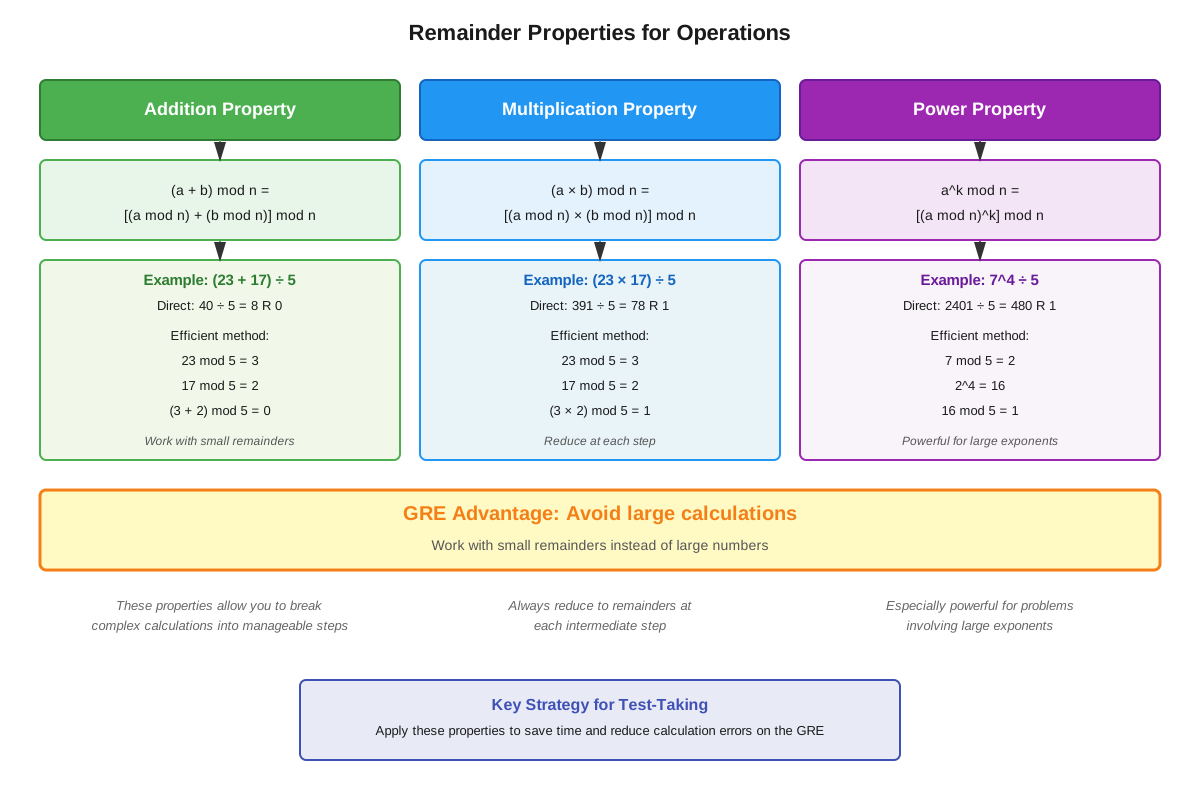
Addition Property: When adding numbers, the remainder of the sum equals the remainder of the sum of the individual remainders. If a has remainder r₁ when divided by n, and b has remainder r₂ when divided by n, then (a + b) has the same remainder as (r₁ + r₂) when divided by n.
Example: 17 ÷ 5 gives remainder 2, and 23 ÷ 5 gives remainder 3. Therefore, (17 + 23) ÷ 5 gives the same remainder as (2 + 3) ÷ 5, which is 0 (since 5 divides evenly into 5).
Multiplication Property: Similarly, the remainder of a product equals the remainder of the product of the individual remainders. If a has remainder r₁ when divided by n, and b has remainder r₂ when divided by n, then (a × b) has the same remainder as (r₁ × r₂) when divided by n.
Example: 17 ÷ 5 gives remainder 2, and 23 ÷ 5 gives remainder 3. Therefore, (17 × 23) ÷ 5 gives the same remainder as (2 × 3) ÷ 5, which is 1 (since 6 ÷ 5 gives remainder 1).
Subtraction Property: The remainder of a difference equals the remainder of the difference of remainders, though care must be taken when the difference would be negative (in which case, add the divisor to make it positive).
| Operation | Remainder Rule | Example |
|---|---|---|
| Addition | R(a + b) = R(R(a) + R(b)) | R(17 + 23, mod 5) = R(2 + 3, mod 5) = 0 |
| Multiplication | R(a × b) = R(R(a) × R(b)) | R(17 × 23, mod 5) = R(2 × 3, mod 5) = 1 |
| Subtraction | R(a - b) = R(R(a) - R(b)) | R(23 - 17, mod 5) = R(3 - 2, mod 5) = 1 |
| Powers | R(aⁿ) = R(R(a)ⁿ) | R(17³, mod 5) = R(2³, mod 5) = 3 |
Cyclical Patterns and Remainders
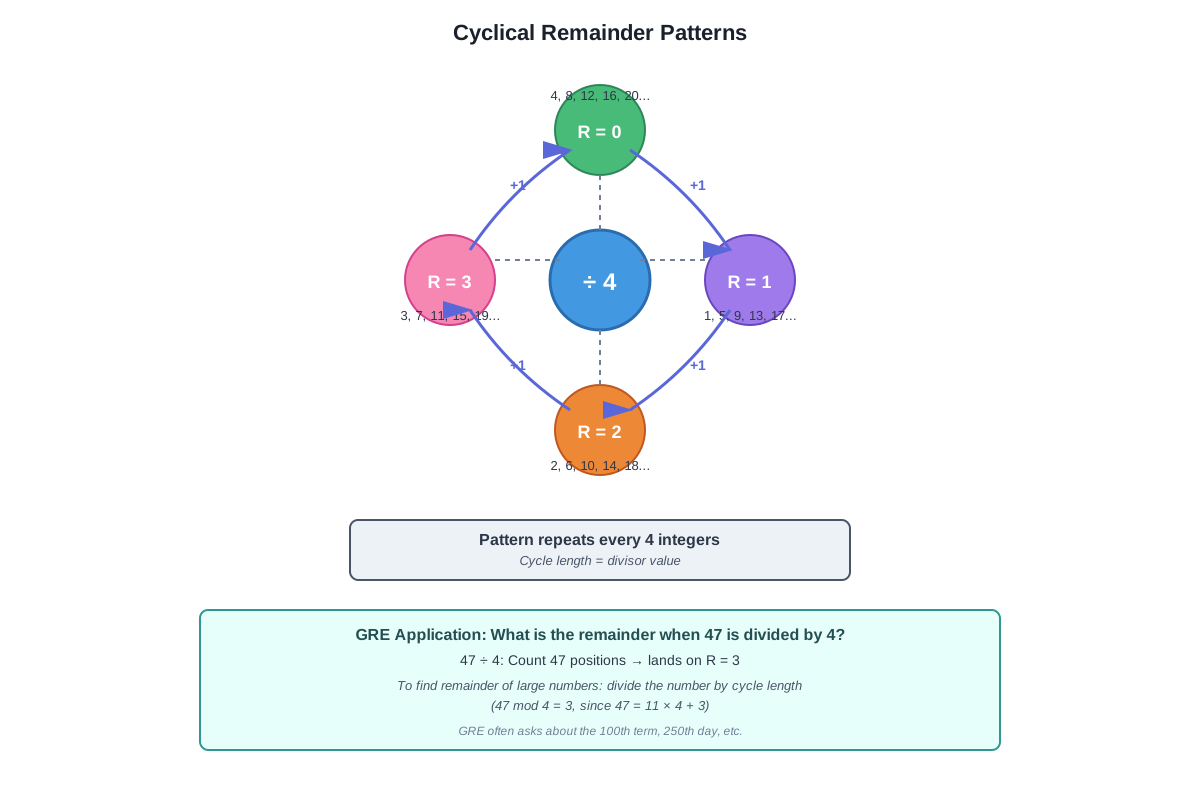
Many GRE questions exploit the fact that remainders create cyclical patterns. When dividing consecutive integers by a fixed divisor, the remainders cycle through a predictable sequence.
Example: Dividing consecutive integers by 4 produces the remainder pattern: 0, 1, 2, 3, 0, 1, 2, 3, 0, 1, 2, 3...
This cyclical behavior is particularly useful for:
- Finding the remainder of large powers (e.g., the units digit of 7⁵⁰)
- Determining properties of the nth term in a sequence
- Solving calendar and scheduling problems
To find the remainder when a large number is divided by n, identify the cycle length and use the division algorithm: if the cycle has length n, then the remainder of position k is the same as the remainder of position (k mod n).
Negative Numbers and Remainders
While the GRE rarely tests remainders with negative dividends, understanding the convention is important. By definition, remainders must be non-negative and less than the divisor. When dividing -17 by 5, the answer is NOT quotient -3 with remainder -2. Instead, it's quotient -4 with remainder 3, because -17 = (5 × -4) + 3.
The key principle: adjust the quotient to ensure the remainder stays in the range [0, divisor).
Special Remainder Cases
Remainder of 0: When the remainder is 0, the dividend is divisible by the divisor. This connects remainder theory to divisibility rules.
Remainder of 1: Numbers that leave remainder 1 when divided by n can be expressed as n × k + 1 for some integer k. These numbers are exactly 1 more than multiples of n.
Remainder of (divisor - 1): Numbers that leave remainder (n - 1) when divided by n can be expressed as n × k - 1, meaning they're exactly 1 less than multiples of n.
The Chinese Remainder Theorem (Conceptual)
While the formal theorem is beyond GRE scope, the underlying concept appears: if you know the remainders when a number is divided by several coprime divisors, you can determine the remainder when divided by their product. For instance, if a number leaves remainder 2 when divided by 3 and remainder 3 when divided by 5, there's a unique remainder (between 0 and 14) when divided by 15.
Concept Relationships
The concepts within remainder theory form an interconnected web. The fundamental definition (Dividend = Divisor × Quotient + Remainder) serves as the foundation from which all other concepts derive. This definition → leads to → calculation methods (long division, subtraction, modular arithmetic), which are simply different algorithmic approaches to finding the values in the fundamental equation.
The remainder properties (addition, multiplication, subtraction) emerge directly from the fundamental definition and → enable → efficient solving of complex remainder problems without performing full calculations. These properties are particularly powerful when combined with cyclical patterns, as the patterns themselves result from applying remainder operations to sequences of consecutive integers.
Cyclical patterns → connect to → power and exponent problems, since raising a number to successive powers creates a remainder sequence that eventually repeats. This relationship is why finding the units digit of 7¹⁰⁰ (a remainder problem with divisor 10) can be solved by identifying the 4-term cycle in the units digits of powers of 7.
The connection to prerequisite topics is equally important. Divisibility rules are simply special cases of remainder theory where the remainder equals zero. Prime factorization relates to remainders because the remainder when dividing by a composite number can be analyzed by examining remainders with respect to its prime factors. Basic algebra enables expressing remainder relationships symbolically, transforming concrete numerical problems into general principles.
Looking forward, remainder concepts → prepare students for → modular arithmetic (the formal mathematical system), number theory (where remainders are central to understanding integer properties), and even probability (where cyclical patterns help solve problems about repeating events).
Quick check — test yourself on Remainders so far.
Try Flashcards →High-Yield Facts
⭐ The remainder must always be non-negative and strictly less than the divisor: 0 ≤ R < D
⭐ Fundamental remainder equation: Dividend = (Divisor × Quotient) + Remainder, which can be rearranged to solve for any unknown component
⭐ The remainder when dividing by n cycles through values 0, 1, 2, ..., n-1 for consecutive integers
⭐ Remainder of a sum equals the remainder of the sum of remainders: R(a + b, mod n) = R(R(a) + R(b), mod n)
⭐ Remainder of a product equals the remainder of the product of remainders: R(a × b, mod n) = R(R(a) × R(b), mod n)
- When a number is divided by 10, the remainder is simply the units digit
- If two numbers have the same remainder when divided by n, their difference is divisible by n
- The remainder when n is divided by n is always 0 (any number is divisible by itself)
- The remainder when any integer is divided by 2 is either 0 (even) or 1 (odd)
- To find the remainder of a large power, identify the cyclical pattern in remainders of successive powers
- If a leaves remainder r when divided by n, then a + n, a + 2n, a + 3n, etc., all leave remainder r when divided by n
- The remainder when dividing a by b equals a itself when a < b (since the divisor doesn't fit even once)
Common Misconceptions
Misconception: The remainder can be equal to or greater than the divisor.
Correction: By definition, the remainder must be strictly less than the divisor. If your calculation yields a remainder ≥ divisor, you haven't extracted all possible complete groups and need to continue dividing.
Misconception: When dividing negative numbers, the remainder can be negative.
Correction: Remainders are always non-negative by convention. When dividing -17 by 5, the correct answer is quotient -4 with remainder 3, not quotient -3 with remainder -2.
Misconception: To find the remainder of a large number, you must perform the complete division.
Correction: Using remainder properties and cyclical patterns, you can often find remainders of very large numbers by working with much smaller values. For example, to find the remainder when 7⁵⁰ is divided by 10, identify the 4-term cycle in units digits rather than calculating 7⁵⁰.
Misconception: The remainder when dividing by 10 is the last two digits of a number.
Correction: The remainder when dividing by 10 is only the units digit (last single digit). The last two digits represent the remainder when dividing by 100.
Misconception: If a number leaves remainder r when divided by both a and b, it leaves remainder r when divided by a × b.
Correction: This is only guaranteed when a and b are coprime (share no common factors). For example, 5 leaves remainder 1 when divided by both 2 and 4, but leaves remainder 1 (not 1) when divided by 8.
Misconception: Adding remainders directly gives the remainder of the sum.
Correction: You must find the remainder of the sum of remainders. If two numbers leave remainders 7 and 8 when divided by 10, their sum doesn't leave remainder 15 (impossible since 15 > 10); it leaves remainder 5 (since 15 mod 10 = 5).
Worked Examples
Example 1: Multi-Step Remainder Problem
Question: What is the remainder when (15 × 23 × 37) is divided by 6?
Solution:
Step 1: Recognize that calculating 15 × 23 × 37 = 12,765 and then dividing by 6 is time-consuming. Instead, use the multiplication property of remainders.
Step 2: Find the remainder of each factor when divided by 6:
- 15 ÷ 6 = 2 remainder 3 (since 15 = 6 × 2 + 3)
- 23 ÷ 6 = 3 remainder 5 (since 23 = 6 × 3 + 5)
- 37 ÷ 6 = 6 remainder 1 (since 37 = 6 × 6 + 1)
Step 3: Apply the multiplication property. The remainder of the product equals the remainder of the product of remainders:
R(15 × 23 × 37, mod 6) = R(3 × 5 × 1, mod 6)
Step 4: Calculate 3 × 5 × 1 = 15
Step 5: Find the remainder when 15 is divided by 6:
15 ÷ 6 = 2 remainder 3
Answer: The remainder is 3.
Connection to Learning Objectives: This problem demonstrates applying remainders to GRE-style questions accurately by using the core strategy of remainder properties rather than brute-force calculation, identifying that remainder concepts are being tested through the phrase "remainder when divided by."
Example 2: Cyclical Pattern Problem
Question: A factory produces widgets in a repeating color pattern: red, blue, green, yellow, red, blue, green, yellow, and so on. If the first widget is red, what color is the 157th widget?
Solution:
Step 1: Identify this as a remainder problem. The pattern repeats every 4 widgets, so we need to find where 157 falls in the cycle.
Step 2: Set up the remainder framework. The pattern positions are:
- Position 1: red (remainder 1 when divided by 4)
- Position 2: blue (remainder 2 when divided by 4)
- Position 3: green (remainder 3 when divided by 4)
- Position 4: yellow (remainder 0 when divided by 4)
Step 3: Find the remainder when 157 is divided by 4:
157 = 4 × 39 + 1
Step 4: The remainder is 1, which corresponds to the first position in the pattern.
Answer: The 157th widget is red.
Alternative approach: Since position 4, 8, 12, 16, ... (all multiples of 4) are yellow, and 156 is a multiple of 4 (156 = 4 × 39), the 156th widget is yellow. Therefore, the 157th widget is the next color in the pattern: red.
Connection to Learning Objectives: This problem illustrates identifying when remainders are being tested (cyclical patterns are fundamentally remainder problems) and explains the core strategy of using division to determine position within a repeating cycle.
Exam Strategy
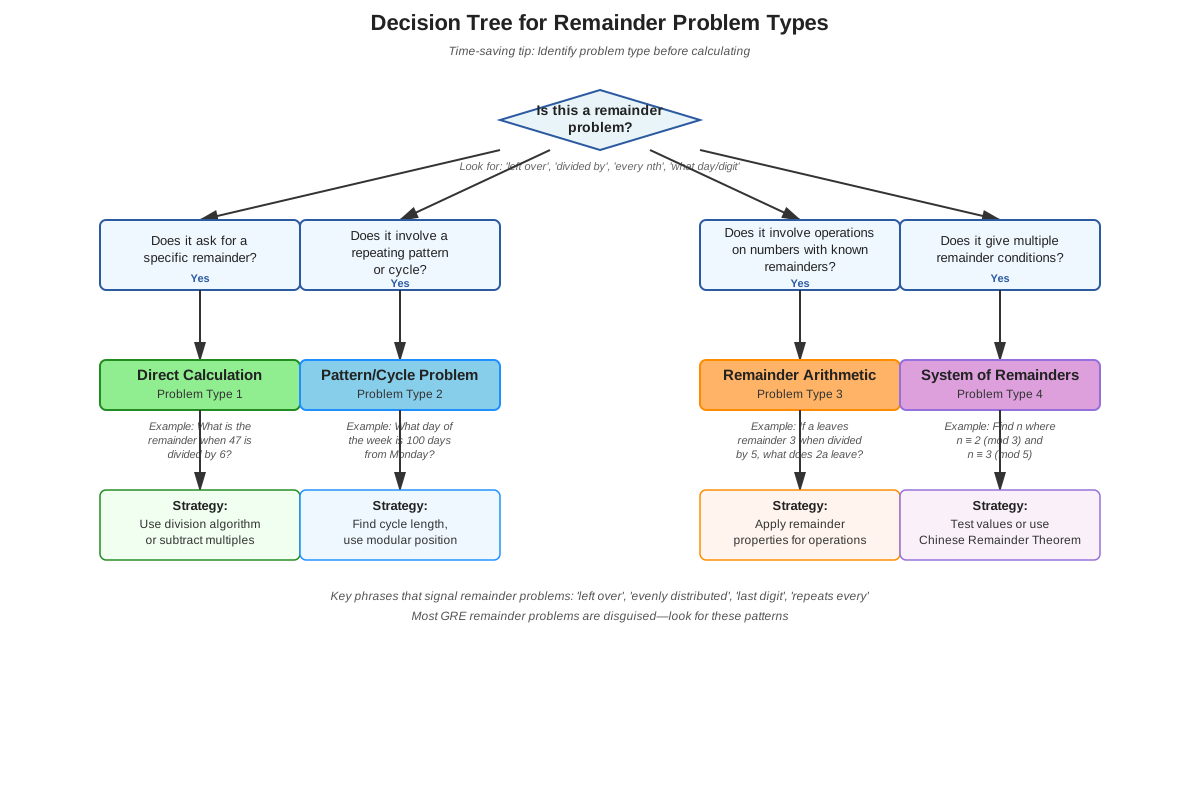
When approaching GRE remainder questions, begin by identifying trigger words and phrases: "remainder when divided by," "left over," "what is the units digit" (remainder when divided by 10), "what day of the week" (remainder when divided by 7), "repeating pattern," or "cyclical." These phrases signal that remainder concepts are being tested, even if the word "remainder" doesn't appear explicitly.
Strategic approach sequence:
- Identify the divisor: Determine what number you're dividing by. This is often stated directly but may be implicit (e.g., "units digit" means divisor is 10).
- Assess calculation feasibility: Can you calculate the dividend directly, or is it prohibitively large? If the latter, plan to use remainder properties.
- Look for patterns: If the problem involves sequences, powers, or repetition, identify the cycle length before calculating.
- Apply remainder properties: For sums, products, or powers, break down the problem using the addition and multiplication properties rather than computing the full value.
- Verify your remainder is valid: Ensure your answer is non-negative and less than the divisor.
Process-of-elimination tips:
- Immediately eliminate any answer choice that equals or exceeds the divisor (impossible for a remainder)
- If the question asks for the remainder when dividing an even number by 2, the answer must be 0
- For remainder when divided by 10, only answer choices 0-9 are possible
- If you know the remainder must be even or odd based on the dividend's properties, eliminate accordingly
Time allocation: Simple remainder calculations should take 30-45 seconds. Complex problems involving patterns or multiple steps warrant 90-120 seconds. If you find yourself performing lengthy calculations, pause and reconsider whether there's a pattern or property you can exploit. The GRE rewards strategic thinking over computational endurance.
Exam Tip: When stuck, work backwards from answer choices. If the question asks "What is the remainder when N is divided by 7?" and gives specific answer choices, test each by checking if N = 7k + (answer choice) for some integer k makes sense given other constraints in the problem.
Memory Techniques
Mnemonic for the fundamental equation: "Dad Quickly Drove Right" represents Dividend = (Divisor × Quotient) + Remainder, with the first letters matching the equation components in order.
Visualization for remainder properties: Picture remainders as "leftover pieces" that can be combined. When adding numbers, you're combining their leftover pieces; if the combined leftovers make a complete group, that group gets absorbed into the quotient, leaving a new (smaller) remainder.
Acronym for remainder validity: NNLD - "Non-Negative, Less than Divisor" - the two essential properties every remainder must satisfy.
Pattern recognition shortcut: For cyclical problems, remember "Divide position by cycle" - the remainder tells you where in the cycle you land.
Units digit memory aid: The units digit is the "Remainder of 10" - this connects the common GRE question type to remainder theory.
Finger counting for small cycles: For cycles of length 4 or less, use fingers to count through the pattern rather than calculating. This kinesthetic approach is faster and less error-prone for simple cyclical problems.
Summary
Remainders represent the amount left over when one integer is divided by another, formally expressed as Dividend = (Divisor × Quotient) + Remainder, where the remainder must be non-negative and strictly less than the divisor. The GRE tests remainders through direct calculation problems, word problems involving distribution, and pattern recognition tasks requiring identification of cyclical behavior. Mastery requires understanding that remainders follow predictable rules under arithmetic operations: the remainder of a sum equals the remainder of the sum of remainders, and similarly for products. These properties enable solving complex problems without performing prohibitive calculations. Cyclical patterns emerge when examining remainders of consecutive integers or successive powers, making remainder theory essential for problems involving repeating sequences, units digits, and calendar calculations. Success on GRE remainder questions depends on recognizing when remainder concepts are being tested (often disguised in context), applying strategic shortcuts rather than brute-force computation, and verifying that answers satisfy the fundamental constraints of remainder theory.
Key Takeaways
- The fundamental remainder equation Dividend = (Divisor × Quotient) + Remainder is the foundation for solving all remainder problems
- Remainders must always be non-negative and strictly less than the divisor (0 ≤ R < D)
- Remainder properties for addition and multiplication allow finding remainders of complex expressions by working with remainders of components
- Cyclical patterns in remainders enable solving problems about large powers, repeating sequences, and nth terms without exhaustive calculation
- The GRE tests remainders through multiple question types: direct calculation, word problems, pattern recognition, and disguised contexts like units digits
- Strategic problem-solving involves identifying the divisor, assessing whether direct calculation is feasible, looking for patterns, and applying remainder properties
- Common trigger phrases include "remainder when divided by," "left over," "units digit," "repeating pattern," and "what day of the week"
Related Topics
Divisibility Rules: Understanding when numbers divide evenly (remainder = 0) provides shortcuts for identifying factors and simplifying calculations. Mastering remainders creates the foundation for divisibility since divisibility is simply the special case where remainders equal zero.
Modular Arithmetic: The formal mathematical system built on remainder concepts, using congruence notation and modular operations. After mastering basic remainders, modular arithmetic provides a more sophisticated framework for advanced number theory.
Number Properties (Even/Odd, Prime/Composite): Remainder theory connects deeply to classifying integers by their properties. Even numbers are those with remainder 0 when divided by 2; understanding remainders illuminates why certain number property rules work.
Exponents and Powers: Finding remainders of large exponential expressions requires identifying cyclical patterns in successive powers. Remainder mastery enables solving otherwise intractable problems involving expressions like 7¹⁰⁰.
Sequences and Patterns: Many sequence problems involve finding the nth term of a repeating pattern, which is fundamentally a remainder problem. The skills developed in remainder theory transfer directly to pattern recognition tasks.
Practice CTA
Now that you've mastered the core concepts of remainders, it's time to solidify your understanding through active practice. Attempt the practice questions to test your ability to identify remainder problems, apply strategic shortcuts, and avoid common pitfalls. Use the flashcards to reinforce high-yield facts and ensure instant recall of remainder properties during the exam. Remember: the GRE rewards strategic thinking over mechanical calculation, and remainder problems are specifically designed to test whether you can recognize patterns and apply properties efficiently. Your investment in mastering this high-yield topic will pay dividends across multiple question types on test day!
Sign up free to keep reading
Create a free AnvayaPrep account to finish this GRE guide on Remainders — plus flashcards and practice questions.