Overview
Integers form the backbone of arithmetic reasoning on the GRE Quantitative section, appearing in approximately 20-30% of all quantitative questions either directly or as part of more complex problems. Understanding integers goes far beyond simply knowing they are whole numbers; success on GRE integers questions requires mastery of their properties, behaviors under various operations, and the subtle ways test-makers exploit common misconceptions about positive and negative numbers, zero, and even/odd classifications.
The GRE tests integer concepts in multiple contexts: pure arithmetic problems, word problems involving discrete quantities, data interpretation questions, and algebraic expressions with integer constraints. Questions may ask about divisibility, remainders, prime factorization, consecutive integers, or the results of operations on integers with specific properties. The test particularly favors questions that combine multiple integer properties—for example, asking about the product of consecutive even integers or the sum of negative odd integers—requiring students to synthesize several concepts simultaneously.
Mastering integers creates a foundation for virtually every other Quantitative Reasoning topic. Number properties build directly on integer concepts, algebra frequently involves integer solutions and constraints, and even geometry problems often require integer-based calculations for areas, perimeters, and coordinate geometry. Students who develop fluency with integer properties gain significant advantages in speed and accuracy across the entire quantitative section, making this a high-return investment of study time.
Learning Objectives
- [ ] Identify when Integers is being tested in GRE questions
- [ ] Explain the core rule or strategy behind Integers
- [ ] Apply Integers to GRE-style questions accurately
- [ ] Distinguish between different integer classifications (positive, negative, even, odd, prime)
- [ ] Predict the properties of results when performing operations on integers with specific characteristics
- [ ] Evaluate statements about integer sets and determine their validity using counterexamples or proofs
- [ ] Solve complex problems involving multiple integer constraints efficiently
Prerequisites
- Basic arithmetic operations: Addition, subtraction, multiplication, and division are the fundamental operations applied to integers throughout GRE problems
- Number line concept: Understanding the ordering and relative position of numbers is essential for comparing integers and understanding magnitude
- Algebraic notation: Variables representing integers appear frequently, requiring comfort with symbolic representation
- Set notation basics: Integer problems often involve sets of numbers with specific properties (e.g., "all positive even integers less than 20")
Why This Topic Matters
Integer concepts have practical applications throughout mathematics, computer science, finance, and everyday problem-solving. Discrete quantities—items that can only be counted in whole numbers—dominate real-world scenarios: people, objects, days, dollars and cents (when counted as pennies), and countless other measurable quantities. Understanding integer properties enables accurate modeling of situations where fractional values are meaningless or impossible.
On the GRE specifically, integer questions appear in multiple formats across both Quantitative Comparison and Problem Solving question types. Research on GRE question distributions indicates that integer properties appear in 15-20% of questions as the primary concept being tested, and in an additional 10-15% as a secondary concept combined with algebra, word problems, or data interpretation. The test frequently uses integer constraints to limit possible answers or to create trap answers for students who overlook the integer requirement.
Common question formats include: determining whether statements about integer properties are always, sometimes, or never true; finding the number of integers in a specific range that satisfy certain conditions; calculating sums or products of integer sequences; and solving for unknown integers given constraints about their properties. The GRE particularly favors questions involving negative integers and zero, as these create opportunities for students to make sign errors or overlook special cases.
Core Concepts
Definition and Classification of Integers
Integers are the set of whole numbers and their negatives, including zero: {..., -3, -2, -1, 0, 1, 2, 3, ...}. This set extends infinitely in both positive and negative directions. Integers do NOT include fractions, decimals, or irrational numbers. On the GRE, when a problem states that a variable "is an integer" or asks "how many integers," this constraint significantly limits possible values and often provides the key to solving the problem.
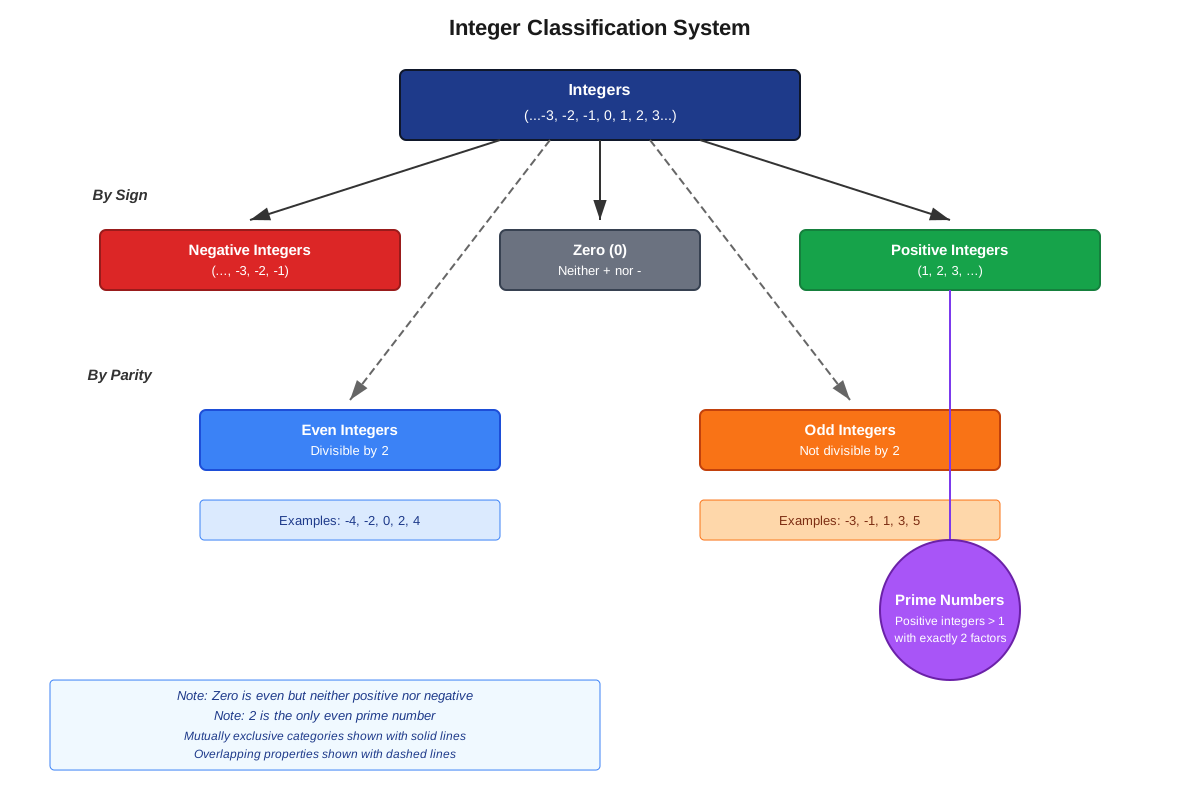
Integers can be classified in several important ways:
| Classification | Definition | Examples |
|---|---|---|
| Positive integers | Integers greater than zero | 1, 2, 3, 4, 5, ... |
| Negative integers | Integers less than zero | -1, -2, -3, -4, -5, ... |
| Non-negative integers | Zero and positive integers | 0, 1, 2, 3, 4, ... |
| Non-positive integers | Zero and negative integers | 0, -1, -2, -3, -4, ... |
| Even integers | Integers divisible by 2 | ..., -4, -2, 0, 2, 4, ... |
| Odd integers | Integers not divisible by 2 | ..., -3, -1, 1, 3, 5, ... |
Critical note: Zero is an integer, but it is neither positive nor negative. This special status of zero creates numerous trap answers on the GRE.
Even and Odd Integer Properties
Understanding how even and odd integers behave under arithmetic operations is essential for GRE success. These properties allow you to determine characteristics of results without performing actual calculations.
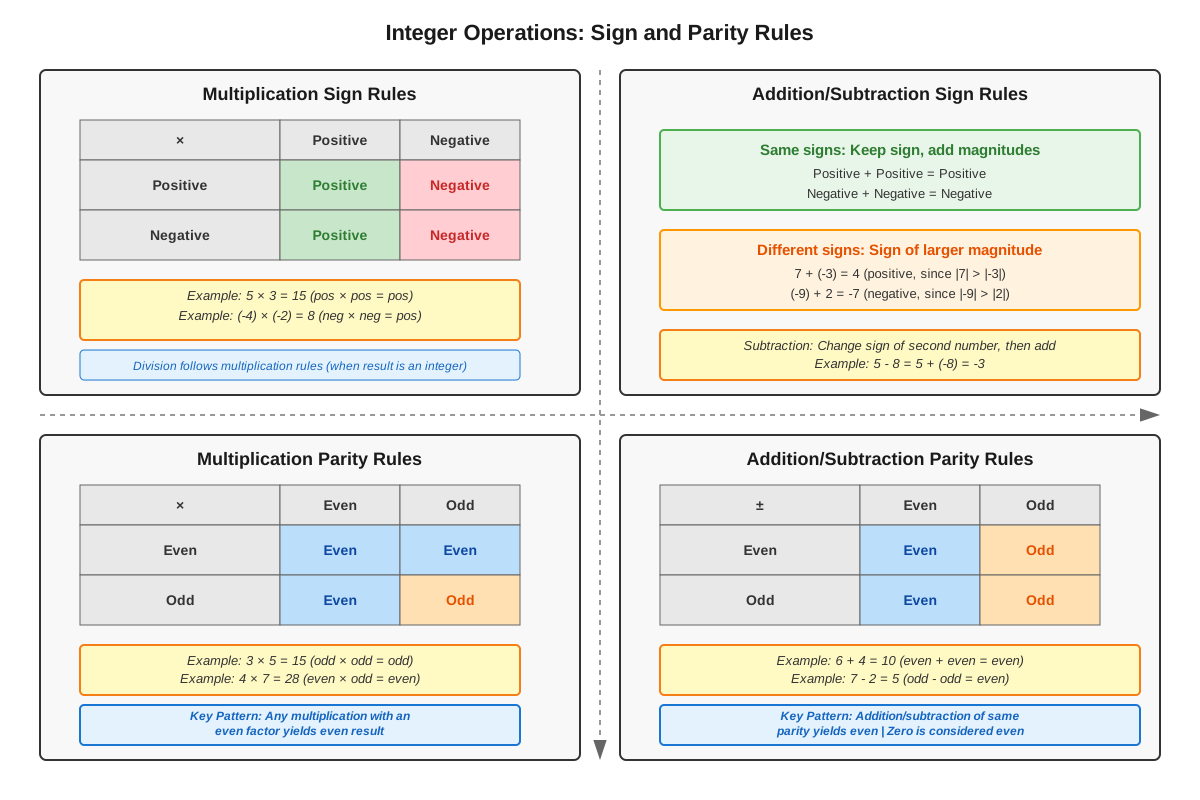
Addition and Subtraction Rules:
- Even ± Even = Even (e.g., 4 + 6 = 10, 8 - 2 = 6)
- Odd ± Odd = Even (e.g., 3 + 5 = 8, 7 - 3 = 4)
- Even ± Odd = Odd (e.g., 4 + 3 = 7, 6 - 5 = 1)
- Odd ± Even = Odd (e.g., 5 + 2 = 7, 9 - 4 = 5)
Multiplication Rules:
- Even × Even = Even (e.g., 4 × 6 = 24)
- Odd × Odd = Odd (e.g., 3 × 5 = 15)
- Even × Odd = Even (e.g., 4 × 3 = 12)
- Key insight: Any product containing at least one even factor is even
Division Considerations:
Division of integers does not always produce integers, so the even/odd framework applies only when the result is guaranteed to be an integer (i.e., when one integer divides evenly into another).
Consecutive Integers
Consecutive integers are integers that follow one another in order without gaps: n, n+1, n+2, n+3, etc. The GRE frequently tests properties of consecutive integer sets:
- Sum properties: The sum of any set of consecutive integers equals the number of integers multiplied by their average (which equals their median)
- Even/odd patterns: Consecutive integers alternate between even and odd
- Consecutive even/odd integers: These have a common difference of 2 (e.g., 2, 4, 6, 8 or 3, 5, 7, 9)
For any set of consecutive integers:
- If there's an odd number of integers, the middle integer equals the average
- If there's an even number of integers, the average falls between the two middle integers
- The sum of n consecutive integers starting from a can be calculated as: n × (first + last) / 2
Positive and Negative Integer Operations
The interaction between positive and negative integers creates predictable patterns that the GRE exploits:
Multiplication and Division Sign Rules:
- Positive × Positive = Positive
- Negative × Negative = Positive
- Positive × Negative = Negative
- Negative × Positive = Negative
- The same rules apply to division
Key principle: An even number of negative factors produces a positive result; an odd number of negative factors produces a negative result.
Addition and Subtraction with Signs:
- Adding a negative is equivalent to subtracting its absolute value
- Subtracting a negative is equivalent to adding its absolute value
- When adding integers with different signs, subtract the smaller absolute value from the larger and use the sign of the larger
Magnitude considerations: Negative integers with larger absolute values are actually smaller (e.g., -10 < -3). This counterintuitive relationship frequently appears in Quantitative Comparison questions.
Special Integer: Zero
Zero occupies a unique position among integers and creates numerous special cases:
- Zero is even (divisible by 2: 0 = 2 × 0)
- Zero is neither positive nor negative
- Zero multiplied by any number equals zero
- Division by zero is undefined
- Zero raised to any positive power equals zero
- Any non-zero number raised to the power of zero equals one
- Zero is the additive identity (a + 0 = a)
The GRE frequently includes zero as a trap answer option, particularly in questions asking about "positive integers" (which excludes zero) versus "non-negative integers" (which includes zero).
Integer Divisibility and Factors
An integer a is divisible by an integer b if a/b produces an integer result with no remainder. Understanding divisibility is crucial for many GRE integer problems:
Divisibility tests (high-yield for quick calculations):
- Divisible by 2: Last digit is even
- Divisible by 3: Sum of digits is divisible by 3
- Divisible by 4: Last two digits form a number divisible by 4
- Divisible by 5: Last digit is 0 or 5
- Divisible by 9: Sum of digits is divisible by 9
- Divisible by 10: Last digit is 0
Factors are integers that divide evenly into another integer. Every integer has at least two factors: 1 and itself (except for 1, which has only one factor). Understanding factor relationships helps solve problems involving divisibility, greatest common factors, and least common multiples.
Concept Relationships
The concepts within integer theory form an interconnected web where understanding one property illuminates others. Even and odd classifications connect directly to divisibility (even integers are those divisible by 2), which in turn relates to factors (2 is a factor of all even integers). The behavior of positive and negative integers under multiplication determines the sign of products, which combines with even/odd properties when evaluating expressions like (-2)^n, where the result depends on whether n is even or odd.
Consecutive integers synthesize multiple concepts: they alternate even/odd, their sums relate to their count and average, and they form the basis for understanding arithmetic sequences. The special role of zero intersects with every other concept—it's the boundary between positive and negative, it's even, and it creates special cases in multiplication and exponentiation.
These integer concepts serve as prerequisites for more advanced topics: Number properties (primes, factors, multiples) build directly on integer foundations; Algebra frequently involves integer constraints and solutions; Sequences and series often deal with integer terms; Coordinate geometry typically uses integer coordinates; and Probability and counting problems count discrete outcomes using integers.
The relationship map flows as: Basic integer definition → Classification (positive/negative, even/odd) → Operations on classified integers → Special cases (zero, consecutive integers) → Advanced applications (divisibility, factors) → Integration with other quantitative topics.
Quick check — test yourself on Integers so far.
Try Flashcards →High-Yield Facts
⭐ Zero is an even integer but is neither positive nor negative—this creates trap answers in approximately 10% of integer questions
⭐ Any product containing at least one even factor is even—this allows quick determination of product properties without calculation
⭐ The sum of an odd number of odd integers is odd; the sum of an even number of odd integers is even—essential for sequence problems
⭐ Multiplying or dividing an even number of negative integers produces a positive result—critical for sign determination in expressions
⭐ Consecutive integers alternate between even and odd—any set of two or more consecutive integers contains at least one even integer
- The product of any integer and zero equals zero, regardless of the other integer's value
- When comparing negative integers, the one with the larger absolute value is actually smaller (e.g., -10 < -5)
- The sum of n consecutive integers equals n times their average (which equals their median)
- An integer is divisible by 3 if and only if the sum of its digits is divisible by 3
- Subtracting a negative integer is equivalent to adding its positive counterpart (a - (-b) = a + b)
- The integer 1 is odd and positive but is NOT prime (primes must have exactly two distinct factors)
- Any even integer can be expressed as 2k where k is an integer; any odd integer can be expressed as 2k + 1
- The product of two odd integers is always odd, but the sum of two odd integers is always even
Common Misconceptions
Misconception: Zero is positive because it's not negative. → Correction: Zero is neither positive nor negative; it occupies a unique neutral position on the number line. Questions asking about "positive integers" exclude zero, while "non-negative integers" include it.
Misconception: All integers are positive. → Correction: Integers include negative whole numbers, zero, and positive whole numbers. The set extends infinitely in both directions: {..., -2, -1, 0, 1, 2, ...}.
Misconception: The product of two negative integers is negative. → Correction: The product of two negative integers is positive. Only when multiplying an odd number of negative factors does the result remain negative. For example, (-3) × (-4) = 12, not -12.
Misconception: If a number is not even, it must be odd, so zero must be odd since it's not obviously even. → Correction: Zero is even because it's divisible by 2 (0 ÷ 2 = 0, which is an integer). The definition of even is "divisible by 2 with no remainder," which zero satisfies.
Misconception: When a problem says "integer," it means positive integer. → Correction: Unless explicitly stated as "positive integer," the term "integer" includes negative integers and zero. Always consider all possibilities unless restricted by the problem statement.
Misconception: The sum of consecutive integers is always even. → Correction: The sum depends on how many consecutive integers are included. An odd number of consecutive integers produces an odd sum if the middle value is odd, and an even sum if the middle value is even. For example, 1 + 2 + 3 = 6 (even), but 2 + 3 + 4 = 9 (odd).
Misconception: Larger negative numbers are greater than smaller negative numbers. → Correction: On the number line, numbers to the right are greater. Since -10 is to the left of -3, we have -10 < -3. The negative integer with the larger absolute value is actually the smaller number.
Misconception: Division of integers always produces integers. → Correction: Division of integers produces integers only when the divisor divides evenly into the dividend. For example, 7 ÷ 2 = 3.5, which is not an integer. When a problem requires an integer result, this constraint becomes crucial.
Worked Examples
Example 1: Even/Odd Properties with Multiple Operations
Problem: If x and y are integers, x is even, and y is odd, which of the following must be odd?
(A) x + y + 1
(B) xy + x
(C) x² + y²
(D) 3x + 2y
(E) (x + 1)(y + 1)
Solution:
Let's systematically evaluate each option using even/odd properties:
(A) x + y + 1
- x is even
- y is odd
- x + y = even + odd = odd
- odd + 1 = odd + odd = even
- This is even, not odd ✗
(B) xy + x
- xy = even × odd = even
- x is even
- even + even = even
- This is even, not odd ✗
(C) x² + y²
- x² = (even)² = even (the square of an even number is even)
- y² = (odd)² = odd (the square of an odd number is odd)
- even + odd = odd
- This must be odd ✓
(D) 3x + 2y
- 3x = odd × even = even
- 2y = even × odd = even
- even + even = even
- This is even, not odd ✗
(E) (x + 1)(y + 1)
- x + 1 = even + odd = odd
- y + 1 = odd + odd = even
- odd × even = even
- This is even, not odd ✗
Answer: (C)
Key takeaway: This problem tests the learning objective of predicting properties of results from operations on integers with specific characteristics. The systematic approach—determining the even/odd nature of each component before combining—prevents errors and works efficiently.
Example 2: Consecutive Integers with Constraints
Problem: The sum of four consecutive even integers is 52. What is the largest of these integers?
Solution:
Step 1: Represent consecutive even integers algebraically.
Let the four consecutive even integers be: n, n+2, n+4, n+6
(Consecutive even integers differ by 2)
Step 2: Set up the equation.
n + (n+2) + (n+4) + (n+6) = 52
Step 3: Simplify and solve.
4n + 12 = 52
4n = 40
n = 10
Step 4: Identify the largest integer.
The four integers are: 10, 12, 14, 16
The largest is 16
Verification: 10 + 12 + 14 + 16 = 52 ✓
Alternative approach using averages:
- The sum of four consecutive even integers is 52
- Their average is 52 ÷ 4 = 13
- For four consecutive even integers, the average falls between the second and third integers
- The four integers centered around 13 are: 10, 12, 14, 16
- The largest is 16
Key takeaway: This problem demonstrates applying integer concepts to GRE-style questions accurately. Two valid approaches exist: algebraic representation and average-based reasoning. The average method is often faster for consecutive integer problems.
Exam Strategy
When approaching GRE integers questions, implement this systematic strategy:
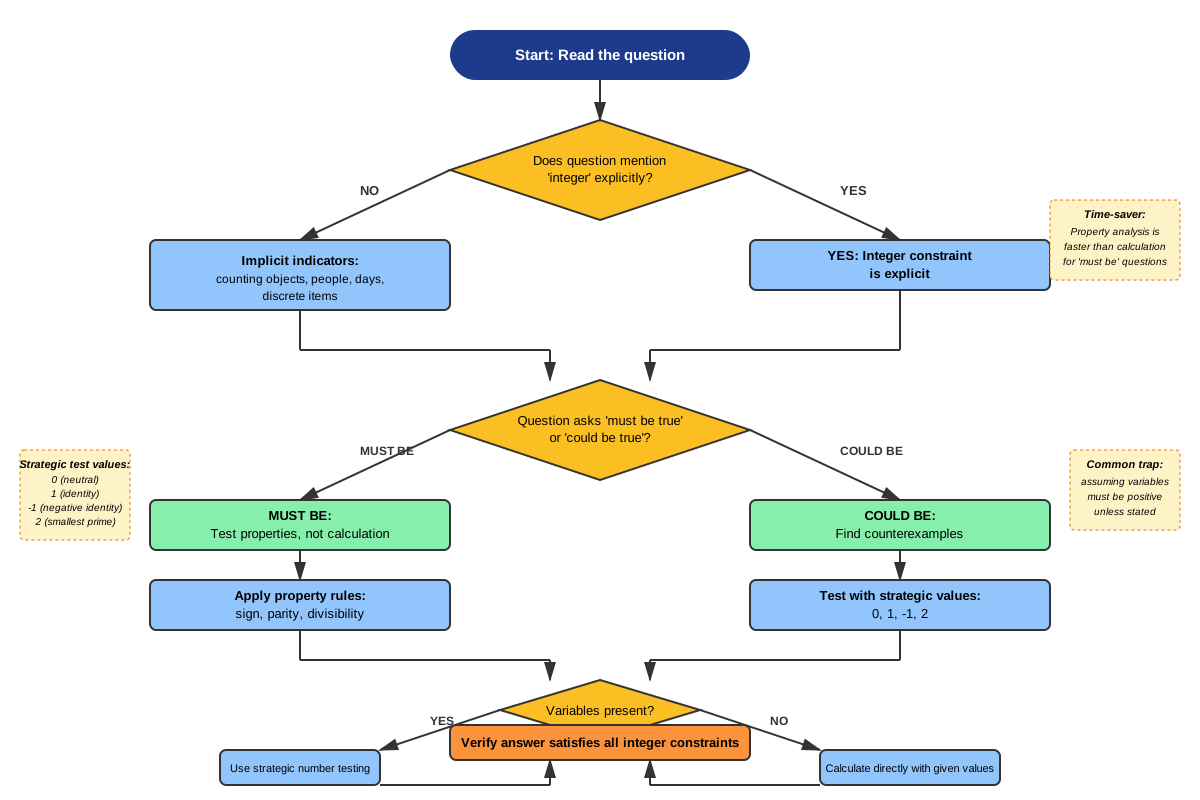
1. Identify integer constraints immediately: When a problem states variables are integers, circle or highlight this information. This constraint often provides the key to elimination or solution.
2. Watch for trigger phrases:
- "must be" vs. "could be" (the former requires proof for all cases; the latter needs only one example)
- "positive integers" (excludes zero and negatives)
- "non-negative integers" (includes zero)
- "consecutive integers" (signals even/odd alternation and sum properties)
- "even integer" or "odd integer" (activate operation rules)
3. Test special cases systematically:
When evaluating whether statements are always true, test these high-yield cases:
- Zero (often overlooked)
- Negative integers (especially -1)
- The integer 1 (smallest positive integer)
- Small even and odd integers (2, 3, 4, 5)
4. Use properties before calculation:
Rather than computing actual values, determine properties (even/odd, positive/negative, relative magnitude) using rules. This saves time and reduces arithmetic errors.
5. Process of elimination for Quantitative Comparison:
- If a relationship depends on whether an integer is positive or negative, the answer is typically (D) "Cannot be determined"
- If you can find one case where Quantity A is larger and another where Quantity B is larger, immediately select (D)
6. Time allocation:
Pure integer property questions should take 45-60 seconds. If you're spending more than 90 seconds, you're likely missing a property-based shortcut. Consider strategic guessing and moving forward.
7. Avoid calculation traps:
The GRE designs wrong answers to match results from common errors (sign mistakes, forgetting zero, misapplying even/odd rules). If your answer appears among the choices but required complex calculation, verify using properties.
Exam Tip: When a problem asks "which of the following MUST be true," you need to prove it's always true. When it asks "which CAN be true," you need only one valid example. This distinction determines your entire approach.
Memory Techniques
MNEMONIC for multiplication sign rules: "Same Signs Stay Positive" (positive × positive = positive; negative × negative = positive), while different signs produce negative results.
MNEMONIC for even/odd addition: "EEEO" (Even + Even = Even; Odd + Odd = Even; Even + Odd = Odd). Notice that matching parities (both even or both odd) produce even results.
Visualization for negative integer comparison: Picture the number line with negative numbers extending left from zero. Numbers further left are smaller, so -10 is "more negative" and therefore smaller than -3, even though 10 > 3.
ACRONYM for zero's special properties: "ZENO"
- Zero is even
- Exponent: anything (except 0) to the power of 0 equals 1
- Neither positive nor negative
- One times zero equals zero (multiplication property)
Finger technique for consecutive integers: When finding the sum of consecutive integers, use your fingers to count how many integers are in the set, then multiply by the average. This physical action reinforces the formula: sum = count × average.
Pattern recognition for powers of negatives:
- (-1)^(even) = 1
- (-1)^(odd) = -1
Remember: "Even powers Eliminate the negative"
Summary
Integers form the foundation of GRE Quantitative Reasoning, appearing in roughly one-quarter of all questions either as the primary concept or as constraints within other problems. Mastery requires understanding that integers include all whole numbers (positive, negative, and zero), recognizing that zero is even but neither positive nor negative, and fluently applying even/odd properties to predict results of operations without calculation. The GRE particularly tests whether students can handle negative integers correctly, remember to consider zero as a special case, and apply properties of consecutive integers. Success demands systematic testing of special cases (especially zero, negative integers, and 1), recognition of trigger phrases that signal integer constraints, and preference for property-based reasoning over computation. Students who internalize the rules for operations on even/odd integers, understand sign rules for multiplication and division, and remember that "integer" without qualification includes negatives and zero will efficiently navigate the majority of integer questions. The key to excellence is recognizing that integer problems test logical reasoning about number properties rather than computational ability.
Key Takeaways
- Integers include negative whole numbers, zero, and positive whole numbers—never assume "integer" means only positive values unless explicitly stated
- Zero is even, neither positive nor negative, and creates special cases in multiplication, division, and exponentiation that frequently appear as trap answers
- Even/odd properties allow prediction of results without calculation: even × anything = even; odd × odd = odd; even ± even = even; odd ± odd = even
- Sign rules for multiplication/division: an even number of negative factors produces positive results; an odd number produces negative results
- Consecutive integers alternate even/odd, and their sum equals the count multiplied by their average—use this for quick calculations
- Test special cases systematically (zero, -1, 1, small even/odd integers) when evaluating "must be true" statements
- Larger absolute values mean smaller numbers for negatives: -10 < -5 because -10 is further left on the number line
Related Topics
Number Properties (Primes, Factors, Multiples): Building directly on integer foundations, this topic explores divisibility in depth, prime factorization, greatest common factors, and least common multiples—essential for advanced arithmetic problems.
Exponents and Roots: Understanding how integers behave under exponentiation (especially negative bases and zero) extends integer concepts to more complex operations.
Algebraic Expressions with Integer Constraints: Many algebra problems specify that variables must be integers, requiring synthesis of algebraic manipulation with integer properties.
Sequences and Series: Arithmetic sequences often involve consecutive integers or integers with constant differences, applying integer properties to pattern recognition.
Coordinate Geometry: Integer coordinates create lattice points, and many geometry problems involve integer side lengths, areas, and perimeters.
Mastering integers enables confident progression to all these topics, as integer properties underlie the logical structure of quantitative reasoning across the GRE.
Practice CTA
Now that you've built a comprehensive understanding of integers and their properties, it's time to solidify your mastery through active practice. Attempt the practice questions associated with this topic, focusing on applying the systematic strategies and property-based reasoning you've learned. Use the flashcards to reinforce high-yield facts and rules until they become automatic. Remember: the GRE rewards pattern recognition and efficient problem-solving, both of which develop through deliberate practice. Each question you work through strengthens your ability to identify integer concepts quickly and apply the right approach confidently. You've invested the time to understand the theory—now transform that knowledge into points on test day!
Sign up free to keep reading
Create a free AnvayaPrep account to finish this GRE guide on Integers — plus flashcards and practice questions.