Overview
Number properties form the foundation of many quantitative reasoning problems on the GRE. These properties encompass the fundamental characteristics and behaviors of integers, including divisibility rules, prime and composite numbers, even and odd integers, positive and negative numbers, and special number categories like consecutive integers and perfect squares. Understanding these properties is not merely about memorizing definitions—it requires developing an intuitive sense of how numbers interact with one another through various operations.
The GRE frequently tests gre number properties both directly and indirectly. Direct questions might ask students to identify prime factors or determine whether a number is divisible by another. Indirect questions embed number properties within algebra problems, data interpretation questions, or quantitative comparison formats. For instance, a problem might ask about the possible values of an expression involving unknown integers, requiring students to consider whether those integers could be even, odd, prime, or negative. The test-makers deliberately design questions that reward students who can quickly recognize which number properties are relevant and apply them efficiently.
Mastering number properties creates a multiplier effect across the entire Quantitative Reasoning section. These concepts underlie arithmetic operations, algebraic manipulations, and even some geometry problems. Students who develop strong number sense can often solve complex-looking problems in seconds by recognizing patterns or applying simple divisibility rules, while those lacking this foundation may resort to time-consuming trial-and-error approaches or algebraic manipulation that leads nowhere.
Learning Objectives
- [ ] Identify when Number properties is being tested
- [ ] Explain the core rule or strategy behind Number properties
- [ ] Apply Number properties to GRE-style questions accurately
- [ ] Distinguish between different categories of integers (prime, composite, even, odd) and predict how they behave under various operations
- [ ] Analyze divisibility patterns and factor relationships to eliminate incorrect answer choices efficiently
- [ ] Evaluate expressions involving unknown integers by systematically testing number property constraints
Prerequisites
- Basic arithmetic operations (addition, subtraction, multiplication, division): Number properties questions require fluent manipulation of integers through these fundamental operations
- Understanding of integers: Distinguishing integers from other real numbers is essential since most number properties apply specifically to whole numbers
- Factors and multiples: Recognizing the relationship between factors and multiples provides the foundation for divisibility and prime factorization concepts
- Order of operations: Correctly evaluating expressions ensures accurate application of number properties in multi-step problems
Why This Topic Matters
Number properties appear in approximately 15-20% of GRE Quantitative Reasoning questions, making this one of the highest-yield topics for test preparation. These questions span multiple formats: quantitative comparison, multiple-choice (single and multiple answer), and numeric entry. The GRE particularly favors questions that combine number properties with algebraic reasoning, requiring students to determine possible values or ranges for variables constrained by integer properties.
In real-world applications, number properties underlie cryptography, computer science algorithms, financial calculations, and statistical analysis. Understanding divisibility helps in resource allocation problems, while prime factorization is fundamental to data encryption. Pattern recognition involving number properties appears in scheduling, inventory management, and quality control scenarios.
On the GRE, number properties commonly appear disguised within word problems about consecutive integers, questions about remainders when dividing, problems involving even/odd arithmetic, and quantitative comparisons asking students to evaluate expressions with constrained variables. The test frequently presents scenarios where students must determine "which of the following MUST be true" or "which COULD be true," requiring systematic analysis of number properties rather than computation.
Core Concepts
Even and Odd Integers
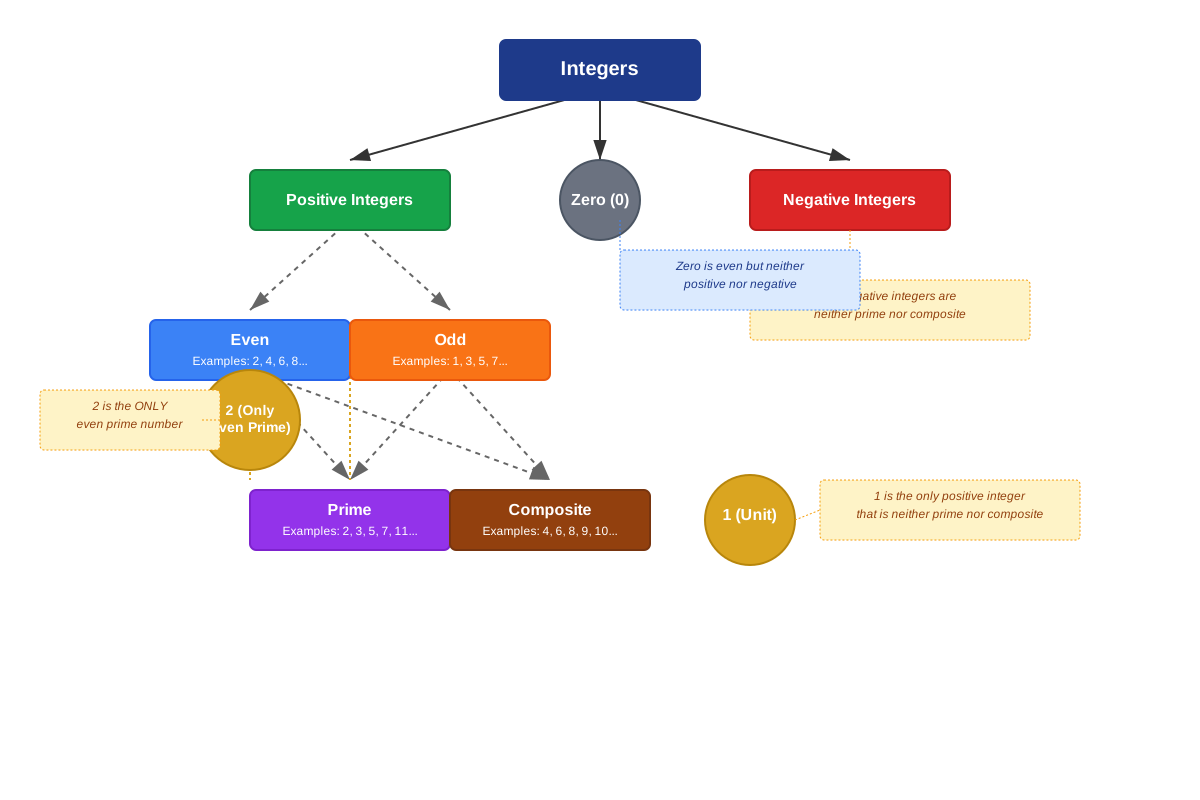
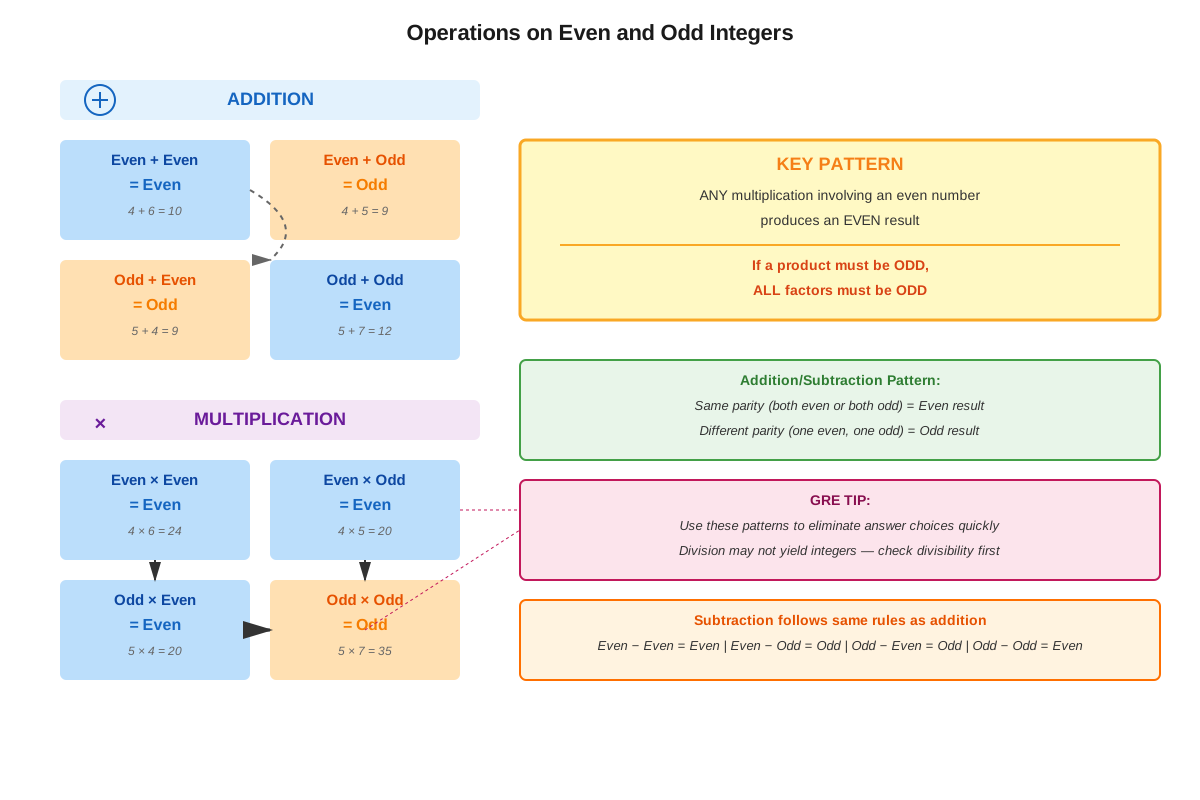
Even integers are divisible by 2 and can be expressed as 2k where k is any integer. Odd integers leave a remainder of 1 when divided by 2 and can be expressed as 2k + 1. Understanding how these numbers behave under operations is crucial:
Addition and Subtraction Rules:
- Even ± Even = Even
- Odd ± Odd = Even
- Even ± Odd = Odd
Multiplication Rules:
- Even × Even = Even
- Even × Odd = Even
- Odd × Odd = Odd
Division Considerations:
When dividing integers, the result may not be an integer. However, if the result IS an integer, then Even ÷ Even could be either even or odd (8 ÷ 4 = 2, but 8 ÷ 2 = 4), while Odd ÷ Odd = Odd only when the division results in an integer.
GRE Tip: If a problem states that the product of two integers is odd, you can immediately conclude that BOTH integers must be odd. This single fact can eliminate multiple answer choices.
Prime and Composite Numbers
A prime number is a positive integer greater than 1 that has exactly two distinct positive divisors: 1 and itself. A composite number is a positive integer greater than 1 that has more than two positive divisors.
Key Prime Number Facts:
- 2 is the only even prime number
- 1 is neither prime nor composite
- The first ten primes are: 2, 3, 5, 7, 11, 13, 17, 19, 23, 29
- Every composite number can be expressed as a unique product of prime factors (Fundamental Theorem of Arithmetic)
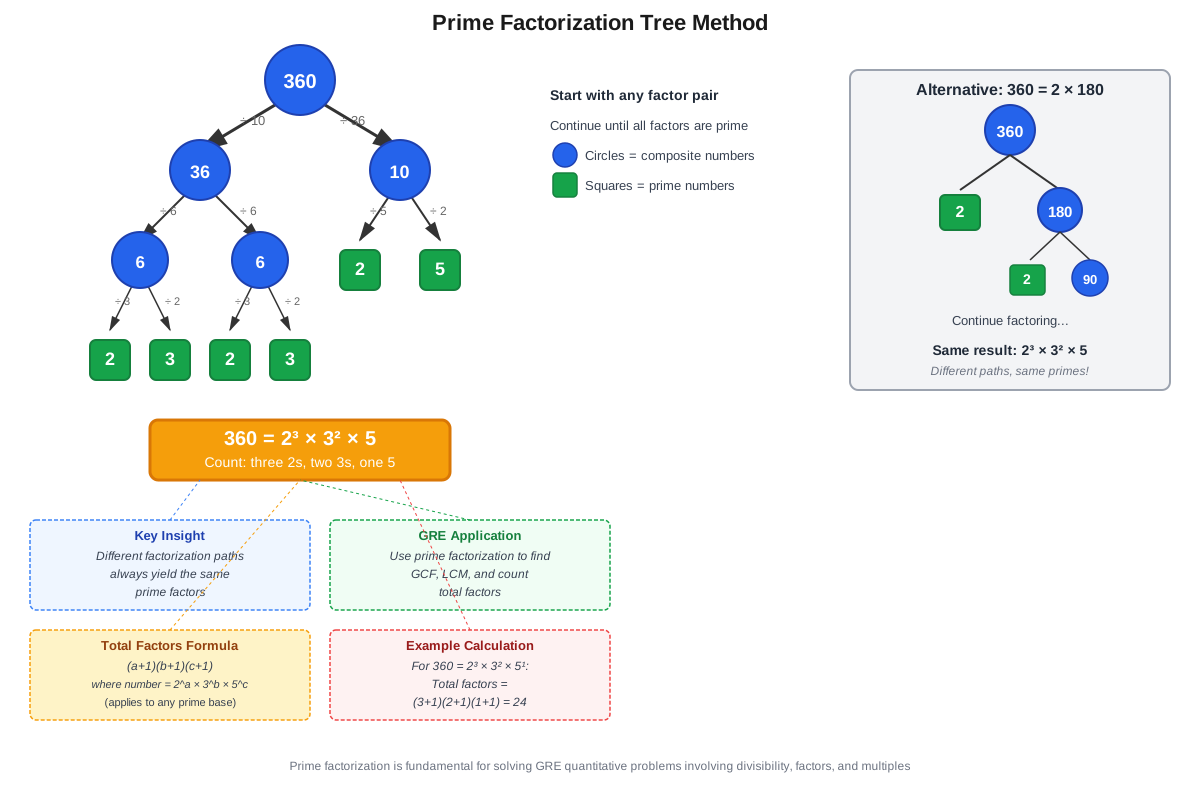
Prime Factorization expresses any integer as a product of prime numbers. For example, 60 = 2² × 3 × 5. This representation is unique (except for order) and proves invaluable for finding greatest common divisors, least common multiples, and determining the number of factors.
Divisibility Rules
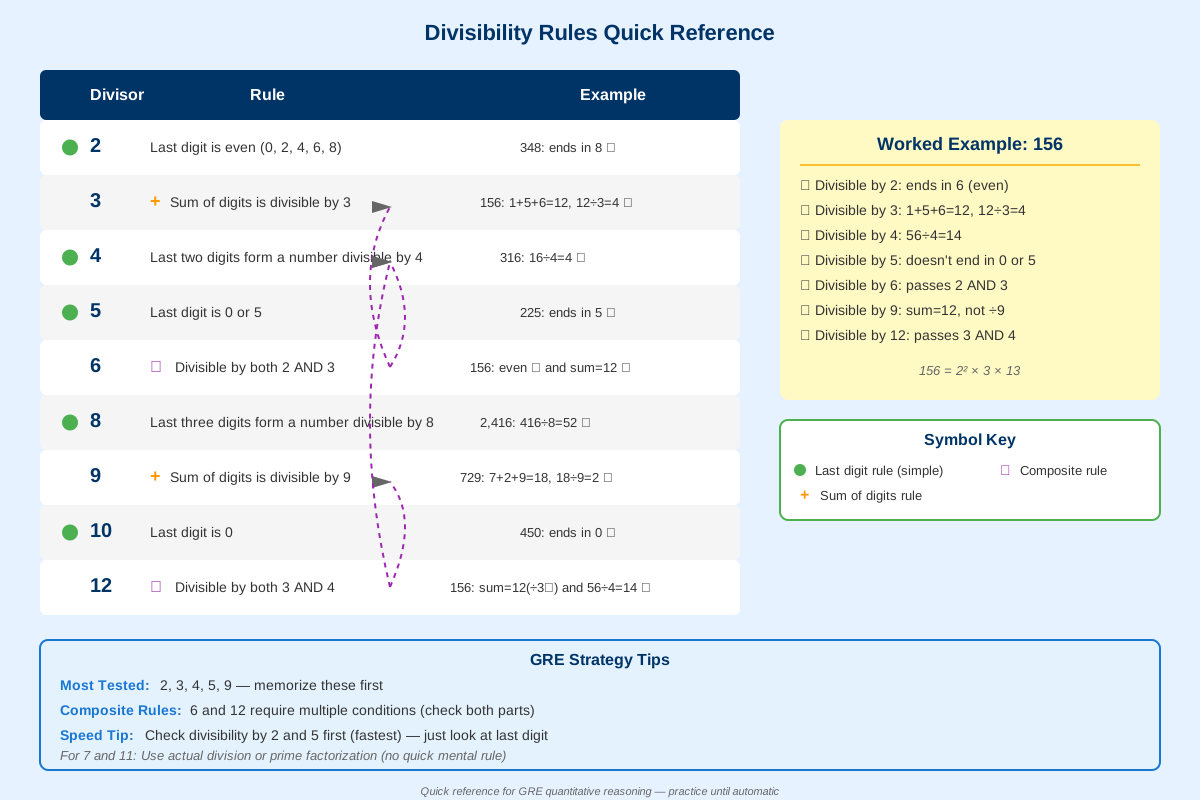
Divisibility rules allow quick determination of whether one integer divides evenly into another without performing long division:
| Divisor | Rule |
|---|---|
| 2 | Last digit is even (0, 2, 4, 6, 8) |
| 3 | Sum of digits is divisible by 3 |
| 4 | Last two digits form a number divisible by 4 |
| 5 | Last digit is 0 or 5 |
| 6 | Number is divisible by both 2 and 3 |
| 8 | Last three digits form a number divisible by 8 |
| 9 | Sum of digits is divisible by 9 |
| 10 | Last digit is 0 |
These rules dramatically speed up factor identification and remainder problems on the GRE.
Positive and Negative Integers
The behavior of positive and negative integers under operations follows specific patterns:
Multiplication and Division:
- Positive × Positive = Positive
- Negative × Negative = Positive
- Positive × Negative = Negative
- Same rules apply for division
Addition and Subtraction:
- Adding a negative is equivalent to subtracting its absolute value
- Subtracting a negative is equivalent to adding its absolute value
- The sign of the sum depends on which absolute value is larger
Powers and Roots:
- A negative number raised to an even power becomes positive
- A negative number raised to an odd power remains negative
- Even roots of negative numbers are not real numbers (not tested on GRE)
Consecutive Integers
Consecutive integers are integers that follow one another in order, differing by 1. Examples include {5, 6, 7, 8} or {-3, -2, -1, 0}.
Important Properties:
- The sum of n consecutive integers equals n times the average of the first and last terms
- Among any set of consecutive integers, exactly one is divisible by any given integer n
- The product of n consecutive integers is divisible by n! (n factorial)
- In any set of two consecutive integers, one is even and one is odd
Consecutive even integers (like 4, 6, 8) differ by 2, while consecutive odd integers (like 3, 5, 7) also differ by 2.
Factors and Multiples
A factor (or divisor) of integer n is any integer that divides n evenly. A multiple of integer n is any integer that can be expressed as n × k for some integer k.
Number of Factors Formula:
If n = p₁^a × p₂^b × p₃^c (prime factorization), then the number of positive factors = (a+1)(b+1)(c+1)
For example, 60 = 2² × 3¹ × 5¹, so it has (2+1)(1+1)(1+1) = 12 positive factors.
Greatest Common Divisor (GCD) is the largest positive integer that divides both numbers. Least Common Multiple (LCM) is the smallest positive integer that both numbers divide evenly.
For any two positive integers a and b: GCD(a,b) × LCM(a,b) = a × b
Remainders
When integer a is divided by positive integer b, the result can be expressed as: a = bq + r, where q is the quotient and r is the remainder (0 ≤ r < b).
Remainder Properties:
- If a and b leave the same remainder when divided by n, then (a - b) is divisible by n
- The remainder when dividing a sum is related to the sum of individual remainders
- Remainders follow cyclic patterns, particularly useful for problems involving powers
Perfect Squares and Cubes
A perfect square is an integer that equals some integer squared (1, 4, 9, 16, 25, 36...). A perfect cube is an integer that equals some integer cubed (1, 8, 27, 64...).
Perfect Square Properties:
- Always non-negative
- Prime factorization contains only even exponents
- The number of positive factors is always odd
- The last digit can only be 0, 1, 4, 5, 6, or 9
- The difference between consecutive perfect squares follows the pattern: (n+1)² - n² = 2n + 1
Concept Relationships
Number properties form an interconnected web where understanding one concept enhances comprehension of others. Even and odd integers connect directly to divisibility by 2, which is the simplest divisibility rule. This relationship extends to prime numbers, where recognizing that 2 is the only even prime immediately helps identify all other primes as odd (except 2).
Prime factorization serves as the central hub connecting multiple concepts. It enables calculation of the number of factors, determination of GCD and LCM, and identification of perfect squares (which have all even exponents in their prime factorization). The relationship flows: Prime Factorization → Number of Factors → Perfect Squares.
Divisibility rules derive from remainder properties and connect to factors and multiples. Understanding that a number is divisible by 6 requires recognizing it must be divisible by both 2 and 3, linking back to even/odd properties and the divisibility rule for 3.
Consecutive integers integrate multiple properties: they always contain both even and odd numbers, their product is divisible by factorial values, and their sum relates to average calculations. This concept bridges number properties with arithmetic sequences.
The relationship between positive and negative integers affects all operations and connects to absolute value concepts. When combined with even and odd exponents, these properties determine the sign of results in complex expressions.
Quick check — test yourself on Number properties so far.
Try Flashcards →High-Yield Facts
⭐ The product of two integers is odd if and only if both integers are odd
⭐ 2 is the only even prime number; all other primes are odd
⭐ If a number is divisible by both a and b (where a and b are coprime), then it is divisible by a × b
⭐ A perfect square has an odd number of total factors
⭐ Among any n consecutive integers, exactly one is divisible by n
- Zero is even (divisible by 2) and is neither positive nor negative
- 1 is neither prime nor composite
- The sum of n consecutive integers is divisible by n if n is odd, but not necessarily if n is even
- If x² is even, then x must be even; if x² is odd, then x must be odd
- The units digit of powers follows predictable cycles (e.g., powers of 7 cycle through 7, 9, 3, 1)
- The GCD of two numbers multiplied by their LCM equals the product of the two numbers
- A number is divisible by 3 if and only if the sum of its digits is divisible by 3
- Negative numbers raised to even powers become positive; raised to odd powers remain negative
- The difference between consecutive perfect squares increases by 2 each time: 1, 3, 5, 7, 9...
- If a and b are both divisible by n, then (a + b) and (a - b) are also divisible by n
Common Misconceptions
Misconception: 1 is a prime number → Correction: 1 is neither prime nor composite. By definition, a prime number must have exactly two distinct positive divisors (1 and itself), but 1 has only one divisor.
Misconception: Zero is neither even nor odd → Correction: Zero is even because it is divisible by 2 (0 = 2 × 0). This matters in GRE questions asking about even/odd properties of expressions that could equal zero.
Misconception: If a number is divisible by 4 and by 6, it must be divisible by 24 → Correction: The number must be divisible by LCM(4,6) = 12, not by 4 × 6 = 24. For example, 12 is divisible by both 4 and 6 but not by 24. The rule "divisible by a and b means divisible by a × b" only works when a and b are coprime (share no common factors).
Misconception: The sum of two prime numbers is always even → Correction: This is only true when both primes are odd. Since 2 is prime and even, 2 + 3 = 5 (odd). However, the sum of any two odd primes is indeed even.
Misconception: If x² = 16, then x = 4 → Correction: x could be 4 or -4. Students often forget the negative solution. On the GRE, this appears in questions about possible values or in quantitative comparisons.
Misconception: All odd numbers are prime → Correction: Many odd numbers are composite (9, 15, 21, 25, 27, etc.). Being odd is necessary but not sufficient for being prime (except for the number 2).
Misconception: A number ending in 5 is always divisible by 5 only → Correction: While numbers ending in 5 are divisible by 5, they may have other factors. For example, 15 is divisible by 3, and 25 is divisible by 5 twice (25 = 5²).
Worked Examples
Example 1: Even/Odd and Prime Properties
Question: If x and y are positive integers, x is odd, and x + y is even, which of the following MUST be true?
(A) y is prime
(B) xy is even
(C) x - y is even
(D) y² is odd
(E) x/y is an integer
Solution:
Step 1: Analyze the given information. We know x is odd and x + y is even.
Step 2: Apply even/odd addition rules. Since x (odd) + y = even, and odd + odd = even, we can conclude that y must be odd.
Step 3: Evaluate each answer choice:
(A) y is prime - Not necessarily. y could be 9, 15, or any odd composite number. Eliminate.
(B) xy is even - Since both x and y are odd, and odd × odd = odd, xy must be odd, not even. Eliminate.
(C) x - y is even - Since both x and y are odd, and odd - odd = even, this MUST be true. Keep.
(D) y² is odd - Since y is odd, and odd × odd = odd, this is true. However, let's verify (C) is also true before selecting. Both (C) and (D) appear correct, but the question asks for a single answer, so let's reconsider...
Actually, both (C) and (D) must be true based on our analysis. If this were a "select all that apply" question, both would be correct. For a single-answer question, (C) is the more direct consequence of the given information.
Answer: (C) x - y is even
Connection to Learning Objectives: This problem tests the ability to identify when number properties are being tested (even/odd relationships), explain the core rules (even/odd arithmetic), and apply them accurately to eliminate wrong answers.
Example 2: Divisibility and Factors
Question: A positive integer n has exactly 4 positive factors. If n is odd, which of the following could be the value of n?
Indicate all that apply.
(A) 15
(B) 27
(C) 35
(D) 49
(E) 63
Solution:
Step 1: Recall the formula for the number of factors. If n = p₁^a × p₂^b × ..., then the number of factors = (a+1)(b+1)...
Step 2: Determine what prime factorizations yield exactly 4 factors.
- (a+1) = 4, so a = 3: n = p³ (a prime cubed)
- (a+1)(b+1) = 4, so a = 1, b = 1: n = p × q (product of two distinct primes)
Step 3: Since n must be odd, all prime factors must be odd (cannot include 2).
Step 4: Evaluate each choice:
(A) 15 = 3 × 5 (two distinct odd primes)
Factors: 1, 3, 5, 15 → 4 factors ✓
(B) 27 = 3³ (odd prime cubed)
Factors: 1, 3, 9, 27 → 4 factors ✓
(C) 35 = 5 × 7 (two distinct odd primes)
Factors: 1, 5, 7, 35 → 4 factors ✓
(D) 49 = 7² (odd prime squared)
Factors: 1, 7, 49 → 3 factors ✗
(E) 63 = 3² × 7
Number of factors = (2+1)(1+1) = 6 factors ✗
Answer: (A), (B), and (C)
Connection to Learning Objectives: This problem requires identifying that factor counting is being tested, explaining the relationship between prime factorization and number of factors, and systematically applying this knowledge to evaluate multiple options.
Exam Strategy
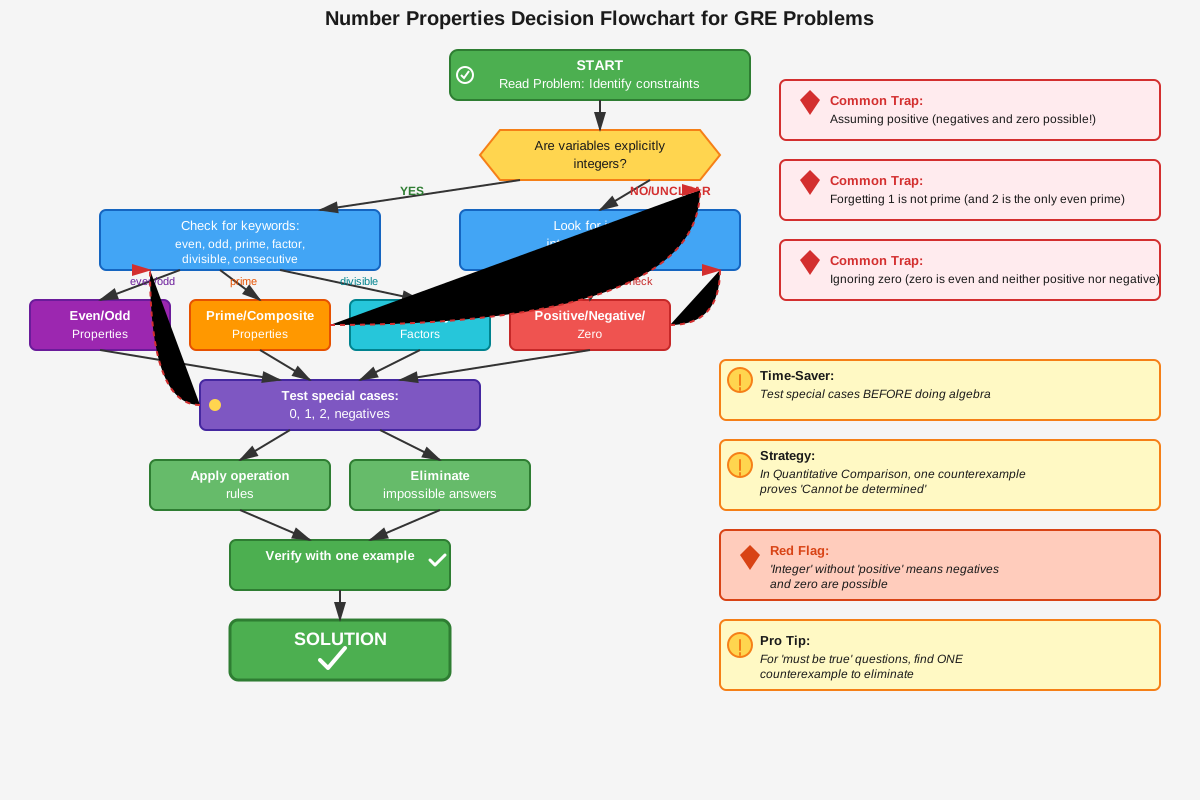
When approaching GRE number properties questions, follow this systematic process:
1. Identify the constraint type: Determine whether the problem involves even/odd, prime/composite, divisibility, positive/negative, or factor relationships. Look for trigger words like "integer," "divisible," "factor," "multiple," "consecutive," "even," "odd," or "prime."
2. List what you know and what you need: Write down given constraints explicitly. If x is even, write "x = 2k." If y is odd, write "y = 2m + 1." This concrete representation often reveals the path forward.
3. Test extreme cases: For "must be true" questions, try to find counterexamples. For "could be true" questions, try to find one example that works. Use small numbers first: 0, 1, 2, 3, -1, -2.
4. Use the answer choices strategically: In quantitative comparison questions, plug in values that test boundaries (positive, negative, zero, one, prime numbers). In multiple-choice questions, eliminate answers that violate basic number properties.
5. Watch for trap answers: The GRE often includes answers that would be correct if you forgot about negative numbers, zero, or the number 2 (the only even prime). Always consider these special cases.
Time allocation: Spend 15-20 seconds identifying the property being tested, 30-45 seconds applying the relevant rules, and 15-20 seconds verifying your answer. If you're stuck after one minute, make an educated guess and move on.
Trigger Phrases to Watch For: - "must be true" vs. "could be true" (different approaches needed) - "positive integer" (excludes zero and negatives) - "integer" without "positive" (includes negatives and zero) - "distinct" (numbers must be different) - "consecutive" (triggers specific properties)
Memory Techniques
PEMDAS for Even/Odd Operations: Remember "Product Even Means Definitely A Single even factor" - if a product is even, at least one factor must be even.
"Two is the Odd Prime Out": Visualize the number 2 standing alone, separated from all other primes. This reminds you that 2 is the only even prime and must be treated specially.
Divisibility Rules Mnemonic - "2, 3, 4, 5, 6 - Digits, Sums, and Tricks":
- 2: Last Digit even
- 3: Sum of digits divisible by 3
- 4: Last Two digits divisible by 4
- 5: Last digit 0 or 5
- 6: Both 2 and 3 rules apply
Perfect Square Visualization: Picture perfect squares as actual squares. A 3×3 square has 9 units. This helps remember that perfect squares have odd numbers of factors (you can pair up all factors except the square root, which pairs with itself).
Consecutive Integer Property - "N in N": Among N consecutive integers, exactly 1 is divisible by N. The matching N's help you remember this relationship.
Factor Formula - "Add One to Each": When counting factors from prime factorization, visualize adding "+1" to each exponent, then multiplying. For 2³ × 3², picture (3+1) × (2+1) = 12 factors.
Summary
Number properties constitute a foundational pillar of GRE Quantitative Reasoning, appearing in approximately 15-20% of questions across multiple formats. Mastery requires understanding how integers behave under various operations and constraints. The core concepts include even/odd arithmetic (where products are odd only when all factors are odd), prime and composite numbers (with 2 as the unique even prime), divisibility rules (enabling quick factor identification), and the relationships between factors, multiples, GCD, and LCM. Perfect squares possess special properties including an odd number of factors and all even exponents in prime factorization. Consecutive integers guarantee that exactly one number in any set of n consecutive integers is divisible by n. Success on GRE number properties questions demands systematic analysis: identify the constraint type, test extreme cases including zero and negative numbers, and use answer choices strategically to eliminate options that violate fundamental properties. The ability to quickly recognize which property is being tested and apply the relevant rules efficiently separates high scorers from average performers.
Key Takeaways
- Even × Odd = Even always; Odd × Odd = Odd always - this single rule eliminates many wrong answers in product-based questions
- 2 is the only even prime - treat it as a special case in any problem involving primes
- Perfect squares have an odd number of factors because the square root pairs with itself
- Test zero, negative numbers, and small primes (especially 2 and 3) when evaluating "must be true" vs. "could be true" questions
- Divisibility by both a and b means divisibility by LCM(a,b), not necessarily a × b
- Prime factorization unlocks multiple properties: number of factors, GCD, LCM, and perfect square identification
- Among n consecutive integers, exactly one is divisible by n - a high-yield fact for sequence problems
Related Topics
Integer Exponents and Roots: Building on perfect squares and cubes, this topic explores how number properties extend to exponential expressions and radical simplification, particularly important for GRE algebra questions.
Ratios and Proportions: Understanding factors and multiples provides the foundation for working with ratios, as ratios represent relationships between quantities that share common factors.
Sequences and Series: Consecutive integer properties extend naturally to arithmetic sequences, where understanding patterns in sums and products becomes essential.
Algebraic Expressions with Integer Constraints: Many GRE algebra problems impose integer constraints on variables, requiring application of number properties to determine possible values or ranges.
Data Interpretation with Integer Quantities: Real-world data often involves integer quantities (people, items, days), where divisibility and factor relationships help answer questions about distributions and allocations.
Practice CTA
Now that you've mastered the core concepts of number properties, it's time to solidify your understanding through active practice. Attempt the practice questions associated with this topic, focusing on identifying which property is being tested before jumping to calculations. Use the flashcards to drill high-yield facts until they become automatic. Remember: number properties questions reward pattern recognition and systematic thinking more than computational skill. Each practice problem you solve strengthens your intuition and speeds up your test-day performance. You've built the foundation—now make it unshakeable through deliberate practice!
Sign up free to keep reading
Create a free AnvayaPrep account to finish this GRE guide on Number properties — plus flashcards and practice questions.