Overview
The greatest common factor (GCF), also known as the greatest common divisor, represents the largest positive integer that divides two or more integers without leaving a remainder. This fundamental concept in number theory appears frequently throughout the GRE Quantitative Reasoning section, both as a standalone topic and as an essential tool for solving more complex problems involving fractions, ratios, algebraic expressions, and word problems. Understanding how to quickly identify and calculate the GCF enables test-takers to simplify expressions, reduce fractions to lowest terms, and solve optimization problems that ask for maximum values under divisibility constraints.
Mastery of the GRE greatest common factor is crucial because it serves as a gateway skill that connects multiple areas of arithmetic and algebra. Questions testing this concept may appear directly, asking students to find the GCF of given numbers, or indirectly, where recognizing that a GCF approach will simplify the problem becomes the key insight. The GRE frequently embeds GCF concepts within questions about prime factorization, least common multiples, fraction operations, and divisibility rules, making it one of the most versatile tools in a test-taker's mathematical arsenal.
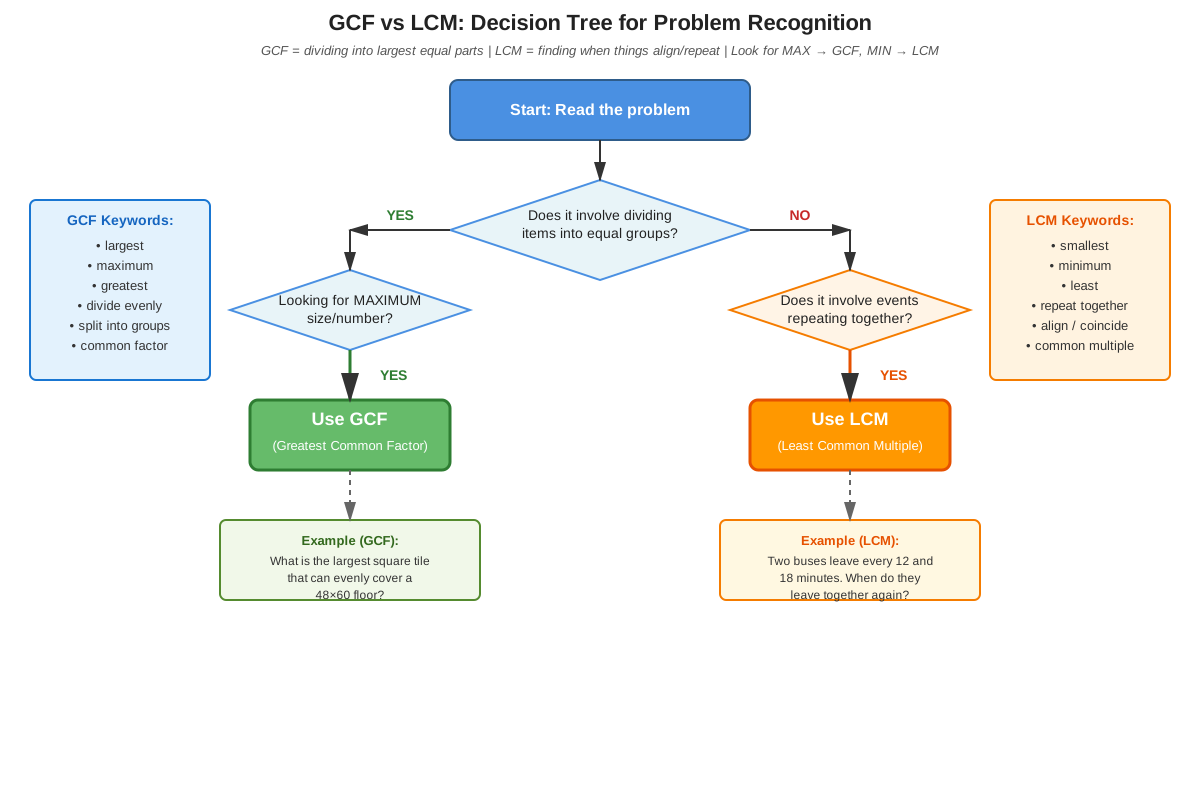
The greatest common factor relates intimately to other Quantitative Reasoning concepts including prime factorization (the foundation for systematic GCF calculation), the least common multiple (its mathematical complement), and simplification of algebraic expressions (where factoring out the GCF is a standard technique). Additionally, GCF concepts underpin many real-world optimization problems that appear on the GRE, such as determining the largest square tiles that can evenly cover a rectangular floor or finding the maximum number of identical groups that can be formed from different quantities of items.
Learning Objectives
- [ ] Identify when Greatest common factor is being tested
- [ ] Explain the core rule or strategy behind Greatest common factor
- [ ] Apply Greatest common factor to GRE-style questions accurately
- [ ] Calculate the GCF of two or more integers using multiple methods (listing factors, prime factorization, Euclidean algorithm)
- [ ] Recognize when GCF concepts are embedded within word problems and algebraic expressions
- [ ] Distinguish between situations requiring GCF versus those requiring LCM
- [ ] Factor out the GCF from algebraic expressions to simplify complex problems
Prerequisites
- Prime numbers and composite numbers: Understanding which numbers are prime is essential because prime factorization forms the most efficient method for finding GCF
- Divisibility rules: Knowing when one number divides evenly into another helps identify common factors quickly
- Factors and multiples: Distinguishing between factors (numbers that divide into a given number) and multiples (numbers that result from multiplication) prevents confusion between GCF and LCM
- Basic multiplication and division: Fluency with these operations enables rapid calculation and verification of common factors
Why This Topic Matters
The greatest common factor appears in approximately 5-8% of GRE Quantitative Reasoning questions, making it a high-yield topic that warrants thorough preparation. Beyond direct questions asking for the GCF of specific numbers, this concept underlies numerous problem types including fraction simplification, ratio problems, algebraic factoring, and optimization word problems. Test-takers who can quickly recognize GCF applications gain significant time advantages and avoid computational errors that arise from working with unnecessarily large numbers.
In real-world contexts, GCF concepts apply to resource allocation problems, scheduling scenarios, measurement conversions, and any situation requiring the determination of maximum uniform groupings. For example, architects use GCF principles when determining tile sizes, event planners apply them when creating equal-sized groups from different populations, and manufacturers employ them when optimizing packaging configurations. This practical relevance means GRE questions often present GCF problems within realistic scenarios that test both mathematical understanding and problem-solving intuition.
On the GRE, greatest common factor questions typically appear in three formats: direct calculation questions in Quantitative Comparison or Problem Solving formats, embedded applications within word problems (especially those involving "maximum," "largest," or "greatest" language), and as a simplification step within multi-step algebraic problems. Recognizing these patterns enables strategic test-takers to quickly identify when GCF methods will provide the most efficient solution path.
Core Concepts
Definition and Fundamental Properties
The greatest common factor of two or more integers is the largest positive integer that divides each of the numbers without leaving a remainder. For any set of integers, the GCF always exists and is at least 1, since 1 divides every integer. When the GCF of two numbers equals 1, those numbers are called relatively prime or coprime, meaning they share no common factors other than 1.
Key properties of the GCF include:
- The GCF of any number and itself equals that number: GCF(a, a) = a
- The GCF of any number and 1 equals 1: GCF(a, 1) = 1
- The GCF is commutative: GCF(a, b) = GCF(b, a)
- The GCF is associative: GCF(GCF(a, b), c) = GCF(a, GCF(b, c))
- The GCF of any number and 0 equals that number: GCF(a, 0) = a
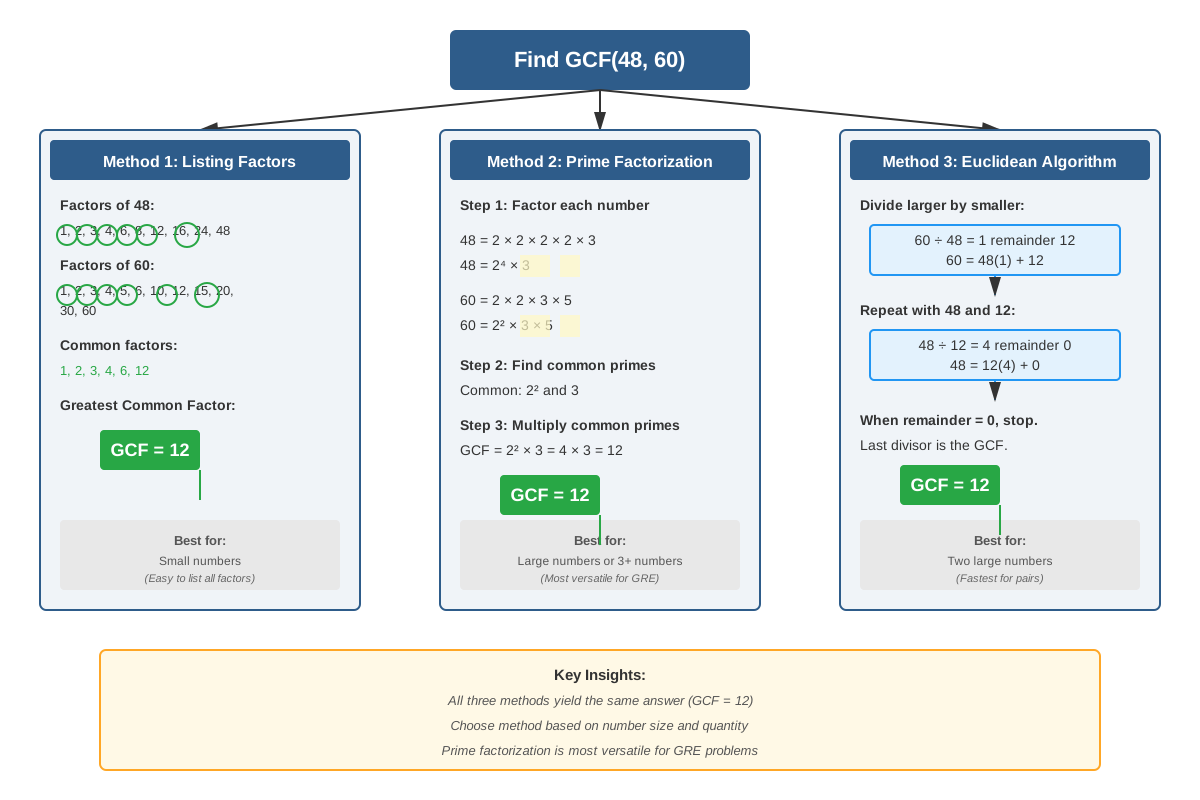
Method 1: Listing Factors
The most intuitive method for finding the GCF involves listing all factors of each number and identifying the largest factor common to all numbers. This approach works well for smaller numbers but becomes impractical for larger values.
Process:
- List all positive factors of the first number
- List all positive factors of the second number
- Identify factors appearing in both lists
- Select the largest common factor
For example, to find GCF(24, 36):
- Factors of 24: 1, 2, 3, 4, 6, 8, 12, 24
- Factors of 36: 1, 2, 3, 4, 6, 9, 12, 18, 36
- Common factors: 1, 2, 3, 4, 6, 12
- GCF(24, 36) = 12
Method 2: Prime Factorization
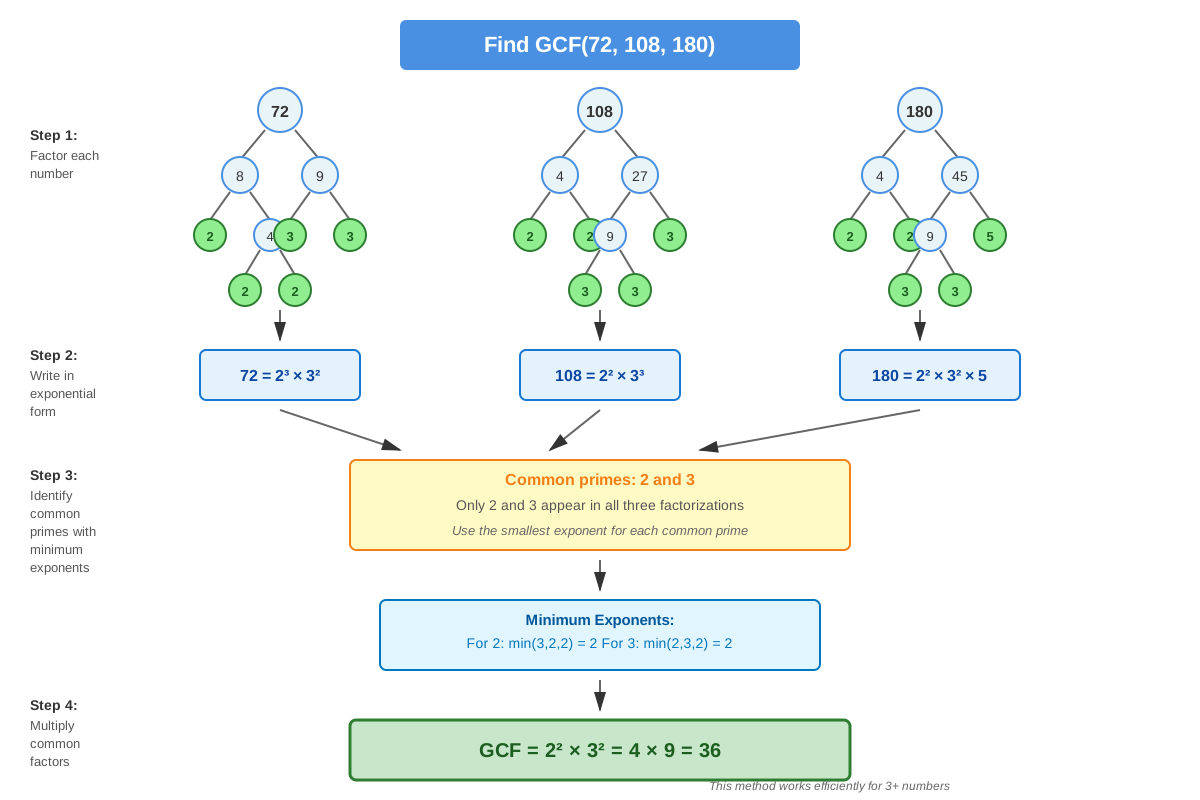
The prime factorization method provides the most systematic and reliable approach for finding the GCF, especially for larger numbers or when working with three or more values. This method leverages the fundamental theorem of arithmetic, which states that every integer greater than 1 has a unique prime factorization.
Process:
- Express each number as a product of prime factors
- Identify prime factors common to all numbers
- For each common prime factor, take the lowest exponent appearing across all factorizations
- Multiply these prime powers together to obtain the GCF
For example, to find GCF(180, 234):
- 180 = 2² × 3² × 5
- 234 = 2 × 3² × 13
- Common prime factors: 2 and 3
- Lowest exponent for 2: 1 (from 234)
- Lowest exponent for 3: 2 (appears in both)
- GCF(180, 234) = 2¹ × 3² = 2 × 9 = 18
This method extends naturally to three or more numbers. For GCF(60, 90, 150):
- 60 = 2² × 3 × 5
- 90 = 2 × 3² × 5
- 150 = 2 × 3 × 5²
- Common prime factors: 2, 3, and 5
- Lowest exponents: 2¹, 3¹, 5¹
- GCF(60, 90, 150) = 2 × 3 × 5 = 30
Method 3: Euclidean Algorithm
The Euclidean algorithm offers the most efficient computational method for finding the GCF of two numbers, particularly when dealing with large values where prime factorization becomes tedious. This ancient algorithm, dating back to Euclid's Elements (circa 300 BCE), uses repeated division to reduce the problem to simpler cases.
Process:
- Divide the larger number by the smaller number
- Replace the larger number with the smaller number
- Replace the smaller number with the remainder from step 1
- Repeat until the remainder equals 0
- The last non-zero remainder is the GCF
For example, to find GCF(252, 105):
- 252 ÷ 105 = 2 remainder 42
- 105 ÷ 42 = 2 remainder 21
- 42 ÷ 21 = 2 remainder 0
- GCF(252, 105) = 21
The Euclidean algorithm proves particularly valuable on the GRE when dealing with large numbers where prime factorization would be time-consuming, though the GRE rarely requires this method explicitly.
GCF in Algebraic Expressions
Finding the GCF extends beyond numerical values to algebraic expressions containing variables. When factoring algebraic expressions, identifying the GCF of all terms allows for simplification through factoring out the common elements.
For algebraic terms, the GCF includes:
- The GCF of all numerical coefficients
- Each variable raised to the lowest exponent appearing in all terms
For example, to find the GCF of 12x³y² and 18x²y⁴:
- GCF of coefficients: GCF(12, 18) = 6
- Lowest exponent of x: 2
- Lowest exponent of y: 2
- GCF = 6x²y²
This allows factoring: 12x³y² + 18x²y⁴ = 6x²y²(2x + 3y²)
GCF and Fraction Simplification
The greatest common factor plays a crucial role in reducing fractions to lowest terms or simplest form. A fraction is in lowest terms when the GCF of its numerator and denominator equals 1, meaning they share no common factors other than 1.
To simplify a fraction:
- Find the GCF of the numerator and denominator
- Divide both numerator and denominator by this GCF
For example, to simplify 168/252:
- GCF(168, 252) = 84
- 168/252 = (168 ÷ 84)/(252 ÷ 84) = 2/3
Concept Relationships
The greatest common factor serves as a central hub connecting multiple arithmetic and algebraic concepts. At its foundation, GCF relies on prime factorization, which breaks numbers into their fundamental building blocks. The systematic approach of expressing numbers as products of primes enables reliable GCF calculation and connects to broader number theory concepts tested on the GRE.
The relationship between GCF and least common multiple (LCM) represents a mathematical duality: while GCF identifies the largest number dividing all given values, LCM identifies the smallest number divisible by all given values. These concepts connect through the formula: GCF(a, b) × LCM(a, b) = a × b for any two positive integers a and b. This relationship allows test-takers to find one value when given the other, a technique the GRE occasionally tests.
Divisibility rules → enable quick identification of → common factors → which inform → GCF calculation → which enables → fraction simplification → which supports → ratio and proportion problems
In algebraic contexts, GCF connects to factoring techniques, where recognizing common factors allows simplification of complex expressions. This factoring skill extends to solving equations, simplifying rational expressions, and working with polynomials—all topics that appear on the GRE Quantitative Reasoning section.
The GCF also underlies many optimization word problems where questions ask for maximum values under divisibility constraints. These problems often involve finding the largest uniform grouping, the biggest square tile, or the greatest number of identical sets—all applications requiring GCF reasoning.
Quick check — test yourself on Greatest common factor so far.
Try Flashcards →High-Yield Facts
⭐ The GCF of two numbers is always less than or equal to the smaller of the two numbers
⭐ When two numbers are relatively prime (coprime), their GCF equals 1
⭐ The GCF of any number and zero equals that number itself
⭐ For the prime factorization method, take the lowest exponent of each common prime factor
⭐ The product of GCF and LCM of two numbers equals the product of the two numbers: GCF(a,b) × LCM(a,b) = a × b
- The GCF of consecutive integers always equals 1
- If one number divides another evenly, the GCF equals the smaller number
- The GCF of two prime numbers always equals 1 (unless they are the same prime)
- Multiplying or dividing both numbers by the same value multiplies or divides their GCF by that value
- The GCF of three or more numbers can be found by repeatedly finding the GCF of pairs
- In algebraic expressions, the GCF includes both numerical coefficients and variable factors with lowest exponents
- A fraction is in simplest form when the GCF of numerator and denominator equals 1
Common Misconceptions
Misconception: The GCF of two numbers is always smaller than both numbers → Correction: The GCF equals the smaller number when one number divides the other evenly. For example, GCF(12, 24) = 12, not a number smaller than 12.
Misconception: To find the GCF of three numbers, find GCF of the first two, then find GCF of that result with the third number → Correction: This approach is actually correct! The misconception is thinking this doesn't work, when in fact the associative property of GCF makes this a valid method.
Misconception: The GCF of two even numbers must be 2 → Correction: While 2 is always a common factor of two even numbers, the GCF may be much larger. For example, GCF(24, 36) = 12, not 2.
Misconception: When using prime factorization, multiply all common prime factors together → Correction: You must take the lowest exponent of each common prime factor. For GCF(12, 18) where 12 = 2² × 3 and 18 = 2 × 3², the GCF is 2¹ × 3¹ = 6, not 2² × 3² = 36.
Misconception: GCF and LCM are the same thing → Correction: GCF finds the largest number that divides all given numbers, while LCM finds the smallest number that all given numbers divide into. They are mathematical complements, not equivalents.
Misconception: The GCF of two numbers can be larger than their product → Correction: The GCF is always less than or equal to the smallest of the numbers being considered, making it impossible for the GCF to exceed either number, let alone their product.
Misconception: Negative numbers don't have a GCF → Correction: While GCF is defined for positive integers, the concept extends to negative integers by considering their absolute values. GCF(-12, -18) = GCF(12, 18) = 6.
Worked Examples
Example 1: Direct GCF Calculation with Prime Factorization
Problem: What is the greatest common factor of 126 and 180?
Solution:
Step 1: Find the prime factorization of each number.
For 126:
- 126 = 2 × 63
- 63 = 9 × 7 = 3² × 7
- Therefore, 126 = 2 × 3² × 7
For 180:
- 180 = 18 × 10
- 18 = 2 × 9 = 2 × 3²
- 10 = 2 × 5
- Therefore, 180 = 2² × 3² × 5
Step 2: Identify common prime factors.
Both numbers contain 2 and 3 as prime factors.
Step 3: Take the lowest exponent for each common prime.
- For prime 2: appears as 2¹ in 126 and 2² in 180, so take 2¹
- For prime 3: appears as 3² in both, so take 3²
Step 4: Multiply these prime powers.
GCF(126, 180) = 2¹ × 3² = 2 × 9 = 18
Connection to Learning Objectives: This example demonstrates the core strategy of using prime factorization to calculate GCF accurately, addressing the objective of applying GCF methods to GRE-style questions.
Example 2: GCF in a Word Problem Context
Problem: A school is organizing a field day and has 48 sixth-graders and 72 seventh-graders. The organizers want to divide the students into the largest possible equal groups, with each group containing the same number of sixth-graders and the same number of seventh-graders. What is the maximum number of groups that can be formed?
Solution:
Step 1: Recognize this as a GCF problem.
The phrase "largest possible equal groups" signals that we need the greatest common factor. Each group must contain an equal number of sixth-graders (48 total divided by number of groups) and an equal number of seventh-graders (72 total divided by number of groups).
Step 2: Find GCF(48, 72) using prime factorization.
For 48:
- 48 = 16 × 3 = 2⁴ × 3
For 72:
- 72 = 8 × 9 = 2³ × 3²
Step 3: Identify common primes and take lowest exponents.
- Common primes: 2 and 3
- Lowest exponent for 2: 2³
- Lowest exponent for 3: 3¹
- GCF(48, 72) = 2³ × 3 = 8 × 3 = 24
Step 4: Interpret the result.
The maximum number of groups is 24.
Step 5: Verify the answer makes sense.
- Each group would have 48 ÷ 24 = 2 sixth-graders
- Each group would have 72 ÷ 24 = 3 seventh-graders
- Total: 24 groups with 2 sixth-graders and 3 seventh-graders each ✓
Connection to Learning Objectives: This example shows how to identify when GCF is being tested in word problems, particularly when "maximum," "largest," or "greatest" appears with grouping or division scenarios.
Exam Strategy
When approaching GRE questions involving greatest common factor, begin by identifying trigger words and phrases that signal GCF applications: "greatest," "largest," "maximum," "most," "evenly divide," "equal groups," "simplest form," and "reduce." These terms often indicate that finding the GCF will provide the solution or an important intermediate step.
Question Type Recognition:
- Direct GCF questions: Explicitly ask for the greatest common factor of given numbers
- Embedded GCF questions: Present word problems where GCF reasoning solves the problem
- Simplification questions: Require reducing fractions or factoring expressions using GCF
- Quantitative Comparison questions: May compare GCF values or test understanding of GCF properties
Strategic Approach:
For numbers under 100, quickly listing factors often proves faster than prime factorization. For larger numbers or three or more values, prime factorization becomes more efficient. When time is limited and answer choices are provided, test the largest answer choice first—if it divides all given numbers evenly, it's the GCF.
Process of Elimination Tips:
- Eliminate any answer choice larger than the smallest number in the problem
- Eliminate answer choices that don't divide evenly into all given numbers
- For Quantitative Comparison questions, remember that GCF(a, b) ≤ min(a, b)
- If two numbers are both odd, eliminate even answer choices (the GCF cannot be even)
Time Allocation:
Allocate 1-2 minutes for straightforward GCF calculation problems. For word problems requiring GCF reasoning, budget 2-3 minutes to read carefully, identify the GCF application, calculate, and verify. Don't spend excessive time on prime factorization of large numbers—if the calculation becomes unwieldy, consider whether a different approach or estimation might work.
Exam Tip: When a problem asks for "the greatest number that..." or "the largest value that divides...", you're almost certainly dealing with a GCF question. Immediately think about common factors.
Memory Techniques
Mnemonic for Prime Factorization Method: "CLIP"
- Common primes only
- Lowest exponents
- Identify all factors
- Product gives GCF
Visualization Strategy: Picture the GCF as the "largest building block" that can construct all given numbers. Just as the largest LEGO brick that fits into multiple structures determines what they share, the GCF represents the largest numerical unit common to all values.
Acronym for GCF vs. LCM: "GCF Goes Down, LCM Lifts Up"
- GCF finds the largest factor (going down into the numbers)
- LCM finds the smallest multiple (lifting up from the numbers)
Memory Hook for Properties: "One is the Loneliest GCF"
- When GCF = 1, the numbers are relatively prime (share nothing but 1)
- This is the "loneliest" relationship numbers can have
Factor Listing Technique: Use the "Rainbow Method"—write factors in pairs that multiply to give the original number, creating a rainbow pattern that ensures no factors are missed:
- For 24: 1×24, 2×12, 3×8, 4×6
- Factors: 1, 2, 3, 4, 6, 8, 12, 24
Summary
The greatest common factor represents the largest positive integer that divides two or more numbers without remainder, serving as a foundational concept that appears throughout GRE Quantitative Reasoning questions. Mastery requires understanding three primary calculation methods: listing factors (efficient for small numbers), prime factorization (systematic and reliable for any size numbers), and the Euclidean algorithm (optimal for very large values). The GCF connects intimately with fraction simplification, algebraic factoring, and optimization word problems, making it one of the most versatile tools for test-takers. Success on GRE questions requires not only computational proficiency but also the ability to recognize when GCF reasoning applies, particularly in word problems featuring "maximum," "largest," or "greatest" language combined with divisibility or grouping scenarios. The relationship between GCF and LCM, the properties of relatively prime numbers, and the technique of taking lowest exponents in prime factorization represent high-yield knowledge that appears frequently on the exam.
Key Takeaways
- The GCF is the largest positive integer dividing all given numbers; it always exists and is at least 1
- Prime factorization method: express numbers as products of primes, identify common primes, take lowest exponents, multiply together
- Trigger words "greatest," "largest," "maximum" with divisibility or grouping contexts signal GCF applications
- GCF(a, b) × LCM(a, b) = a × b provides a powerful relationship for solving related problems
- When GCF = 1, numbers are relatively prime (coprime), sharing no common factors except 1
- For algebraic expressions, the GCF includes both numerical coefficients and variables with lowest exponents
- The GCF is always less than or equal to the smallest number being considered
Related Topics
Least Common Multiple (LCM): The mathematical complement to GCF, finding the smallest number divisible by all given values. Mastering GCF provides the foundation for understanding LCM, as both rely on prime factorization and share the relationship GCF × LCM = product of the numbers.
Prime Factorization: The process of expressing numbers as products of prime numbers, which serves as the most reliable method for calculating GCF. Deepening prime factorization skills enhances speed and accuracy with GCF problems.
Fraction Operations: Simplifying fractions to lowest terms requires finding the GCF of numerator and denominator. Strong GCF skills enable faster, more accurate fraction work throughout the GRE.
Algebraic Factoring: Factoring out the GCF represents the first step in factoring polynomials and simplifying algebraic expressions, a skill tested extensively in GRE algebra questions.
Ratio and Proportion: Simplifying ratios to lowest terms uses GCF concepts, and many ratio word problems require GCF reasoning to find maximum groupings or optimal divisions.
Practice CTA
Now that you've mastered the core concepts, strategies, and applications of greatest common factor, it's time to solidify your understanding through active practice. Attempt the practice questions to test your ability to recognize GCF applications, calculate efficiently, and apply these skills to GRE-style problems. Use the flashcards to reinforce high-yield facts and properties until they become automatic. Remember: the difference between understanding GCF and mastering it lies in deliberate practice. Each problem you solve strengthens your pattern recognition and builds the confidence needed to tackle any GCF question the GRE presents. You've got this!
Sign up free to keep reading
Create a free AnvayaPrep account to finish this GRE guide on Greatest common factor — plus flashcards and practice questions.