Overview
The least common multiple (LCM) is a fundamental arithmetic concept that appears regularly on the GRE Quantitative Reasoning section. Understanding LCM is essential for solving problems involving cyclical patterns, scheduling scenarios, fraction operations, and divisibility questions. The least common multiple of two or more integers is the smallest positive integer that is divisible by each of the given numbers without leaving a remainder.
On the GRE, gre least common multiple questions often appear disguised within word problems about repeating events, coordinating schedules, or finding when multiple cycles align. These questions test not only computational ability but also the capacity to recognize when LCM is the appropriate tool to apply. Mastery of this topic enables efficient problem-solving and connects directly to other arithmetic concepts including greatest common divisor (GCD), prime factorization, and fraction manipulation.
The importance of LCM extends beyond isolated calculation problems. It serves as a bridge between basic arithmetic operations and more complex algebraic reasoning. Students who thoroughly understand LCM can quickly identify patterns, simplify complex fraction problems, and solve real-world optimization questions that frequently appear in the quantitative comparison and problem-solving formats. Given that arithmetic forms approximately 20-25% of GRE Quantitative Reasoning questions, and LCM appears in roughly 5-8% of all quant questions, this topic represents a high-yield area for focused study.
Learning Objectives
- [ ] Identify when Least common multiple is being tested
- [ ] Explain the core rule or strategy behind Least common multiple
- [ ] Apply Least common multiple to GRE-style questions accurately
- [ ] Calculate LCM using multiple methods (prime factorization, listing multiples, and the GCD relationship)
- [ ] Distinguish between situations requiring LCM versus GCD
- [ ] Solve multi-step word problems involving cyclical events and scheduling
- [ ] Apply LCM concepts to fraction addition and subtraction problems
Prerequisites
- Prime factorization: Understanding how to break down integers into their prime components is essential for the most efficient LCM calculation method
- Divisibility rules: Recognizing when one number divides evenly into another helps identify multiples quickly
- Greatest Common Divisor (GCD): The relationship between LCM and GCD provides an alternative calculation method and deepens conceptual understanding
- Basic multiplication and division: Fundamental operations are necessary for computing and verifying LCM values
- Factors and multiples: Distinguishing between these related concepts prevents confusion when identifying the least common multiple
Why This Topic Matters
In real-world applications, LCM problems arise whenever multiple repeating cycles need to synchronize. Traffic light coordination, manufacturing schedules, planetary alignments, and project management timelines all involve LCM calculations. Understanding this concept enables practical problem-solving in engineering, logistics, and resource allocation scenarios.
On the GRE specifically, LCM questions appear in approximately 5-8% of Quantitative Reasoning sections, making them moderately frequent but highly predictable. These questions typically manifest in three formats: direct calculation problems (least common), word problems involving cyclical events or scheduling (most common), and fraction operations requiring common denominators (moderate frequency). The Educational Testing Service (ETS) particularly favors word problems that require students to recognize the underlying LCM structure rather than explicitly stating "find the LCM."
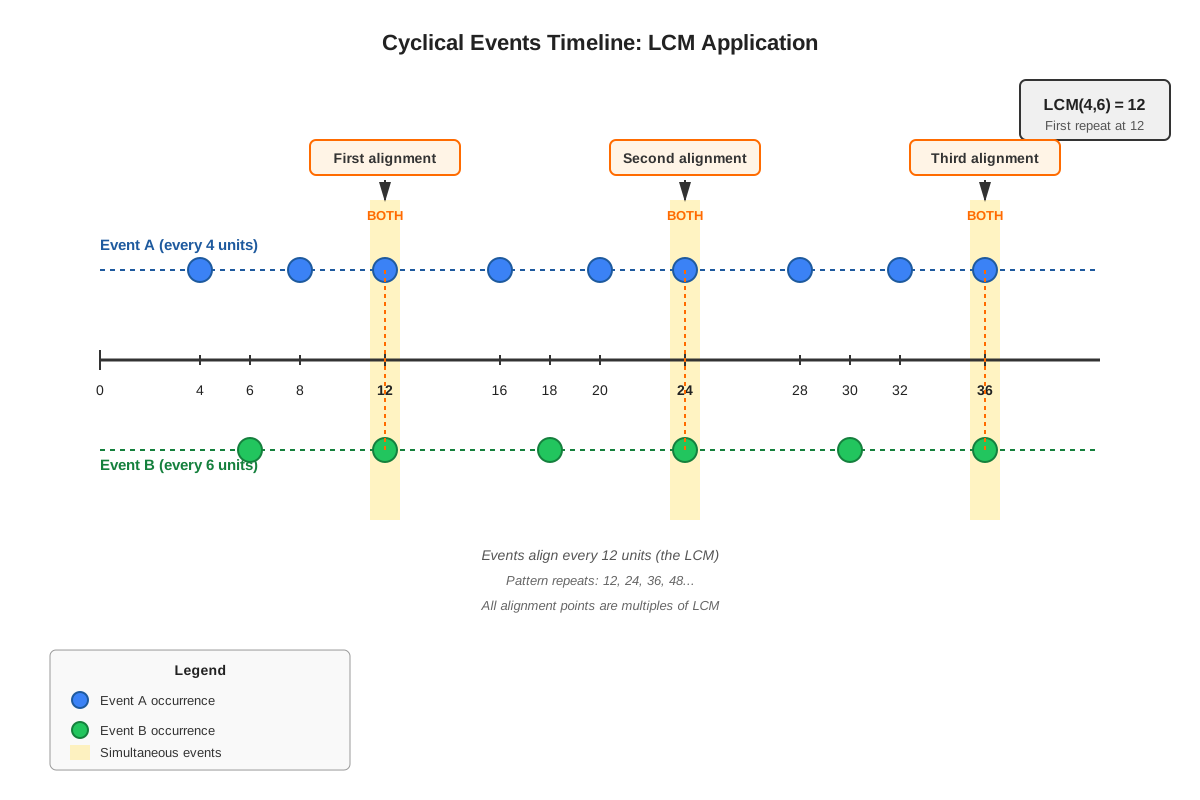
Common exam scenarios include: buses departing at different intervals and asking when they'll depart simultaneously again; machines producing items at different rates and determining when production totals align; bells ringing at different frequencies and identifying when they'll ring together; and fraction addition problems where finding the least common denominator is essential. The ability to quickly identify these patterns and apply LCM methodology can save valuable time and improve accuracy on test day.
Core Concepts
Definition and Fundamental Properties
The least common multiple of two or more positive integers is the smallest positive integer that is a multiple of all the given numbers. For any integers a and b, their LCM is denoted as LCM(a, b) or lcm(a, b).
Key properties include:
- LCM(a, b) ≥ max(a, b) — the LCM is always at least as large as the largest input number
- If a divides b evenly, then LCM(a, b) = b
- LCM is commutative: LCM(a, b) = LCM(b, a)
- LCM is associative: LCM(a, LCM(b, c)) = LCM(LCM(a, b), c)
- For any integer n: LCM(n, n) = n
Method 1: Listing Multiples
The most intuitive method involves listing multiples of each number until a common multiple appears. This approach works well for small numbers but becomes impractical for larger values.
Process:
- List the first several multiples of each number
- Identify the smallest multiple that appears in all lists
- Verify by confirming divisibility
For example, to find LCM(6, 8):
- Multiples of 6: 6, 12, 18, 24, 30, 36, 42, 48...
- Multiples of 8: 8, 16, 24, 32, 40, 48...
- The smallest common multiple is 24
Method 2: Prime Factorization Method
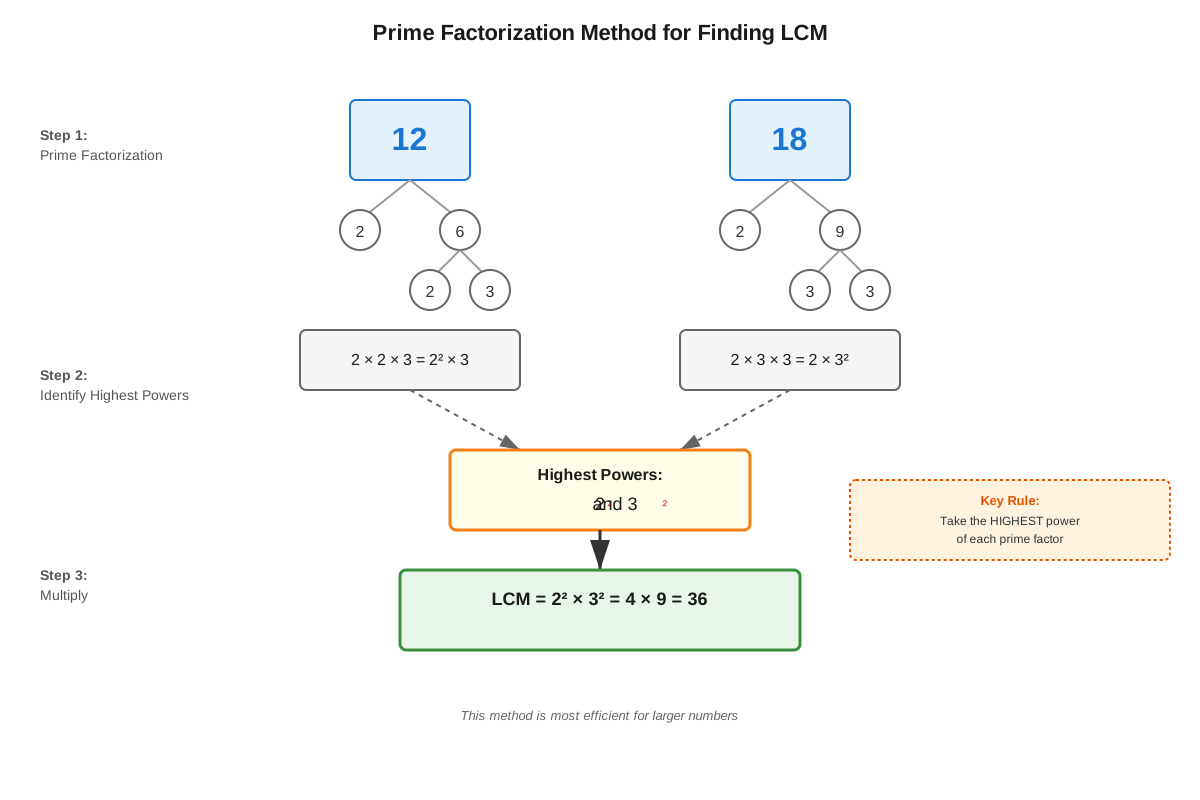
The prime factorization method is the most efficient approach for GRE questions and works reliably for all positive integers. This method leverages the fundamental theorem of arithmetic.
Process:
- Express each number as a product of prime factors with exponents
- For each distinct prime factor, identify the highest power that appears in any factorization
- Multiply these highest powers together to obtain the LCM
Example: Find LCM(12, 18, 30)
- 12 = 2² × 3¹
- 18 = 2¹ × 3²
- 30 = 2¹ × 3¹ × 5¹
Taking the highest power of each prime:
- Highest power of 2: 2²
- Highest power of 3: 3²
- Highest power of 5: 5¹
LCM = 2² × 3² × 5¹ = 4 × 9 × 5 = 180
Method 3: Using the GCD Relationship
For two numbers, there exists a fundamental relationship between LCM and GCD (greatest common divisor):
LCM(a, b) × GCD(a, b) = a × bTherefore:
LCM(a, b) = (a × b) / GCD(a, b)This method is particularly efficient when the GCD is easily identifiable or when both values are needed for a problem.
Example: Find LCM(24, 36)
- First find GCD(24, 36) = 12
- LCM(24, 36) = (24 × 36) / 12 = 864 / 12 = 72
LCM for More Than Two Numbers
When finding the LCM of three or more numbers, apply the operation sequentially:
- LCM(a, b, c) = LCM(LCM(a, b), c)
Alternatively, use the prime factorization method directly, which is often more efficient for multiple numbers.
Special Cases and Patterns
| Scenario | LCM Result | Example |
|---|---|---|
| Two consecutive integers | Their product | LCM(5, 6) = 30 |
| Two coprime numbers (GCD = 1) | Their product | LCM(7, 9) = 63 |
| One number divides another | The larger number | LCM(4, 12) = 12 |
| Powers of the same base | The higher power | LCM(8, 32) = 32 |
| Two identical numbers | That number | LCM(15, 15) = 15 |
LCM in Fraction Operations
When adding or subtracting fractions with different denominators, the least common denominator (LCD) is simply the LCM of the denominators. This application frequently appears on the GRE in both explicit fraction problems and in algebraic expressions.
Example: To add 5/12 + 7/18
- Find LCM(12, 18) = 36
- Convert: 15/36 + 14/36 = 29/36
Concept Relationships
The least common multiple sits at the intersection of several fundamental arithmetic concepts. Prime factorization serves as the foundation → enabling the most efficient LCM calculation method → which then facilitates fraction operations and solving cyclical problems.
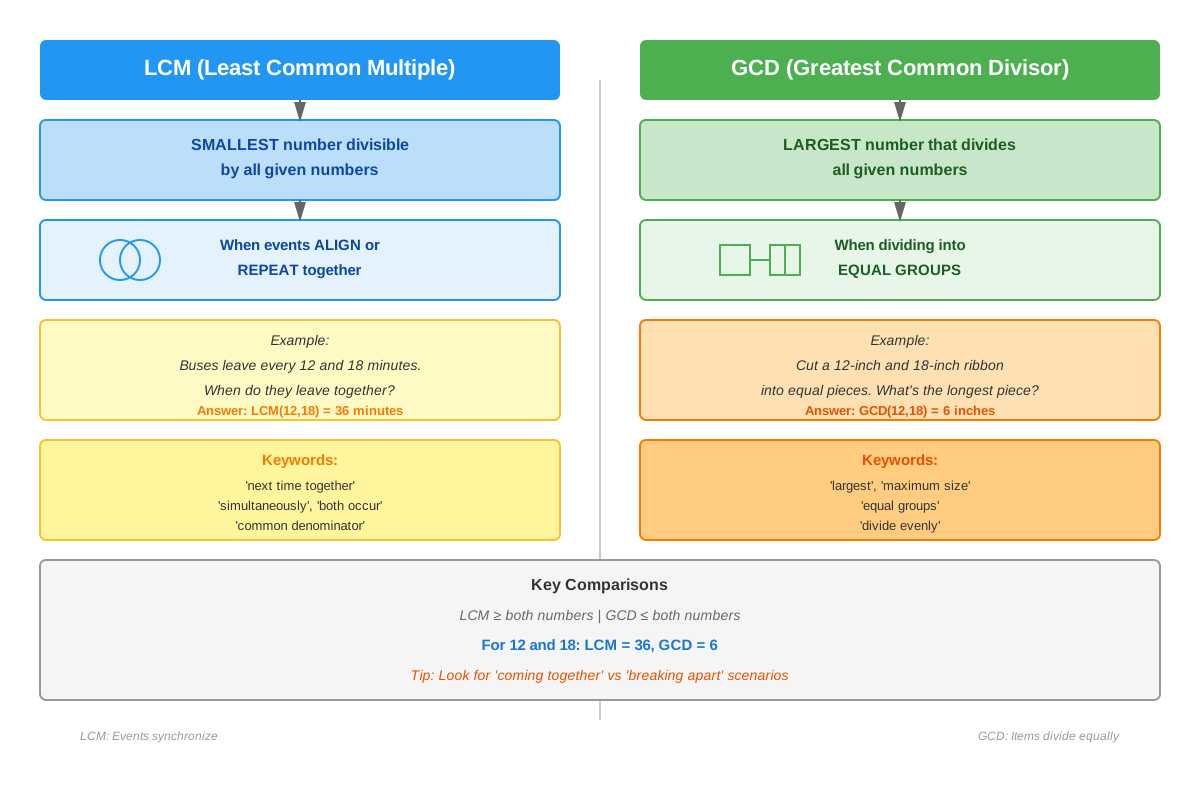
The relationship between LCM and GCD is particularly important: these concepts are mathematical duals. While GCD finds the largest number that divides into all given numbers, LCM finds the smallest number that all given numbers divide into. Together, they satisfy the fundamental relationship: LCM(a,b) × GCD(a,b) = a × b.
LCM connects forward to more advanced topics including:
- Modular arithmetic: Understanding when remainders align
- Algebraic fractions: Finding common denominators in rational expressions
- Number theory: Exploring divisibility patterns and integer properties
- Word problems: Translating real-world cyclical scenarios into mathematical models
The concept also relates laterally to multiples and factors: every common multiple is a multiple of the LCM, and the LCM itself is a multiple of each input number. Understanding this hierarchy helps in verification and problem-checking.
High-Yield Facts
⭐ The LCM of two numbers is always greater than or equal to the larger of the two numbers
⭐ For two coprime numbers (numbers with no common factors except 1), the LCM equals their product
⭐ LCM(a, b) × GCD(a, b) = a × b for any two positive integers a and b
⭐ The prime factorization method uses the highest power of each prime factor present in any of the numbers
⭐ When one number divides another evenly, the LCM is simply the larger number
- The LCM of consecutive integers is their product (since consecutive integers are always coprime)
- To find LCM of three or more numbers, you can find LCM of the first two, then find LCM of that result with the third number, and so on
- The least common denominator (LCD) used in fraction addition is the LCM of the denominators
- If you multiply the LCM of two numbers by any positive integer, the result is also a common multiple (but not the least)
- For any set of numbers, there are infinitely many common multiples, but only one least common multiple
- The LCM of any number with 1 is the number itself: LCM(n, 1) = n
- When all numbers in a set share a common factor, you can factor it out, find the LCM of the reduced numbers, then multiply back by the common factor
Quick check — test yourself on Least common multiple so far.
Try Flashcards →Common Misconceptions
Misconception: The LCM is always the product of the two numbers → Correction: The LCM equals the product only when the numbers are coprime (share no common factors). For numbers with common factors, the LCM is less than their product. For example, LCM(6, 8) = 24, not 48.
Misconception: LCM and GCD are the same thing → Correction: LCM (least common multiple) finds the smallest number divisible by all given numbers, while GCD (greatest common divisor) finds the largest number that divides into all given numbers. They are inverse concepts related by the formula LCM(a,b) × GCD(a,b) = a × b.
Misconception: To find LCM of three numbers, multiply all three together → Correction: Simply multiplying gives a common multiple but rarely the least one. Use prime factorization with highest powers, or find LCM(a,b) first, then find LCM of that result with c.
Misconception: The LCM must be larger than both input numbers → Correction: When one number divides another, the LCM equals the larger number. For example, LCM(5, 15) = 15, not something larger than 15.
Misconception: You should always use the listing method because it's most straightforward → Correction: While listing works for small numbers, it becomes extremely inefficient for larger numbers. The prime factorization method is faster and more reliable for GRE-level problems, especially when numbers exceed 20.
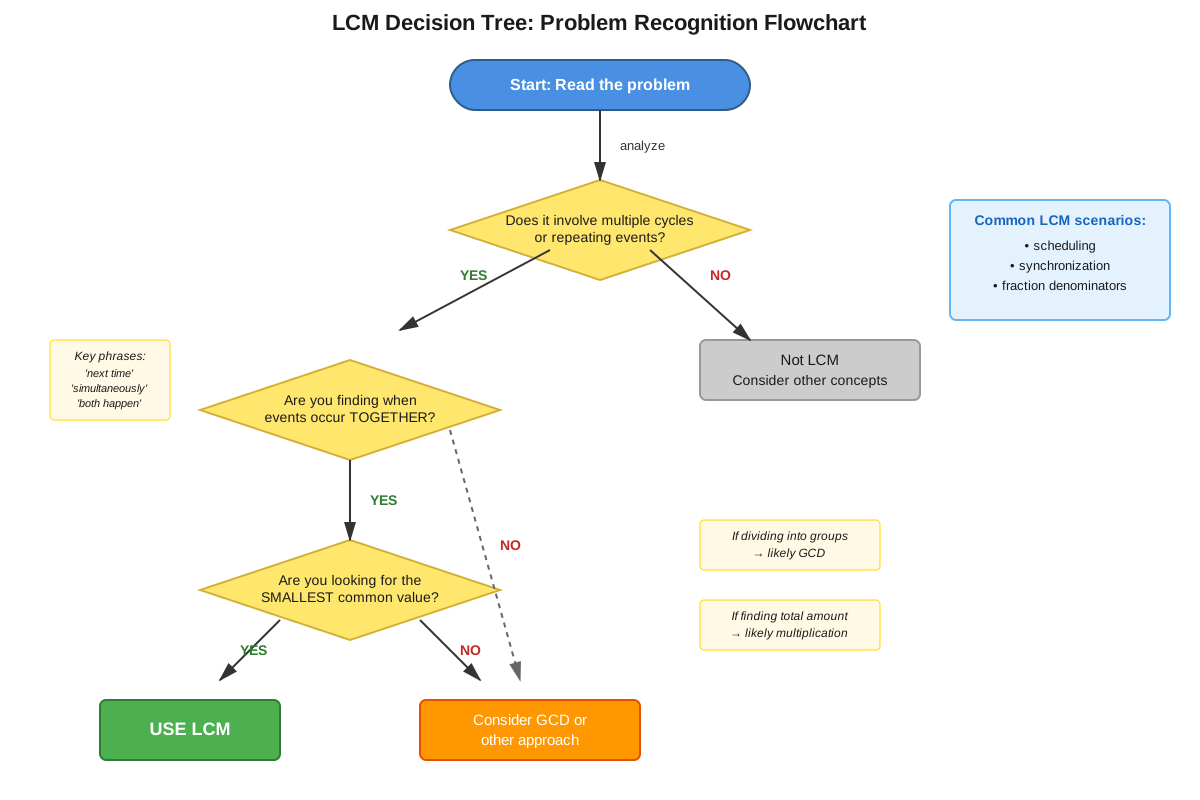
Misconception: LCM problems always explicitly ask for "the least common multiple" → Correction: On the GRE, LCM is often disguised in word problems about cycles, schedules, or repeating events. Questions asking "when will both events occur simultaneously again" or "what is the smallest number that..." typically require LCM.
Worked Examples
Example 1: Classic LCM Calculation
Problem: Find the least common multiple of 45 and 75.
Solution:
Step 1: Choose the prime factorization method for efficiency
Step 2: Factor each number into primes
- 45 = 9 × 5 = 3² × 5¹
- 75 = 25 × 3 = 3¹ × 5²
Step 3: Identify the highest power of each prime factor
- Prime 3 appears as 3² (in 45) and 3¹ (in 75) → use 3²
- Prime 5 appears as 5¹ (in 45) and 5² (in 75) → use 5²
Step 4: Multiply the highest powers
- LCM = 3² × 5² = 9 × 25 = 225
Step 5: Verify
- 225 ÷ 45 = 5 ✓
- 225 ÷ 75 = 3 ✓
Answer: 225
Connection to Learning Objectives: This example demonstrates the core strategy (prime factorization method) and accurate application to a straightforward calculation problem.
Example 2: GRE-Style Word Problem
Problem: Three bells ring at intervals of 12 minutes, 18 minutes, and 30 minutes, respectively. If all three bells ring together at noon, at what time will they next ring together?
Solution:
Step 1: Identify that this is an LCM problem
The question asks when all three cycles align again, which requires finding the LCM of the intervals.
Step 2: Find LCM(12, 18, 30) using prime factorization
- 12 = 2² × 3¹
- 18 = 2¹ × 3²
- 30 = 2¹ × 3¹ × 5¹
Step 3: Take highest powers of all primes
- Highest power of 2: 2²
- Highest power of 3: 3²
- Highest power of 5: 5¹
Step 4: Calculate
- LCM = 2² × 3² × 5¹ = 4 × 9 × 5 = 180 minutes
Step 5: Convert to hours and add to noon
- 180 minutes = 3 hours
- Noon + 3 hours = 3:00 PM
Answer: 3:00 PM (or 15:00)
Connection to Learning Objectives: This example demonstrates identifying when LCM is being tested (cyclical events), applying the strategy to a word problem, and connecting the mathematical result back to the real-world context.
Exam Strategy
When approaching GRE questions involving least common multiple, follow this systematic approach:
Recognition Phase: Look for trigger words and phrases that signal LCM:
- "When will both/all... occur together again"
- "What is the smallest number that..."
- "At what time will they next coincide"
- "Find the least common denominator"
- Problems involving repeating cycles, schedules, or patterns
- Questions about events happening at different intervals
Method Selection: Choose your calculation approach based on the numbers:
- For numbers under 20 with obvious patterns: listing multiples may be fastest
- For most GRE problems: prime factorization method is most reliable
- When GCD is given or easily found: use the LCM × GCD = a × b relationship
- For three or more numbers: prime factorization is almost always most efficient
Process-of-Elimination Tips:
- Eliminate any answer choice smaller than the largest input number
- Eliminate any answer that isn't divisible by all input numbers
- If numbers are coprime, eliminate anything less than their product
- For quantitative comparison, you often don't need the exact LCM—just relative size
Time Allocation: Budget 1.5-2 minutes for straightforward LCM calculations and 2-3 minutes for word problems requiring LCM identification and application. If prime factorization is taking too long, verify you've correctly identified the primes and haven't made arithmetic errors.
Common Traps to Avoid:
- Don't automatically multiply all numbers together
- Don't confuse LCM with GCD (read carefully whether the problem asks for the smallest common multiple or largest common divisor)
- Don't forget to convert your answer back to the requested units (minutes to hours, etc.)
- Don't stop at the first common multiple you find—verify it's the least
GRE Tip: If a problem gives you the GCD and asks for the LCM (or vice versa), immediately think of the relationship formula: LCM(a,b) × GCD(a,b) = a × b. This can save significant calculation time.
Memory Techniques
Mnemonic for Prime Factorization Method: "HELP"
- Highest power
- Each prime
- List them all
- Product gives LCM
Visualization Strategy: Picture LCM as a "container" that must hold all the input numbers perfectly. The container must be large enough (at least as big as the largest number) but no larger than necessary. Each prime factor represents a dimension of the container, and you need the maximum dimension from any input.
Acronym for LCM vs GCD: "LCM = Least Contains Multiple, GCD = Greatest Cuts Down"
This helps remember that LCM finds what contains all numbers (going up) while GCD finds what cuts into all numbers (going down).
Pattern Recognition Rhyme:
"When numbers share no common ground, multiply them—LCM is found. But when they share a factor true, divide their product by GCD too."
Finger Method for Small Numbers: For numbers under 10, use fingers to count multiples of the larger number until you reach one divisible by the smaller number. This kinesthetic approach helps some learners internalize the concept.
Summary
The least common multiple represents the smallest positive integer divisible by all given numbers, serving as a crucial tool for solving GRE problems involving cycles, schedules, and fraction operations. Mastery requires understanding three calculation methods—listing multiples, prime factorization, and the GCD relationship—with prime factorization being most efficient for exam conditions. The key to success lies in recognizing when LCM is being tested, which often occurs in disguised word problems about repeating events rather than explicit calculation requests. The fundamental relationship LCM(a,b) × GCD(a,b) = a × b provides both a calculation shortcut and conceptual insight. Special cases include coprime numbers (LCM equals their product) and divisibility relationships (LCM equals the larger number). Students must distinguish LCM from GCD, apply the concept to fraction operations through least common denominators, and efficiently handle three or more numbers through sequential application or direct prime factorization. With systematic recognition of trigger words and strategic method selection, LCM problems become highly predictable and manageable within the time constraints of the GRE Quantitative Reasoning section.
Key Takeaways
- The least common multiple is the smallest positive integer divisible by all given numbers, always at least as large as the largest input
- Prime factorization method (taking highest power of each prime) is the most reliable and efficient approach for GRE questions
- LCM and GCD are related by the formula: LCM(a,b) × GCD(a,b) = a × b
- Recognize LCM problems through trigger phrases about cycles, schedules, and "when will events coincide again"
- For coprime numbers (no common factors), LCM equals their product; when one divides another, LCM equals the larger number
- Least common denominator in fraction problems is simply the LCM of the denominators
- Don't confuse LCM (smallest common multiple) with GCD (largest common divisor)—read questions carefully
Related Topics
Greatest Common Divisor (GCD): The mathematical dual of LCM, finding the largest number that divides into all given numbers. Understanding both concepts together provides deeper insight into divisibility and number relationships.
Prime Factorization: The foundation for efficient LCM calculation. Deeper study of prime numbers and factorization techniques enhances speed and accuracy.
Fraction Operations: LCM directly applies to adding and subtracting fractions through finding least common denominators, extending to algebraic fractions and rational expressions.
Modular Arithmetic: Advanced applications of LCM in understanding when remainders align and solving congruence problems that occasionally appear on the GRE.
Divisibility Rules: Complementary knowledge that speeds up factor identification and verification of LCM calculations.
Word Problem Translation: Many LCM problems require translating real-world scenarios into mathematical models, a skill that transfers across all GRE quantitative topics.
Practice CTA
Now that you've mastered the conceptual foundation of least common multiple, it's time to solidify your understanding through active practice. Attempt the practice questions to test your ability to recognize LCM scenarios, apply the prime factorization method efficiently, and solve GRE-style word problems under timed conditions. Use the flashcards to reinforce key formulas, special cases, and trigger words until recognition becomes automatic. Remember: understanding the concept is just the first step—fluency comes from repeated application. Each practice problem you solve strengthens your pattern recognition and builds the confidence needed to tackle LCM questions quickly and accurately on test day. You've got this!
Sign up free to keep reading
Create a free AnvayaPrep account to finish this GRE guide on Least common multiple — plus flashcards and practice questions.