Overview
Composite numbers are integers greater than 1 that have more than two distinct positive divisors. In other words, they are positive integers that can be divided evenly by at least one number other than 1 and themselves. Understanding composite numbers is fundamental to success on the GRE Quantitative Reasoning section, as they appear frequently in questions involving divisibility, prime factorization, greatest common divisors, least common multiples, and number properties.
The GRE regularly tests gre composite numbers through both direct and indirect questioning strategies. Students may encounter questions that explicitly ask them to identify composite numbers, or more commonly, questions where recognizing composite numbers becomes the key to solving problems involving factors, multiples, or number patterns. Mastery of this topic enables efficient problem-solving and helps students avoid time-consuming trial-and-error approaches.
Composite numbers form a critical bridge between several core arithmetic concepts tested on the GRE. They are intrinsically linked to prime numbers (their counterpart in the classification of integers), divisibility rules, factorization techniques, and modular arithmetic. A solid understanding of composite numbers also supports more advanced topics such as rational number operations, algebraic factoring, and even certain data interpretation questions where number properties determine answer choices. This topic represents essential foundational knowledge that appears across approximately 15-20% of GRE Quantitative Reasoning questions either directly or as a component of multi-step problems.
Learning Objectives
- [ ] Identify when Composite numbers is being tested
- [ ] Explain the core rule or strategy behind Composite numbers
- [ ] Apply Composite numbers to GRE-style questions accurately
- [ ] Distinguish between composite numbers, prime numbers, and special cases (1 and 0)
- [ ] Determine the number of factors a composite number has using prime factorization
- [ ] Recognize patterns in composite numbers to solve problems efficiently
- [ ] Apply composite number properties to solve complex divisibility and factorization problems
Prerequisites
- Basic multiplication and division: Essential for determining whether a number can be evenly divided by potential factors
- Understanding of factors and multiples: Composite numbers are defined by having multiple factors beyond 1 and themselves
- Prime number recognition: Composite numbers are defined in contrast to prime numbers, making this distinction critical
- Integer properties: Composite numbers exist within the integer number system and follow integer arithmetic rules
Why This Topic Matters
Composite numbers represent a fundamental classification system in number theory that appears throughout mathematics and real-world applications. In cryptography, the difficulty of factoring large composite numbers into their prime components forms the basis of modern encryption systems. In computer science, algorithms for identifying and working with composite numbers optimize computational processes. In everyday contexts, composite numbers appear in scheduling problems, resource allocation, and pattern recognition.
On the GRE, composite numbers appear in approximately 15-20% of Quantitative Reasoning questions, either as the primary focus or as a component of more complex problems. The exam tests this concept through multiple question formats: Quantitative Comparison questions that require comparing properties of composite versus prime numbers, Problem Solving questions involving factorization or divisibility, and Data Interpretation questions where number properties constrain possible solutions. Questions may ask students to identify composite numbers within a range, determine how many factors a composite number has, or use composite number properties to solve optimization problems.
Common exam scenarios include: identifying the smallest or largest composite number meeting certain criteria, determining whether an algebraic expression yields a composite result, counting composite numbers within a specified range, finding the greatest common divisor or least common multiple of composite numbers, and recognizing when a number's composite nature simplifies a calculation. The GRE particularly favors questions where recognizing a number as composite immediately eliminates incorrect answer choices or reveals a shortcut solution path.
Core Concepts
Definition and Classification
A composite number is a positive integer greater than 1 that has at least one positive divisor other than 1 and itself. Equivalently, a composite number can be expressed as the product of two or more positive integers, each greater than 1. This definition immediately distinguishes composite numbers from prime numbers (which have exactly two divisors: 1 and themselves) and from the special cases of 0 and 1 (which are neither prime nor composite).
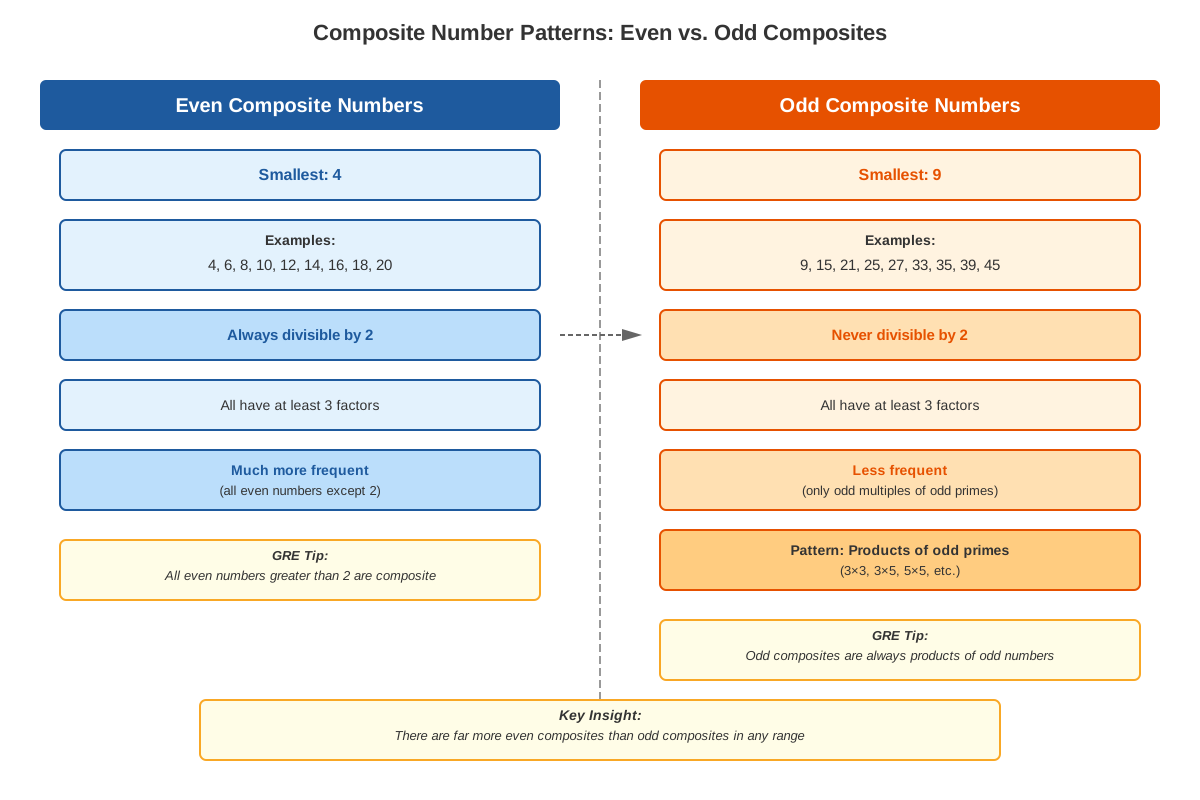
The smallest composite number is 4, which equals 2 × 2 and has divisors 1, 2, and 4. The sequence of composite numbers begins: 4, 6, 8, 9, 10, 12, 14, 15, 16, 18, 20, 21, 22, 24, 25, 26, 27, 28, and continues infinitely. Notice that composite numbers can be either even (like 4, 6, 8) or odd (like 9, 15, 21), though all even numbers greater than 2 are composite since they are divisible by 2.
Identifying Composite Numbers
To determine whether a number is composite, test whether it has any divisors other than 1 and itself. For smaller numbers, this can be done through direct division testing. For a number n, test divisibility by all prime numbers up to √n. If any of these primes divides n evenly, then n is composite. If none divide evenly, n is prime.
For example, to test whether 91 is composite:
- √91 ≈ 9.5, so test primes up to 9: {2, 3, 5, 7}
- 91 is odd, so not divisible by 2
- Sum of digits: 9 + 1 = 10, not divisible by 3
- Doesn't end in 0 or 5, so not divisible by 5
- 91 ÷ 7 = 13, so 91 = 7 × 13
Since 91 has divisors beyond 1 and itself, it is composite.
Prime Factorization of Composite Numbers
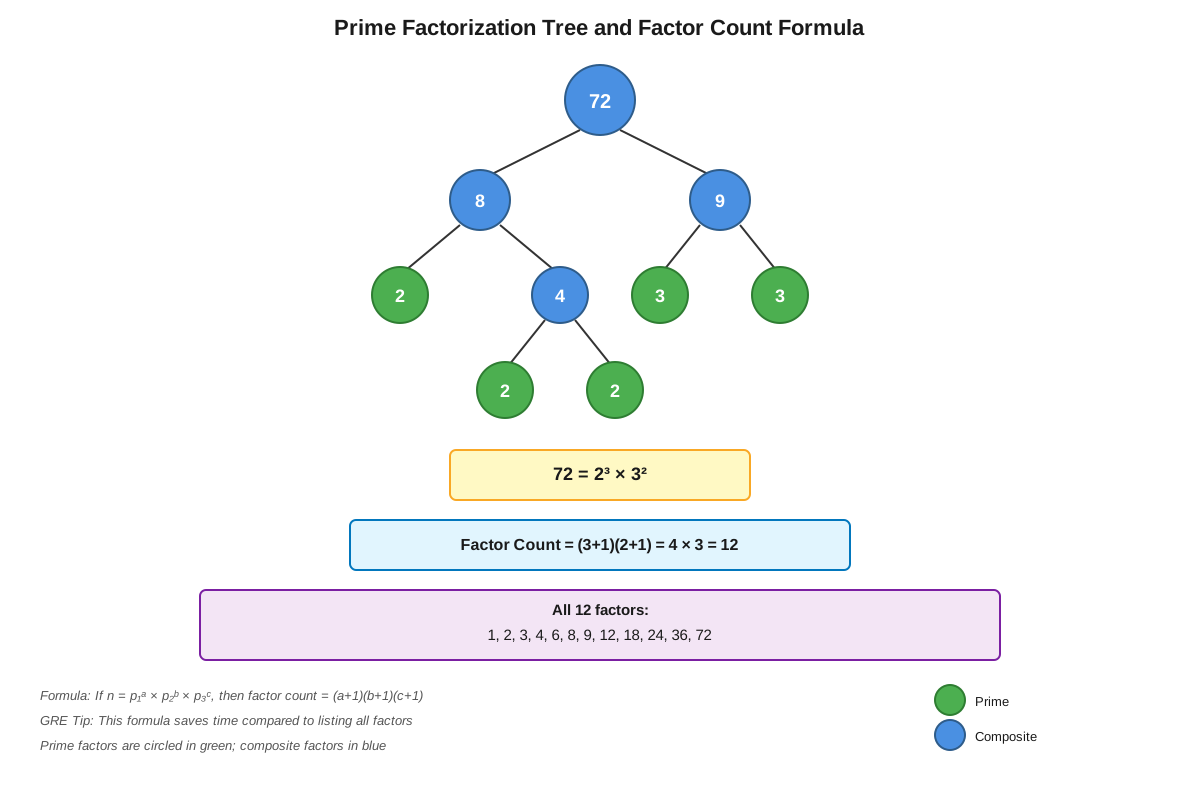
Every composite number can be expressed uniquely as a product of prime numbers, a representation called prime factorization. This fundamental theorem of arithmetic provides the foundation for many GRE problems involving composite numbers. The prime factorization reveals all information about a number's divisors and relationships to other numbers.
For example:
- 12 = 2² × 3
- 60 = 2² × 3 × 5
- 100 = 2² × 5²
- 144 = 2⁴ × 3²
The prime factorization allows calculation of the total number of divisors using the formula: if n = p₁^a₁ × p₂^a₂ × ... × pₖ^aₖ, then the number of divisors equals (a₁ + 1)(a₂ + 1)...(aₖ + 1).
Types of Composite Numbers
| Type | Definition | Examples | Key Properties |
|---|---|---|---|
| Even Composites | Divisible by 2 | 4, 6, 8, 10, 12 | All even numbers > 2 are composite |
| Odd Composites | Not divisible by 2 | 9, 15, 21, 25, 27 | Product of odd primes or powers of odd primes |
| Perfect Squares | Product of integer with itself | 4, 9, 16, 25, 36 | Always composite (except 1); odd number of divisors |
| Perfect Cubes | Product of integer with itself three times | 8, 27, 64, 125 | Always composite (except 1) |
| Highly Composite | More divisors than any smaller number | 12, 24, 36, 48, 60 | Useful in optimization problems |
Divisor Properties
The number and nature of divisors distinguish composite numbers from primes. While prime numbers have exactly two divisors, composite numbers have at least three. Understanding divisor patterns helps solve GRE problems efficiently:
- Counting divisors: Use prime factorization and the formula (a₁ + 1)(a₂ + 1)...(aₖ + 1)
- Sum of divisors: Can be calculated from prime factorization using the formula: [(p₁^(a₁+1) - 1)/(p₁ - 1)] × [(p₂^(a₂+1) - 1)/(p₂ - 1)] × ...
- Proper divisors: All divisors except the number itself; for composite numbers, this includes at least 1 and one other number
Special Composite Numbers
Certain composite numbers have special properties that frequently appear on the GRE:
- Semiprimes: Products of exactly two prime numbers (not necessarily distinct), such as 6 = 2 × 3, 9 = 3 × 3, 10 = 2 × 5
- Square-free composites: No prime factor appears more than once, such as 6 = 2 × 3, 30 = 2 × 3 × 5
- Powers of primes: Numbers like 4 = 2², 8 = 2³, 9 = 3², 27 = 3³, which are composite despite having only one distinct prime factor
Concept Relationships
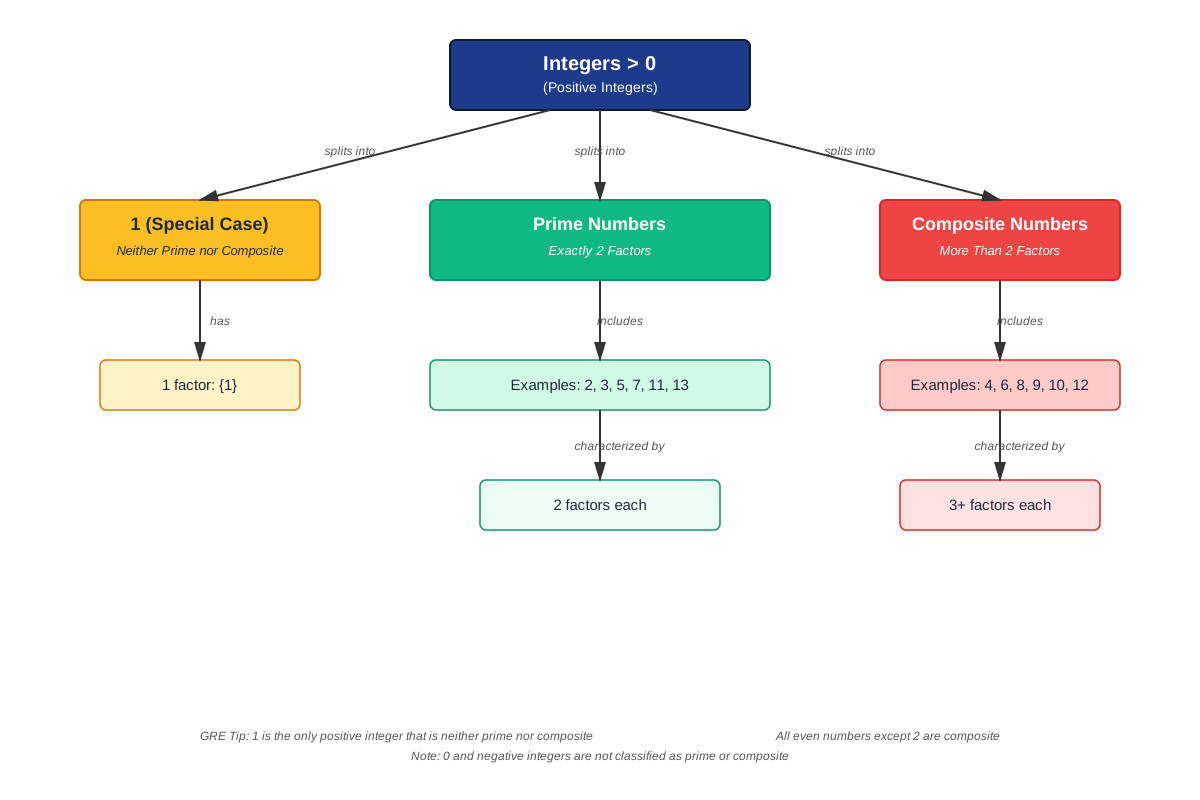
Composite numbers exist within a hierarchical classification of integers. At the broadest level, positive integers greater than 1 divide into exactly two categories: prime numbers and composite numbers. This binary classification forms the foundation of number theory and appears throughout GRE questions.
The relationship flows as follows: Integers → Positive Integers > 1 → branches into Prime Numbers (exactly 2 divisors) and Composite Numbers (more than 2 divisors). Composite numbers further subdivide based on properties: Even Composites (all divisible by 2) and Odd Composites (products of odd primes).
Prime factorization serves as the bridge connecting composite numbers to their constituent primes. This relationship enables calculation of divisors, which in turn connects to concepts of greatest common divisor (GCD) and least common multiple (LCM). The chain: Composite Number → Prime Factorization → Divisor Analysis → GCD/LCM Applications represents a common problem-solving pathway on the GRE.
Composite numbers also relate to divisibility rules, as recognizing a number as composite often involves applying these rules. For instance, knowing that 15 is composite (divisible by 3 and 5) helps quickly evaluate whether larger numbers are divisible by 15. Similarly, perfect squares and perfect cubes represent special subsets of composite numbers with unique divisor properties that frequently appear in GRE questions.
High-Yield Facts
⭐ The smallest composite number is 4, and 1 is neither prime nor composite
⭐ All even numbers greater than 2 are composite because they are divisible by 2
⭐ Every composite number has a unique prime factorization (Fundamental Theorem of Arithmetic)
⭐ To test if n is composite, check divisibility by primes up to √n; if any divide evenly, n is composite
⭐ The number of divisors of n = p₁^a₁ × p₂^a₂ × ... × pₖ^aₖ is (a₁ + 1)(a₂ + 1)...(aₖ + 1)
- Composite numbers can be either even or odd, but all even numbers > 2 are composite
- Perfect squares (except 1) are always composite and have an odd number of divisors
- Between any two consecutive composite numbers, there may or may not be a prime number
- The product of any two integers both greater than 1 is always composite
- 9 is the smallest odd composite number
- Consecutive composite numbers can occur in arbitrarily long sequences (e.g., n! + 2, n! + 3, ..., n! + n)
- A number ending in 0, 2, 4, 5, 6, or 8 may be composite (but 2 and 5 are prime)
- The sum of two prime numbers greater than 2 is always composite (since both primes are odd, their sum is even)
Quick check — test yourself on Composite numbers so far.
Try Flashcards →Common Misconceptions
Misconception: All odd numbers are prime → Correction: Many odd numbers are composite, such as 9 (3 × 3), 15 (3 × 5), 21 (3 × 7), 25 (5 × 5), and 27 (3 × 3 × 3). Only odd numbers with no divisors other than 1 and themselves are prime.
Misconception: 1 is a composite number because it can be divided by 1 → Correction: The number 1 is neither prime nor composite by definition. Composite numbers must have at least three divisors (1, themselves, and at least one other), but 1 has only one divisor.
Misconception: If a number is divisible by a composite number, it must be composite → Correction: While this is often true, the statement requires the number to be greater than the divisor. For example, 6 is divisible by 6 (a composite), and 6 is composite, but this is because 6 > 1, not simply because of the divisibility relationship.
Misconception: All composite numbers have an even number of divisors → Correction: Only perfect squares have an odd number of divisors. For example, 16 has divisors {1, 2, 4, 8, 16} (five divisors), while 12 has divisors {1, 2, 3, 4, 6, 12} (six divisors).
Misconception: The largest composite number less than a prime p is always p - 1 → Correction: This is not always true. For example, the largest prime less than 11 is 7, but 10 (not 6) is the largest composite less than 11. The number p - 1 may itself be prime.
Misconception: If n is composite, then n + 1 must be prime → Correction: Consecutive integers can both be composite. For example, 8 and 9 are both composite, as are 14 and 15, and 20 and 21.
Misconception: A number with many digits must be composite → Correction: Large numbers can be prime. For example, 97 is prime despite being close to 100, and mathematicians have discovered prime numbers with millions of digits.
Worked Examples
Example 1: Identifying Composite Numbers in a Range
Question: How many composite numbers are there between 20 and 30, inclusive?
Solution:
Step 1: List all integers from 20 to 30:
20, 21, 22, 23, 24, 25, 26, 27, 28, 29, 30
Step 2: Identify which numbers are prime (these are NOT composite):
- 23 is prime (only divisible by 1 and 23)
- 29 is prime (only divisible by 1 and 29)
Step 3: All other numbers in the range are composite:
- 20 = 2² × 5 (divisible by 2, 4, 5, 10)
- 21 = 3 × 7 (divisible by 3, 7)
- 22 = 2 × 11 (divisible by 2, 11)
- 24 = 2³ × 3 (divisible by 2, 3, 4, 6, 8, 12)
- 25 = 5² (divisible by 5)
- 26 = 2 × 13 (divisible by 2, 13)
- 27 = 3³ (divisible by 3, 9)
- 28 = 2² × 7 (divisible by 2, 4, 7, 14)
- 30 = 2 × 3 × 5 (divisible by 2, 3, 5, 6, 10, 15)
Step 4: Count the composite numbers: 9 composite numbers
Answer: 9
Connection to Learning Objectives: This example demonstrates how to identify when composite numbers are being tested (recognizing that the question asks about number classification) and how to apply the core definition (numbers with more than two divisors) to solve GRE-style questions accurately.
Example 2: Using Prime Factorization to Determine Divisor Count
Question: If n = 2³ × 3² × 5, how many positive divisors does n have?
Solution:
Step 1: Identify the prime factorization (already given):
n = 2³ × 3² × 5¹
Step 2: Apply the divisor formula:
Number of divisors = (a₁ + 1)(a₂ + 1)(a₃ + 1)
where a₁, a₂, a₃ are the exponents of the prime factors
Step 3: Calculate:
- Exponent of 2: 3, so (3 + 1) = 4
- Exponent of 3: 2, so (2 + 1) = 3
- Exponent of 5: 1, so (1 + 1) = 2
Number of divisors = 4 × 3 × 2 = 24
Step 4: Verify understanding:
Since n has 24 divisors and 24 > 2, n is definitely composite. The divisors include 1, 2, 3, 4, 5, 6, 8, 9, 10, 12, 15, 18, 20, 24, 30, 36, 40, 45, 60, 72, 90, 120, 180, and 360.
Answer: 24 divisors
Connection to Learning Objectives: This example shows how to explain the core strategy behind composite numbers (using prime factorization to analyze properties) and demonstrates the relationship between composite numbers and their divisor structure, a high-yield concept for GRE questions.
Exam Strategy
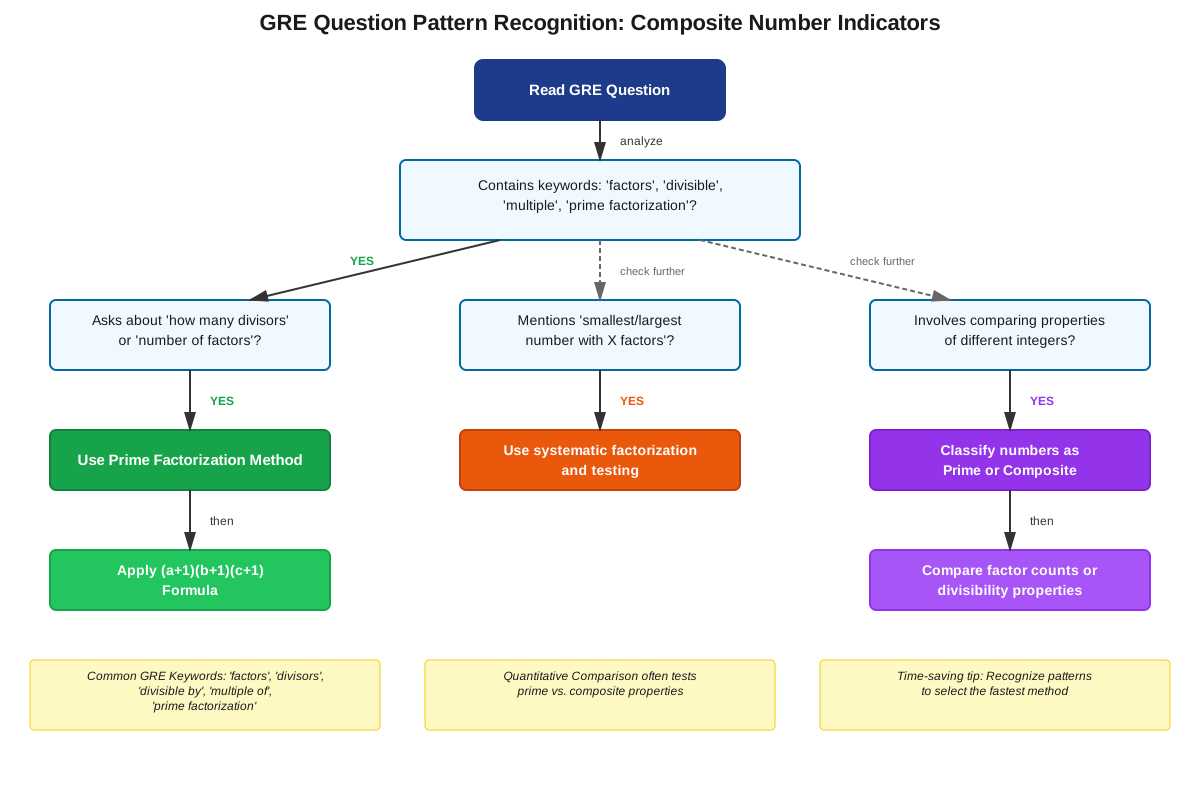
When approaching GRE questions involving composite numbers, begin by identifying trigger words and phrases: "divisible by," "factors of," "multiple of," "prime factorization," "how many divisors," or direct mentions of "composite." These signals indicate that number classification and divisor analysis will be central to the solution.
Step-by-step approach:
- Classify the numbers: Immediately determine whether given numbers are prime, composite, or special cases (0, 1)
- Consider prime factorization: For composite numbers, mentally note or write out the prime factorization
- Analyze divisor properties: Use the factorization to determine divisor count, GCD, or LCM as needed
- Check answer choices: Often, recognizing that a number is composite eliminates certain answer choices
Process of elimination tips:
- If a question asks for a prime number, immediately eliminate all even numbers except 2
- If a question asks for a composite number, eliminate 2, 3, 5, 7, 11, 13, and other small primes
- For "must be composite" questions, look for expressions that always yield products of integers > 1
- For Quantitative Comparison questions, test small values first (4, 6, 8, 9) to establish patterns
Time allocation: Composite number questions typically require 1-2 minutes. Spend 15-20 seconds identifying the question type, 30-45 seconds on calculations (factorization or divisor counting), and 15-20 seconds verifying your answer. If a question requires testing multiple numbers, set a 90-second limit before making an educated guess.
Common shortcuts:
- Memorize that all even numbers > 2 are composite (saves testing time)
- Recognize perfect squares immediately: 4, 9, 16, 25, 36, 49, 64, 81, 100
- Know small primes by heart: 2, 3, 5, 7, 11, 13, 17, 19, 23, 29, 31
- Use divisibility rules (2, 3, 5, 9) to quickly identify composite numbers
Exam Tip: When a question provides a large number, don't attempt complete factorization unless necessary. Often, proving a number is composite requires finding just one factor other than 1 and the number itself.
Memory Techniques
Mnemonic for the definition: "Composite numbers are Complex—they Can be Cut into smaller pieces" (remembering that composite numbers have multiple factors)
Visualization strategy: Picture composite numbers as LEGO structures that can be broken down into smaller blocks (prime factors), while prime numbers are single, indivisible blocks. This mental image reinforces that composite numbers are "built" from primes.
Acronym for quick identification - EVEN:
- Every
- Value
- Even (except 2)
- Necessarily composite
Number line visualization: Mentally mark the first several integers:
- 1 (special)
- 2 (prime)
- 3 (prime)
- 4 (first composite)
- 5 (prime)
- 6 (composite)
- 7 (prime)
- 8 (composite)
- 9 (first odd composite)
- 10 (composite)
Rhyme for divisor formula: "Add one to each power, then multiply together—that's how many divisors, no matter the weather!" (Helps remember to add 1 to each exponent before multiplying)
Pattern recognition: Remember "FOES" for composite identification:
- Factors (more than two)
- Odd or even (can be either)
- Expressible as products
- Smallest is four
Summary
Composite numbers are positive integers greater than 1 that possess more than two positive divisors, distinguishing them from prime numbers and the special cases of 0 and 1. Every composite number can be uniquely expressed as a product of prime numbers through prime factorization, which serves as the foundation for analyzing divisor properties, calculating GCD and LCM, and solving complex number theory problems. The GRE tests composite numbers both directly—through identification and classification questions—and indirectly—as components of divisibility, factorization, and optimization problems. Successful students recognize that all even numbers greater than 2 are composite, understand how to use prime factorization to determine divisor count using the formula (a₁ + 1)(a₂ + 1)...(aₖ + 1), and can quickly identify composite numbers through divisibility testing up to the square root. Mastery requires distinguishing composite numbers from primes, understanding special cases like perfect squares and semiprimes, and applying these concepts efficiently under timed conditions to solve the 15-20% of Quantitative Reasoning questions that involve number classification and properties.
Key Takeaways
- Composite numbers have at least three divisors (1, themselves, and at least one other factor), distinguishing them from prime numbers which have exactly two divisors
- All even numbers greater than 2 are composite because they are divisible by 2, making this the fastest way to identify many composite numbers
- Prime factorization is unique for every composite number and enables calculation of total divisors using (a₁ + 1)(a₂ + 1)...(aₖ + 1)
- To test if n is composite, check divisibility by primes up to √n—finding even one prime divisor proves the number is composite
- The number 1 is neither prime nor composite, and 4 is the smallest composite number
- Perfect squares (except 1) are always composite and have an odd number of divisors, a property frequently tested on the GRE
- Composite numbers appear in approximately 15-20% of GRE Quantitative Reasoning questions, making them a high-yield topic for focused study
Related Topics
Prime Numbers: The complementary classification to composite numbers; understanding primes deepens comprehension of why certain numbers are composite and enables efficient problem-solving on number theory questions.
Greatest Common Divisor (GCD) and Least Common Multiple (LCM): These concepts build directly on composite number properties and prime factorization, appearing frequently in ratio, fraction, and word problems.
Divisibility Rules: Mastering divisibility tests for 2, 3, 4, 5, 6, 8, 9, and 10 accelerates identification of composite numbers and their factors.
Perfect Squares and Perfect Cubes: Special subsets of composite numbers with unique properties that appear in geometry, algebra, and number theory questions.
Number Properties and Integer Constraints: Advanced applications where composite number recognition helps solve optimization problems and inequality questions.
Practice CTA
Now that you've mastered the fundamentals of composite numbers, it's time to solidify your understanding through active practice. Attempt the practice questions to test your ability to identify composite numbers quickly, apply prime factorization strategies, and solve GRE-style problems under timed conditions. Use the flashcards to reinforce high-yield facts and ensure instant recall of key properties. Remember: composite numbers appear in nearly one-fifth of Quantitative Reasoning questions, making your investment in this topic one of the highest-yield uses of your study time. Each practice problem you solve builds the pattern recognition and strategic thinking that will save you valuable seconds on test day. You've got this!
Sign up free to keep reading
Create a free AnvayaPrep account to finish this GRE guide on Composite numbers — plus flashcards and practice questions.