Overview
Even and odd numbers form one of the most fundamental yet frequently tested concepts in GRE Quantitative Reasoning. While the basic definitions may seem elementary, the GRE tests this topic through sophisticated problem-solving scenarios that require deep understanding of how these numbers behave under various arithmetic operations. Questions involving GRE even and odd numbers appear regularly across multiple question formats, including Quantitative Comparison, Multiple Choice, and Numeric Entry questions, making this a high-yield topic that demands thorough mastery.
Understanding even and odd number properties is essential because these concepts serve as building blocks for more complex mathematical reasoning on the GRE. Test-makers frequently embed even/odd logic within algebra problems, number theory questions, divisibility scenarios, and word problems. The ability to quickly determine whether an expression will yield an even or odd result can dramatically accelerate problem-solving speed and accuracy. Moreover, even/odd analysis often provides elegant shortcuts that allow test-takers to eliminate answer choices or solve problems that might otherwise require lengthy calculations.
This topic connects intimately with broader Quantitative Reasoning concepts including integer properties, divisibility rules, prime numbers, and algebraic manipulation. Mastery of even and odd number behavior enables students to tackle advanced topics such as remainders, modular arithmetic, and pattern recognition in sequences. The logical reasoning skills developed through even/odd analysis also transfer to Data Interpretation questions where recognizing numerical patterns becomes crucial for efficient problem-solving.
Learning Objectives
- [ ] Identify when Even and odd numbers is being tested
- [ ] Explain the core rule or strategy behind Even and odd numbers
- [ ] Apply Even and odd numbers to GRE-style questions accurately
- [ ] Determine the parity (even or odd nature) of complex algebraic expressions without calculation
- [ ] Recognize and exploit even/odd patterns in sequences and series
- [ ] Use even/odd properties to eliminate incorrect answer choices efficiently
- [ ] Solve multi-step problems combining even/odd logic with other arithmetic properties
Prerequisites
- Basic arithmetic operations: Understanding addition, subtraction, multiplication, and division is essential because even/odd rules depend on how these operations affect number parity
- Integer definition and properties: Recognizing that even and odd classifications apply only to integers ensures proper application of rules
- Divisibility concepts: Understanding what it means for one number to divide evenly into another provides the foundation for the formal definition of even numbers
- Algebraic notation: Familiarity with variables and expressions enables working with generalized even/odd problems
Why This Topic Matters
Even and odd number properties appear in approximately 10-15% of GRE Quantitative Reasoning questions, either as the primary focus or as a component of multi-concept problems. This frequency, combined with the topic's accessibility, makes it one of the highest-yield areas for score improvement. Questions testing this concept span all difficulty levels, from straightforward identification problems to complex scenarios requiring multiple logical steps.
In real-world applications, even/odd logic underpins computer science algorithms (particularly in binary systems), cryptography, scheduling problems, and pattern recognition. Engineers use parity checks for error detection, while data scientists employ even/odd analysis in algorithm optimization. These practical applications reflect why the GRE values this reasoning skill—it demonstrates fundamental logical thinking applicable across quantitative disciplines.
On the exam, even/odd concepts commonly appear disguised within: word problems about arranging objects or people; algebraic expressions where you must determine the parity of a result without calculating exact values; Quantitative Comparison questions where recognizing even/odd patterns eliminates the need for computation; Data Interpretation questions involving alternating patterns; and number property questions combined with divisibility, prime numbers, or remainders. The GRE particularly favors questions where recognizing even/odd behavior provides a shortcut that saves 30-60 seconds per problem—time that proves invaluable on this tightly-timed exam.
Core Concepts
Fundamental Definitions
An even number is any integer that can be expressed as 2k, where k is an integer. Equivalently, an even number is divisible by 2 with no remainder. The set of even integers includes: {..., -6, -4, -2, 0, 2, 4, 6, 8, ...}. Note that zero is even—a fact the GRE frequently tests through trap answer choices.
An odd number is any integer that can be expressed as 2k + 1 (or 2k - 1), where k is an integer. Odd numbers leave a remainder of 1 when divided by 2. The set of odd integers includes: {..., -5, -3, -1, 1, 3, 5, 7, ...}. Negative odd numbers follow the same rules as positive odd numbers.
Parity refers to whether a number is even or odd. Two numbers have the same parity if both are even or both are odd; they have opposite parity if one is even and the other odd.
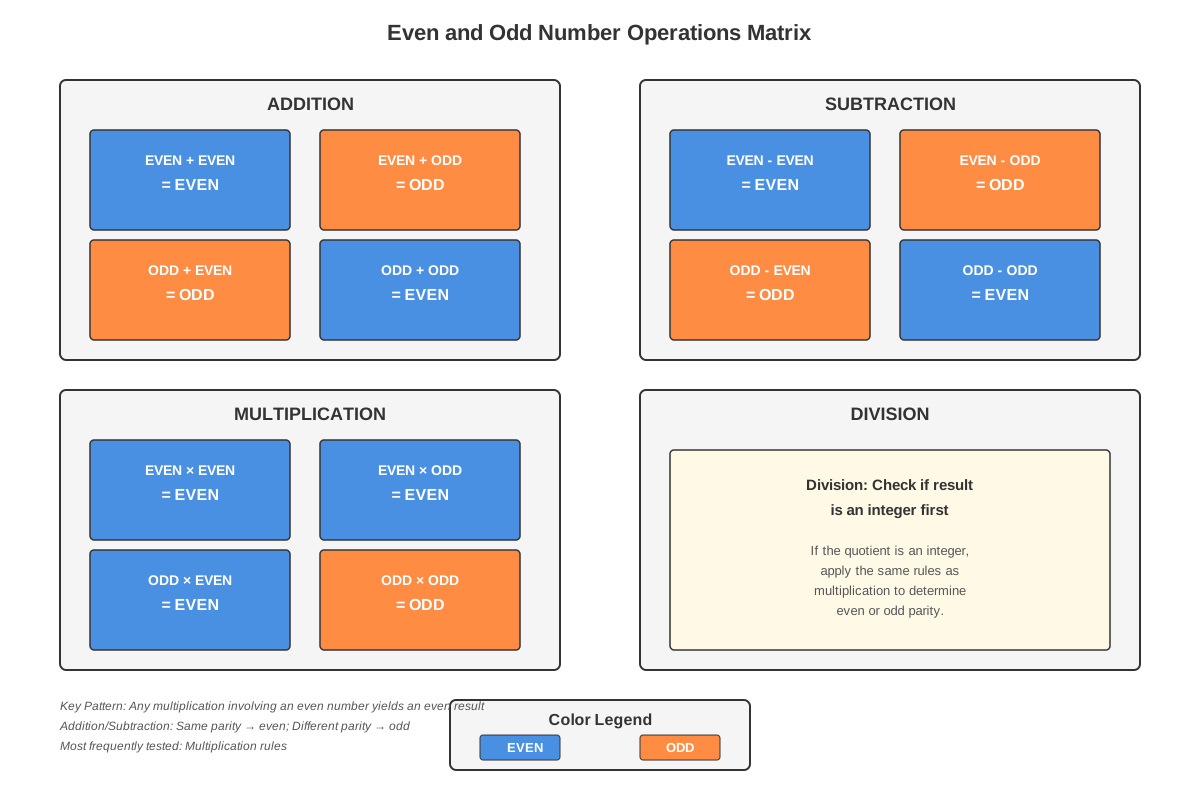
Addition and Subtraction Rules
The behavior of even and odd numbers under addition and subtraction follows predictable patterns that the GRE tests extensively:
| Operation | Result | Example |
|---|---|---|
| Even + Even | Even | 4 + 6 = 10 |
| Odd + Odd | Even | 3 + 5 = 8 |
| Even + Odd | Odd | 4 + 5 = 9 |
| Even - Even | Even | 8 - 2 = 6 |
| Odd - Odd | Even | 7 - 3 = 4 |
| Even - Odd | Odd | 6 - 3 = 3 |
| Odd - Even | Odd | 7 - 4 = 3 |
Key principle: Adding or subtracting two numbers of the same parity always yields an even result. Adding or subtracting numbers of opposite parity always yields an odd result.
This principle extends to multiple terms: when adding several integers, count how many odd numbers appear. If the count is even (including zero), the sum is even. If the count is odd, the sum is odd. For example, 2 + 3 + 5 + 7 + 8 contains three odd numbers (3, 5, 7), so the sum must be odd.
Multiplication Rules
Multiplication follows simpler patterns than addition:
| Operation | Result | Example |
|---|---|---|
| Even × Even | Even | 4 × 6 = 24 |
| Odd × Odd | Odd | 3 × 5 = 15 |
| Even × Odd | Even | 4 × 5 = 20 |
Key principle: A product is odd if and only if ALL factors are odd. If even one factor is even, the entire product is even.
This rule has powerful implications for GRE problems. When evaluating an expression like (2x + 1)(3y)(5z - 2), you can immediately determine that the result must be even because the middle factor (3y) is even when y is even, and the last factor (5z - 2) is even when z is even. Only when both y and z produce odd factors will the product be odd.
Division and Remainders
Division presents more complexity because dividing two integers doesn't always yield an integer result. However, several important principles apply:
- Even ÷ Even may be even, odd, or non-integer (8 ÷ 4 = 2 even; 12 ÷ 4 = 3 odd; 6 ÷ 4 = 1.5 non-integer)
- Odd ÷ Odd may be odd or non-integer, but never even (9 ÷ 3 = 3 odd; 7 ÷ 3 = 2.33... non-integer)
- Even ÷ Odd may be even or non-integer, but never odd (8 ÷ 3 = 2.67... non-integer; 12 ÷ 3 = 4 even)
- Odd ÷ Even is never an integer (cannot divide an odd number evenly by 2 or any multiple of 2)
The GRE rarely asks about division directly but often tests whether a division result could be an integer based on even/odd properties.
Exponents and Powers
When raising numbers to powers, the base's parity determines the result's parity:
- Even base: Any positive integer power of an even number is even (2² = 4, 2³ = 8, 4⁵ = 1024)
- Odd base: Any positive integer power of an odd number is odd (3² = 9, 3³ = 27, 5⁴ = 625)
This principle holds regardless of whether the exponent is even or odd. The base's parity completely determines the result's parity. For expressions like (2n)^k, the result is always even for any positive integer k. For (2n + 1)^k, the result is always odd.
Consecutive Integers
Consecutive integers alternate between even and odd. In any set of consecutive integers:
- Any two consecutive integers have opposite parity
- Any three consecutive integers contain either two evens and one odd, or two odds and one even
- The sum of any two consecutive integers is always odd
- The sum of any three consecutive integers is always divisible by 3 and has the same parity as the middle number
- The product of any two consecutive integers is always even (since one must be even)
Special Cases and Edge Scenarios
Zero: Zero is even because 0 = 2(0). This frequently appears as a trap on the GRE, where students incorrectly assume zero is neither even nor odd.
Negative numbers: Negative integers follow identical even/odd rules as positive integers. -4 is even, -7 is odd, and all operational rules apply unchanged.
Non-integers: Even and odd classifications apply only to integers. Fractions, decimals, and irrational numbers are neither even nor odd. If a problem asks about the parity of x/2, you must first determine whether x/2 is an integer.
Concept Relationships
The core even/odd concepts build upon each other hierarchically. Fundamental definitions (expressing numbers as 2k or 2k+1) → enable understanding of addition/subtraction rules (same parity sums to even, opposite parity sums to odd) → which combine with multiplication rules (product is odd only when all factors are odd) → allowing analysis of complex expressions involving multiple operations.
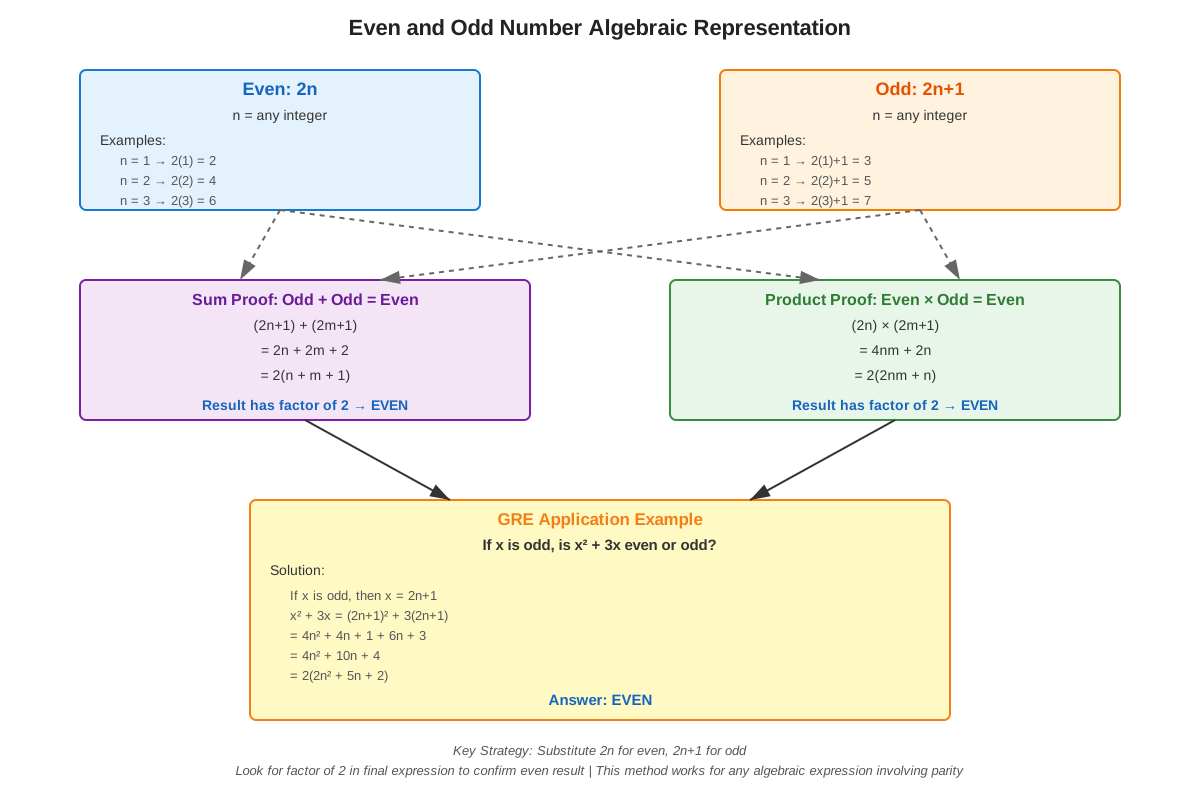
Even/odd logic connects to prerequisite knowledge of integer properties by providing a classification system that reveals hidden structure in number behavior. This classification extends to divisibility concepts, since even numbers are precisely those divisible by 2. The relationship to algebraic notation becomes crucial when working with variables: representing an even number as 2n and an odd number as 2n+1 allows algebraic manipulation while preserving parity information.
Within Quantitative Reasoning, even/odd analysis links to prime numbers (all primes except 2 are odd), factorization (even numbers always contain 2 as a prime factor), remainders (odd numbers leave remainder 1 when divided by 2), and sequences (arithmetic sequences with even common difference preserve parity). These connections mean that even/odd reasoning often provides the key insight for problems that initially appear to test other concepts.
High-Yield Facts
⭐ Zero is even: 0 = 2(0), making zero divisible by 2 with no remainder
⭐ A product is odd if and only if ALL factors are odd: Even a single even factor makes the entire product even
⭐ Adding two numbers of the same parity yields even; opposite parity yields odd: This applies to both addition and subtraction
⭐ Any power of an even number is even; any power of an odd number is odd: The base's parity determines the result's parity regardless of the exponent
⭐ The sum of n consecutive integers is even if n is odd, and odd if n is even: This follows from pairing consecutive integers
- Negative integers follow identical even/odd rules as positive integers
- The product of any two consecutive integers is always even
- When adding multiple integers, count the odd numbers: even count → even sum; odd count → odd sum
- Even ± Even = Even; Odd ± Odd = Even; Even ± Odd = Odd
- Dividing an odd number by an even number never yields an integer
- The square of any odd number is odd; the square of any even number is even
- In any set of three consecutive integers, at least one is even
Quick check — test yourself on Even and odd numbers so far.
Try Flashcards →Common Misconceptions
Misconception: Zero is neither even nor odd, or zero is odd because it's "nothing."
Correction: Zero is definitively even because it equals 2(0) and is divisible by 2 with remainder 0. The GRE frequently exploits this misconception in trap answers.
Misconception: Negative numbers follow different even/odd rules than positive numbers.
Correction: Negative integers follow identical rules. -6 is even, -7 is odd, and all operational rules (addition, multiplication, etc.) apply unchanged. For example, (-3) × (-5) = 15, which is odd, following the odd × odd = odd rule.
Misconception: When multiplying several numbers, if most factors are odd, the product is odd.
Correction: A product is odd only when ALL factors are odd, without exception. Even if 99 factors are odd and just one is even, the product is even. This "all or nothing" rule is crucial for GRE problems.
Misconception: The sum of two odd numbers is odd because "odd plus odd should give odd."
Correction: The sum of two odd numbers is always even. Algebraically, (2k+1) + (2m+1) = 2(k+m+1), which is even. Intuitively, two odd numbers each have one "extra" unit beyond an even number, and these two extras combine to form a pair.
Misconception: If x² is even, then x could be either even or odd.
Correction: If x² is even, then x must be even. If x were odd, then x² would be odd (since odd × odd = odd). This principle extends to any power: if x^n is even for any positive integer n, then x must be even.
Misconception: Fractions and decimals can be classified as even or odd.
Correction: Even and odd classifications apply exclusively to integers. The number 2.5 is neither even nor odd. When a problem involves expressions like x/2, you must first determine whether the result is an integer before assessing parity.
Misconception: In the expression 2n, if n is odd, the result is odd.
Correction: The expression 2n is always even regardless of whether n is even or odd, because it represents 2 times some integer, which is the definition of an even number. The factor of 2 guarantees evenness.
Worked Examples
Example 1: Multi-Operation Expression Analysis
Problem: If x and y are integers, and x is even while y is odd, which of the following expressions must be odd?
(A) 3x + 2y
(B) x² + y²
(C) xy + x
(D) 2x + 3y
(E) (x + y)²
Solution:
Let's represent x as an even number (x = 2k for some integer k) and y as an odd number (y = 2m + 1 for some integer m). We'll analyze each choice systematically:
(A) 3x + 2y: Since x is even, 3x = 3(even) = even (even times any integer is even). Since y is odd, 2y = 2(odd) = even (2 times any integer is even). Therefore, 3x + 2y = even + even = even. Not necessarily odd.
(B) x² + y²: Since x is even, x² is even (even raised to any power is even). Since y is odd, y² is odd (odd raised to any power is odd). Therefore, x² + y² = even + odd = odd. This must be odd.
(C) xy + x: Since x is even and y is odd, xy = even × odd = even. Also, x is even. Therefore, xy + x = even + even = even. Not necessarily odd.
(D) 2x + 3y: Since x is even, 2x = even. Since y is odd, 3y = 3(odd) = odd. Therefore, 2x + 3y = even + odd = odd. This must be odd.
(E) (x + y)²: Since x is even and y is odd, x + y = even + odd = odd. Therefore, (x + y)² = (odd)² = odd. This must be odd.
Wait—we have three expressions that must be odd: (B), (D), and (E). Let me reconsider the problem. If the question asks "which of the following expressions must be odd?" and multiple answers work, I should verify my reasoning.
Actually, checking again: all three expressions (B), (D), and (E) must indeed be odd given the conditions. If this were a real GRE question with a single answer, the wording would likely be "which of the following expressions must be even?" or there would be an "all of the above" option. For instructional purposes, this demonstrates that recognizing patterns allows you to evaluate each expression without computing specific values.
Key takeaway: Represent even numbers as 2k and odd numbers as 2m+1 when needed, but more efficiently, apply the operational rules directly: even × anything = even, odd × odd = odd, same parity sum = even, opposite parity sum = odd.
Example 2: Quantitative Comparison with Consecutive Integers
Problem:
Column A: The sum of 5 consecutive integers
Column B: 5 times the middle integer
(A) Column A is greater
(B) Column B is greater
(C) The two columns are equal
(D) The relationship cannot be determined from the information given
Solution:
Let's represent the 5 consecutive integers as: n, n+1, n+2, n+3, n+4, where n is any integer.
Column A: Sum = n + (n+1) + (n+2) + (n+3) + (n+4) = 5n + 10
Column B: The middle integer is n+2, so 5 times the middle integer = 5(n+2) = 5n + 10
Both columns equal 5n + 10, so they're always equal regardless of which consecutive integers we choose.
Answer: (C) The two columns are equal
Alternative approach using even/odd logic: The sum of any odd number of consecutive integers equals the number of integers times the middle value. This is because consecutive integers are symmetrically distributed around the middle value. For 5 consecutive integers, the two below the middle and two above the middle "balance out," leaving 5 times the middle value.
This principle extends: the sum of 3 consecutive integers equals 3 times the middle integer, the sum of 7 consecutive integers equals 7 times the middle integer, and so on for any odd count.
Even/odd insight: The sum of 5 consecutive integers must be divisible by 5 (since it equals 5 times an integer). Additionally, since we're adding an odd number (5) of integers, and consecutive integers alternate parity, we'll have either 3 odd and 2 even, or 3 even and 2 odd. In the first case (3 odd, 2 even), the sum is odd (odd count of odd numbers). In the second case (3 even, 2 odd), the sum is odd (odd count of odd numbers). Therefore, the sum of 5 consecutive integers is always odd.
This even/odd analysis, while not necessary to solve this particular problem, demonstrates how parity reasoning can provide additional insights and verification of answers.
Exam Strategy
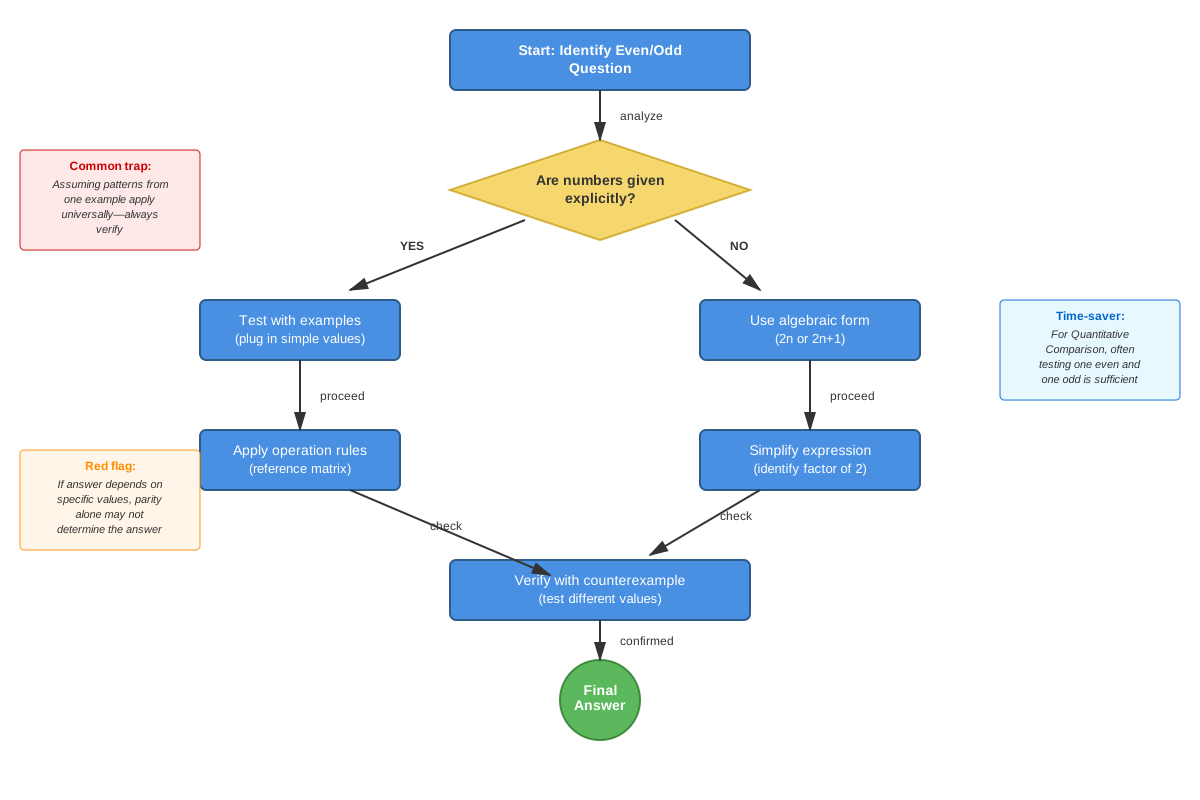
When approaching GRE even and odd numbers questions, follow this systematic process:
1. Identify the trigger: Watch for phrases like "x is even," "n is an odd integer," "consecutive integers," "the product of," or "the sum of." Questions asking "which MUST be true" or "which COULD be true" almost always involve even/odd analysis when integers are mentioned.
2. Classify all given information: Immediately note the parity of all numbers and variables mentioned. If a variable's parity isn't specified, consider both cases or look for constraints that determine it.
3. Apply operational rules systematically: Rather than calculating specific values, use the rules:
- Same parity sum → even
- Opposite parity sum → odd
- All odd factors → odd product
- Any even factor → even product
- Even base to any power → even
- Odd base to any power → odd
4. Use algebraic representation strategically: When the problem involves variables, represent even numbers as 2n and odd numbers as 2n+1. This allows algebraic manipulation while preserving parity information. However, don't over-rely on this—direct application of rules is often faster.
5. Eliminate aggressively in multiple-choice questions: If you determine an expression must be even, immediately eliminate all odd answer choices. If you determine it must be odd, eliminate all even choices. This often reduces five choices to two or three within seconds.
6. Test extreme cases for "could be" questions: When asked what "could be true," test n = 1 (odd), n = 2 (even), n = 0 (even), and n = -1 (odd). These simple values quickly reveal possibilities without complex calculation.
7. Watch for zero traps: The GRE loves to include zero in answer choices for even/odd questions, knowing many students incorrectly believe zero is neither even nor odd. Remember: zero is even.
Time-saving tip: Most even/odd questions should take 30-60 seconds once you've mastered the rules. If you find yourself calculating specific values, you're likely missing a pattern-based shortcut.
Process of elimination specific strategies:
- If an answer choice contains a fraction or decimal, eliminate it immediately for "must be even/odd" questions (parity applies only to integers)
- If the question states "x is even" and an answer choice is "x + 1," you know this must be odd—use this to quickly evaluate compound expressions
- For Quantitative Comparison, if you can determine that both columns have the same parity and differ by 2 or more, you can often determine the relationship without exact calculation
Memory Techniques
SOAP Mnemonic for Addition/Subtraction:
- Same parity → Even result
- Opposite parity → Odd result
"All Odd or All Wrong" for Multiplication:
Remember that a product is odd only when ALL factors are odd. If even one factor is even, the product is even. Think: "All odd or all wrong (even)."
"Base Determines the Race" for Exponents:
The base's parity determines the result's parity—the exponent doesn't matter. Even base → even result; odd base → odd result, regardless of what power you raise it to.
Visualization for Consecutive Integer Sums:
Picture consecutive integers as a balanced scale:
[n-2] [n-1] [n] [n+1] [n+2]The middle value (n) is the balance point. The sum equals the number of integers times this middle value when you have an odd count of consecutive integers.
"Count the Odds" for Multiple Addends:
When adding several integers, count how many are odd:
- Even count of odds (0, 2, 4, ...) → sum is even
- Odd count of odds (1, 3, 5, ...) → sum is odd
Think of odd numbers as having a "+1 extra" beyond an even number. These extras pair up (becoming even) or leave one unpaired (staying odd).
Zero is a Hero (Even Hero):
Create a mental image of zero wearing a cape with a big "2" on it, representing that 0 = 2(0), making it even. This memorable image prevents the common zero-parity error.
Summary
Even and odd numbers represent a fundamental classification of integers that the GRE tests extensively through pattern recognition and logical reasoning rather than computation. Mastery requires internalizing the operational rules: same parity sums to even while opposite parity sums to odd; products are odd only when all factors are odd; and any power of an even number is even while any power of an odd number is odd. Critical edge cases include recognizing that zero is even and that negative integers follow identical rules to positive integers. The GRE typically embeds even/odd logic within algebraic expressions, consecutive integer problems, and Quantitative Comparison questions where determining parity eliminates the need for calculation. Success depends on quickly classifying given information, applying rules systematically, and recognizing that these problems reward pattern recognition over arithmetic computation. Students who master this topic gain both direct points on even/odd questions and powerful problem-solving shortcuts applicable across numerous Quantitative Reasoning scenarios.
Key Takeaways
- Even and odd numbers follow predictable patterns under arithmetic operations that enable solving problems without calculation
- Zero is even, and negative integers follow identical even/odd rules as positive integers
- A product is odd if and only if ALL factors are odd—even one even factor makes the product even
- Same parity addition/subtraction yields even; opposite parity yields odd
- The base's parity determines the result's parity for any positive integer exponent
- Count odd addends when summing multiple integers: even count → even sum; odd count → odd sum
- GRE even and odd numbers questions reward pattern recognition and rule application over computation
Related Topics
Divisibility Rules: Understanding even/odd properties provides the foundation for divisibility by 2 and connects to divisibility tests for other numbers. Mastering even/odd logic makes divisibility rules more intuitive.
Prime Numbers: All prime numbers except 2 are odd, making even/odd analysis essential for prime number problems. This connection appears frequently in GRE number theory questions.
Remainders and Modular Arithmetic: Even numbers leave remainder 0 when divided by 2, while odd numbers leave remainder 1. This relationship extends to more complex remainder problems.
Integer Properties and Number Theory: Even/odd classification is one of several ways to categorize integers, alongside positive/negative, prime/composite, and perfect squares. These classifications often combine in advanced GRE problems.
Algebraic Expressions with Integers: Determining whether algebraic expressions yield even or odd results requires combining even/odd logic with algebraic manipulation skills.
Practice CTA
Now that you've mastered the core concepts of even and odd numbers, it's time to cement your understanding through active practice. Attempt the practice questions to apply these rules under test-like conditions, and use the flashcards to drill the operational rules until they become automatic. Remember: the GRE rewards speed and accuracy, both of which come from transforming conscious rule application into instant pattern recognition. Every practice problem you solve strengthens the neural pathways that will fire automatically on test day, giving you the confidence and efficiency to maximize your Quantitative Reasoning score. You've built the foundation—now build the mastery through deliberate practice!
Sign up free to keep reading
Create a free AnvayaPrep account to finish this GRE guide on Even and odd numbers — plus flashcards and practice questions.