Overview
Factors are fundamental building blocks in arithmetic and number theory, representing the integers that divide evenly into a given number. Understanding factors is crucial for success on the GRE Quantitative Reasoning section, as they appear directly in approximately 10-15% of arithmetic questions and indirectly support concepts tested in algebra, data analysis, and problem-solving scenarios. A factor of a number n is any integer that divides n without leaving a remainder. For example, the factors of 12 are 1, 2, 3, 4, 6, and 12 because each of these numbers divides 12 evenly.
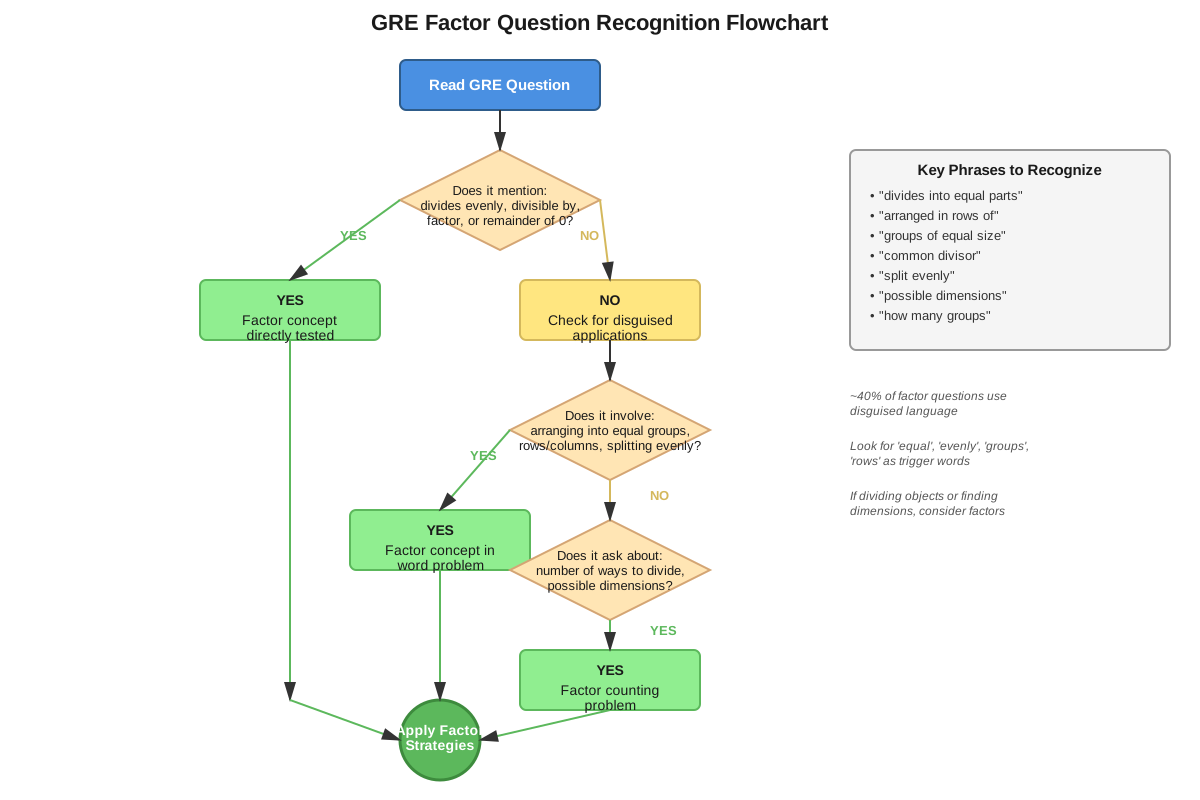
The concept of factors extends far beyond simple division problems on the GRE. Questions involving gre factors frequently appear disguised within word problems about arranging objects, determining divisibility, finding common measurements, or optimizing quantities. The test-makers deliberately embed factor-related concepts within complex scenarios to assess both computational skills and conceptual understanding. Students who master factors gain significant advantages in time management and accuracy, as recognizing factor patterns allows for rapid elimination of incorrect answer choices and efficient problem-solving strategies.
Factors form essential connections to multiple areas within GRE Quantitative Reasoning. They serve as the foundation for understanding multiples, greatest common factors (GCF), least common multiples (LCM), prime factorization, and divisibility rules. Additionally, factor concepts frequently intersect with ratio problems, fraction simplification, exponent manipulation, and even certain geometry questions involving area and perimeter. Developing fluency with factors creates a mathematical toolkit that enhances performance across the entire quantitative section, making this topic one of the highest-yield areas for focused study.
Learning Objectives
- [ ] Identify when Factors is being tested in GRE questions, including disguised applications in word problems
- [ ] Explain the core rule or strategy behind Factors, including systematic methods for finding all factors
- [ ] Apply Factors to GRE-style questions accurately under timed conditions
- [ ] Determine the total number of factors for any integer using prime factorization
- [ ] Distinguish between factors, multiples, and divisors in various problem contexts
- [ ] Solve complex problems involving factor pairs and factor relationships
- [ ] Recognize and exploit factor patterns to eliminate incorrect answer choices efficiently
Prerequisites
- Basic multiplication and division: Essential for determining whether one number divides evenly into another, which is the fundamental definition of a factor
- Understanding of integers: Factors are always integers, and distinguishing between positive and negative integers affects factor counting
- Prime numbers: Recognizing prime numbers accelerates factor identification and supports prime factorization techniques
- Exponent rules: Prime factorization uses exponential notation, and calculating total factors requires manipulating exponents
Why This Topic Matters
Factors appear throughout real-world applications, from dividing resources equally among groups to determining optimal packaging configurations in manufacturing. Architects use factors when designing modular spaces, event planners apply factor concepts when arranging seating, and computer scientists leverage factorization in cryptography algorithms. The practical utility of understanding factors extends to personal finance, where factor relationships help calculate payment schedules and interest periods.
On the GRE specifically, factor questions appear in multiple formats across the Quantitative Reasoning section. Approximately 10-15% of arithmetic questions directly test factor knowledge, while another 15-20% of questions incorporate factors as intermediate steps in solving more complex problems. The exam presents factor concepts through direct calculation questions, quantitative comparison problems, word problems requiring factor analysis, and data interpretation scenarios. Questions may ask students to find all factors of a number, determine how many factors exist, identify factor pairs, or apply factor concepts to solve optimization problems.
Common GRE question formats include: "How many positive factors does n have?", "Which of the following could be a factor of both x and y?", "If n has exactly three factors, what must be true about n?", and word problems like "A rectangular garden with integer dimensions has an area of 48 square feet. How many different perimeter values are possible?" Recognizing these patterns allows students to immediately activate the appropriate problem-solving strategies, saving valuable time during the exam.
Core Concepts
Definition and Fundamental Properties
A factor (also called a divisor) of an integer n is any integer that divides n evenly, leaving no remainder. Mathematically, if a and b are integers and a × b = n, then both a and b are factors of n. Every positive integer has at least two factors: 1 and itself. The number 1 is unique in having exactly one positive factor (itself), while prime numbers have exactly two positive factors.
When discussing factors on the GRE, the context typically refers to positive factors unless explicitly stated otherwise. However, technically every positive factor has a corresponding negative factor. For example, while 12 has positive factors {1, 2, 3, 4, 6, 12}, it also has negative factors {-1, -2, -3, -4, -6, -12}. GRE questions almost always focus on positive factors, but reading carefully for specifications like "positive factors" versus "factors" prevents errors.
Finding All Factors Systematically
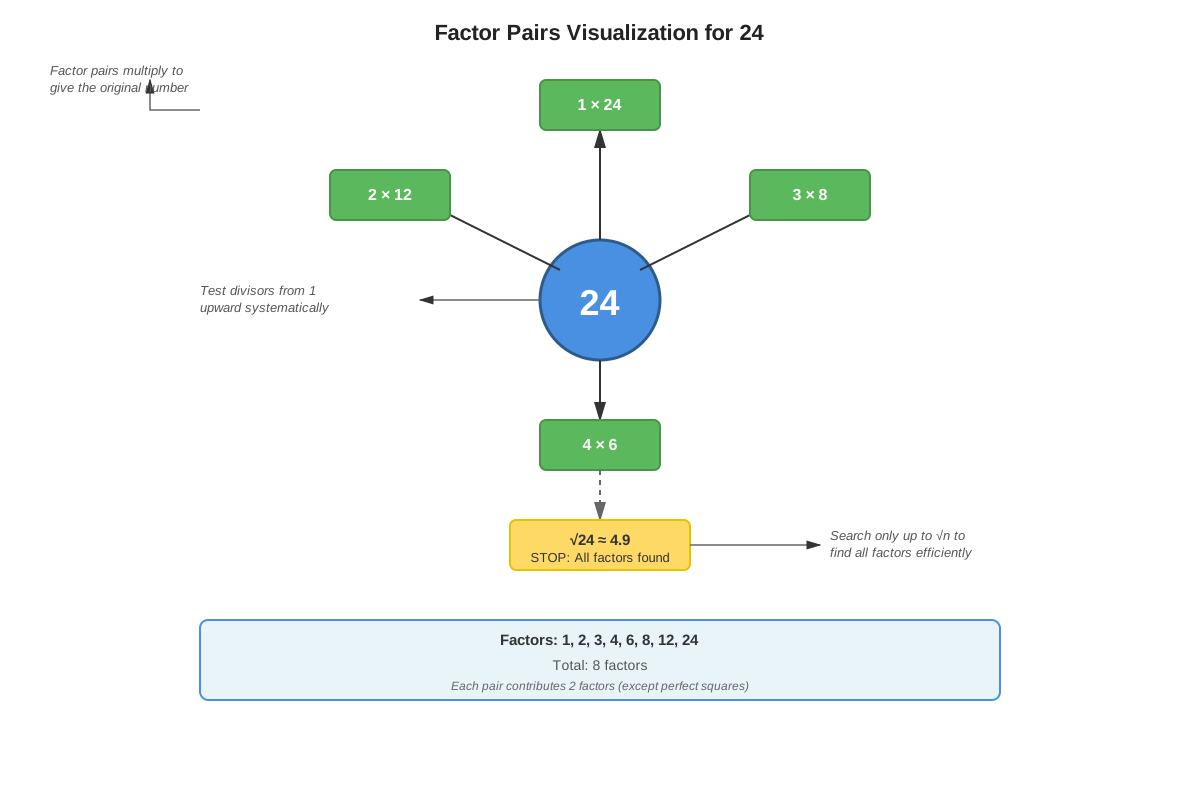
The most reliable method for finding all factors involves checking divisibility systematically from 1 up to the square root of the number. This approach leverages the fact that factors come in pairs: if a is a factor of n, then n/a is also a factor. Once checking reaches the square root, all factor pairs have been identified.
Step-by-step process for finding all factors of 72:
- Start with 1: 1 × 72 = 72 → factors: 1, 72
- Check 2: 2 × 36 = 72 → factors: 2, 36
- Check 3: 3 × 24 = 72 → factors: 3, 24
- Check 4: 4 × 18 = 72 → factors: 4, 18
- Check 5: 72 ÷ 5 = 14.4 (not a factor)
- Check 6: 6 × 12 = 72 → factors: 6, 12
- Check 7: 72 ÷ 7 ≈ 10.3 (not a factor)
- Check 8: 8 × 9 = 72 → factors: 8, 9
- Stop at √72 ≈ 8.5
Complete factor list for 72: {1, 2, 3, 4, 6, 8, 9, 12, 18, 24, 36, 72}
Counting Factors Using Prime Factorization
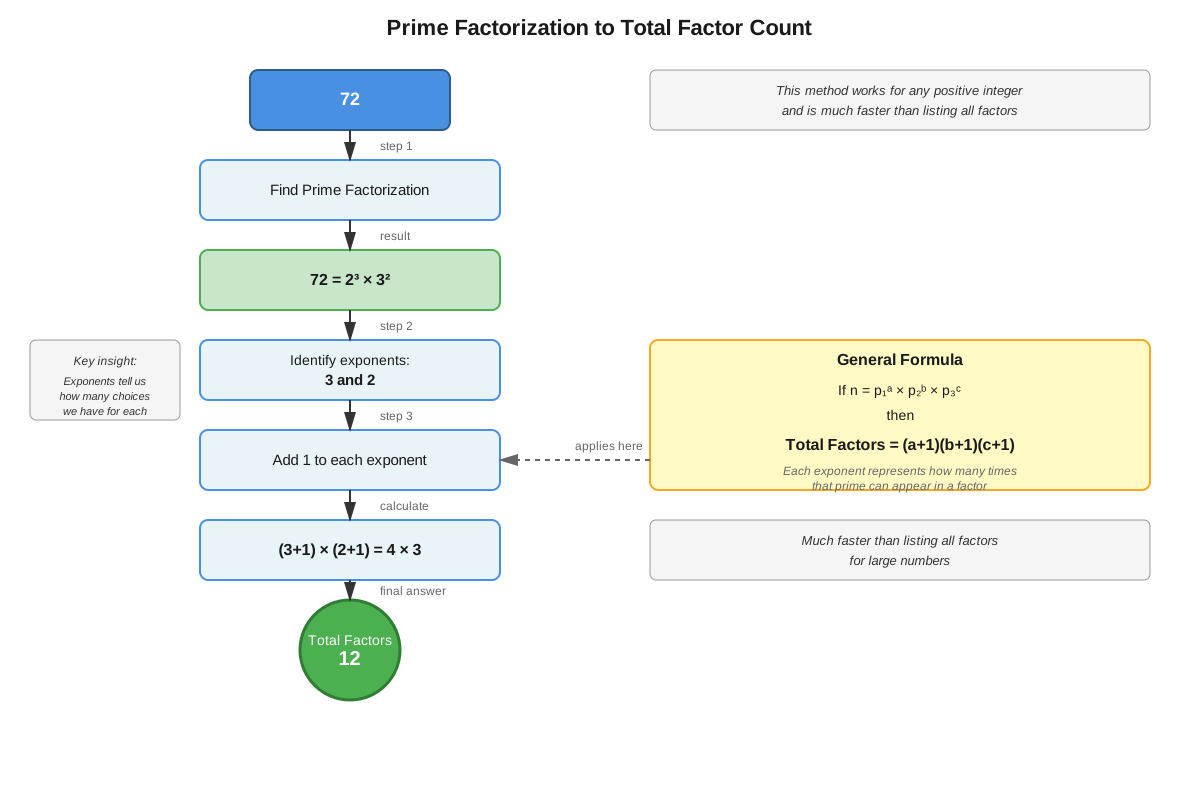
Prime factorization provides the most efficient method for determining the total number of factors without listing them all. This technique is particularly valuable on the GRE when questions ask "How many factors does n have?" rather than requesting the actual factors.
Formula for counting factors:
If n = p₁^a × p₂^b × p₃^c × ... (prime factorization), then the total number of positive factors = (a+1)(b+1)(c+1)...
Example: Find the number of positive factors of 180.
180 = 2² × 3² × 5¹
Number of factors = (2+1)(2+1)(1+1) = 3 × 3 × 2 = 18 factors
This formula works because each factor of 180 must be formed by selecting exponents for each prime: 2^(0,1, or 2) × 3^(0,1, or 2) × 5^(0 or 1). The multiplication principle gives (3 choices)(3 choices)(2 choices) = 18 total combinations.
Factor Pairs and Their Properties
Factor pairs are two factors that multiply together to produce the original number. Understanding factor pairs helps solve geometry problems involving area and perimeter, as well as optimization problems requiring specific products.
For any number n, factor pairs can be organized systematically:
- The smallest factor (1) pairs with the largest factor (n)
- Factor pairs "meet in the middle" at the square root
- If n is a perfect square, one factor pair consists of the same number twice (√n × √n)
Factor pairs of 36:
- 1 × 36
- 2 × 18
- 3 × 12
- 4 × 9
- 6 × 6 (middle pair, since 36 is a perfect square)
Special Cases and Factor Patterns
Certain numbers exhibit distinctive factor patterns that frequently appear on the GRE:
| Number Type | Factor Count | Example |
|---|---|---|
| Prime numbers | Exactly 2 | 7 has factors {1, 7} |
| Perfect squares | Odd number of factors | 16 has 5 factors {1, 2, 4, 8, 16} |
| Prime squared | Exactly 3 factors | 25 has factors {1, 5, 25} |
| Powers of 2 | (exponent + 1) factors | 32 = 2⁵ has 6 factors |
Perfect squares have an odd number of factors because one factor pair consists of the same number repeated (the square root), while all other factors come in distinct pairs. This property frequently appears in GRE questions asking about factor counts.
Common Factors and Factor Relationships
When comparing two or more numbers, common factors are those that divide all numbers in the set. The greatest common factor (GCF) is the largest integer that divides all numbers evenly. While GCF is a separate topic, understanding that common factors form a subset of each number's factor list helps solve comparison problems.
For numbers 24 and 36:
- Factors of 24: {1, 2, 3, 4, 6, 8, 12, 24}
- Factors of 36: {1, 2, 3, 4, 6, 9, 12, 18, 36}
- Common factors: {1, 2, 3, 4, 6, 12}
- GCF: 12
Concept Relationships
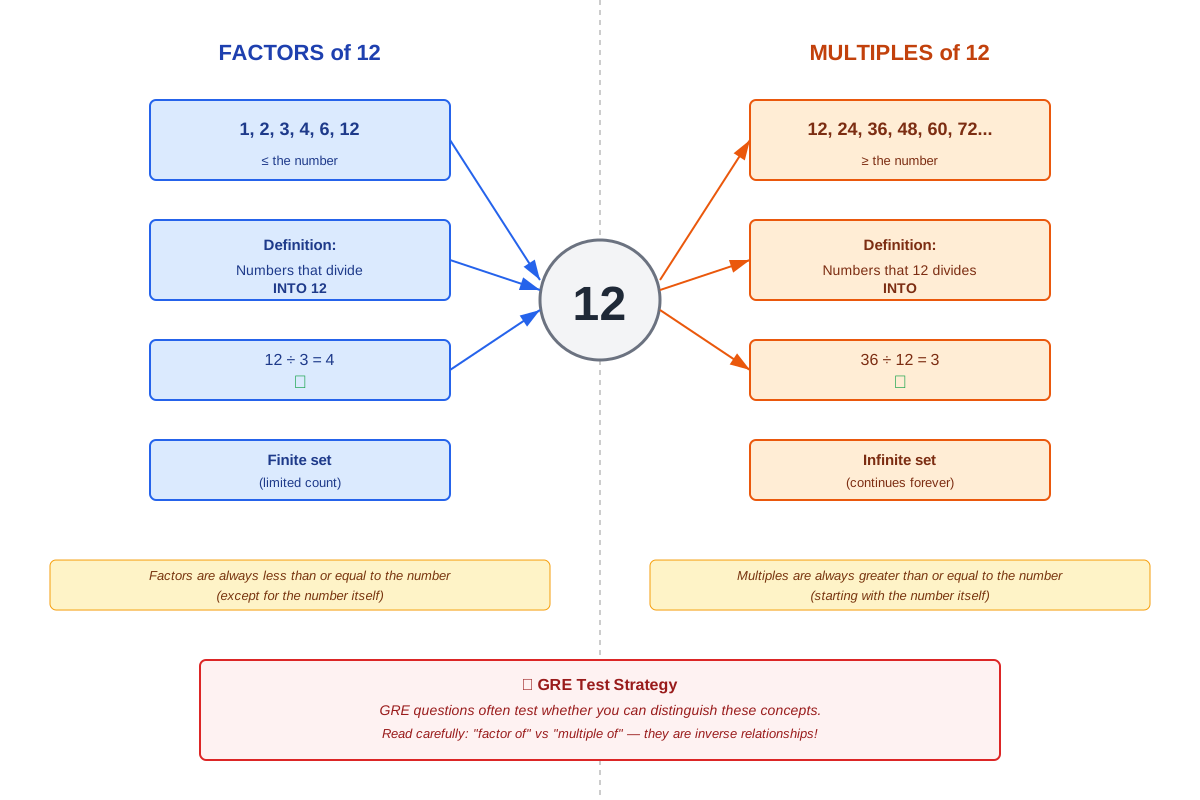
The concept of factors serves as a central hub connecting multiple arithmetic and algebraic topics. Prime factorization → enables efficient factor counting → which supports divisibility analysis. Understanding factors directly leads to mastery of multiples (the inverse relationship: if a is a factor of b, then b is a multiple of a). This factor-multiple duality appears frequently in GRE questions that can be approached from either perspective.
Factors connect upward to more advanced concepts: factors → support understanding of GCF and LCM → which enable fraction operations and ratio simplification. In algebra, factor concepts extend to polynomial factorization, where the same principles of breaking down composite expressions into multiplicative components apply. Geometry problems involving area and perimeter often reduce to factor pair analysis, creating a bridge between arithmetic and spatial reasoning.
The relationship between factors and exponents becomes crucial when using prime factorization. Exponent rules → facilitate prime factorization → which enables systematic factor counting. Additionally, divisibility rules serve as shortcuts for factor identification: divisibility tests → quickly identify certain factors → which accelerates problem-solving. Recognizing these interconnections allows students to approach problems from multiple angles, selecting the most efficient strategy for each question type.
High-Yield Facts
⭐ Every positive integer has at least two positive factors: 1 and itself (except 1, which has only one factor)
⭐ Perfect squares have an odd number of factors; all other positive integers have an even number of factors
⭐ To count factors efficiently, use prime factorization: if n = p₁^a × p₂^b × p₃^c, then factor count = (a+1)(b+1)(c+1)
⭐ Factor pairs multiply to give the original number and "meet" at the square root
⭐ A number with exactly two factors is prime; a number with exactly three factors is the square of a prime
- The factors of any number always include 1 and the number itself
- If a is a factor of b, and b is a factor of c, then a is a factor of c (transitive property)
- The sum of all factors of a perfect number equals twice the number (e.g., 6: 1+2+3+6 = 12 = 2×6)
- Every factor of n is also a factor of any multiple of n
- The number of factors increases as numbers have more diverse prime factors in their factorization
- For consecutive integers, the only common factor is 1 (they are relatively prime)
- If n has k factors, then n² has an odd number of factors related to k's structure
Quick check — test yourself on Factors so far.
Try Flashcards →Common Misconceptions
Misconception: Factors and multiples are the same thing.
Correction: Factors divide into a number evenly (factors are smaller or equal), while multiples are the results of multiplying a number by integers (multiples are larger or equal). For 12, factors include 3 and 4, while multiples include 24 and 36.
Misconception: Only prime numbers can be factors.
Correction: Any integer that divides evenly into a number is a factor, including composite numbers. For example, 12 is a factor of 36, even though 12 is composite.
Misconception: The number of factors equals the number itself divided by something.
Correction: There is no simple division relationship between a number and its factor count. The factor count depends on the prime factorization structure, not the magnitude of the number. For instance, 24 has 8 factors while 23 has only 2 factors, despite being nearly equal in value.
Misconception: All numbers have an even number of factors.
Correction: Perfect squares have an odd number of factors because the square root pairs with itself rather than with a different number. For example, 36 has factors {1, 2, 3, 4, 6, 9, 12, 18, 36}—nine factors total.
Misconception: To find all factors, you must check every number from 1 to n.
Correction: Only check numbers up to √n because factors come in pairs. Once you reach the square root, you've identified all factor pairs. This dramatically reduces computation time for large numbers.
Misconception: Negative numbers don't have factors.
Correction: Negative numbers have factors, but GRE questions typically focus on positive factors of positive integers. When considering negative numbers, both positive and negative integers can serve as factors (e.g., -2 is a factor of -12 because -2 × 6 = -12).
Worked Examples
Example 1: Finding All Factors and Factor Count
Question: How many positive factors does 360 have?
Solution:
Step 1: Find the prime factorization of 360.
360 = 36 × 10 = 6² × 10 = (2 × 3)² × (2 × 5) = 2² × 3² × 2 × 5 = 2³ × 3² × 5¹Step 2: Apply the factor-counting formula.
For n = 2³ × 3² × 5¹, the number of factors = (3+1)(2+1)(1+1)
Step 3: Calculate.
Number of factors = 4 × 3 × 2 = 24
Answer: 360 has 24 positive factors.
Connection to learning objectives: This example demonstrates applying the core strategy (prime factorization method) to efficiently count factors without listing them all—a crucial time-saving technique for GRE questions.
Example 2: Factor Pairs in a Word Problem
Question: A rectangular garden has an area of 48 square meters, and both the length and width are positive integers. How many different possible perimeters could this garden have?
Solution:
Step 1: Recognize this as a factor pair problem. The length and width must be factors of 48 that multiply to give 48.
Step 2: Find all factor pairs of 48.
- 1 × 48
- 2 × 24
- 3 × 16
- 4 × 12
- 6 × 8
Step 3: Calculate the perimeter for each factor pair using P = 2(length + width).
- 1 × 48: P = 2(1 + 48) = 98
- 2 × 24: P = 2(2 + 24) = 52
- 3 × 16: P = 2(3 + 16) = 38
- 4 × 12: P = 2(4 + 12) = 32
- 6 × 8: P = 2(6 + 8) = 28
Step 4: Count the distinct perimeter values.
All five perimeters are different: 28, 32, 38, 52, 98
Answer: 5 different possible perimeters.
Connection to learning objectives: This example shows how to identify when factors are being tested in a disguised format (geometry word problem) and apply factor pair analysis to solve it accurately—addressing the first and third learning objectives.
Example 3: Special Factor Properties
Question: If n is a positive integer with exactly three positive factors, which of the following must be true?
(A) n is prime
(B) n is odd
(C) n is the square of a prime number
(D) n is divisible by 3
(E) n is less than 10
Solution:
Step 1: Recall that the number of factors relates to prime factorization structure. For n = p₁^a × p₂^b × ..., factor count = (a+1)(b+1)...
Step 2: Determine what prime factorization gives exactly 3 factors.
We need (a+1)(b+1)... = 3
Since 3 is prime, the only factorization is 3 = 3 × 1
This means (a+1) = 3, so a = 2, and there's only one prime in the factorization.
Step 3: Conclude the form of n.
n = p² for some prime p (the square of a prime number)
Step 4: Verify with examples.
- 4 = 2² has factors {1, 2, 4} ✓
- 9 = 3² has factors {1, 3, 9} ✓
- 25 = 5² has factors {1, 5, 25} ✓
Step 5: Evaluate answer choices.
(A) False: 4 has three factors but isn't prime
(B) False: 4 has three factors but is even
(C) True: All numbers with exactly three factors are squares of primes
(D) False: 4 has three factors but isn't divisible by 3
(E) False: 25 has three factors but equals 10
Answer: (C) n is the square of a prime number.
Connection to learning objectives: This example demonstrates explaining the core rule behind factors (the relationship between prime factorization and factor count) and applying it to identify special number properties—a high-yield GRE question type.
Exam Strategy
When approaching gre factors questions, begin by identifying the question type: Are you asked to list all factors, count factors, find factor pairs, or apply factor concepts to a word problem? This classification determines the optimal strategy. For counting questions, immediately consider prime factorization rather than listing. For word problems, translate the scenario into mathematical relationships involving factors.
Trigger words and phrases that signal factor questions include: "divides evenly," "divisible by," "goes into," "how many factors," "factor pairs," "rectangular dimensions with integer sides," "groups of equal size," and "arrangements with no remainder." Questions asking about "positive divisors" are identical to factor questions. Quantitative comparison questions may present expressions like "the number of factors of x" versus "the number of factors of y," requiring efficient factor-counting techniques.
Process-of-elimination strategies specific to factors:
- Eliminate answer choices that aren't factors by checking divisibility quickly (use divisibility rules)
- For "how many factors" questions, eliminate answers with incorrect parity (odd vs. even) based on whether the number is a perfect square
- When comparing factor counts, eliminate choices by considering prime factorization complexity rather than number magnitude
- For word problems, eliminate geometrically impossible scenarios (e.g., factor pairs that don't satisfy stated constraints)
Time allocation: Simple factor-listing questions should take 30-45 seconds. Factor-counting questions using prime factorization should take 45-60 seconds. Complex word problems involving factors may require 90-120 seconds. If a question asks for all factors of a large number (above 100), look for a shortcut or alternative approach—the test-makers rarely require exhaustive listing of many factors.
Exam Tip: When you see a question asking "How many positive factors does n have?" and n is given as a large number, immediately write out the prime factorization. Don't waste time listing factors individually. The formula (a+1)(b+1)(c+1)... saves significant time and prevents counting errors.
Memory Techniques
FACTOR mnemonic for the systematic approach:
- Find the prime factorization first
- Add one to each exponent
- Combine by multiplying these sums
- Total gives the factor count
- Organize factor pairs from smallest to largest
- Remember perfect squares have odd factor counts
Visualization strategy: Picture factors as building blocks that stack together to create the original number. Each factor represents a possible "height" of a rectangular arrangement where the area equals the number. This mental image helps with word problems involving arrangements and dimensions.
Perfect square recognition: Remember "ODD SQUARES" — perfect squares have an ODD number of factors because one factor pair consists of the SQUARE root repeated. This connection between "odd" and "square" helps recall this high-yield property.
Factor pair pattern: Visualize factors as a ladder where the rungs represent factor pairs. The ladder starts wide (1 × n) and narrows as you climb toward the middle (√n × √n for perfect squares). This image reinforces that you only need to check up to the square root.
Summary
Factors represent the integers that divide evenly into a given number, forming a foundational concept for GRE Quantitative Reasoning success. Mastery requires understanding three core competencies: systematically finding all factors by checking divisibility up to the square root, efficiently counting factors using the prime factorization formula (a+1)(b+1)(c+1)..., and recognizing factor applications in word problems and special cases. Perfect squares uniquely possess an odd number of factors because the square root pairs with itself, while all other positive integers have an even number of factors. Factor pairs multiply to produce the original number and provide the key to solving geometry problems involving integer dimensions. The GRE tests factor concepts both directly through computational questions and indirectly through word problems requiring factor analysis, making this topic essential for achieving competitive quantitative scores. Students who develop fluency with prime factorization and factor-counting formulas gain significant advantages in speed and accuracy across multiple question types.
Key Takeaways
- Factors are integers that divide evenly into a number; find them systematically by checking divisibility up to the square root
- Use prime factorization to count factors efficiently: for n = p₁^a × p₂^b × p₃^c, factor count = (a+1)(b+1)(c+1)
- Perfect squares have an odd number of factors; all other positive integers have an even number of factors
- Numbers with exactly three factors are always squares of prime numbers (4, 9, 25, 49, etc.)
- Factor pairs multiply to give the original number and meet at the square root, making them crucial for geometry problems
- Recognize disguised factor questions in word problems involving equal groups, rectangular dimensions, or divisibility scenarios
- Master the relationship between factors and prime factorization to solve problems quickly under timed conditions
Related Topics
Prime Factorization: Breaking numbers into their prime components forms the foundation for efficient factor counting and connects directly to this topic. Mastering factors enables deeper understanding of how prime factorization simplifies complex arithmetic operations.
Greatest Common Factor (GCF): The largest factor shared by two or more numbers builds directly on factor identification skills. Understanding individual factors is prerequisite knowledge for finding common factors efficiently.
Least Common Multiple (LCM): The inverse relationship between factors and multiples makes LCM a natural progression. Factor mastery provides the conceptual framework for understanding how multiples relate to the original numbers.
Divisibility Rules: Quick tests for determining whether numbers are divisible by 2, 3, 4, 5, 6, 8, 9, and 10 accelerate factor identification. These rules serve as shortcuts for the systematic factor-finding process.
Perfect Squares and Square Roots: The special factor properties of perfect squares connect to broader understanding of exponential relationships and radical expressions, extending factor concepts into algebra.
Practice CTA
Now that you've mastered the core concepts of factors, it's time to solidify your understanding through active practice. Attempt the practice questions designed specifically to test the strategies and patterns covered in this guide. Work through each problem methodically, applying the prime factorization technique for counting factors and the systematic approach for finding factor pairs. Use the flashcards to reinforce high-yield facts and special cases until recognizing factor patterns becomes automatic. Remember: consistent practice with GRE-style questions transforms conceptual knowledge into test-day performance. Your investment in mastering factors will pay dividends across multiple question types throughout the Quantitative Reasoning section!
Sign up free to keep reading
Create a free AnvayaPrep account to finish this GRE guide on Factors — plus flashcards and practice questions.