Overview
Multiples represent one of the most fundamental yet frequently tested concepts in GRE Quantitative Reasoning. A multiple of a number is the product of that number and any integer. For example, the multiples of 5 are 5, 10, 15, 20, and so on, as well as 0, -5, -10, and other negative values. While this definition appears straightforward, the GRE tests multiples in sophisticated ways that require students to recognize patterns, apply divisibility rules, and solve complex word problems involving constraints.
Understanding gre multiples is essential because this concept appears across numerous question types, from basic Quantitative Comparison questions to complex Problem Solving scenarios involving number properties. The GRE frequently combines multiples with other arithmetic concepts such as factors, divisibility, remainders, and prime numbers. Questions may ask students to identify the least common multiple (LCM) of two or more numbers, determine how many multiples of a given number fall within a specific range, or solve problems involving periodic events that occur at regular intervals.
Mastery of multiples provides the foundation for understanding more advanced topics in GRE Quantitative Reasoning, including ratio and proportion problems, sequence questions, and even certain data interpretation scenarios. The concept connects directly to divisibility rules, which allow for quick mental calculations, and to factors, which represent the inverse relationship. Students who develop strong intuition about multiples gain significant advantages in time management and accuracy, as many GRE questions can be solved more efficiently by recognizing multiple patterns rather than performing lengthy calculations.
Learning Objectives
- [ ] Identify when Multiples is being tested in GRE questions
- [ ] Explain the core rule or strategy behind Multiples
- [ ] Apply Multiples to GRE-style questions accurately
- [ ] Calculate the least common multiple (LCM) of two or more numbers using multiple methods
- [ ] Determine the number of multiples within a given range using systematic approaches
- [ ] Solve word problems involving periodic events and cyclical patterns using multiple concepts
- [ ] Distinguish between multiples and factors and apply the appropriate concept to different question types
Prerequisites
- Basic multiplication and division: Essential for calculating multiples and understanding the relationship between numbers and their multiples
- Integer properties: Necessary for recognizing that multiples extend to negative integers and zero, not just positive numbers
- Prime factorization: Required for efficiently finding least common multiples and understanding the structure of numbers
- Divisibility rules: Helpful for quickly identifying whether one number is a multiple of another without performing full division
Why This Topic Matters
In real-world applications, multiples appear in scheduling problems (when will two events coincide?), measurement conversions (how many inches in multiple feet?), and resource allocation (distributing items into equal groups). Understanding multiples enables efficient problem-solving in fields ranging from project management to engineering, where synchronization and periodic patterns are crucial.
On the GRE, multiples appear in approximately 10-15% of Quantitative Reasoning questions, making this a high-yield topic for test preparation. Questions involving multiples appear across all question formats: Quantitative Comparison, Multiple Choice (select one answer), Multiple Choice (select one or more answers), and Numeric Entry. The concept is particularly prevalent in Problem Solving questions that involve number properties and in word problems requiring students to set up equations based on multiple constraints.
Common exam presentations include: finding common multiples of two or more numbers; determining how many multiples of a specific number exist within a range; solving problems where quantities must be multiples of certain values; identifying patterns in sequences of multiples; and applying multiple concepts to remainder problems. The GRE often disguises multiple questions within real-world contexts such as scheduling, packaging, or measurement scenarios, requiring students to translate verbal descriptions into mathematical relationships.
Core Concepts
Definition and Basic Properties
A multiple of a number n is any value that can be expressed as n × k, where k is an integer. This definition yields several critical properties:
- Every integer is a multiple of itself (n × 1 = n)
- Zero is a multiple of every integer (n × 0 = 0)
- Multiples extend infinitely in both positive and negative directions
- The set of multiples of any non-zero integer is infinite
For example, the multiples of 7 include: ..., -21, -14, -7, 0, 7, 14, 21, 28, 35, ...
The GRE typically focuses on positive multiples, but understanding that multiples include zero and negative values prevents errors in Quantitative Comparison questions where the range of possible values matters.
Identifying Multiples
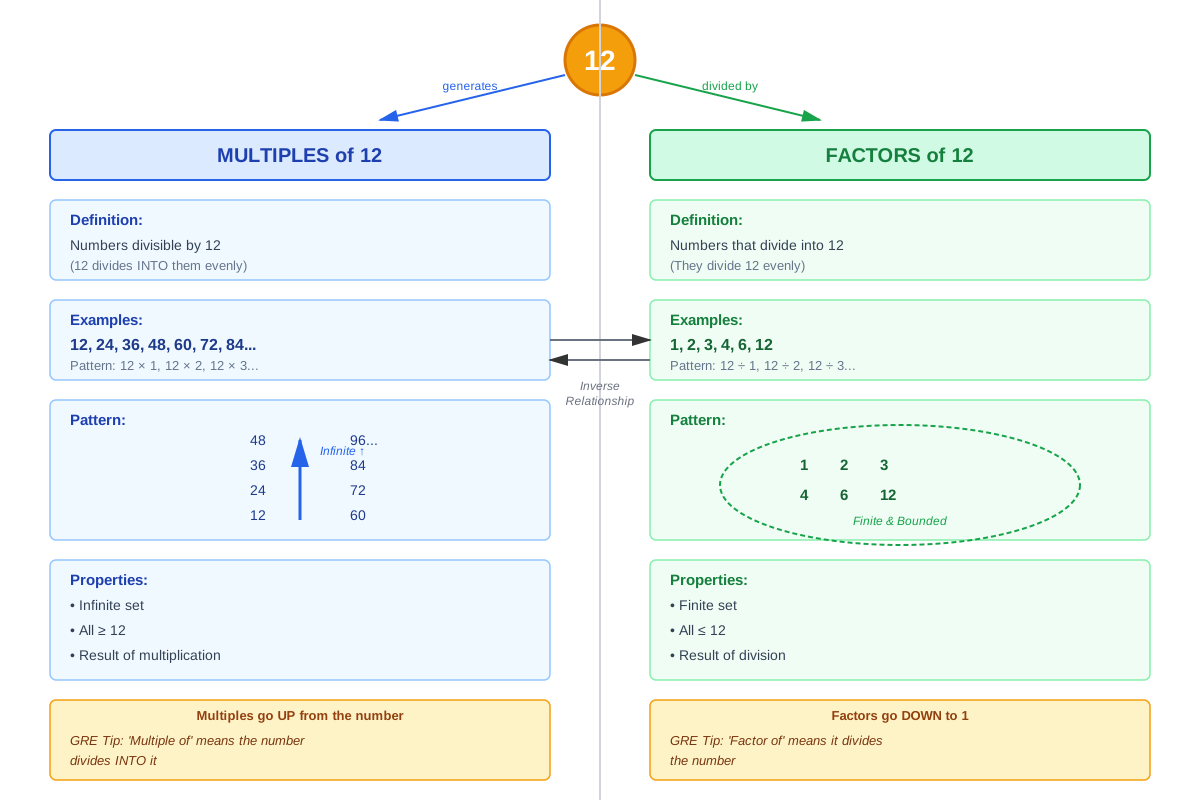
To determine whether number A is a multiple of number B, check if A ÷ B yields an integer with no remainder. Equivalently, A is a multiple of B if B is a factor of A. This reciprocal relationship between multiples and factors is fundamental:
- If 24 is a multiple of 6, then 6 is a factor of 24
- If x is divisible by y, then x is a multiple of y
The GRE tests this concept by asking questions in various forms: "Which of the following is a multiple of 12?" or "If n is divisible by 8, which must be true?" Recognizing these as equivalent phrasings saves valuable time.
Least Common Multiple (LCM)
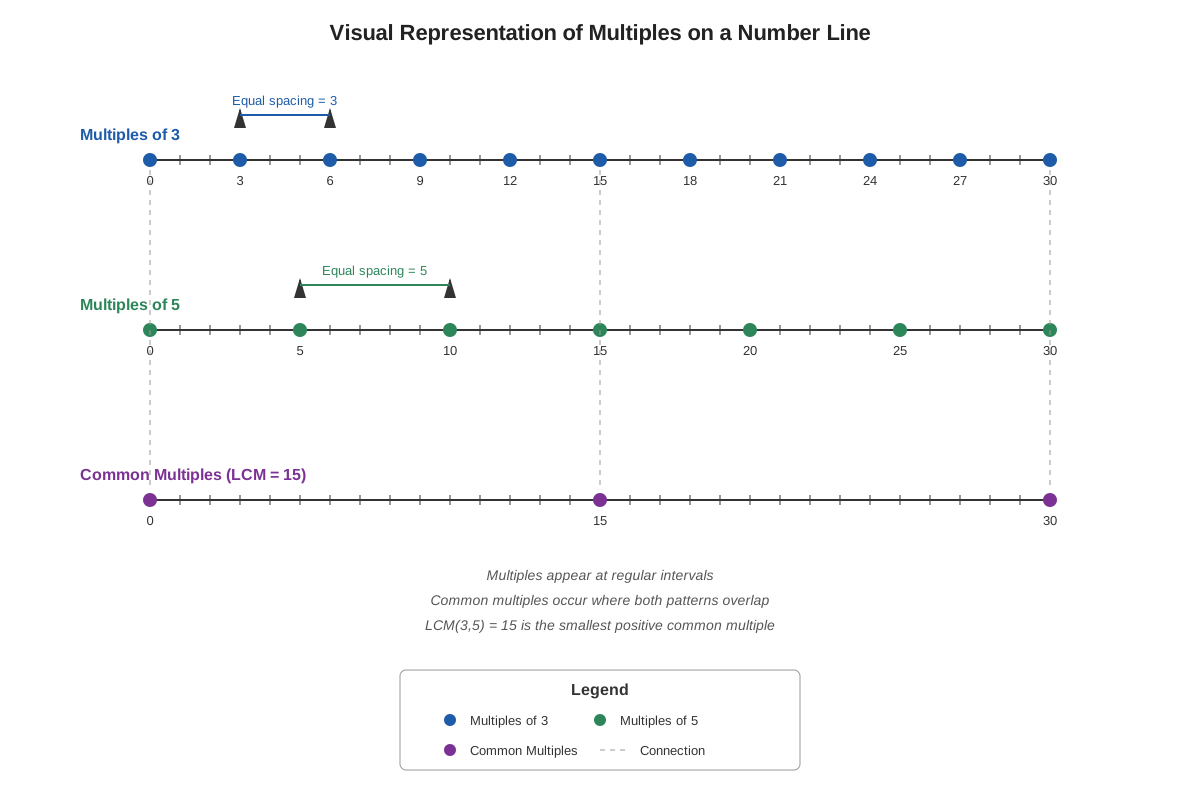
The least common multiple of two or more numbers is the smallest positive integer that is a multiple of all the given numbers. The LCM is crucial for solving problems involving synchronization, such as when two periodic events will occur simultaneously.
Method 1: Listing Multiples
For small numbers, list multiples of each number until finding the first common value:
- Multiples of 6: 6, 12, 18, 24, 30, 36...
- Multiples of 8: 8, 16, 24, 32, 40...
- LCM(6, 8) = 24
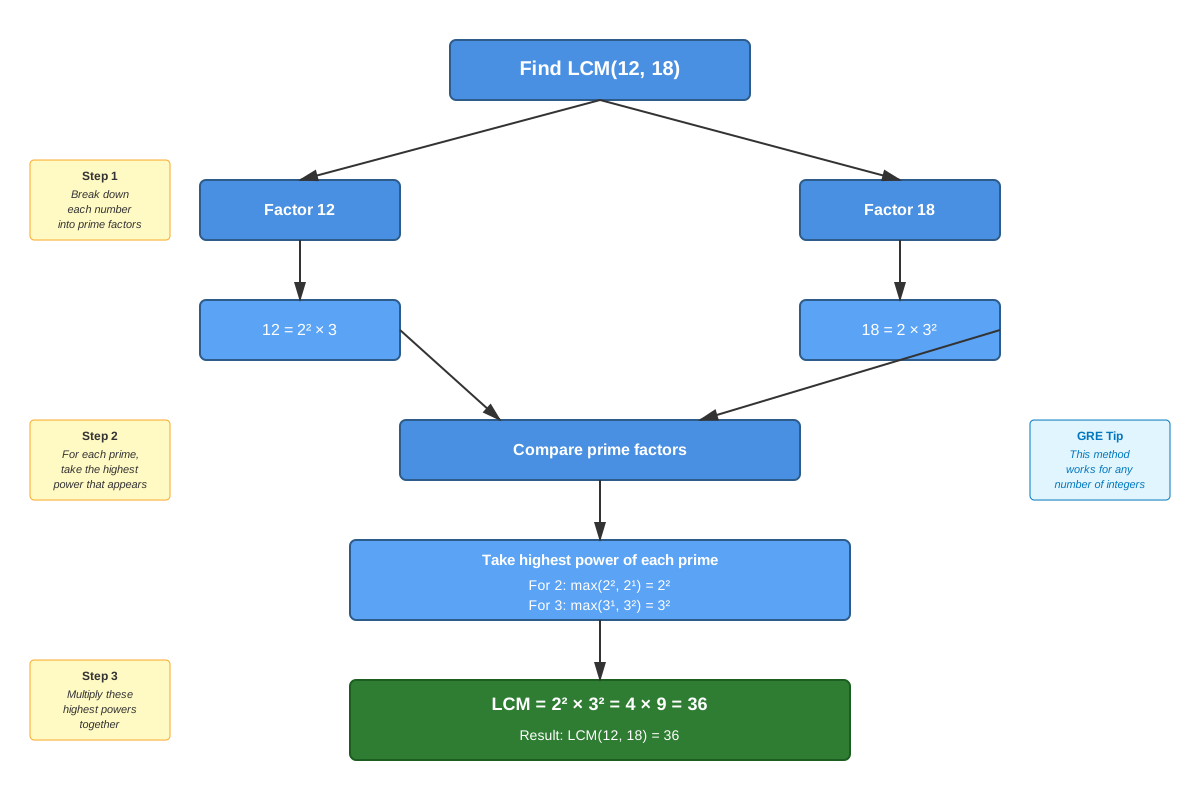
Method 2: Prime Factorization
For larger numbers or multiple values, use prime factorization:
- Express each number as a product of prime factors
- For each prime that appears, take the highest power present in any factorization
- Multiply these together
Example: Find LCM(12, 18, 20)
- 12 = 2² × 3
- 18 = 2 × 3²
- 20 = 2² × 5
- LCM = 2² × 3² × 5 = 4 × 9 × 5 = 180
Method 3: Using GCD
For two numbers a and b: LCM(a, b) = (a × b) / GCD(a, b)
This formula is efficient when the greatest common divisor is easily identified.
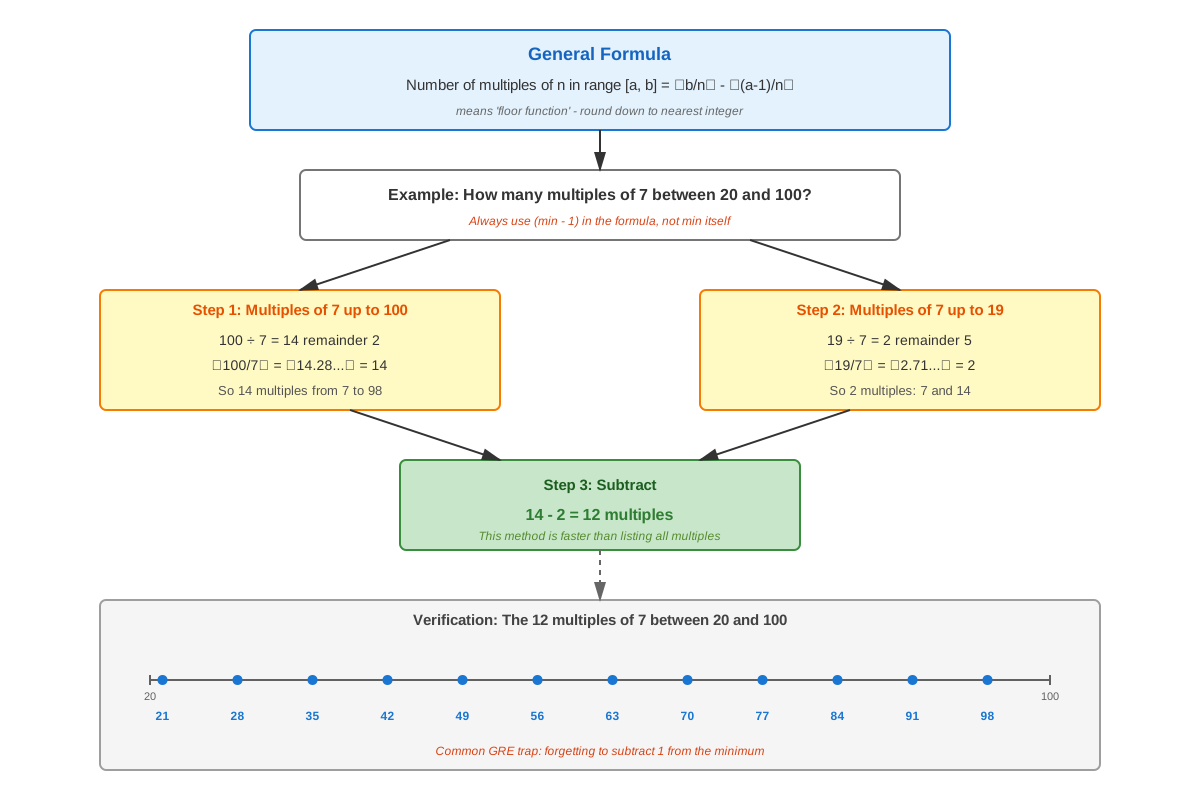
Counting Multiples in a Range
A frequent GRE question type asks: "How many multiples of n are there between a and b?" The systematic approach:
- Find the smallest multiple of n that is ≥ a
- Find the largest multiple of n that is ≤ b
- Use the formula: (Largest multiple - Smallest multiple) / n + 1
Example: How many multiples of 7 are between 50 and 150?
- Smallest: 7 × 8 = 56 (since 7 × 7 = 49 < 50)
- Largest: 7 × 21 = 147 (since 7 × 22 = 154 > 150)
- Count: (147 - 56) / 7 + 1 = 91/7 + 1 = 13 + 1 = 14
Important consideration: Pay careful attention to whether endpoints are included ("between" vs. "from...to") and whether the question asks for "between" (exclusive) or "from...to" (inclusive).
Common Multiples and Patterns
When working with multiples of multiple numbers simultaneously, recognize these patterns:
| Concept | Definition | Example |
|---|---|---|
| Common multiple | A number that is a multiple of two or more given numbers | 24 is a common multiple of 6 and 8 |
| LCM | The smallest positive common multiple | LCM(6, 8) = 24 |
| All common multiples | All multiples of the LCM | Common multiples of 6 and 8: 24, 48, 72, 96... |
This pattern is powerful: once you find the LCM, all other common multiples are simply multiples of the LCM.
Multiples in Word Problems
The GRE frequently embeds multiple concepts in word problems:
Scheduling problems: "Bus A arrives every 12 minutes, Bus B every 18 minutes. If both arrive at noon, when will they next arrive together?" (Answer: LCM(12, 18) = 36 minutes later, at 12:36)
Packaging problems: "Boxes hold 15 items each. How many complete boxes can be filled with 237 items?" (Answer: 237 ÷ 15 = 15 remainder 12, so 15 complete boxes)
Constraint problems: "Find the smallest number that leaves remainder 3 when divided by 5 and remainder 4 when divided by 7." (This requires finding LCM(5, 7) = 35 and adjusting for remainders)
Divisibility and Multiples
Understanding divisibility rules accelerates multiple identification:
- Multiples of 2: Last digit is even (0, 2, 4, 6, 8)
- Multiples of 3: Sum of digits is divisible by 3
- Multiples of 4: Last two digits form a number divisible by 4
- Multiples of 5: Last digit is 0 or 5
- Multiples of 6: Number is divisible by both 2 and 3
- Multiples of 9: Sum of digits is divisible by 9
- Multiples of 10: Last digit is 0
These rules enable quick mental verification without calculation.
Concept Relationships
The concept of multiples sits at the center of a web of interconnected number properties. Multiples and factors represent inverse relationships: if A is a multiple of B, then B is a factor of A. This bidirectional connection means that any problem involving factors can be reframed using multiples, and vice versa.
Divisibility → Multiples: When a number is divisible by another, it is by definition a multiple of that number. Divisibility rules provide shortcuts for identifying multiples without performing division.
Prime Factorization → LCM Calculation: Breaking numbers into prime factors enables efficient calculation of least common multiples, which in turn helps solve synchronization and scheduling problems.
Multiples → Remainders: Understanding multiples is essential for remainder problems. If n leaves remainder r when divided by d, then n = (multiple of d) + r. This relationship appears frequently in GRE number theory questions.
LCM → Common Multiples: The least common multiple generates all other common multiples through multiplication. If LCM(a, b) = L, then all common multiples are L, 2L, 3L, 4L, and so on.
GCD and LCM: For any two numbers a and b, the relationship GCD(a, b) × LCM(a, b) = a × b provides an alternative calculation method and reveals the deep connection between these concepts.
Quick check — test yourself on Multiples so far.
Try Flashcards →High-Yield Facts
⭐ Zero is a multiple of every integer (0 = n × 0 for any n), but zero has no multiples other than itself
⭐ Every positive integer has infinitely many multiples, extending without bound in the positive direction
⭐ The LCM of two numbers is equal to their product divided by their GCD: LCM(a, b) = (a × b) / GCD(a, b)
⭐ All common multiples of two numbers are multiples of their LCM: If LCM(a, b) = L, then common multiples are L, 2L, 3L, ...
⭐ To count multiples of n from a to b (inclusive): Find the largest multiple ≤ b, subtract the smallest multiple ≥ a, divide by n, and add 1
- If two numbers are coprime (GCD = 1), their LCM equals their product
- A number that is a multiple of both a and b must be a multiple of LCM(a, b)
- The smallest positive multiple of any non-zero integer is the absolute value of that integer
- Negative multiples follow the same patterns as positive multiples but extend in the negative direction
- If a is a multiple of b, and b is a multiple of c, then a is a multiple of c (transitivity)
- The LCM of three or more numbers can be found by repeatedly applying the two-number LCM formula or by using prime factorization
- Multiples of 10, 100, 1000, etc., are particularly useful for estimation and can be identified by counting trailing zeros
Common Misconceptions
Misconception: Zero is not a multiple of any number because "you can't multiply by zero to get other numbers."
Correction: Zero is a multiple of every integer because 0 = n × 0 for any integer n. This fact is particularly important in Quantitative Comparison questions where the range of possible values includes zero.
Misconception: The LCM of two numbers is always their product.
Correction: The LCM equals the product only when the two numbers are coprime (share no common factors other than 1). For example, LCM(6, 8) = 24, not 48, because they share the common factor 2.
Misconception: Multiples only include positive numbers.
Correction: Multiples extend infinitely in both positive and negative directions. The multiples of 5 include -15, -10, -5, 0, 5, 10, 15, and so on. The GRE occasionally tests this understanding in Quantitative Comparison questions.
Misconception: To find how many multiples of n exist between a and b, simply calculate (b - a) / n.
Correction: This formula doesn't account for the endpoints or the position of the first multiple. The correct approach requires finding the actual smallest and largest multiples within the range, then applying the formula: (Largest - Smallest) / n + 1.
Misconception: If a number is a multiple of 6, it must be a multiple of 12.
Correction: A multiple of 6 is divisible by both 2 and 3, but not necessarily by 12 (which requires divisibility by 4 and 3). For example, 18 is a multiple of 6 but not of 12. However, every multiple of 12 is automatically a multiple of 6.
Misconception: The LCM of two numbers is always larger than both numbers.
Correction: When one number is a multiple of the other, the LCM equals the larger number. For example, LCM(5, 15) = 15, not some larger value.
Misconception: Finding multiples in a range requires listing all multiples.
Correction: Use division to find the first and last multiples directly. For multiples of 7 between 50 and 150, divide 50 by 7 (round up to get 8, so 7×8=56 is first) and divide 150 by 7 (round down to get 21, so 7×21=147 is last).
Worked Examples
Example 1: Counting Multiples in a Range
Question: How many positive integers less than 200 are multiples of both 6 and 8?
Solution:
Step 1: Recognize that a number that is a multiple of both 6 and 8 must be a multiple of their LCM.
Step 2: Find LCM(6, 8) using prime factorization:
- 6 = 2 × 3
- 8 = 2³
- LCM = 2³ × 3 = 8 × 3 = 24
Step 3: The question now becomes: How many multiples of 24 are less than 200?
Step 4: Divide 200 by 24: 200 ÷ 24 = 8.333...
Step 5: Since we need multiples less than 200, we take the integer part: 8
Step 6: Verify: 24 × 8 = 192 < 200 ✓ and 24 × 9 = 216 > 200 ✓
Answer: 8 positive integers (24, 48, 72, 96, 120, 144, 168, 192)
Connection to Learning Objectives: This problem demonstrates identifying when multiples are being tested (the phrase "multiples of both"), applying the core strategy (finding LCM), and accurately solving a GRE-style question.
Example 2: Scheduling Problem with Multiple Constraints
Question: A factory has three machines that require maintenance. Machine A needs maintenance every 12 days, Machine B every 18 days, and Machine C every 30 days. If all three machines receive maintenance on January 1st, on what date will all three next require maintenance on the same day?
Solution:
Step 1: Recognize this as an LCM problem—we need the smallest number of days until all three cycles align.
Step 2: Find LCM(12, 18, 30) using prime factorization:
- 12 = 2² × 3
- 18 = 2 × 3²
- 30 = 2 × 3 × 5
Step 3: Take the highest power of each prime:
- Highest power of 2: 2²
- Highest power of 3: 3²
- Highest power of 5: 5¹
Step 4: Calculate LCM = 2² × 3² × 5 = 4 × 9 × 5 = 180
Step 5: All three machines will next require maintenance together after 180 days.
Step 6: Count 180 days from January 1st:
- January has 31 days, leaving 149 days
- February has 28 days (assuming non-leap year), leaving 121 days
- March has 31 days, leaving 90 days
- April has 30 days, leaving 60 days
- May has 31 days, leaving 29 days
- June 29th
Answer: June 29th (or June 30th in a leap year)
Connection to Learning Objectives: This example shows how to identify multiples in a real-world context, apply the LCM strategy to multiple numbers, and solve a complex word problem accurately.
Exam Strategy
When approaching gre multiples questions, follow this systematic process:
Trigger Words: Watch for "multiple of," "divisible by," "every n units," "occurs every," "least common," "how many," and "between." These phrases signal that multiple concepts are being tested.
Step 1: Identify the Question Type
- Is it asking for the LCM of numbers?
- Does it require counting multiples in a range?
- Is it a word problem involving periodic events?
- Does it involve common multiples of two or more numbers?
Step 2: Choose Your Method
- For small numbers or simple questions: List multiples directly
- For larger numbers or LCM questions: Use prime factorization
- For counting questions: Use the division method to find endpoints
Step 3: Check for Traps
- Does the range include or exclude endpoints?
- Are negative numbers or zero possible answers?
- Is the question asking for multiples of one number or common multiples of several?
- Have you found the LCM or just a common multiple?
Process of Elimination Tips:
- In Quantitative Comparison questions, test whether zero or negative values are possible
- Eliminate answer choices that aren't divisible by all required factors
- For "how many" questions, eliminate answers that seem too large (more than range/divisor) or too small
- Check whether answer choices are actually multiples by using divisibility rules
Time Allocation:
- Simple multiple identification: 30-45 seconds
- LCM calculations: 60-90 seconds
- Counting multiples in range: 60-90 seconds
- Complex word problems: 90-120 seconds
If a problem seems to require extensive calculation, look for a pattern or shortcut. The GRE rewards mathematical insight over computational endurance.
Memory Techniques
LCM Calculation Mnemonic: "Please Find My Highest Power"
- Prime factorization first
- Find all prime factors
- Maximize each prime's power
- Highest power of each prime
- Product gives you the LCM
Divisibility Rules Acronym: "Two Through Ten" (2-3-4-5-6-9-10)
Remember the most useful divisibility rules in order: 2 (even), 3 (digit sum), 4 (last two digits), 5 (ends in 0 or 5), 6 (divisible by 2 and 3), 9 (digit sum), 10 (ends in 0)
Counting Formula Visualization: Picture a number line with multiples marked as dots. To count dots from point A to point B, find the first dot, find the last dot, calculate how many "jumps" between them, then add 1 for the starting dot: (Last - First) / Jump + 1
Multiple vs. Factor Memory Aid: "Multiples are More" (multiples are larger than or equal to the original number), while "Factors are Fewer" (factors are smaller than or equal to the original number, and there are finitely many factors but infinitely many multiples).
Zero Rule: Remember "Zero is Everyone's Multiple" (ZEM) because 0 = n × 0 for any n.
Summary
Multiples represent products of integers and form the foundation for numerous GRE Quantitative Reasoning questions. A multiple of n is any value expressible as n × k where k is an integer, creating an infinite set extending in both positive and negative directions, including zero. The GRE tests multiples through direct identification questions, least common multiple (LCM) calculations, counting problems that ask how many multiples exist within a range, and word problems involving periodic events or scheduling. Mastery requires understanding three key methods: listing multiples for simple cases, using prime factorization for LCM calculations, and applying systematic formulas for counting multiples in ranges. The relationship between multiples and factors is reciprocal—if A is a multiple of B, then B is a factor of A—and this connection enables flexible problem-solving approaches. Common pitfalls include forgetting that zero is a multiple of every integer, assuming LCM always equals the product of numbers, and miscounting multiples in ranges by neglecting endpoints. Success on GRE multiple questions demands recognizing trigger words, selecting efficient calculation methods, and avoiding conceptual traps through careful attention to question wording and constraints.
Key Takeaways
- Multiples are products of a number and any integer; they extend infinitely in both directions and include zero
- The least common multiple (LCM) is most efficiently calculated using prime factorization: take the highest power of each prime factor
- All common multiples of two numbers are multiples of their LCM, creating a predictable pattern
- To count multiples of n in a range, find the first and last multiples, then use: (Last - First) / n + 1
- Zero is a multiple of every integer, but this fact is often overlooked in Quantitative Comparison questions
- Multiples and factors are inverse concepts: if A is a multiple of B, then B is a factor of A
- Watch for trigger words like "divisible by," "every n units," and "occurs every" to identify multiple questions
Related Topics
Factors and Divisibility: Understanding factors deepens multiple mastery since these concepts are reciprocal. Factors are the numbers that divide evenly into a given number, while multiples are the results of multiplying by integers.
Greatest Common Divisor (GCD): The GCD connects to multiples through the formula LCM(a,b) × GCD(a,b) = a × b, providing alternative calculation methods and revealing deep number theory relationships.
Remainders and Modular Arithmetic: Remainder problems build on multiple concepts, as understanding what's left over requires knowing the multiple structure of numbers.
Prime Numbers and Prime Factorization: Prime factorization is the most efficient method for calculating LCM with larger numbers, making prime number fluency essential for advanced multiple problems.
Sequences and Patterns: Arithmetic sequences often involve multiples, and recognizing multiple patterns accelerates sequence problem-solving.
Practice CTA
Now that you've mastered the core concepts of multiples, it's time to solidify your understanding through active practice. Attempt the practice questions to test your ability to identify multiple patterns, calculate LCMs efficiently, and solve complex word problems under timed conditions. Use the flashcards to reinforce high-yield facts and divisibility rules until they become automatic. Remember: the GRE rewards not just knowledge but speed and accuracy, which come only through deliberate practice. Each problem you solve strengthens your pattern recognition and builds the confidence you need to excel on test day. Start practicing now—your target score is within reach!
Sign up free to keep reading
Create a free AnvayaPrep account to finish this GRE guide on Multiples — plus flashcards and practice questions.